A signal is the quantity that carry information and varies 
with time, space, or any independent variable. It can 
also be define as the function of two or more variable. 
Analogue signal is continuous in nature, it differ from 
digital in which a continuous quantity is represented by 
a discrete function which can take on only one of the 
finite number of values.
Man is by nature an analogue, he can interact and understand 
only an analogue information. However analogue signal is 
subjected to noise and distortion which progressively 
degrade the signal-to-noise ratio. This degradation is 
impossible to recover, since there is no sure way to 
distinguish the noise from the signal, amplifying the signal 
to recover attenuated parts of the signal amplifies the noise 
as well. To avoid or minimise this scenario, and to take 
advantage of the great capabilities available for digital data 
storage,
processing, and computation, requires the conversion of 
analog to digital. Hence, analog to digital (A/D) 
conversion techniques have become extremely 
important. There are three main technique involved in 
the conversion of analog signals to digital signals, 
these are:- 
• Sampling of the continuous signal 
• Quantization of the sampled signal, and 
• Encoding. This can be explained below
sampling is the reduction of a continuous signal to 
a discrete signal. A common example is the conversion 
of a sound wave (a continuous signal) to a sequence of 
samples (a discrete-time signal). Sampling of the signal 
can be achieve with sample and hold circuit which can 
be described below
The function of the sample and hold circuit is to sample 
an analog input signal and hold this value over a 
certain length of time for subsequent 
processing. Below is the sampled and hold circuit
The operation of the sample and hold circuit can be explain in the 
following steps 
• During sample mode, the SOP behaves just like a regular op-amp, in 
which the value of the output follows the value of the input. 
• During hold mode, the MOS transistors at the output node of the SOP 
are turned off while they are still operating in saturation, thus 
preventing any channel charge from flowing into the output of the 
SOP. 
• In addition, the SOP is shut off and its output is held at high 
impedance, allowing the charge on Ch to be preserved throughout 
the hold mode
On the other hand, the output buffer of this S/H circuit is always 
operational during sample and hold mode and is always providing 
the voltage on Ch to the output of the S/H circuit. 
The frequency at which the continuous signal is sample is explained 
by the Nyquist and shannon in first half of 20th century.
Nyquist sampling theory provide the prescription for the minimal 
sampling frequency required to avoid aliasing during the 
reconstruction of the signal. It state that:- 
The sampling frequency should be at least twice the highest 
frequency contained in the signal, Or in mathematical terms: 
fs ≥ 2 fc 
where fs is the sampling frequency (how often samples are taken per 
unit of time or space), and fc is the highest frequency contained in 
the signal. Example if the maximum frequency component of a 
signal to be sample is 2khz, the from nyquist sampling theory
This signal should be sampled at a frequency which is equal or grater 
than 4khz. However if this signal is sample at a frequency below 
this(nyquist rate), then aliasing will occur. 
Aliasing is an effect that causes different signals to become 
indistinguishable (or aliases of one another) when sampled It also 
refers to the distortion that results when the signal reconstructed 
from samples is different from the original continuous signal. 
However this effect of aliasing can be eliminated by using anti-aliasing 
filter
Quantization, is the process of mapping a large set of input values 
to a (countable) smaller set – such as rounding values to some unit 
of precision. A device or algorithmic function that performs 
quantization is called a quantizer. The error introduced by 
quantization is referred to as quantization error. 
There are two main method of quantization which involved 
• Truncation and 
• Rounding
Rounding a numerical value means replacing it by another value 
that is approximately equal but has a shorter, simpler, or more 
explicit representation Rounding is often done to obtain a value 
that is easier to report and communicate than the original. The 
following table illustrated sampled values and it equivalent 
quantized value using rounding technique. 
s.no Sampled value of the signal. Quantized value 
1 0.45 0.5 
2 0.44 0.4 
3 0.67 0.7 
4 0.64 0.6 
5 0.55 0.6
truncation is the term for limiting the number of digits right of 
the decimal point by discarding the least significant ones. 
However the error in this processing is twice than the rounding 
method, below is the table showing the sampled value ofa signal 
and it equivalent quantized value 
s.no Sampled value of signal Quantized value using 
truncation 
1 3.3 3 
2 4.2 4 
3 5.3 5
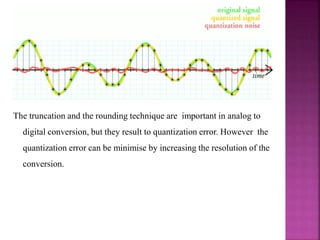
The truncation and the rounding technique are important in analog to 
digital conversion, but they result to quantization error. However the 
quantization error can be minimise by increasing the resolution of the 
conversion.
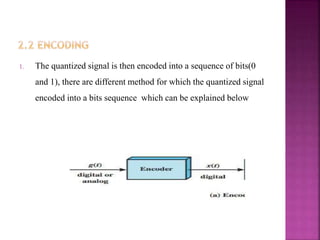
1. The quantized signal is then encoded into a sequence of bits(0 
and 1), there are different method for which the quantized signal 
encoded into a bits sequence which can be explained below
Below is the diagram showing the encoding format of the above
Analog to digital conversion technique

Analog to digital conversion technique

  • 2.
    A signal isthe quantity that carry information and varies with time, space, or any independent variable. It can also be define as the function of two or more variable. Analogue signal is continuous in nature, it differ from digital in which a continuous quantity is represented by a discrete function which can take on only one of the finite number of values.
  • 3.
    Man is bynature an analogue, he can interact and understand only an analogue information. However analogue signal is subjected to noise and distortion which progressively degrade the signal-to-noise ratio. This degradation is impossible to recover, since there is no sure way to distinguish the noise from the signal, amplifying the signal to recover attenuated parts of the signal amplifies the noise as well. To avoid or minimise this scenario, and to take advantage of the great capabilities available for digital data storage,
  • 4.
    processing, and computation,requires the conversion of analog to digital. Hence, analog to digital (A/D) conversion techniques have become extremely important. There are three main technique involved in the conversion of analog signals to digital signals, these are:- • Sampling of the continuous signal • Quantization of the sampled signal, and • Encoding. This can be explained below
  • 5.
    sampling is thereduction of a continuous signal to a discrete signal. A common example is the conversion of a sound wave (a continuous signal) to a sequence of samples (a discrete-time signal). Sampling of the signal can be achieve with sample and hold circuit which can be described below
  • 6.
    The function ofthe sample and hold circuit is to sample an analog input signal and hold this value over a certain length of time for subsequent processing. Below is the sampled and hold circuit
  • 7.
    The operation ofthe sample and hold circuit can be explain in the following steps • During sample mode, the SOP behaves just like a regular op-amp, in which the value of the output follows the value of the input. • During hold mode, the MOS transistors at the output node of the SOP are turned off while they are still operating in saturation, thus preventing any channel charge from flowing into the output of the SOP. • In addition, the SOP is shut off and its output is held at high impedance, allowing the charge on Ch to be preserved throughout the hold mode
  • 8.
    On the otherhand, the output buffer of this S/H circuit is always operational during sample and hold mode and is always providing the voltage on Ch to the output of the S/H circuit. The frequency at which the continuous signal is sample is explained by the Nyquist and shannon in first half of 20th century.
  • 9.
    Nyquist sampling theoryprovide the prescription for the minimal sampling frequency required to avoid aliasing during the reconstruction of the signal. It state that:- The sampling frequency should be at least twice the highest frequency contained in the signal, Or in mathematical terms: fs ≥ 2 fc where fs is the sampling frequency (how often samples are taken per unit of time or space), and fc is the highest frequency contained in the signal. Example if the maximum frequency component of a signal to be sample is 2khz, the from nyquist sampling theory
  • 10.
    This signal shouldbe sampled at a frequency which is equal or grater than 4khz. However if this signal is sample at a frequency below this(nyquist rate), then aliasing will occur. Aliasing is an effect that causes different signals to become indistinguishable (or aliases of one another) when sampled It also refers to the distortion that results when the signal reconstructed from samples is different from the original continuous signal. However this effect of aliasing can be eliminated by using anti-aliasing filter
  • 11.
    Quantization, is theprocess of mapping a large set of input values to a (countable) smaller set – such as rounding values to some unit of precision. A device or algorithmic function that performs quantization is called a quantizer. The error introduced by quantization is referred to as quantization error. There are two main method of quantization which involved • Truncation and • Rounding
  • 12.
    Rounding a numericalvalue means replacing it by another value that is approximately equal but has a shorter, simpler, or more explicit representation Rounding is often done to obtain a value that is easier to report and communicate than the original. The following table illustrated sampled values and it equivalent quantized value using rounding technique. s.no Sampled value of the signal. Quantized value 1 0.45 0.5 2 0.44 0.4 3 0.67 0.7 4 0.64 0.6 5 0.55 0.6
  • 13.
    truncation is theterm for limiting the number of digits right of the decimal point by discarding the least significant ones. However the error in this processing is twice than the rounding method, below is the table showing the sampled value ofa signal and it equivalent quantized value s.no Sampled value of signal Quantized value using truncation 1 3.3 3 2 4.2 4 3 5.3 5
  • 14.
    The truncation andthe rounding technique are important in analog to digital conversion, but they result to quantization error. However the quantization error can be minimise by increasing the resolution of the conversion.
  • 15.
    1. The quantizedsignal is then encoded into a sequence of bits(0 and 1), there are different method for which the quantized signal encoded into a bits sequence which can be explained below
  • 17.
    Below is thediagram showing the encoding format of the above