Data Communications - Multiplexing
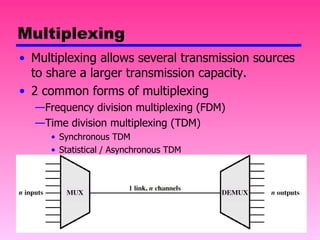
Multiplexing Multiplexing allows several transmission sources to share a larger transmission capacity. 2 common forms of multiplexing Frequency division multiplexing (FDM) Time division multiplexing (TDM) Synchronous TDM Statistical / Asynchronous TDM
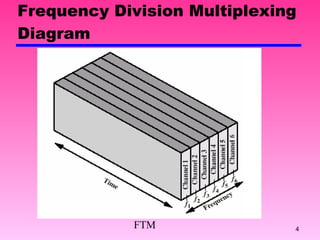
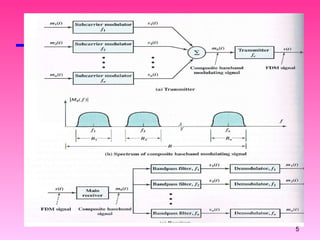
Frequency Division Multiplexing FDM Possible if  useful bandwidth  of medium exceeds( melebihi )  required bandwidth  of  channel [ bandwidth/frequency range : medium>signal ] Each signal is modulated to a different carrier frequency Carrier frequencies separated so signals do not overlap (guard bands) e.g. broadcast radio Channel allocated even if no data
Frequency Division Multiplexing Diagram FTM
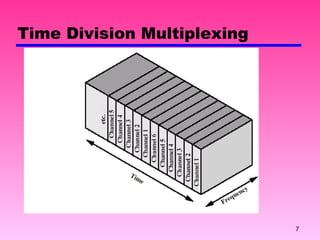
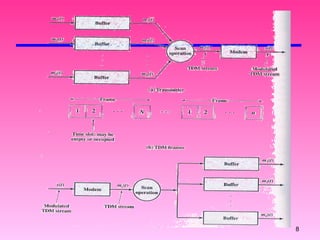
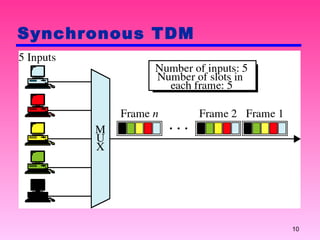
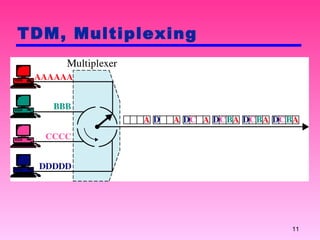
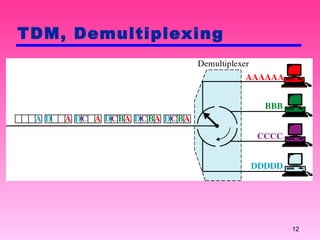
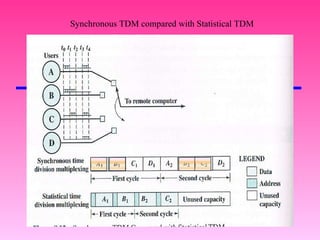
Synchronous Time    Division Multiplexing (TDM) Possible if  data rate of medium  exceeds  data rate of digital signal to be transmitted [ data rate : medium>signal ] Multiple digital signals interleaved in time Interleaving can be at bit level of blocks Time slots pre-assigned to sources and fixed Time slots allocated even if no data to send
Time Division Multiplexing
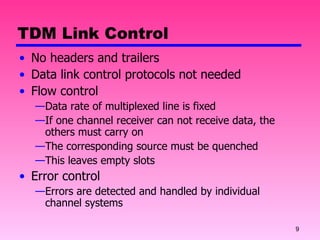
TDM Link Control No headers and trailers Data link control protocols not needed Flow control Data rate of multiplexed line is fixed If one channel receiver can not receive data, the others must carry on The corresponding source must be quenched This leaves empty slots Error control Errors are detected and handled by individual channel systems
Synchronous TDM
TDM, Multiplexing
TDM, Demultiplexing
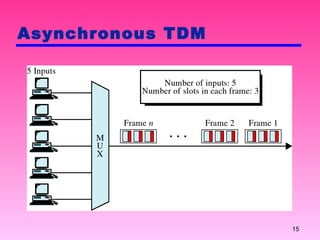
Statistical TDM In Synchronous TDM many slots are wasted Statistical TDM allocates time slots dynamically based on demand Multiplexer scans input lines (buffer) and collects data until frame full, and then send the frame Data rate on line lower than aggregate(sum of) rates of input lines  Thus, statistical TDM can use a lower data rate to support as many devices as asynchronous multiplexer
Synchronous TDM compared with Statistical TDM
Asynchronous TDM
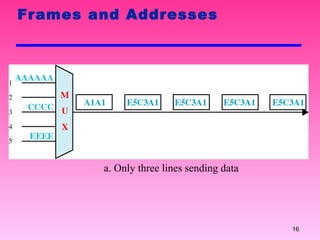
Frames and Addresses a. Only three lines sending data
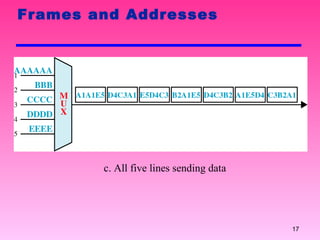
Frames and Addresses c. All five lines sending data
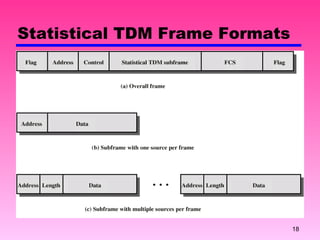
Statistical TDM Frame Formats
Performance Output data rate less than aggregate (the sum of the data rates of the inputs) input rates May cause problems during peak periods Buffer inputs Keep buffer size to minimum to reduce delay
Cable Modem Outline Cable TV provider provides dedicated 2 channels to support data transfer to/from cable modem One for transmission in each direction Each channel shared by number of subscribers Scheme needed to allocate capacity (fraction of down/upstream capacity) Statistical TDM
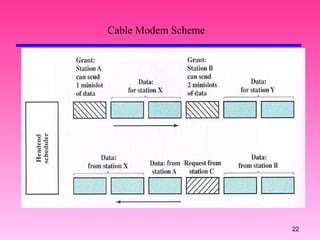
Cable Modem Operation Downstream Cable scheduler delivers data in small packets If more than one subscriber active, each gets fraction of downstream capacity May get 500kbps to 1.5Mbps Also used to allocate upstream time slots to subscribers Upstream User requests timeslots on shared upstream channel Dedicated slots for this Headend scheduler sends back assignment of future time slots to subscriber
Cable Modem Scheme
Asymmetrical Digital    Subscriber Line ADSL Link between subscriber and network Local loop Uses currently installed twisted pair cable Can carry broader spectrum 1 MHz or more Most widely publicized of a family of new modem technologies designed to provide high-speed digital data transmission over ordinary telephone wire
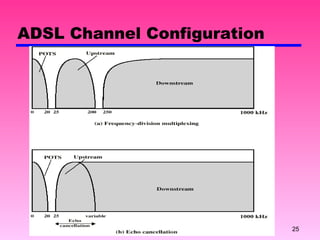
ADSL Design Asymmetric Greater capacity downstream than upstream ADSL uses Frequency division multiplexing (FDM) Reserve lowest 25kHz for voice Plain old telephone service (POTS) Use echo cancellation or FDM to give two bands Use FDM within bands Range 5.5km
ADSL Channel Configuration
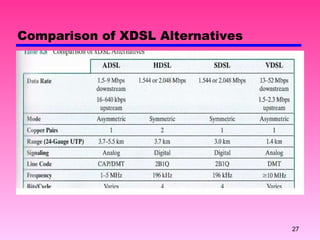
xDSL High data rate DSL Single line DSL Very high data rate DSL Various types of xDSL Asynchronous Digital Subscriber Line (ADSL) High Bit-rate Digital Subscriber Line (HDSL)  Symmetric Digital Subscriber Line (SDSL)  Very High Bit-rate Digital Subscriber Line (VDSL)
Comparison of XDSL Alternatives

7 multiplexing

  • 1.
  • 2.
    Multiplexing Multiplexing allowsseveral transmission sources to share a larger transmission capacity. 2 common forms of multiplexing Frequency division multiplexing (FDM) Time division multiplexing (TDM) Synchronous TDM Statistical / Asynchronous TDM
  • 3.
    Frequency Division MultiplexingFDM Possible if useful bandwidth of medium exceeds( melebihi ) required bandwidth of channel [ bandwidth/frequency range : medium>signal ] Each signal is modulated to a different carrier frequency Carrier frequencies separated so signals do not overlap (guard bands) e.g. broadcast radio Channel allocated even if no data
  • 4.
  • 6.
    Synchronous Time Division Multiplexing (TDM) Possible if data rate of medium exceeds data rate of digital signal to be transmitted [ data rate : medium>signal ] Multiple digital signals interleaved in time Interleaving can be at bit level of blocks Time slots pre-assigned to sources and fixed Time slots allocated even if no data to send
  • 7.
  • 9.
    TDM Link ControlNo headers and trailers Data link control protocols not needed Flow control Data rate of multiplexed line is fixed If one channel receiver can not receive data, the others must carry on The corresponding source must be quenched This leaves empty slots Error control Errors are detected and handled by individual channel systems
  • 10.
  • 11.
  • 12.
  • 13.
    Statistical TDM InSynchronous TDM many slots are wasted Statistical TDM allocates time slots dynamically based on demand Multiplexer scans input lines (buffer) and collects data until frame full, and then send the frame Data rate on line lower than aggregate(sum of) rates of input lines Thus, statistical TDM can use a lower data rate to support as many devices as asynchronous multiplexer
  • 14.
    Synchronous TDM comparedwith Statistical TDM
  • 15.
  • 16.
    Frames and Addressesa. Only three lines sending data
  • 17.
    Frames and Addressesc. All five lines sending data
  • 18.
  • 19.
    Performance Output datarate less than aggregate (the sum of the data rates of the inputs) input rates May cause problems during peak periods Buffer inputs Keep buffer size to minimum to reduce delay
  • 20.
    Cable Modem OutlineCable TV provider provides dedicated 2 channels to support data transfer to/from cable modem One for transmission in each direction Each channel shared by number of subscribers Scheme needed to allocate capacity (fraction of down/upstream capacity) Statistical TDM
  • 21.
    Cable Modem OperationDownstream Cable scheduler delivers data in small packets If more than one subscriber active, each gets fraction of downstream capacity May get 500kbps to 1.5Mbps Also used to allocate upstream time slots to subscribers Upstream User requests timeslots on shared upstream channel Dedicated slots for this Headend scheduler sends back assignment of future time slots to subscriber
  • 22.
  • 23.
    Asymmetrical Digital Subscriber Line ADSL Link between subscriber and network Local loop Uses currently installed twisted pair cable Can carry broader spectrum 1 MHz or more Most widely publicized of a family of new modem technologies designed to provide high-speed digital data transmission over ordinary telephone wire
  • 24.
    ADSL Design AsymmetricGreater capacity downstream than upstream ADSL uses Frequency division multiplexing (FDM) Reserve lowest 25kHz for voice Plain old telephone service (POTS) Use echo cancellation or FDM to give two bands Use FDM within bands Range 5.5km
  • 25.
  • 26.
    xDSL High datarate DSL Single line DSL Very high data rate DSL Various types of xDSL Asynchronous Digital Subscriber Line (ADSL) High Bit-rate Digital Subscriber Line (HDSL) Symmetric Digital Subscriber Line (SDSL) Very High Bit-rate Digital Subscriber Line (VDSL)
  • 27.
    Comparison of XDSLAlternatives