CHAPTER 7: STRUCTURES
Outline: Objectives 7.1 Introduction 7.2 Defining a Structure 7.3 Defining a Structure using  typedef 7.4 Structure Members 7.5 Initializing Structures 7.6 Nested Structures 7.7 Array of Structures 7.8 Structures and Pointers 7.9 Passing Structures to Functions
Objectives Defining structures in various ways of structure declaration. Initializing members of a structure variable. Defining element array of structures. Accessing individual structure members. Defining structures using  typedef . Accessing members of a structure using pointer. Passing structures as arguments to functions.
7.1 Introduction A structure can have  individual elements different in type .  contain integer elements, floating-point elements and character elements.  included elements: pointers, arrays and other structures.  The individual structure elements are referred to as  members .
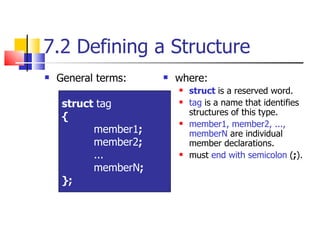
7.2 Defining a Structure General terms: where: struct   is a reserved word. tag  is a name that identifies structures of this type. member1, member2, ..., memberN  are individual member declarations. must  end with semicolon  ( ; ). struct  tag  { member1 ; member2 ; ... memberN ; };
7.2 Defining a Structure – cont’1 The  individual members : can be ordinary variables, pointers, arrays or other structures.  cannot  be  initialized  within a  structure-type  declaration. The  member names: within a particular structure must be  distinct from one another .  can be  the same  as the variable name that is  defined outside  of the structure.  A  storage class   cannot  be  assigned  to an individual member.
7.2 Defining a Structure – cont’2 Example 7.1: Typical structure declarations.  Explanations: Structure named  custAccount . The custAccount contains  4 members  and  2 structure variables . struct custAccount  { int accNo; char accType; char name[80]; float accBalance; }; struct custAccount oldcust, newcust;
7.2 Defining a Structure – cont’3 Example 7.2: This declaration is equivalent with Example 7.1.   struct custAccount  { int accNo; char accType; char name[80]; float accBalance; } oldcust, newcust;
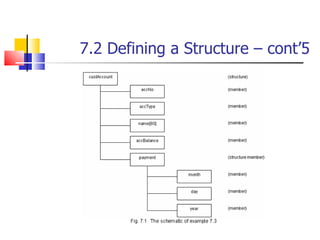
7.2 Defining a Structure – cont’4 Example 7.3: A structure variable may be defined as a member of another structure. struct date { int month; int day; int year; }; struct custAccount { int accNo; char accType; char name[80]; float accBalance; struct date payment; } oldcust, newcust; The  declaration of the embedded structure  must  appear before  the declaration of the outer structure. Eg.: Structure  date  is declared before structure  custAccount .
7.2 Defining a Structure – cont’5
7.3 Defining using  typedef Alternative approach on defining a structure. Made  once at the head  of the program. Subsequent  declarations: using the  new name .
7.3 Defining using  typedef  - cont’1 Features: Allows users to define new data-types that are equivalent to existing data-types. Eliminates the need to repeated write  struct tag  whenever a structure is referenced.
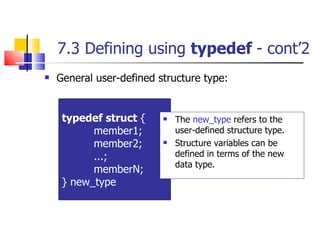
7.3 Defining using  typedef  - cont’2 General user-defined structure type: typedef struct  { member1; member2; ...; memberN; } new_type  The  new_type  refers to the user-defined structure type. Structure variables can be defined in terms of the new data type.
7.3 Defining using  typedef  - cont’3 Example 7.14: Alternative declaration using  typedef . typedef struct { int accNo; char accType; char name[80]; float accBalance; } record; record oldcust, newcust; The  record   is defined as a user-defined data type. The second declaration defines  oldcust  and  newcust  as structure variables of type  record .
7.3 Defining using  typedef  - cont’3 The typedef features can be used  repeatedly , to define one data type in terms of other user-defined data types.  Example 7.5 shows: the  date  and  record  are user-defined structure types. The  cust  is a 100-element array of type  record . typedef struct { int month; int day; int year; } date; typedef struct { int accNo; char accType; char name[80]; float accBalance; date payment; } record; record cust[100];
7.3 Defining using  typedef  - cont’4 Exp. 7.6 and Exp. 7.7 shows the variation of Exp. 7.5. typedef struct { int month; int day; int year; } date; typedef struct { int accNo; char accType; char name[80]; float accBalance; date payment; } record[100]; record cust; typedef struct { int month; int day; int year; } date; struct { int accNo; char accType; char name[80]; float accBalance; date payment; } cust[100];
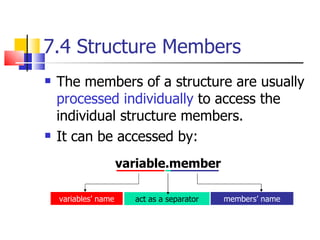
7.4 Structure Members The members of a structure are usually  processed individually  to access the individual structure members.  It can be accessed by: variable.member variables’ name act as a separator members’ name
7.4 Structure Members  - cont’1 Example 7.8  struct date { int month; int day; int year; }; struct custAccount{ int accNo; char accType; char name[80]; float accBalance; struct date payment; } cust; Example: To access the info. of cust. /* to access the customer’s */ /* account no. */ cust.accNo /* to access the customer’s */ /* name */ cust.name cust.name[2] &cust.name[2] /* to access the month of */ /* the payment of customer */ cust.payment.month
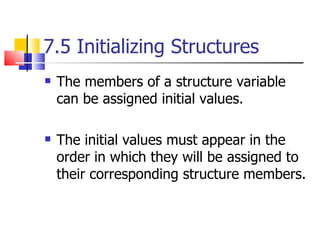
7.5 Initializing Structures The members of a structure variable can be assigned initial values.  The initial values must appear in the order in which they will be assigned to their corresponding structure members.
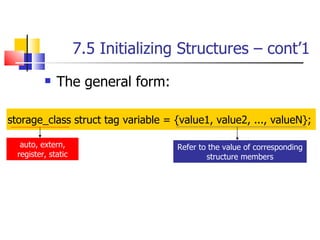
7.5 Initializing Structures – cont’1 The general form: storage_class struct tag variable = {value1, value2, ..., valueN};  Refer to the value of corresponding structure members auto, extern, register, static
7.5 Initializing Structures – cont’1 struct date { int month; int day; int year; }; struct custAccount { int accNo; char accType; char name[80]; float accBalance; struct date payment; }; static  struct custAccount cust= {2345,‘S’,“Khadijah Ismail”,2400.90,9,7,2006}; : Example 7.9
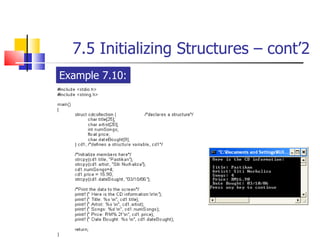
7.5 Initializing Structures – cont’2 Example 7.10:
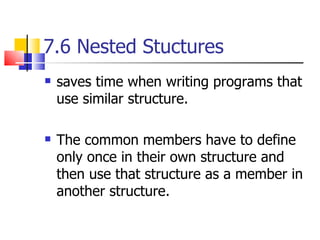
7.6 Nested Stuctures saves time when writing programs that use similar structure.  The common members have to define only once in their own structure and then use that structure as a member in another structure.
7.6 Nested Structures – cont’1 struct employees{ char empName[25]; char  address[30] ; char  city [10] ; char  state[2] ; long int  poscode ; double salary; }; struct customers{ char custName[25]; char  address[30] ; char  city [10] ; char  state[2] ; long int  poscode ; double balance; }; struct addressInfo{ char address[30]; char city [10]; char state[2]; long int poscode; }; struct employees{ char empName[25]; struct addressInfo eAddress; double salary; }e1; struct customers{ char custName[25]; struct addressInfo cAddress; double balance; }c1; Example 7.12: :Example 7.13
7.7 Arrays of Structures Example 7.14: Declaration of a 200-element array of structures. struct date { int month; int day; int year; }; struct custAccount{ int accNo; char accType; char name[80]; float accBalance; struct date payment; } cust[200]; struct date { int month; int day; int year; }; struct custAccount{ int accNo; char accType; char name[80]; float accBalance; struct date payment; }; struct custAccount cust[200]; OR
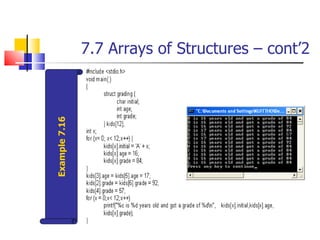
7.7 Arrays of Structures – cont’2 Example 7.16
7.7 Arrays of Structures – cont’1 Example 7.15: Assigning initial values to an array of structures  struct student { char name[80]; float courseMark; float finalMark; int TotMark; }; static struct student MarkList[ ] = { “ Kadir”, 45.50, 30.00, 76, "Azizan", 43.50, 30.00, 73, "Xavier", 44.50, 30.00, 75, "Nantha", 46.50, 30.00, 77, "Junani", 42.50, 30.00, 73, "Martha", 42.00, 30.00, 72 } ;
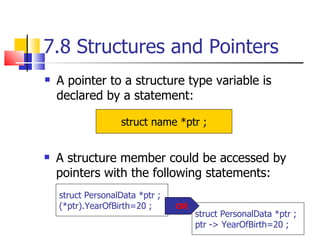
7.8 Structures and Pointers A pointer to a structure type variable is declared by a statement: struct name *ptr ; A structure member could be accessed by pointers with the following statements: struct PersonalData *ptr ; (*ptr).YearOfBirth=20 ; struct PersonalData *ptr ; ptr -> YearOfBirth=20 ; OR
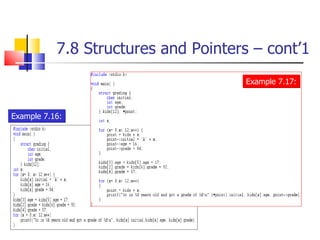
7.8 Structures and Pointers – cont’1 Example 7.16: Example 7.17:
7.9 Passing Structures to Func There are several different ways to pass structure-type information to or from a function.  transferred individually , or  entire structures  can be transferred.
7.9 Passing Structures … – cont’1 Individual structure members can be: passed to a function  as arguments  in the function call, and  a single structure member can be  returned  by the  return   statement.  Each structure member is treated the same as an ordinary single-valued variable.
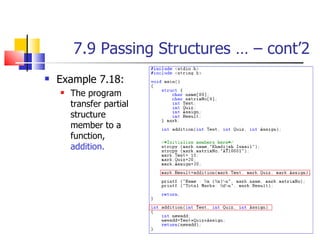
7.9 Passing Structures … – cont’2 Example 7.18: The program transfer partial structure member to a function,  addition.
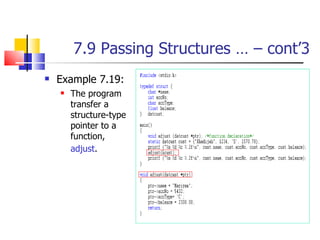
7.9 Passing Structures … – cont’3 Example 7.19: The program transfer a structure-type pointer to a function,  adjust .

Ch7 structures

  • 1.
  • 2.
    Outline: Objectives 7.1Introduction 7.2 Defining a Structure 7.3 Defining a Structure using typedef 7.4 Structure Members 7.5 Initializing Structures 7.6 Nested Structures 7.7 Array of Structures 7.8 Structures and Pointers 7.9 Passing Structures to Functions
  • 3.
    Objectives Defining structuresin various ways of structure declaration. Initializing members of a structure variable. Defining element array of structures. Accessing individual structure members. Defining structures using typedef . Accessing members of a structure using pointer. Passing structures as arguments to functions.
  • 4.
    7.1 Introduction Astructure can have individual elements different in type . contain integer elements, floating-point elements and character elements. included elements: pointers, arrays and other structures. The individual structure elements are referred to as members .
  • 5.
    7.2 Defining aStructure General terms: where: struct is a reserved word. tag is a name that identifies structures of this type. member1, member2, ..., memberN are individual member declarations. must end with semicolon ( ; ). struct tag { member1 ; member2 ; ... memberN ; };
  • 6.
    7.2 Defining aStructure – cont’1 The individual members : can be ordinary variables, pointers, arrays or other structures. cannot be initialized within a structure-type declaration. The member names: within a particular structure must be distinct from one another . can be the same as the variable name that is defined outside of the structure. A storage class cannot be assigned to an individual member.
  • 7.
    7.2 Defining aStructure – cont’2 Example 7.1: Typical structure declarations. Explanations: Structure named custAccount . The custAccount contains 4 members and 2 structure variables . struct custAccount { int accNo; char accType; char name[80]; float accBalance; }; struct custAccount oldcust, newcust;
  • 8.
    7.2 Defining aStructure – cont’3 Example 7.2: This declaration is equivalent with Example 7.1. struct custAccount { int accNo; char accType; char name[80]; float accBalance; } oldcust, newcust;
  • 9.
    7.2 Defining aStructure – cont’4 Example 7.3: A structure variable may be defined as a member of another structure. struct date { int month; int day; int year; }; struct custAccount { int accNo; char accType; char name[80]; float accBalance; struct date payment; } oldcust, newcust; The declaration of the embedded structure must appear before the declaration of the outer structure. Eg.: Structure date is declared before structure custAccount .
  • 10.
    7.2 Defining aStructure – cont’5
  • 11.
    7.3 Defining using typedef Alternative approach on defining a structure. Made once at the head of the program. Subsequent declarations: using the new name .
  • 12.
    7.3 Defining using typedef - cont’1 Features: Allows users to define new data-types that are equivalent to existing data-types. Eliminates the need to repeated write struct tag whenever a structure is referenced.
  • 13.
    7.3 Defining using typedef - cont’2 General user-defined structure type: typedef struct { member1; member2; ...; memberN; } new_type The new_type refers to the user-defined structure type. Structure variables can be defined in terms of the new data type.
  • 14.
    7.3 Defining using typedef - cont’3 Example 7.14: Alternative declaration using typedef . typedef struct { int accNo; char accType; char name[80]; float accBalance; } record; record oldcust, newcust; The record is defined as a user-defined data type. The second declaration defines oldcust and newcust as structure variables of type record .
  • 15.
    7.3 Defining using typedef - cont’3 The typedef features can be used repeatedly , to define one data type in terms of other user-defined data types. Example 7.5 shows: the date and record are user-defined structure types. The cust is a 100-element array of type record . typedef struct { int month; int day; int year; } date; typedef struct { int accNo; char accType; char name[80]; float accBalance; date payment; } record; record cust[100];
  • 16.
    7.3 Defining using typedef - cont’4 Exp. 7.6 and Exp. 7.7 shows the variation of Exp. 7.5. typedef struct { int month; int day; int year; } date; typedef struct { int accNo; char accType; char name[80]; float accBalance; date payment; } record[100]; record cust; typedef struct { int month; int day; int year; } date; struct { int accNo; char accType; char name[80]; float accBalance; date payment; } cust[100];
  • 17.
    7.4 Structure MembersThe members of a structure are usually processed individually to access the individual structure members. It can be accessed by: variable.member variables’ name act as a separator members’ name
  • 18.
    7.4 Structure Members - cont’1 Example 7.8 struct date { int month; int day; int year; }; struct custAccount{ int accNo; char accType; char name[80]; float accBalance; struct date payment; } cust; Example: To access the info. of cust. /* to access the customer’s */ /* account no. */ cust.accNo /* to access the customer’s */ /* name */ cust.name cust.name[2] &cust.name[2] /* to access the month of */ /* the payment of customer */ cust.payment.month
  • 19.
    7.5 Initializing StructuresThe members of a structure variable can be assigned initial values. The initial values must appear in the order in which they will be assigned to their corresponding structure members.
  • 20.
    7.5 Initializing Structures– cont’1 The general form: storage_class struct tag variable = {value1, value2, ..., valueN}; Refer to the value of corresponding structure members auto, extern, register, static
  • 21.
    7.5 Initializing Structures– cont’1 struct date { int month; int day; int year; }; struct custAccount { int accNo; char accType; char name[80]; float accBalance; struct date payment; }; static struct custAccount cust= {2345,‘S’,“Khadijah Ismail”,2400.90,9,7,2006}; : Example 7.9
  • 22.
    7.5 Initializing Structures– cont’2 Example 7.10:
  • 23.
    7.6 Nested Stucturessaves time when writing programs that use similar structure. The common members have to define only once in their own structure and then use that structure as a member in another structure.
  • 24.
    7.6 Nested Structures– cont’1 struct employees{ char empName[25]; char address[30] ; char city [10] ; char state[2] ; long int poscode ; double salary; }; struct customers{ char custName[25]; char address[30] ; char city [10] ; char state[2] ; long int poscode ; double balance; }; struct addressInfo{ char address[30]; char city [10]; char state[2]; long int poscode; }; struct employees{ char empName[25]; struct addressInfo eAddress; double salary; }e1; struct customers{ char custName[25]; struct addressInfo cAddress; double balance; }c1; Example 7.12: :Example 7.13
  • 25.
    7.7 Arrays ofStructures Example 7.14: Declaration of a 200-element array of structures. struct date { int month; int day; int year; }; struct custAccount{ int accNo; char accType; char name[80]; float accBalance; struct date payment; } cust[200]; struct date { int month; int day; int year; }; struct custAccount{ int accNo; char accType; char name[80]; float accBalance; struct date payment; }; struct custAccount cust[200]; OR
  • 26.
    7.7 Arrays ofStructures – cont’2 Example 7.16
  • 27.
    7.7 Arrays ofStructures – cont’1 Example 7.15: Assigning initial values to an array of structures struct student { char name[80]; float courseMark; float finalMark; int TotMark; }; static struct student MarkList[ ] = { “ Kadir”, 45.50, 30.00, 76, "Azizan", 43.50, 30.00, 73, "Xavier", 44.50, 30.00, 75, "Nantha", 46.50, 30.00, 77, "Junani", 42.50, 30.00, 73, "Martha", 42.00, 30.00, 72 } ;
  • 28.
    7.8 Structures andPointers A pointer to a structure type variable is declared by a statement: struct name *ptr ; A structure member could be accessed by pointers with the following statements: struct PersonalData *ptr ; (*ptr).YearOfBirth=20 ; struct PersonalData *ptr ; ptr -> YearOfBirth=20 ; OR
  • 29.
    7.8 Structures andPointers – cont’1 Example 7.16: Example 7.17:
  • 30.
    7.9 Passing Structuresto Func There are several different ways to pass structure-type information to or from a function. transferred individually , or entire structures can be transferred.
  • 31.
    7.9 Passing Structures… – cont’1 Individual structure members can be: passed to a function as arguments in the function call, and a single structure member can be returned by the return statement. Each structure member is treated the same as an ordinary single-valued variable.
  • 32.
    7.9 Passing Structures… – cont’2 Example 7.18: The program transfer partial structure member to a function, addition.
  • 33.
    7.9 Passing Structures… – cont’3 Example 7.19: The program transfer a structure-type pointer to a function, adjust .