Transmission Media
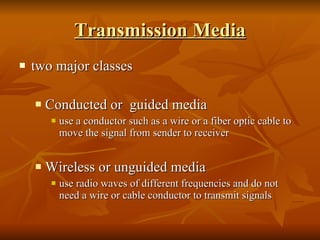
Transmission Media two major classes Conducted or  guided media use a conductor such as a wire or a fiber optic cable to move the signal from sender to receiver Wireless or unguided media use radio waves of different frequencies and do not need a wire or cable conductor to transmit signals
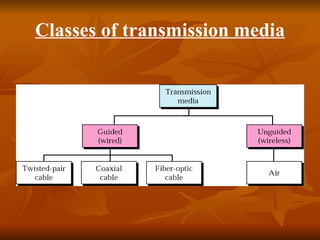
Classes of transmission media
Guided Media Twisted-Pair Cable Coaxial Cable Fiber-Optic Cable
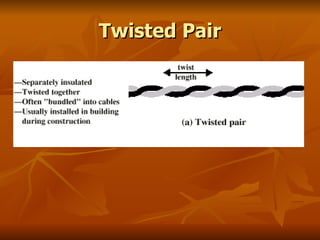
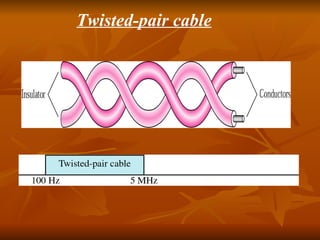
Twisted Pair Wires Consists of two insulated copper wires arranged in a regular spiral pattern to minimize the electromagnetic interference between adjacent pairs. Often used at customer facilities and also over distances to carry voice as well as data communications. Low frequency transmission medium.
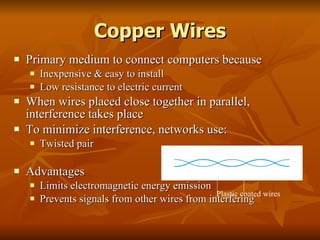
Copper Wires Primary medium to connect computers because Inexpensive & easy to install Low resistance to electric current When wires placed close together in parallel, interference takes place To minimize interference, networks use: Twisted pair Advantages Limits electromagnetic energy emission Prevents signals from other wires from interfering Plastic coated wires
Twisted Pair
Twisted-pair cable
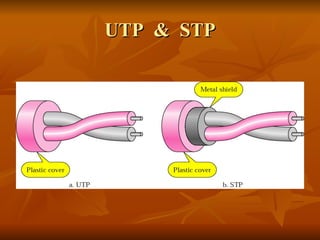
Twisted Pair Wires Two varieties UTP (unshielded twisted pair) Each wire is insulated with plastic wrap. The plastic insulation is color-banded for identification. UTP is ordinary telephone wire. UTP can transfer data at 1 to 100Mbps over a distance of 100M.   STP (shielded twisted pair) The pair is wrapped with metallic foil or braid to insulate the pair from electromagnetic interference. The metal covering prevents the penetration of electromagnetic noise. It can eliminate the phenomena called crosstalk. Provide better performance at lower data rates.
UTP  &  STP
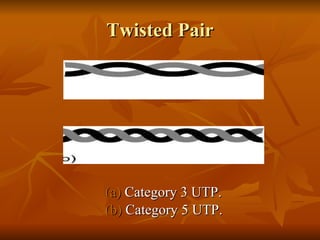
Twisted Pair Wires Category 3 UTP data rates of up to 10mbps are achievable Standard cable for most telephone systems Category 5 UTP data rates of up to 100mbps are achievable more tightly twisted than Category 3 cables more expensive, but better performance Used in LAN. STP More expensive, harder to work with
Twisted Pair (a)  Category 3 UTP. (b)  Category 5 UTP.
Twisted Pair - Applications Most common medium Telephone network Between house and local exchange (subscriber loop) Within buildings To private branch exchange (PBX) For local area networks (LAN) 10Mbps or 100Mbps
Twisted Pair Advantages Twisted-pair cable is used in telephone lines for voice and data communications.  Inexpensive and readily available Flexible and light weight  Easy to work with and install
Twisted Pair Disadvantages Susceptibility to interference and noise Attenuation problem For analog, repeaters needed every 5-6km For digital, repeaters needed every 2-3km Relatively low bandwidth (3000Hz)
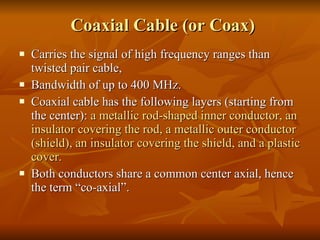
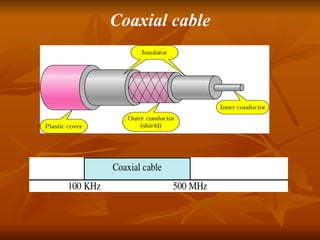
Coaxial Cable (or Coax) Carries the signal of high frequency ranges than twisted pair cable, Bandwidth of up to 400 MHz. Coaxial cable has the following layers (starting from the center):  a metallic rod-shaped inner conductor, an insulator covering the rod, a metallic outer conductor (shield), an insulator covering the shield, and a plastic cover.  Both conductors share a common center axial, hence the term “co-axial”.
Coaxial cable
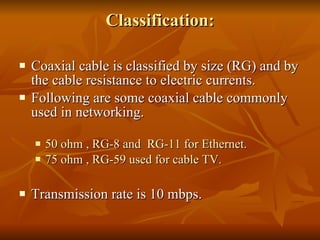
Classification: Coaxial cable is classified by size (RG) and by the cable resistance to electric currents. Following are some coaxial cable commonly used in networking. 50 ohm , RG-8 and  RG-11 for Ethernet. 75 ohm , RG-59 used for cable TV.  Transmission rate is 10 mbps.
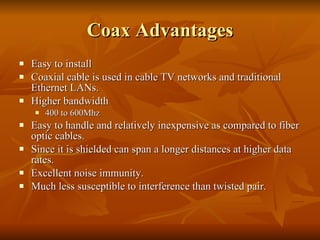
Coax Advantages Easy to install Coaxial cable is used in cable TV networks and traditional Ethernet LANs.  Higher bandwidth 400 to 600Mhz Easy to handle and relatively inexpensive as compared to fiber optic cables. Since it is shielded can span a longer distances at higher data rates. Excellent noise immunity. Much less susceptible to interference than twisted pair.
Coax Disadvantages High attenuation rate makes it expensive over long distance Distance is limited. Bulky  Higher cost compared to twisted pair Harder to work with & cable easily get damaged
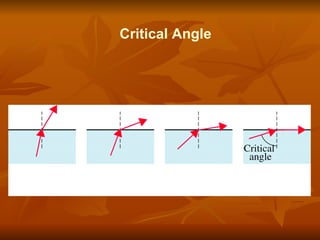
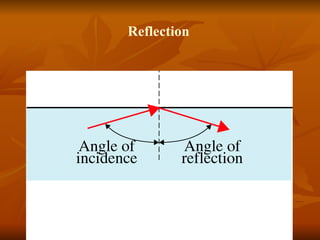
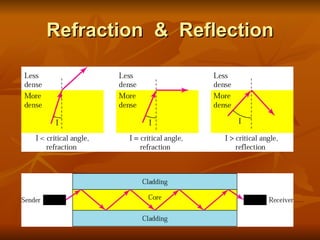
Fiber Optic Cable Fiber-optic cables are composed of a glass or plastic inner core surrounded by cladding, all encased in an outside jacket.  Fiber-optic cables carry data signals in the form of light. The signal is propagated along the inner core by reflection. Relatively new transmission medium used by telephone companies in place of long-distance trunk lines. Also used by private companies in implementing local data communications networks. Require a light source with injection laser diode (ILD) or light-emitting diodes (LED).
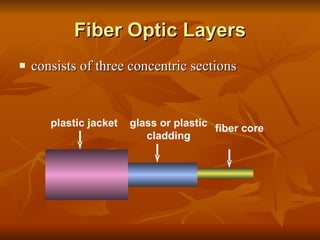
Fiber Optic Layers consists of three concentric sections plastic jacket glass or plastic cladding fiber core
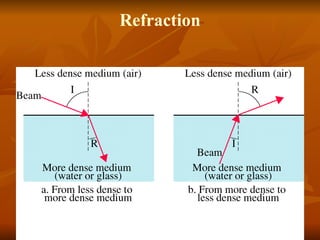
Refraction
Critical Angle
Reflection
Refraction  &  Reflection
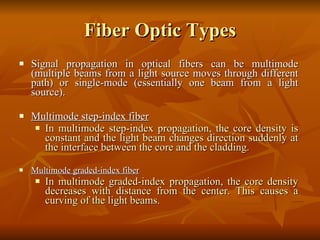
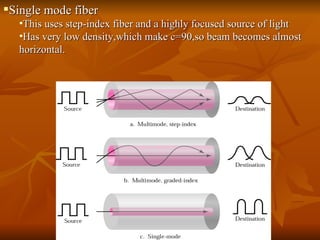
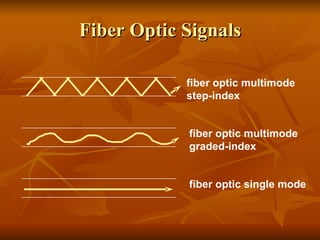
Fiber Optic Types Signal propagation in optical fibers can be multimode (multiple beams from a light source moves through different path) or single-mode (essentially one beam from a light source).  Multimode step-index fiber In multimode step-index propagation, the core density is constant and the light beam changes direction suddenly at the interface between the core and the cladding. Multimode graded-index fiber In multimode graded-index propagation, the core density decreases with distance from the center. This causes a curving of the light beams.
Single mode fiber This uses step-index fiber and a highly focused source of light  Has very low density,which make c=90,so beam becomes almost horizontal.
Fiber Optic Signals fiber optic multimode step-index fiber optic multimode graded-index fiber optic single mode
Fiber Optic Advantages Higher transmission rate of 100Mbps. It supports voice,video and data. Greater capacity (bandwidth of up to 2 Gbps). Smaller size and lighter weight Lower attenuation Immunity to environmental interference Highly secure , it is almost impossible to tap into a fiber cable. Safe and easy installation. More compact & lighter than copper wire
Fiber Optic Disadvantages expensive over short distance Unidirectional requires highly skilled installers adding additional nodes is difficult Maintenance and repairing cost is high.

Transmision media

  • 1.
  • 2.
    Transmission Media twomajor classes Conducted or guided media use a conductor such as a wire or a fiber optic cable to move the signal from sender to receiver Wireless or unguided media use radio waves of different frequencies and do not need a wire or cable conductor to transmit signals
  • 3.
  • 4.
    Guided Media Twisted-PairCable Coaxial Cable Fiber-Optic Cable
  • 5.
    Twisted Pair WiresConsists of two insulated copper wires arranged in a regular spiral pattern to minimize the electromagnetic interference between adjacent pairs. Often used at customer facilities and also over distances to carry voice as well as data communications. Low frequency transmission medium.
  • 6.
    Copper Wires Primarymedium to connect computers because Inexpensive & easy to install Low resistance to electric current When wires placed close together in parallel, interference takes place To minimize interference, networks use: Twisted pair Advantages Limits electromagnetic energy emission Prevents signals from other wires from interfering Plastic coated wires
  • 7.
  • 8.
  • 9.
    Twisted Pair WiresTwo varieties UTP (unshielded twisted pair) Each wire is insulated with plastic wrap. The plastic insulation is color-banded for identification. UTP is ordinary telephone wire. UTP can transfer data at 1 to 100Mbps over a distance of 100M. STP (shielded twisted pair) The pair is wrapped with metallic foil or braid to insulate the pair from electromagnetic interference. The metal covering prevents the penetration of electromagnetic noise. It can eliminate the phenomena called crosstalk. Provide better performance at lower data rates.
  • 10.
    UTP & STP
  • 11.
    Twisted Pair WiresCategory 3 UTP data rates of up to 10mbps are achievable Standard cable for most telephone systems Category 5 UTP data rates of up to 100mbps are achievable more tightly twisted than Category 3 cables more expensive, but better performance Used in LAN. STP More expensive, harder to work with
  • 12.
    Twisted Pair (a) Category 3 UTP. (b) Category 5 UTP.
  • 13.
    Twisted Pair -Applications Most common medium Telephone network Between house and local exchange (subscriber loop) Within buildings To private branch exchange (PBX) For local area networks (LAN) 10Mbps or 100Mbps
  • 14.
    Twisted Pair AdvantagesTwisted-pair cable is used in telephone lines for voice and data communications. Inexpensive and readily available Flexible and light weight Easy to work with and install
  • 15.
    Twisted Pair DisadvantagesSusceptibility to interference and noise Attenuation problem For analog, repeaters needed every 5-6km For digital, repeaters needed every 2-3km Relatively low bandwidth (3000Hz)
  • 16.
    Coaxial Cable (orCoax) Carries the signal of high frequency ranges than twisted pair cable, Bandwidth of up to 400 MHz. Coaxial cable has the following layers (starting from the center): a metallic rod-shaped inner conductor, an insulator covering the rod, a metallic outer conductor (shield), an insulator covering the shield, and a plastic cover. Both conductors share a common center axial, hence the term “co-axial”.
  • 17.
  • 18.
    Classification: Coaxial cableis classified by size (RG) and by the cable resistance to electric currents. Following are some coaxial cable commonly used in networking. 50 ohm , RG-8 and RG-11 for Ethernet. 75 ohm , RG-59 used for cable TV. Transmission rate is 10 mbps.
  • 19.
    Coax Advantages Easyto install Coaxial cable is used in cable TV networks and traditional Ethernet LANs. Higher bandwidth 400 to 600Mhz Easy to handle and relatively inexpensive as compared to fiber optic cables. Since it is shielded can span a longer distances at higher data rates. Excellent noise immunity. Much less susceptible to interference than twisted pair.
  • 20.
    Coax Disadvantages Highattenuation rate makes it expensive over long distance Distance is limited. Bulky Higher cost compared to twisted pair Harder to work with & cable easily get damaged
  • 21.
    Fiber Optic CableFiber-optic cables are composed of a glass or plastic inner core surrounded by cladding, all encased in an outside jacket. Fiber-optic cables carry data signals in the form of light. The signal is propagated along the inner core by reflection. Relatively new transmission medium used by telephone companies in place of long-distance trunk lines. Also used by private companies in implementing local data communications networks. Require a light source with injection laser diode (ILD) or light-emitting diodes (LED).
  • 22.
    Fiber Optic Layersconsists of three concentric sections plastic jacket glass or plastic cladding fiber core
  • 23.
  • 24.
  • 25.
  • 26.
    Refraction & Reflection
  • 27.
    Fiber Optic TypesSignal propagation in optical fibers can be multimode (multiple beams from a light source moves through different path) or single-mode (essentially one beam from a light source). Multimode step-index fiber In multimode step-index propagation, the core density is constant and the light beam changes direction suddenly at the interface between the core and the cladding. Multimode graded-index fiber In multimode graded-index propagation, the core density decreases with distance from the center. This causes a curving of the light beams.
  • 28.
    Single mode fiberThis uses step-index fiber and a highly focused source of light Has very low density,which make c=90,so beam becomes almost horizontal.
  • 29.
    Fiber Optic Signalsfiber optic multimode step-index fiber optic multimode graded-index fiber optic single mode
  • 30.
    Fiber Optic AdvantagesHigher transmission rate of 100Mbps. It supports voice,video and data. Greater capacity (bandwidth of up to 2 Gbps). Smaller size and lighter weight Lower attenuation Immunity to environmental interference Highly secure , it is almost impossible to tap into a fiber cable. Safe and easy installation. More compact & lighter than copper wire
  • 31.
    Fiber Optic Disadvantagesexpensive over short distance Unidirectional requires highly skilled installers adding additional nodes is difficult Maintenance and repairing cost is high.