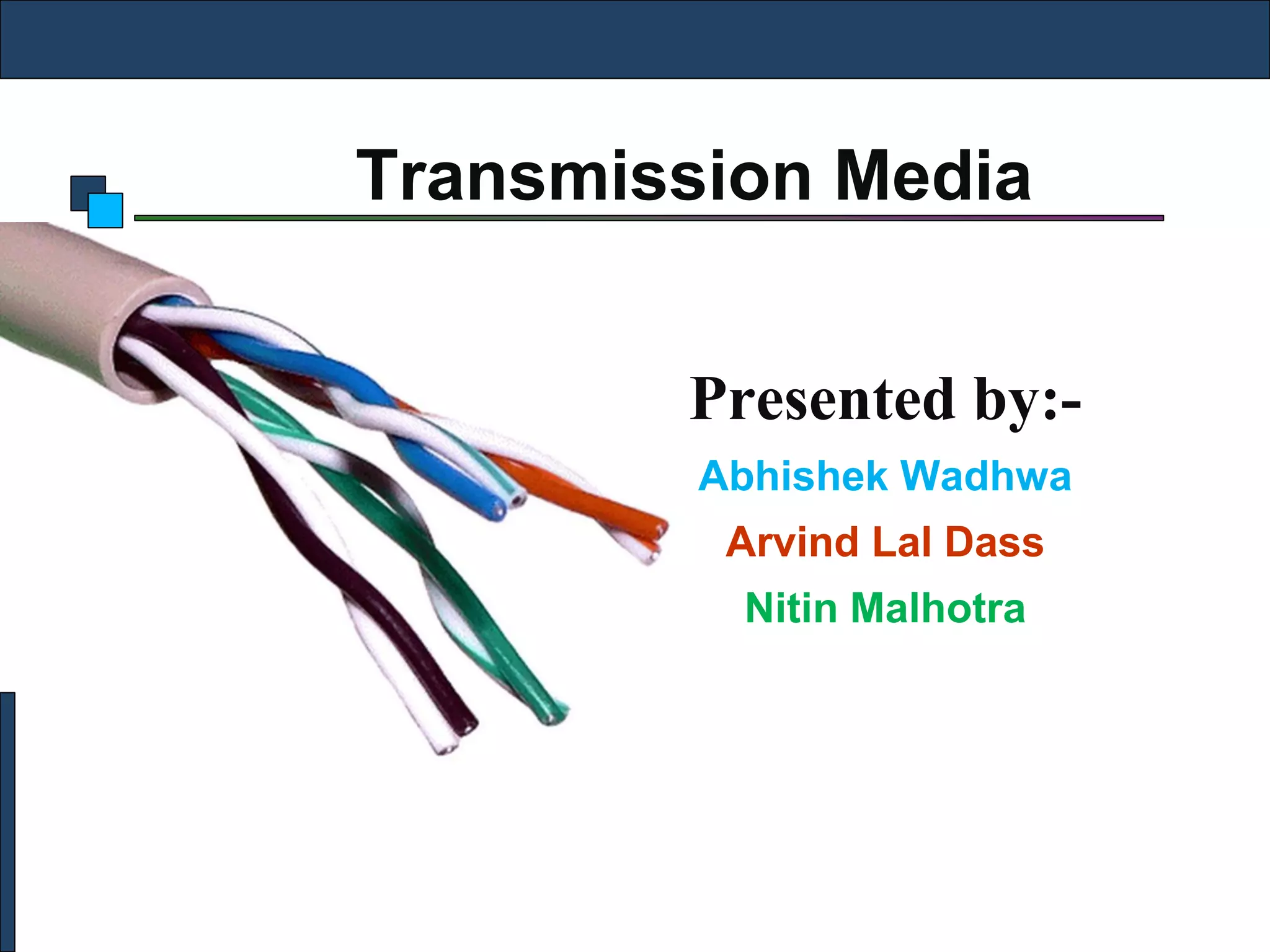
Transmission Media


        Presented by:-
         Abhishek Wadhwa
          Arvind Lal Dass
          Nitin Malhotra
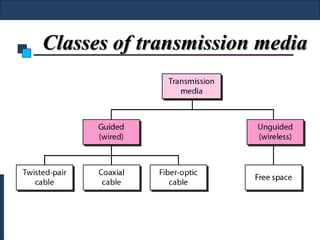
Classes of transmission media
Transmission Media


                     Guided Media

     Guided media, which are those that provide a
     conduit from one device to another, include twisted-
     pair cable, coaxial cable, and fiber-optic cable.
   Topics discussed in this section:
     Twisted-Pair Cable
     Coaxial Cable
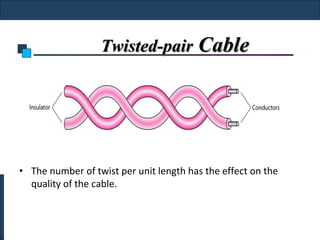
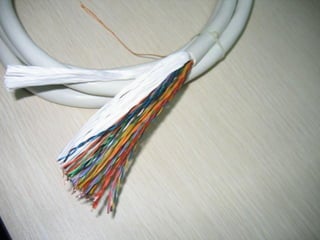
Twisted-pair Cable


• The number of twist per unit length has the effect on the
  quality of the cable.
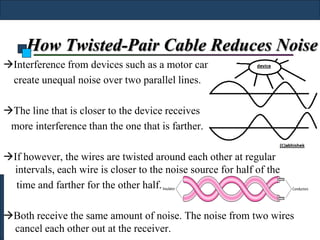
How Twisted-Pair Cable Reduces Noise
Interference from devices such as a motor can
 create unequal noise over two parallel lines.

The line that is closer to the device receives
 more interference than the one that is farther.

If however, the wires are twisted around each other at regular
 intervals, each wire is closer to the noise source for half of the
  time and farther for the other half.

Both receive the same amount of noise. The noise from two wires
 cancel each other out at the receiver.
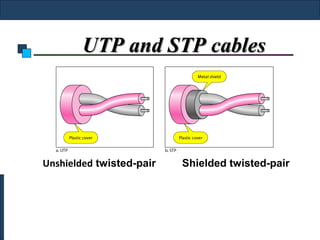
UTP and STP cables


Unshielded twisted-pair   Shielded twisted-pair
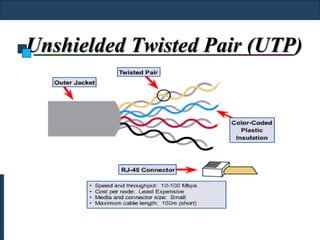
Unshielded Twisted Pair (UTP)
UTP


       Contd..
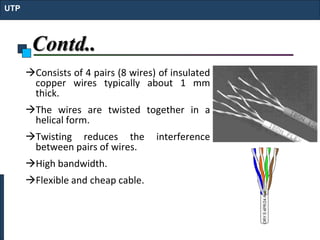
      Consists of 4 pairs (8 wires) of insulated
       copper wires typically about 1 mm
       thick.
      The wires are twisted together in a
       helical form.
      Twisting reduces the         interference
       between pairs of wires.
      High bandwidth.
      Flexible and cheap cable.
Categories of UTP
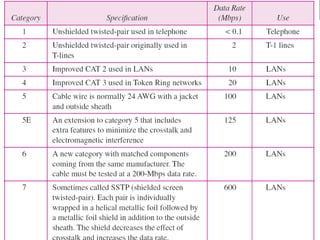
UTP comes in several categories that are based on the
 number of twists in the wires, the diameter of the wires and
 the material used in the wires.


CAT 1,CAT 2,CAT 3, CAT 4, CAT 5, Enhanced CAT 5 ,CAT 6,
 and now CAT 7.


Category 3 is the wiring used primarily for telephone
 connections.


Category 5e and Category 6 are currently the most common
 Ethernet cables used.
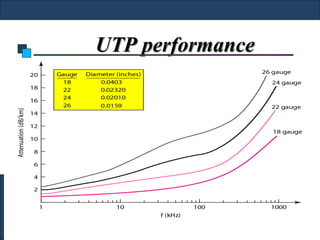
UTP performance
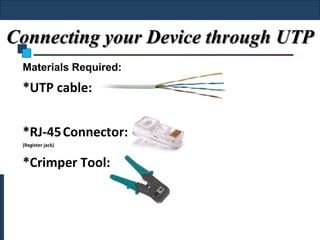
Connecting your Device through UTP
 Materials Required:
 *UTP cable:


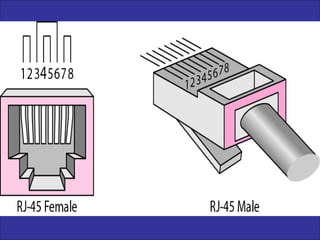
 *RJ-45 Connector:
 (Register jack)


 *Crimper Tool:
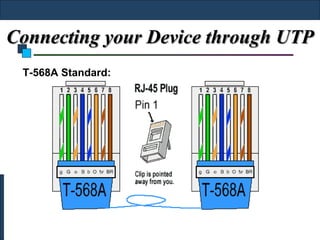
Connecting your Device through UTP
 T-568A Standard:
Applications
Twisted-pair cables are used in telephone lines to provide
 voice and data channels.

The local loop (the line that connects subscribers to the
 central telephone office) commonly consists of unshielded
 twisted-pair cables.

The DSL(Digital Subscriber Line) lines that are used by the
 telephone companies to provide high-data-rate connections.

High-bandwidth capability of unshielded twisted-pair cables is
 used in LAN connections.
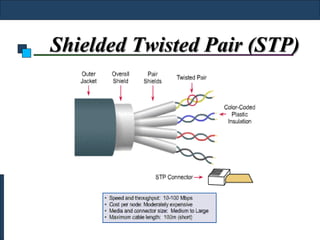
Shielded Twisted Pair (STP)
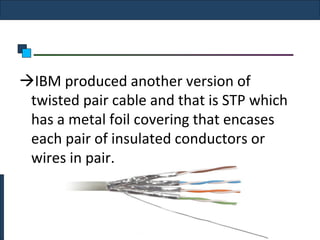
IBM produced another version of
 twisted pair cable and that is STP which
 has a metal foil covering that encases
 each pair of insulated conductors or
 wires in pair.
What it is and what it do
• STP cable combines the techniques of
  shielding,cancellation and wire twisting.
• Each pair of wires is wrapped in a metallic foil.
• The five pairs then wrapped in an overall metallic
  foil.
• STP reduces electrical noise both from
        a. Within the cable(Pair to pair coupling)
        b. Outside the cable.
• In addition the metallic shielding must be
  grounded at both ends of the cable.
• If it is improperly grounded the shield
  acts like an antenna which can pick
  signals not needed.
• It rarely comes in actual use because of
  its cost and difficult to terminate.
Important points
• SPEED – 10 to 100MBPS(1000)
• Average cost per node – Expensive than
  UTP
• Media connector size – Medium to
  large(S-L)
• Maximum cable length – 100m
Difference
When comparing UTP and STP we should know
that:

These are the least expensive media for data
 communication but if we do a comparison of
 these both then we must know that UTP is
 less expensive than the STP.
Contd..
And because most buildings are already
 wired with the UTP many transmission
 standards are adapted to use it to avoid
 costly rewiring with an alternative cable
 type like STP.
Few things we should know about STP
STP cable is developed by IBM
 for token ring that consists of
 two individual wires wrapped in a
 foil shielding to help provide a
 more reliable data connection.
Contd..
Token ring-A network where all computers on
 the network are connected in a circle fashion.
 The term token is used to describe a segment
 of information that is sent through that circle;
 when a computer on the network is able to
 decode that token, the information is received
 on that computer.
Contd..
• It is a type of wiring in which each of the two
  wires that are twisted together are coated
  with an insulating coating.

• The extra covering in shielded twisted pair
  wiring protects the transmission line from
  electromagnetic interference.
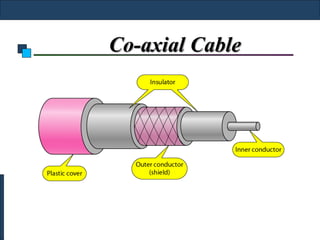
Co-axial Cable
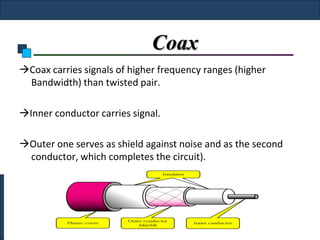
Coax
Coax carries signals of higher frequency ranges (higher
 Bandwidth) than twisted pair.

Inner conductor carries signal.

Outer one serves as shield against noise and as the second
 conductor, which completes the circuit).
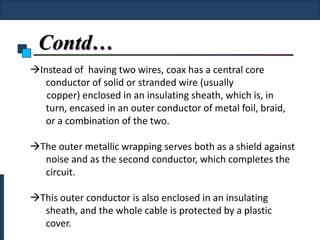
Contd…
Instead of having two wires, coax has a central core
   conductor of solid or stranded wire (usually
   copper) enclosed in an insulating sheath, which is, in
   turn, encased in an outer conductor of metal foil, braid,
   or a combination of the two.

The outer metallic wrapping serves both as a shield against
  noise and as the second conductor, which completes the
  circuit.

This outer conductor is also enclosed in an insulating
  sheath, and the whole cable is protected by a plastic
  cover.
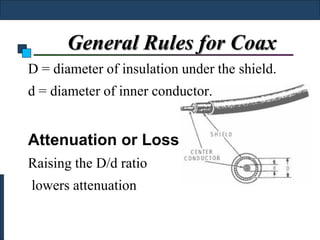
General Rules for Coax
D = diameter of insulation under the shield.
d = diameter of inner conductor.


Attenuation or Loss
Raising the D/d ratio
lowers attenuation
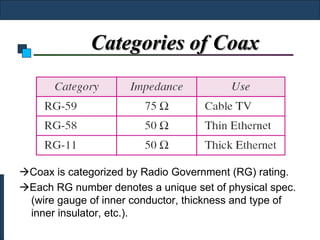
Categories of Coax


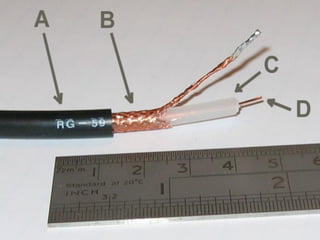
Coax is categorized by Radio Government (RG) rating.
Each RG number denotes a unique set of physical spec.
 (wire gauge of inner conductor, thickness and type of
 inner insulator, etc.).
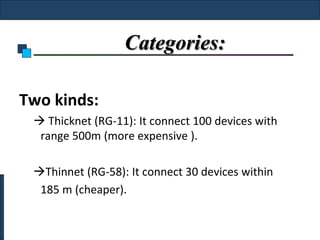
Categories:

Two kinds:
  Thicknet (RG-11): It connect 100 devices with
  range 500m (more expensive ).

 Thinnet (RG-58): It connect 30 devices within
  185 m (cheaper).
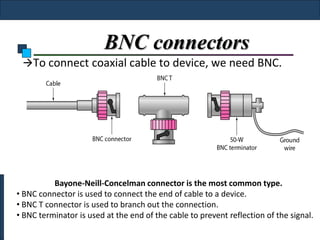
BNC connectors
 To connect coaxial cable to device, we need BNC.


          Bayone-Neill-Concelman connector is the most common type.
• BNC connector is used to connect the end of cable to a device.
• BNC T connector is used to branch out the connection.
• BNC terminator is used at the end of the cable to prevent reflection of the signal.
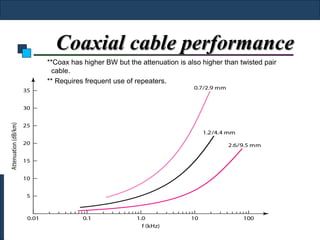
Coaxial cable performance
**Coax has higher BW but the attenuation is also higher than twisted pair
 cable.
** Requires frequent use of repeaters.
Coaxial Cable Applications
Most versatile medium

Television distribution
   Ariel to TV
   Cable TV

Long distance telephone transmission
  Can carry 10,000 voice calls simultaneously
  Being replaced by fiber optic

Short distance computer systems links
Local area networks
Any
Questions?
Thank you
             Download it
from:www.programming90.blogspot.com

Transmission Media

  • 1.
    Transmission Media Presented by:- Abhishek Wadhwa Arvind Lal Dass Nitin Malhotra
  • 2.
  • 3.
    Transmission Media Guided Media Guided media, which are those that provide a conduit from one device to another, include twisted- pair cable, coaxial cable, and fiber-optic cable. Topics discussed in this section: Twisted-Pair Cable Coaxial Cable
  • 4.
    Twisted-pair Cable • Thenumber of twist per unit length has the effect on the quality of the cable.
  • 6.
    How Twisted-Pair CableReduces Noise Interference from devices such as a motor can create unequal noise over two parallel lines. The line that is closer to the device receives more interference than the one that is farther. If however, the wires are twisted around each other at regular intervals, each wire is closer to the noise source for half of the time and farther for the other half. Both receive the same amount of noise. The noise from two wires cancel each other out at the receiver.
  • 7.
    UTP and STPcables Unshielded twisted-pair Shielded twisted-pair
  • 8.
  • 9.
    UTP Contd.. Consists of 4 pairs (8 wires) of insulated copper wires typically about 1 mm thick. The wires are twisted together in a helical form. Twisting reduces the interference between pairs of wires. High bandwidth. Flexible and cheap cable.
  • 10.
    Categories of UTP UTPcomes in several categories that are based on the number of twists in the wires, the diameter of the wires and the material used in the wires. CAT 1,CAT 2,CAT 3, CAT 4, CAT 5, Enhanced CAT 5 ,CAT 6, and now CAT 7. Category 3 is the wiring used primarily for telephone connections. Category 5e and Category 6 are currently the most common Ethernet cables used.
  • 12.
  • 13.
    Connecting your Devicethrough UTP Materials Required: *UTP cable: *RJ-45 Connector: (Register jack) *Crimper Tool:
  • 14.
    Connecting your Devicethrough UTP T-568A Standard:
  • 18.
    Applications Twisted-pair cables areused in telephone lines to provide voice and data channels. The local loop (the line that connects subscribers to the central telephone office) commonly consists of unshielded twisted-pair cables. The DSL(Digital Subscriber Line) lines that are used by the telephone companies to provide high-data-rate connections. High-bandwidth capability of unshielded twisted-pair cables is used in LAN connections.
  • 19.
  • 20.
    IBM produced anotherversion of twisted pair cable and that is STP which has a metal foil covering that encases each pair of insulated conductors or wires in pair.
  • 21.
    What it isand what it do • STP cable combines the techniques of shielding,cancellation and wire twisting. • Each pair of wires is wrapped in a metallic foil. • The five pairs then wrapped in an overall metallic foil. • STP reduces electrical noise both from a. Within the cable(Pair to pair coupling) b. Outside the cable.
  • 22.
    • In additionthe metallic shielding must be grounded at both ends of the cable. • If it is improperly grounded the shield acts like an antenna which can pick signals not needed. • It rarely comes in actual use because of its cost and difficult to terminate.
  • 23.
    Important points • SPEED– 10 to 100MBPS(1000) • Average cost per node – Expensive than UTP • Media connector size – Medium to large(S-L) • Maximum cable length – 100m
  • 24.
    Difference When comparing UTPand STP we should know that: These are the least expensive media for data communication but if we do a comparison of these both then we must know that UTP is less expensive than the STP.
  • 25.
    Contd.. And because mostbuildings are already wired with the UTP many transmission standards are adapted to use it to avoid costly rewiring with an alternative cable type like STP.
  • 26.
    Few things weshould know about STP STP cable is developed by IBM for token ring that consists of two individual wires wrapped in a foil shielding to help provide a more reliable data connection.
  • 27.
    Contd.. Token ring-A networkwhere all computers on the network are connected in a circle fashion. The term token is used to describe a segment of information that is sent through that circle; when a computer on the network is able to decode that token, the information is received on that computer.
  • 28.
    Contd.. • It isa type of wiring in which each of the two wires that are twisted together are coated with an insulating coating. • The extra covering in shielded twisted pair wiring protects the transmission line from electromagnetic interference.
  • 29.
  • 31.
    Coax Coax carries signalsof higher frequency ranges (higher Bandwidth) than twisted pair. Inner conductor carries signal. Outer one serves as shield against noise and as the second conductor, which completes the circuit).
  • 32.
    Contd… Instead of havingtwo wires, coax has a central core conductor of solid or stranded wire (usually copper) enclosed in an insulating sheath, which is, in turn, encased in an outer conductor of metal foil, braid, or a combination of the two. The outer metallic wrapping serves both as a shield against noise and as the second conductor, which completes the circuit. This outer conductor is also enclosed in an insulating sheath, and the whole cable is protected by a plastic cover.
  • 33.
    General Rules forCoax D = diameter of insulation under the shield. d = diameter of inner conductor. Attenuation or Loss Raising the D/d ratio lowers attenuation
  • 34.
    Categories of Coax Coaxis categorized by Radio Government (RG) rating. Each RG number denotes a unique set of physical spec. (wire gauge of inner conductor, thickness and type of inner insulator, etc.).
  • 35.
    Categories: Two kinds: Thicknet (RG-11): It connect 100 devices with range 500m (more expensive ). Thinnet (RG-58): It connect 30 devices within 185 m (cheaper).
  • 36.
    BNC connectors Toconnect coaxial cable to device, we need BNC. Bayone-Neill-Concelman connector is the most common type. • BNC connector is used to connect the end of cable to a device. • BNC T connector is used to branch out the connection. • BNC terminator is used at the end of the cable to prevent reflection of the signal.
  • 37.
    Coaxial cable performance **Coaxhas higher BW but the attenuation is also higher than twisted pair cable. ** Requires frequent use of repeaters.
  • 38.
    Coaxial Cable Applications Mostversatile medium Television distribution  Ariel to TV  Cable TV Long distance telephone transmission Can carry 10,000 voice calls simultaneously Being replaced by fiber optic Short distance computer systems links Local area networks
  • 39.
  • 40.
    Thank you Download it from:www.programming90.blogspot.com