SUBMITTED BY:-
   GROUP 2
  EIE 7TH SEM
   Sample-and-hold (S/H) is an important analog
    building block with many applications, including
    analog-to-digital converters (ADCs) and switched-
    capacitor filters.
   The function of the S/H circuit is to sample an
    analog input signal and hold this value over a
    certain length of time for subsequent processing.
   Taking advantages of the excellent properties of
    MOS capacitors and switches, traditional switched
    capacitor techniques can be used to realize
    different S/H circuits .
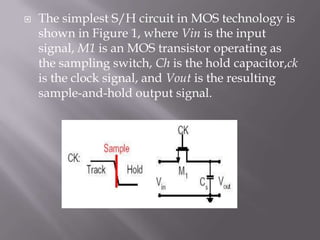
   The simplest S/H circuit in MOS technology is
    shown in Figure 1, where Vin is the input
    signal, M1 is an MOS transistor operating as
    the sampling switch, Ch is the hold capacitor,ck
    is the clock signal, and Vout is the resulting
    sample-and-hold output signal.
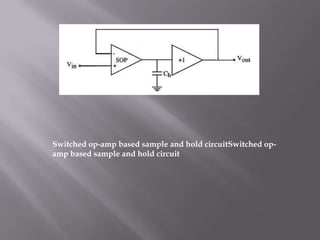
Switched op-amp based sample and hold circuitSwitched op-
amp based sample and hold circuit
   During sample mode, the SOP behaves just like
    a regular op-amp, in which the value of the
    output follows the value of the input.
   During hold mode, the MOS transistors at the
    output node of the SOP are turned off while
    they are still operating in saturation, thus
    preventing any channel charge from flowing
    into the output of the SOP.
   In addition, the SOP is shut off and its output is
    held at high impedance, allowing the charge on
    Ch to be preserved throughout the hold mode.
   On the other hand, the output buffer of this
    S/H circuit is always operational during
    sample and hold mode and is always
    providing the voltage on Ch to the output of
    the S/H circuit.
   The sample and hold circuits are essentially
    used in linear systems.
   In some kinds of analog-to-digital converters,
    the input is often compared to a voltage
    generated internally from a digital to analog
    converter D-A-C.
   The circuit tries a series of values and stops
    converting once the voltages are "the same"
    within some defined error margin.
   If the input value was permitted to change during
    this comparison process, the resulting conversion
    would be inaccurate and possibly completely
    unrelated to the true input value. Such successive
    approximation converters will often incorporate
    internal sample and hold circuitry.
    In addition, sample and hold circuits are often
    used when multiple samples need to be measured
    at the same time. Each value is sampled and held,
    using a common sample clock.
   In order that the input voltage is held constant
    for all practical purposes, it is essential that the
    capacitor have very low leakage, and that it not
    be loaded to any significant degree which calls
    for a very high input impedance.
   A true sample and hold circuit is connected to
    the buffer for a short period of time; a track and
    hold circuit is designed to track input
    continuously.
   - Obtain a low droop rate during holding mode
   - Stability is determined by the stabilities of OP
    Amps.


   - OP Amps offset can constrain the accuracy of
    SHA.
   Needs a special circuitry to stabilize the input
    amplifier during the holding mode
   Sample-and-hold (S/H) is an important analog
    building block that has many applications.
   The simplest S/H circuit can be constructed using
    only one MOS transistor and one hold capacitor.
    However, due to the limitations of the MOS
    transistor switches, errors due to charge injection
    and clock feed through restrict the performance of
    S/H circuits.
   As a result, different S/H techniques and
    architectures are developed with the intention to
    reduce or eliminate these errors.
   More new S/H techniques and architectures
    need to be proposed in order to meet the
    increasing demand for high-speed, low-
    power, and low voltage S/H circuits for data
    acquisition systems.

Sample and hold circuit

  • 1.
    SUBMITTED BY:- GROUP 2 EIE 7TH SEM
  • 2.
    Sample-and-hold (S/H) is an important analog building block with many applications, including analog-to-digital converters (ADCs) and switched- capacitor filters.  The function of the S/H circuit is to sample an analog input signal and hold this value over a certain length of time for subsequent processing.  Taking advantages of the excellent properties of MOS capacitors and switches, traditional switched capacitor techniques can be used to realize different S/H circuits .
  • 3.
    The simplest S/H circuit in MOS technology is shown in Figure 1, where Vin is the input signal, M1 is an MOS transistor operating as the sampling switch, Ch is the hold capacitor,ck is the clock signal, and Vout is the resulting sample-and-hold output signal.
  • 4.
    Switched op-amp basedsample and hold circuitSwitched op- amp based sample and hold circuit
  • 5.
    During sample mode, the SOP behaves just like a regular op-amp, in which the value of the output follows the value of the input.  During hold mode, the MOS transistors at the output node of the SOP are turned off while they are still operating in saturation, thus preventing any channel charge from flowing into the output of the SOP.  In addition, the SOP is shut off and its output is held at high impedance, allowing the charge on Ch to be preserved throughout the hold mode.
  • 6.
    On the other hand, the output buffer of this S/H circuit is always operational during sample and hold mode and is always providing the voltage on Ch to the output of the S/H circuit.
  • 7.
    The sample and hold circuits are essentially used in linear systems.  In some kinds of analog-to-digital converters, the input is often compared to a voltage generated internally from a digital to analog converter D-A-C.  The circuit tries a series of values and stops converting once the voltages are "the same" within some defined error margin.
  • 8.
    If the input value was permitted to change during this comparison process, the resulting conversion would be inaccurate and possibly completely unrelated to the true input value. Such successive approximation converters will often incorporate internal sample and hold circuitry.  In addition, sample and hold circuits are often used when multiple samples need to be measured at the same time. Each value is sampled and held, using a common sample clock.
  • 9.
    In order that the input voltage is held constant for all practical purposes, it is essential that the capacitor have very low leakage, and that it not be loaded to any significant degree which calls for a very high input impedance.  A true sample and hold circuit is connected to the buffer for a short period of time; a track and hold circuit is designed to track input continuously.
  • 10.
    - Obtain a low droop rate during holding mode  - Stability is determined by the stabilities of OP Amps.  - OP Amps offset can constrain the accuracy of SHA.  Needs a special circuitry to stabilize the input amplifier during the holding mode
  • 11.
    Sample-and-hold (S/H) is an important analog building block that has many applications.  The simplest S/H circuit can be constructed using only one MOS transistor and one hold capacitor.  However, due to the limitations of the MOS transistor switches, errors due to charge injection and clock feed through restrict the performance of S/H circuits.  As a result, different S/H techniques and architectures are developed with the intention to reduce or eliminate these errors.
  • 12.
    More new S/H techniques and architectures need to be proposed in order to meet the increasing demand for high-speed, low- power, and low voltage S/H circuits for data acquisition systems.