Chapter 7  Counters and Registers
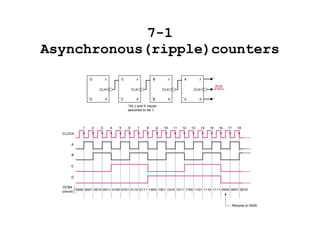
7-1 Asynchronous(ripple)counters
Asychronous Counters(Cont.) Each FF output drives the CLK input of the next FF.  FFs do not change states in exact synchronism with the applied clock pulses. There is delay between the responses of successive FFS. It is also often referred to as a  ripple counter  due to the way the FFs respond one after another in a kind of rippling effect.
Signal Flow It is conventional in circuit schematics to draw the circuits(whenever possible) such that the signal flow is from left to right, with inputs on the left and outputs one the right. In this chapter, we will often break with this convention, especially in diagrams showing counters.
Example The counter in Figure 7-1  starts off in the 0000 state, and then clock pulses are applied. Some time later the clock pulses are removed, and the counter FFs read 0011.  How many clock pulses have occurred ?
Example The counter in Figure 7-1  starts off in the 0000 state, and then clock pulses are applied. Some time later the clock pulses are removed, and the counter FFs read 0011.  How many clock pulses have occurred ? Answer: 3 or 19 or 163 N*16 + 3 (N is unknown)
MOD Number The counter in Figure 7-1 has 16 distinct states, thus, it is a MOD-16 ripple counter. The MOD number can be increased simply by adding more FFs to the counter. That is MOD number = 2 N Example A counter is needed that will count the number of items passing on a conveyor belt. A photocell and light source combination is used to generate a single pulse each time an item crosses its path. The counter must be able to count as many as one thousand items. How many FFs are required?
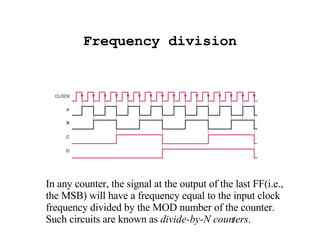
Frequency division In any counter, the signal at the output of the last FF(i.e., the MSB) will have a frequency equal to the input clock frequency divided by the MOD number of the counter. Such circuits are known as  divide-by-N counters .
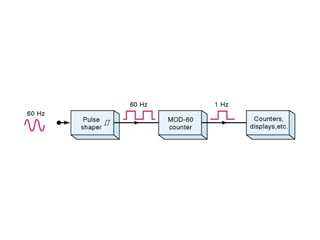
Example The first step involved in building a digital clock is to take the 60-Hz signal and feed it into a Schmitt-trigger, pulse-shaping circuit to produce a square wave as illustrated in Figure 7-3. The 60HZ square wave is then put into a MOD-60 counter, which is used to divide the 60-HZ frequency by exactly 60 to produce a 1-HZ waveform. This 1-HZ waveform is fed to a series of counters, which then count seconds, minutes, hours, and so on. How many FFs are required for the MOD-60 counter?
 
Review Questions True or False: In an asychronous counter, all FFs change states at the same time. Assume that the counter in Figure 7-1 is holding the count 0101. What will be the count after 27 clock pulses? What would be the MOD number of the counter if three more FFs were added?
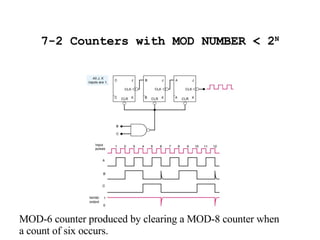
7-2 Counters with MOD NUMBER < 2 N MOD-6 counter produced by clearing a MOD-8 counter when a count of six occurs.
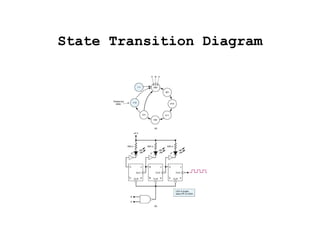
State Transition Diagram
Example What will be the status of the LEDs when the counter is holding the count of five? What will the LEDs display as the counter is clocked by a 1-kHz input? Will the 110 state be visible on the LEDs?
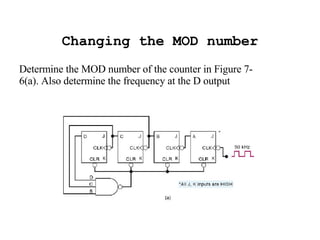
Changing the MOD number Determine the MOD number of the counter in Figure 7-6(a). Also determine the frequency at the D output
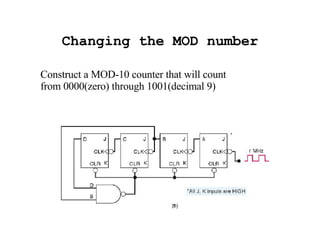
Changing the MOD number Construct a MOD-10 counter that will count from 0000(zero) through 1001(decimal 9)
Decade Counters/BCD counters Decade counter Any counter has 10 distinct states, no matter what the sequence. BCD counter A decade counter counts in sequence from 0000(zero) through 1001(decimal 9).
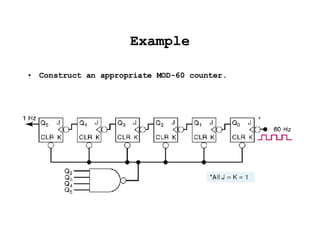
Example Construct an appropriate MOD-60 counter.
Review Questions What FF outputs should be connected to the clearing NAND gate to form a MOD-13 counter? True of False:  All BCD counters are decade counters. What is the output frequency of a decade counter that is clocked from a 50-KHz signal?
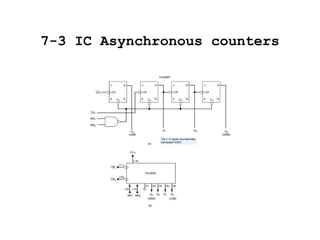
7-3 IC Asynchronous counters
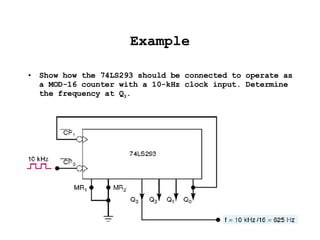
Example Show how the 74LS293 should be connected to operate as a MOD-16 counter with a 10-kHz clock input. Determine the frequency at Q 3 .
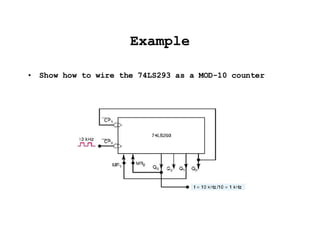
Example Show how to wire the 74LS293 as a MOD-10 counter
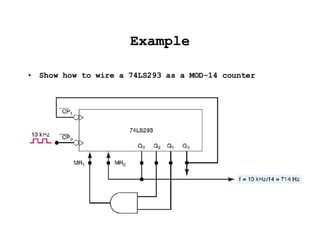
Example Show how to wire a 74LS293 as a MOD-14 counter
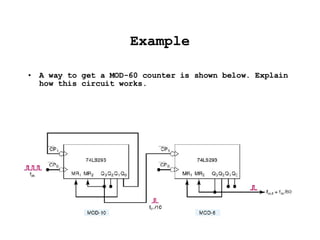
Example A way to get a MOD-60 counter is shown below. Explain how this circuit works.
Review Questions A 2-kHz clock signal is applied to  of a 74LS293. What is the frequency at Q 3 ? What would be the final output frequency if the order of the counters were reversed in Figure 7-12? What is the MOD number of a 74HC4040 counter? What would the notation “DIV64” mean on a counter symbol? Which outputs would you connect to an AND gate to convert the 74HC4024 to a MOD-120 counter?
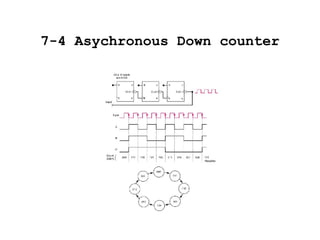
7-4 Asychronous Down counter
Review Questions What is the difference between the counting sequence of an up counter and a down counter? Describe how an asynchronous down-counter circuit differs from an up-counter circuit.
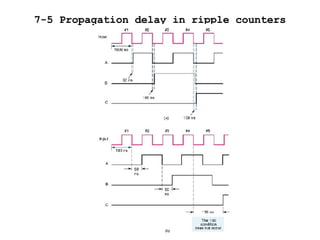
7-5 Propagation delay in ripple counters
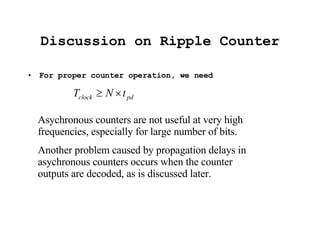
Discussion on Ripple Counter For proper counter operation, we need Asychronous counters are not useful at very high frequencies, especially for large number of bits.  Another problem caused by propagation delays in asychronous counters occurs when the counter outputs are decoded, as is discussed later.
Review Questions Explain why a ripple counter’s maximum frequency limitation decreases as more FFs are added to the counter. A certain J-K flip-flop has t pd =12 ns. What is the largest MOD counter that can be constructed from these FFs and still operate up to 10 MHz?
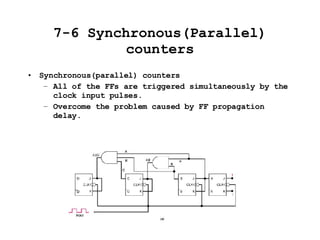
7-6 Synchronous(Parallel) counters Synchronous(parallel) counters All of the FFs are triggered simultaneously by the clock input pulses. Overcome the problem caused by FF propagation delay.
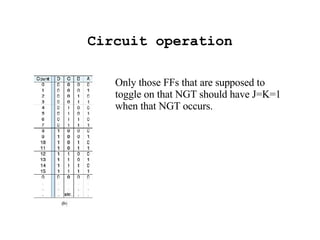
Circuit operation Only those FFs that are supposed to toggle on that NGT should have J=K=1 when that NGT occurs.
Advantage of Synchronous counters over Asychronous States are changed simultaneously. Total delay FFt pd +ANDgate t pd Actual Ics 74ALS160/162, 74HC160/162: Synchronous decade counters 74ALS161/163, 74HC161/163: Synchronous MOD-16 counters
Example Determine f max  for the counter of Figure 7-17(a) if t pd  for each FF is 50ns and t pd  for each AND gate is 20 ns. Compare this value with f max  for a MOD-16 ripple counter. What must be done to convert this counter to MOD-32? Determine f max  for the MOD-32 parallel counter.
Review Questions What is the advantage of a synchronous counter over an asynchronous counter? What is the disadvantage? How many logic devices are required for a MOD-64 parallel counter? What logic signal drives the J,K inputs of the MSB flip-flop for the counter of question 2?
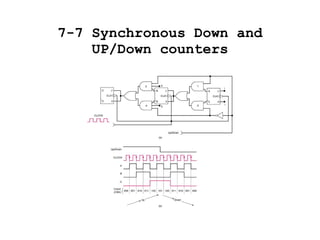
7-7 Synchronous Down and UP/Down counters
Example What problems might be caused if the UP/Down signal changes levels on the NGT of the clock?
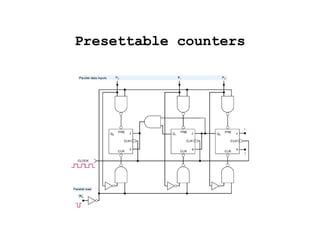
Presettable counters
Synchronous Presetting Examples of IC counters  74ALS160, 74ALS161, 74ALS612, 74ALS163 74Hc160, 74HC161, 74HC162, 74HC163
Review Questions What is meant when we say that a counter is presettable? Describe the difference between asynchronous and synchronous presetting.
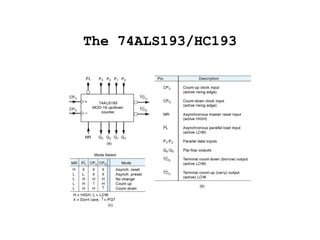
The 74ALS193/HC193
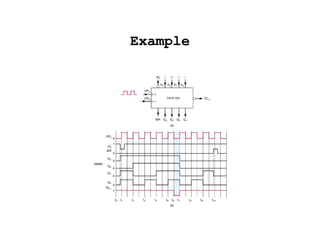
Example
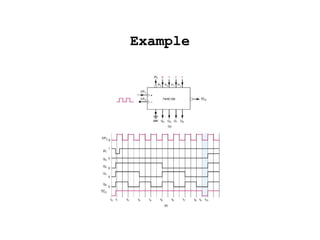
Example
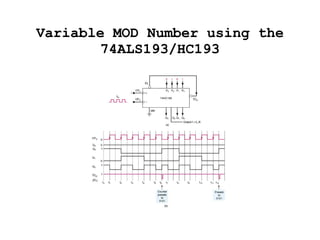
Variable MOD Number using the 74ALS193/HC193
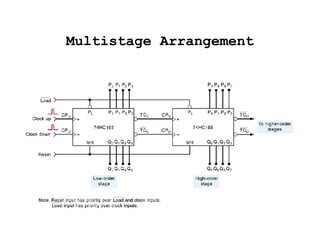
Multistage Arrangement
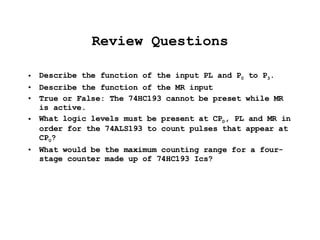
Review Questions Describe the function of the input PL and P 0  to P 3 . Describe the function of the MR input True or False: The 74HC193 cannot be preset while MR is active. What logic levels must be present at CP D , PL and MR in order for the 74ALS193 to count pulses that appear at CP U ? What would be the maximum counting range for a four-stage counter made up of 74HC193 Ics?
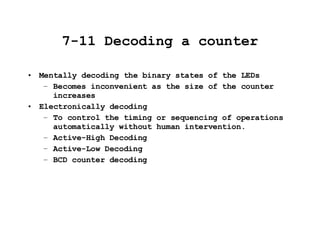
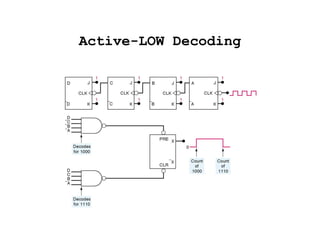
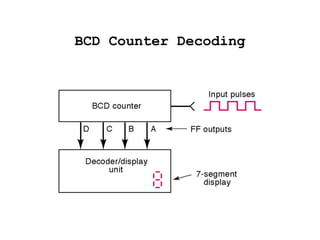
7-11 Decoding a counter Mentally decoding the binary states of the LEDs Becomes inconvenient as the size of the counter increases Electronically decoding To control the timing or sequencing of operations automatically without human intervention. Active-High Decoding Active-Low Decoding BCD counter decoding
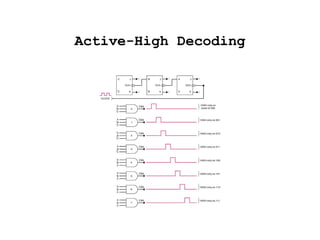
Active-High Decoding
Example How many AND gates are required to decode completely all of the states of a MOD-32 binary counter? What are the inputs to the gate that decodes for the count of 21?
Active-LOW Decoding
BCD Counter Decoding
Review Questions How many gates are needed to decode a six-bit counter fully? Describe the decoding gate needed to produce a LOW output when a MOD-64 counter is at the counter of 23.
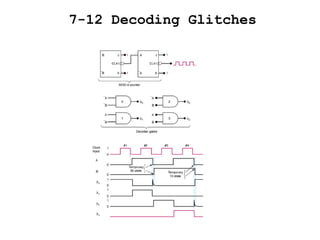
7-12 Decoding Glitches
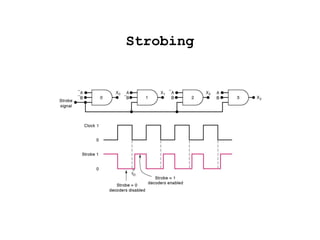
Strobing
Review Questions Explain why the decoding gates for an asynchronous counter may have glitches on their outputs. How does strobing eliminate decoding glitches?
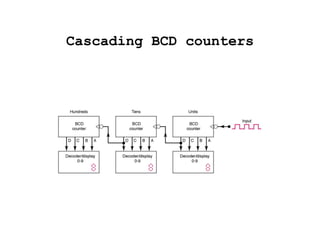
Cascading BCD counters
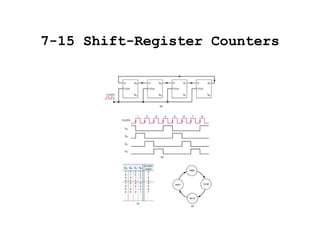
7-15 Shift-Register Counters
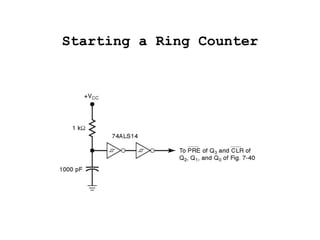
Starting a Ring Counter
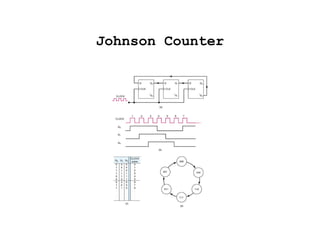
Johnson Counter
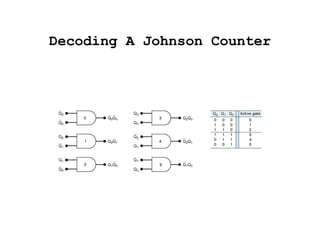
Decoding A Johnson Counter
Review Questions Which shift-register counter requires the most FFs for a given MOD number? Which shift-register counter requires the most decoding circuitry? How can a ring counter be converted to a Johnson counter? True or False: The outputs of a ring counter are always square waves. The decoding circuitry for a Johnson counter is simpler than for a binary counter Ring and Johnson counters are synchronous counters. How many FFs are needed in a MOD-16 ring counter? How many are needed in a MOD-16 Johnson Counter?
Ece221 Ch7 Part1

  • 1.
    Chapter 7 Counters and Registers
  • 2.
  • 3.
    Asychronous Counters(Cont.) EachFF output drives the CLK input of the next FF. FFs do not change states in exact synchronism with the applied clock pulses. There is delay between the responses of successive FFS. It is also often referred to as a ripple counter due to the way the FFs respond one after another in a kind of rippling effect.
  • 4.
    Signal Flow Itis conventional in circuit schematics to draw the circuits(whenever possible) such that the signal flow is from left to right, with inputs on the left and outputs one the right. In this chapter, we will often break with this convention, especially in diagrams showing counters.
  • 5.
    Example The counterin Figure 7-1 starts off in the 0000 state, and then clock pulses are applied. Some time later the clock pulses are removed, and the counter FFs read 0011. How many clock pulses have occurred ?
  • 6.
    Example The counterin Figure 7-1 starts off in the 0000 state, and then clock pulses are applied. Some time later the clock pulses are removed, and the counter FFs read 0011. How many clock pulses have occurred ? Answer: 3 or 19 or 163 N*16 + 3 (N is unknown)
  • 7.
    MOD Number Thecounter in Figure 7-1 has 16 distinct states, thus, it is a MOD-16 ripple counter. The MOD number can be increased simply by adding more FFs to the counter. That is MOD number = 2 N Example A counter is needed that will count the number of items passing on a conveyor belt. A photocell and light source combination is used to generate a single pulse each time an item crosses its path. The counter must be able to count as many as one thousand items. How many FFs are required?
  • 8.
    Frequency division Inany counter, the signal at the output of the last FF(i.e., the MSB) will have a frequency equal to the input clock frequency divided by the MOD number of the counter. Such circuits are known as divide-by-N counters .
  • 9.
    Example The firststep involved in building a digital clock is to take the 60-Hz signal and feed it into a Schmitt-trigger, pulse-shaping circuit to produce a square wave as illustrated in Figure 7-3. The 60HZ square wave is then put into a MOD-60 counter, which is used to divide the 60-HZ frequency by exactly 60 to produce a 1-HZ waveform. This 1-HZ waveform is fed to a series of counters, which then count seconds, minutes, hours, and so on. How many FFs are required for the MOD-60 counter?
  • 10.
  • 11.
    Review Questions Trueor False: In an asychronous counter, all FFs change states at the same time. Assume that the counter in Figure 7-1 is holding the count 0101. What will be the count after 27 clock pulses? What would be the MOD number of the counter if three more FFs were added?
  • 12.
    7-2 Counters withMOD NUMBER < 2 N MOD-6 counter produced by clearing a MOD-8 counter when a count of six occurs.
  • 13.
  • 14.
    Example What willbe the status of the LEDs when the counter is holding the count of five? What will the LEDs display as the counter is clocked by a 1-kHz input? Will the 110 state be visible on the LEDs?
  • 15.
    Changing the MODnumber Determine the MOD number of the counter in Figure 7-6(a). Also determine the frequency at the D output
  • 16.
    Changing the MODnumber Construct a MOD-10 counter that will count from 0000(zero) through 1001(decimal 9)
  • 17.
    Decade Counters/BCD countersDecade counter Any counter has 10 distinct states, no matter what the sequence. BCD counter A decade counter counts in sequence from 0000(zero) through 1001(decimal 9).
  • 18.
    Example Construct anappropriate MOD-60 counter.
  • 19.
    Review Questions WhatFF outputs should be connected to the clearing NAND gate to form a MOD-13 counter? True of False: All BCD counters are decade counters. What is the output frequency of a decade counter that is clocked from a 50-KHz signal?
  • 20.
  • 21.
    Example Show howthe 74LS293 should be connected to operate as a MOD-16 counter with a 10-kHz clock input. Determine the frequency at Q 3 .
  • 22.
    Example Show howto wire the 74LS293 as a MOD-10 counter
  • 23.
    Example Show howto wire a 74LS293 as a MOD-14 counter
  • 24.
    Example A wayto get a MOD-60 counter is shown below. Explain how this circuit works.
  • 25.
    Review Questions A2-kHz clock signal is applied to of a 74LS293. What is the frequency at Q 3 ? What would be the final output frequency if the order of the counters were reversed in Figure 7-12? What is the MOD number of a 74HC4040 counter? What would the notation “DIV64” mean on a counter symbol? Which outputs would you connect to an AND gate to convert the 74HC4024 to a MOD-120 counter?
  • 26.
  • 27.
    Review Questions Whatis the difference between the counting sequence of an up counter and a down counter? Describe how an asynchronous down-counter circuit differs from an up-counter circuit.
  • 28.
    7-5 Propagation delayin ripple counters
  • 29.
    Discussion on RippleCounter For proper counter operation, we need Asychronous counters are not useful at very high frequencies, especially for large number of bits. Another problem caused by propagation delays in asychronous counters occurs when the counter outputs are decoded, as is discussed later.
  • 30.
    Review Questions Explainwhy a ripple counter’s maximum frequency limitation decreases as more FFs are added to the counter. A certain J-K flip-flop has t pd =12 ns. What is the largest MOD counter that can be constructed from these FFs and still operate up to 10 MHz?
  • 31.
    7-6 Synchronous(Parallel) countersSynchronous(parallel) counters All of the FFs are triggered simultaneously by the clock input pulses. Overcome the problem caused by FF propagation delay.
  • 32.
    Circuit operation Onlythose FFs that are supposed to toggle on that NGT should have J=K=1 when that NGT occurs.
  • 33.
    Advantage of Synchronouscounters over Asychronous States are changed simultaneously. Total delay FFt pd +ANDgate t pd Actual Ics 74ALS160/162, 74HC160/162: Synchronous decade counters 74ALS161/163, 74HC161/163: Synchronous MOD-16 counters
  • 34.
    Example Determine fmax for the counter of Figure 7-17(a) if t pd for each FF is 50ns and t pd for each AND gate is 20 ns. Compare this value with f max for a MOD-16 ripple counter. What must be done to convert this counter to MOD-32? Determine f max for the MOD-32 parallel counter.
  • 35.
    Review Questions Whatis the advantage of a synchronous counter over an asynchronous counter? What is the disadvantage? How many logic devices are required for a MOD-64 parallel counter? What logic signal drives the J,K inputs of the MSB flip-flop for the counter of question 2?
  • 36.
    7-7 Synchronous Downand UP/Down counters
  • 37.
    Example What problemsmight be caused if the UP/Down signal changes levels on the NGT of the clock?
  • 38.
  • 39.
    Synchronous Presetting Examplesof IC counters 74ALS160, 74ALS161, 74ALS612, 74ALS163 74Hc160, 74HC161, 74HC162, 74HC163
  • 40.
    Review Questions Whatis meant when we say that a counter is presettable? Describe the difference between asynchronous and synchronous presetting.
  • 41.
  • 42.
  • 43.
  • 44.
    Variable MOD Numberusing the 74ALS193/HC193
  • 45.
  • 46.
    Review Questions Describethe function of the input PL and P 0 to P 3 . Describe the function of the MR input True or False: The 74HC193 cannot be preset while MR is active. What logic levels must be present at CP D , PL and MR in order for the 74ALS193 to count pulses that appear at CP U ? What would be the maximum counting range for a four-stage counter made up of 74HC193 Ics?
  • 47.
    7-11 Decoding acounter Mentally decoding the binary states of the LEDs Becomes inconvenient as the size of the counter increases Electronically decoding To control the timing or sequencing of operations automatically without human intervention. Active-High Decoding Active-Low Decoding BCD counter decoding
  • 48.
  • 49.
    Example How manyAND gates are required to decode completely all of the states of a MOD-32 binary counter? What are the inputs to the gate that decodes for the count of 21?
  • 50.
  • 51.
  • 52.
    Review Questions Howmany gates are needed to decode a six-bit counter fully? Describe the decoding gate needed to produce a LOW output when a MOD-64 counter is at the counter of 23.
  • 53.
  • 54.
  • 55.
    Review Questions Explainwhy the decoding gates for an asynchronous counter may have glitches on their outputs. How does strobing eliminate decoding glitches?
  • 56.
  • 57.
  • 58.
  • 59.
  • 60.
  • 61.
    Review Questions Whichshift-register counter requires the most FFs for a given MOD number? Which shift-register counter requires the most decoding circuitry? How can a ring counter be converted to a Johnson counter? True or False: The outputs of a ring counter are always square waves. The decoding circuitry for a Johnson counter is simpler than for a binary counter Ring and Johnson counters are synchronous counters. How many FFs are needed in a MOD-16 ring counter? How many are needed in a MOD-16 Johnson Counter?