Chapter # 21
XII FDC Prepared by: Sidra Javed
Prepared by: Sidra Javed
Lipids
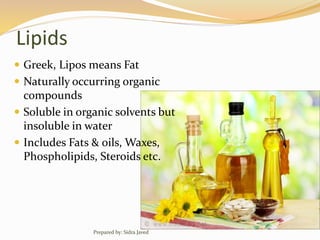
 Greek, Lipos means Fat
 Naturally occurring organic
compounds
 Soluble in organic solvents but
insoluble in water
 Includes Fats & oils, Waxes,
Phospholipids, Steroids etc.
Prepared by: Sidra Javed
Main Composition
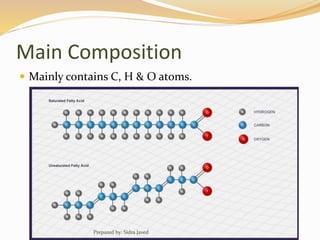
 Mainly contains C, H & O atoms.
Prepared by: Sidra Javed
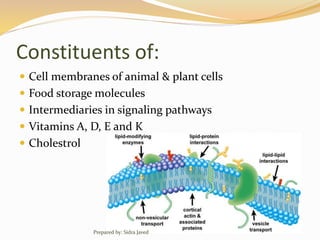
Constituents of:
 Cell membranes of animal & plant cells
 Food storage molecules
 Intermediaries in signaling pathways
 Vitamins A, D, E and K
 Cholestrol
Prepared by: Sidra Javed
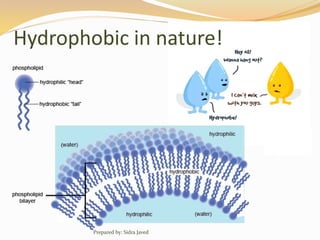
Hydrophobic in nature!
Prepared by: Sidra Javed
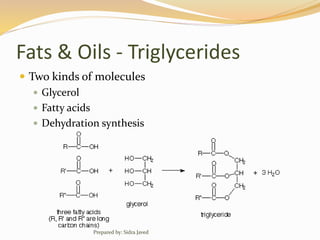
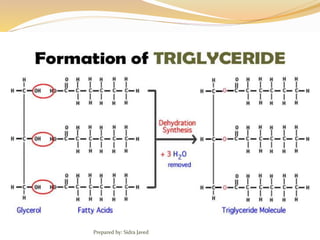
Fats & Oils - Triglycerides
 Two kinds of molecules
 Glycerol
 Fatty acids
 Dehydration synthesis
Prepared by: Sidra Javed
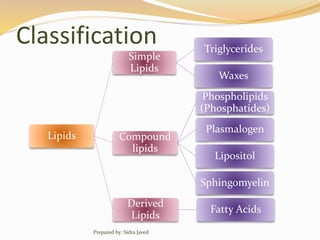
Classification
Lipids
Simple
Lipids
Triglycerides
Waxes
Compound
lipids
Phospholipids
(Phosphatides)
Plasmalogen
Lipositol
Sphingomyelin
Derived
Lipids
Fatty Acids
Prepared by: Sidra Javed
Simple Lipids
 Ester of fatty acids with glycerol
 Triglycerides, neutral fats
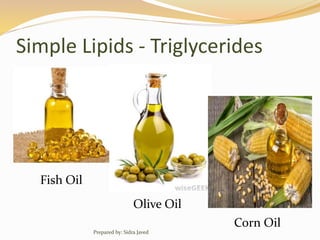
 Adipose tissues, butterfat, fish oils, olive oil & Corn oil
 Waxes
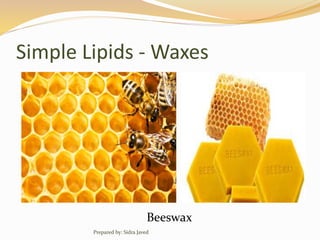
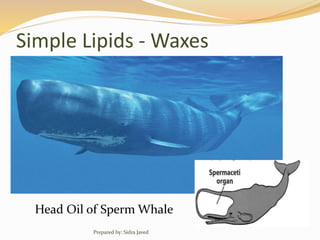
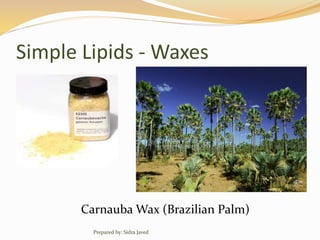
 Beeswax, head oil of sperm whale, carnauba oil and
lanolin of industrial and medicinal importance
Prepared by: Sidra Javed
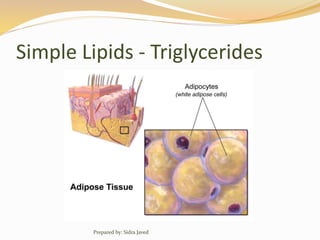
Simple Lipids - Triglycerides
Prepared by: Sidra Javed
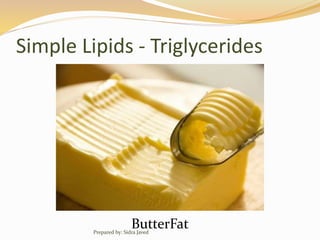
Simple Lipids - Triglycerides
ButterFatPrepared by: Sidra Javed
Simple Lipids - Triglycerides
Fish Oil
Olive Oil
Corn Oil
Prepared by: Sidra Javed
Simple Lipids - Waxes
Beeswax
Prepared by: Sidra Javed
Simple Lipids - Waxes
Head Oil of Sperm Whale
Prepared by: Sidra Javed
Simple Lipids - Waxes
Carnauba Wax (Brazilian Palm)
Prepared by: Sidra Javed
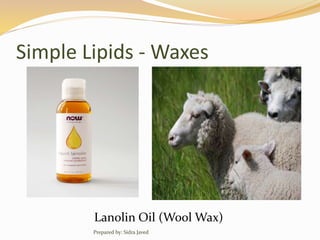
Simple Lipids - Waxes
Lanolin Oil (Wool Wax)
Prepared by: Sidra Javed
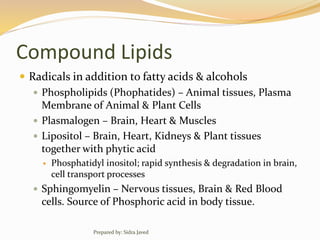
Compound Lipids
 Radicals in addition to fatty acids & alcohols
 Phospholipids (Phophatides) – Animal tissues, Plasma
Membrane of Animal & Plant Cells
 Plasmalogen – Brain, Heart & Muscles
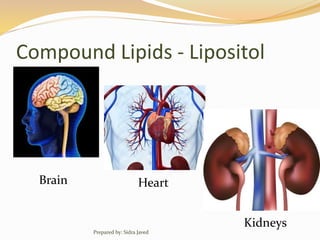
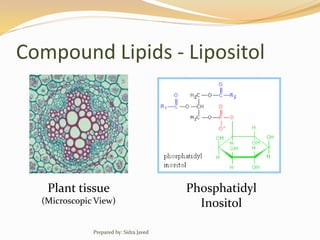
 Lipositol – Brain, Heart, Kidneys & Plant tissues
together with phytic acid
 Phosphatidyl inositol; rapid synthesis & degradation in brain,
cell transport processes
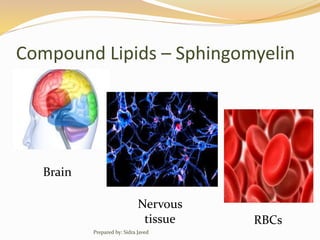
 Sphingomyelin – Nervous tissues, Brain & Red Blood
cells. Source of Phosphoric acid in body tissue.
Prepared by: Sidra Javed
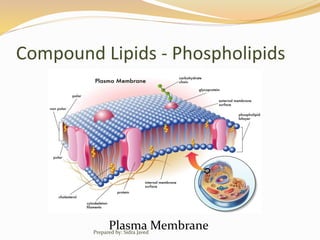
Compound Lipids - Phospholipids
Plasma MembranePrepared by: Sidra Javed
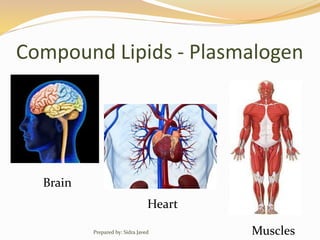
Compound Lipids - Plasmalogen
Brain
Heart
MusclesPrepared by: Sidra Javed
Compound Lipids - Lipositol
Brain Heart
Kidneys
Prepared by: Sidra Javed
Compound Lipids - Lipositol
Plant tissue
(Microscopic View)
Phosphatidyl
Inositol
Prepared by: Sidra Javed
Compound Lipids – Sphingomyelin
Brain
Nervous
tissue RBCs
Prepared by: Sidra Javed
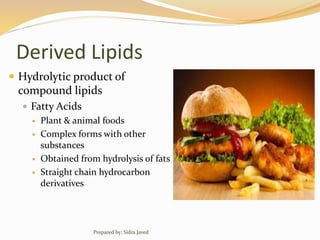
Derived Lipids
 Hydrolytic product of
compound lipids
 Fatty Acids
 Plant & animal foods
 Complex forms with other
substances
 Obtained from hydrolysis of fats
 Straight chain hydrocarbon
derivatives
Prepared by: Sidra Javed
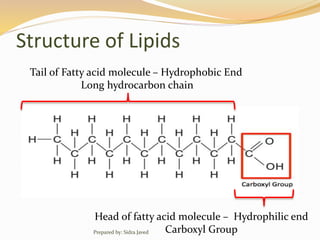
Structure of Lipids
Tail of Fatty acid molecule – Hydrophobic End
Long hydrocarbon chain
Head of fatty acid molecule – Hydrophilic end
Carboxyl GroupPrepared by: Sidra Javed
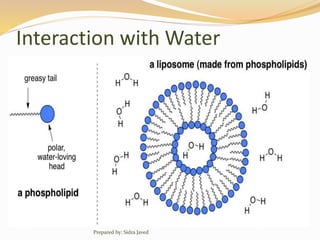
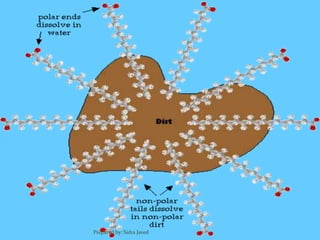
Interaction with Water
Prepared by: Sidra Javed
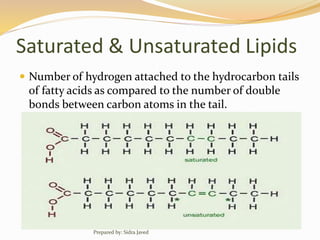
Saturated & Unsaturated Lipids
 Number of hydrogen attached to the hydrocarbon tails
of fatty acids as compared to the number of double
bonds between carbon atoms in the tail.
Prepared by: Sidra Javed
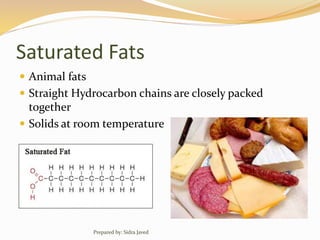
Saturated Fats
 Animal fats
 Straight Hydrocarbon chains are closely packed
together
 Solids at room temperature
Prepared by: Sidra Javed
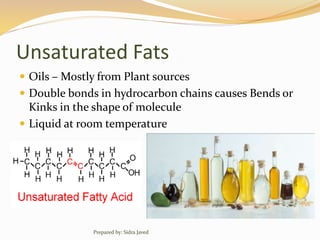
Unsaturated Fats
 Oils – Mostly from Plant sources
 Double bonds in hydrocarbon chains causes Bends or
Kinks in the shape of molecule
 Liquid at room temperature
Prepared by: Sidra Javed
Physical Properties of Lipids
 May be either liquid or non crystalline solids at room
temperature
 Colorless, odorless and tasteless in their pure state
 Color of fat is due to other substances
 Yellow color of butter is due to Keratin
 Lighter than water
 Insoluble in water
 Readily soluble in organic solvents
 Form emulsions when agitated with water in the
presence of soap or other emulsifier
 Poor conductor of heat and electricity – efficient
insulator for animal body
Prepared by: Sidra Javed
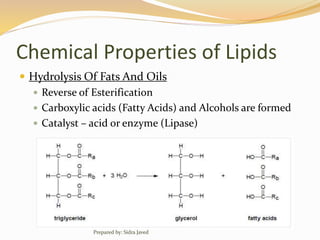
Chemical Properties of Lipids
 Hydrolysis Of Fats And Oils
 Reverse of Esterification
 Carboxylic acids (Fatty Acids) and Alcohols are formed
 Catalyst – acid or enzyme (Lipase)
Prepared by: Sidra Javed
Chemical Properties of Lipids
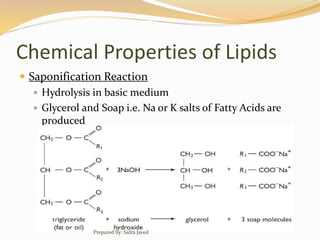
 Saponification Reaction
 Hydrolysis in basic medium
 Glycerol and Soap i.e. Na or K salts of Fatty Acids are
produced
Prepared by: Sidra Javed
Chemical Properties of Lipids
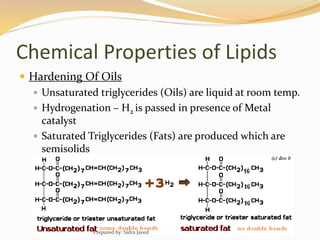
 Hardening Of Oils
 Unsaturated triglycerides (Oils) are liquid at room temp.
 Hydrogenation – H2 is passed in presence of Metal
catalyst
 Saturated Triglycerides (Fats) are produced which are
semisolids
Prepared by: Sidra Javed
Nutritional & Biological Importance
 As a Storage form for metabolic energy (triglycerides)
 As components of membranes
 As messengers (prostaglandins, Steroid hormones)
 Lipids provide 9 calories per gram energy as compared
to Carbohydrate or Protein with 4 calories per gram.
Prepared by: Sidra Javed
Essential Lipids
 Polyunsaturated Fats
 Omega-6 and Omega-3 Fats
 Essential part of diet
 Good for health
 Body cannot produced these lipids
 Hormone synthesis, Cell membrane structure and
healthy brain & vision.
 Lower body cholesterol levels
Prepared by: Sidra Javed
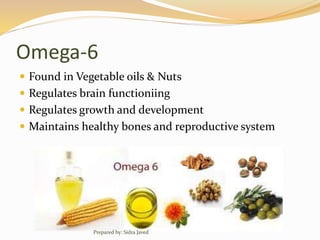
Omega-6
 Found in Vegetable oils & Nuts
 Regulates brain functioniing
 Regulates growth and development
 Maintains healthy bones and reproductive system
Prepared by: Sidra Javed
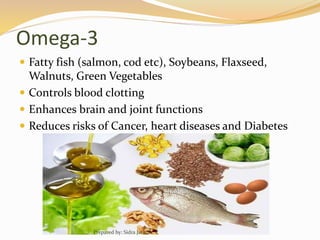
Omega-3
 Fatty fish (salmon, cod etc), Soybeans, Flaxseed,
Walnuts, Green Vegetables
 Controls blood clotting
 Enhances brain and joint functions
 Reduces risks of Cancer, heart diseases and Diabetes
Prepared by: Sidra Javed
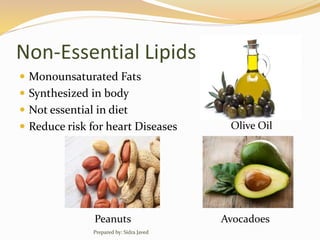
Non-Essential Lipids
 Monounsaturated Fats
 Synthesized in body
 Not essential in diet
 Reduce risk for heart Diseases Olive Oil
Peanuts Avocadoes
Prepared by: Sidra Javed
Bad Fats
 Raise Bad cholesterol levels in blood
 Should be avoided in diet
 Saturated Fats
 Fatty meats , Butter & cheese, Palm & Coconut Oil
 Trans Fats
 Partially Hydrogenated oils
 Processed and fried foods
 Cholesterol
 Fatty animal foods
Prepared by: Sidra Javed
Other Functions of Lipids
 Tissue reconstruction
 Nervous system Organization
 Increases and assures a normal function of the skin
 Antibodies formation
 Good function of endocrine glands (Thyroid)
 Water metabolism
Prepared by: Sidra Javed
Prepared by, Sidra Javed

Lipids

  • 1.
    Chapter # 21 XIIFDC Prepared by: Sidra Javed
  • 2.
  • 3.
    Lipids  Greek, Liposmeans Fat  Naturally occurring organic compounds  Soluble in organic solvents but insoluble in water  Includes Fats & oils, Waxes, Phospholipids, Steroids etc. Prepared by: Sidra Javed
  • 4.
    Main Composition  Mainlycontains C, H & O atoms. Prepared by: Sidra Javed
  • 5.
    Constituents of:  Cellmembranes of animal & plant cells  Food storage molecules  Intermediaries in signaling pathways  Vitamins A, D, E and K  Cholestrol Prepared by: Sidra Javed
  • 6.
  • 7.
    Fats & Oils- Triglycerides  Two kinds of molecules  Glycerol  Fatty acids  Dehydration synthesis Prepared by: Sidra Javed
  • 8.
  • 9.
  • 10.
    Simple Lipids  Esterof fatty acids with glycerol  Triglycerides, neutral fats  Adipose tissues, butterfat, fish oils, olive oil & Corn oil  Waxes  Beeswax, head oil of sperm whale, carnauba oil and lanolin of industrial and medicinal importance Prepared by: Sidra Javed
  • 11.
    Simple Lipids -Triglycerides Prepared by: Sidra Javed
  • 12.
    Simple Lipids -Triglycerides ButterFatPrepared by: Sidra Javed
  • 13.
    Simple Lipids -Triglycerides Fish Oil Olive Oil Corn Oil Prepared by: Sidra Javed
  • 14.
    Simple Lipids -Waxes Beeswax Prepared by: Sidra Javed
  • 15.
    Simple Lipids -Waxes Head Oil of Sperm Whale Prepared by: Sidra Javed
  • 16.
    Simple Lipids -Waxes Carnauba Wax (Brazilian Palm) Prepared by: Sidra Javed
  • 17.
    Simple Lipids -Waxes Lanolin Oil (Wool Wax) Prepared by: Sidra Javed
  • 18.
    Compound Lipids  Radicalsin addition to fatty acids & alcohols  Phospholipids (Phophatides) – Animal tissues, Plasma Membrane of Animal & Plant Cells  Plasmalogen – Brain, Heart & Muscles  Lipositol – Brain, Heart, Kidneys & Plant tissues together with phytic acid  Phosphatidyl inositol; rapid synthesis & degradation in brain, cell transport processes  Sphingomyelin – Nervous tissues, Brain & Red Blood cells. Source of Phosphoric acid in body tissue. Prepared by: Sidra Javed
  • 19.
    Compound Lipids -Phospholipids Plasma MembranePrepared by: Sidra Javed
  • 20.
    Compound Lipids -Plasmalogen Brain Heart MusclesPrepared by: Sidra Javed
  • 21.
    Compound Lipids -Lipositol Brain Heart Kidneys Prepared by: Sidra Javed
  • 22.
    Compound Lipids -Lipositol Plant tissue (Microscopic View) Phosphatidyl Inositol Prepared by: Sidra Javed
  • 23.
    Compound Lipids –Sphingomyelin Brain Nervous tissue RBCs Prepared by: Sidra Javed
  • 24.
    Derived Lipids  Hydrolyticproduct of compound lipids  Fatty Acids  Plant & animal foods  Complex forms with other substances  Obtained from hydrolysis of fats  Straight chain hydrocarbon derivatives Prepared by: Sidra Javed
  • 25.
    Structure of Lipids Tailof Fatty acid molecule – Hydrophobic End Long hydrocarbon chain Head of fatty acid molecule – Hydrophilic end Carboxyl GroupPrepared by: Sidra Javed
  • 26.
  • 27.
  • 28.
    Saturated & UnsaturatedLipids  Number of hydrogen attached to the hydrocarbon tails of fatty acids as compared to the number of double bonds between carbon atoms in the tail. Prepared by: Sidra Javed
  • 29.
    Saturated Fats  Animalfats  Straight Hydrocarbon chains are closely packed together  Solids at room temperature Prepared by: Sidra Javed
  • 30.
    Unsaturated Fats  Oils– Mostly from Plant sources  Double bonds in hydrocarbon chains causes Bends or Kinks in the shape of molecule  Liquid at room temperature Prepared by: Sidra Javed
  • 31.
    Physical Properties ofLipids  May be either liquid or non crystalline solids at room temperature  Colorless, odorless and tasteless in their pure state  Color of fat is due to other substances  Yellow color of butter is due to Keratin  Lighter than water  Insoluble in water  Readily soluble in organic solvents  Form emulsions when agitated with water in the presence of soap or other emulsifier  Poor conductor of heat and electricity – efficient insulator for animal body Prepared by: Sidra Javed
  • 32.
    Chemical Properties ofLipids  Hydrolysis Of Fats And Oils  Reverse of Esterification  Carboxylic acids (Fatty Acids) and Alcohols are formed  Catalyst – acid or enzyme (Lipase) Prepared by: Sidra Javed
  • 33.
    Chemical Properties ofLipids  Saponification Reaction  Hydrolysis in basic medium  Glycerol and Soap i.e. Na or K salts of Fatty Acids are produced Prepared by: Sidra Javed
  • 34.
    Chemical Properties ofLipids  Hardening Of Oils  Unsaturated triglycerides (Oils) are liquid at room temp.  Hydrogenation – H2 is passed in presence of Metal catalyst  Saturated Triglycerides (Fats) are produced which are semisolids Prepared by: Sidra Javed
  • 35.
    Nutritional & BiologicalImportance  As a Storage form for metabolic energy (triglycerides)  As components of membranes  As messengers (prostaglandins, Steroid hormones)  Lipids provide 9 calories per gram energy as compared to Carbohydrate or Protein with 4 calories per gram. Prepared by: Sidra Javed
  • 36.
    Essential Lipids  PolyunsaturatedFats  Omega-6 and Omega-3 Fats  Essential part of diet  Good for health  Body cannot produced these lipids  Hormone synthesis, Cell membrane structure and healthy brain & vision.  Lower body cholesterol levels Prepared by: Sidra Javed
  • 37.
    Omega-6  Found inVegetable oils & Nuts  Regulates brain functioniing  Regulates growth and development  Maintains healthy bones and reproductive system Prepared by: Sidra Javed
  • 38.
    Omega-3  Fatty fish(salmon, cod etc), Soybeans, Flaxseed, Walnuts, Green Vegetables  Controls blood clotting  Enhances brain and joint functions  Reduces risks of Cancer, heart diseases and Diabetes Prepared by: Sidra Javed
  • 39.
    Non-Essential Lipids  MonounsaturatedFats  Synthesized in body  Not essential in diet  Reduce risk for heart Diseases Olive Oil Peanuts Avocadoes Prepared by: Sidra Javed
  • 40.
    Bad Fats  RaiseBad cholesterol levels in blood  Should be avoided in diet  Saturated Fats  Fatty meats , Butter & cheese, Palm & Coconut Oil  Trans Fats  Partially Hydrogenated oils  Processed and fried foods  Cholesterol  Fatty animal foods Prepared by: Sidra Javed
  • 41.
    Other Functions ofLipids  Tissue reconstruction  Nervous system Organization  Increases and assures a normal function of the skin  Antibodies formation  Good function of endocrine glands (Thyroid)  Water metabolism Prepared by: Sidra Javed
  • 42.