BIODIESEL PRODUCTION TECHNOLOGY & FEEDSTOCKS FOR INDIA PROF. NAVEEN KUMAR COORDINATOR, BIODIESEL RESEARCH DELHI COLLEGE OF ENGINEERING DELHI, INDIA Email:  [email_address] Phone : 27871248, 32924637 Mobile : 9891963530, 9810363530 UNIVERSITY OF MINNESOTA, OCTOBER 24,2006 Organized by  Moving Toward Sustainable Energy Systems:  Exploring Global Pathways to a Common Destination   Expert Lecture at Workshop on
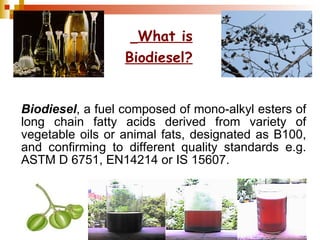
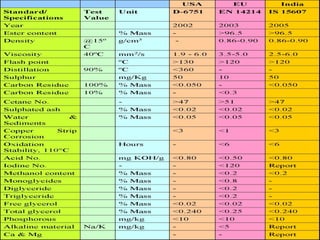
What is Biodiesel?   Biodiesel , a fuel composed of mono-alkyl esters of long chain fatty acids derived from variety of vegetable oils or animal fats, designated as B100, and confirming to different quality standards e.g. ASTM D 6751, EN14214 or IS 15607.
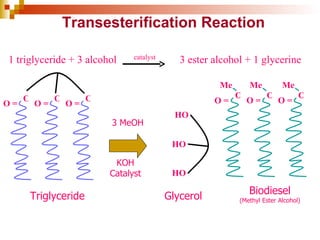
Transesterification Reaction Glycerol O O O Me Me Me O = O = O = HO HO HO Biodiesel (Methyl Ester Alcohol) 3 ester alcohol + 1 glycerine O = O O O = O O = Triglyceride 1 triglyceride + 3 alcohol 3 MeOH KOH Catalyst catalyst

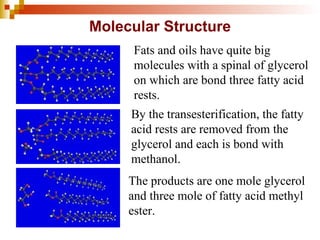
Molecular Structure Fats and oils have quite big molecules with a spinal of glycerol on which are bond three fatty acid rests. By the transesterification, the fatty acid rests are removed from the glycerol and each is bond with methanol. The products are one mole glycerol and three mole of fatty acid methyl ester.
Issues Related to Base Catalyzed Transesterification Process Feedstock Issues FFA Water Process Issues Type of Alcohol Molar Ratio Catalyst Reaction time & temperature Agitation
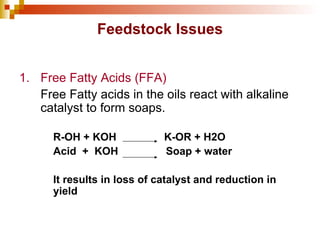
Feedstock Issues 1. Free Fatty Acids (FFA) Free Fatty acids in the oils react with alkaline catalyst to form soaps. R-OH + KOH  K-OR + H2O  Acid  +  KOH  Soap + water It results in loss of catalyst and reduction in yield
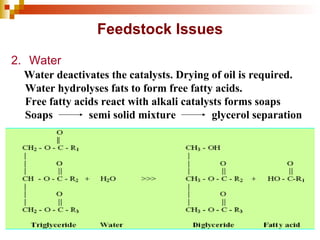
Feedstock Issues 2. Water Water deactivates the catalysts. Drying of oil is required. Water hydrolyses fats to form free fatty acids. Free fatty acids react with alkali catalysts forms soaps Soaps  semi solid mixture  glycerol separation
Process Issues Methanol, Ethanol, Butanol etc Methanol –commercially used In methanolysis, emulsion forms and separated into lower glycerol portion and upper ester portion. Reaction time is small In ethanolysis, emulsions are stable and requires more complicated separation and purification  process. Reaction time is large Typical alcohol: TG ratio is 6:1 for base catalyzed reactions. Type of Alcohol
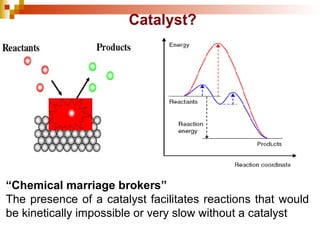
Catalyst? “ Chemical marriage brokers” The presence of a catalyst facilitates reactions that would be kinetically impossible or very slow without a catalyst
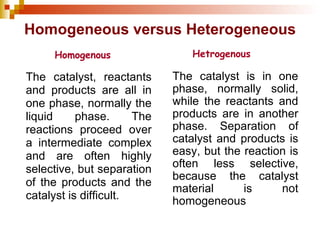
Homogeneous versus Heterogeneous Homogenous The catalyst, reactants and products are all in one phase, normally the liquid phase. The reactions proceed over a intermediate complex and are often highly selective, but separation of the products and the catalyst is difficult. Hetrogenous The catalyst is in one phase, normally solid, while the reactants and products are in another phase. Separation of catalyst and products is easy, but the reaction is often less selective, because the catalyst material is not homogeneous
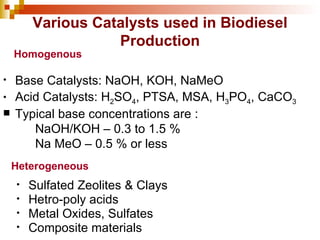
Various Catalysts used in Biodiesel Production Base Catalysts: NaOH, KOH, NaMeO Acid Catalysts: H 2 SO 4 , PTSA, MSA, H 3 PO 4 , CaCO 3 Typical base concentrations are : NaOH/KOH – 0.3 to 1.5 % Na MeO – 0.5 % or less Sulfated Zeolites & Clays Hetro-poly acids Metal Oxides, Sulfates Composite materials Homogenous Heterogeneous
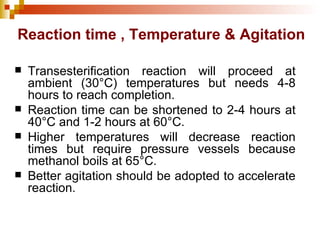
Reaction time , Temperature & Agitation Transesterification reaction will proceed at ambient (30°C) temperatures but needs 4-8 hours to reach completion. Reaction time can be shortened to 2-4 hours at 40°C and 1-2 hours at 60°C. Higher temperatures will decrease reaction times but require pressure vessels because methanol boils at 65°C. Better agitation should be adopted to accelerate reaction.
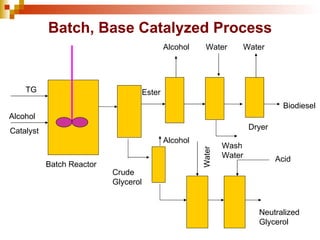
Batch, Base Catalyzed Process TG Alcohol Catalyst Batch Reactor Ester Crude Glycerol Alcohol Alcohol Water Water Neutralized Glycerol Wash Water Dryer Biodiesel Water Acid
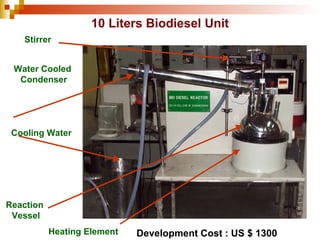
Reaction  Vessel Heating Element Water Cooled Condenser Cooling Water 10 Liters Biodiesel Unit Stirrer Development Cost : US $ 1300
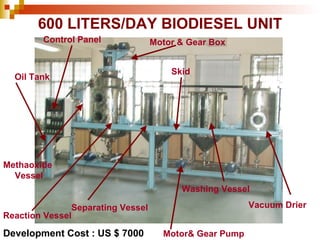
600 LITERS/DAY BIODIESEL UNIT Vacuum Drier Separating Vessel Reaction Vessel Washing Vessel Control Panel Oil Tank Methaoxide Vessel Skid Motor & Gear Box  Motor& Gear Pump Development Cost : US $ 7000
High FFA Feed Stocks Biodiesel feed stocks are classified by the amount of free fatty acids they contain: Refined vegetable oils < 0.05% Crude vegetable oil 0.5-5% Used Cooking Oil 2-7% Animal fat 10-30% Price decreases as FFAs increase but processing cost also increase Base Catalyzed Reaction not suitable for high FFA feeds because of soap formation. Most of the non-edible oils available in India contains high FFA (2-12%) & to decrease the cost of biodiesel, it is imperative to utilize high FFA oil or fatty acids
Acid Catalyzed Processes Acid catalyzed processes are used for direct esterification of free fatty acids in a high FFA feedstock Limitations: Water formation by FFA + methanol ==> methyl ester + water High alcohol: FFA ratio required – about 40:1 Large amounts (5 to 25 %) catalyst may be required
Use acid catalysis for conversion of FFAs to methyl esters, until FFA < 0.5%. Acid esterification of FFA is fast (1 hour) but acid catalyzed transesterification is slow (2 days at 60°C). 2.  Then, add additional methanol and base catalyst  to transesterify the triglycerides. Preferred method for High FFA feeds: Acid Catalysis followed by base catalysis
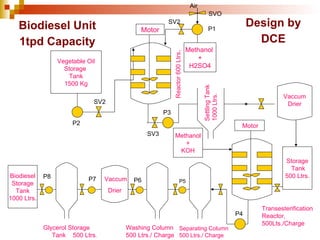
Methanol + KOH Vegetable Oil Storage  Tank 1500 Kg Methanol  + H2SO4 Motor Storage Tank 500 Ltrs. Motor Biodiesel Storage Tank 1000 Ltrs . P2 SV2 Reactor 600 Ltrs . SV2 Air SVO P1 SV3 P3 Settling Tank 1000 Ltrs. Vaccum Drier Separating Column 500 Ltrs./ Charge Washing Column 500 Ltrs./ Charge Vaccum Drier Glycerol Storage  Tank  500 Ltrs .  Transesterification Reactor, 500Lts./Charge P4 P5 P6 P7 P8 Biodiesel Unit 1tpd Capacity Design by DCE
Barriers to Homogeneous Catalyst Sensitivity to FFA & water content of the feedstocks Removal of catalyst Formation of soap with high FFA feedstock Large quantity of effluent water as a result of removal of catalyst Necessities pre-treatment of oil in case FFA content are higher  No scope for regeneration or re-utilization
Heterogeneous Catalyst
Benefits - Heterogeneous Catalyst Catalyst Regeneration – Decrease of Catalyst Cost Utilization of lower quality feed stocks for biodiesel production Simplification of separation process – Decrease of production cost Decrease of wastewater – Development of environmental friendly process
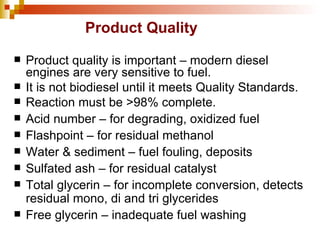
Product Quality Product quality is important – modern diesel engines are very sensitive to fuel. It is not biodiesel until it meets Quality Standards. Reaction must be >98% complete. Acid number – for degrading, oxidized fuel Flashpoint – for residual methanol Water & sediment – fuel fouling, deposits Sulfated ash – for residual catalyst Total glycerin – for incomplete conversion, detects residual mono, di and tri glycerides Free glycerin – inadequate fuel washing
 
Feed Stocks for India
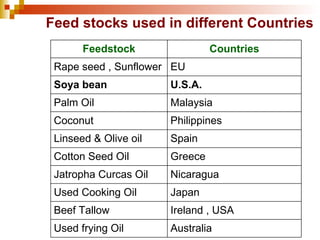
Feed stocks used in different Countries Australia Used frying Oil Ireland , USA Beef Tallow Japan Used Cooking Oil Nicaragua Jatropha Curcas Oil Greece Cotton Seed Oil Spain Linseed & Olive oil Philippines Coconut Malaysia Palm Oil U.S.A. Soya bean EU Rape seed , Sunflower Countries Feedstock
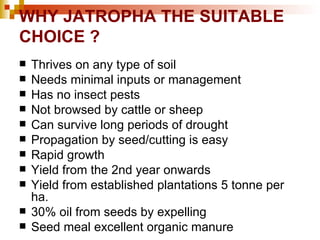
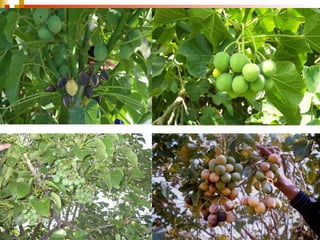
WHY JATROPHA THE SUITABLE CHOICE ? Thrives on any type of soil Needs minimal inputs or management Has no insect pests Not browsed by cattle or sheep Can survive long periods of drought Propagation by seed/cutting is easy Rapid growth Yield from the 2nd year onwards  Yield from established plantations 5 tonne per ha. 30% oil from seeds by expelling Seed meal excellent organic manure
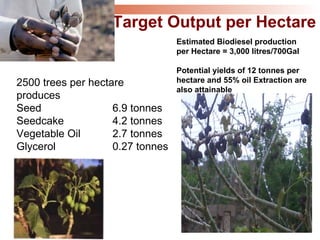
Target Output per Hectare Estimated Biodiesel production per Hectare = 3,000 litres/700Gal Potential yields of 12 tonnes per hectare and 55% oil Extraction are also attainable  2500 trees per hectare  produces  Seed  6.9 tonnes  Seedcake  4.2 tonnes  Vegetable Oil  2.7 tonnes  Glycerol  0.27 tonnes
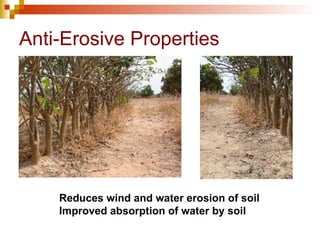
Anti-Erosive Properties Reduces wind and water erosion of soil Improved absorption of water by soil
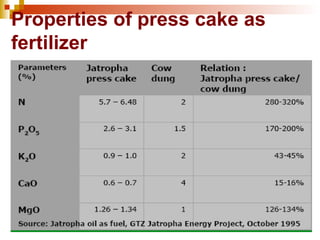
Properties of press cake as fertilizer
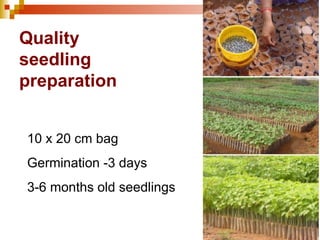
Quality seedling preparation 10 x 20 cm bag  Germination -3 days 3-6 months old seedlings
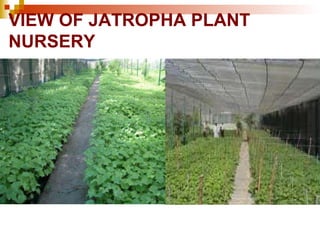
VIEW OF JATROPHA PLANT NURSERY
 
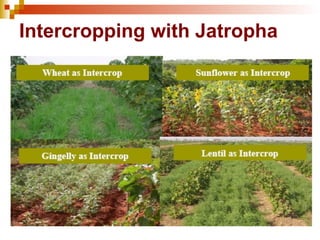
Intercropping with Jatropha
Indian Biodiesel Program Name of Biodiesel started making appearance at Indian Conferences, Workshops & Seminars in 1999 ‘ Report of the Committee on Development of Biofuel’ – Planning Commission, GOI in 2003 Stage I ‘Demonstration Project’ use Jatropha curcas on 400,000 ha (0.5 MMT BD) Nation-wide investment $ 300mn Stage II – 11 mill ha (13 MMT biodiesel) for 20% blend. Demonstration project started with initial grant of $11mn for nursery raising rest is expected to be sanctioned late this year First 10,000 TPA plant in Hyderabad about to start production Garware100,000 TPA DMT plant modified for biodiesel production A 250,000 TPA plant is being setup in Vishakhapatnam , A.P. A 100,000 TPA plant is coming up in Kakinada , A.P.
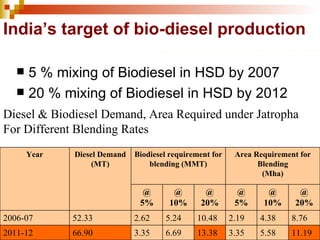
India’s target of bio-diesel production   5 % mixing of Biodiesel in HSD by 2007 20 % mixing of Biodiesel in HSD by 2012 Diesel & Biodiesel Demand, Area Required under Jatropha For Different Blending Rates 11.19 5.58 3.35 13.38 6.69 3.35 66.90 2011-12 8.76 4.38 2.19 10.48 5.24 2.62 52.33 2006-07 @ 20% @ 10% @ 5% @ 20% @ 10% @ 5% Area Requirement for Blending (Mha) Biodiesel requirement for blending (MMT) Diesel Demand (MT) Year
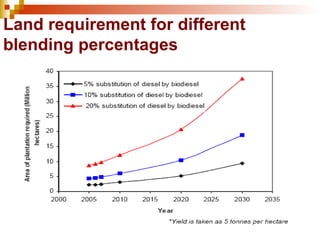
Land requirement for different blending percentages
Summary Biodiesel is an renewable fuel for diesel engines that can be made from virtually any oil or fat feedstock. Biodiesel with a potential consumption of 15000 million litres can have a retail turnover of more than US$ 9000 mn per year It can provide huge rural employment potential of 40 to 50 million families and transform the rural economy Remote village electrification and power for agriculture application – Energy grown & used by village. The technology choice is a function of desired capacity, feedstock type and quality, alcohol recovery, and catalyst recovery.
Summary The dominant factor in biodiesel production is the feedstock cost which around 70%, with capital cost contributing only about 7 % of the product cost. Therefore high FFA, lower quality feedstock should be promoted for biodiesel production in India. For meeting energy security and electricity for all, it is necessary to develop and commission small to medium capacity biodiesel unit at village & community level.. Maintaining product quality is also essential for the growth of the biodiesel industry in India.
Thank You all for your precious time

Biodiesel Production Technology &amp; Feedstocks For India

  • 1.
    BIODIESEL PRODUCTION TECHNOLOGY& FEEDSTOCKS FOR INDIA PROF. NAVEEN KUMAR COORDINATOR, BIODIESEL RESEARCH DELHI COLLEGE OF ENGINEERING DELHI, INDIA Email: [email_address] Phone : 27871248, 32924637 Mobile : 9891963530, 9810363530 UNIVERSITY OF MINNESOTA, OCTOBER 24,2006 Organized by Moving Toward Sustainable Energy Systems: Exploring Global Pathways to a Common Destination Expert Lecture at Workshop on
  • 2.
    What is Biodiesel? Biodiesel , a fuel composed of mono-alkyl esters of long chain fatty acids derived from variety of vegetable oils or animal fats, designated as B100, and confirming to different quality standards e.g. ASTM D 6751, EN14214 or IS 15607.
  • 3.
    Transesterification Reaction GlycerolO O O Me Me Me O = O = O = HO HO HO Biodiesel (Methyl Ester Alcohol) 3 ester alcohol + 1 glycerine O = O O O = O O = Triglyceride 1 triglyceride + 3 alcohol 3 MeOH KOH Catalyst catalyst
  • 4.
    Molecular Structure Fatsand oils have quite big molecules with a spinal of glycerol on which are bond three fatty acid rests. By the transesterification, the fatty acid rests are removed from the glycerol and each is bond with methanol. The products are one mole glycerol and three mole of fatty acid methyl ester.
  • 5.
    Issues Related toBase Catalyzed Transesterification Process Feedstock Issues FFA Water Process Issues Type of Alcohol Molar Ratio Catalyst Reaction time & temperature Agitation
  • 6.
    Feedstock Issues 1.Free Fatty Acids (FFA) Free Fatty acids in the oils react with alkaline catalyst to form soaps. R-OH + KOH K-OR + H2O Acid + KOH Soap + water It results in loss of catalyst and reduction in yield
  • 7.
    Feedstock Issues 2.Water Water deactivates the catalysts. Drying of oil is required. Water hydrolyses fats to form free fatty acids. Free fatty acids react with alkali catalysts forms soaps Soaps semi solid mixture glycerol separation
  • 8.
    Process Issues Methanol,Ethanol, Butanol etc Methanol –commercially used In methanolysis, emulsion forms and separated into lower glycerol portion and upper ester portion. Reaction time is small In ethanolysis, emulsions are stable and requires more complicated separation and purification process. Reaction time is large Typical alcohol: TG ratio is 6:1 for base catalyzed reactions. Type of Alcohol
  • 9.
    Catalyst? “ Chemicalmarriage brokers” The presence of a catalyst facilitates reactions that would be kinetically impossible or very slow without a catalyst
  • 10.
    Homogeneous versus HeterogeneousHomogenous The catalyst, reactants and products are all in one phase, normally the liquid phase. The reactions proceed over a intermediate complex and are often highly selective, but separation of the products and the catalyst is difficult. Hetrogenous The catalyst is in one phase, normally solid, while the reactants and products are in another phase. Separation of catalyst and products is easy, but the reaction is often less selective, because the catalyst material is not homogeneous
  • 11.
    Various Catalysts usedin Biodiesel Production Base Catalysts: NaOH, KOH, NaMeO Acid Catalysts: H 2 SO 4 , PTSA, MSA, H 3 PO 4 , CaCO 3 Typical base concentrations are : NaOH/KOH – 0.3 to 1.5 % Na MeO – 0.5 % or less Sulfated Zeolites & Clays Hetro-poly acids Metal Oxides, Sulfates Composite materials Homogenous Heterogeneous
  • 12.
    Reaction time ,Temperature & Agitation Transesterification reaction will proceed at ambient (30°C) temperatures but needs 4-8 hours to reach completion. Reaction time can be shortened to 2-4 hours at 40°C and 1-2 hours at 60°C. Higher temperatures will decrease reaction times but require pressure vessels because methanol boils at 65°C. Better agitation should be adopted to accelerate reaction.
  • 13.
    Batch, Base CatalyzedProcess TG Alcohol Catalyst Batch Reactor Ester Crude Glycerol Alcohol Alcohol Water Water Neutralized Glycerol Wash Water Dryer Biodiesel Water Acid
  • 14.
    Reaction VesselHeating Element Water Cooled Condenser Cooling Water 10 Liters Biodiesel Unit Stirrer Development Cost : US $ 1300
  • 15.
    600 LITERS/DAY BIODIESELUNIT Vacuum Drier Separating Vessel Reaction Vessel Washing Vessel Control Panel Oil Tank Methaoxide Vessel Skid Motor & Gear Box Motor& Gear Pump Development Cost : US $ 7000
  • 16.
    High FFA FeedStocks Biodiesel feed stocks are classified by the amount of free fatty acids they contain: Refined vegetable oils < 0.05% Crude vegetable oil 0.5-5% Used Cooking Oil 2-7% Animal fat 10-30% Price decreases as FFAs increase but processing cost also increase Base Catalyzed Reaction not suitable for high FFA feeds because of soap formation. Most of the non-edible oils available in India contains high FFA (2-12%) & to decrease the cost of biodiesel, it is imperative to utilize high FFA oil or fatty acids
  • 17.
    Acid Catalyzed ProcessesAcid catalyzed processes are used for direct esterification of free fatty acids in a high FFA feedstock Limitations: Water formation by FFA + methanol ==> methyl ester + water High alcohol: FFA ratio required – about 40:1 Large amounts (5 to 25 %) catalyst may be required
  • 18.
    Use acid catalysisfor conversion of FFAs to methyl esters, until FFA < 0.5%. Acid esterification of FFA is fast (1 hour) but acid catalyzed transesterification is slow (2 days at 60°C). 2. Then, add additional methanol and base catalyst to transesterify the triglycerides. Preferred method for High FFA feeds: Acid Catalysis followed by base catalysis
  • 19.
    Methanol + KOHVegetable Oil Storage Tank 1500 Kg Methanol + H2SO4 Motor Storage Tank 500 Ltrs. Motor Biodiesel Storage Tank 1000 Ltrs . P2 SV2 Reactor 600 Ltrs . SV2 Air SVO P1 SV3 P3 Settling Tank 1000 Ltrs. Vaccum Drier Separating Column 500 Ltrs./ Charge Washing Column 500 Ltrs./ Charge Vaccum Drier Glycerol Storage Tank 500 Ltrs . Transesterification Reactor, 500Lts./Charge P4 P5 P6 P7 P8 Biodiesel Unit 1tpd Capacity Design by DCE
  • 20.
    Barriers to HomogeneousCatalyst Sensitivity to FFA & water content of the feedstocks Removal of catalyst Formation of soap with high FFA feedstock Large quantity of effluent water as a result of removal of catalyst Necessities pre-treatment of oil in case FFA content are higher No scope for regeneration or re-utilization
  • 21.
  • 22.
    Benefits - HeterogeneousCatalyst Catalyst Regeneration – Decrease of Catalyst Cost Utilization of lower quality feed stocks for biodiesel production Simplification of separation process – Decrease of production cost Decrease of wastewater – Development of environmental friendly process
  • 23.
    Product Quality Productquality is important – modern diesel engines are very sensitive to fuel. It is not biodiesel until it meets Quality Standards. Reaction must be >98% complete. Acid number – for degrading, oxidized fuel Flashpoint – for residual methanol Water & sediment – fuel fouling, deposits Sulfated ash – for residual catalyst Total glycerin – for incomplete conversion, detects residual mono, di and tri glycerides Free glycerin – inadequate fuel washing
  • 24.
  • 25.
  • 26.
    Feed stocks usedin different Countries Australia Used frying Oil Ireland , USA Beef Tallow Japan Used Cooking Oil Nicaragua Jatropha Curcas Oil Greece Cotton Seed Oil Spain Linseed & Olive oil Philippines Coconut Malaysia Palm Oil U.S.A. Soya bean EU Rape seed , Sunflower Countries Feedstock
  • 27.
    WHY JATROPHA THESUITABLE CHOICE ? Thrives on any type of soil Needs minimal inputs or management Has no insect pests Not browsed by cattle or sheep Can survive long periods of drought Propagation by seed/cutting is easy Rapid growth Yield from the 2nd year onwards Yield from established plantations 5 tonne per ha. 30% oil from seeds by expelling Seed meal excellent organic manure
  • 28.
    Target Output perHectare Estimated Biodiesel production per Hectare = 3,000 litres/700Gal Potential yields of 12 tonnes per hectare and 55% oil Extraction are also attainable 2500 trees per hectare produces Seed 6.9 tonnes Seedcake 4.2 tonnes Vegetable Oil 2.7 tonnes Glycerol 0.27 tonnes
  • 29.
    Anti-Erosive Properties Reduceswind and water erosion of soil Improved absorption of water by soil
  • 30.
    Properties of presscake as fertilizer
  • 31.
    Quality seedling preparation10 x 20 cm bag Germination -3 days 3-6 months old seedlings
  • 32.
    VIEW OF JATROPHAPLANT NURSERY
  • 33.
  • 34.
  • 35.
    Indian Biodiesel ProgramName of Biodiesel started making appearance at Indian Conferences, Workshops & Seminars in 1999 ‘ Report of the Committee on Development of Biofuel’ – Planning Commission, GOI in 2003 Stage I ‘Demonstration Project’ use Jatropha curcas on 400,000 ha (0.5 MMT BD) Nation-wide investment $ 300mn Stage II – 11 mill ha (13 MMT biodiesel) for 20% blend. Demonstration project started with initial grant of $11mn for nursery raising rest is expected to be sanctioned late this year First 10,000 TPA plant in Hyderabad about to start production Garware100,000 TPA DMT plant modified for biodiesel production A 250,000 TPA plant is being setup in Vishakhapatnam , A.P. A 100,000 TPA plant is coming up in Kakinada , A.P.
  • 36.
    India’s target ofbio-diesel production 5 % mixing of Biodiesel in HSD by 2007 20 % mixing of Biodiesel in HSD by 2012 Diesel & Biodiesel Demand, Area Required under Jatropha For Different Blending Rates 11.19 5.58 3.35 13.38 6.69 3.35 66.90 2011-12 8.76 4.38 2.19 10.48 5.24 2.62 52.33 2006-07 @ 20% @ 10% @ 5% @ 20% @ 10% @ 5% Area Requirement for Blending (Mha) Biodiesel requirement for blending (MMT) Diesel Demand (MT) Year
  • 37.
    Land requirement fordifferent blending percentages
  • 38.
    Summary Biodiesel isan renewable fuel for diesel engines that can be made from virtually any oil or fat feedstock. Biodiesel with a potential consumption of 15000 million litres can have a retail turnover of more than US$ 9000 mn per year It can provide huge rural employment potential of 40 to 50 million families and transform the rural economy Remote village electrification and power for agriculture application – Energy grown & used by village. The technology choice is a function of desired capacity, feedstock type and quality, alcohol recovery, and catalyst recovery.
  • 39.
    Summary The dominantfactor in biodiesel production is the feedstock cost which around 70%, with capital cost contributing only about 7 % of the product cost. Therefore high FFA, lower quality feedstock should be promoted for biodiesel production in India. For meeting energy security and electricity for all, it is necessary to develop and commission small to medium capacity biodiesel unit at village & community level.. Maintaining product quality is also essential for the growth of the biodiesel industry in India.
  • 40.
    Thank You allfor your precious time