By,
YASHWANTH SAGAR T.K
4UB13CV422
8th
sem, BE, CIVIL
UBDTCE, DAVANGERE.
Under the guidance of
Dr. TEJASWINI N. BHAGWAT,
Associate Professor,
Department of Studies in Civil Engineering
UBDTCE, Davangere
 Introduction
 Types of stabilizers
 Why plastic ?
 Properties of plastic
 Research and significance
 Objectives
 Materials and methodology
 Results and discussions
 Conclusion
 Reference
2
Introduction
 Soil stabilisation means the improvement of stability or bearing
capacity of the soil by the use of controlled compaction,
proportioning and/or the addition of suitable admixture or
stabilisers.
 Stabilization is the process of blending and mixing materials with
a soil to improve certain properties of the soil. Stabilization can be
done with, cement, lime, bitumen, flyash.
 Here we are using plastic as soil stabilizer.
3
 Plastic
 Lime Cement-Fly Ash (LCF)
 Lime-Fly Ash (LF)
 Portland Cement
 Bitumen
 Lime
4
 Increased shear strength,
 Tensile strength and
 California Bearing Ratio (CBR) of the soil
 It can significantly enhance the properties of the soil used in
the construction of road infrastructure.
 Available in abundance
5
 Plastic have a numerous properties
That make them superior to other materials
In many application
 The diffrent types of properties are
Physical properties,chemical properties
6
 Transparency
 Flexibility
 Elasticity
 Water resistant
 Electrical resistanc
 Soft when hot
7
 Chemical resistance
 Thermal resistance
 Reactivity with water
 Flammability
 Heat of combustion
8
SOIL STABILIISATION USING RAW
PLASTIC BOTTLES
Anas Ashraf, Arya Sunil, J. Dhanya, B. Mariamma Joseph, Meera Varghese, M. Veena,
9
 The objective of this study is to improve the characteristics at
site and make soil capable of carrying load and to increase the
shear strength by decrease the compressibility of the soil.
 Using plastic as a stabilizer addition of plastic strips on the
floor; Increased shear strength, tensile strength and California
Bearing Ratio (CBR) of the soil.
10
 In order to conduct this study, various materials such as
lateritic soil, plastic bottles (both cut and uncut), sea sand and
synthetic threads were used.
 The Standard Proctor Compaction tests were done to assess
the amount of compaction
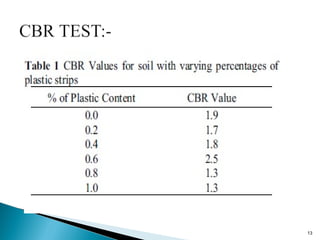
 The California Bearing Ratio test was conducted to determine
the optimum amount of plastic strips in soil. This is done by
mixing soil with varying percentages (0.0%, 0.2%, 0.4% etc.)
of plastic strips in soil and the 4 day soaked CBR Value is
obtained
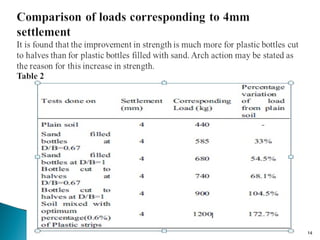
 Plate load tests were conducted with plain lateritic soil
11
RESULTS AND DISCUSSIONS
 
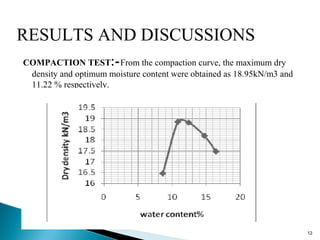
COMPACTION TEST:-From the compaction curve, the maximum dry
density and optimum moisture content were obtained as 18.95kN/m3 and
11.22 % respectively.
12
13
14
15
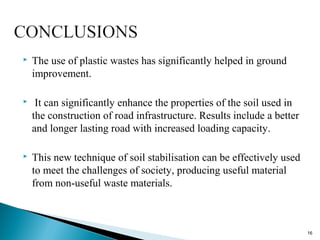
 The use of plastic wastes has significantly helped in ground
improvement.
 It can significantly enhance the properties of the soil used in
the construction of road infrastructure. Results include a better
and longer lasting road with increased loading capacity.
 This new technique of soil stabilisation can be effectively used
to meet the challenges of society, producing useful material
from non-useful waste materials.
16
 Arora, K. R. (2004). Soil Mechanics and Foundation
Engineering. Standard Publishers Distributors.
 Kumar, M. A., Prasad, D. S. V. and Prasadaraju, G.
V. R. (2009). Utilisation of industrial waste in flexible
pavement construction. Electronic Journal of
Geotechnical Engineering, Vol. 13
 IS: 1888(1982), Method of Load Test on Soils. Indian
Standards Institutions, New Delhi.
 Bateni, F. (2009). Stabilisation Mechanisms of oilpalm
fruit bunch fibre reinforced silty sand.
Unpublished Ph.D. Thesis, University of Auckland.
 Purushothama Raj, P. (2005). Soil Mechanics and
Foundation Engineering. Pearson Education.
17
18

Plastic as a soil stabilizer by yashwanth sagar

  • 1.
    By, YASHWANTH SAGAR T.K 4UB13CV422 8th sem,BE, CIVIL UBDTCE, DAVANGERE. Under the guidance of Dr. TEJASWINI N. BHAGWAT, Associate Professor, Department of Studies in Civil Engineering UBDTCE, Davangere
  • 2.
     Introduction  Typesof stabilizers  Why plastic ?  Properties of plastic  Research and significance  Objectives  Materials and methodology  Results and discussions  Conclusion  Reference 2
  • 3.
    Introduction  Soil stabilisationmeans the improvement of stability or bearing capacity of the soil by the use of controlled compaction, proportioning and/or the addition of suitable admixture or stabilisers.  Stabilization is the process of blending and mixing materials with a soil to improve certain properties of the soil. Stabilization can be done with, cement, lime, bitumen, flyash.  Here we are using plastic as soil stabilizer. 3
  • 4.
     Plastic  LimeCement-Fly Ash (LCF)  Lime-Fly Ash (LF)  Portland Cement  Bitumen  Lime 4
  • 5.
     Increased shearstrength,  Tensile strength and  California Bearing Ratio (CBR) of the soil  It can significantly enhance the properties of the soil used in the construction of road infrastructure.  Available in abundance 5
  • 6.
     Plastic havea numerous properties That make them superior to other materials In many application  The diffrent types of properties are Physical properties,chemical properties 6
  • 7.
     Transparency  Flexibility Elasticity  Water resistant  Electrical resistanc  Soft when hot 7
  • 8.
     Chemical resistance Thermal resistance  Reactivity with water  Flammability  Heat of combustion 8
  • 9.
    SOIL STABILIISATION USINGRAW PLASTIC BOTTLES Anas Ashraf, Arya Sunil, J. Dhanya, B. Mariamma Joseph, Meera Varghese, M. Veena, 9
  • 10.
     The objectiveof this study is to improve the characteristics at site and make soil capable of carrying load and to increase the shear strength by decrease the compressibility of the soil.  Using plastic as a stabilizer addition of plastic strips on the floor; Increased shear strength, tensile strength and California Bearing Ratio (CBR) of the soil. 10
  • 11.
     In orderto conduct this study, various materials such as lateritic soil, plastic bottles (both cut and uncut), sea sand and synthetic threads were used.  The Standard Proctor Compaction tests were done to assess the amount of compaction  The California Bearing Ratio test was conducted to determine the optimum amount of plastic strips in soil. This is done by mixing soil with varying percentages (0.0%, 0.2%, 0.4% etc.) of plastic strips in soil and the 4 day soaked CBR Value is obtained  Plate load tests were conducted with plain lateritic soil 11
  • 12.
    RESULTS AND DISCUSSIONS   COMPACTIONTEST:-From the compaction curve, the maximum dry density and optimum moisture content were obtained as 18.95kN/m3 and 11.22 % respectively. 12
  • 13.
  • 14.
  • 15.
  • 16.
     The useof plastic wastes has significantly helped in ground improvement.  It can significantly enhance the properties of the soil used in the construction of road infrastructure. Results include a better and longer lasting road with increased loading capacity.  This new technique of soil stabilisation can be effectively used to meet the challenges of society, producing useful material from non-useful waste materials. 16
  • 17.
     Arora, K.R. (2004). Soil Mechanics and Foundation Engineering. Standard Publishers Distributors.  Kumar, M. A., Prasad, D. S. V. and Prasadaraju, G. V. R. (2009). Utilisation of industrial waste in flexible pavement construction. Electronic Journal of Geotechnical Engineering, Vol. 13  IS: 1888(1982), Method of Load Test on Soils. Indian Standards Institutions, New Delhi.  Bateni, F. (2009). Stabilisation Mechanisms of oilpalm fruit bunch fibre reinforced silty sand. Unpublished Ph.D. Thesis, University of Auckland.  Purushothama Raj, P. (2005). Soil Mechanics and Foundation Engineering. Pearson Education. 17
  • 18.