INTRODUCTION TO
METABOLISM
Dr. Ifat Ara Begum
Assistant Professor
Dept. of Biochemistry
Dhaka Medical College
Dhaka
INTRODUCTION
Metabolism is the sum of an
organism’s chemical reaction
It is an emergent property of life
that arises from interactions
between molecules within the cell
TYPES OF METABOLISM
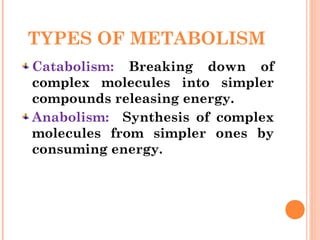
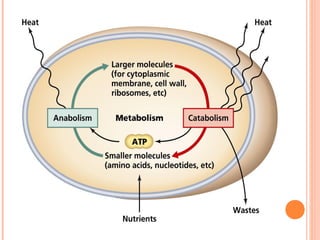
Catabolism: Breaking down of
complex molecules into simpler
compounds releasing energy.
Anabolism: Synthesis of complex
molecules from simpler ones by
consuming energy.
A) CATABOLISM
The set of metabolic processes
that break down large molecules
The purpose of the catabolic
reactions is to provide the energy
and components needed by
anabolic reactions.
B) ANABOLISM
The set of constructive metabolic
processes where the energy
released by catabolism is used to
synthesize complex molecules
Anabolism involves three basic
stages:
CONTD
i. The production of precursors (like
amino acids, monosaccharides,
nucleotides)
ii. Their activation into reactive
forms using energy from ATP
iii. The assembly of these precursors
into complex molecules such
as proteins, polysaccharides, lipid
s and nucleic acids.
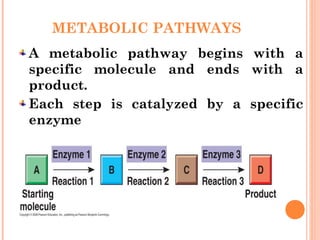
METABOLIC PATHWAYS
A metabolic pathway begins with a
specific molecule and ends with a
product.
Each step is catalyzed by a specific
enzyme
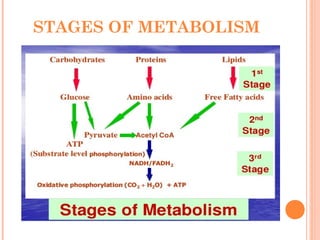
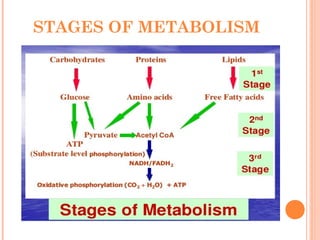
STAGES OF METABOLISM

Introduction to metabolism

  • 1.
    INTRODUCTION TO METABOLISM Dr. IfatAra Begum Assistant Professor Dept. of Biochemistry Dhaka Medical College Dhaka
  • 2.
    INTRODUCTION Metabolism is thesum of an organism’s chemical reaction It is an emergent property of life that arises from interactions between molecules within the cell
  • 3.
    TYPES OF METABOLISM Catabolism:Breaking down of complex molecules into simpler compounds releasing energy. Anabolism: Synthesis of complex molecules from simpler ones by consuming energy.
  • 4.
    A) CATABOLISM The setof metabolic processes that break down large molecules The purpose of the catabolic reactions is to provide the energy and components needed by anabolic reactions.
  • 5.
    B) ANABOLISM The setof constructive metabolic processes where the energy released by catabolism is used to synthesize complex molecules Anabolism involves three basic stages:
  • 6.
    CONTD i. The productionof precursors (like amino acids, monosaccharides, nucleotides) ii. Their activation into reactive forms using energy from ATP iii. The assembly of these precursors into complex molecules such as proteins, polysaccharides, lipid s and nucleic acids.
  • 8.
    METABOLIC PATHWAYS A metabolicpathway begins with a specific molecule and ends with a product. Each step is catalyzed by a specific enzyme
  • 9.
  • 10.