Lipids
Course Contents
• Functions of lipids
• structure of lipids
• Properties of Lipids
• Biological significance of Lipids
• Classifications of Lipids
– 1. Simple lipids
– 2. Compound Lipids
– 3. Derived Lipids
• Fatty Acids
• Fats & oil
• Saturated and unsaturated fatty acids
• Uses of fats in the body
• Physical and chemical properties of fats
• Role of phospholipids in cell membranes.
• Role of steroids (cholesterol )
• Distinguish between soap and detergents.
Objectives
• After the completion of this unit students will be able to:
• 1.Describes the structure and general properties of lipids and fatty
acids.
• 2.Discuss the classification of lipids that is simple, compound
& derived lipids.
• 3.Distinguish between saturated and unsaturated fats
• 4.Distinguish between soap and detergents.
• 5.Explain briefly the role of phospholipids in cell membranes.
• 6.Role of steroids (cholesterol )
• Hydrophobic
• amphiphilic
• small molecules
• the amphiphilic nature of some lipids allows them to form
structures such as
•
• 1. Vesicles
– Liposomes
• 2. membranes in an aqueous environment
Lipids
Examples of lipids
• Fats
• Waxes
• Sterols
• fat-soluble vitamins
– (such as vitamins A, D, E, and K)
• Glycerides
– Monoglycerides
– Diglycerides
– Triglycerides
• phospholipids.
Functions
• Source of heat and energy
• structural components of cell membranes
• signaling molecules
• Insulation for the organs and nerves
• Regulator of fat soluble vitamins
• Source of essential fatty acids
• Lipids regulate membrane permeability.
• They act electrical insulators to the nerve fibres, where the myelin sheath contains lipids.
• Lipids are components of some enzyme systems.
• Some lipids like prostaglandins and steroid hormones act as cellular metabolic regulators.
• Cholesterol is found in cell membranes, blood, and bile of many organisms.
• Layers of fat in the subcutaneous layer, provides insulation and protection from cold. Body temperature maintenance is done by brown fat.
• Polyunsaturated phospholipids are important constituents of phospholipids, they provide fluidity and flexibility to the cell membranes.
• Lipoproteins that are complexes of lipids and proteins, occur in blood as plasma lipoprotein, they enable transport of lipids in aqueous environment,
and their transport throughout the body.
• Cholesterol maintains fluidity of membranes by interacting with lipid complexes.
• Cholesterol is the precursor of bile acids, Vitamin D and steroids.
• Essential fatty acids like linoleic and linolenic acids are precursors of many different types of ecosanoids including prostaglandins, thromboxanes.
These play a important role in pain, fever, inflammation and blood clotting.
• Gives shape to your body
• Cushions your skin
• A component of myelin, the fatty material that sheathes nerve cells and makes it
possible for them to fire the electrical messages that enable you to think, see,
speak, move, and perform the multitude of tasks natural to a living body; brain
tissue also is rich in fat
• A shock absorber that protects your organs (as much as possible) if you fall or are
injured
• A constituent of hormones and other biochemicals, such as vitamin D and bile
Details of some Biological Functions
Uses of fats in the body
• A healthy body needs some fat
• which contains essential nutrients.
• Body uses dietary fat to
– make tissue
– manufacture biochemicals, such as hormones.
• Fats in your diet are sources of energy
• They also add flavor to food — the sizzle on the steak,
• However, fats may also be hazardous to your health.
Role of phospholipids in cell membranes
• Phospholipids form the basic structure of a cell membrane,
called the lipid bilayer.
http://www.rsc.org/Education/Teachers/Resources/cfb/images/09A.jpg
November 11, 2015
Membranes
The glycerophospholipids are the main structural component of biological
membranes, such as the cellular plasma membrane and the intracellular
membranes of organelles
• They include:
• phosphatidylcholine,
• phosphatidylethanolamine,
• phosphatidylserine, and
• sphingomyelin
Role of steroids (cholesterol )
• The body makes cholesterol in the liver and uses it for a variety of
important functions, ranging from maintaining healthy cell
membranes to building crucial hormones and vitamins.
• Cholesterol is an essential lipid constituent of cell membranes
• Scattered in the lipid bilayer are cholesterol molecules, which help
to keep the membrane fluid consistent.
• Cholesterol is a precursor of steroid hormones and of bile acids
• Intermediates of cholesterol biosynthesis are required to make
vitamin D
• High plasma cholesterol promotes atherosclerosis
Energy storage
• Triglycerides, stored in adipose tissue, are a major form of
energy storage both in animals and plants.
• The complete oxidation of fatty acids provides 9 kcal/g,
compared with 4 kcal/g for the breakdown of carbohydrates
and proteins.
Signaling
• In recent years, evidence has emerged showing that lipid
signaling is a vital part of the cell signaling
Other functions
• The "fat-soluble" vitamins (A, D, E and K) – are essential
nutrients stored in the liver and fatty tissues, with a diverse
range of functions.
• Fats are a subgroup of lipids called triglycerides.
• Lipids also encompass molecules such as
– fatty acids and their derivatives
– sterol-containing metabolites such as cholesterol
Fats vs lipids
Classification of Lipids
STERYL ESTERS
LIPOPROTEINS
Glycerols
LIPOPROTEINS
STERYL ESTERS
Simple Lipids
• These lipids belong to a heterogeneous class of predominantly nonpolar compounds
• They are mostly insoluble in water, but soluble in nonpolar solvents
• A simple lipid is a fatty acid ester of different alcohols
• It contains 2 types of units
– fatty acid
– alcohol
– and carries no other substance
• The main simple lipids are
– Triglycerides (also known as triacylglycerols: glycerol+fatty acids),
– Steryl esters (sterols + fatty acids)
– Wax esters (fatty alcohols + fatty acids)
LIPOPROTEINS
STERYL ESTERS
Complex lipids
• Lipids combined with carbohydrates, proteins, aminoacids
phosphates or other non lipid compounds
• Phospholipids
• Glycolipids
• Lipoproteins
• Sulfolipids
LIPOPROTEINS
STERYL ESTERS
Derived lipids
• These are substances derived from simple lipids and compound
lipids by hydrolysis.
•
• Derived lipids include:
• 1- Fatty acids
• 2- Glycerol (fatty alcohols)
• 3- Steroids
• 4- Isoprenoids
• 5- Prostglandins
• 6. Leukotriens
LIPOPROTEINS
STERYL ESTERS
Fats
• They are triesters of fatty acids with glycerol (1,2,3-trihydroxypropane)
• These triglycerides (or triacylglycerols) are found in both plants and animals
• They compose one of the major food groups of our diet.
• They are solid or semisolid at room temperature
• They occur predominantly in animals
Oil
• They are also triesters
• Oils are in the liquid state at room temperature
• Why?
• Because they contain unsaturated fatty acids
LIPOPROTEINS
STERYL ESTERS
Waxes
• Waxes are a diverse class of organic compounds
• They are lipophilic, malleable solids at room temperature
• They include higher alkanes and lipids, typically with melting points above about 40 °C
• One of most widespread group of wax is an ester of a long-chain monohydroxy alcohol and a fatty acid
• Waxes are found in nature as coatings on leaves and stems
• The wax prevents the plant from losing excessive amounts of water
• Carnuba wax is found on the leaves of Brazilian palm trees
• Lanolin coats lambs, wool
• Beeswax is secreted by bees
• Spermaceti wax is found in the head cavities sperm whale
• Paraffin wax, used in some candles, is not based upon the ester functional group,
• It is a mixture of high molecular weight alkanes
• Earwax consists of dead skin cells, hair, long chain fatty acids, both saturated and unsaturated,
alcohols, squalene, esters and cholesterol
• Many of the waxes mentioned are used in ointments, hand creams, and cosmetics
LIPOPROTEINS
STERYL ESTERS
Sterol Esters
They are a heterogeneous group of chemical compounds
They are esters of sterol with a fatty acid
LIPOPROTEINS
STERYL ESTERS
Phospholipids
• Phospholipids, also known as phosphatides
• They are a class of lipids
• Cell membrane is composed of a bilayer of phospholipids
• They are composed of
– a hydrophilic "head" containing a phosphate group
– two hydrophobic "tails" derived from fatty acids
– joined by a glycerol molecule
LIPOPROTEINS
STERYL ESTERS
Glycolipids
• Glycolipids are lipids with a carbohydrate attached by a glycosidic bond
• Generally found on the extracellular face of eukaryotic cell membranes
• Their role is to
– maintain the stability of the cell membrane
– facilitate cellular recognition
– facilitate cell–cell interactions
– act as receptors for viruses and other pathogens to enter cells
LIPOPROTEINS
STERYL ESTERS
Lipoproteins
• A lipoprotein is a biochemical assembly
• Their primary function is to transport hydrophobic lipid molecules in water
• Such as in blood plasma or other extracellular fluids
• Types
– Chylomicrons
– very low-density lipoproteins (VLDL)
– Intermediate density lipoproteins (IDL)
– low-density lipoproteins (LDL)
– high-density lipoproteins (HDL)
LIPOPROTEINS
STERYL ESTERS
Sulfolipids
• Sulfolipids are a class of lipids which possess a sulfur-containing functional group
LIPOPROTEINS
STERYL ESTERS
Lecithin
• A subgroup of phospholipids
• They are amphiphilic
• They are esters of glycerol with
– phosphoric acid
– Cholines
– two fatty acids
• It can be found in many foods, including soybeans and egg yolks
• Lecithin is also used in the manufacturing of medicines
• It is used for treating memory disorders such as
– Dementia
– Alzheimer's disease
LIPOPROTEINS
STERYL ESTERS
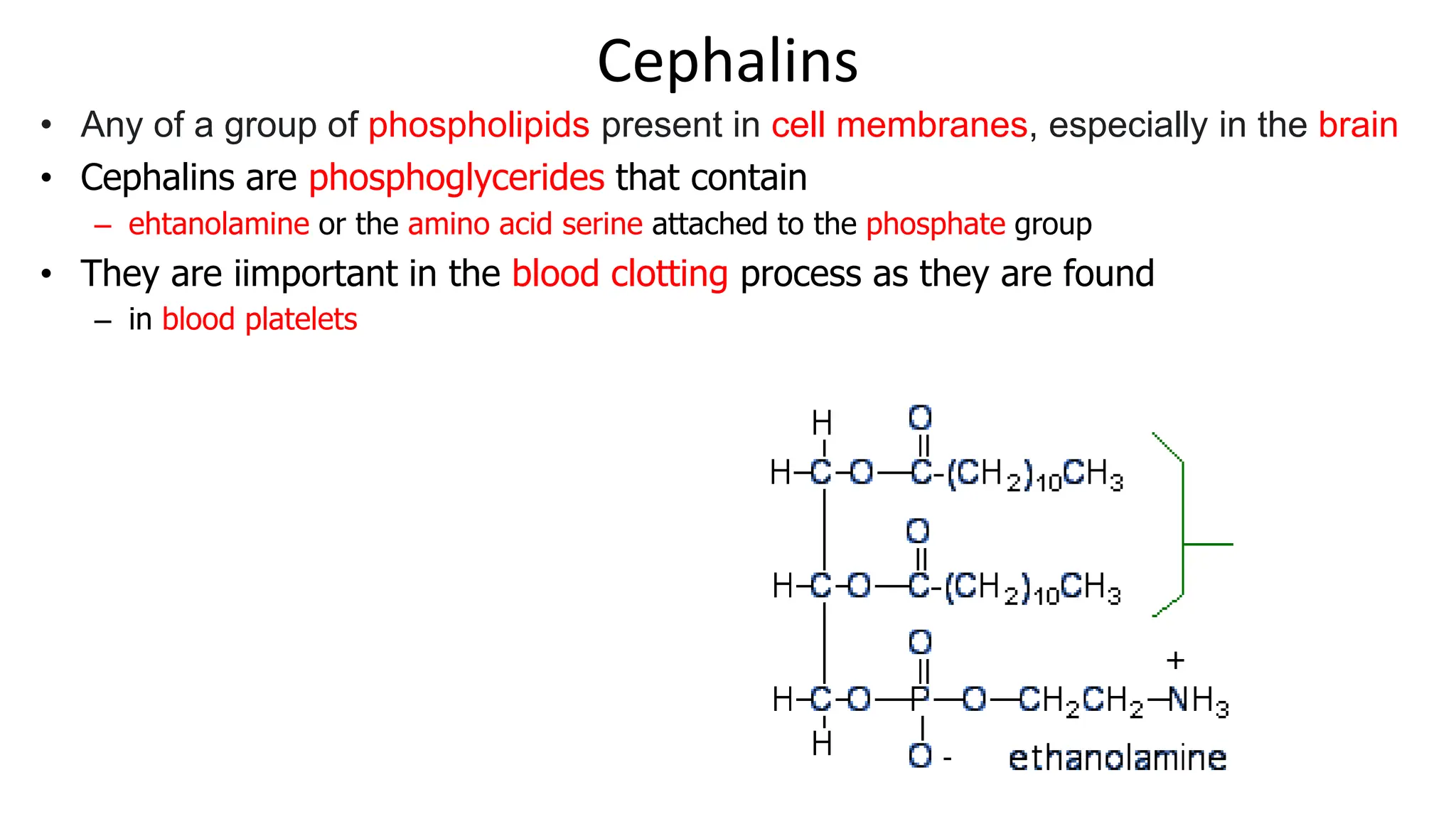
Cephalins
• Any of a group of phospholipids present in cell membranes, especially in the brain
• Cephalins are phosphoglycerides that contain
– ehtanolamine or the amino acid serine attached to the phosphate group
• They are iimportant in the blood clotting process as they are found
– in blood platelets
LIPOPROTEINS
STERYL ESTERS
Plasmalogens
• They are a class of glycerophospholipids
• Subclass of ether phospholipids
• They contain a
– Glycerol
– Vinyl-ether at sn-1
– An ester bond at sn-2
• Commonly found in cell membranes
LIPOPROTEINS
STERYL ESTERS
Sphingomyelins
• Sphingomyelin is a type of sphingolipid
• found in animal cell membranes
• especially in myelin sheath
• They are composed of
– Sphingosine
– Fatty acid
– Phosphate group
– Choline or Ethanolamine
LIPOPROTEINS
STERYL ESTERS
Cerebrosides
• A group of glycosphingolipids
• They are called monoglycosylceramides
• They consist of
– ceramide (sphingosine and FA)
– a monosaccharide bound to the C1 of sphingosine
• They are important components in animal
– Muscle cell membranes
– Nerve cell membranes
LIPOPROTEINS
STERYL ESTERS
Gangliosides
• They are composed of a
– glycosphingolipid
• ceramide and oligosaccharide
– one or more sialic acids
– linked on the sugar chain
LIPOPROTEINS
STERYL ESTERS
Alcohols
• Glycerols
• Fatty alcohols
Fatty alcohols (or long-chain alcohols) are usually high-molecular-weight, straight-chain primary alcohols
LIPOPROTEINS
STERYL ESTERS
Fatty acids
• Hydrocarbon with a carboxylic acid group
• Polar, hydrophilic end, and a nonpolar, hydrophobic end
• Chain, typically between 4 and 24 carbons
• May be saturated or unsaturated
• And may be attached to functional groups
Fatty acids
There is the possibility of either a cis or a trans geometric isomerism
• Cis-double bonds cause the fatty acid chain to bend, an effect that
is more pronounced the more double bonds there are in a chain.
This in turn plays an important role in the structure and function of
cell membranes
• Most naturally occurring fatty acids are of the cis configuration
• Trans fats and oils have higher melting points than cis ones because
the packing isn't affected quite as much.
Cis and Trans Fatty acids
LIPOPROTEINS
STERYL ESTERS
Steroids
• Steroids comprise a group of cyclical organic compounds
• whose basis is a characteristic arrangement of seventeen
carbon atoms in a four-ring structure linked together from
three 6-carbon rings followed by a 5-carbon ring and an eight-
carbon side chain on carbon 17
Cholestane
Sterol
• Sterols are a subgroup of the steroids
• They have a skeleton derived from cholestane
• Cholestane is a saturated tetracyclic triterpene
• A hydroxyl group at position three
Cholesterols (A sterol)
• A compound of the sterol type found in most body tissues
• including the
– Blood
– Nerves
– Cell membranes
LIPOPROTEINS
STERYL ESTERS
Isoprenoids
• They are also known as terpenoids
• They are derived from the
– 5-carbon compound isoprene
– Isoprene polymers called terpenes
LIPOPROTEINS
STERYL ESTERS
Terpenoids
• They have unsaturated molecules composed of linked
isoprene units
LIPOPROTEINS
STERYL ESTERS
Carotenoids
• Carotenoids are pigments in plants, algae, and photosynthetic bacteria
• They produce yellow, red, and orange colors in plants, vegetables, and fruits
• Carotenoids act as a type of antioxidant for humans
• There are more than 600 different types of carotenoids
• Carotenoids are also called tetraterpenoids
• Because they derived from tetraterpens
• Tetraterpens are produced from 8 isoprene molecules
Physical and chemical properties of fats
• Colorless, odorless, and tasteless
• Solid or liquid at room temperature
• The characteristic colors, odors, and flavors are due to impurities
• Lighter than water
• Insoluble in water
• Soluble in nonpolar solvents
• They are poor conductors of heat and electricity
• Excellent insulators for the body, slowing the loss of heat through the skin
• Greasy to the touch
• lubricating
• not readily volatile
• burn without leaving any residue, i.e., ash.
• Low density, low mp, bp.
Properties
• Rancidity
– Hydrolysis
– Oxidation
• Hydrogenation
• Halogenation
• Saponification
Rancidity
• Rancidification is the process of complete or incomplete oxidation or hydrolysis of fats and oils
• It happens when exposed to air, light, or moisture or by bacterial action
• It results in unpleasant taste and odor
• Specifically, it is the hydrolysis or autoxidation of fats into short-chain aldehydes and ketones
• When these processes occur in food, undesirable odors and flavors can result
• In certain cases, however, the flavors can be desirable (as in aged cheeses)
Hydrolysis
• Triglycerols react with water to form their carboxylic acid and alcohol.
Lipase
Oxidation
• Unsaturated fatty acids undergo a chemical change known as auto-oxidation
• The process requires oxygen and is accelerated by the presence of
– trace metals
– sunlight
• Vegetable oils resists this process if they contain antioxidants, such as
– tocopherol
Hydrogenation
• Double bonds in unsaturated fatty acids can be hydrogenated by reacting with hydrogen to
produce saturated fatty acids
• This process has a vital role in the fats and oils industry because it achieves two main goals.
• Firstly, liquid oils into semisolid fats
• secondly, improved stability
Halogenation
• Halogenation means addition of halogens
• The halogen is added at the double bonds
Saponification
• It is the conversion of fat, oil, or lipid, into soap and alcohol
• Heat is applied in the presence of aqueous alkali in the process
• Soaps are salts of fatty acids
Surfactants
• Compounds that lower
– the surface tension
• or
– interfacial tension between
• two liquids
• gas and a liquid
• liquid and a solid
• Surfactants may act as
– detergents
– wetting agents
– emulsifiers
– foaming agents
– dispersants
Surfactants
• Carboxylic acids and its salts having long alkyl chains have amphiphilic nature
• It has two poles
– one hydrophilic
– one hydrophobic
• They are insoluble in water and float on the surface when mixed with water
• They then spread evenly over an extended water surface
• It forms a monomolecular layer in which
– the polar carboxyl groups are hydrogen bonded at the water interface
– the hydrocarbon chains are aligned together away from the water
• Substances that accumulate at water surfaces and change the surface properties are called surfactants
• Salts are stronger surfactants compared to their acids
Examples of Surfactants
• Soaps
• detergents
• The use of such compounds as cleaning agents is facilitated by their surfactant character
• They lower the surface tension of water
• That allows it to penetrate and wet a variety of materials
If Put in Water
• Very small amounts:
– dissolve in water and give a random dispersion of solute molecules
• Higher concentration:
– They assemble into micelles
• Micelles are spherical/cylindrical/branched structures
– Its core is hydrophobic
– its surface is hydrophilic
Mechanism of Action of micelle
• Micelles can encapsulate nonpolar substances inside its core
– such as grease
– and thus solubilize it
– so it is removed with the wash water
• Since the micelles of anionic amphiphiles have a negatively charged surface
– they repel one another
– and the nonpolar dirt is effectively emulsified
History
• The oldest amphiphilic cleaning agent known to humans is soap
• Boiling solution of potassium carbonate leached from wood ashes was used
• Soft potassium soaps were then converted to the harder sodium soaps
Problems with Soap and Its solution
• 1. If the pH of a soap solution is lowered by acidic contaminants
– fatty acids precipitate and form a scum
• 2. Ca and Mg in hard water cause the aggregation of the micelles
– which then deposit as scum
• Solution:
– detergents
• They have much stronger acid for the polar head group
– water solutions of the amphiphile are less sensitive to pH changes
• Their sulfonate functions confer greater solubility on micelles
• Cationic detergents often exhibit germicidal properties,
• They are used as fabric softeners and hair conditioners
https://www2.chemistry.msu.edu/faculty/reusch/VirtTxtJml/lipids.htm
November 11, 2015
Thank You

6bTahir-Lipids IHS by TA series for nurse.pptx

  • 1.
  • 2.
    Course Contents • Functionsof lipids • structure of lipids • Properties of Lipids • Biological significance of Lipids • Classifications of Lipids – 1. Simple lipids – 2. Compound Lipids – 3. Derived Lipids • Fatty Acids • Fats & oil • Saturated and unsaturated fatty acids • Uses of fats in the body • Physical and chemical properties of fats • Role of phospholipids in cell membranes. • Role of steroids (cholesterol ) • Distinguish between soap and detergents.
  • 3.
    Objectives • After thecompletion of this unit students will be able to: • 1.Describes the structure and general properties of lipids and fatty acids. • 2.Discuss the classification of lipids that is simple, compound & derived lipids. • 3.Distinguish between saturated and unsaturated fats • 4.Distinguish between soap and detergents. • 5.Explain briefly the role of phospholipids in cell membranes. • 6.Role of steroids (cholesterol )
  • 4.
    • Hydrophobic • amphiphilic •small molecules • the amphiphilic nature of some lipids allows them to form structures such as • • 1. Vesicles – Liposomes • 2. membranes in an aqueous environment Lipids
  • 5.
    Examples of lipids •Fats • Waxes • Sterols • fat-soluble vitamins – (such as vitamins A, D, E, and K) • Glycerides – Monoglycerides – Diglycerides – Triglycerides • phospholipids.
  • 6.
    Functions • Source ofheat and energy • structural components of cell membranes • signaling molecules • Insulation for the organs and nerves • Regulator of fat soluble vitamins • Source of essential fatty acids • Lipids regulate membrane permeability. • They act electrical insulators to the nerve fibres, where the myelin sheath contains lipids. • Lipids are components of some enzyme systems. • Some lipids like prostaglandins and steroid hormones act as cellular metabolic regulators. • Cholesterol is found in cell membranes, blood, and bile of many organisms. • Layers of fat in the subcutaneous layer, provides insulation and protection from cold. Body temperature maintenance is done by brown fat. • Polyunsaturated phospholipids are important constituents of phospholipids, they provide fluidity and flexibility to the cell membranes. • Lipoproteins that are complexes of lipids and proteins, occur in blood as plasma lipoprotein, they enable transport of lipids in aqueous environment, and their transport throughout the body. • Cholesterol maintains fluidity of membranes by interacting with lipid complexes. • Cholesterol is the precursor of bile acids, Vitamin D and steroids. • Essential fatty acids like linoleic and linolenic acids are precursors of many different types of ecosanoids including prostaglandins, thromboxanes. These play a important role in pain, fever, inflammation and blood clotting.
  • 7.
    • Gives shapeto your body • Cushions your skin • A component of myelin, the fatty material that sheathes nerve cells and makes it possible for them to fire the electrical messages that enable you to think, see, speak, move, and perform the multitude of tasks natural to a living body; brain tissue also is rich in fat • A shock absorber that protects your organs (as much as possible) if you fall or are injured • A constituent of hormones and other biochemicals, such as vitamin D and bile
  • 8.
    Details of someBiological Functions
  • 9.
    Uses of fatsin the body • A healthy body needs some fat • which contains essential nutrients. • Body uses dietary fat to – make tissue – manufacture biochemicals, such as hormones. • Fats in your diet are sources of energy • They also add flavor to food — the sizzle on the steak, • However, fats may also be hazardous to your health.
  • 10.
    Role of phospholipidsin cell membranes • Phospholipids form the basic structure of a cell membrane, called the lipid bilayer. http://www.rsc.org/Education/Teachers/Resources/cfb/images/09A.jpg November 11, 2015
  • 11.
    Membranes The glycerophospholipids arethe main structural component of biological membranes, such as the cellular plasma membrane and the intracellular membranes of organelles • They include: • phosphatidylcholine, • phosphatidylethanolamine, • phosphatidylserine, and • sphingomyelin
  • 12.
    Role of steroids(cholesterol ) • The body makes cholesterol in the liver and uses it for a variety of important functions, ranging from maintaining healthy cell membranes to building crucial hormones and vitamins. • Cholesterol is an essential lipid constituent of cell membranes • Scattered in the lipid bilayer are cholesterol molecules, which help to keep the membrane fluid consistent. • Cholesterol is a precursor of steroid hormones and of bile acids • Intermediates of cholesterol biosynthesis are required to make vitamin D • High plasma cholesterol promotes atherosclerosis
  • 13.
    Energy storage • Triglycerides,stored in adipose tissue, are a major form of energy storage both in animals and plants. • The complete oxidation of fatty acids provides 9 kcal/g, compared with 4 kcal/g for the breakdown of carbohydrates and proteins.
  • 14.
    Signaling • In recentyears, evidence has emerged showing that lipid signaling is a vital part of the cell signaling
  • 15.
    Other functions • The"fat-soluble" vitamins (A, D, E and K) – are essential nutrients stored in the liver and fatty tissues, with a diverse range of functions.
  • 16.
    • Fats area subgroup of lipids called triglycerides. • Lipids also encompass molecules such as – fatty acids and their derivatives – sterol-containing metabolites such as cholesterol Fats vs lipids
  • 17.
  • 18.
  • 19.
  • 20.
    Simple Lipids • Theselipids belong to a heterogeneous class of predominantly nonpolar compounds • They are mostly insoluble in water, but soluble in nonpolar solvents • A simple lipid is a fatty acid ester of different alcohols • It contains 2 types of units – fatty acid – alcohol – and carries no other substance • The main simple lipids are – Triglycerides (also known as triacylglycerols: glycerol+fatty acids), – Steryl esters (sterols + fatty acids) – Wax esters (fatty alcohols + fatty acids)
  • 22.
  • 23.
    Complex lipids • Lipidscombined with carbohydrates, proteins, aminoacids phosphates or other non lipid compounds • Phospholipids • Glycolipids • Lipoproteins • Sulfolipids
  • 24.
  • 25.
    Derived lipids • Theseare substances derived from simple lipids and compound lipids by hydrolysis. • • Derived lipids include: • 1- Fatty acids • 2- Glycerol (fatty alcohols) • 3- Steroids • 4- Isoprenoids • 5- Prostglandins • 6. Leukotriens
  • 26.
  • 27.
    Fats • They aretriesters of fatty acids with glycerol (1,2,3-trihydroxypropane) • These triglycerides (or triacylglycerols) are found in both plants and animals • They compose one of the major food groups of our diet. • They are solid or semisolid at room temperature • They occur predominantly in animals
  • 28.
    Oil • They arealso triesters • Oils are in the liquid state at room temperature • Why? • Because they contain unsaturated fatty acids
  • 29.
  • 30.
    Waxes • Waxes area diverse class of organic compounds • They are lipophilic, malleable solids at room temperature • They include higher alkanes and lipids, typically with melting points above about 40 °C • One of most widespread group of wax is an ester of a long-chain monohydroxy alcohol and a fatty acid • Waxes are found in nature as coatings on leaves and stems • The wax prevents the plant from losing excessive amounts of water • Carnuba wax is found on the leaves of Brazilian palm trees • Lanolin coats lambs, wool • Beeswax is secreted by bees • Spermaceti wax is found in the head cavities sperm whale • Paraffin wax, used in some candles, is not based upon the ester functional group, • It is a mixture of high molecular weight alkanes • Earwax consists of dead skin cells, hair, long chain fatty acids, both saturated and unsaturated, alcohols, squalene, esters and cholesterol • Many of the waxes mentioned are used in ointments, hand creams, and cosmetics
  • 32.
  • 33.
    Sterol Esters They area heterogeneous group of chemical compounds They are esters of sterol with a fatty acid
  • 34.
  • 35.
    Phospholipids • Phospholipids, alsoknown as phosphatides • They are a class of lipids • Cell membrane is composed of a bilayer of phospholipids • They are composed of – a hydrophilic "head" containing a phosphate group – two hydrophobic "tails" derived from fatty acids – joined by a glycerol molecule
  • 36.
  • 37.
    Glycolipids • Glycolipids arelipids with a carbohydrate attached by a glycosidic bond • Generally found on the extracellular face of eukaryotic cell membranes • Their role is to – maintain the stability of the cell membrane – facilitate cellular recognition – facilitate cell–cell interactions – act as receptors for viruses and other pathogens to enter cells
  • 38.
  • 39.
    Lipoproteins • A lipoproteinis a biochemical assembly • Their primary function is to transport hydrophobic lipid molecules in water • Such as in blood plasma or other extracellular fluids • Types – Chylomicrons – very low-density lipoproteins (VLDL) – Intermediate density lipoproteins (IDL) – low-density lipoproteins (LDL) – high-density lipoproteins (HDL)
  • 40.
  • 41.
    Sulfolipids • Sulfolipids area class of lipids which possess a sulfur-containing functional group
  • 42.
  • 43.
    Lecithin • A subgroupof phospholipids • They are amphiphilic • They are esters of glycerol with – phosphoric acid – Cholines – two fatty acids • It can be found in many foods, including soybeans and egg yolks • Lecithin is also used in the manufacturing of medicines • It is used for treating memory disorders such as – Dementia – Alzheimer's disease
  • 44.
  • 45.
    Cephalins • Any ofa group of phospholipids present in cell membranes, especially in the brain • Cephalins are phosphoglycerides that contain – ehtanolamine or the amino acid serine attached to the phosphate group • They are iimportant in the blood clotting process as they are found – in blood platelets
  • 46.
  • 47.
    Plasmalogens • They area class of glycerophospholipids • Subclass of ether phospholipids • They contain a – Glycerol – Vinyl-ether at sn-1 – An ester bond at sn-2 • Commonly found in cell membranes
  • 48.
  • 49.
    Sphingomyelins • Sphingomyelin isa type of sphingolipid • found in animal cell membranes • especially in myelin sheath • They are composed of – Sphingosine – Fatty acid – Phosphate group – Choline or Ethanolamine
  • 50.
  • 51.
    Cerebrosides • A groupof glycosphingolipids • They are called monoglycosylceramides • They consist of – ceramide (sphingosine and FA) – a monosaccharide bound to the C1 of sphingosine • They are important components in animal – Muscle cell membranes – Nerve cell membranes
  • 52.
  • 53.
    Gangliosides • They arecomposed of a – glycosphingolipid • ceramide and oligosaccharide – one or more sialic acids – linked on the sugar chain
  • 54.
  • 55.
    Alcohols • Glycerols • Fattyalcohols Fatty alcohols (or long-chain alcohols) are usually high-molecular-weight, straight-chain primary alcohols
  • 56.
  • 57.
    Fatty acids • Hydrocarbonwith a carboxylic acid group • Polar, hydrophilic end, and a nonpolar, hydrophobic end • Chain, typically between 4 and 24 carbons • May be saturated or unsaturated • And may be attached to functional groups
  • 58.
  • 59.
    There is thepossibility of either a cis or a trans geometric isomerism • Cis-double bonds cause the fatty acid chain to bend, an effect that is more pronounced the more double bonds there are in a chain. This in turn plays an important role in the structure and function of cell membranes • Most naturally occurring fatty acids are of the cis configuration • Trans fats and oils have higher melting points than cis ones because the packing isn't affected quite as much. Cis and Trans Fatty acids
  • 60.
  • 61.
    Steroids • Steroids comprisea group of cyclical organic compounds • whose basis is a characteristic arrangement of seventeen carbon atoms in a four-ring structure linked together from three 6-carbon rings followed by a 5-carbon ring and an eight- carbon side chain on carbon 17
  • 62.
  • 63.
    Sterol • Sterols area subgroup of the steroids • They have a skeleton derived from cholestane • Cholestane is a saturated tetracyclic triterpene • A hydroxyl group at position three
  • 64.
    Cholesterols (A sterol) •A compound of the sterol type found in most body tissues • including the – Blood – Nerves – Cell membranes
  • 65.
  • 66.
    Isoprenoids • They arealso known as terpenoids • They are derived from the – 5-carbon compound isoprene – Isoprene polymers called terpenes
  • 67.
  • 68.
    Terpenoids • They haveunsaturated molecules composed of linked isoprene units
  • 70.
  • 71.
    Carotenoids • Carotenoids arepigments in plants, algae, and photosynthetic bacteria • They produce yellow, red, and orange colors in plants, vegetables, and fruits • Carotenoids act as a type of antioxidant for humans • There are more than 600 different types of carotenoids • Carotenoids are also called tetraterpenoids • Because they derived from tetraterpens • Tetraterpens are produced from 8 isoprene molecules
  • 73.
    Physical and chemicalproperties of fats • Colorless, odorless, and tasteless • Solid or liquid at room temperature • The characteristic colors, odors, and flavors are due to impurities • Lighter than water • Insoluble in water • Soluble in nonpolar solvents • They are poor conductors of heat and electricity • Excellent insulators for the body, slowing the loss of heat through the skin • Greasy to the touch • lubricating • not readily volatile • burn without leaving any residue, i.e., ash. • Low density, low mp, bp.
  • 74.
    Properties • Rancidity – Hydrolysis –Oxidation • Hydrogenation • Halogenation • Saponification
  • 75.
    Rancidity • Rancidification isthe process of complete or incomplete oxidation or hydrolysis of fats and oils • It happens when exposed to air, light, or moisture or by bacterial action • It results in unpleasant taste and odor • Specifically, it is the hydrolysis or autoxidation of fats into short-chain aldehydes and ketones • When these processes occur in food, undesirable odors and flavors can result • In certain cases, however, the flavors can be desirable (as in aged cheeses)
  • 76.
    Hydrolysis • Triglycerols reactwith water to form their carboxylic acid and alcohol. Lipase
  • 77.
    Oxidation • Unsaturated fattyacids undergo a chemical change known as auto-oxidation • The process requires oxygen and is accelerated by the presence of – trace metals – sunlight • Vegetable oils resists this process if they contain antioxidants, such as – tocopherol
  • 78.
    Hydrogenation • Double bondsin unsaturated fatty acids can be hydrogenated by reacting with hydrogen to produce saturated fatty acids • This process has a vital role in the fats and oils industry because it achieves two main goals. • Firstly, liquid oils into semisolid fats • secondly, improved stability
  • 79.
    Halogenation • Halogenation meansaddition of halogens • The halogen is added at the double bonds
  • 80.
    Saponification • It isthe conversion of fat, oil, or lipid, into soap and alcohol • Heat is applied in the presence of aqueous alkali in the process • Soaps are salts of fatty acids
  • 81.
    Surfactants • Compounds thatlower – the surface tension • or – interfacial tension between • two liquids • gas and a liquid • liquid and a solid • Surfactants may act as – detergents – wetting agents – emulsifiers – foaming agents – dispersants
  • 82.
    Surfactants • Carboxylic acidsand its salts having long alkyl chains have amphiphilic nature • It has two poles – one hydrophilic – one hydrophobic • They are insoluble in water and float on the surface when mixed with water • They then spread evenly over an extended water surface • It forms a monomolecular layer in which – the polar carboxyl groups are hydrogen bonded at the water interface – the hydrocarbon chains are aligned together away from the water • Substances that accumulate at water surfaces and change the surface properties are called surfactants • Salts are stronger surfactants compared to their acids
  • 83.
    Examples of Surfactants •Soaps • detergents • The use of such compounds as cleaning agents is facilitated by their surfactant character • They lower the surface tension of water • That allows it to penetrate and wet a variety of materials
  • 84.
    If Put inWater • Very small amounts: – dissolve in water and give a random dispersion of solute molecules • Higher concentration: – They assemble into micelles • Micelles are spherical/cylindrical/branched structures – Its core is hydrophobic – its surface is hydrophilic
  • 85.
    Mechanism of Actionof micelle • Micelles can encapsulate nonpolar substances inside its core – such as grease – and thus solubilize it – so it is removed with the wash water • Since the micelles of anionic amphiphiles have a negatively charged surface – they repel one another – and the nonpolar dirt is effectively emulsified
  • 86.
    History • The oldestamphiphilic cleaning agent known to humans is soap • Boiling solution of potassium carbonate leached from wood ashes was used • Soft potassium soaps were then converted to the harder sodium soaps
  • 87.
    Problems with Soapand Its solution • 1. If the pH of a soap solution is lowered by acidic contaminants – fatty acids precipitate and form a scum • 2. Ca and Mg in hard water cause the aggregation of the micelles – which then deposit as scum • Solution: – detergents • They have much stronger acid for the polar head group – water solutions of the amphiphile are less sensitive to pH changes • Their sulfonate functions confer greater solubility on micelles • Cationic detergents often exhibit germicidal properties, • They are used as fabric softeners and hair conditioners
  • 88.
  • 89.