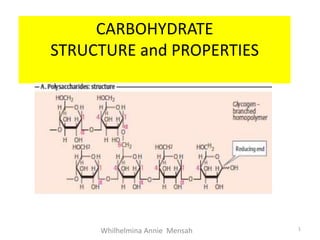
CARBOHYDRATE
STRUCTURE and PROPERTIES
Whilhelmina Annie Mensah 1
• I would feel more optimistic about a bright
future for man, if he spent less time proving
that he can outwit Nature and more time
tasting her sweetness and respecting her
seniority.
—E. B. White, “Coon Tree,” 1977
2
A. Biological and medical
importance
Functions
B. Chemical nature
 Ketose and hexoses
C. Structure
Fisher , Haworth and
Comformations
D. Classification of carbohydrates
Monosaccharides
Hexoses of physiologic importance
Important sugar derivatives
Oligosaccharides: Disaccharides
Polysaccharides
Homopolysaccharides and
heteropolysaccharides
E. Properties of monosaccharides
Lecture objectives
3
Key Words
Saccharide: sugar
Chiral /Asymmetrical : a carbon with four groups
bounded to it.
Anomeric or carbonyl : carbon 1
Hydroxyl group: OH group
Reduction : addition of hydrogen, removal of oxygen
Oxidation : addition of oxygen, removal of hydrogen,
4
5
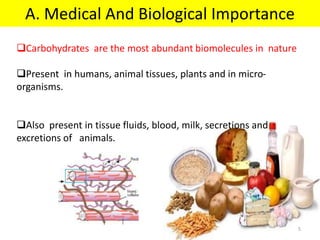
Carbohydrates are the most abundant biomolecules in nature
Present in humans, animal tissues, plants and in micro-
organisms.
Also present in tissue fluids, blood, milk, secretions and
excretions of animals.
A. Medical And Biological Importance
– Functions
Serve as energy stores and fuels, and metabolic
intermediates, glucose and glycogen
Components of several animal structure and plant
structures e.g. cartilage, tendons, cellluose
A part of DNA and RNA
Part of drugs e.g. the antibiotic streptomycin
 etc.
6
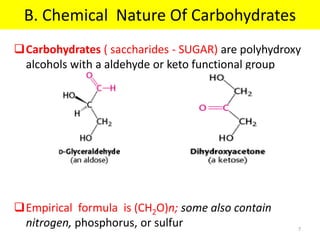
Carbohydrates ( saccharides - SUGAR) are polyhydroxy
alcohols with a aldehyde or keto functional group
Empirical formula is (CH2O)n; some also contain
nitrogen, phosphorus, or sulfur
B. Chemical Nature Of Carbohydrates
7
C. STRUCTURE
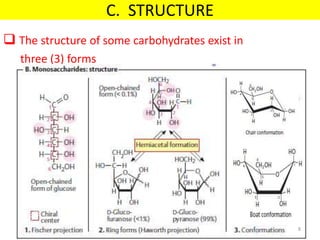
 The structure of some carbohydrates exist in
three (3) forms
8
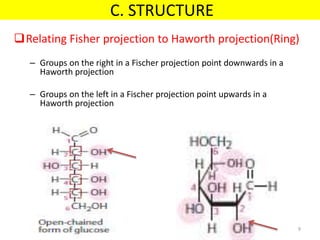
Relating Fisher projection to Haworth projection(Ring)
– Groups on the right in a Fischer projection point downwards in a
Haworth projection
– Groups on the left in a Fischer projection point upwards in a
Haworth projection
C. STRUCTURE
9
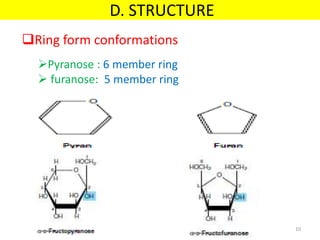
Ring form conformations
Pyranose : 6 member ring
 furanose: 5 member ring
D. STRUCTURE
10
D. Classification Of Carbohydrates
1. Monosaccharides
2. Oligosaccharides
2a. Disaccharides
3. Polysaccharides
11
D. Classification Of Carbohydrates
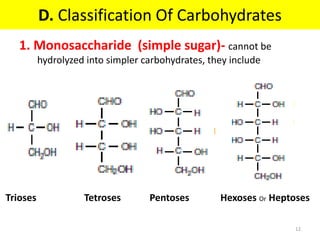
1. Monosaccharide (simple sugar)- cannot be
hydrolyzed into simpler carbohydrates, they include
Trioses Tetroses Pentoses Hexoses Or Heptoses
12
D. Classification Of Carbohydrates
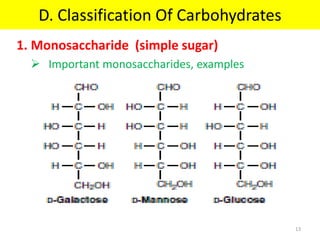
1. Monosaccharide (simple sugar)
 Important monosaccharides, examples
13
D. Classification Of Carbohydrates
1. Monosaccharide (simple sugars)
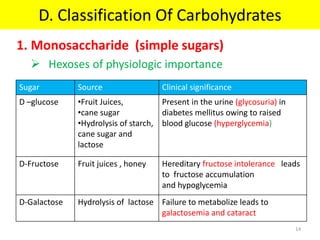
 Hexoses of physiologic importance
Sugar Source Clinical significance
D –glucose •Fruit Juices,
•cane sugar
•Hydrolysis of starch,
cane sugar and
lactose
Present in the urine (glycosuria) in
diabetes mellitus owing to raised
blood glucose (hyperglycemia)
D-Fructose Fruit juices , honey Hereditary fructose intolerance leads
to fructose accumulation
and hypoglycemia
D-Galactose Hydrolysis of lactose Failure to metabolize leads to
galactosemia and cataract
14
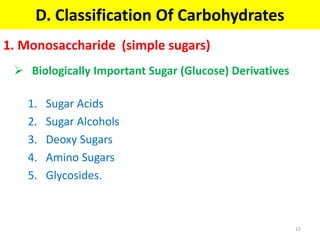
 Biologically Important Sugar (Glucose) Derivatives
1. Sugar Acids
2. Sugar Alcohols
3. Deoxy Sugars
4. Amino Sugars
5. Glycosides.
D. Classification Of Carbohydrates
1. Monosaccharide (simple sugars)
15
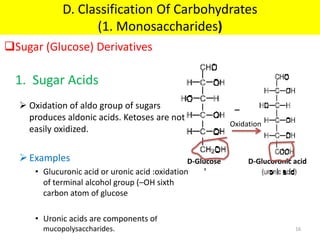
1. Sugar Acids
 Oxidation of aldo group of sugars
produces aldonic acids. Ketoses are not
easily oxidized.
Examples
• Glucuronic acid or uronic acid :oxidation
of terminal alcohol group (–OH sixth
carbon atom of glucose
• Uronic acids are components of
mucopolysaccharides.
Oxidation
D-Glucose D-Glucoronic acid
Sugar (Glucose) Derivatives
D. Classification Of Carbohydrates
(1. Monosaccharides)
16
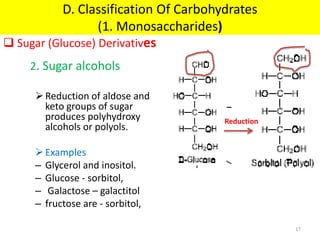
2. Sugar alcohols
Reduction of aldose and
keto groups of sugar
produces polyhydroxy
alcohols or polyols.
Examples
– Glycerol and inositol.
– Glucose - sorbitol,
– Galactose – galactitol
– fructose are - sorbitol,
Reduction
 Sugar (Glucose) Derivatives
D. Classification Of Carbohydrates
(1. Monosaccharides)
17
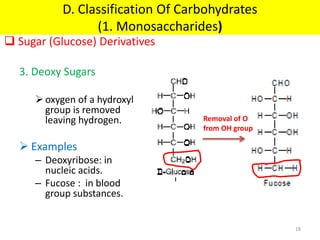
3. Deoxy Sugars
oxygen of a hydroxyl
group is removed
leaving hydrogen.
 Examples
– Deoxyribose: in
nucleic acids.
– Fucose : in blood
group substances.
Removal of O
from OH group
 Sugar (Glucose) Derivatives
D. Classification Of Carbohydrates
(1. Monosaccharides)
18
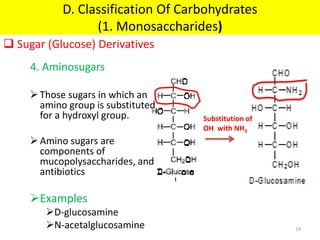
Substitution of
OH with NH3
 Sugar (Glucose) Derivatives
4. Aminosugars
Those sugars in which an
amino group is substituted
for a hydroxyl group.
Amino sugars are
components of
mucopolysaccharides, and
antibiotics
Examples
D-glucosamine
N-acetalglucosamine
D. Classification Of Carbohydrates
(1. Monosaccharides)
19
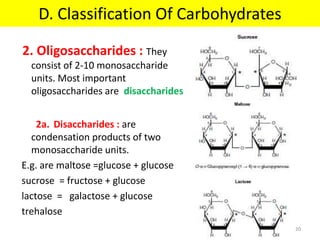
2. Oligosaccharides : They
consist of 2-10 monosaccharide
units. Most important
oligosaccharides are disaccharides
2a. Disaccharides : are
condensation products of two
monosaccharide units.
E.g. are maltose =glucose + glucose
sucrose = fructose + glucose
lactose = galactose + glucose
trehalose
D. Classification Of Carbohydrates
20
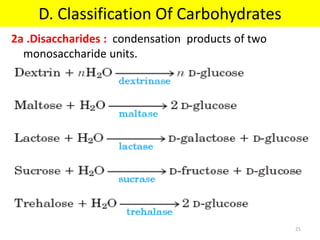
2a .Disaccharides : condensation products of two
monosaccharide units.
D. Classification Of Carbohydrates
21
Classification Of Carbohydrates
2a. Disaccharides
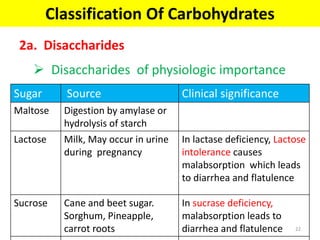
 Disaccharides of physiologic importance
Sugar Source Clinical significance
Maltose Digestion by amylase or
hydrolysis of starch
Lactose Milk, May occur in urine
during pregnancy
In lactase deficiency, Lactose
intolerance causes
malabsorption which leads
to diarrhea and flatulence
Sucrose Cane and beet sugar.
Sorghum, Pineapple,
carrot roots
In sucrase deficiency,
malabsorption leads to
diarrhea and flatulence 22
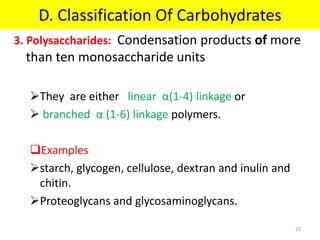
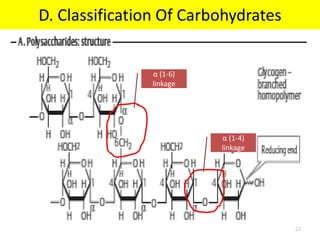
3. Polysaccharides: Condensation products of more
than ten monosaccharide units
They are either linear α(1-4) linkage or
 branched α (1-6) linkage polymers.
Examples
starch, glycogen, cellulose, dextran and inulin and
chitin.
Proteoglycans and glycosaminoglycans.
D. Classification Of Carbohydrates
23
D. Classification Of Carbohydrates
24
α (1-6)
linkage
α (1-4)
linkage
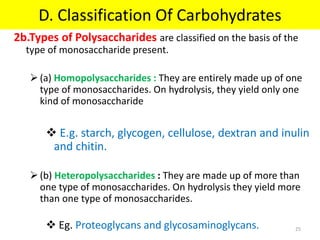
2b.Types of Polysaccharides are classified on the basis of the
type of monosaccharide present.
(a) Homopolysaccharides : They are entirely made up of one
type of monosaccharides. On hydrolysis, they yield only one
kind of monosaccharide
 E.g. starch, glycogen, cellulose, dextran and inulin
and chitin.
(b) Heteropolysaccharides : They are made up of more than
one type of monosaccharides. On hydrolysis they yield more
than one type of monosaccharides.
 Eg. Proteoglycans and glycosaminoglycans.
D. Classification Of Carbohydrates
25
2b. b.Heteropolysaccharides
Types
 Proteoglycans (Mucopolysaccharides) : consist of
protein with a repeating polysaccharide unit.
 Glycoproteins : Proteins which has less than 100
saccharide residues have been added.
 Glycosaminoglycans: a proteoglycan with the protein
portion removed
D.Classification Of Carbohydrates
26
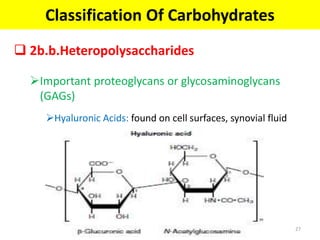
 2b.b.Heteropolysaccharides
Important proteoglycans or glycosaminoglycans
(GAGs)
Hyaluronic Acids: found on cell surfaces, synovial fluid
and vitrous humour
Classification Of Carbohydrates
27
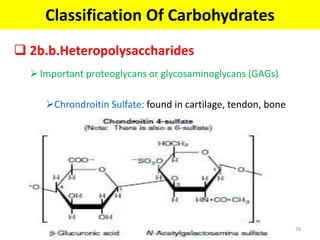
 2b.b.Heteropolysaccharides
Important proteoglycans or glycosaminoglycans (GAGs)
Chrondroitin Sulfate: found in cartilage, tendon, bone
Classification Of Carbohydrates
28
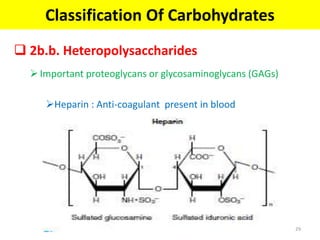
 2b.b. Heteropolysaccharides
Important proteoglycans or glycosaminoglycans (GAGs)
Heparin : Anti-coagulant present in blood
Classification Of Carbohydrates
29
1. Optical isomerism
2. Optical activity
3. Epimerism
4. Hemiacetal and hemiketal formation
5. L and D forms
6. Anomers
7. Mutarotaion
8. Formation of glycosidic bonds
9. Reducing properties
E. Properties of Monosaccharides
30
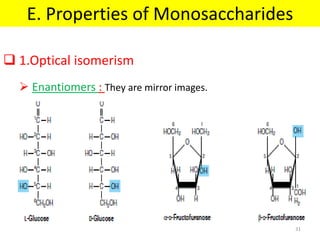
 1.Optical isomerism
 Enantiomers : They are mirror images.
E. Properties of Monosaccharides
31
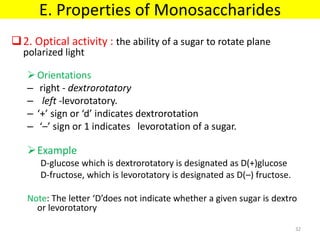
2. Optical activity : the ability of a sugar to rotate plane
polarized light
Orientations
– right - dextrorotatory
– left -levorotatory.
– ‘+’ sign or ‘d’ indicates dextrorotation
– ‘–’ sign or 1 indicates levorotation of a sugar.
Example
D-glucose which is dextrorotatory is designated as D(+)glucose
D-fructose, which is levorotatory is designated as D(–) fructose.
Note: The letter ‘D’does not indicate whether a given sugar is dextro
or levorotatory
E. Properties of Monosaccharides
32
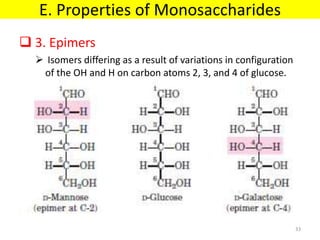
 3. Epimers
 Isomers differing as a result of variations in configuration
of the OH and H on carbon atoms 2, 3, and 4 of glucose.
E. Properties of Monosaccharides
33
E. Properties of Monosaccharides
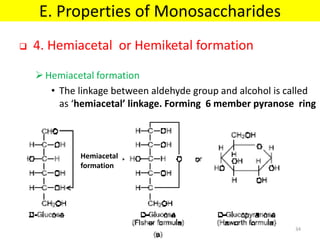
 4. Hemiacetal or Hemiketal formation
Hemiacetal formation
• The linkage between aldehyde group and alcohol is called
as ‘hemiacetal’ linkage. Forming 6 member pyranose ring
Hemiacet
al
formationHemiacetal
formation
34
E. Properties of Monosaccharides
 4. Hemiacetal or Hemiketal formation
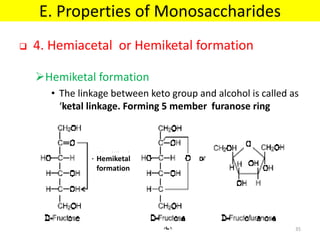
Hemiketal formation
• The linkage between keto group and alcohol is called as
‘ketal linkage. Forming 5 member furanose ring
Hemiketal
formation
35
PROPERTIES and STRUCTURE
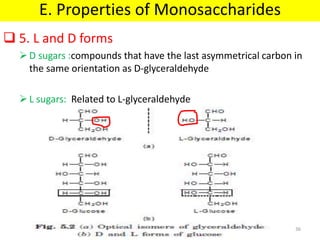
 5. L and D forms
D sugars :compounds that have the last asymmetrical carbon in
the same orientation as D-glyceraldehyde
L sugars: Related to L-glyceraldehyde
E. Properties of Monosaccharides
36
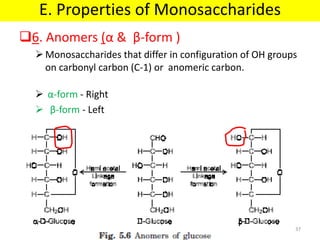
6. Anomers (α & β-form )
Monosaccharides that differ in configuration of OH groups
on carbonyl carbon (C-1) or anomeric carbon.
 α-form - Right
 β-form - Left
E. Properties of Monosaccharides
37
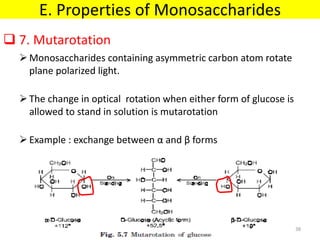
 7. Mutarotation
Monosaccharides containing asymmetric carbon atom rotate
plane polarized light.
The change in optical rotation when either form of glucose is
allowed to stand in solution is mutarotation
Example : exchange between α and β forms
E. Properties of Monosaccharides
38
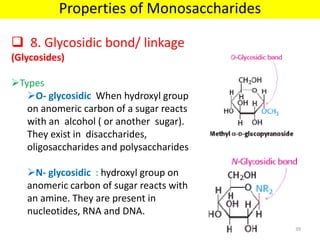
 8. Glycosidic bond/ linkage
(Glycosides)
Types
O- glycosidic When hydroxyl group
on anomeric carbon of a sugar reacts
with an alcohol ( or another sugar).
They exist in disaccharides,
oligosaccharides and polysaccharides
N- glycosidic : hydroxyl group on
anomeric carbon of sugar reacts with
an amine. They are present in
nucleotides, RNA and DNA.
Properties of Monosaccharides
39
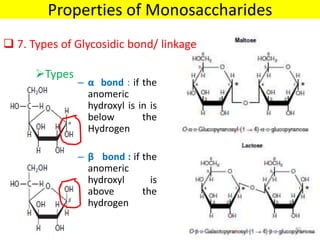
– α bond : if the
anomeric
hydroxyl is in is
below the
Hydrogen
– β bond : if the
anomeric
hydroxyl is
above the
hydrogen
 7. Types of Glycosidic bond/ linkage
Types
Properties of Monosaccharides
40
 9.Reducing properties
Glucose and other sugars capable of reducing
ferric or cupric ion in solution are called reducing
sugars.
They reduce and colour Benedicts and Fehlings
solution with the aldehyde group of the sugar
E. Properties of Monosaccharides
41
A.Biological and medical importance
Functions : energy source, storage, structural, part of DNA
& RNA, component of drugs
B. Chemical nature
 Ketose and hexoses
 Empirical formular - ( CH2O)n
C. Structure
Fisher projection
 Haworth projection (Ring forms – pyranose and furanose)
 Comformations (boat and chair)
Lecture Summary
42
D. Classification of carbohydrates
Monosaccharides
Hexoses of physiologic importance : glucose , fructose ,
galactose
Important sugar derivatives : sugar acids, sugar alcohols,
deoxy sugars, amino sugars and glycosides
Oligosaccharides
Disaccharides of physiologic importance: lactose , sucrose,
maltose
Polysaccharides
Homopolysaccharides : chitin, cellulose, glycogen, starch
 heteropolysaccharides : Proteoglycans, glycoproteins, GAGS
Lecture Summary
43
E. Properties of monosaccharides
 Optical isomerism
 Optical activity
 Epimerism
 Hemiacetal and hemiketal formation
 L and D forms
 Anomers
 Mutarotaion
 Formation of glycosidic bonds
Lecture Summary
44
45
46
47

Carbohydrate structure

  • 1.
  • 2.
    • I wouldfeel more optimistic about a bright future for man, if he spent less time proving that he can outwit Nature and more time tasting her sweetness and respecting her seniority. —E. B. White, “Coon Tree,” 1977 2
  • 3.
    A. Biological andmedical importance Functions B. Chemical nature  Ketose and hexoses C. Structure Fisher , Haworth and Comformations D. Classification of carbohydrates Monosaccharides Hexoses of physiologic importance Important sugar derivatives Oligosaccharides: Disaccharides Polysaccharides Homopolysaccharides and heteropolysaccharides E. Properties of monosaccharides Lecture objectives 3
  • 4.
    Key Words Saccharide: sugar Chiral/Asymmetrical : a carbon with four groups bounded to it. Anomeric or carbonyl : carbon 1 Hydroxyl group: OH group Reduction : addition of hydrogen, removal of oxygen Oxidation : addition of oxygen, removal of hydrogen, 4
  • 5.
    5 Carbohydrates are themost abundant biomolecules in nature Present in humans, animal tissues, plants and in micro- organisms. Also present in tissue fluids, blood, milk, secretions and excretions of animals. A. Medical And Biological Importance
  • 6.
    A. Medical AndBiological Importance – Functions Serve as energy stores and fuels, and metabolic intermediates, glucose and glycogen Components of several animal structure and plant structures e.g. cartilage, tendons, cellluose A part of DNA and RNA Part of drugs e.g. the antibiotic streptomycin  etc. 6
  • 7.
    Carbohydrates ( saccharides- SUGAR) are polyhydroxy alcohols with a aldehyde or keto functional group Empirical formula is (CH2O)n; some also contain nitrogen, phosphorus, or sulfur B. Chemical Nature Of Carbohydrates 7
  • 8.
    C. STRUCTURE  Thestructure of some carbohydrates exist in three (3) forms 8
  • 9.
    Relating Fisher projectionto Haworth projection(Ring) – Groups on the right in a Fischer projection point downwards in a Haworth projection – Groups on the left in a Fischer projection point upwards in a Haworth projection C. STRUCTURE 9
  • 10.
    Ring form conformations Pyranose: 6 member ring  furanose: 5 member ring D. STRUCTURE 10
  • 11.
    D. Classification OfCarbohydrates 1. Monosaccharides 2. Oligosaccharides 2a. Disaccharides 3. Polysaccharides 11
  • 12.
    D. Classification OfCarbohydrates 1. Monosaccharide (simple sugar)- cannot be hydrolyzed into simpler carbohydrates, they include Trioses Tetroses Pentoses Hexoses Or Heptoses 12
  • 13.
    D. Classification OfCarbohydrates 1. Monosaccharide (simple sugar)  Important monosaccharides, examples 13
  • 14.
    D. Classification OfCarbohydrates 1. Monosaccharide (simple sugars)  Hexoses of physiologic importance Sugar Source Clinical significance D –glucose •Fruit Juices, •cane sugar •Hydrolysis of starch, cane sugar and lactose Present in the urine (glycosuria) in diabetes mellitus owing to raised blood glucose (hyperglycemia) D-Fructose Fruit juices , honey Hereditary fructose intolerance leads to fructose accumulation and hypoglycemia D-Galactose Hydrolysis of lactose Failure to metabolize leads to galactosemia and cataract 14
  • 15.
     Biologically ImportantSugar (Glucose) Derivatives 1. Sugar Acids 2. Sugar Alcohols 3. Deoxy Sugars 4. Amino Sugars 5. Glycosides. D. Classification Of Carbohydrates 1. Monosaccharide (simple sugars) 15
  • 16.
    1. Sugar Acids Oxidation of aldo group of sugars produces aldonic acids. Ketoses are not easily oxidized. Examples • Glucuronic acid or uronic acid :oxidation of terminal alcohol group (–OH sixth carbon atom of glucose • Uronic acids are components of mucopolysaccharides. Oxidation D-Glucose D-Glucoronic acid Sugar (Glucose) Derivatives D. Classification Of Carbohydrates (1. Monosaccharides) 16
  • 17.
    2. Sugar alcohols Reductionof aldose and keto groups of sugar produces polyhydroxy alcohols or polyols. Examples – Glycerol and inositol. – Glucose - sorbitol, – Galactose – galactitol – fructose are - sorbitol, Reduction  Sugar (Glucose) Derivatives D. Classification Of Carbohydrates (1. Monosaccharides) 17
  • 18.
    3. Deoxy Sugars oxygenof a hydroxyl group is removed leaving hydrogen.  Examples – Deoxyribose: in nucleic acids. – Fucose : in blood group substances. Removal of O from OH group  Sugar (Glucose) Derivatives D. Classification Of Carbohydrates (1. Monosaccharides) 18
  • 19.
    Substitution of OH withNH3  Sugar (Glucose) Derivatives 4. Aminosugars Those sugars in which an amino group is substituted for a hydroxyl group. Amino sugars are components of mucopolysaccharides, and antibiotics Examples D-glucosamine N-acetalglucosamine D. Classification Of Carbohydrates (1. Monosaccharides) 19
  • 20.
    2. Oligosaccharides :They consist of 2-10 monosaccharide units. Most important oligosaccharides are disaccharides 2a. Disaccharides : are condensation products of two monosaccharide units. E.g. are maltose =glucose + glucose sucrose = fructose + glucose lactose = galactose + glucose trehalose D. Classification Of Carbohydrates 20
  • 21.
    2a .Disaccharides :condensation products of two monosaccharide units. D. Classification Of Carbohydrates 21
  • 22.
    Classification Of Carbohydrates 2a.Disaccharides  Disaccharides of physiologic importance Sugar Source Clinical significance Maltose Digestion by amylase or hydrolysis of starch Lactose Milk, May occur in urine during pregnancy In lactase deficiency, Lactose intolerance causes malabsorption which leads to diarrhea and flatulence Sucrose Cane and beet sugar. Sorghum, Pineapple, carrot roots In sucrase deficiency, malabsorption leads to diarrhea and flatulence 22
  • 23.
    3. Polysaccharides: Condensationproducts of more than ten monosaccharide units They are either linear α(1-4) linkage or  branched α (1-6) linkage polymers. Examples starch, glycogen, cellulose, dextran and inulin and chitin. Proteoglycans and glycosaminoglycans. D. Classification Of Carbohydrates 23
  • 24.
    D. Classification OfCarbohydrates 24 α (1-6) linkage α (1-4) linkage
  • 25.
    2b.Types of Polysaccharidesare classified on the basis of the type of monosaccharide present. (a) Homopolysaccharides : They are entirely made up of one type of monosaccharides. On hydrolysis, they yield only one kind of monosaccharide  E.g. starch, glycogen, cellulose, dextran and inulin and chitin. (b) Heteropolysaccharides : They are made up of more than one type of monosaccharides. On hydrolysis they yield more than one type of monosaccharides.  Eg. Proteoglycans and glycosaminoglycans. D. Classification Of Carbohydrates 25
  • 26.
    2b. b.Heteropolysaccharides Types  Proteoglycans(Mucopolysaccharides) : consist of protein with a repeating polysaccharide unit.  Glycoproteins : Proteins which has less than 100 saccharide residues have been added.  Glycosaminoglycans: a proteoglycan with the protein portion removed D.Classification Of Carbohydrates 26
  • 27.
     2b.b.Heteropolysaccharides Important proteoglycansor glycosaminoglycans (GAGs) Hyaluronic Acids: found on cell surfaces, synovial fluid and vitrous humour Classification Of Carbohydrates 27
  • 28.
     2b.b.Heteropolysaccharides Important proteoglycansor glycosaminoglycans (GAGs) Chrondroitin Sulfate: found in cartilage, tendon, bone Classification Of Carbohydrates 28
  • 29.
     2b.b. Heteropolysaccharides Importantproteoglycans or glycosaminoglycans (GAGs) Heparin : Anti-coagulant present in blood Classification Of Carbohydrates 29
  • 30.
    1. Optical isomerism 2.Optical activity 3. Epimerism 4. Hemiacetal and hemiketal formation 5. L and D forms 6. Anomers 7. Mutarotaion 8. Formation of glycosidic bonds 9. Reducing properties E. Properties of Monosaccharides 30
  • 31.
     1.Optical isomerism Enantiomers : They are mirror images. E. Properties of Monosaccharides 31
  • 32.
    2. Optical activity: the ability of a sugar to rotate plane polarized light Orientations – right - dextrorotatory – left -levorotatory. – ‘+’ sign or ‘d’ indicates dextrorotation – ‘–’ sign or 1 indicates levorotation of a sugar. Example D-glucose which is dextrorotatory is designated as D(+)glucose D-fructose, which is levorotatory is designated as D(–) fructose. Note: The letter ‘D’does not indicate whether a given sugar is dextro or levorotatory E. Properties of Monosaccharides 32
  • 33.
     3. Epimers Isomers differing as a result of variations in configuration of the OH and H on carbon atoms 2, 3, and 4 of glucose. E. Properties of Monosaccharides 33
  • 34.
    E. Properties ofMonosaccharides  4. Hemiacetal or Hemiketal formation Hemiacetal formation • The linkage between aldehyde group and alcohol is called as ‘hemiacetal’ linkage. Forming 6 member pyranose ring Hemiacet al formationHemiacetal formation 34
  • 35.
    E. Properties ofMonosaccharides  4. Hemiacetal or Hemiketal formation Hemiketal formation • The linkage between keto group and alcohol is called as ‘ketal linkage. Forming 5 member furanose ring Hemiketal formation 35
  • 36.
    PROPERTIES and STRUCTURE 5. L and D forms D sugars :compounds that have the last asymmetrical carbon in the same orientation as D-glyceraldehyde L sugars: Related to L-glyceraldehyde E. Properties of Monosaccharides 36
  • 37.
    6. Anomers (α& β-form ) Monosaccharides that differ in configuration of OH groups on carbonyl carbon (C-1) or anomeric carbon.  α-form - Right  β-form - Left E. Properties of Monosaccharides 37
  • 38.
     7. Mutarotation Monosaccharidescontaining asymmetric carbon atom rotate plane polarized light. The change in optical rotation when either form of glucose is allowed to stand in solution is mutarotation Example : exchange between α and β forms E. Properties of Monosaccharides 38
  • 39.
     8. Glycosidicbond/ linkage (Glycosides) Types O- glycosidic When hydroxyl group on anomeric carbon of a sugar reacts with an alcohol ( or another sugar). They exist in disaccharides, oligosaccharides and polysaccharides N- glycosidic : hydroxyl group on anomeric carbon of sugar reacts with an amine. They are present in nucleotides, RNA and DNA. Properties of Monosaccharides 39
  • 40.
    – α bond: if the anomeric hydroxyl is in is below the Hydrogen – β bond : if the anomeric hydroxyl is above the hydrogen  7. Types of Glycosidic bond/ linkage Types Properties of Monosaccharides 40
  • 41.
     9.Reducing properties Glucoseand other sugars capable of reducing ferric or cupric ion in solution are called reducing sugars. They reduce and colour Benedicts and Fehlings solution with the aldehyde group of the sugar E. Properties of Monosaccharides 41
  • 42.
    A.Biological and medicalimportance Functions : energy source, storage, structural, part of DNA & RNA, component of drugs B. Chemical nature  Ketose and hexoses  Empirical formular - ( CH2O)n C. Structure Fisher projection  Haworth projection (Ring forms – pyranose and furanose)  Comformations (boat and chair) Lecture Summary 42
  • 43.
    D. Classification ofcarbohydrates Monosaccharides Hexoses of physiologic importance : glucose , fructose , galactose Important sugar derivatives : sugar acids, sugar alcohols, deoxy sugars, amino sugars and glycosides Oligosaccharides Disaccharides of physiologic importance: lactose , sucrose, maltose Polysaccharides Homopolysaccharides : chitin, cellulose, glycogen, starch  heteropolysaccharides : Proteoglycans, glycoproteins, GAGS Lecture Summary 43
  • 44.
    E. Properties ofmonosaccharides  Optical isomerism  Optical activity  Epimerism  Hemiacetal and hemiketal formation  L and D forms  Anomers  Mutarotaion  Formation of glycosidic bonds Lecture Summary 44
  • 45.
  • 46.
  • 47.