FUNCTIONS,PROPERTIESAND
IMPORTANCEOF LIPIDS
PRESENTED TO:
DR. SAMEENA
PRESENTED BY:
Roll #1- Almas M Arshad (Group Leader)
Roll # 2 - Sana Ch
Roll # 4 - Qurat-ul-Ain Aslam
Roll # 5 - Waleed Maqbool
Roll # 6 - Afia Tariq
Roll # 83 - Iqra Rafi
Page 2 of 25
TABLE OF CONTENTS
Structure of Lipids ................................................................................................................................................................3
Fatty Acids...................................................................................................................................................................................4
Definition
Major Points
Classification of Fatty Acids........................................................................................................................................5 -6
Saturated Fatty Acids
Unsaturated Fatty Acids
Branched chain Fatty Acids
Cyclic Fatty Acids
Substituted Fatty Acids
Eicosanoid
Properties Of Lipids.....................................................................................................................................................7 - 13
Chemical Properties
 Hydrolysis
 Saponification
 Hydrogenation
 Rancidity
 Ester Formation
 Prostaglandin Formation
Physical Properties
Functions Of Lipids....................................................................................................................................................14 – 18
Functions of Saturated Lipids
Functions of Unsaturated Lipids
Functions of Essential Lipids
Importance Of Lipids...............................................................................................................................................19 - 22
Structural Importance Of Lipids
Chemical Importance Of Lipids
Role of Lipids in Brain Injury
Page 3 of 25
Importance of Lipids in Food Industry
Exact Balance of Lipids which should be taken in Diet
STRUCTURE OF LIPIDS
The “tail” of a fatty acid is a long hydrocarbon chain, making it hydrophobic. The
“head” of the molecule is a carboxyl group which is hydrophilic.
Page 4 of 25
HYDROPHILIC
PART
FATTY ACIDS:
Definition:
"Structural Units of lipids that are monocarboxylic, organic acids that made up of
the hydrocarbon chains."
Major Points:
 Are made up of atleast 2 carbonatoms
 Chain length of lipid forming fatty acids range from 4 to about 24v carbon
atoms.
 Fatty acids which occur in neutral fats usually contain even number of carbon
atoms.
Classification:
On the Basis Of biological Importance;
 Essential Fatty Acids
 Non-Essential Fatty Acids
On the Basis Of types of bonds;
 Saturated fatty acids
 Unsaturated fatty acids
Other Fatty acids;
 Branched Chain fatty acids.
 Substituted fatty acids
 Cyclic fatty acids
 Eicosanoid fatty acids
Page 5 of 25
Fatty
acid viscosity, (thickness)
and melting
temperature increases
with decreasing number
of double bonds
Classification of Fatty Acids
1) Saturated fatty acids:
Fatty acids have no double bonds between the individual carbonatoms of the fatty
acid chain.
Butter, Cheese and cream are some examples of saturated fatty acids
2) Un-saturated fatty acids:
Fatty acid which has at least one double bond within
the fatty acid chain.
Unsaturated fatty acids increase the fluidity of the cell
membrane.
Types of Unsaturated Fatty Acids:
 Mono unsaturated fatty acids.
Lower Fatty Acids: Having 10 or less than 10 Carbons  Acetic Acid.
Higher Fatty Acids: Having more than 10 Carbons  Palmitic Acid.
Page 6 of 25
 Poly unsaturated fatty acids.
3) Branched Chain fatty acids:
Are branched at different points.
EXAMPLE: sebum and butter.
4) Substituted fatty acids:
Naturally occurring fatty acids in which the methyl group is replaced by –OH
group.
Examples: Cerebronic acid of brain, Glycolipids.
5) Cyclic fatty acids:
Fatty acids bearing cyclic groups.
Example: Hydnocarpic acid, Chaulmoogric acid.
Where earlier used as treatment of leprosy.
6) Eicosanoids fatty acids:
Derivatives of eicosapolyenoic fatty acids.
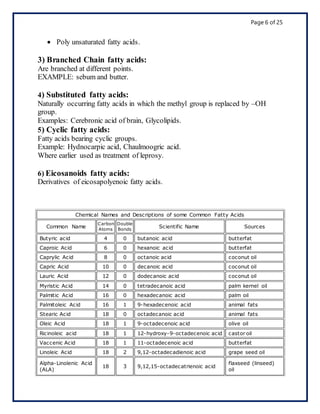
Chemical Names and Descriptions of some Common Fatty Acids
Common Name
Carbon
Atoms
Double
Bonds
Scientific Name Sources
Butyric acid 4 0 butanoic acid butterfat
Caproic Acid 6 0 hexanoic acid butterfat
Caprylic Acid 8 0 octanoic acid coconut oil
Capric Acid 10 0 decanoic acid coconut oil
Lauric Acid 12 0 dodecanoic acid coconut oil
Myristic Acid 14 0 tetradecanoic acid palm kernel oil
Palmitic Acid 16 0 hexadecanoic acid palm oil
Palmitoleic Acid 16 1 9-hexadecenoic acid animal fats
Stearic Acid 18 0 octadecanoic acid animal fats
Oleic Acid 18 1 9-octadecenoic acid olive oil
Ricinoleic acid 18 1 12-hydroxy-9-octadecenoic acid castor oil
Vaccenic Acid 18 1 11-octadecenoic acid butterfat
Linoleic Acid 18 2 9,12-octadecadienoic acid grape seed oil
Alpha-Linolenic Acid
(ALA)
18 3 9,12,15-octadecatrienoic acid
flaxseed (linseed)
oil
Page 7 of 25
Gamma-Linolenic
Acid
(GLA)
18 3 6,9,12-octadecatrienoic acid borage oil
Arachidic Acid 20 0 eicosanoic acid
peanut oil,
fish oil
Gadoleic Acid 20 1 9-eicosenoic acid fish oil
Arachidonic Acid
(AA)
20 4 5,8,11,14-eicosatetraenoic acid liver fats
EPA 20 5
5,8,11,14,17-eicosapentaenoic
acid
fish oil
PROPERTIES OF LIPIDS:
CHEMICAL PROPERTIES OF LIPIDS:
Essential components that define fatty acids:
 Hydrocarbonchain(/s)
 Saturated (pure C-C bonds)or unsaturated (contains one or more C=C
bonds)
 Carboxylic acid
Chemical Properties of a substancedepend upon its active group. In lipids these
are because of Carboxyl Group [which react with alcohols (R′OH) to form esters]
Do you know?
The long hydrocarbon
chain is quite resistant,
barely reacts in any
chemical reaction.
Page 8 of 25
Carboxyl part participating in Reaction of Fatty Acid
Some Chemical Properties are:
 Hydrolysis
 Saponification
 Hydrogenation
 Rancidity
 Ester Formation
 Prostaglandin Formation
1. Hydrolysis:
“Hydrolysis is the process wherein a covalent
bond within a molecule is broken down by
the addition of water”
The fats may be hydrolyzed with the following:
 Super heated steam.
 By acids, or alkalis.
 By the specific fat splitting enzymes lipases.
Process results in one of the reaction products having a hydrogen atom where the
bond used to be, and the other having a hydroxyl group (-OH, also known as an
alcohol)
Lipases are hydrolyzing
enzymes found in
 Saliva
 gastric juice
 pancreatic juice
Page 9 of 25
Hydrolysis of Glyceride
2. Saponification:
“Triglycerides are reacted with strong Alkali (sodium or potassium hydroxide)
to produceglycerol and a fatty acid salt, called soap.”
 Triglycerides, are mixtures derived from diverse fatty acids.
 For soap making, the triglycerides are highly purified.
 Soap formed by this process is precipitated by salting it
out with saturated sodium chloride.
 Saponification value: The number of milligrams of potassium
hydroxide required to saponify 1g of fat under the conditions
specified.
Ref:
Page 10 of 25
Saponification of a triglyceride with sodium hydroxide to give soap and glycerine
3. Hydrogenation:
“A chemical reduction, between molecular hydrogen (H2) and another
compound or element, usually in the presence of a catalyst.”
 The Catalysts used are: Platinum, palladium, rhodium, and ruthenium
and Raney nickel and Urushibara nickel
 Unsaturated fatty acids may be converted to saturated fatty acids by
the relatively simple hydrogenation reaction.
Oleic Acid-Unsaturated + H2 ---- Stearic Acid-Saturated
Hydrogenation of Oleic Acid-Unsaturated
Page 11 of 25
4. Rancidity:
“Rancidity is the chemical decomposition of fats, oils and other lipids
yielding an unpleasant and noxious odor.”
Types of Rancidity:
 Hydrolytic rancidity occurs when water
splits fatty acid chains away from the
glycerol backbonein glycerides.
 Oxidative rancidity occurs when the double bonds ofan unsaturated
fatty acid react chemically with oxygen.
 Microbial rancidity refers to a process in which microorganisms such
as bacteria use their enzymes, including lipases, to break down
chemical structures in the fat.
It results in formation of aldehydes and ketones which occurs in contactwith
air at room temperature which gives undesirable odorand flavor.
Factors affecting oxidation  A cause of Rancidity:
 Light, heat, metals (iron and copper), oxidizer as chlorophyll,
hemoglobin, and certain synthetic dyes.
 Another factor affecting the oxidation rate is the amount of oxygen, the
degree of unsaturation of fatty acids in oils etc
 And the presence of antioxidants.
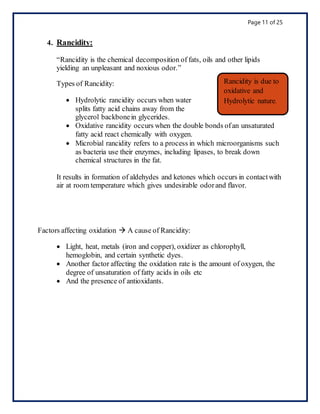
Rancidity is due to
oxidative and
Hydrolytic nature.
Page 12 of 25
Process of oxidization of Lipids-Rancidity
5. Ester Formation:
Fatty acids in combination with alcohols form esters.
Examples with glycerol form mono-, di- and tri- glycerides and with other
alcohols form waxes.
Ester Formation
6. Prostaglandin Formation:
 Prostaglandins are substances enzymatic-ally derived from essential
fatty acids in almost all nucleated cells and are found in most tissues
and organs.
 They are mediators acting
upon platelets, endothelium, uterine and mast cells and have a variety
Page 13 of 25
of strong physiological effects (such as regulating the contraction and
relaxation of smoothmuscle tissue).
 Have short half life and are soonexcreted out of the bodywhen
released and used.
Prostaglandin Formation
PHYSICAL PROPERTIES OF LIPIDS:
 Colorless
 Odorless
 Tasteless
Prostaglandins differ from hormones
in that they are not produced at a
discrete site but in many places
throughout the human body.
Page 14 of 25
 Hydrophobic (repel water and so insoluble in
water) and soluble in only organic solvents (such
as ether, hexane or chloroform) because of the
non-polar hydrocarbonchain.
 Specific gravity is less than 1.0
 Are Saturated* and unsaturated**
*Saturated : No double bonds in structure of any fatty acid
chain..like fat and butter..
*Unsaturated : Having Double or Triple bond in the structure of their
fatty acid chain like Olive oil
 Emulsified when shaken with water.
 High solubility with increasing number of
double bonds of its long hydrophobic fatty
acid chain.
 Melting point of lipids increase with
increasing number of carbon atoms in the
fatty acid chain.
FUNCTIONS OF LIPIDS:
Functions of Saturated Lipids:
Glycerophospholipid
s are good
emulsifying agents.
Page 15 of 25
 Saturated fat tends to increase blood cholesterol levels. Most saturated fats
tend to be solid at room temperature, with the exception of tropical oils.
Functions of Unsaturated Lipids:
 Monounsaturated fat tends to lower LDL cholesterol (the "bad" cholesterol).
 Polyunsaturated Fat ends to lower blood cholesterol levels.
Functions of Essential Lipids:
 Enhance the energy production by helping the bodyobtain more oxygen
Increase oxidative rate, increase metabolic rate, increase energy levels,
increase stamina, enhance the fat burning.
 Development and function of the brain and nervous system. Especially helps
in learning problems: Dyslexia and Hyperactivity, correction in criminal
behavior, improved function in metabolic illness.
 They play a role in thinning your blood by formation of prostaglandins
which makes blood less sticky, which can prevent blood clots that lead to
heart attacks and stroke.
 Help regulate properliver, kidney and glands (thyroid and adrenal) activity.
 Help Kidney dump the extra water out of it.
 Immune system use Essential fatty acids to make ‘oxygen’ bullets to fight
against foreign invaders.
 Responsible for cholesterol transport.
Page 16 of 25
Cholesterol Transport
 Eicosanoid are signaling molecules derived from the essential fatty acids
(EFA); they are a major pathway by which the EFAs act in the body.
Inflammatory Response
Functions of Other Lipids:
 Phospholipids are important components of the cell membrane.
Page 17 of 25
Lipids-an important component of all the Membranes
 Energy storage: Triglycerides, stored in adipose tissue, are a major form of
energy storage both in animals and plants. The fat cell-adipocyte is broken
down by the activation of hormone-sensitive enzyme lipase.
 Storage and transport of vitamins-ADEK
The complete oxidation of fatty
acids provides high caloric content,
about 9 kcal/g, compared with
4 kcal/g for the breakdown
of carbohydrates and proteins.
Page 18 of 25
Transport of vitamins
 Hormone production: Arachidonic acid is used for the biosynthesis of
prostaglandins. These molecules are used in the cascade events associated
with pain and inflammation.
Hormone production from lipids
 Protection of organs (e.g on Kidneys) and acts as an insulation material
around it to maintain the temperature.
Page 19 of 25
Fat on Kidney
 Cholesterol-an important lipid responsible for the formation of membranes,
steroid hormones, vitamin D and Bile Salts.
 Cell Signaling: Lipid signaling may occurvia activation of G protein-
coupled or nuclear receptors.
Cell Signaling
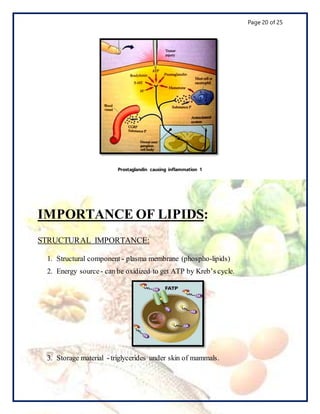
 Lipids are responsible for inflammation
after a tissue injury by the formation of
prostaglandins.
Cholesterol-an important Lipid
Page 20 of 25
Prostaglandin causing inflammation 1
IMPORTANCE OF LIPIDS:
STRUCTURAL IMPORTANCE:
1. Structural component - plasma membrane (phospho-lipids)
2. Energy source- can be oxidized to get ATP by Kreb’s cycle.
3. Storage material - triglycerides under skin of mammals.
Page 21 of 25
4. Protection - cuticle prevents drying of leaves sebum prevents drying and
cracking of skin fat layer around some organs like heart protects and absorbs
shock
5. Insulation
 myelin sheath around neurons (electrical insulation)
 Keeps bodywarm (Thermal Insulation)
6. Gives characteristic scent to plants (lemon - limoneme, mint – menthol
7. Gives buoyancy - blubber in whales
8. Surfactant in lungs prevent collapsing of lungs
CLINICAL IMPORTANCE OF LIPIDS:
Lipids can be responsible for Immunodeficiency:
 Radiation and vegetable oils can cause "acquired
immunodeficiency."
 Unsaturated oils, especially polyunsaturated fat,
weaken the immune system's function in ways
that are similar to the damage causedby
radiation, hormone imbalance, cancer, aging, or
viral infections.
 Immune system modulation by dietary lipids is attributed due to changes in
the composition of membrane phospholipids, lipid per-oxidation, alteration
of gene expression, or eicosanoid production.
Insulation
Page 22 of 25
Schematic representation of potential role of dietary lipids and biological and clinical consequences of the
administration of several dietary lipids. PUFAs, polyunsaturated fatty acids; MUFAs, monounsaturated fatty
acids; SFAs, saturated fatty acids.
ROLE OF LIPIDS IN BRAIN INJURY AND DISEASES:
 Lipidosis: Lipid storage diseases, or the lipidoses, are a group of
inherited metabolic disorders in which harmful amounts of fatty materials
(lipids) accumulate particularly in the brain, peripheral nervous system,
liver, spleen, and bone marrow.
 People with these disorders either do not produceenough of one of the
enzymes needed to break down (metabolize) lipids or they produceenzymes
that do not work properly.
 Over time, this excessive storage of fats can cause permanent cellular and
tissue damage, causing:
Page 23 of 25
i. Alzheimer’s Disease
ii. Parkinson’s Disease;
iii. Niemann-Pick;
iv. Multiple sclerosis,
v. Schizophrenia,
vi. Epilepsy
vii. CNS injury (Stroke, traumatic brain injury; and spinal cord injury)
IMPORTANCE OF LIPIDS IN DIET:
Oils and fats are almost ubiquitous in food processing - whether naturally
occurring in foods or added as ingredients for
 Functional benefits and
 Essential part
 Both the quantity and the quality of the fat consumed are vital to achieving a
balanced diet.
 Role of lipids in some of the more important disease conditions such as
obesity, diabetes, coronary heart disease and cancer.
 Affects he nutritional value, taste and texture of foods.
 Health concerns regarding high-fat diets damages blood vessel, high blood
pressure, increases weight, increases metabolic diseases, obesity.
 Diseases caused by Obesity are indirectly related to High-lipid diet when
obesity is due to high-lipids, include; Heart Failure, Enlarged Heart,
Pulmonary Embolism, Menstrual Disorder, Fatty Liver Disease, Infertility,
Hernia, Urinary incontinence, Chronic Renal Failure, Breast Cancer and
Stretch marks
Page 24 of 25
Exact Balance of Lipid which Should Be Taken In Diet:
References:
http://www.elmhurst.edu/~chm/vchembook/555prostagland.html
www.google.com
http://raypeat.com/articles/articles/unsaturad-oils.shtteml
www.wikipedia.com
http://www2.chemistry.msu.edu/faculty/reusch/VirtTxtJml/lipids.htm
http://biology.clc.uc.edu/courses/bio104/lipids.htm
http://www.jbc.org/content/122/1/77.full.pdf
http://www.whereincity.com/medical/fats/
Page 25 of 25
http://www.biotopics.co.uk/as/condensation_and_hydrolysis.html
http://www.rpi.edu/dept/bcbp/molbiochem/MBWeb/mb2/part1/prostag.htm
http://www.cyberlipid.org/fa/acid0001.htm
http://www.margarine.org.uk/whatisfat-types.html
http://www.fitday.com/fitness-articles/nutrition/fats/saturated-vs-unsaturated-fatty-
acids.html#b
http://www.elmhurst.edu/~chm/vchembook/551fattyacids.html
http://en.wikipedia.org/wiki/Essential_fatty_acid
http://www.umm.edu/altmed/articles/omega-3-000316.htm/
http://www.scientificpsychic.com/fitness/fattyacids.html
http://www.wisegeek.com/what-are-fatty-acids.htm

LIPIDS

  • 1.
    FUNCTIONS,PROPERTIESAND IMPORTANCEOF LIPIDS PRESENTED TO: DR.SAMEENA PRESENTED BY: Roll #1- Almas M Arshad (Group Leader) Roll # 2 - Sana Ch Roll # 4 - Qurat-ul-Ain Aslam Roll # 5 - Waleed Maqbool Roll # 6 - Afia Tariq Roll # 83 - Iqra Rafi
  • 2.
    Page 2 of25 TABLE OF CONTENTS Structure of Lipids ................................................................................................................................................................3 Fatty Acids...................................................................................................................................................................................4 Definition Major Points Classification of Fatty Acids........................................................................................................................................5 -6 Saturated Fatty Acids Unsaturated Fatty Acids Branched chain Fatty Acids Cyclic Fatty Acids Substituted Fatty Acids Eicosanoid Properties Of Lipids.....................................................................................................................................................7 - 13 Chemical Properties  Hydrolysis  Saponification  Hydrogenation  Rancidity  Ester Formation  Prostaglandin Formation Physical Properties Functions Of Lipids....................................................................................................................................................14 – 18 Functions of Saturated Lipids Functions of Unsaturated Lipids Functions of Essential Lipids Importance Of Lipids...............................................................................................................................................19 - 22 Structural Importance Of Lipids Chemical Importance Of Lipids Role of Lipids in Brain Injury
  • 3.
    Page 3 of25 Importance of Lipids in Food Industry Exact Balance of Lipids which should be taken in Diet STRUCTURE OF LIPIDS The “tail” of a fatty acid is a long hydrocarbon chain, making it hydrophobic. The “head” of the molecule is a carboxyl group which is hydrophilic.
  • 4.
    Page 4 of25 HYDROPHILIC PART FATTY ACIDS: Definition: "Structural Units of lipids that are monocarboxylic, organic acids that made up of the hydrocarbon chains." Major Points:  Are made up of atleast 2 carbonatoms  Chain length of lipid forming fatty acids range from 4 to about 24v carbon atoms.  Fatty acids which occur in neutral fats usually contain even number of carbon atoms. Classification: On the Basis Of biological Importance;  Essential Fatty Acids  Non-Essential Fatty Acids On the Basis Of types of bonds;  Saturated fatty acids  Unsaturated fatty acids Other Fatty acids;  Branched Chain fatty acids.  Substituted fatty acids  Cyclic fatty acids  Eicosanoid fatty acids
  • 5.
    Page 5 of25 Fatty acid viscosity, (thickness) and melting temperature increases with decreasing number of double bonds Classification of Fatty Acids 1) Saturated fatty acids: Fatty acids have no double bonds between the individual carbonatoms of the fatty acid chain. Butter, Cheese and cream are some examples of saturated fatty acids 2) Un-saturated fatty acids: Fatty acid which has at least one double bond within the fatty acid chain. Unsaturated fatty acids increase the fluidity of the cell membrane. Types of Unsaturated Fatty Acids:  Mono unsaturated fatty acids. Lower Fatty Acids: Having 10 or less than 10 Carbons  Acetic Acid. Higher Fatty Acids: Having more than 10 Carbons  Palmitic Acid.
  • 6.
    Page 6 of25  Poly unsaturated fatty acids. 3) Branched Chain fatty acids: Are branched at different points. EXAMPLE: sebum and butter. 4) Substituted fatty acids: Naturally occurring fatty acids in which the methyl group is replaced by –OH group. Examples: Cerebronic acid of brain, Glycolipids. 5) Cyclic fatty acids: Fatty acids bearing cyclic groups. Example: Hydnocarpic acid, Chaulmoogric acid. Where earlier used as treatment of leprosy. 6) Eicosanoids fatty acids: Derivatives of eicosapolyenoic fatty acids. Chemical Names and Descriptions of some Common Fatty Acids Common Name Carbon Atoms Double Bonds Scientific Name Sources Butyric acid 4 0 butanoic acid butterfat Caproic Acid 6 0 hexanoic acid butterfat Caprylic Acid 8 0 octanoic acid coconut oil Capric Acid 10 0 decanoic acid coconut oil Lauric Acid 12 0 dodecanoic acid coconut oil Myristic Acid 14 0 tetradecanoic acid palm kernel oil Palmitic Acid 16 0 hexadecanoic acid palm oil Palmitoleic Acid 16 1 9-hexadecenoic acid animal fats Stearic Acid 18 0 octadecanoic acid animal fats Oleic Acid 18 1 9-octadecenoic acid olive oil Ricinoleic acid 18 1 12-hydroxy-9-octadecenoic acid castor oil Vaccenic Acid 18 1 11-octadecenoic acid butterfat Linoleic Acid 18 2 9,12-octadecadienoic acid grape seed oil Alpha-Linolenic Acid (ALA) 18 3 9,12,15-octadecatrienoic acid flaxseed (linseed) oil
  • 7.
    Page 7 of25 Gamma-Linolenic Acid (GLA) 18 3 6,9,12-octadecatrienoic acid borage oil Arachidic Acid 20 0 eicosanoic acid peanut oil, fish oil Gadoleic Acid 20 1 9-eicosenoic acid fish oil Arachidonic Acid (AA) 20 4 5,8,11,14-eicosatetraenoic acid liver fats EPA 20 5 5,8,11,14,17-eicosapentaenoic acid fish oil PROPERTIES OF LIPIDS: CHEMICAL PROPERTIES OF LIPIDS: Essential components that define fatty acids:  Hydrocarbonchain(/s)  Saturated (pure C-C bonds)or unsaturated (contains one or more C=C bonds)  Carboxylic acid Chemical Properties of a substancedepend upon its active group. In lipids these are because of Carboxyl Group [which react with alcohols (R′OH) to form esters] Do you know? The long hydrocarbon chain is quite resistant, barely reacts in any chemical reaction.
  • 8.
    Page 8 of25 Carboxyl part participating in Reaction of Fatty Acid Some Chemical Properties are:  Hydrolysis  Saponification  Hydrogenation  Rancidity  Ester Formation  Prostaglandin Formation 1. Hydrolysis: “Hydrolysis is the process wherein a covalent bond within a molecule is broken down by the addition of water” The fats may be hydrolyzed with the following:  Super heated steam.  By acids, or alkalis.  By the specific fat splitting enzymes lipases. Process results in one of the reaction products having a hydrogen atom where the bond used to be, and the other having a hydroxyl group (-OH, also known as an alcohol) Lipases are hydrolyzing enzymes found in  Saliva  gastric juice  pancreatic juice
  • 9.
    Page 9 of25 Hydrolysis of Glyceride 2. Saponification: “Triglycerides are reacted with strong Alkali (sodium or potassium hydroxide) to produceglycerol and a fatty acid salt, called soap.”  Triglycerides, are mixtures derived from diverse fatty acids.  For soap making, the triglycerides are highly purified.  Soap formed by this process is precipitated by salting it out with saturated sodium chloride.  Saponification value: The number of milligrams of potassium hydroxide required to saponify 1g of fat under the conditions specified. Ref:
  • 10.
    Page 10 of25 Saponification of a triglyceride with sodium hydroxide to give soap and glycerine 3. Hydrogenation: “A chemical reduction, between molecular hydrogen (H2) and another compound or element, usually in the presence of a catalyst.”  The Catalysts used are: Platinum, palladium, rhodium, and ruthenium and Raney nickel and Urushibara nickel  Unsaturated fatty acids may be converted to saturated fatty acids by the relatively simple hydrogenation reaction. Oleic Acid-Unsaturated + H2 ---- Stearic Acid-Saturated Hydrogenation of Oleic Acid-Unsaturated
  • 11.
    Page 11 of25 4. Rancidity: “Rancidity is the chemical decomposition of fats, oils and other lipids yielding an unpleasant and noxious odor.” Types of Rancidity:  Hydrolytic rancidity occurs when water splits fatty acid chains away from the glycerol backbonein glycerides.  Oxidative rancidity occurs when the double bonds ofan unsaturated fatty acid react chemically with oxygen.  Microbial rancidity refers to a process in which microorganisms such as bacteria use their enzymes, including lipases, to break down chemical structures in the fat. It results in formation of aldehydes and ketones which occurs in contactwith air at room temperature which gives undesirable odorand flavor. Factors affecting oxidation  A cause of Rancidity:  Light, heat, metals (iron and copper), oxidizer as chlorophyll, hemoglobin, and certain synthetic dyes.  Another factor affecting the oxidation rate is the amount of oxygen, the degree of unsaturation of fatty acids in oils etc  And the presence of antioxidants. Rancidity is due to oxidative and Hydrolytic nature.
  • 12.
    Page 12 of25 Process of oxidization of Lipids-Rancidity 5. Ester Formation: Fatty acids in combination with alcohols form esters. Examples with glycerol form mono-, di- and tri- glycerides and with other alcohols form waxes. Ester Formation 6. Prostaglandin Formation:  Prostaglandins are substances enzymatic-ally derived from essential fatty acids in almost all nucleated cells and are found in most tissues and organs.  They are mediators acting upon platelets, endothelium, uterine and mast cells and have a variety
  • 13.
    Page 13 of25 of strong physiological effects (such as regulating the contraction and relaxation of smoothmuscle tissue).  Have short half life and are soonexcreted out of the bodywhen released and used. Prostaglandin Formation PHYSICAL PROPERTIES OF LIPIDS:  Colorless  Odorless  Tasteless Prostaglandins differ from hormones in that they are not produced at a discrete site but in many places throughout the human body.
  • 14.
    Page 14 of25  Hydrophobic (repel water and so insoluble in water) and soluble in only organic solvents (such as ether, hexane or chloroform) because of the non-polar hydrocarbonchain.  Specific gravity is less than 1.0  Are Saturated* and unsaturated** *Saturated : No double bonds in structure of any fatty acid chain..like fat and butter.. *Unsaturated : Having Double or Triple bond in the structure of their fatty acid chain like Olive oil  Emulsified when shaken with water.  High solubility with increasing number of double bonds of its long hydrophobic fatty acid chain.  Melting point of lipids increase with increasing number of carbon atoms in the fatty acid chain. FUNCTIONS OF LIPIDS: Functions of Saturated Lipids: Glycerophospholipid s are good emulsifying agents.
  • 15.
    Page 15 of25  Saturated fat tends to increase blood cholesterol levels. Most saturated fats tend to be solid at room temperature, with the exception of tropical oils. Functions of Unsaturated Lipids:  Monounsaturated fat tends to lower LDL cholesterol (the "bad" cholesterol).  Polyunsaturated Fat ends to lower blood cholesterol levels. Functions of Essential Lipids:  Enhance the energy production by helping the bodyobtain more oxygen Increase oxidative rate, increase metabolic rate, increase energy levels, increase stamina, enhance the fat burning.  Development and function of the brain and nervous system. Especially helps in learning problems: Dyslexia and Hyperactivity, correction in criminal behavior, improved function in metabolic illness.  They play a role in thinning your blood by formation of prostaglandins which makes blood less sticky, which can prevent blood clots that lead to heart attacks and stroke.  Help regulate properliver, kidney and glands (thyroid and adrenal) activity.  Help Kidney dump the extra water out of it.  Immune system use Essential fatty acids to make ‘oxygen’ bullets to fight against foreign invaders.  Responsible for cholesterol transport.
  • 16.
    Page 16 of25 Cholesterol Transport  Eicosanoid are signaling molecules derived from the essential fatty acids (EFA); they are a major pathway by which the EFAs act in the body. Inflammatory Response Functions of Other Lipids:  Phospholipids are important components of the cell membrane.
  • 17.
    Page 17 of25 Lipids-an important component of all the Membranes  Energy storage: Triglycerides, stored in adipose tissue, are a major form of energy storage both in animals and plants. The fat cell-adipocyte is broken down by the activation of hormone-sensitive enzyme lipase.  Storage and transport of vitamins-ADEK The complete oxidation of fatty acids provides high caloric content, about 9 kcal/g, compared with 4 kcal/g for the breakdown of carbohydrates and proteins.
  • 18.
    Page 18 of25 Transport of vitamins  Hormone production: Arachidonic acid is used for the biosynthesis of prostaglandins. These molecules are used in the cascade events associated with pain and inflammation. Hormone production from lipids  Protection of organs (e.g on Kidneys) and acts as an insulation material around it to maintain the temperature.
  • 19.
    Page 19 of25 Fat on Kidney  Cholesterol-an important lipid responsible for the formation of membranes, steroid hormones, vitamin D and Bile Salts.  Cell Signaling: Lipid signaling may occurvia activation of G protein- coupled or nuclear receptors. Cell Signaling  Lipids are responsible for inflammation after a tissue injury by the formation of prostaglandins. Cholesterol-an important Lipid
  • 20.
    Page 20 of25 Prostaglandin causing inflammation 1 IMPORTANCE OF LIPIDS: STRUCTURAL IMPORTANCE: 1. Structural component - plasma membrane (phospho-lipids) 2. Energy source- can be oxidized to get ATP by Kreb’s cycle. 3. Storage material - triglycerides under skin of mammals.
  • 21.
    Page 21 of25 4. Protection - cuticle prevents drying of leaves sebum prevents drying and cracking of skin fat layer around some organs like heart protects and absorbs shock 5. Insulation  myelin sheath around neurons (electrical insulation)  Keeps bodywarm (Thermal Insulation) 6. Gives characteristic scent to plants (lemon - limoneme, mint – menthol 7. Gives buoyancy - blubber in whales 8. Surfactant in lungs prevent collapsing of lungs CLINICAL IMPORTANCE OF LIPIDS: Lipids can be responsible for Immunodeficiency:  Radiation and vegetable oils can cause "acquired immunodeficiency."  Unsaturated oils, especially polyunsaturated fat, weaken the immune system's function in ways that are similar to the damage causedby radiation, hormone imbalance, cancer, aging, or viral infections.  Immune system modulation by dietary lipids is attributed due to changes in the composition of membrane phospholipids, lipid per-oxidation, alteration of gene expression, or eicosanoid production. Insulation
  • 22.
    Page 22 of25 Schematic representation of potential role of dietary lipids and biological and clinical consequences of the administration of several dietary lipids. PUFAs, polyunsaturated fatty acids; MUFAs, monounsaturated fatty acids; SFAs, saturated fatty acids. ROLE OF LIPIDS IN BRAIN INJURY AND DISEASES:  Lipidosis: Lipid storage diseases, or the lipidoses, are a group of inherited metabolic disorders in which harmful amounts of fatty materials (lipids) accumulate particularly in the brain, peripheral nervous system, liver, spleen, and bone marrow.  People with these disorders either do not produceenough of one of the enzymes needed to break down (metabolize) lipids or they produceenzymes that do not work properly.  Over time, this excessive storage of fats can cause permanent cellular and tissue damage, causing:
  • 23.
    Page 23 of25 i. Alzheimer’s Disease ii. Parkinson’s Disease; iii. Niemann-Pick; iv. Multiple sclerosis, v. Schizophrenia, vi. Epilepsy vii. CNS injury (Stroke, traumatic brain injury; and spinal cord injury) IMPORTANCE OF LIPIDS IN DIET: Oils and fats are almost ubiquitous in food processing - whether naturally occurring in foods or added as ingredients for  Functional benefits and  Essential part  Both the quantity and the quality of the fat consumed are vital to achieving a balanced diet.  Role of lipids in some of the more important disease conditions such as obesity, diabetes, coronary heart disease and cancer.  Affects he nutritional value, taste and texture of foods.  Health concerns regarding high-fat diets damages blood vessel, high blood pressure, increases weight, increases metabolic diseases, obesity.  Diseases caused by Obesity are indirectly related to High-lipid diet when obesity is due to high-lipids, include; Heart Failure, Enlarged Heart, Pulmonary Embolism, Menstrual Disorder, Fatty Liver Disease, Infertility, Hernia, Urinary incontinence, Chronic Renal Failure, Breast Cancer and Stretch marks
  • 24.
    Page 24 of25 Exact Balance of Lipid which Should Be Taken In Diet: References: http://www.elmhurst.edu/~chm/vchembook/555prostagland.html www.google.com http://raypeat.com/articles/articles/unsaturad-oils.shtteml www.wikipedia.com http://www2.chemistry.msu.edu/faculty/reusch/VirtTxtJml/lipids.htm http://biology.clc.uc.edu/courses/bio104/lipids.htm http://www.jbc.org/content/122/1/77.full.pdf http://www.whereincity.com/medical/fats/
  • 25.
    Page 25 of25 http://www.biotopics.co.uk/as/condensation_and_hydrolysis.html http://www.rpi.edu/dept/bcbp/molbiochem/MBWeb/mb2/part1/prostag.htm http://www.cyberlipid.org/fa/acid0001.htm http://www.margarine.org.uk/whatisfat-types.html http://www.fitday.com/fitness-articles/nutrition/fats/saturated-vs-unsaturated-fatty- acids.html#b http://www.elmhurst.edu/~chm/vchembook/551fattyacids.html http://en.wikipedia.org/wiki/Essential_fatty_acid http://www.umm.edu/altmed/articles/omega-3-000316.htm/ http://www.scientificpsychic.com/fitness/fattyacids.html http://www.wisegeek.com/what-are-fatty-acids.htm