SIMPLE LIPIDS
1
• Lipids are a heterogamous group of chemical
compounds including:
• Fats
• Oils
• Waxes
• Steroids
• Other related compounds
[they are related more by their physical
properties than their chemical properties.]
2
Common properties of lipids:
• Relatively insoluble in water.
• Soluble in nonpolar solvents such as:
–Ether .
–Chloroform.
–Benzene.
–Acetone.
3
Lipids are important dietary constituents:
• High energy value.
• Essential fatty acids.
• Fat soluble vitamins [ A D E K].
4
• Lipids are stored in adipose tissue
• It serves as thermal insulator
• Nonpolar lipids serve as electrical insulator in
nerves.
• Lipids and proteins (Lipoproteins) are important
constituents of cell and mitochondrial
membranes.
• Lipoproteins serve as means of transport of lipids
in blood.
5
Knowledge of lipids biochemistry is necessary in
understanding many important biochemical areas e.g.:
Obesity.
Diabetes mellitus.
Atherosclerosis.
Nutrition: role of polyunsaturated fatty acids and fat
soluble vitamins.
etc……
6
Classification of lipids:
• Simple lipids.
• Complex lipids.
• Precursor and derived lipids.
7
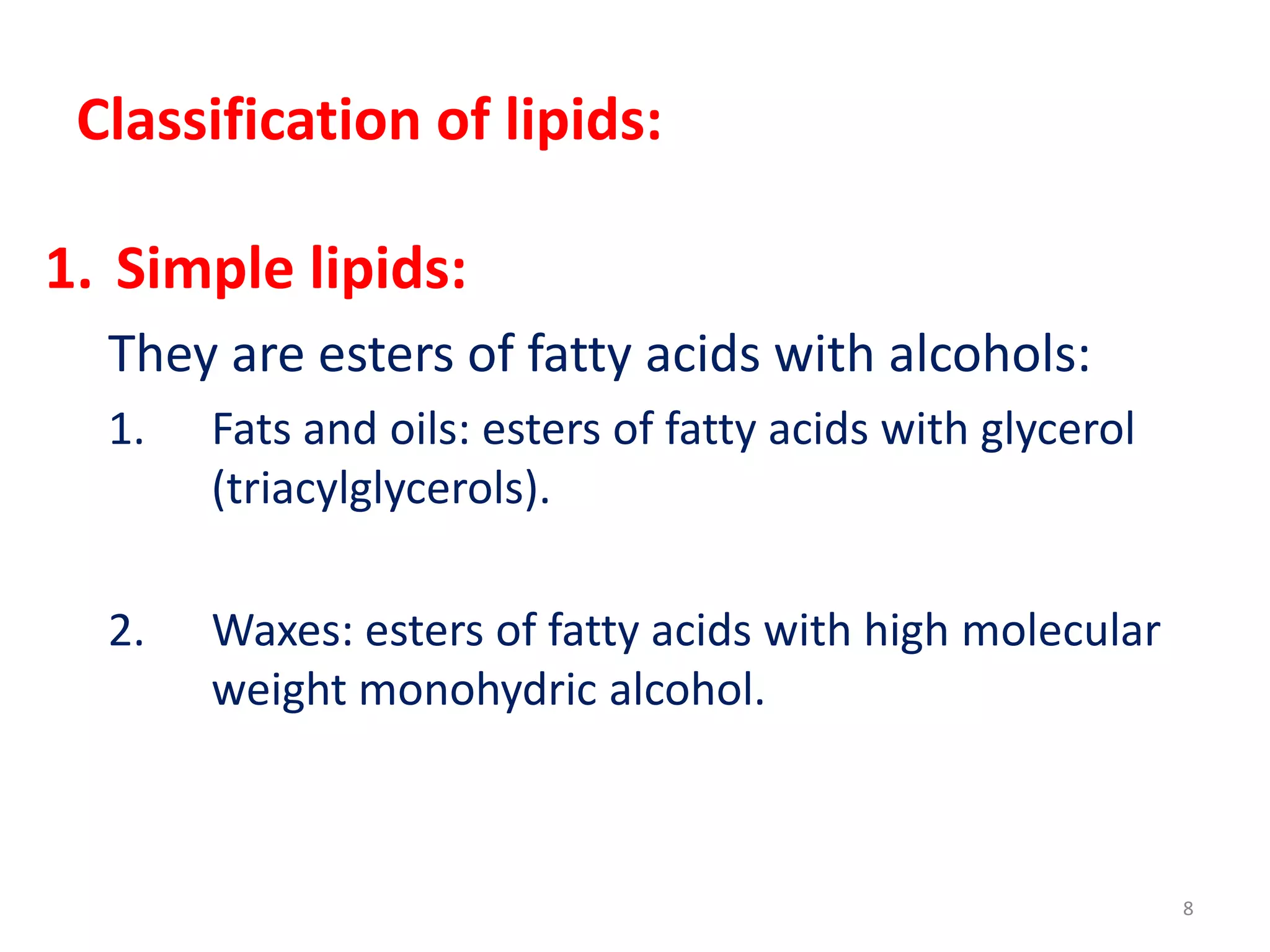
Classification of lipids:
1. Simple lipids:
They are esters of fatty acids with alcohols:
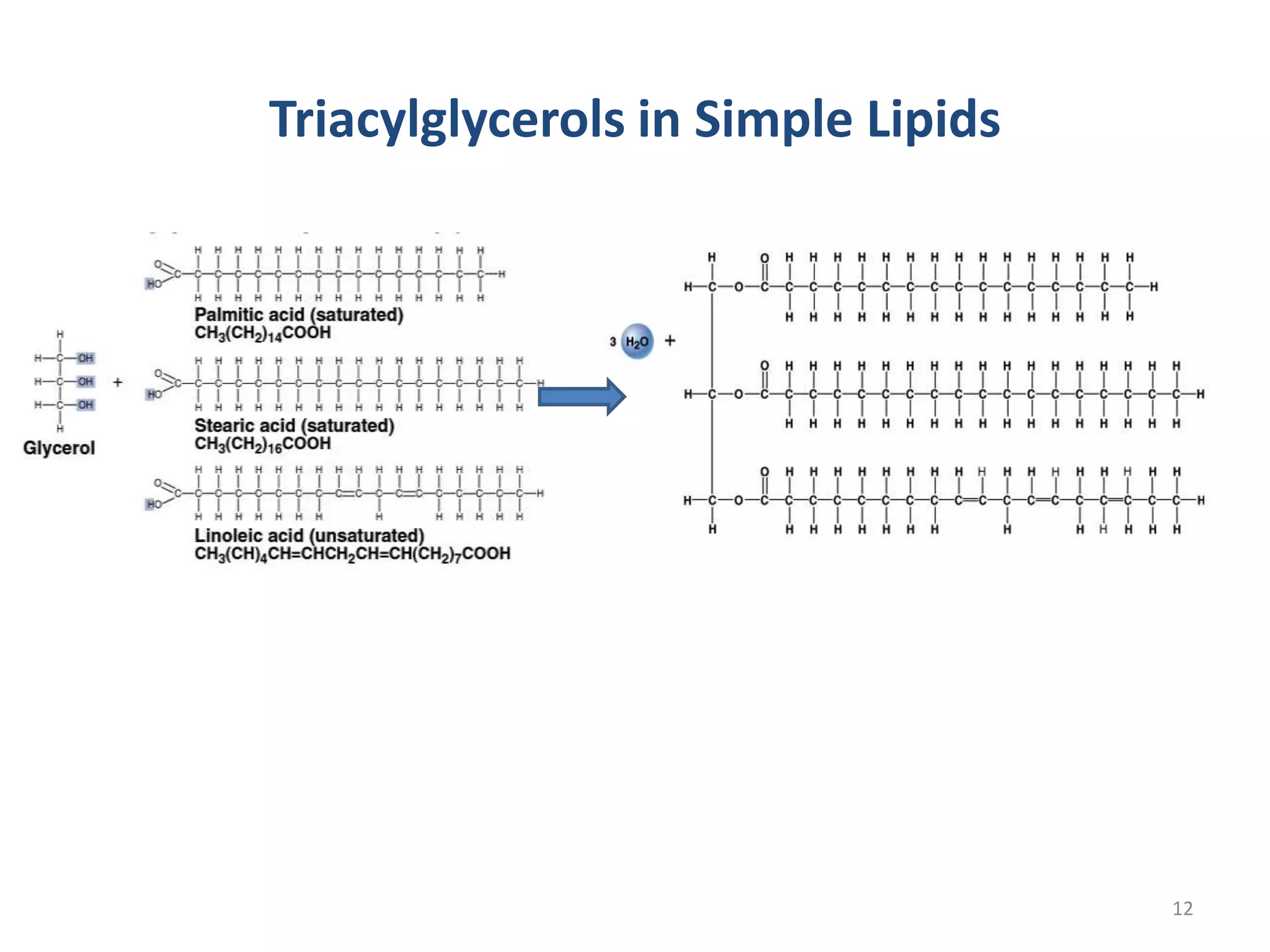
1. Fats and oils: esters of fatty acids with glycerol
(triacylglycerols).
2. Waxes: esters of fatty acids with high molecular
weight monohydric alcohol.
8
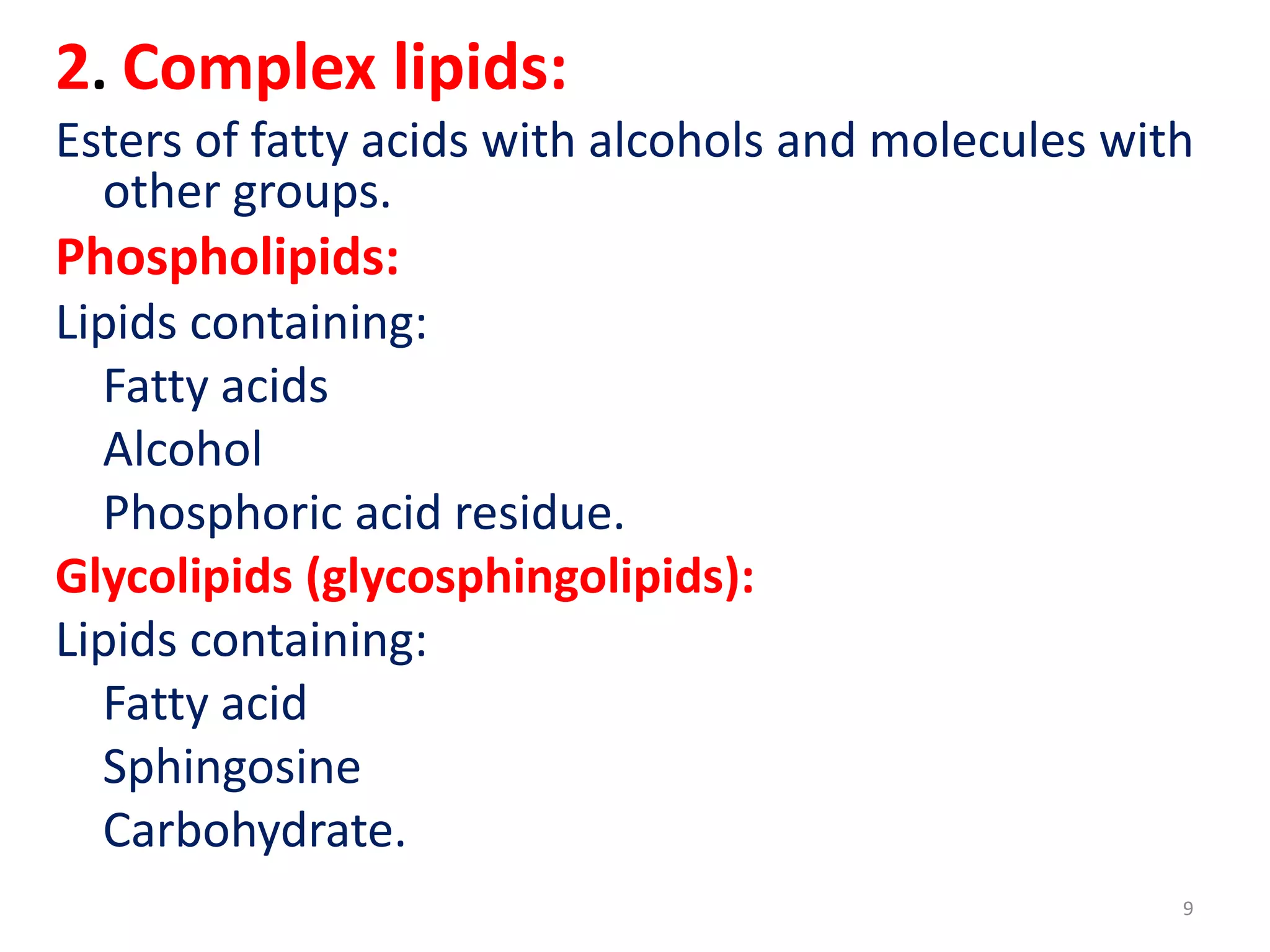
2. Complex lipids:
Esters of fatty acids with alcohols and molecules with
other groups.
Phospholipids:
Lipids containing:
Fatty acids
Alcohol
Phosphoric acid residue.
Glycolipids (glycosphingolipids):
Lipids containing:
Fatty acid
Sphingosine
Carbohydrate.
9
3. Precursor and derived lipids:
• This group includes:
–Fatty Acids.
–Glycerol.
–Cholesterol.
–Steroid hormones.
–Fatty aldehydes.
–Fat soluble vitamins [ A D E K].
–Some other alcohols.
10
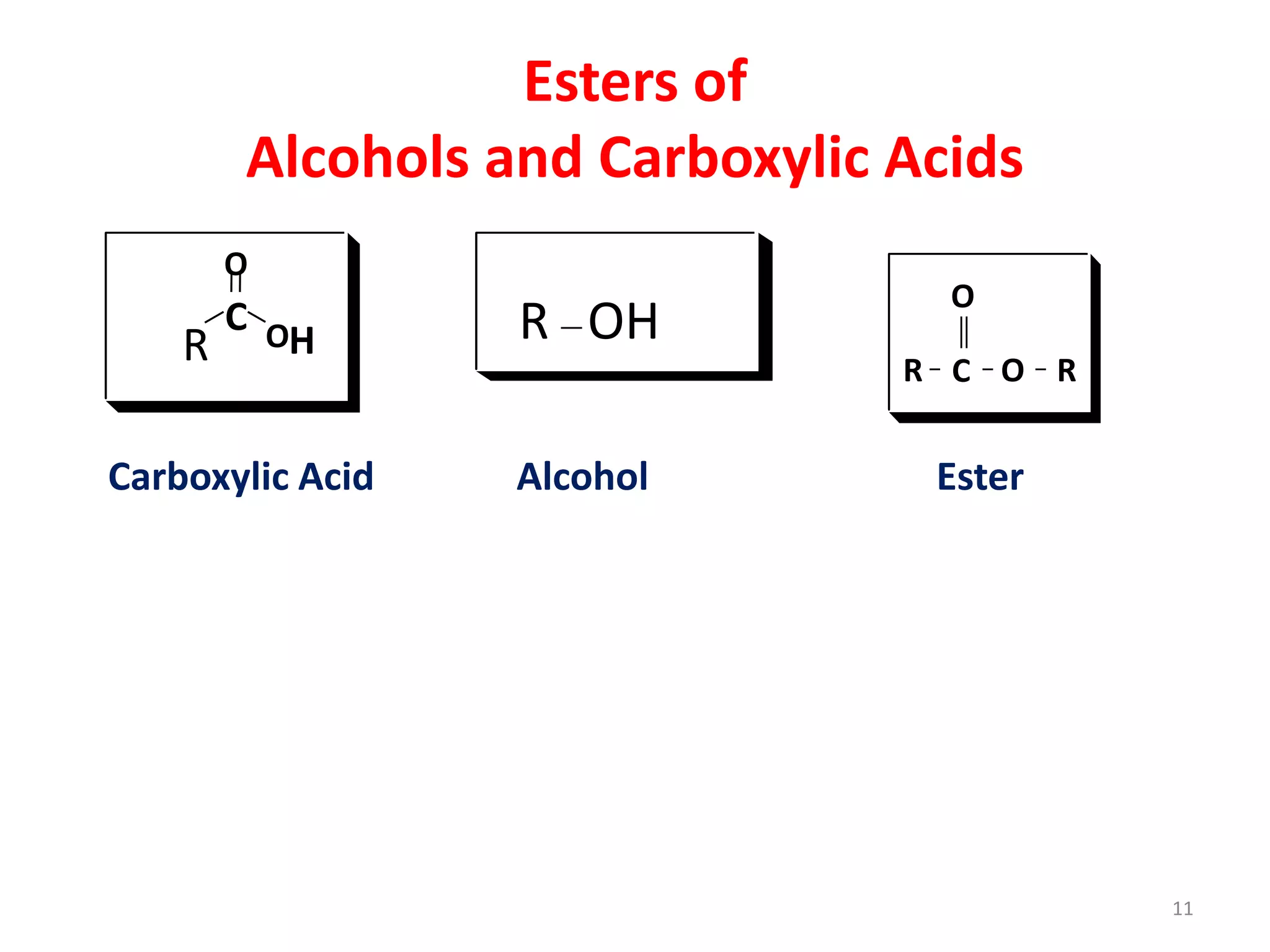
Esters of
Alcohols and Carboxylic Acids
11
R
C OH
O
Carboxylic Acid Alcohol Ester
R OH
R C O R
O
Triacylglycerols in Simple Lipids
12
Fatty Acids
• Fatty acids (FAs) exist as:
• Esterified fatty acids:
Fatty acids occur mainly as esters in natural fats
and oils (Triacylglycerols).
• Free fatty acids (FFA).
13
• more than 90% of FAs found in plasma are in the
form of FA esters.
– Triacylglycerols (triglycerides).
– Cholesterol esters
– Phospholipids
ALL are contained in lipoproteins.
• Unesterified FAs are circulated in association with
albumin.
14
Physiological Functions of Fatty Acids:
• Energy Source: During fasting, blood level of FFA
increases.
• FAs can be oxidized by many tissues including liver
and muscle to produce energy.
• FAs are structural components of membrane lipids.
• FAs are attached to some intracellular proteins.
• FAs are precursors of hormone-like prostaglandins.
• FAs esterified as TAGs stored in adipose tissue serve
as major energy reserve in the body.
15
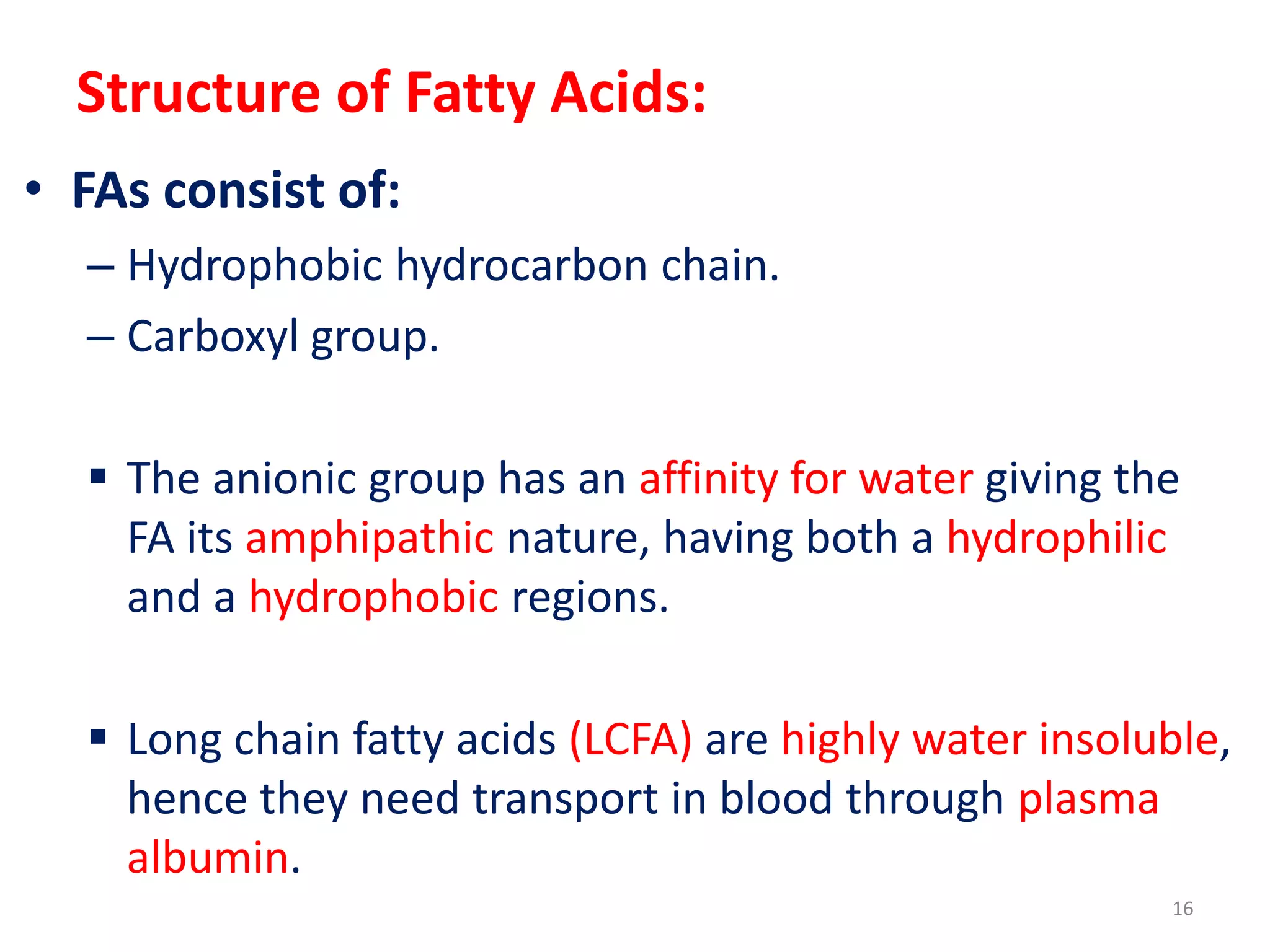
Structure of Fatty Acids:
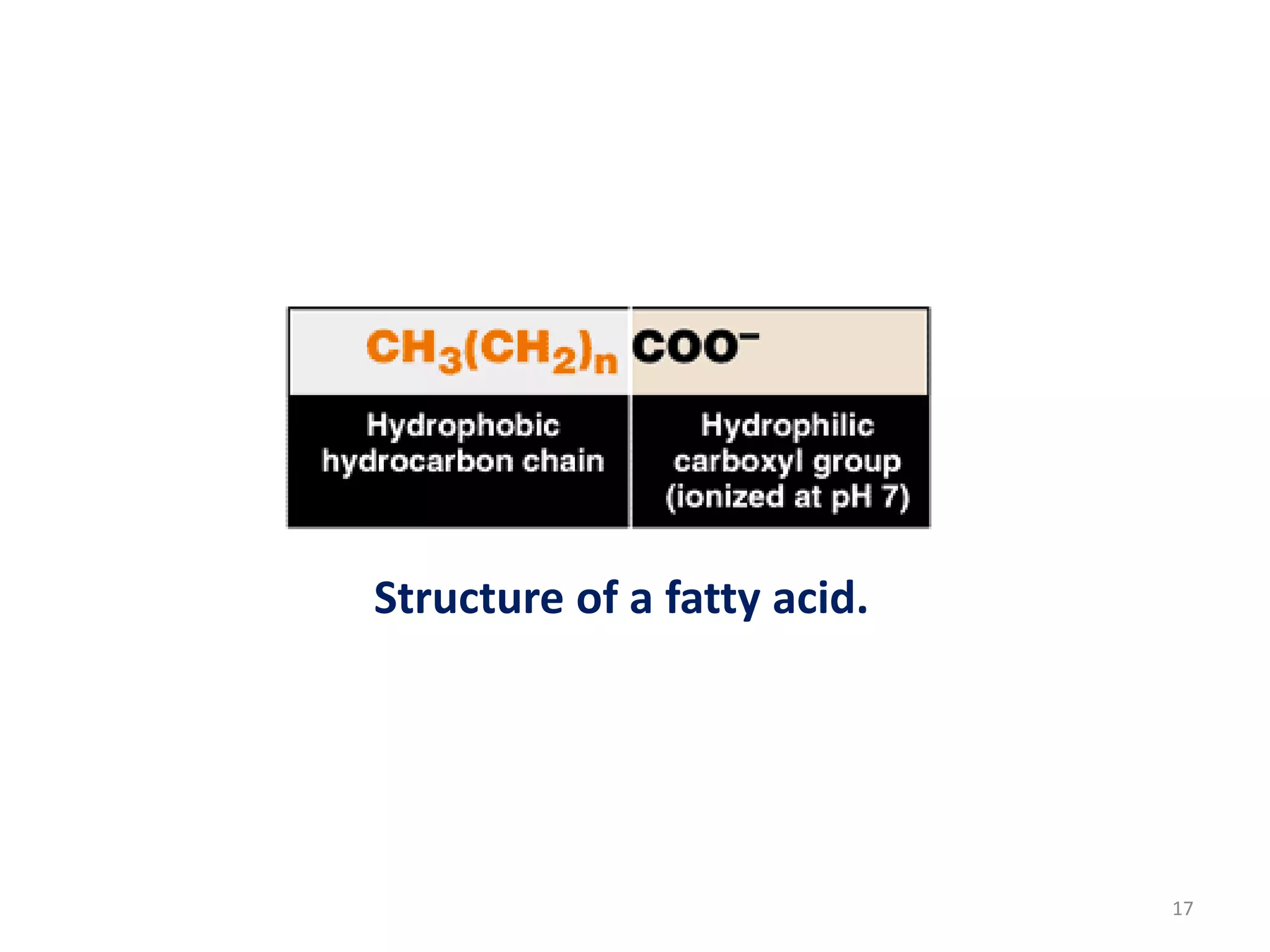
• FAs consist of:
– Hydrophobic hydrocarbon chain.
– Carboxyl group.
 The anionic group has an affinity for water giving the
FA its amphipathic nature, having both a hydrophilic
and a hydrophobic regions.
 Long chain fatty acids (LCFA) are highly water insoluble,
hence they need transport in blood through plasma
albumin.
16
Structure of a fatty acid.
17
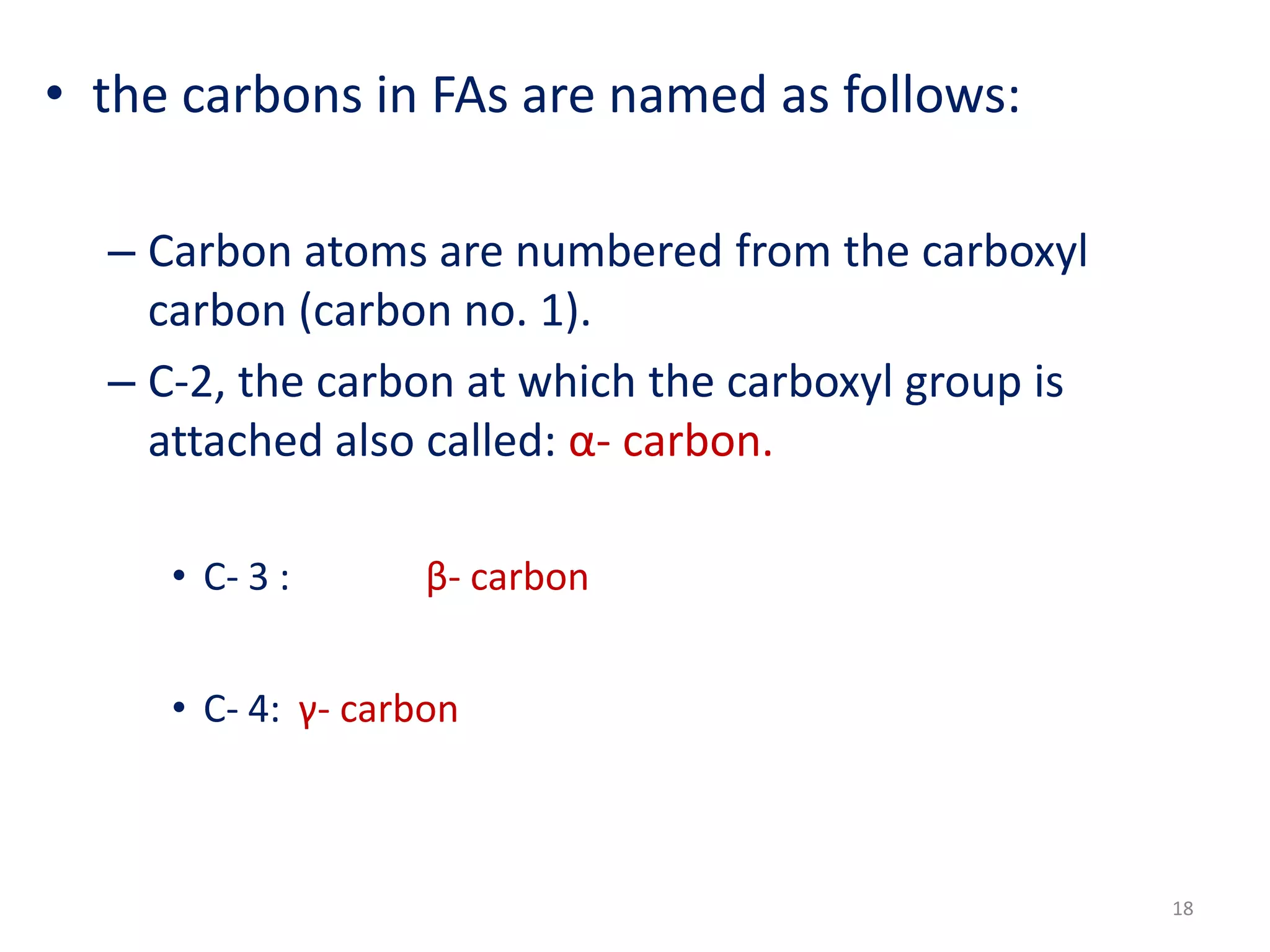
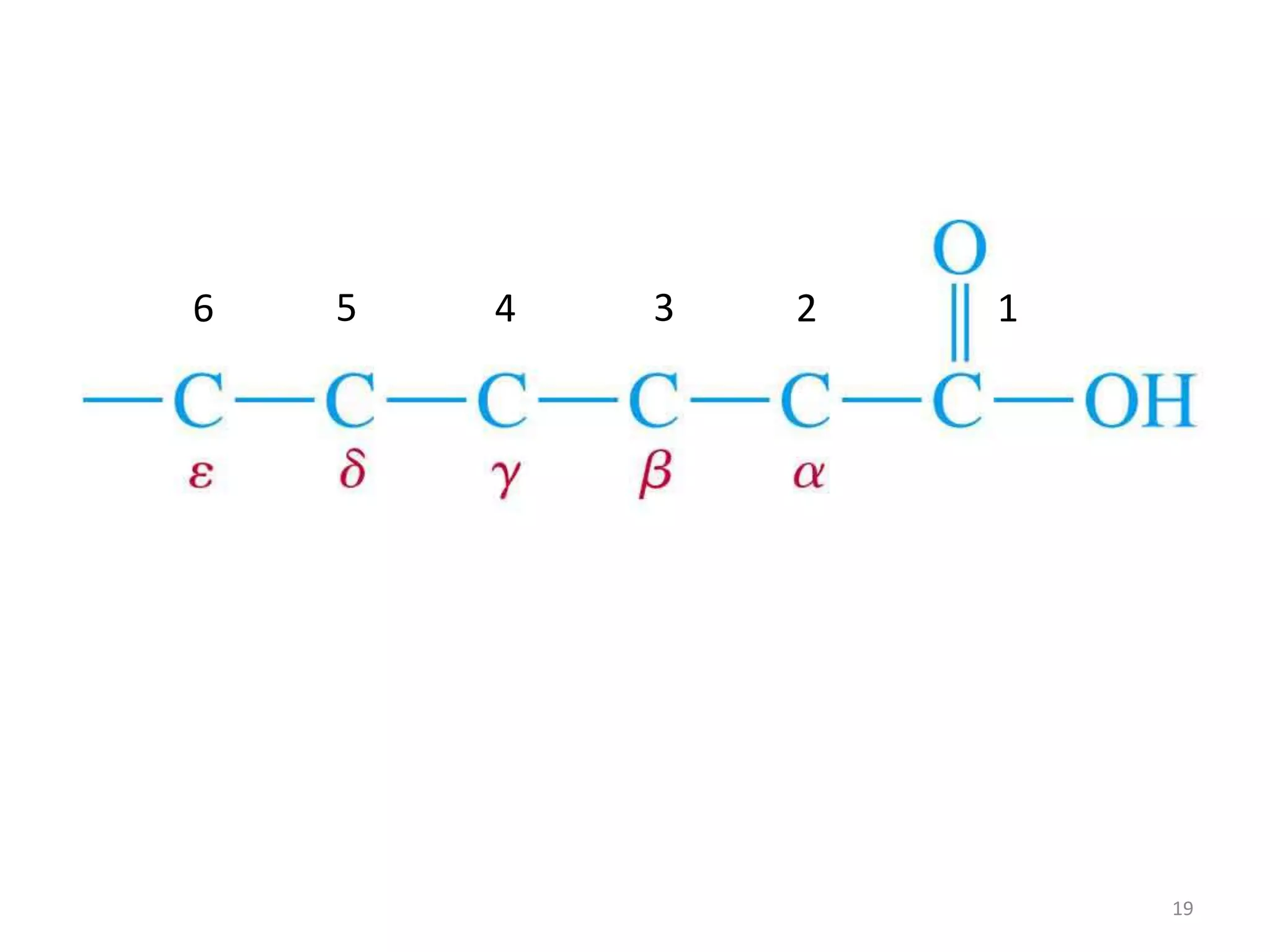
• the carbons in FAs are named as follows:
– Carbon atoms are numbered from the carboxyl
carbon (carbon no. 1).
– C-2, the carbon at which the carboxyl group is
attached also called: α- carbon.
• C- 3 : β- carbon
• C- 4: γ- carbon
18
19
126 5 4 3
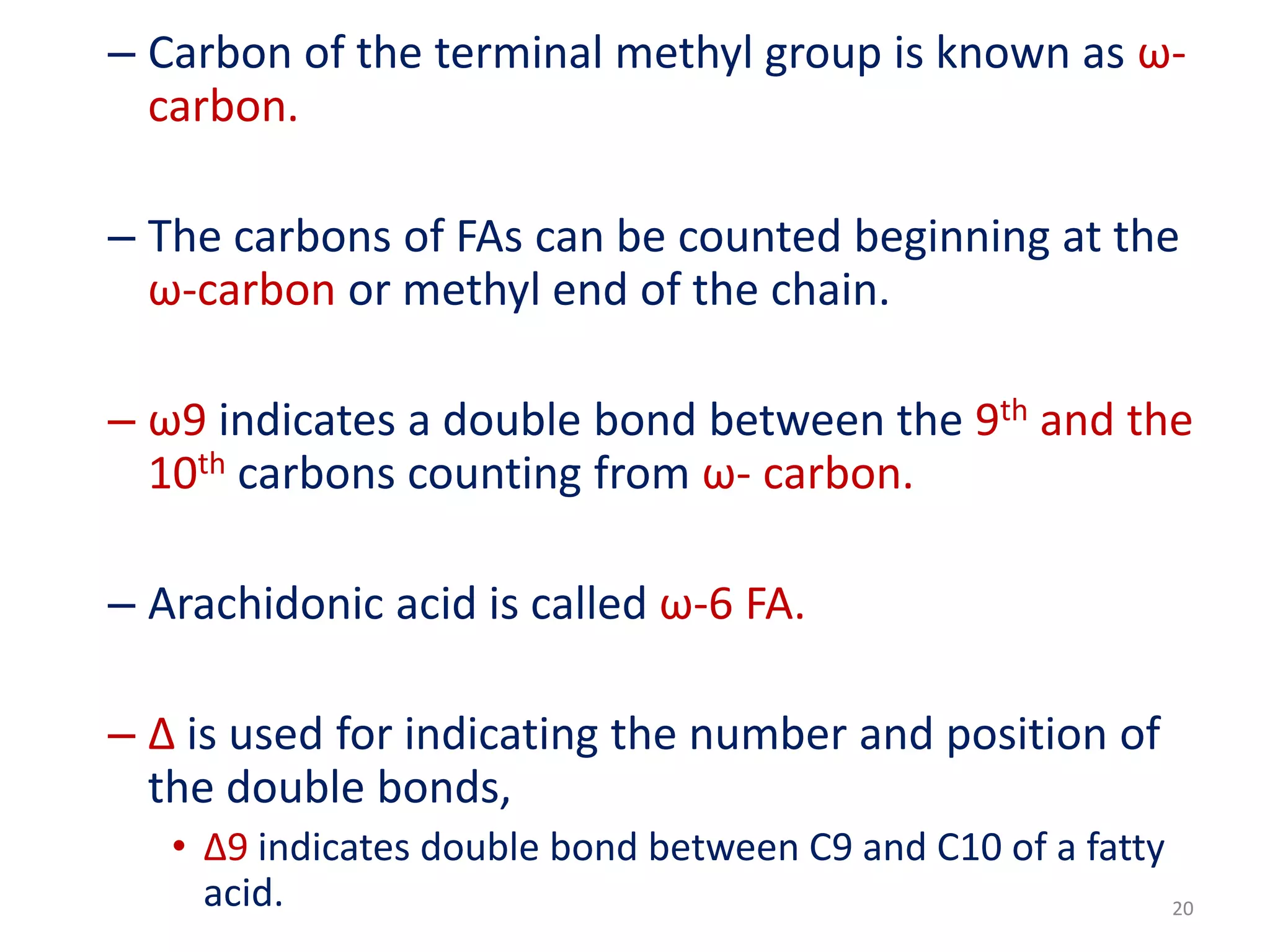
– Carbon of the terminal methyl group is known as ω-
carbon.
– The carbons of FAs can be counted beginning at the
ω-carbon or methyl end of the chain.
– ω9 indicates a double bond between the 9th and the
10th carbons counting from ω- carbon.
– Arachidonic acid is called ω-6 FA.
– Δ is used for indicating the number and position of
the double bonds,
• Δ9 indicates double bond between C9 and C10 of a fatty
acid. 20
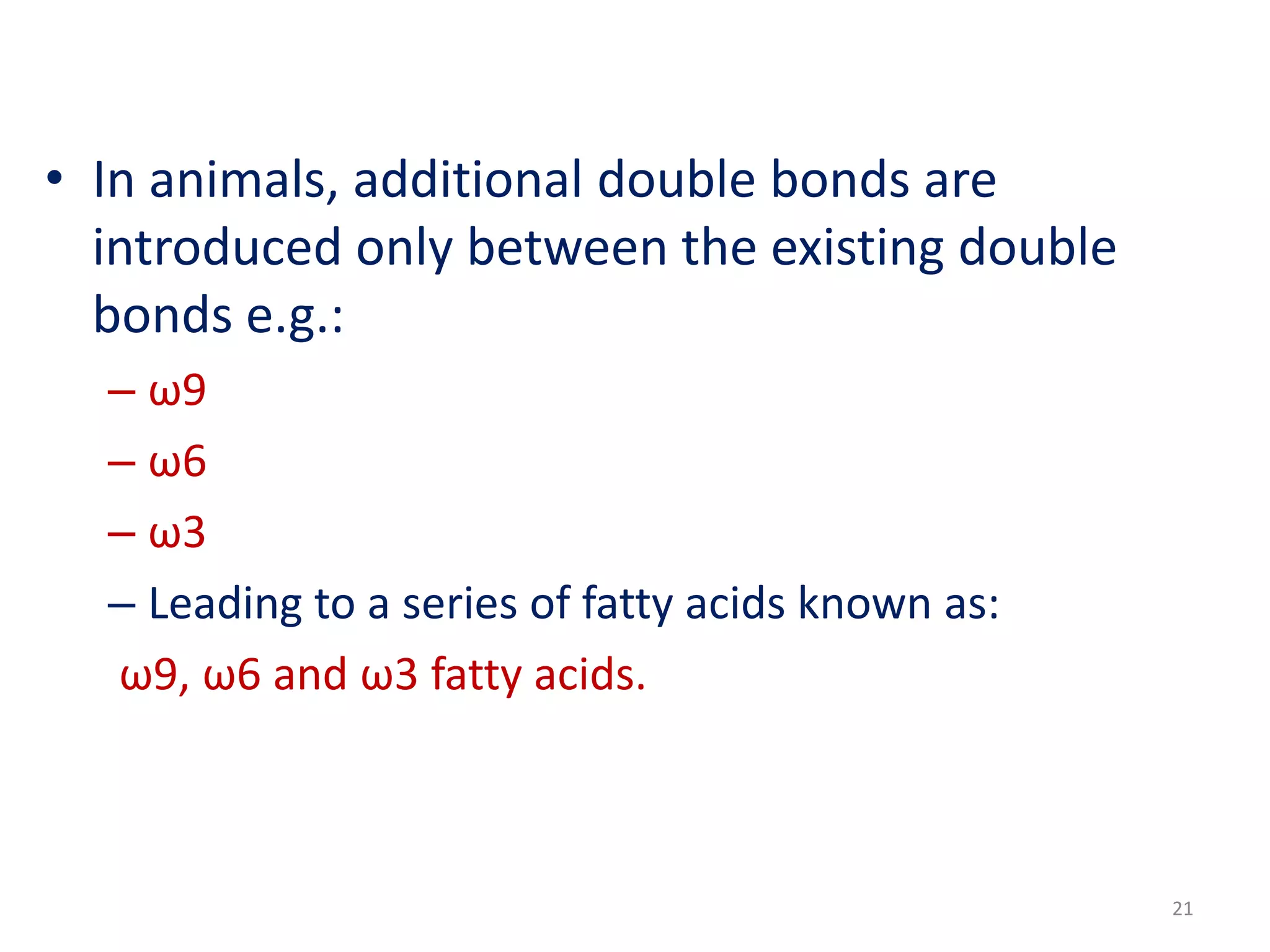
• In animals, additional double bonds are
introduced only between the existing double
bonds e.g.:
– ω9
– ω6
– ω3
– Leading to a series of fatty acids known as:
ω9, ω6 and ω3 fatty acids.
21
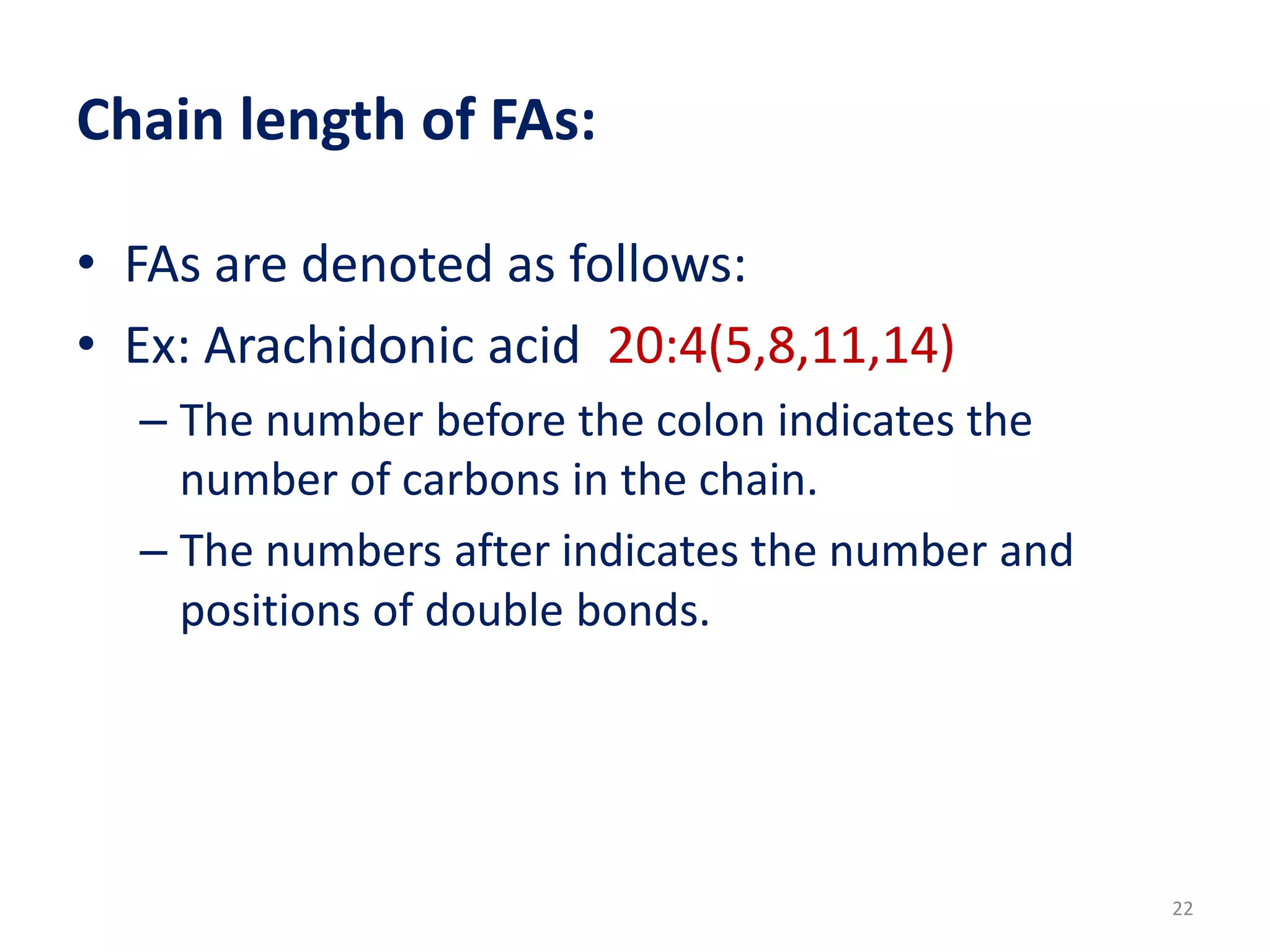
Chain length of FAs:
• FAs are denoted as follows:
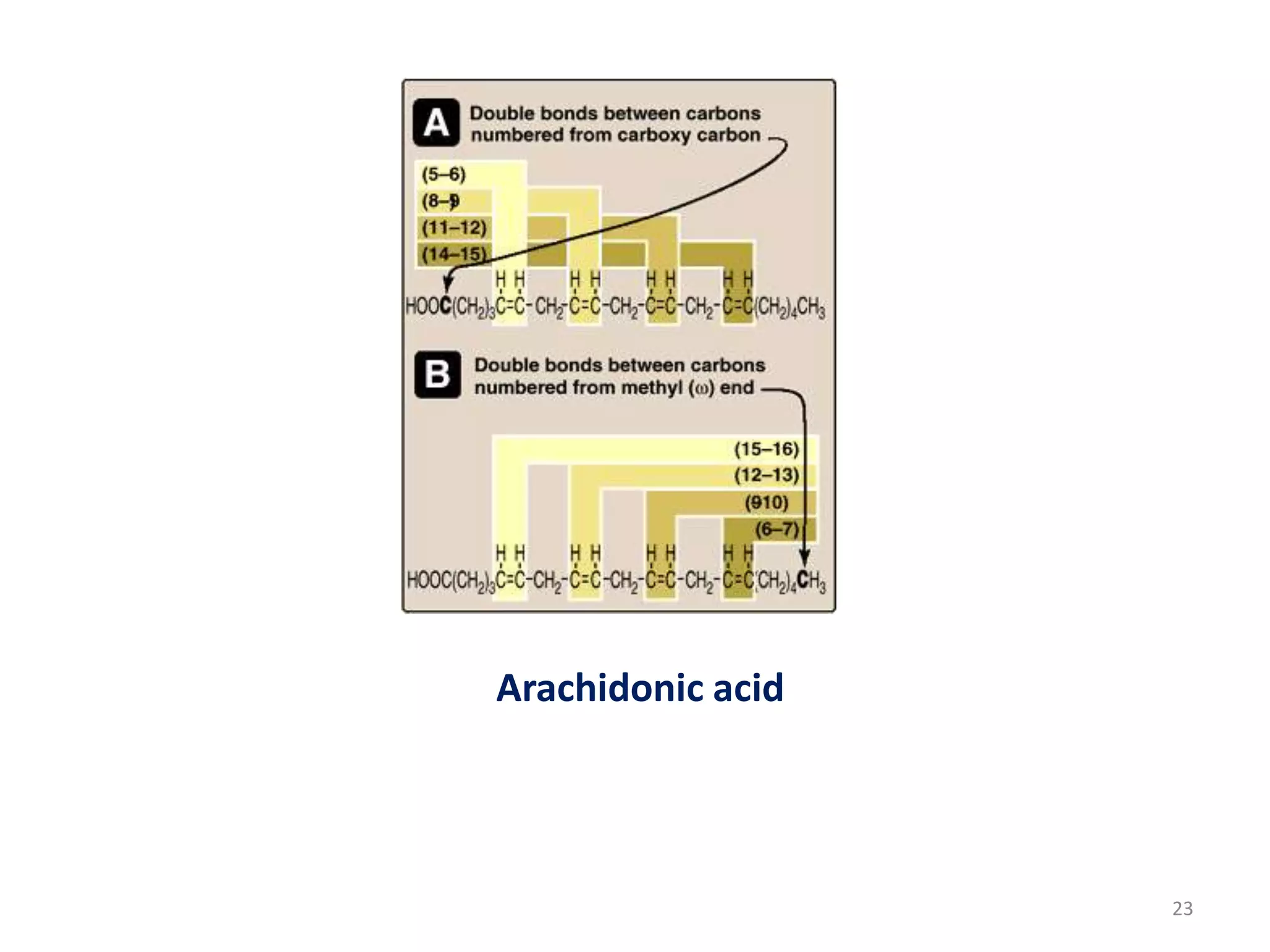
• Ex: Arachidonic acid 20:4(5,8,11,14)
– The number before the colon indicates the
number of carbons in the chain.
– The numbers after indicates the number and
positions of double bonds.
22
Arachidonic acid
23
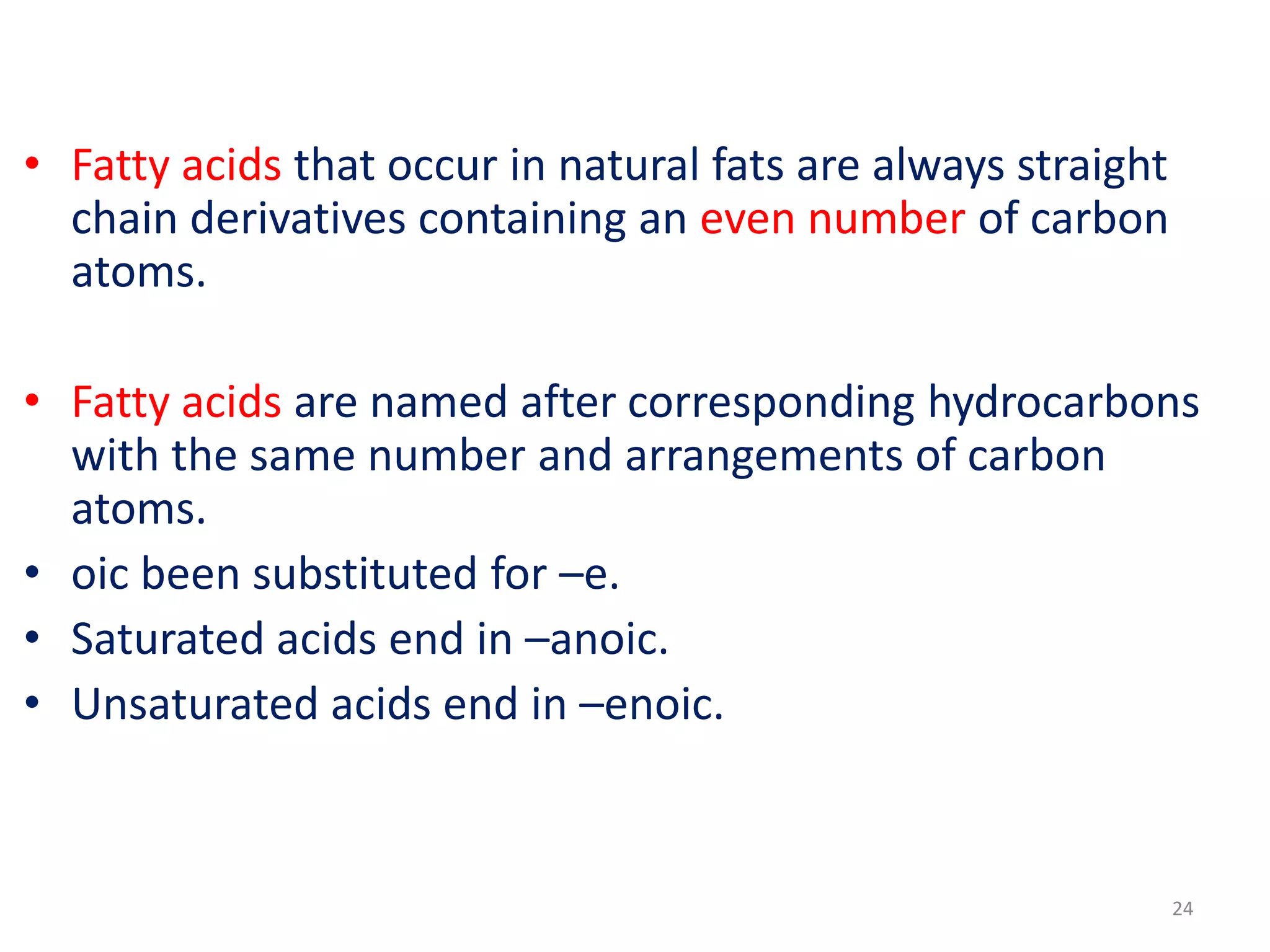
• Fatty acids that occur in natural fats are always straight
chain derivatives containing an even number of carbon
atoms.
• Fatty acids are named after corresponding hydrocarbons
with the same number and arrangements of carbon
atoms.
• oic been substituted for –e.
• Saturated acids end in –anoic.
• Unsaturated acids end in –enoic.
24
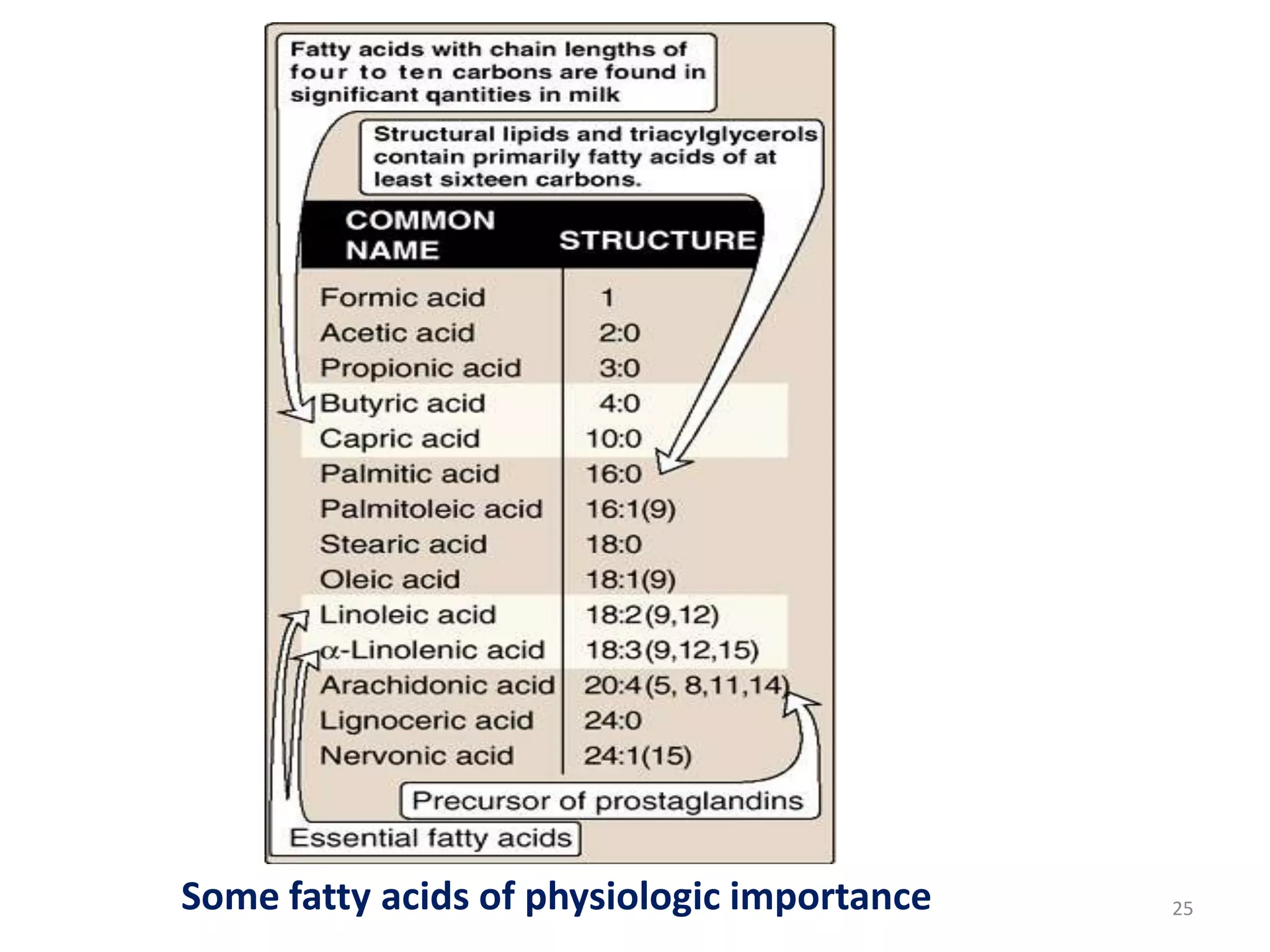
Some fatty acids of physiologic importance 25
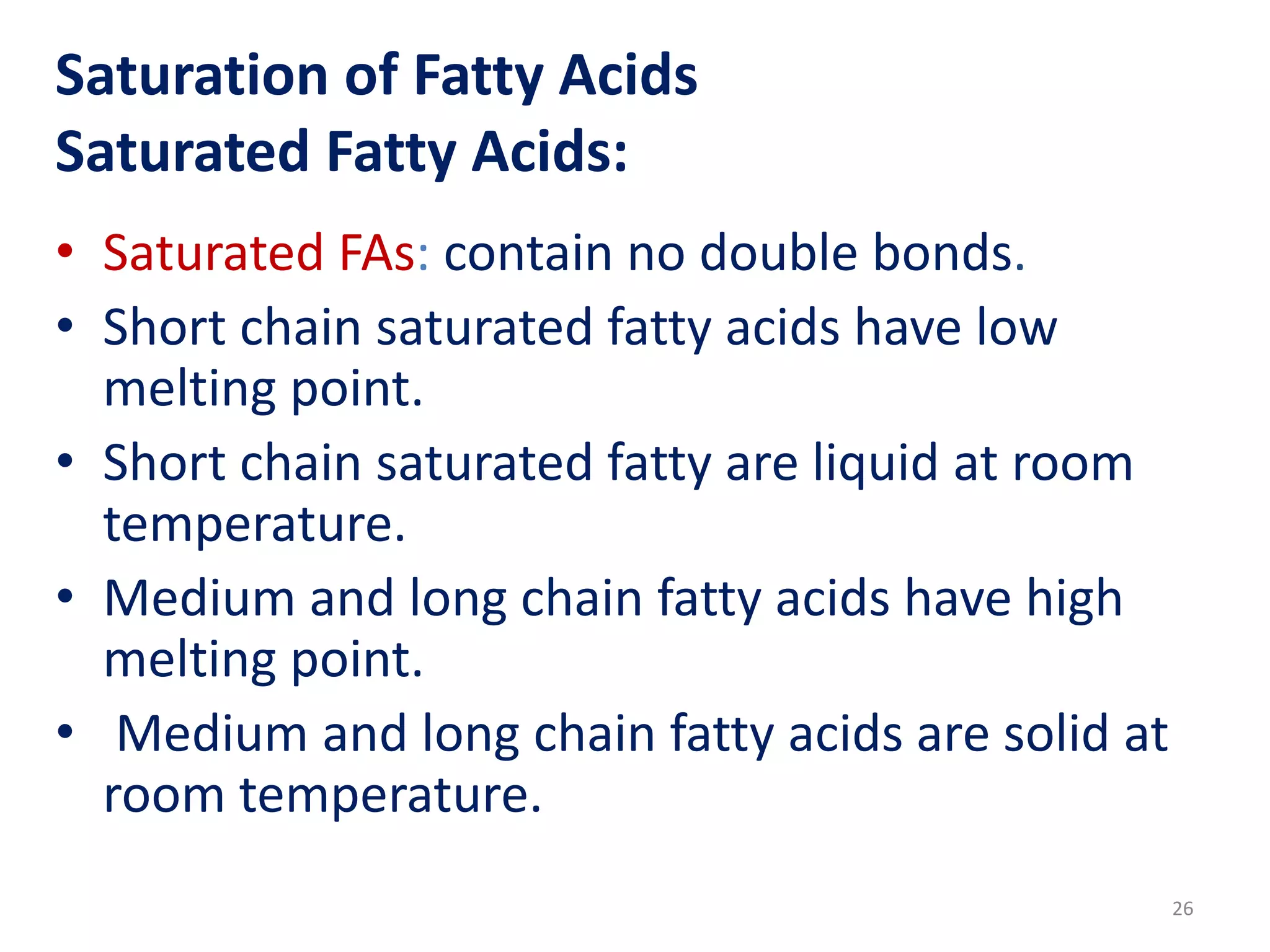
Saturation of Fatty Acids
Saturated Fatty Acids:
• Saturated FAs: contain no double bonds.
• Short chain saturated fatty acids have low
melting point.
• Short chain saturated fatty are liquid at room
temperature.
• Medium and long chain fatty acids have high
melting point.
• Medium and long chain fatty acids are solid at
room temperature.
26
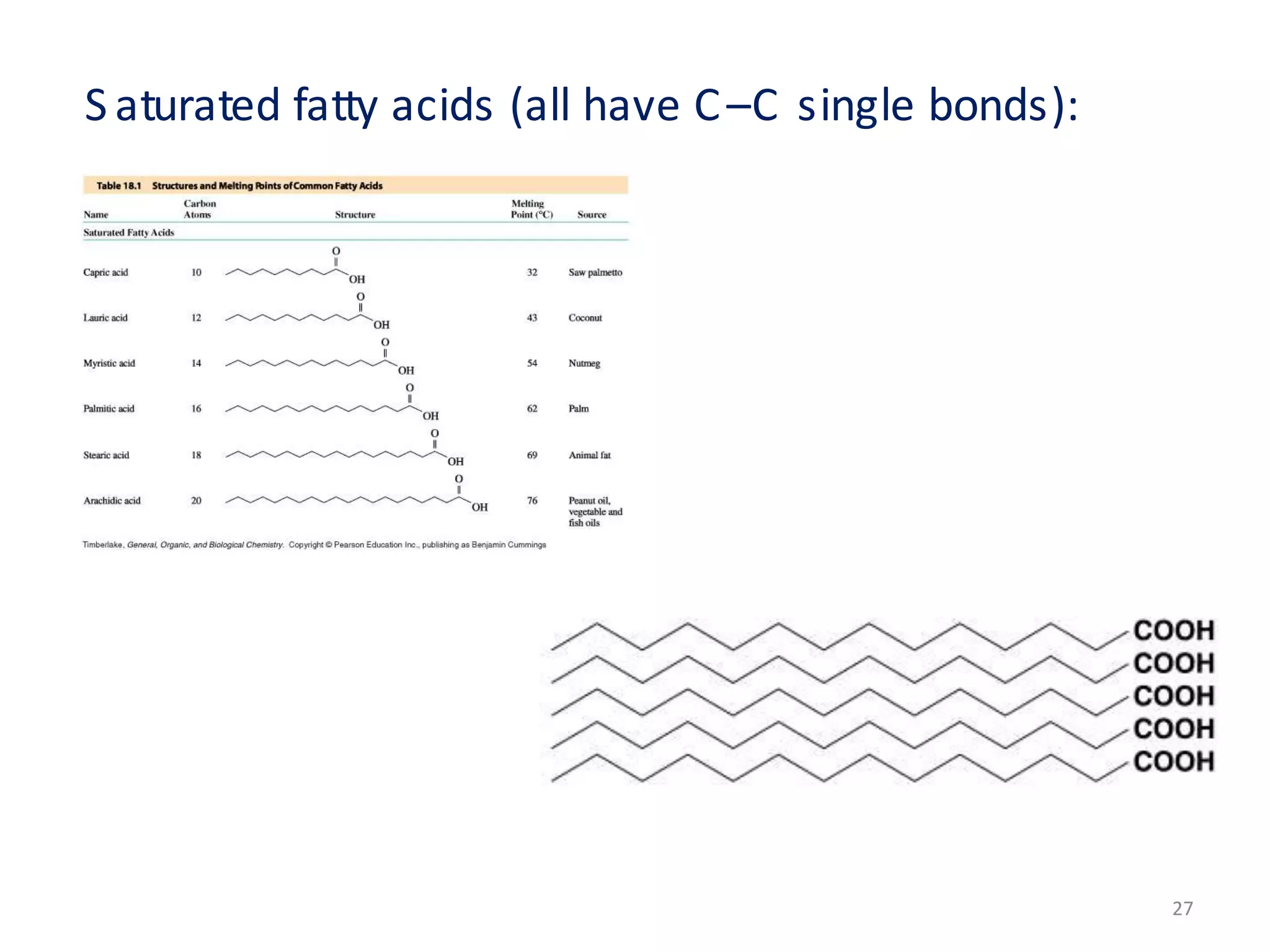
S aturated fatty acids (all have C–C single bonds):
27
Unsaturated Fatty Acids:
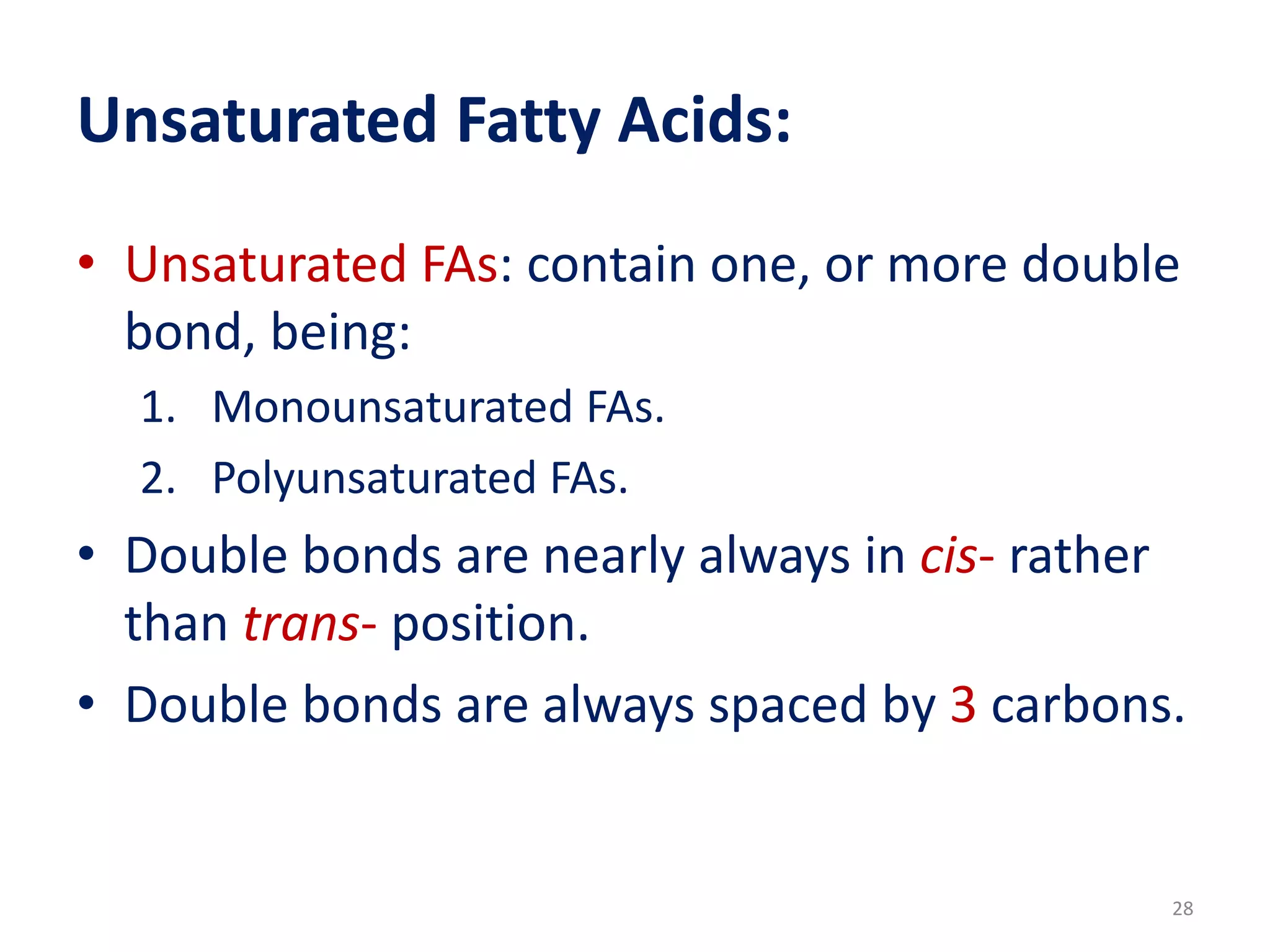
• Unsaturated FAs: contain one, or more double
bond, being:
1. Monounsaturated FAs.
2. Polyunsaturated FAs.
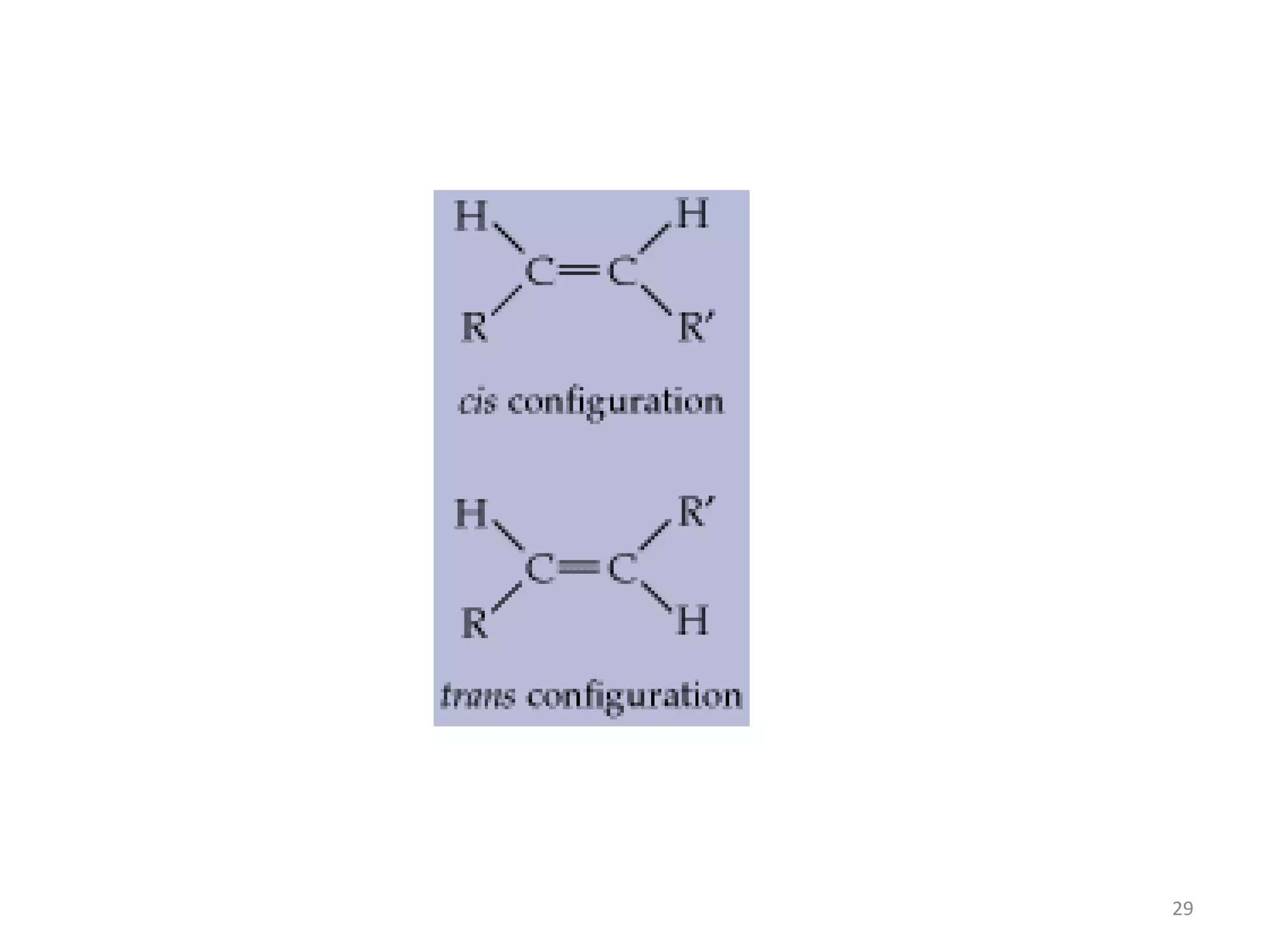
• Double bonds are nearly always in cis- rather
than trans- position.
• Double bonds are always spaced by 3 carbons.
28
29
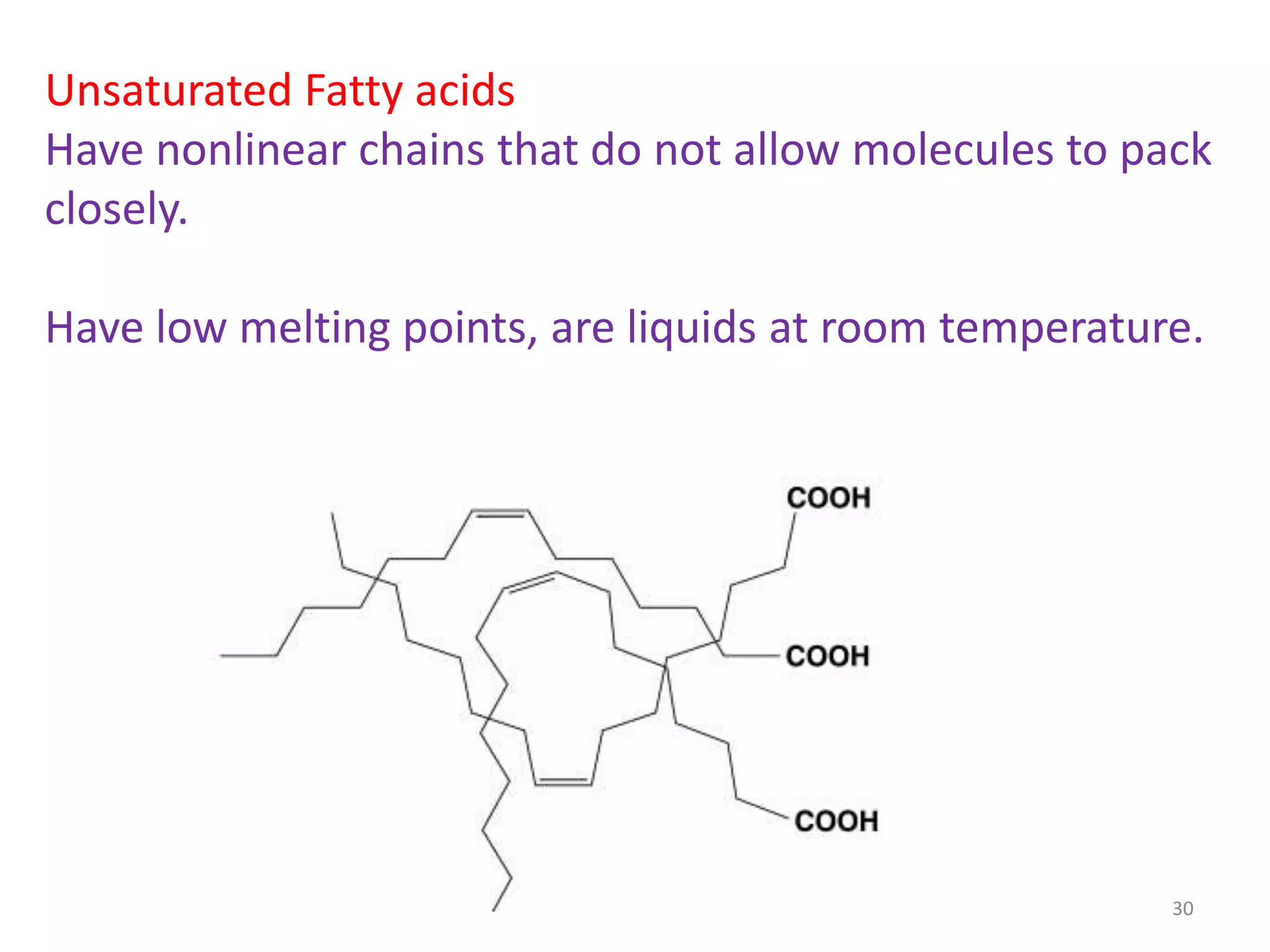
Unsaturated Fatty acids
Have nonlinear chains that do not allow molecules to pack
closely.
Have low melting points, are liquids at room temperature.
30
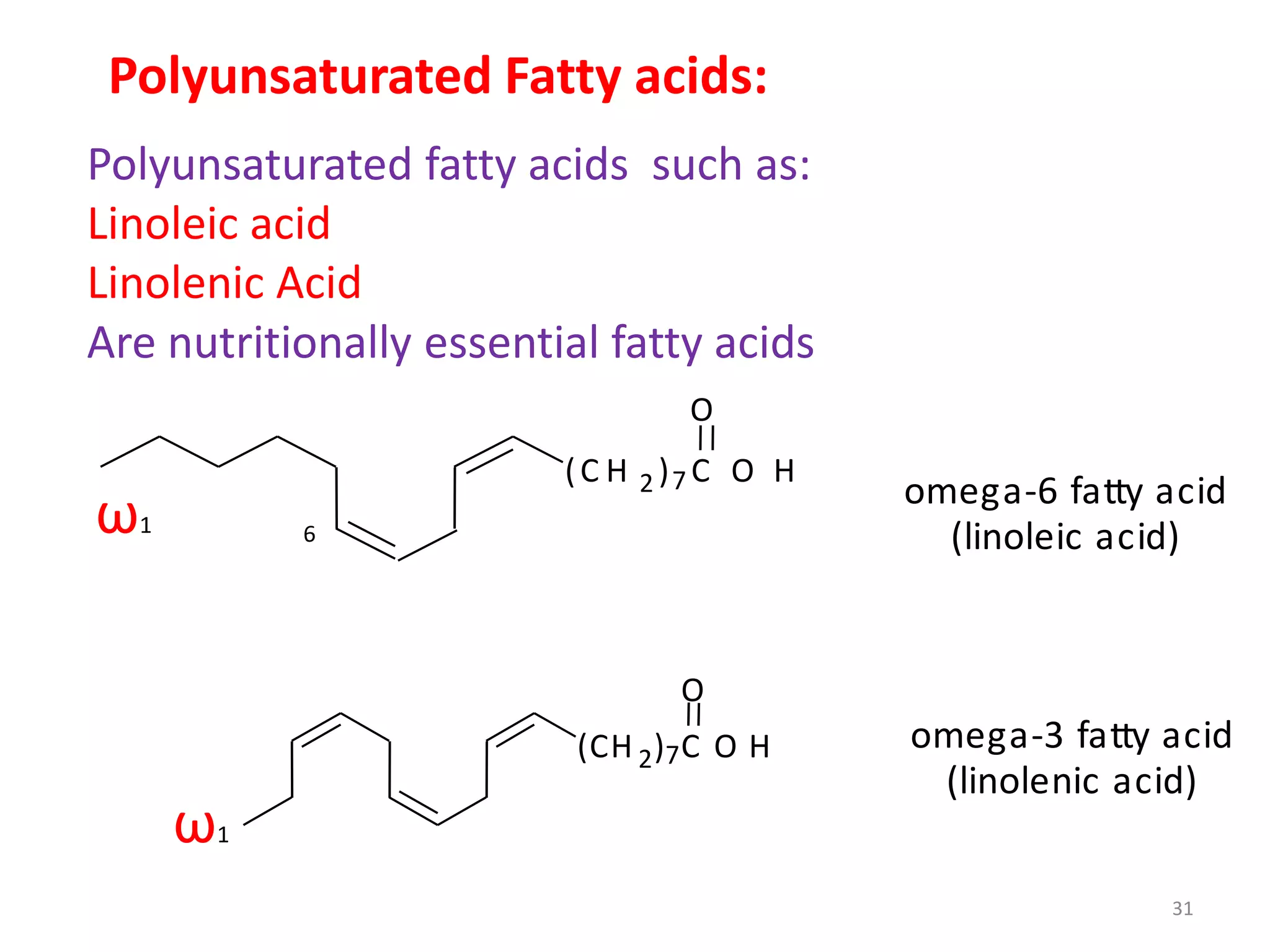
(CH 2)7C O H
O
omega-6 fatty acid
(linoleic acid)
(C H 2 )7 C O H
O
6ω1
ω1
omega-3 fatty acid
(linolenic acid)
Polyunsaturated Fatty acids:
Polyunsaturated fatty acids such as:
Linoleic acid
Linolenic Acid
Are nutritionally essential fatty acids
31
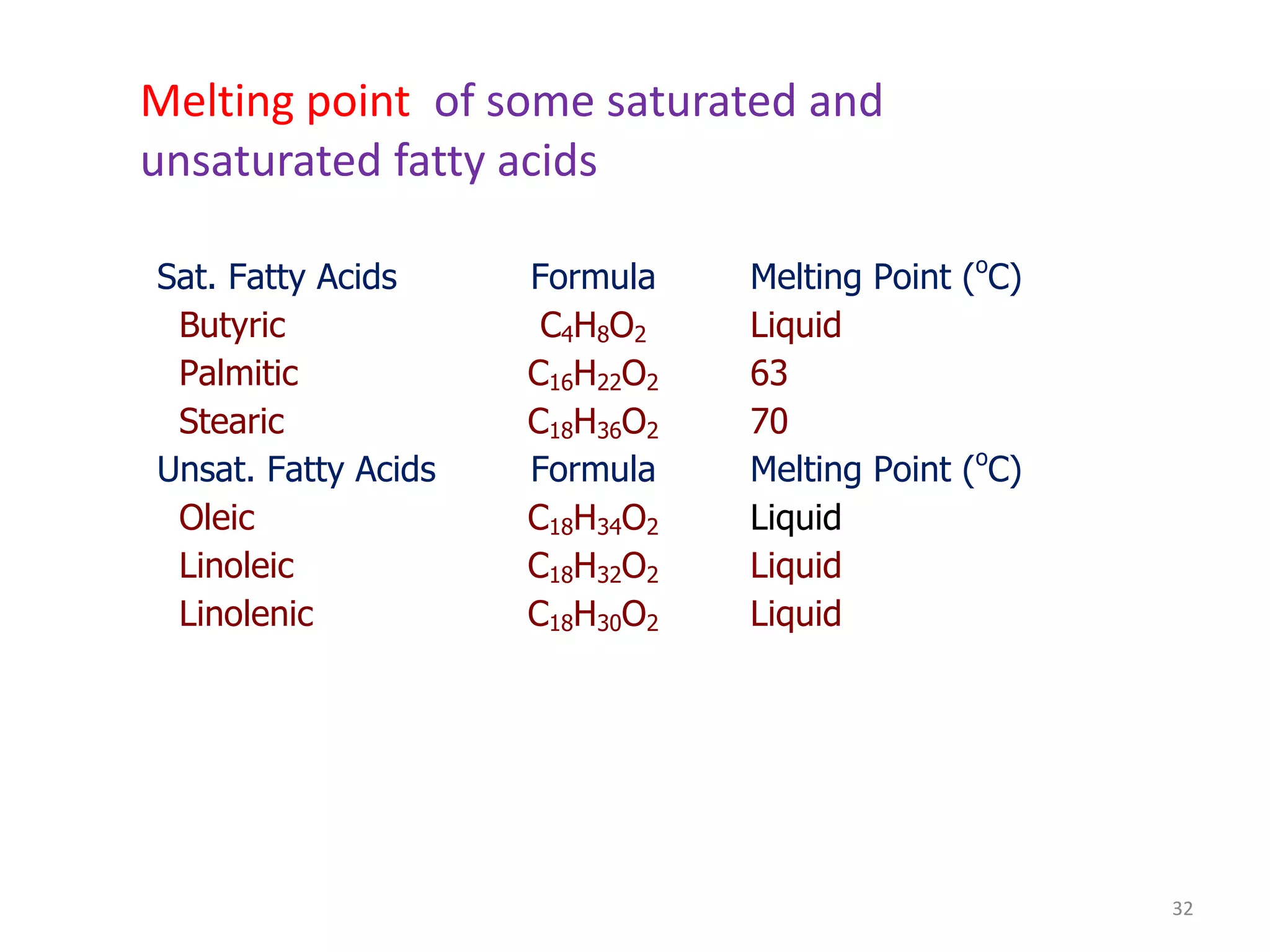
Sat. Fatty Acids Formula Melting Point (o
C)
Butyric C4H8O2 Liquid
Palmitic C16H22O2 63
Stearic C18H36O2 70
Unsat. Fatty Acids Formula Melting Point (o
C)
Oleic C18H34O2 Liquid
Linoleic C18H32O2 Liquid
Linolenic C18H30O2 Liquid
Melting point of some saturated and
unsaturated fatty acids
32
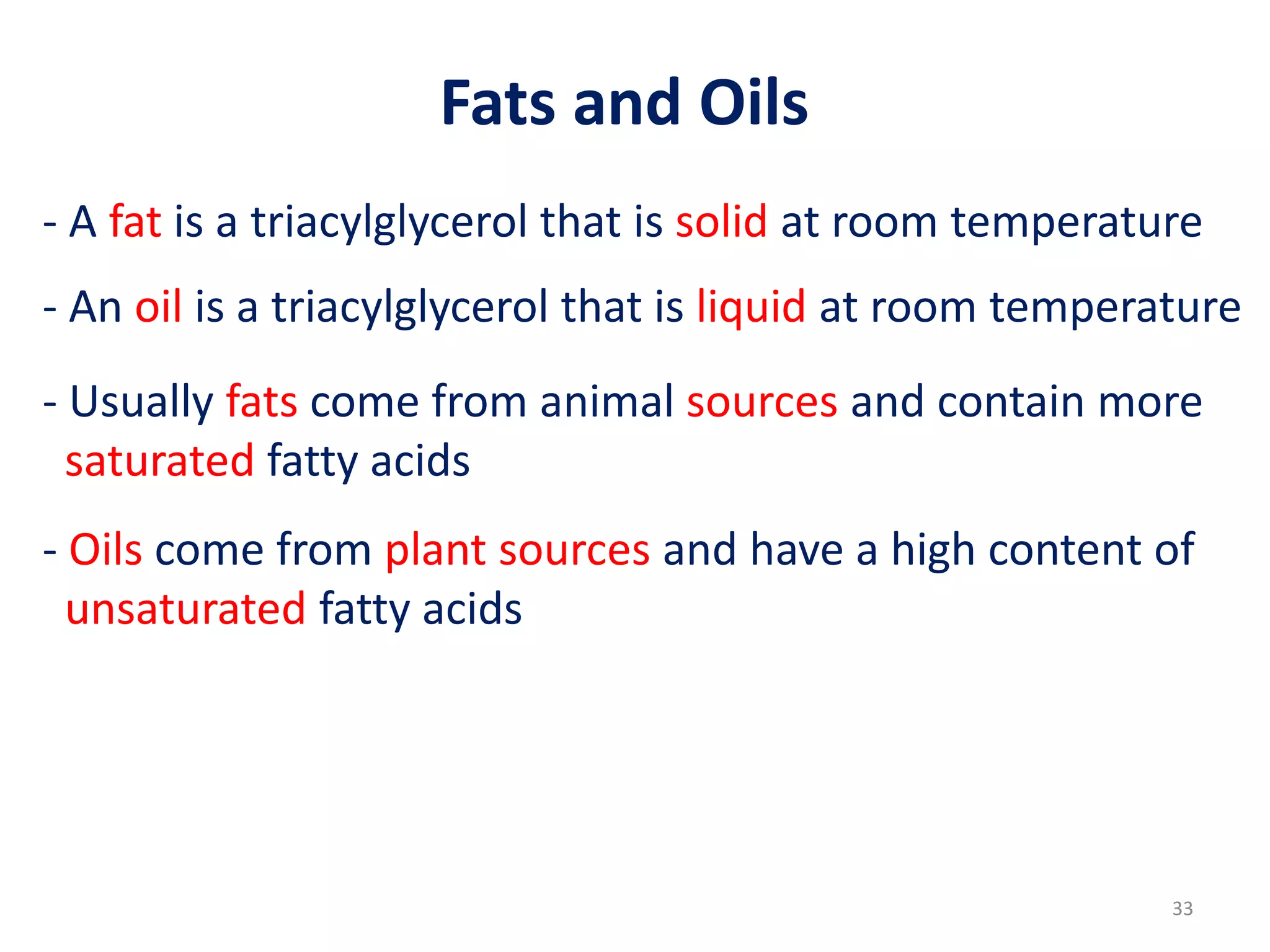
- A fat is a triacylglycerol that is solid at room temperature
- An oil is a triacylglycerol that is liquid at room temperature
- Usually fats come from animal sources and contain more
saturated fatty acids
- Oils come from plant sources and have a high content of
unsaturated fatty acids
Fats and Oils
33
THANKS
34

Simple lipids

  • 1.
  • 2.
    • Lipids area heterogamous group of chemical compounds including: • Fats • Oils • Waxes • Steroids • Other related compounds [they are related more by their physical properties than their chemical properties.] 2
  • 3.
    Common properties oflipids: • Relatively insoluble in water. • Soluble in nonpolar solvents such as: –Ether . –Chloroform. –Benzene. –Acetone. 3
  • 4.
    Lipids are importantdietary constituents: • High energy value. • Essential fatty acids. • Fat soluble vitamins [ A D E K]. 4
  • 5.
    • Lipids arestored in adipose tissue • It serves as thermal insulator • Nonpolar lipids serve as electrical insulator in nerves. • Lipids and proteins (Lipoproteins) are important constituents of cell and mitochondrial membranes. • Lipoproteins serve as means of transport of lipids in blood. 5
  • 6.
    Knowledge of lipidsbiochemistry is necessary in understanding many important biochemical areas e.g.: Obesity. Diabetes mellitus. Atherosclerosis. Nutrition: role of polyunsaturated fatty acids and fat soluble vitamins. etc…… 6
  • 7.
    Classification of lipids: •Simple lipids. • Complex lipids. • Precursor and derived lipids. 7
  • 8.
    Classification of lipids: 1.Simple lipids: They are esters of fatty acids with alcohols: 1. Fats and oils: esters of fatty acids with glycerol (triacylglycerols). 2. Waxes: esters of fatty acids with high molecular weight monohydric alcohol. 8
  • 9.
    2. Complex lipids: Estersof fatty acids with alcohols and molecules with other groups. Phospholipids: Lipids containing: Fatty acids Alcohol Phosphoric acid residue. Glycolipids (glycosphingolipids): Lipids containing: Fatty acid Sphingosine Carbohydrate. 9
  • 10.
    3. Precursor andderived lipids: • This group includes: –Fatty Acids. –Glycerol. –Cholesterol. –Steroid hormones. –Fatty aldehydes. –Fat soluble vitamins [ A D E K]. –Some other alcohols. 10
  • 11.
    Esters of Alcohols andCarboxylic Acids 11 R C OH O Carboxylic Acid Alcohol Ester R OH R C O R O
  • 12.
  • 13.
    Fatty Acids • Fattyacids (FAs) exist as: • Esterified fatty acids: Fatty acids occur mainly as esters in natural fats and oils (Triacylglycerols). • Free fatty acids (FFA). 13
  • 14.
    • more than90% of FAs found in plasma are in the form of FA esters. – Triacylglycerols (triglycerides). – Cholesterol esters – Phospholipids ALL are contained in lipoproteins. • Unesterified FAs are circulated in association with albumin. 14
  • 15.
    Physiological Functions ofFatty Acids: • Energy Source: During fasting, blood level of FFA increases. • FAs can be oxidized by many tissues including liver and muscle to produce energy. • FAs are structural components of membrane lipids. • FAs are attached to some intracellular proteins. • FAs are precursors of hormone-like prostaglandins. • FAs esterified as TAGs stored in adipose tissue serve as major energy reserve in the body. 15
  • 16.
    Structure of FattyAcids: • FAs consist of: – Hydrophobic hydrocarbon chain. – Carboxyl group.  The anionic group has an affinity for water giving the FA its amphipathic nature, having both a hydrophilic and a hydrophobic regions.  Long chain fatty acids (LCFA) are highly water insoluble, hence they need transport in blood through plasma albumin. 16
  • 17.
    Structure of afatty acid. 17
  • 18.
    • the carbonsin FAs are named as follows: – Carbon atoms are numbered from the carboxyl carbon (carbon no. 1). – C-2, the carbon at which the carboxyl group is attached also called: α- carbon. • C- 3 : β- carbon • C- 4: γ- carbon 18
  • 19.
  • 20.
    – Carbon ofthe terminal methyl group is known as ω- carbon. – The carbons of FAs can be counted beginning at the ω-carbon or methyl end of the chain. – ω9 indicates a double bond between the 9th and the 10th carbons counting from ω- carbon. – Arachidonic acid is called ω-6 FA. – Δ is used for indicating the number and position of the double bonds, • Δ9 indicates double bond between C9 and C10 of a fatty acid. 20
  • 21.
    • In animals,additional double bonds are introduced only between the existing double bonds e.g.: – ω9 – ω6 – ω3 – Leading to a series of fatty acids known as: ω9, ω6 and ω3 fatty acids. 21
  • 22.
    Chain length ofFAs: • FAs are denoted as follows: • Ex: Arachidonic acid 20:4(5,8,11,14) – The number before the colon indicates the number of carbons in the chain. – The numbers after indicates the number and positions of double bonds. 22
  • 23.
  • 24.
    • Fatty acidsthat occur in natural fats are always straight chain derivatives containing an even number of carbon atoms. • Fatty acids are named after corresponding hydrocarbons with the same number and arrangements of carbon atoms. • oic been substituted for –e. • Saturated acids end in –anoic. • Unsaturated acids end in –enoic. 24
  • 25.
    Some fatty acidsof physiologic importance 25
  • 26.
    Saturation of FattyAcids Saturated Fatty Acids: • Saturated FAs: contain no double bonds. • Short chain saturated fatty acids have low melting point. • Short chain saturated fatty are liquid at room temperature. • Medium and long chain fatty acids have high melting point. • Medium and long chain fatty acids are solid at room temperature. 26
  • 27.
    S aturated fattyacids (all have C–C single bonds): 27
  • 28.
    Unsaturated Fatty Acids: •Unsaturated FAs: contain one, or more double bond, being: 1. Monounsaturated FAs. 2. Polyunsaturated FAs. • Double bonds are nearly always in cis- rather than trans- position. • Double bonds are always spaced by 3 carbons. 28
  • 29.
  • 30.
    Unsaturated Fatty acids Havenonlinear chains that do not allow molecules to pack closely. Have low melting points, are liquids at room temperature. 30
  • 31.
    (CH 2)7C OH O omega-6 fatty acid (linoleic acid) (C H 2 )7 C O H O 6ω1 ω1 omega-3 fatty acid (linolenic acid) Polyunsaturated Fatty acids: Polyunsaturated fatty acids such as: Linoleic acid Linolenic Acid Are nutritionally essential fatty acids 31
  • 32.
    Sat. Fatty AcidsFormula Melting Point (o C) Butyric C4H8O2 Liquid Palmitic C16H22O2 63 Stearic C18H36O2 70 Unsat. Fatty Acids Formula Melting Point (o C) Oleic C18H34O2 Liquid Linoleic C18H32O2 Liquid Linolenic C18H30O2 Liquid Melting point of some saturated and unsaturated fatty acids 32
  • 33.
    - A fatis a triacylglycerol that is solid at room temperature - An oil is a triacylglycerol that is liquid at room temperature - Usually fats come from animal sources and contain more saturated fatty acids - Oils come from plant sources and have a high content of unsaturated fatty acids Fats and Oils 33
  • 34.