CARBOHYDRATES
Presented by;
M Pharm (Pharmaceutical Chemistry) students
Gunturu .Aparna
Akshintala. Sree Gayatri
Thota. Madhu latha
Kamre. Sunil
Daram. Sekhar
University college of pharmaceutical sciences
Department of pharmaceutical chemistry
Acharya Nagarjuna University
Guntur
1
2
3
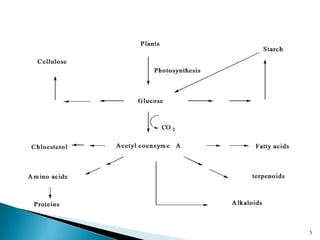
 Cells of organisms - plants, fungi, bacteria.
 Insects, animals - produce a large variety of
organic compounds.
 Many substances were obtained anciently, e.g.
foodstuffs, building materials, dyes, medicinals, and
other extracts from nature.
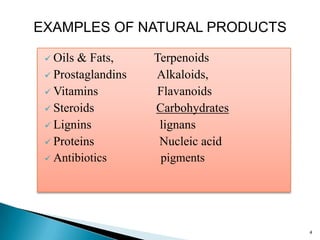
 Oils & Fats, Terpenoids
 Prostaglandins Alkaloids,
 Vitamins Flavanoids
 Steroids Carbohydrates
 Lignins lignans
 Proteins Nucleic acid
 Antibiotics pigments
EXAMPLES OF NATURAL PRODUCTS
4
5
CARBOHYDRATES
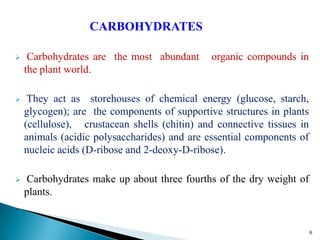
 Carbohydrates are the most abundant organic compounds in
the plant world.
 They act as storehouses of chemical energy (glucose, starch,
glycogen); are the components of supportive structures in plants
(cellulose), crustacean shells (chitin) and connective tissues in
animals (acidic polysaccharides) and are essential components of
nucleic acids (D-ribose and 2-deoxy-D-ribose).
 Carbohydrates make up about three fourths of the dry weight of
plants.
.
6
7
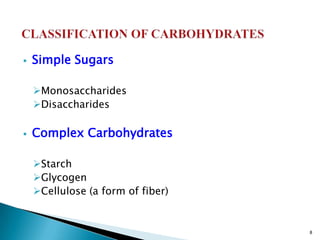
 Simple Sugars
Monosaccharides
Disaccharides
 Complex Carbohydrates
Starch
Glycogen
Cellulose (a form of fiber)
8
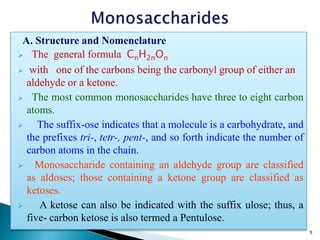
A. Structure and Nomenclature
 The general formula CnH2nOn
 with one of the carbons being the carbonyl group of either an
aldehyde or a ketone.
 The most common monosaccharides have three to eight carbon
atoms.
 The suffix-ose indicates that a molecule is a carbohydrate, and
the prefixes tri-, tetr-, pent-, and so forth indicate the number of
carbon atoms in the chain.
 Monosaccharide containing an aldehyde group are classified
as aldoses; those containing a ketone group are classified as
ketoses.
 A ketose can also be indicated with the suffix ulose; thus, a
five- carbon ketose is also termed a Pentulose.
9
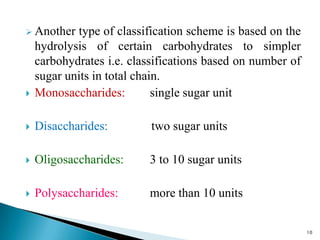
 Another type of classification scheme is based on the
hydrolysis of certain carbohydrates to simpler
carbohydrates i.e. classifications based on number of
sugar units in total chain.
 Monosaccharides: single sugar unit
 Disaccharides: two sugar units
 Oligosaccharides: 3 to 10 sugar units
 Polysaccharides: more than 10 units
10
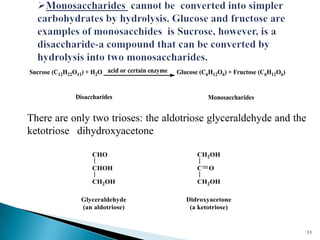
Sucrose (C12H22O11) + H2O acid or certain enzyme Glucose (C6H12O6) + Fructose (C6H12O6)
MonosaccharidesDisaccharides
There are only two trioses: the aldotriose glyceraldehyde and the
ketotriose dihydroxyacetone
Glyceraldehyde
(an aldotriose)
CHO
CHOH
CH2OH
CH2OH
C
CH2OH
O
Didroxyacetone
(a ketotriose)
11
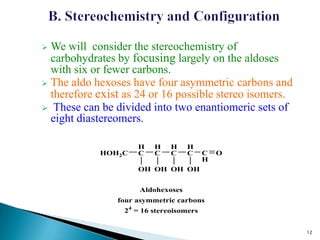
 We will consider the stereochemistry of
carbohydrates by focusing largely on the aldoses
with six or fewer carbons.
 The aldo hexoses have four asymmetric carbons and
therefore exist as 24 or 16 possible stereo isomers.
 These can be divided into two enantiomeric sets of
eight diastereomers.
HOH2C
OH
H
C
OH
H
C
OH
H
C
H
C
OH
C
H
O
Aldohexoses
four asymmetric carbons
24
= 16 stereoisomers
12
 Similarly, there are two enantiomeric sets of four
diastereomers (eight stereoisomers total) in the aldopentose
series. Each diastereomer is a different carbohydrate with
different properties, known by a different name.
 The aldoses with six or fewer carbons are given as Fischer
projections. Be sure you understand how to draw and interpret
Fischer projections, as they are widely used in carbohydrate
chemistry.
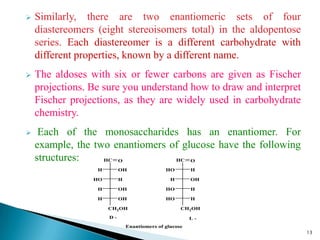
 Each of the monosaccharides has an enantiomer. For
example, the two enantiomers of glucose have the following
structures: HC
OHH
HHO
OHH
OHH
CH2OH
HC
HO H
H OH
HO H
HO H
CH2OH
O
Enantiomers of glucose
D - L -
O
13
 It is important to specify the enantiomers of
carbohydrates in a simple way.
 Suppose you had a model of one of these glucose
enantiomers in your hand. You could, of course, use
the R,S system to describe the configuration of one
or more of the asymmetric carbon atoms.
 A different system, however, was in use long before
the R,S system was established.
 The D,L system, which came from proposals made
in 1906 by M. A. Rosanoff, is used for this purpose.
14
 Glyceraldehydes contains a chiral center and therefore exists
as a pair of enantiomers.
 Glyceraldehyde is a common name; the IUPAC name for this
monosaccharide is 2,3-dihydroxypropanal.
15
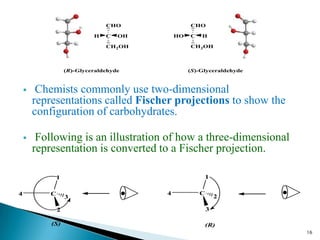
 Chemists commonly use two-dimensional
representations called Fischer projections to show the
configuration of carbohydrates.
 Following is an illustration of how a three-dimensional
representation is converted to a Fischer projection.
CHO
CH OH
CH2OH
CHO
C HHO
CH2OH
(R)-Glyceraldehyde (S)-Glyceraldehyde
4 C
3
1
2
4 C
2
1
3
(S) (R)
16
CHO
HO H
H OH
H OH
CH2OH
CHO
H OH
HO H
H OH
CH2OH
CHO
HO H
HO H
H OH
CH2OH
CHO
H OH
H OH
H OH
CH2OH
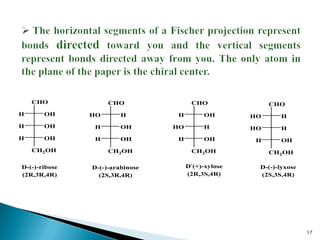
D-(-)-ribose
(2R,3R,4R)
D-(-)-arabinose
(2S,3R,4R)
D-
(+)-xylose
(2R,3S,4R)
D-(-)-lyxose
(2S,3S,4R)
17
CHO
H OH
H OH
CH2OH
CHO
HO H
H OH
CH2OH
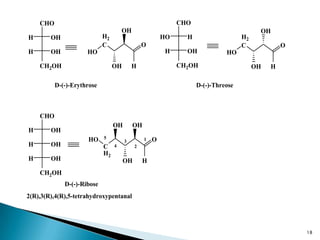
D-(-)-Erythrose D-(-)-Threose
CHO
H OH
H OH
H OH
CH2OH
D-(-)-Ribose
H
OH
O
OH
H2
C
HO
H
O
OH
H2
C
HO
OH
H
OH
O
OH
C
H2
OH
HO
4
3
2
15
2(R),3(R),4(R),5-tetrahydroxypentanal
18
 Even though the R,S system is widely accepted today as a
standard for designating configuration, the configuration of
carbohydrates as well as those of amino acids and many other
compounds in biochemistry is commonly designated by the D,L
system proposed by Emil Fischer in 1891.
 At that time, it was known that one enantiomer of glyceraldehyde
has a specific rotation of + 13.5; the other has a specific rotation of
-13.5.
19
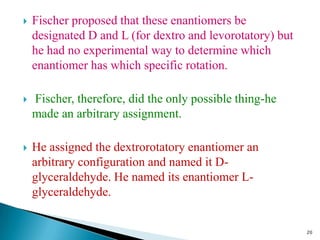
 Fischer proposed that these enantiomers be
designated D and L (for dextro and levorotatory) but
he had no experimental way to determine which
enantiomer has which specific rotation.
 Fischer, therefore, did the only possible thing-he
made an arbitrary assignment.
 He assigned the dextrorotatory enantiomer an
arbitrary configuration and named it D-
glyceraldehyde. He named its enantiomer L-
glyceraldehyde.
20
 Fischer could have been wrong, but by a stroke of good
fortune he was correct, as proven in 1952 by a special
application of X-ray crystallography.
 D- and L-glyceraldehyde serve as reference points for the
assignment of relative configuration to all other aldoses and
ketoses.
CHO
CH OH
CH2OH
D-Glyceraldehyde
[]D = +13.5
CHO
C HHO
CH2OH
25
L-Glyceraldehyde
[]D = -13.525
21
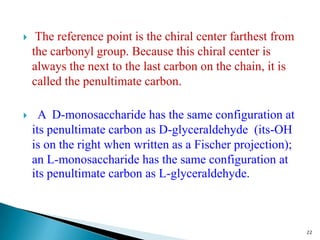
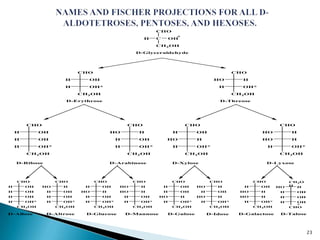
 The reference point is the chiral center farthest from
the carbonyl group. Because this chiral center is
always the next to the last carbon on the chain, it is
called the penultimate carbon.
 A D-monosaccharide has the same configuration at
its penultimate carbon as D-glyceraldehyde (its-OH
is on the right when written as a Fischer projection);
an L-monosaccharide has the same configuration at
its penultimate carbon as L-glyceraldehyde.
22
CHO
CH OH
CH2OH
*
D-Glyceraldehyde
CHO
H OH
H OH*
CH2OH
CHO
HO H
H OH*
CH2OH
D-Erythrose D-Threose
CHO
H OH
H OH
H OH*
CH2OH
CHO
HO H
H OH
H OH*
CH2OH
CHO
H OH
HO H
H OH*
CH2OH
CHO
HO H
HO H
H OH*
CH2OH
D-Ribose D-Arabinose D-Xylose D-Lyxose
CHO
OHH
OHH
OHH
OH*H
CH2OH
CHO
HHO
OHH
OHH
OH*H
CH2OH
CHO
OHH
HHO
OHH
OH*H
CH2OH
CHO
HHO
HHO
OHH
OH*H
CH2OH
CHO
OHH
OHH
HHO
OH*H
CH2OH
CHO
HHO
OHH
HHO
OH*H
CH2OH
CHO
OHH
HHO
HHO
OH*H
CH2OH CHO
H OH
*
H OH
H OH
HO H
CH2O
H
D-Allose D-Altrose D-Glucose D-Mannose D-Gulose D-TaloseD-GalactoseD-Idose
23
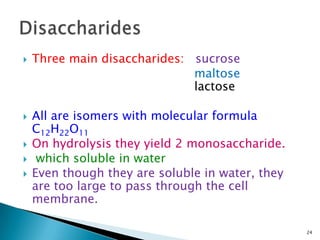
 Three main disaccharides: sucrose
maltose
lactose
 All are isomers with molecular formula
C12H22O11
 On hydrolysis they yield 2 monosaccharide.
 which soluble in water
 Even though they are soluble in water, they
are too large to pass through the cell
membrane.
24
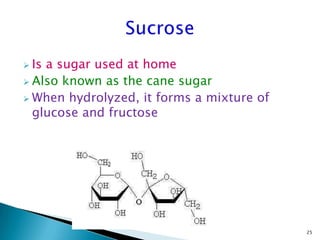
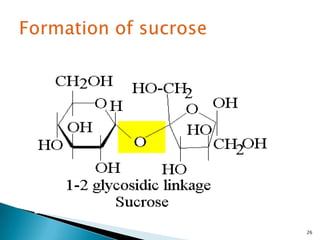
 Is a sugar used at home
 Also known as the cane sugar
 When hydrolyzed, it forms a mixture of
glucose and fructose
25
26
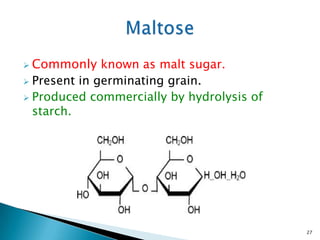
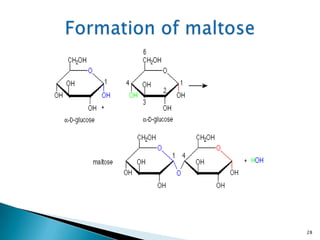
 Commonly known as malt sugar.
 Present in germinating grain.
 Produced commercially by hydrolysis of
starch.
27
28
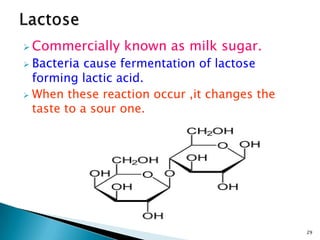
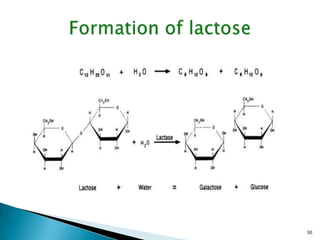
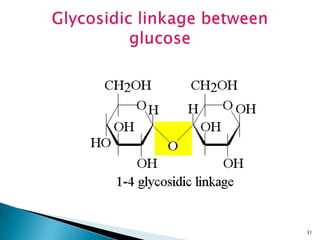
 Commercially known as milk sugar.
 Bacteria cause fermentation of lactose
forming lactic acid.
 When these reaction occur ,it changes the
taste to a sour one.
29
30
31
 Sucrose and maltose will ferment when yeast
is added because yeast contains the enzyme
sucrase and maltase.
 Lactose will not ferment because yeast does
not contain lactase.
32
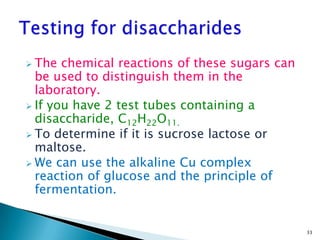
 The chemical reactions of these sugars can
be used to distinguish them in the
laboratory.
 If you have 2 test tubes containing a
disaccharide, C12H22O11.
 To determine if it is sucrose lactose or
maltose.
 We can use the alkaline Cu complex
reaction of glucose and the principle of
fermentation.
33
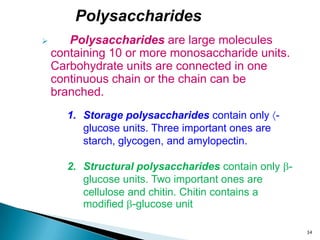
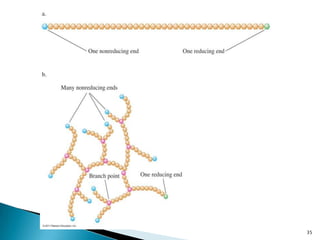
 Polysaccharides are large molecules
containing 10 or more monosaccharide units.
Carbohydrate units are connected in one
continuous chain or the chain can be
branched.
1. Storage polysaccharides contain only -
glucose units. Three important ones are
starch, glycogen, and amylopectin.
2. Structural polysaccharides contain only -
glucose units. Two important ones are
cellulose and chitin. Chitin contains a
modified -glucose unit
Polysaccharides
34
35
Amylose and amylopectin—starch
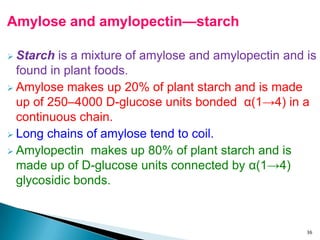
 Starch is a mixture of amylose and amylopectin and is
found in plant foods.
 Amylose makes up 20% of plant starch and is made
up of 250–4000 D-glucose units bonded α(1→4) in a
continuous chain.
 Long chains of amylose tend to coil.
 Amylopectin makes up 80% of plant starch and is
made up of D-glucose units connected by α(1→4)
glycosidic bonds.
36
 Glycogen is a storage polysaccharide found in
animals.
 Glycogen is stored in the liver and muscles.
 Its structure is identical to amylopectin, except that
α(1→6) branching occurs about every
12 glucose units.
 When glucose is needed, glycogen is hydrolyzed in
the liver to glucose.
37
Structural Polysaccharides
Cellulose
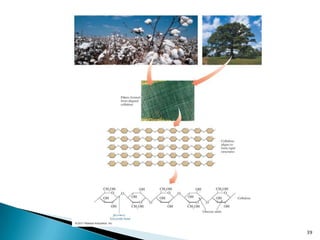
 Cellulose contains glucose units bonded (1→4).
 This glycosidic bond configuration changes the
three-dimensional shape of cellulose compared with
that of amylose.
 The chain of glucose units is straight. This allows
chains to align next to each other to form a strong
rigid structure.
38
39
 Cellulose is an insoluble fiber in our diet
because we lack the enzyme cellulase to
hydrolyze the (1→4) glycosidic bond.
 Whole grains are a good source of cellulose.
 Cellulose is important in our diet because it
assists with digestive movement in the small
and large intestine.
 Some animals and insects can digest cellulose
because they contain bacteria that produce
cellulase.
40
Chitin
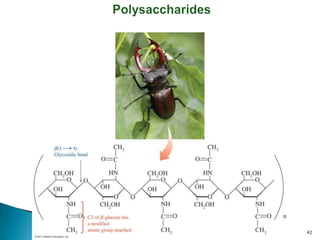
 Chitin makes up the exoskeleton of insects
and crustaceans and cell walls of some fungi.
 It is made up of N-acetyl glucosamine
containing (1→4) glycosidic bonds.
 It is structurally strong.
 Chitin is used as surgical thread that
biodegrades as a wound heals.
 It serves as a protection from water in insects.
 Chitin is also used to waterproof paper, and in
cosmetics and lotions to retain moisture.
41
42
Heparin:
 Heparin is a medically important
polysaccharide because it prevents clotting in the
bloodstream.
 It is a highly ionic polysaccharide of repeating
disaccharide units of an oxidized monosaccharide
and D-glucosamine. Heparin also contains sulfate
groups that are negatively charged.
 It belongs to a group of polysaccharides called
glycosaminoglycans.
43

Carbohydrate ppt

  • 1.
    CARBOHYDRATES Presented by; M Pharm(Pharmaceutical Chemistry) students Gunturu .Aparna Akshintala. Sree Gayatri Thota. Madhu latha Kamre. Sunil Daram. Sekhar University college of pharmaceutical sciences Department of pharmaceutical chemistry Acharya Nagarjuna University Guntur 1
  • 2.
  • 3.
    3  Cells oforganisms - plants, fungi, bacteria.  Insects, animals - produce a large variety of organic compounds.  Many substances were obtained anciently, e.g. foodstuffs, building materials, dyes, medicinals, and other extracts from nature.
  • 4.
     Oils &Fats, Terpenoids  Prostaglandins Alkaloids,  Vitamins Flavanoids  Steroids Carbohydrates  Lignins lignans  Proteins Nucleic acid  Antibiotics pigments EXAMPLES OF NATURAL PRODUCTS 4
  • 5.
  • 6.
    CARBOHYDRATES  Carbohydrates arethe most abundant organic compounds in the plant world.  They act as storehouses of chemical energy (glucose, starch, glycogen); are the components of supportive structures in plants (cellulose), crustacean shells (chitin) and connective tissues in animals (acidic polysaccharides) and are essential components of nucleic acids (D-ribose and 2-deoxy-D-ribose).  Carbohydrates make up about three fourths of the dry weight of plants. . 6
  • 7.
  • 8.
     Simple Sugars Monosaccharides Disaccharides Complex Carbohydrates Starch Glycogen Cellulose (a form of fiber) 8
  • 9.
    A. Structure andNomenclature  The general formula CnH2nOn  with one of the carbons being the carbonyl group of either an aldehyde or a ketone.  The most common monosaccharides have three to eight carbon atoms.  The suffix-ose indicates that a molecule is a carbohydrate, and the prefixes tri-, tetr-, pent-, and so forth indicate the number of carbon atoms in the chain.  Monosaccharide containing an aldehyde group are classified as aldoses; those containing a ketone group are classified as ketoses.  A ketose can also be indicated with the suffix ulose; thus, a five- carbon ketose is also termed a Pentulose. 9
  • 10.
     Another typeof classification scheme is based on the hydrolysis of certain carbohydrates to simpler carbohydrates i.e. classifications based on number of sugar units in total chain.  Monosaccharides: single sugar unit  Disaccharides: two sugar units  Oligosaccharides: 3 to 10 sugar units  Polysaccharides: more than 10 units 10
  • 11.
    Sucrose (C12H22O11) +H2O acid or certain enzyme Glucose (C6H12O6) + Fructose (C6H12O6) MonosaccharidesDisaccharides There are only two trioses: the aldotriose glyceraldehyde and the ketotriose dihydroxyacetone Glyceraldehyde (an aldotriose) CHO CHOH CH2OH CH2OH C CH2OH O Didroxyacetone (a ketotriose) 11
  • 12.
     We willconsider the stereochemistry of carbohydrates by focusing largely on the aldoses with six or fewer carbons.  The aldo hexoses have four asymmetric carbons and therefore exist as 24 or 16 possible stereo isomers.  These can be divided into two enantiomeric sets of eight diastereomers. HOH2C OH H C OH H C OH H C H C OH C H O Aldohexoses four asymmetric carbons 24 = 16 stereoisomers 12
  • 13.
     Similarly, thereare two enantiomeric sets of four diastereomers (eight stereoisomers total) in the aldopentose series. Each diastereomer is a different carbohydrate with different properties, known by a different name.  The aldoses with six or fewer carbons are given as Fischer projections. Be sure you understand how to draw and interpret Fischer projections, as they are widely used in carbohydrate chemistry.  Each of the monosaccharides has an enantiomer. For example, the two enantiomers of glucose have the following structures: HC OHH HHO OHH OHH CH2OH HC HO H H OH HO H HO H CH2OH O Enantiomers of glucose D - L - O 13
  • 14.
     It isimportant to specify the enantiomers of carbohydrates in a simple way.  Suppose you had a model of one of these glucose enantiomers in your hand. You could, of course, use the R,S system to describe the configuration of one or more of the asymmetric carbon atoms.  A different system, however, was in use long before the R,S system was established.  The D,L system, which came from proposals made in 1906 by M. A. Rosanoff, is used for this purpose. 14
  • 15.
     Glyceraldehydes containsa chiral center and therefore exists as a pair of enantiomers.  Glyceraldehyde is a common name; the IUPAC name for this monosaccharide is 2,3-dihydroxypropanal. 15
  • 16.
     Chemists commonlyuse two-dimensional representations called Fischer projections to show the configuration of carbohydrates.  Following is an illustration of how a three-dimensional representation is converted to a Fischer projection. CHO CH OH CH2OH CHO C HHO CH2OH (R)-Glyceraldehyde (S)-Glyceraldehyde 4 C 3 1 2 4 C 2 1 3 (S) (R) 16
  • 17.
    CHO HO H H OH HOH CH2OH CHO H OH HO H H OH CH2OH CHO HO H HO H H OH CH2OH CHO H OH H OH H OH CH2OH D-(-)-ribose (2R,3R,4R) D-(-)-arabinose (2S,3R,4R) D- (+)-xylose (2R,3S,4R) D-(-)-lyxose (2S,3S,4R) 17
  • 18.
    CHO H OH H OH CH2OH CHO HOH H OH CH2OH D-(-)-Erythrose D-(-)-Threose CHO H OH H OH H OH CH2OH D-(-)-Ribose H OH O OH H2 C HO H O OH H2 C HO OH H OH O OH C H2 OH HO 4 3 2 15 2(R),3(R),4(R),5-tetrahydroxypentanal 18
  • 19.
     Even thoughthe R,S system is widely accepted today as a standard for designating configuration, the configuration of carbohydrates as well as those of amino acids and many other compounds in biochemistry is commonly designated by the D,L system proposed by Emil Fischer in 1891.  At that time, it was known that one enantiomer of glyceraldehyde has a specific rotation of + 13.5; the other has a specific rotation of -13.5. 19
  • 20.
     Fischer proposedthat these enantiomers be designated D and L (for dextro and levorotatory) but he had no experimental way to determine which enantiomer has which specific rotation.  Fischer, therefore, did the only possible thing-he made an arbitrary assignment.  He assigned the dextrorotatory enantiomer an arbitrary configuration and named it D- glyceraldehyde. He named its enantiomer L- glyceraldehyde. 20
  • 21.
     Fischer couldhave been wrong, but by a stroke of good fortune he was correct, as proven in 1952 by a special application of X-ray crystallography.  D- and L-glyceraldehyde serve as reference points for the assignment of relative configuration to all other aldoses and ketoses. CHO CH OH CH2OH D-Glyceraldehyde []D = +13.5 CHO C HHO CH2OH 25 L-Glyceraldehyde []D = -13.525 21
  • 22.
     The referencepoint is the chiral center farthest from the carbonyl group. Because this chiral center is always the next to the last carbon on the chain, it is called the penultimate carbon.  A D-monosaccharide has the same configuration at its penultimate carbon as D-glyceraldehyde (its-OH is on the right when written as a Fischer projection); an L-monosaccharide has the same configuration at its penultimate carbon as L-glyceraldehyde. 22
  • 23.
    CHO CH OH CH2OH * D-Glyceraldehyde CHO H OH HOH* CH2OH CHO HO H H OH* CH2OH D-Erythrose D-Threose CHO H OH H OH H OH* CH2OH CHO HO H H OH H OH* CH2OH CHO H OH HO H H OH* CH2OH CHO HO H HO H H OH* CH2OH D-Ribose D-Arabinose D-Xylose D-Lyxose CHO OHH OHH OHH OH*H CH2OH CHO HHO OHH OHH OH*H CH2OH CHO OHH HHO OHH OH*H CH2OH CHO HHO HHO OHH OH*H CH2OH CHO OHH OHH HHO OH*H CH2OH CHO HHO OHH HHO OH*H CH2OH CHO OHH HHO HHO OH*H CH2OH CHO H OH * H OH H OH HO H CH2O H D-Allose D-Altrose D-Glucose D-Mannose D-Gulose D-TaloseD-GalactoseD-Idose 23
  • 24.
     Three maindisaccharides: sucrose maltose lactose  All are isomers with molecular formula C12H22O11  On hydrolysis they yield 2 monosaccharide.  which soluble in water  Even though they are soluble in water, they are too large to pass through the cell membrane. 24
  • 25.
     Is asugar used at home  Also known as the cane sugar  When hydrolyzed, it forms a mixture of glucose and fructose 25
  • 26.
  • 27.
     Commonly knownas malt sugar.  Present in germinating grain.  Produced commercially by hydrolysis of starch. 27
  • 28.
  • 29.
     Commercially knownas milk sugar.  Bacteria cause fermentation of lactose forming lactic acid.  When these reaction occur ,it changes the taste to a sour one. 29
  • 30.
  • 31.
  • 32.
     Sucrose andmaltose will ferment when yeast is added because yeast contains the enzyme sucrase and maltase.  Lactose will not ferment because yeast does not contain lactase. 32
  • 33.
     The chemicalreactions of these sugars can be used to distinguish them in the laboratory.  If you have 2 test tubes containing a disaccharide, C12H22O11.  To determine if it is sucrose lactose or maltose.  We can use the alkaline Cu complex reaction of glucose and the principle of fermentation. 33
  • 34.
     Polysaccharides arelarge molecules containing 10 or more monosaccharide units. Carbohydrate units are connected in one continuous chain or the chain can be branched. 1. Storage polysaccharides contain only - glucose units. Three important ones are starch, glycogen, and amylopectin. 2. Structural polysaccharides contain only - glucose units. Two important ones are cellulose and chitin. Chitin contains a modified -glucose unit Polysaccharides 34
  • 35.
  • 36.
    Amylose and amylopectin—starch Starch is a mixture of amylose and amylopectin and is found in plant foods.  Amylose makes up 20% of plant starch and is made up of 250–4000 D-glucose units bonded α(1→4) in a continuous chain.  Long chains of amylose tend to coil.  Amylopectin makes up 80% of plant starch and is made up of D-glucose units connected by α(1→4) glycosidic bonds. 36
  • 37.
     Glycogen isa storage polysaccharide found in animals.  Glycogen is stored in the liver and muscles.  Its structure is identical to amylopectin, except that α(1→6) branching occurs about every 12 glucose units.  When glucose is needed, glycogen is hydrolyzed in the liver to glucose. 37
  • 38.
    Structural Polysaccharides Cellulose  Cellulosecontains glucose units bonded (1→4).  This glycosidic bond configuration changes the three-dimensional shape of cellulose compared with that of amylose.  The chain of glucose units is straight. This allows chains to align next to each other to form a strong rigid structure. 38
  • 39.
  • 40.
     Cellulose isan insoluble fiber in our diet because we lack the enzyme cellulase to hydrolyze the (1→4) glycosidic bond.  Whole grains are a good source of cellulose.  Cellulose is important in our diet because it assists with digestive movement in the small and large intestine.  Some animals and insects can digest cellulose because they contain bacteria that produce cellulase. 40
  • 41.
    Chitin  Chitin makesup the exoskeleton of insects and crustaceans and cell walls of some fungi.  It is made up of N-acetyl glucosamine containing (1→4) glycosidic bonds.  It is structurally strong.  Chitin is used as surgical thread that biodegrades as a wound heals.  It serves as a protection from water in insects.  Chitin is also used to waterproof paper, and in cosmetics and lotions to retain moisture. 41
  • 42.
  • 43.
    Heparin:  Heparin isa medically important polysaccharide because it prevents clotting in the bloodstream.  It is a highly ionic polysaccharide of repeating disaccharide units of an oxidized monosaccharide and D-glucosamine. Heparin also contains sulfate groups that are negatively charged.  It belongs to a group of polysaccharides called glycosaminoglycans. 43