
Osmotic pressure
XI FDC CHEMISTRY
SIDRA JAVED
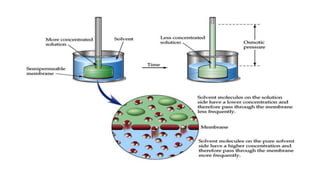
OSMOSIS
The selective passage of solvent molecules through
a porous membrane from a dilute solution to a more
concentrated one.
OSMOTIC PRESSURE
The pressure required to stop osmosis.
The osmotic pressure of an ideal solution is given by MORSE EQUATION
𝜋 = MRT
𝜋 → OSMOTIC PRESSURE M → MOLARITY
R = 0.082 dm3atmmol-1K-1 T → absolute temperature
Tonicity Measure of the osmotic pressure of
the two solutions separated by a
semipermeable membrane
There are 3 classifications of tonicity:
1. Isotonic
2. Hypertonic
3. Hypotonic
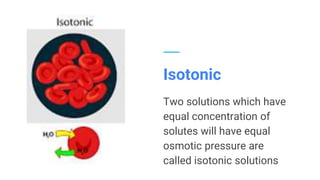
Isotonic
Two solutions which have
equal concentration of
solutes will have equal
osmotic pressure are
called isotonic solutions
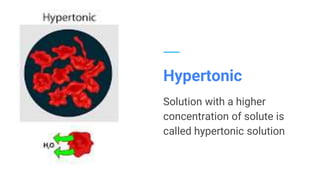
Hypertonic
Solution with a higher
concentration of solute is
called hypertonic solution
Hypotonic
A solution with lower
solute concentration is
called a Hypotonic
solution
Common applications of
Osmotic Pressure
Biochemist uses the
haemolysis to study the
contents of red blood cells.
Haemolysis is the rupture of
RBCs
Common applications of
Osmotic Pressure
Osmosis is the major
mechanism of transporting
water in plants.
Common applications
of Osmotic Pressure
Intracellular water tends to
move out of bacterial cells to
the concentrated solution by
osmosis.
Common
applications of
Osmotic Pressure
Food is preserved by
osmosis.
REVERSE OSMOSIS
Reverse osmosis is a membrane based
filtration method that removes many
types of large molecules and ions from
solutions by applying pressure to the
solution when it is on one side of a
selective membrane.
If an external pressure is applied on a concentrated
solution, this pressure is distributed evenly
throughout the solution
If the applied pressure is higher than the osmotic
pressure water will flow towards the other side of
the membrane leaving solute behind
This technique is used for purification of water
DESALINATION OF SEA WATER
Colloids & Suspensions
Colloids
Colloid
A colloid is a dispersion of particles of one substance (the
dispersed phase) throughout another substance or
solution (the dispersion phase).
A heterogeneous mixture of tiny particles of a substance
dispersed through a medium is called colloidal dispersion
or colloid.
Types of Colloids
1. Lyophilic Colloids
2. Lyophobic Colloids
Lyophilic vs Lyophobic
Such colloidal dispersions
in which dispersed phase
shows an affinity or
attraction for the
dispersion medium are
called Lyophilic Colloids
Such colloidal dispersions
which can not be made by
spontaneous dispersion are
called Lyophobic Colloids
Classification of colloids
Based on Dispersed phase and dispersion medium:
1. Sol - solid dispersed in a liquid
2. Emulsion - liquid dispersed in a liquid
3. Foam - gas particles are trapped in a liquid or solid.
4. Aerosol - particles of liquid or solid dispersed in a gas.
Solid Sol
Dispersed phase -
solid
Dispersion medium -
solid
Example - Ruby
Glass
Solid Emulsion/
Gel
Dispersed phase -
Liquid
Dispersion medium -
solid
Examples - Pearls ,
Cheese
Solid Foam
Dispersed phase -
Gas
Dispersion medium -
solid
Examples - Lava
Sol
Dispersed phase -
Solid
Dispersion medium -
Liquid
Examples - Paints
Emulsion
Dispersed phase -
Liquid
Dispersion medium -
Liquid
Examples - Milk, Oil
in Water
Foam
Dispersed phase -
Gas
Dispersion medium -
Liquid
Examples - whipped
cream
Aerosol
Dispersed phase -
Solid
Dispersion medium -
Gas
Examples - Smoke
Aerosol
Dispersed phase -
Liquid
Dispersion medium -
Gas
Examples - Fog, Mist
Properties of Colloids
Mainly depends upon :
1. Size of particles
2. Shape of Particles
3. Charge on Dispersed Particles
Colloids are generally opaque but some
are transparent
Colloids
exhibit
Brownian
Motion
Colloids do
not set under
gravity
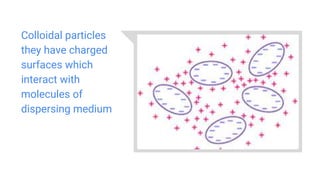
Colloidal particles
they have charged
surfaces which
interact with
molecules of
dispersing medium
Temperature causes
colloids to move
faster and converts
them into lumps.
Example:
coagulation of
casein in milk
Colloidal particles
can pass through
ordinary filter
paper but can not
pass through ultra
thin filter paper
Tyndall
Effect
When light is shined through a
true solution, the light passes
cleanly through the solution.
However when light is passed
through a colloidal solution, the
substance in the dispersed
phases scatters the light in all
directions, making it readily seen.
Suspension
A dispersion in
which the
solute particle
visible to the
naked eyes are
called
suspension
Properties of
Suspension
Particle Size > 103 nm.
Settle down under the
influence of gravity.
Suspension scatter and
reflects light
Comparison of properties
END OF LESSON
sidra.javedali@gmail.com

Osmotic pressure & Colloids