Transition Metals
XII CHEMISTRY CHAPTER 14
Sidra Javed
MANGANESE
The Oxidation State
 Stable Oxidation States: +2, +4 and +7
 KMnO4 – powerful oxidizing agent
 Reduction of KMnO4 in Alkaline Medium:
2KMnO4 + 2KOH  2K2MnO4 + H2O + O
Purple Green
Mn = +7 Mn = +6
2K2MnO4 + 2KOH  2MnO2 + 4KOH + 2O
Green Brown
Mn = +6 Mn= +4
 Reduction of KMnO4 in acidic medium:
2KMnO4 + 3H2SO4 (dilute)  K2SO4 + 2MnSO4 + 3H2O + 5[O]
2MnO4
- + 6H+  2Mn+2 + 3H2O + 5[O]
Purple Colorless
Mn = +7 Mn = +2
Reactions of Manganese (II) ions in solution
1. The reaction of Hexaaquomanganese (II) ions with hydroxide ions:
OH- ions remove H+ from two of the water ligands to give a neutral complex.
This is insoluble in water and a precipitate is formed.
[Mn(H2O)6]+2 + 2OH-  [Mn(H2O)4(OH)2] + 2H2O
2. The reaction of Hexaaquomanganese (II) ions with ammonia solution:
Ammonia removes H+ ions from the aqua complex
[Mn(H2O)6]+2 + 2NH3  [Mn(H2O)4(OH)2] + 2NH4
+
Using Potassium Manganate (VII) as oxidizing agent
in organic chemistry
 Used in neutral or alkaline solutions
 Acidified KMnO4 is a strong oxidizing agent which can break C-C bonds
 The KMnO4 solution is mildly alkaline with Na2CO3 solution and the color changes
are:
In testing for a Double Bond
1. In testing for H2C=CH2
2KMnO4 + H2O  2MnO2 + 2KOH + 3[O]
3x{ H2C=CH2 + O + H2O  HO-CH2-CH2-OH }
2KMnO4 + 4H2O + 3H2C=CH2  2MnO2 + 2KOH + 3HO-CH2-CH2-OH
2. Reaction of Hydrazine with KMnO4 (N=-2 to N = 0)
2x{ 2KMnO4 + 3H2SO4  K2SO4 + 2MnSO4 + 3H2O + 5[O] }
5x{ N2H4 + 2[O]  N2 + 2H2O }
4KMnO4 + 6H2SO4 + 5N2H4  2K2SO4 + 4MnSO4 + 16H2O + 5N2
3. In oxidation of Aromatic side chains
Alkaline KMnO4 oxidises any hydrocarbon side chain attached to a benzene ring
back to a single -COOH group. Prolonged heating is necessary.
For Example:
In the case of the ethyl side chain, you will also get carbon dioxide. With longer
side chains, you will get all sorts of mixtures of other products. but in each
case, the main product will be benzoic acid.
Using KMnO4 as an oxidizing agent in
Titrations
 Potassium manganate(VII) solution is use to find the concentration
of all sorts of reducing agents. It is always used in acidic solution.
 Examples:
1. Oxidation of Fe+2 to Fe+3
2KMnO4 + 3H2SO4  K2SO4 + 2MnSO4 + 3H2O + 5[O]
5x{ 2FeSO4 + H2SO4 + [O]  Fe2(SO4)3 + H2O}
2KMnO4 + 8H2SO4 + 10 FeSO4  K2SO4 + MnSO4 + 5Fe2(SO4)3 + 8H2O
2. Ethanedioic acid (Oxalic Acid) (C=+3) to Carbon Dioxide (C=+4)
2KMnO4 + 3H2SO4  K2SO4 + 2MnSO4 + 3H2O + 5[O]
5x{ H2C2O4 + [O]  2CO2 + 2H2O }
2KMnO4 + 3H2SO4 + 5H2C2O4  K2SO4 + 2MnSO4 + 8H2O + 10CO2
3. Sulphite ions (S=+4) to Sulphate ions (S=+6)
2KMnO4 + 3H2SO4  K2SO4 + 2MnSO4 + 3H2O + 5[O]
5x{ Na2SO3 + [O]  Na2SO4 }
2KMnO4 + 3H2SO4 + 5Na2SO3  K2SO4 + 2MnSO4 + 3H2O + 5Na2SO4
4. Potassium ferrocyanide (Fe= +2) to Potassium ferricyanide (Fe= +3)
2KMnO4 + 3H2SO4  K2SO4 + 2MnSO4 + 3H2O + 5[O]
5x{ 2K4[Fe(CN)6] + O + H2O  2K3[Fe(CN)6] + 2KOH }
2KMnO4 + 3H2SO4 + 10K4[Fe(CN)6]  K2SO4 + 2MnSO4 + 2H2O + 10K3[Fe(CN)6] + 10KOH
Doing the titration
 The KMnO4 solution always goes into
the burette, and the other solution in
the flask is acidified with dilute
sulphuric acid.
 As the KMnO4 solution is run into the
flask it becomes colorless. The end
point is the first faint trace of
permanent pink color in the solution
showing that there is a tiny excess of
MnO4
- ions present.
Problems with the use of KMnO4 Solution
 KMnO4 can't be used in titrations in the presence of ions like chloride
or bromide which it oxidizes. An unknown amount of the KMnO4 would
be used in side reactions, and so the titration result would be
inaccurate. This is why you do not acidify the solution with
hydrochloric acid.
 KMnO4 isn't a primary standard. That means it can’t be made up to
give a stable solution of accurately known concentration.
 It is so strongly colored that it is impossible to see when all the
crystals you have used have dissolved, and over a period of time it
oxidizes the water it is dissolved in to oxygen.
 Bottles of KMnO4 solution usually have a brown precipitate around the
top. This is MnO2 - and is produced when the MnO4
- ions react with
the water.
IRON
Oxidation State
 Iron exists in two common oxidation states, +2 (Fe2+) and +3 (Fe3+).
 In aqueous solution, the Fe is readily oxidized from Fe2+ to Fe3+
Fe2+(aq)  Fe3+(aq) + e-
Iron as catalyst in Haber Process
 The Haber Process combines nitrogen and hydrogen into
ammonia.
Iron ions as a catalyst in the reaction
between Persulphate ions and iodide ions
 The reaction between persulphate ions (peroxodisulphate ions), S2O8-
2 and iodide ions in solution can be catalyzed using either iron(II) or
iron(III) ions. The overall reaction is:
 The reaction happens in two stages:
 If you use Fe(III) ions, the second reactions happens first.
a. Reaction of Iron ions with OH- ions
In case of Iron (II) In case of Iron (III)
OH- ions remove H+ from two of the water ligands to give a neutral
complex. This is insoluble in water and a precipitate is formed.
b. Reaction of Iron ions with NH3
In case of Iron (II) In case of Iron (III)
Ammonia acts a base and removes H+ ions from the water ligands to
form a neutral insoluble complex.
[Fe(H2O)6]+3 + 3NH3  [Fe(H2O)3(OH)3] + 3NH4
+[Fe(H2O)6]+2 + 2NH3  [Fe(H2O)4(OH)2] + 2NH4
+
Reactions of Iron (II) with carbonate ions and
thiocyanate ions
a. Iron (II) ions and carbonate ions:
 Iron (II) carbonate is simply formed
Fe+2 + CO3
-2  FeCO3
b. Iron (III) ions with Carbonate ions
 The hexaaquairon(III) ion is sufficiently acidic to react with weakly
basic carbonate ions.
 Carbonate ions remove H+ from water ligands to produce a neutral
complex
2[Fe(H2O)6]+3 + 3CO3
-2  2[Fe(H2O)3(OH)3] + 3CO2 + 3H2O
Testing for Iron(III) with Thiocyanate ions
 Add thiocyanate ions, SCN-, to a solution containing
iron(III) ions, blood red solution is formed.
[Fe(H2O)6]+3 + SCN-  [Fe(SCN)(H2O)5]+2 + H2O
COPPER
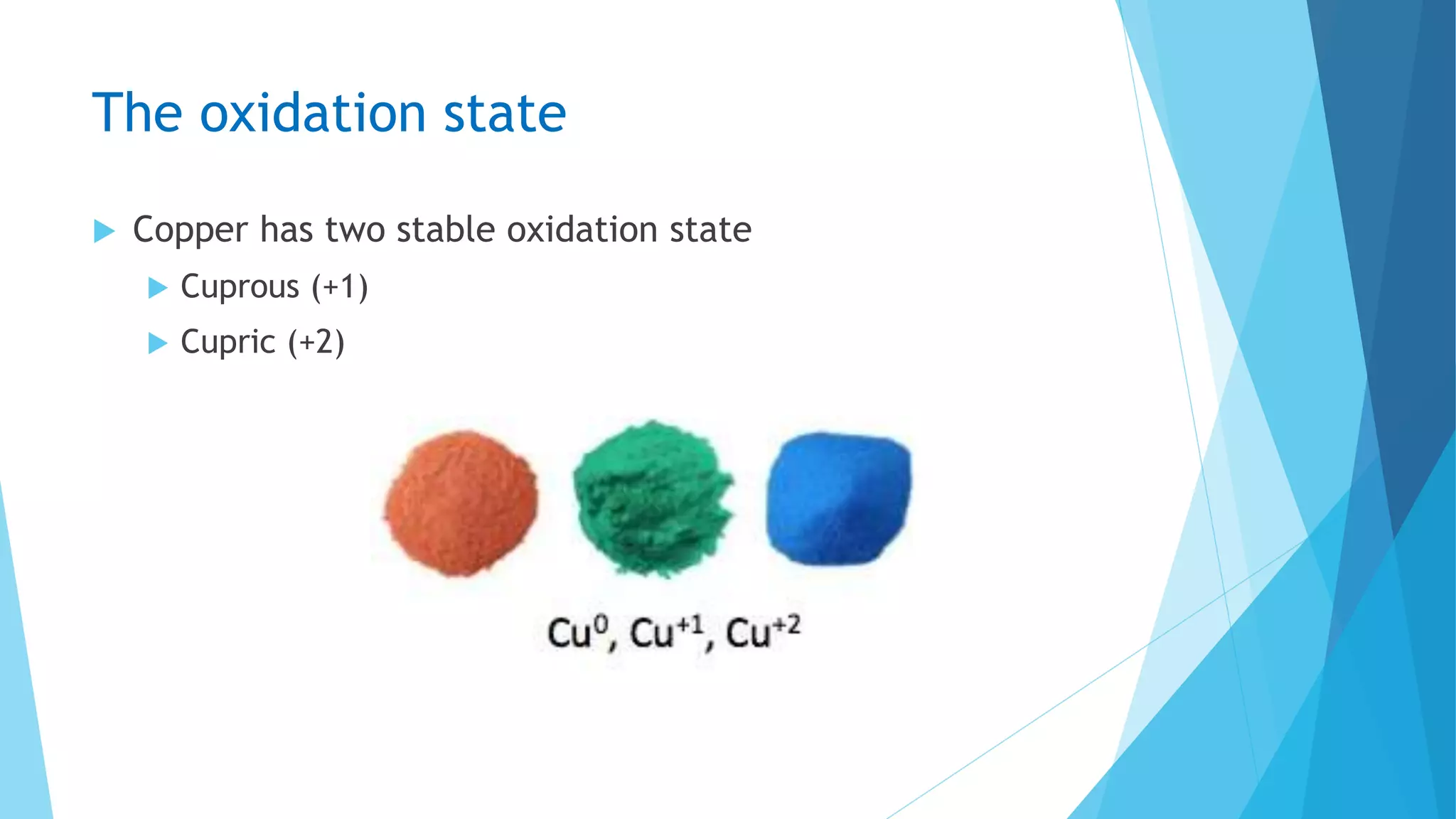
The oxidation state
 Copper has two stable oxidation state
 Cuprous (+1)
 Cupric (+2)
Compounds of Cu+1
 Most of the compounds of Cuprous are colorless and diamagnetic as 3d orbital is
completely filled (Cu+1 = 3d10)
 Exceptions are Cu2O (Red) and Cu2S (Black)
 These are generally insoluble in water
 The soluble compounds of Cu+1 are unstable in aqueous solution, since they
disproportionate to Cu and Cu+2
2Cu+  Cu + Cu+2
 When Cu2O is dissolved in dilute H2SO4 , the products formed are CuSO4 and Cu.
This reaction takes place in two steps:
Cu2O + H2SO4  Cu2SO4 + H2O
Cu2SO4  CuSO4 + Cu
Cu2O + H2SO4  CuSO4 + Cu + H2O
Compounds of Cu+2
 Most of the anhydrous cupric compounds are colorless while the hydrated
cupric compounds are blue due to the formation of Blue hydrated ion
[Cu(H2O)4]+2 or [Cu(H2O)6]+2
 Solutions of Cu+2 salts are acidic in nature due to hydrolysis.
Cu+2 + H2O  [Cu(OH)]+ + H+
 Since the outer most shell of Cu+2 ion has one unpaired electron (3d9), Cu+2
compounds are paramagnetic.
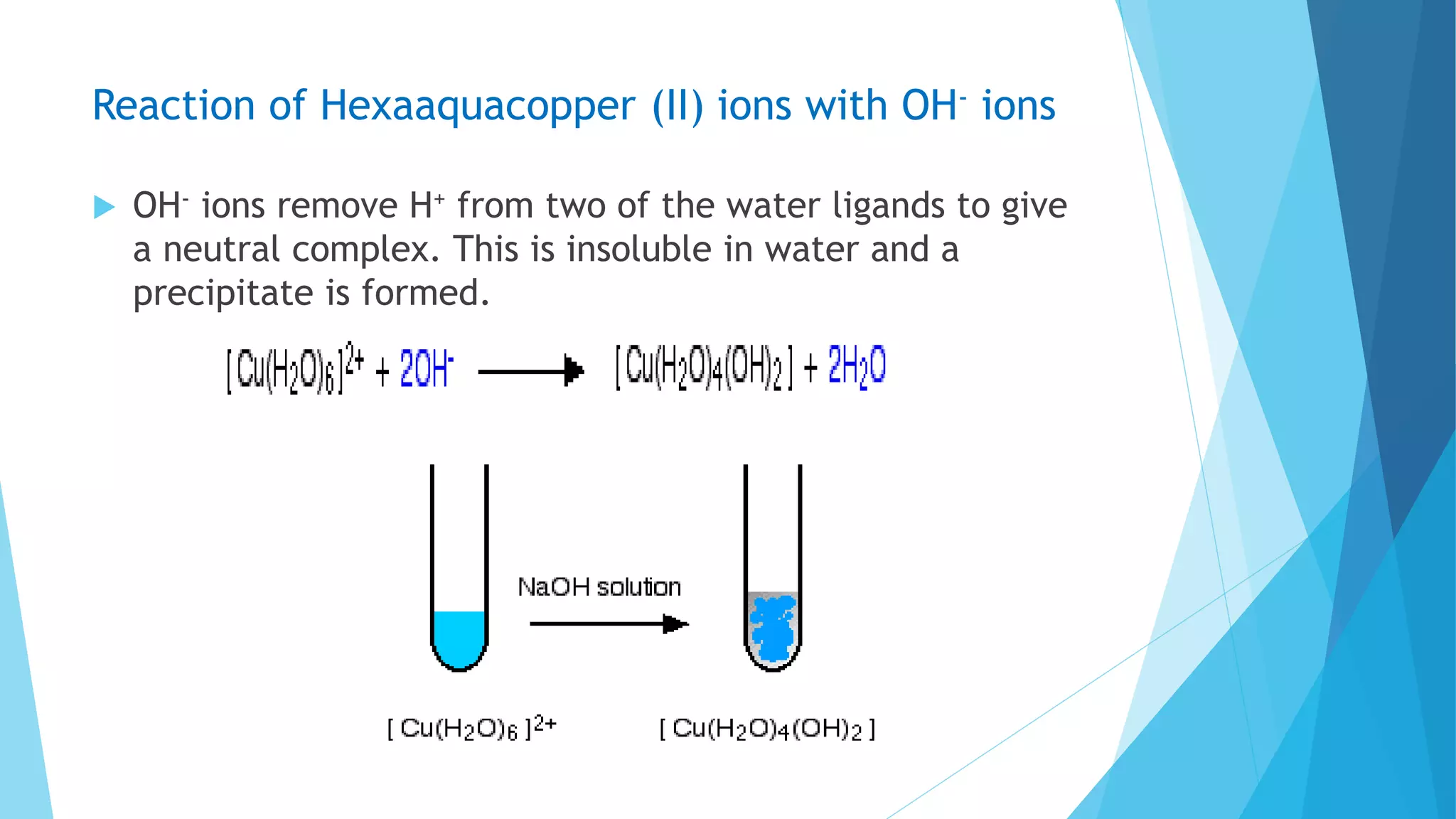
Reaction of Hexaaquacopper (II) ions with OH- ions
 OH- ions remove H+ from two of the water ligands to give
a neutral complex. This is insoluble in water and a
precipitate is formed.
Reaction of Hexaaquacopper (II) ion with NH3 solution
 When Cu(OH)2 is dissolved in excess of NH4OH, a blue
soluble cupric ammine hydroxide is obtained
Cu(OH)2 + 4NH4OH  [Cu(NH3)4(OH)2] + 4H2O
Reaction of Hexaaquacopper (II) ion with Carbonate ion
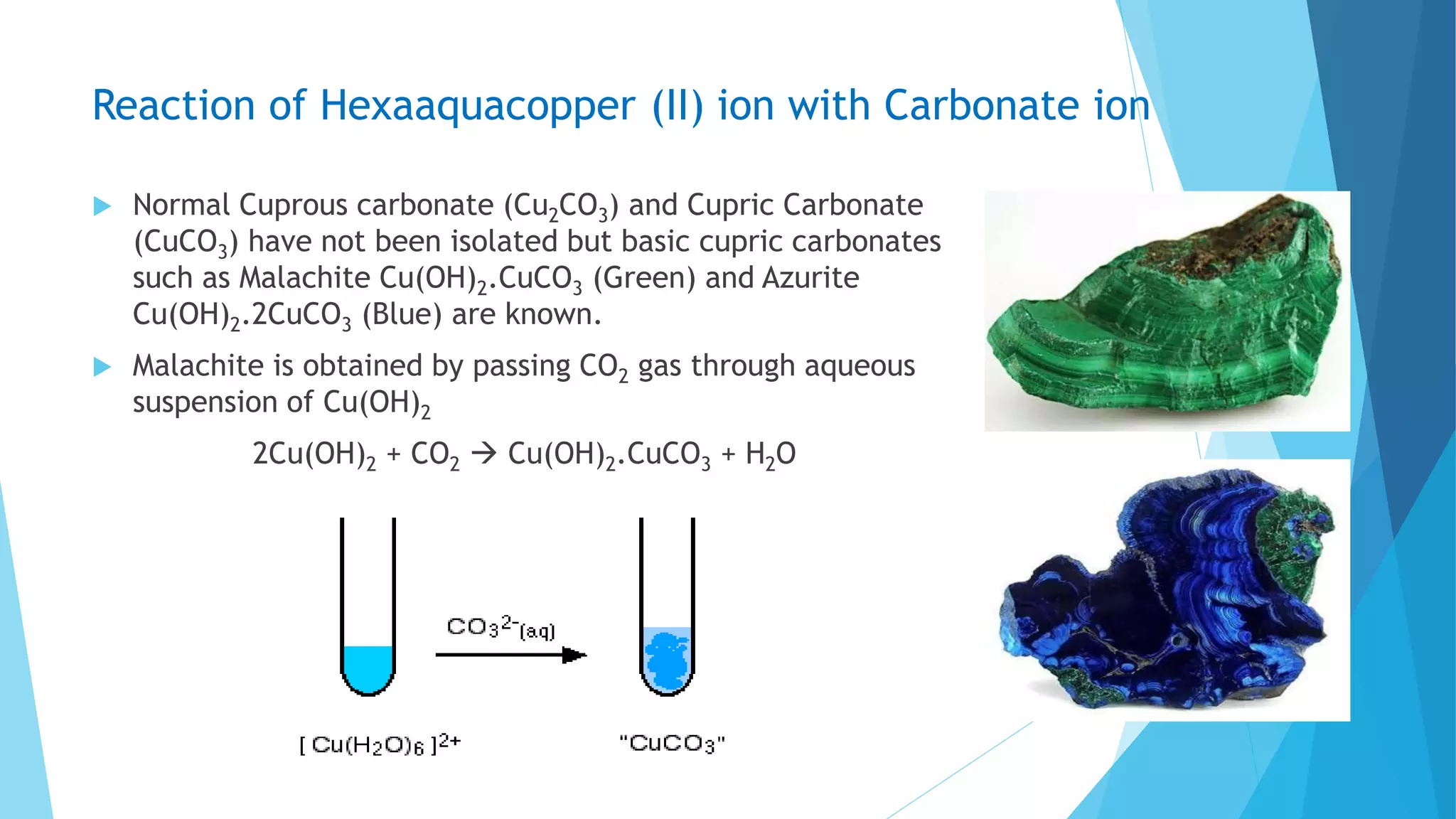
 Normal Cuprous carbonate (Cu2CO3) and Cupric Carbonate
(CuCO3) have not been isolated but basic cupric carbonates
such as Malachite Cu(OH)2.CuCO3 (Green) and Azurite
Cu(OH)2.2CuCO3 (Blue) are known.
 Malachite is obtained by passing CO2 gas through aqueous
suspension of Cu(OH)2
2Cu(OH)2 + CO2  Cu(OH)2.CuCO3 + H2O
End of Lesson
sidra.javedali@gmail.com

Transition metals: Manganese, Iron and Copper

  • 1.
    Transition Metals XII CHEMISTRYCHAPTER 14 Sidra Javed
  • 2.
  • 3.
    The Oxidation State Stable Oxidation States: +2, +4 and +7  KMnO4 – powerful oxidizing agent
  • 4.
     Reduction ofKMnO4 in Alkaline Medium: 2KMnO4 + 2KOH  2K2MnO4 + H2O + O Purple Green Mn = +7 Mn = +6 2K2MnO4 + 2KOH  2MnO2 + 4KOH + 2O Green Brown Mn = +6 Mn= +4  Reduction of KMnO4 in acidic medium: 2KMnO4 + 3H2SO4 (dilute)  K2SO4 + 2MnSO4 + 3H2O + 5[O] 2MnO4 - + 6H+  2Mn+2 + 3H2O + 5[O] Purple Colorless Mn = +7 Mn = +2
  • 5.
    Reactions of Manganese(II) ions in solution 1. The reaction of Hexaaquomanganese (II) ions with hydroxide ions: OH- ions remove H+ from two of the water ligands to give a neutral complex. This is insoluble in water and a precipitate is formed. [Mn(H2O)6]+2 + 2OH-  [Mn(H2O)4(OH)2] + 2H2O
  • 6.
    2. The reactionof Hexaaquomanganese (II) ions with ammonia solution: Ammonia removes H+ ions from the aqua complex [Mn(H2O)6]+2 + 2NH3  [Mn(H2O)4(OH)2] + 2NH4 +
  • 7.
    Using Potassium Manganate(VII) as oxidizing agent in organic chemistry  Used in neutral or alkaline solutions  Acidified KMnO4 is a strong oxidizing agent which can break C-C bonds  The KMnO4 solution is mildly alkaline with Na2CO3 solution and the color changes are:
  • 8.
    In testing fora Double Bond 1. In testing for H2C=CH2 2KMnO4 + H2O  2MnO2 + 2KOH + 3[O] 3x{ H2C=CH2 + O + H2O  HO-CH2-CH2-OH } 2KMnO4 + 4H2O + 3H2C=CH2  2MnO2 + 2KOH + 3HO-CH2-CH2-OH 2. Reaction of Hydrazine with KMnO4 (N=-2 to N = 0) 2x{ 2KMnO4 + 3H2SO4  K2SO4 + 2MnSO4 + 3H2O + 5[O] } 5x{ N2H4 + 2[O]  N2 + 2H2O } 4KMnO4 + 6H2SO4 + 5N2H4  2K2SO4 + 4MnSO4 + 16H2O + 5N2
  • 9.
    3. In oxidationof Aromatic side chains Alkaline KMnO4 oxidises any hydrocarbon side chain attached to a benzene ring back to a single -COOH group. Prolonged heating is necessary. For Example: In the case of the ethyl side chain, you will also get carbon dioxide. With longer side chains, you will get all sorts of mixtures of other products. but in each case, the main product will be benzoic acid.
  • 10.
    Using KMnO4 asan oxidizing agent in Titrations  Potassium manganate(VII) solution is use to find the concentration of all sorts of reducing agents. It is always used in acidic solution.  Examples: 1. Oxidation of Fe+2 to Fe+3 2KMnO4 + 3H2SO4  K2SO4 + 2MnSO4 + 3H2O + 5[O] 5x{ 2FeSO4 + H2SO4 + [O]  Fe2(SO4)3 + H2O} 2KMnO4 + 8H2SO4 + 10 FeSO4  K2SO4 + MnSO4 + 5Fe2(SO4)3 + 8H2O
  • 11.
    2. Ethanedioic acid(Oxalic Acid) (C=+3) to Carbon Dioxide (C=+4) 2KMnO4 + 3H2SO4  K2SO4 + 2MnSO4 + 3H2O + 5[O] 5x{ H2C2O4 + [O]  2CO2 + 2H2O } 2KMnO4 + 3H2SO4 + 5H2C2O4  K2SO4 + 2MnSO4 + 8H2O + 10CO2 3. Sulphite ions (S=+4) to Sulphate ions (S=+6) 2KMnO4 + 3H2SO4  K2SO4 + 2MnSO4 + 3H2O + 5[O] 5x{ Na2SO3 + [O]  Na2SO4 } 2KMnO4 + 3H2SO4 + 5Na2SO3  K2SO4 + 2MnSO4 + 3H2O + 5Na2SO4 4. Potassium ferrocyanide (Fe= +2) to Potassium ferricyanide (Fe= +3) 2KMnO4 + 3H2SO4  K2SO4 + 2MnSO4 + 3H2O + 5[O] 5x{ 2K4[Fe(CN)6] + O + H2O  2K3[Fe(CN)6] + 2KOH } 2KMnO4 + 3H2SO4 + 10K4[Fe(CN)6]  K2SO4 + 2MnSO4 + 2H2O + 10K3[Fe(CN)6] + 10KOH
  • 12.
    Doing the titration The KMnO4 solution always goes into the burette, and the other solution in the flask is acidified with dilute sulphuric acid.  As the KMnO4 solution is run into the flask it becomes colorless. The end point is the first faint trace of permanent pink color in the solution showing that there is a tiny excess of MnO4 - ions present.
  • 13.
    Problems with theuse of KMnO4 Solution  KMnO4 can't be used in titrations in the presence of ions like chloride or bromide which it oxidizes. An unknown amount of the KMnO4 would be used in side reactions, and so the titration result would be inaccurate. This is why you do not acidify the solution with hydrochloric acid.  KMnO4 isn't a primary standard. That means it can’t be made up to give a stable solution of accurately known concentration.  It is so strongly colored that it is impossible to see when all the crystals you have used have dissolved, and over a period of time it oxidizes the water it is dissolved in to oxygen.  Bottles of KMnO4 solution usually have a brown precipitate around the top. This is MnO2 - and is produced when the MnO4 - ions react with the water.
  • 14.
  • 15.
    Oxidation State  Ironexists in two common oxidation states, +2 (Fe2+) and +3 (Fe3+).  In aqueous solution, the Fe is readily oxidized from Fe2+ to Fe3+ Fe2+(aq)  Fe3+(aq) + e-
  • 16.
    Iron as catalystin Haber Process  The Haber Process combines nitrogen and hydrogen into ammonia.
  • 17.
    Iron ions asa catalyst in the reaction between Persulphate ions and iodide ions  The reaction between persulphate ions (peroxodisulphate ions), S2O8- 2 and iodide ions in solution can be catalyzed using either iron(II) or iron(III) ions. The overall reaction is:  The reaction happens in two stages:  If you use Fe(III) ions, the second reactions happens first.
  • 18.
    a. Reaction ofIron ions with OH- ions In case of Iron (II) In case of Iron (III) OH- ions remove H+ from two of the water ligands to give a neutral complex. This is insoluble in water and a precipitate is formed.
  • 19.
    b. Reaction ofIron ions with NH3 In case of Iron (II) In case of Iron (III) Ammonia acts a base and removes H+ ions from the water ligands to form a neutral insoluble complex. [Fe(H2O)6]+3 + 3NH3  [Fe(H2O)3(OH)3] + 3NH4 +[Fe(H2O)6]+2 + 2NH3  [Fe(H2O)4(OH)2] + 2NH4 +
  • 20.
    Reactions of Iron(II) with carbonate ions and thiocyanate ions a. Iron (II) ions and carbonate ions:  Iron (II) carbonate is simply formed Fe+2 + CO3 -2  FeCO3
  • 21.
    b. Iron (III)ions with Carbonate ions  The hexaaquairon(III) ion is sufficiently acidic to react with weakly basic carbonate ions.  Carbonate ions remove H+ from water ligands to produce a neutral complex 2[Fe(H2O)6]+3 + 3CO3 -2  2[Fe(H2O)3(OH)3] + 3CO2 + 3H2O
  • 22.
    Testing for Iron(III)with Thiocyanate ions  Add thiocyanate ions, SCN-, to a solution containing iron(III) ions, blood red solution is formed. [Fe(H2O)6]+3 + SCN-  [Fe(SCN)(H2O)5]+2 + H2O
  • 23.
  • 24.
    The oxidation state Copper has two stable oxidation state  Cuprous (+1)  Cupric (+2)
  • 25.
    Compounds of Cu+1 Most of the compounds of Cuprous are colorless and diamagnetic as 3d orbital is completely filled (Cu+1 = 3d10)  Exceptions are Cu2O (Red) and Cu2S (Black)  These are generally insoluble in water  The soluble compounds of Cu+1 are unstable in aqueous solution, since they disproportionate to Cu and Cu+2 2Cu+  Cu + Cu+2  When Cu2O is dissolved in dilute H2SO4 , the products formed are CuSO4 and Cu. This reaction takes place in two steps: Cu2O + H2SO4  Cu2SO4 + H2O Cu2SO4  CuSO4 + Cu Cu2O + H2SO4  CuSO4 + Cu + H2O
  • 26.
    Compounds of Cu+2 Most of the anhydrous cupric compounds are colorless while the hydrated cupric compounds are blue due to the formation of Blue hydrated ion [Cu(H2O)4]+2 or [Cu(H2O)6]+2  Solutions of Cu+2 salts are acidic in nature due to hydrolysis. Cu+2 + H2O  [Cu(OH)]+ + H+  Since the outer most shell of Cu+2 ion has one unpaired electron (3d9), Cu+2 compounds are paramagnetic.
  • 27.
    Reaction of Hexaaquacopper(II) ions with OH- ions  OH- ions remove H+ from two of the water ligands to give a neutral complex. This is insoluble in water and a precipitate is formed.
  • 28.
    Reaction of Hexaaquacopper(II) ion with NH3 solution  When Cu(OH)2 is dissolved in excess of NH4OH, a blue soluble cupric ammine hydroxide is obtained Cu(OH)2 + 4NH4OH  [Cu(NH3)4(OH)2] + 4H2O
  • 29.
    Reaction of Hexaaquacopper(II) ion with Carbonate ion  Normal Cuprous carbonate (Cu2CO3) and Cupric Carbonate (CuCO3) have not been isolated but basic cupric carbonates such as Malachite Cu(OH)2.CuCO3 (Green) and Azurite Cu(OH)2.2CuCO3 (Blue) are known.  Malachite is obtained by passing CO2 gas through aqueous suspension of Cu(OH)2 2Cu(OH)2 + CO2  Cu(OH)2.CuCO3 + H2O
  • 30.