BY: KAREEM HUSSIEN
 Proteins are organic nitrogenous compounds formed of C H O & “N”
 Proteins are the polymers of 20 naturally occurring amino acids
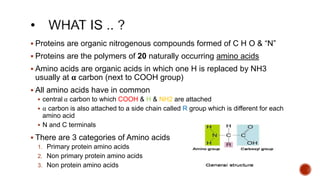
 Amino acids are organic acids in which one H is replaced by NH3
usually at α carbon (next to COOH group)
 All amino acids have in common
 central α carbon to which COOH & H & NH2 are attached
 α carbon is also attached to a side chain called R group which is different for each
amino acid
 N and C terminals
 There are 3 categories of Amino acids
1. Primary protein amino acids
2. Non primary protein amino acids
3. Non protein amino acids
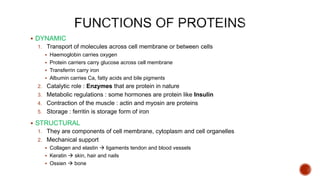
 DYNAMIC
1. Transport of molecules across cell membrane or between cells
 Haemoglobin carries oxygen
 Protein carriers carry glucose across cell membrane
 Transferrin carry iron
 Albumin carries Ca, fatty acids and bile pigments
2. Catalytic role : Enzymes that are protein in nature
3. Metabolic regulations : some hormones are protein like Insulin
4. Contraction of the muscle : actin and myosin are proteins
5. Storage : ferritin is storage form of iron
 STRUCTURAL
1. They are components of cell membrane, cytoplasm and cell organelles
2. Mechanical support
 Collagen and elastin  ligaments tendon and blood vessels
 Keratin  skin, hair and nails
 Ossien  bone
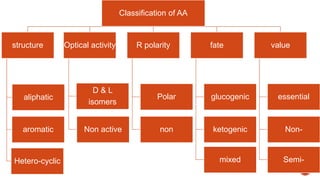
Classification of AA
structure
aliphatic
aromatic
Hetero-cyclic
Optical activity
D & L
isomers
Non active
R polarity
Polar
non
fate
glucogenic
ketogenic
mixed
value
essential
Non-
Semi-
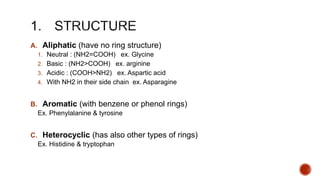
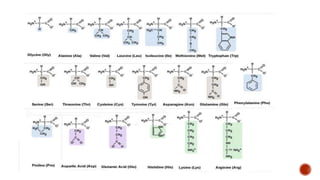
A. Aliphatic (have no ring structure)
1. Neutral : (NH2=COOH) ex. Glycine
2. Basic : (NH2>COOH) ex. arginine
3. Acidic : (COOH>NH2) ex. Aspartic acid
4. With NH2 in their side chain ex. Asparagine
B. Aromatic (with benzene or phenol rings)
Ex. Phenylalanine & tyrosine
C. Heterocyclic (has also other types of rings)
Ex. Histidine & tryptophan
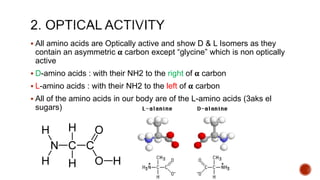
 All amino acids are Optically active and show D & L Isomers as they
contain an asymmetric α carbon except “glycine” which is non optically
active
 D-amino acids : with their NH2 to the right of α carbon
 L-amino acids : with their NH2 to the left of α carbon
 All of the amino acids in our body are of the L-amino acids (3aks el
sugars)
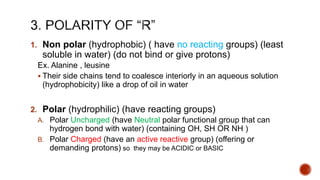
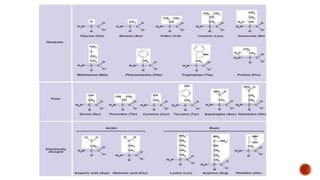
1. Non polar (hydrophobic) ( have no reacting groups) (least
soluble in water) (do not bind or give protons)
Ex. Alanine , leusine
 Their side chains tend to coalesce interiorly in an aqueous solution
(hydrophobicity) like a drop of oil in water
2. Polar (hydrophilic) (have reacting groups)
A. Polar Uncharged (have Neutral polar functional group that can
hydrogen bond with water) (containing OH, SH OR NH )
B. Polar Charged (have an active reactive group) (offering or
demanding protons) so they may be ACIDIC or BASIC
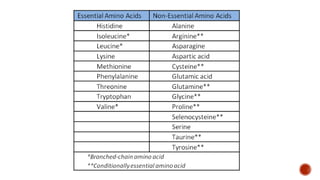
1. Essential amino acids
Cant be synthesized in the body so must be taken in the diet
Ex. Valine , leucine , isoleucine ,…..
1. Non essential amino acids
Can be synthesized in the body
Ex. Glycine , alanine , aspartic ,…..
 Arginine and Histidine are called semi-essential because they are
synthesized in the body in a rate enough for adults but not for growing
individuals
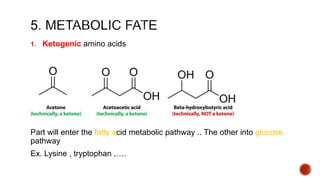
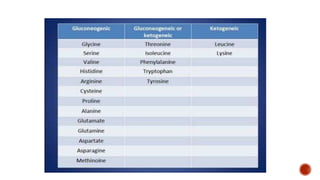
1. Ketogenic amino acids
Give rise to ketone bodies and fats in the catabolic way
Ex. Leucine
1. Glucogenic amino acid
Give rise to carbohydrates …
Ex. glycine, serine ,….
1. Mixed amino acids
Part will enter the fatty acid metabolic pathway .. The other into glucose
pathway
Ex. Lysine , tryptophan ,….
1. Optical activity
2. Amphoteric property
In solution, amino acids act as both acid and alkali d.t the presence of
acidic group (COOH-) and basic group (-NH2)
3. Isoelectric point (zwitter ion state)
It’s the pH at which the protein carries equal +ve and –ve charges
At this point
 Proteins and enzymes loose their function
 Their viscosity in solution becomes maximal
 Their solubility becomes minimal (easily precipitated)
 Amino acids  peptide and polypeptides  protein
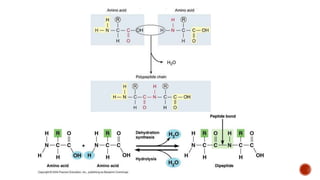
 Amino acids form peptides in a “dehydration” reaction (peptide bonds)
 Polypeptides contain 10-100 amino acid .. Peptides with more than 100 amino acids
are called proteins
 2 types of bonds are responsible for the structure
1. Covalent (strong bonds)(favor stability resist denaturation)
A. Peptide bonds : COOH combines NH3 with removal of water
B. Disulphide bonds : between 2 Cysteine a.a in the same or diff polypeptide chains
2. Non covalent (weak bonds)(favor protein folding)
A. Hydrogen bonds
B. Hydrophobic bonds (help stabilize protein structure)
C. Ionic bonds )repulsive or attractive)
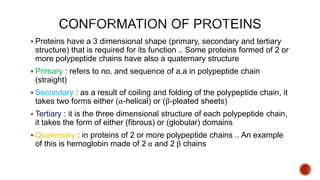
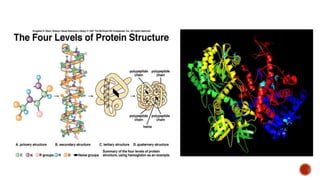
 Proteins have a 3 dimensional shape (primary, secondary and tertiary
structure) that is required for its function .. Some proteins formed of 2 or
more polypeptide chains have also a quaternary structure
 Primary : refers to no. and sequence of a.a in polypeptide chain
(straight)
 Secondary : as a result of coiling and folding of the polypeptide chain, it
takes two forms either (α-helical) or (β-pleated sheets)
 Tertiary : it is the three dimensional structure of each polypeptide chain,
it takes the form of either (fibrous) or (globular) domains
 Quaternary : in proteins of 2 or more polypeptide chains .. An example
of this is hemoglobin made of 2 α and 2 β chains
 Loss of native structure by many causes leading to changes in secondary, tertiary and
quaternary structure due to rupture of non covalent bonds (never peptide bond) with
loss of biological activity
 All levels of structure are disrupted except primary (strong peptide bond)
 CAUSES
 Physical causes : heating above 70, powerful shaking, repeated freezing and melting, UV
and high pressure
 Chemical causes : urea, alcohol, strong bases & acids, salts of heavy metals as MG
 EFFECTS
 Decreased solubility and rate of diffusion
 Increased viscosity due to unfolding
 Loss of activity
 Change in antigenic property

Proteins biochemistry

  • 1.
  • 3.
     Proteins areorganic nitrogenous compounds formed of C H O & “N”  Proteins are the polymers of 20 naturally occurring amino acids  Amino acids are organic acids in which one H is replaced by NH3 usually at α carbon (next to COOH group)  All amino acids have in common  central α carbon to which COOH & H & NH2 are attached  α carbon is also attached to a side chain called R group which is different for each amino acid  N and C terminals  There are 3 categories of Amino acids 1. Primary protein amino acids 2. Non primary protein amino acids 3. Non protein amino acids
  • 4.
     DYNAMIC 1. Transportof molecules across cell membrane or between cells  Haemoglobin carries oxygen  Protein carriers carry glucose across cell membrane  Transferrin carry iron  Albumin carries Ca, fatty acids and bile pigments 2. Catalytic role : Enzymes that are protein in nature 3. Metabolic regulations : some hormones are protein like Insulin 4. Contraction of the muscle : actin and myosin are proteins 5. Storage : ferritin is storage form of iron  STRUCTURAL 1. They are components of cell membrane, cytoplasm and cell organelles 2. Mechanical support  Collagen and elastin  ligaments tendon and blood vessels  Keratin  skin, hair and nails  Ossien  bone
  • 5.
    Classification of AA structure aliphatic aromatic Hetero-cyclic Opticalactivity D & L isomers Non active R polarity Polar non fate glucogenic ketogenic mixed value essential Non- Semi-
  • 6.
    A. Aliphatic (haveno ring structure) 1. Neutral : (NH2=COOH) ex. Glycine 2. Basic : (NH2>COOH) ex. arginine 3. Acidic : (COOH>NH2) ex. Aspartic acid 4. With NH2 in their side chain ex. Asparagine B. Aromatic (with benzene or phenol rings) Ex. Phenylalanine & tyrosine C. Heterocyclic (has also other types of rings) Ex. Histidine & tryptophan
  • 8.
     All aminoacids are Optically active and show D & L Isomers as they contain an asymmetric α carbon except “glycine” which is non optically active  D-amino acids : with their NH2 to the right of α carbon  L-amino acids : with their NH2 to the left of α carbon  All of the amino acids in our body are of the L-amino acids (3aks el sugars)
  • 9.
    1. Non polar(hydrophobic) ( have no reacting groups) (least soluble in water) (do not bind or give protons) Ex. Alanine , leusine  Their side chains tend to coalesce interiorly in an aqueous solution (hydrophobicity) like a drop of oil in water 2. Polar (hydrophilic) (have reacting groups) A. Polar Uncharged (have Neutral polar functional group that can hydrogen bond with water) (containing OH, SH OR NH ) B. Polar Charged (have an active reactive group) (offering or demanding protons) so they may be ACIDIC or BASIC
  • 11.
    1. Essential aminoacids Cant be synthesized in the body so must be taken in the diet Ex. Valine , leucine , isoleucine ,….. 1. Non essential amino acids Can be synthesized in the body Ex. Glycine , alanine , aspartic ,…..  Arginine and Histidine are called semi-essential because they are synthesized in the body in a rate enough for adults but not for growing individuals
  • 13.
    1. Ketogenic aminoacids Give rise to ketone bodies and fats in the catabolic way Ex. Leucine 1. Glucogenic amino acid Give rise to carbohydrates … Ex. glycine, serine ,…. 1. Mixed amino acids Part will enter the fatty acid metabolic pathway .. The other into glucose pathway Ex. Lysine , tryptophan ,….
  • 15.
    1. Optical activity 2.Amphoteric property In solution, amino acids act as both acid and alkali d.t the presence of acidic group (COOH-) and basic group (-NH2) 3. Isoelectric point (zwitter ion state) It’s the pH at which the protein carries equal +ve and –ve charges At this point  Proteins and enzymes loose their function  Their viscosity in solution becomes maximal  Their solubility becomes minimal (easily precipitated)
  • 16.
     Amino acids peptide and polypeptides  protein  Amino acids form peptides in a “dehydration” reaction (peptide bonds)  Polypeptides contain 10-100 amino acid .. Peptides with more than 100 amino acids are called proteins  2 types of bonds are responsible for the structure 1. Covalent (strong bonds)(favor stability resist denaturation) A. Peptide bonds : COOH combines NH3 with removal of water B. Disulphide bonds : between 2 Cysteine a.a in the same or diff polypeptide chains 2. Non covalent (weak bonds)(favor protein folding) A. Hydrogen bonds B. Hydrophobic bonds (help stabilize protein structure) C. Ionic bonds )repulsive or attractive)
  • 18.
     Proteins havea 3 dimensional shape (primary, secondary and tertiary structure) that is required for its function .. Some proteins formed of 2 or more polypeptide chains have also a quaternary structure  Primary : refers to no. and sequence of a.a in polypeptide chain (straight)  Secondary : as a result of coiling and folding of the polypeptide chain, it takes two forms either (α-helical) or (β-pleated sheets)  Tertiary : it is the three dimensional structure of each polypeptide chain, it takes the form of either (fibrous) or (globular) domains  Quaternary : in proteins of 2 or more polypeptide chains .. An example of this is hemoglobin made of 2 α and 2 β chains
  • 20.
     Loss ofnative structure by many causes leading to changes in secondary, tertiary and quaternary structure due to rupture of non covalent bonds (never peptide bond) with loss of biological activity  All levels of structure are disrupted except primary (strong peptide bond)  CAUSES  Physical causes : heating above 70, powerful shaking, repeated freezing and melting, UV and high pressure  Chemical causes : urea, alcohol, strong bases & acids, salts of heavy metals as MG  EFFECTS  Decreased solubility and rate of diffusion  Increased viscosity due to unfolding  Loss of activity  Change in antigenic property