Concentration Units
Chapter # 10
Chemistry XI FDC
Ms. Sidra Javed
Concentraion
Amount of solute dissolved in
given amount of solution
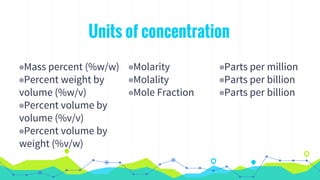
Units of concentration
◉Mass percent (%w/w)
◉Percent weight by
volume (%w/v)
◉Percent volume by
volume (%v/v)
◉Percent volume by
weight (%v/w)
◉Molarity
◉Molality
◉Mole Fraction
◉Parts per million
◉Parts per billion
◉Parts per billion
Mass Percent
1
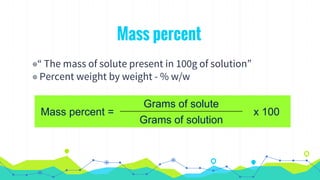
Mass percent
◉“ The mass of solute present in 100g of solution”
◉ Percent weight by weight - % w/w
Mass percent =
Grams of solute
x 100
Grams of solution
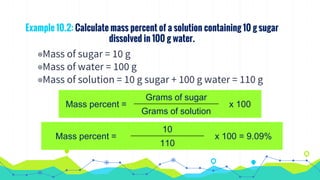
Example 10.2: Calculate mass percent of a solution containing 10 g sugar
dissolved in 100 g water.
◉Mass of sugar = 10 g
◉Mass of water = 100 g
◉Mass of solution = 10 g sugar + 100 g water = 110 g
Mass percent =
Grams of sugar
x 100
Grams of solution
Mass percent =
10
x 100 = 9.09%
110
Percent weight by volume
2
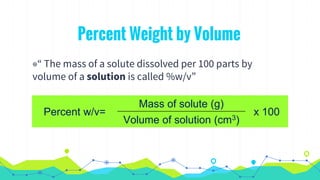
Percent Weight by Volume
◉“ The mass of a solute dissolved per 100 parts by
volume of a solution is called %w/v”
Percent w/v=
Mass of solute (g)
x 100
Volume of solution (cm3)
Percent volume by volume
3
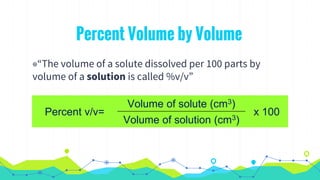
Percent Volume by Volume
◉“The volume of a solute dissolved per 100 parts by
volume of a solution is called %v/v”
Percent v/v=
Volume of solute (cm3)
x 100
Volume of solution (cm3)
Percent volume by weight
4
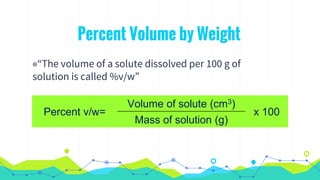
Percent Volume by Weight
◉“The volume of a solute dissolved per 100 g of
solution is called %v/w”
Percent v/w=
Volume of solute (cm3)
x 100
Mass of solution (g)
Molarity or Molar
concentration
5
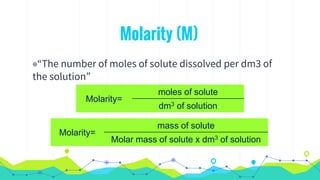
Molarity (M)
◉“The number of moles of solute dissolved per dm3 of
the solution”
Molarity=
moles of solute
dm3 of solution
Molarity=
mass of solute
Molar mass of solute x dm3 of solution
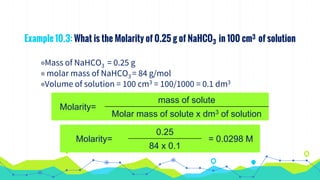
Example 10.3: What is the Molarity of 0.25 g of NaHCO3 in 100 cm3 of solution
◉Mass of NaHCO3 = 0.25 g
◉ molar mass of NaHCO3 = 84 g/mol
◉Volume of solution = 100 cm3 = 100/1000 = 0.1 dm3
Molarity=
mass of solute
Molar mass of solute x dm3 of solution
Molarity=
0.25
= 0.0298 M
84 x 0.1
Molality or Molal
concentration
6
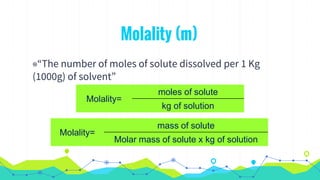
Molality (m)
◉“The number of moles of solute dissolved per 1 Kg
(1000g) of solvent”
Molality=
moles of solute
kg of solution
Molality=
mass of solute
Molar mass of solute x kg of solution
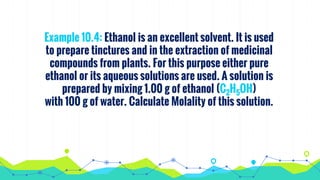
Example 10.4: Ethanol is an excellent solvent. It is used
to prepare tinctures and in the extraction of medicinal
compounds from plants. For this purpose either pure
ethanol or its aqueous solutions are used. A solution is
prepared by mixing 1.00 g of ethanol (C2H5OH)
with 100 g of water. Calculate Molality of this solution.
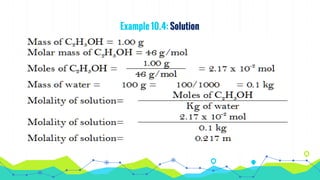
Example 10.4: Solution
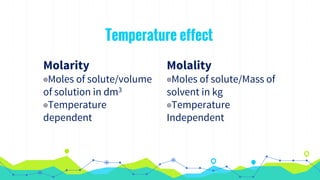
Molarity
◉Moles of solute/volume
of solution in dm3
◉Temperature
dependent
Temperature effect
Molality
◉Moles of solute/Mass of
solvent in kg
◉Temperature
Independent
Temperature effect
◉As temperature is increase the amount of solute
remains same but the volume of a solution increases
slightly as liquid expands hence the Molarity
decreases slightly due to inverse relation.
Mole Fraction
7
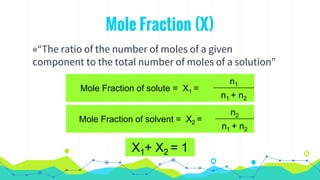
Mole Fraction (X)
◉“The ratio of the number of moles of a given
component to the total number of moles of a solution”
Mole Fraction of solute = X1 =
n1
n1 + n2
Mole Fraction of solvent = X2 =
n2
n1 + n2
X1+ X2 = 1
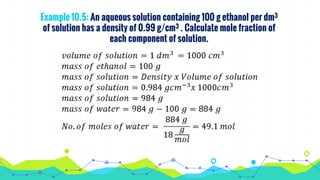
Example 10.5: An aqueous solution containing 100 g ethanol per dm3
of solution has a density of 0.99 g/cm3 . Calculate mole fraction of
each component of solution.
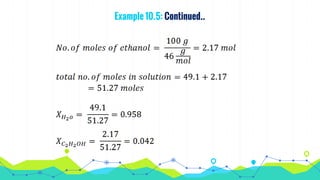
Example 10.5: Continued..
Parts per million
8
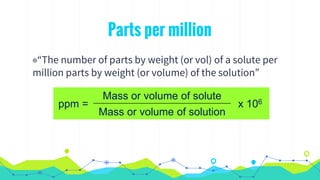
Parts per million
◉“The number of parts by weight (or vol) of a solute per
million parts by weight (or volume) of the solution”
ppm =
Mass or volume of solute
x 106
Mass or volume of solution
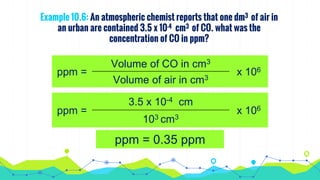
Example 10.6: An atmospheric chemist reports that one dm3 of air in
an urban are contained 3.5 x 10⁻⁴ cm3 of CO. what was the
concentration of CO in ppm?
ppm =
Volume of CO in cm3
x 106
Volume of air in cm3
ppm =
3.5 x 10-4 cm
x 106
103 cm3
ppm = 0.35 ppm
Parts per trillion
10
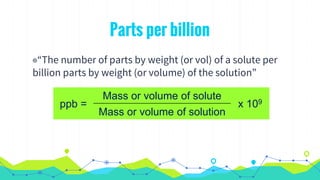
Parts per billion
◉“The number of parts by weight (or vol) of a solute per
billion parts by weight (or volume) of the solution”
ppb =
Mass or volume of solute
x 109
Mass or volume of solution
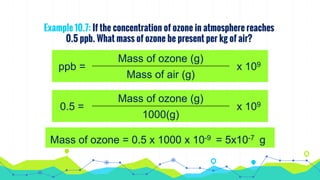
Example 10.7: If the concentration of ozone in atmosphere reaches
0.5 ppb. What mass of ozone be present per kg of air?
ppb =
Mass of ozone (g)
x 109
Mass of air (g)
0.5 =
Mass of ozone (g)
x 109
1000(g)
Mass of ozone = 0.5 x 1000 x 10-9 = 5x10⁻⁷ g
Parts per billion
9
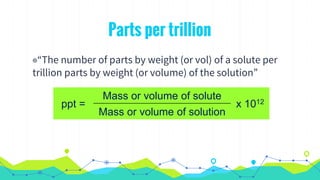
Parts per trillion
◉“The number of parts by weight (or vol) of a solute per
trillion parts by weight (or volume) of the solution”
ppt =
Mass or volume of solute
x 1012
Mass or volume of solution
Inter Conversion of
Various Concentration
Units of Solution
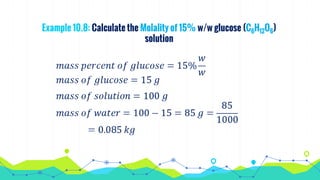
Example 10.8: Calculate the Molality of 15% w/w glucose (C6H12O6)
solution
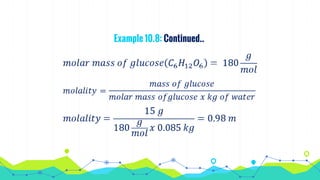
Example 10.8: Continued..
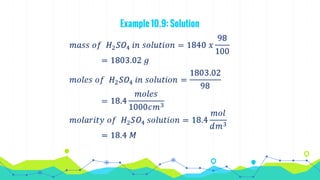
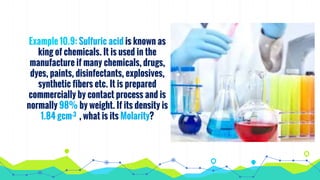
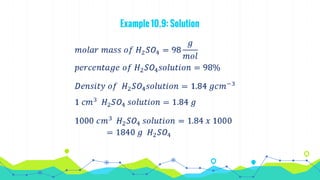
Example 10.9: Sulfuric acid is known as
king of chemicals. It is used in the
manufacture if many chemicals, drugs,
dyes, paints, disinfectants, explosives,
synthetic fibers etc. It is prepared
commercially by contact process and is
normally 98% by weight. If its density is
1.84 gcm-3 , what is its Molarity?
Example 10.9: Solution
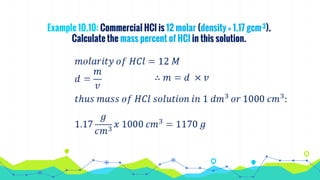
Example 10.10: Commercial HCl is 12 molar (density = 1.17 gcm-3).
Calculate the mass percent of HCl in this solution.
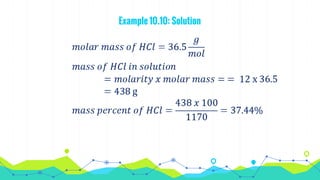
Example 10.10: Solution
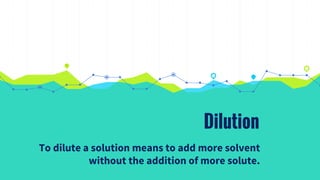
Dilution
To dilute a solution means to add more solvent
without the addition of more solute.
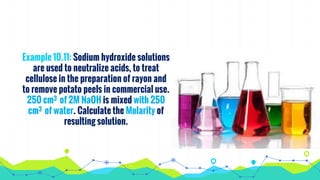
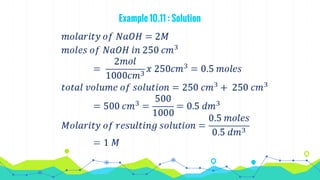
Example 10.11: Sodium hydroxide solutions
are used to neutralize acids, to treat
cellulose in the preparation of rayon and
to remove potato peels in commercial use.
250 cm3 of 2M NaOH is mixed with 250
cm3 of water. Calculate the Molarity of
resulting solution.
Example 10.11 : Solution
THE END
Any questions?
You can find me at
sidra.javedali@gmail.com

Concentration units

  • 1.
    Concentration Units Chapter #10 Chemistry XI FDC Ms. Sidra Javed
  • 2.
    Concentraion Amount of solutedissolved in given amount of solution
  • 3.
    Units of concentration ◉Masspercent (%w/w) ◉Percent weight by volume (%w/v) ◉Percent volume by volume (%v/v) ◉Percent volume by weight (%v/w) ◉Molarity ◉Molality ◉Mole Fraction ◉Parts per million ◉Parts per billion ◉Parts per billion
  • 4.
  • 5.
    Mass percent ◉“ Themass of solute present in 100g of solution” ◉ Percent weight by weight - % w/w Mass percent = Grams of solute x 100 Grams of solution
  • 6.
    Example 10.2: Calculatemass percent of a solution containing 10 g sugar dissolved in 100 g water. ◉Mass of sugar = 10 g ◉Mass of water = 100 g ◉Mass of solution = 10 g sugar + 100 g water = 110 g Mass percent = Grams of sugar x 100 Grams of solution Mass percent = 10 x 100 = 9.09% 110
  • 7.
  • 8.
    Percent Weight byVolume ◉“ The mass of a solute dissolved per 100 parts by volume of a solution is called %w/v” Percent w/v= Mass of solute (g) x 100 Volume of solution (cm3)
  • 9.
  • 10.
    Percent Volume byVolume ◉“The volume of a solute dissolved per 100 parts by volume of a solution is called %v/v” Percent v/v= Volume of solute (cm3) x 100 Volume of solution (cm3)
  • 11.
  • 12.
    Percent Volume byWeight ◉“The volume of a solute dissolved per 100 g of solution is called %v/w” Percent v/w= Volume of solute (cm3) x 100 Mass of solution (g)
  • 13.
  • 14.
    Molarity (M) ◉“The numberof moles of solute dissolved per dm3 of the solution” Molarity= moles of solute dm3 of solution Molarity= mass of solute Molar mass of solute x dm3 of solution
  • 15.
    Example 10.3: Whatis the Molarity of 0.25 g of NaHCO3 in 100 cm3 of solution ◉Mass of NaHCO3 = 0.25 g ◉ molar mass of NaHCO3 = 84 g/mol ◉Volume of solution = 100 cm3 = 100/1000 = 0.1 dm3 Molarity= mass of solute Molar mass of solute x dm3 of solution Molarity= 0.25 = 0.0298 M 84 x 0.1
  • 16.
  • 17.
    Molality (m) ◉“The numberof moles of solute dissolved per 1 Kg (1000g) of solvent” Molality= moles of solute kg of solution Molality= mass of solute Molar mass of solute x kg of solution
  • 18.
    Example 10.4: Ethanolis an excellent solvent. It is used to prepare tinctures and in the extraction of medicinal compounds from plants. For this purpose either pure ethanol or its aqueous solutions are used. A solution is prepared by mixing 1.00 g of ethanol (C2H5OH) with 100 g of water. Calculate Molality of this solution.
  • 19.
  • 20.
    Molarity ◉Moles of solute/volume ofsolution in dm3 ◉Temperature dependent Temperature effect Molality ◉Moles of solute/Mass of solvent in kg ◉Temperature Independent
  • 21.
    Temperature effect ◉As temperatureis increase the amount of solute remains same but the volume of a solution increases slightly as liquid expands hence the Molarity decreases slightly due to inverse relation.
  • 22.
  • 23.
    Mole Fraction (X) ◉“Theratio of the number of moles of a given component to the total number of moles of a solution” Mole Fraction of solute = X1 = n1 n1 + n2 Mole Fraction of solvent = X2 = n2 n1 + n2 X1+ X2 = 1
  • 24.
    Example 10.5: Anaqueous solution containing 100 g ethanol per dm3 of solution has a density of 0.99 g/cm3 . Calculate mole fraction of each component of solution.
  • 25.
  • 26.
  • 27.
    Parts per million ◉“Thenumber of parts by weight (or vol) of a solute per million parts by weight (or volume) of the solution” ppm = Mass or volume of solute x 106 Mass or volume of solution
  • 28.
    Example 10.6: Anatmospheric chemist reports that one dm3 of air in an urban are contained 3.5 x 10⁻⁴ cm3 of CO. what was the concentration of CO in ppm? ppm = Volume of CO in cm3 x 106 Volume of air in cm3 ppm = 3.5 x 10-4 cm x 106 103 cm3 ppm = 0.35 ppm
  • 29.
  • 30.
    Parts per billion ◉“Thenumber of parts by weight (or vol) of a solute per billion parts by weight (or volume) of the solution” ppb = Mass or volume of solute x 109 Mass or volume of solution
  • 31.
    Example 10.7: Ifthe concentration of ozone in atmosphere reaches 0.5 ppb. What mass of ozone be present per kg of air? ppb = Mass of ozone (g) x 109 Mass of air (g) 0.5 = Mass of ozone (g) x 109 1000(g) Mass of ozone = 0.5 x 1000 x 10-9 = 5x10⁻⁷ g
  • 32.
  • 33.
    Parts per trillion ◉“Thenumber of parts by weight (or vol) of a solute per trillion parts by weight (or volume) of the solution” ppt = Mass or volume of solute x 1012 Mass or volume of solution
  • 34.
    Inter Conversion of VariousConcentration Units of Solution
  • 35.
    Example 10.8: Calculatethe Molality of 15% w/w glucose (C6H12O6) solution
  • 36.
  • 37.
    Example 10.9: Sulfuricacid is known as king of chemicals. It is used in the manufacture if many chemicals, drugs, dyes, paints, disinfectants, explosives, synthetic fibers etc. It is prepared commercially by contact process and is normally 98% by weight. If its density is 1.84 gcm-3 , what is its Molarity?
  • 38.
  • 39.
  • 40.
    Example 10.10: CommercialHCl is 12 molar (density = 1.17 gcm-3). Calculate the mass percent of HCl in this solution.
  • 41.
  • 42.
    Dilution To dilute asolution means to add more solvent without the addition of more solute.
  • 43.
    Example 10.11: Sodiumhydroxide solutions are used to neutralize acids, to treat cellulose in the preparation of rayon and to remove potato peels in commercial use. 250 cm3 of 2M NaOH is mixed with 250 cm3 of water. Calculate the Molarity of resulting solution.
  • 44.
  • 45.
    THE END Any questions? Youcan find me at sidra.javedali@gmail.com