d - BLOCK ELEMENTS
XII CHEMISTRY CHAPTER 5
SIDRA JAVED
d – BLOCK ELEMENTS
Those elements with atoms in which there is a progressive
filling of d sub shell are called d – block elements.
OR
Those elements with atoms in which last two shells are
incomplete (i.e. n & n-1) are called d block elements.
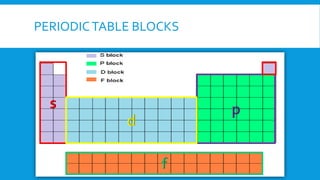
PERIODICTABLE BLOCKS
TRANSITION ELEMENTS
The elements which show properties which are
transitional between electropositive s – block elements
and electronegative p – block elements.
The transition elements include elements of d – block
and f – block of periodic table.
TRANSITION SERIES OF d – BLOCK ELEMENTS
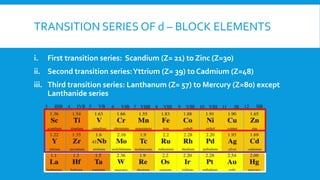
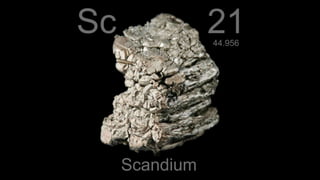
i. First transition series: Scandium (Z= 21) to Zinc (Z=30)
ii. Second transition series:Yttrium (Z= 39) to Cadmium (Z=48)
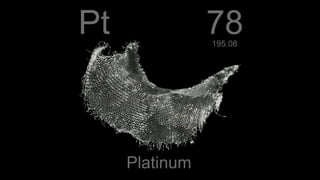
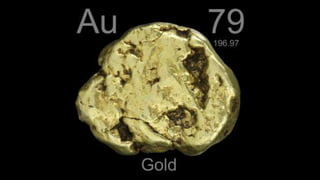
iii. Third transition series: Lanthanum (Z= 57) to Mercury (Z=80) except
Lanthanide series
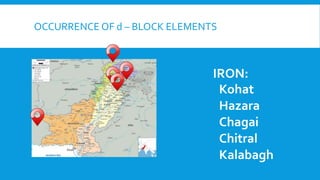
OCCURRENCE OF d – BLOCK ELEMENTS
IRON:
Kohat
Hazara
Chagai
Chitral
Kalabagh
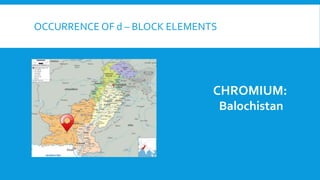
OCCURRENCE OF d – BLOCK ELEMENTS
CHROMIUM:
Balochistan
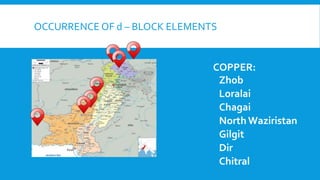
OCCURRENCE OF d – BLOCK ELEMENTS
COPPER:
Zhob
Loralai
Chagai
NorthWaziristan
Gilgit
Dir
Chitral
OCCURRENCE
OF d – BLOCK
ELEMENTS
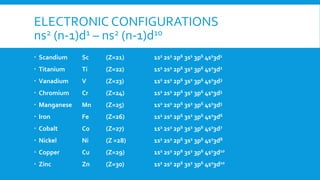
ELECTRONIC CONFIGURATIONS
ns2 (n-1)d1 – ns2 (n-1)d10
 Scandium Sc (Z=21) 1s2 2s2 2p6 3s2 3p6 4s23d1
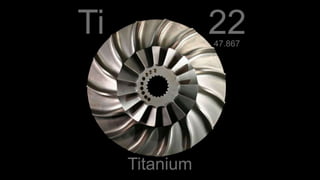
 Titanium Ti (Z=22) 1s2 2s2 2p6 3s2 3p6 4s23d2
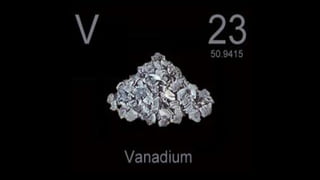
 Vanadium V (Z=23) 1s2 2s2 2p6 3s2 3p6 4s23d3
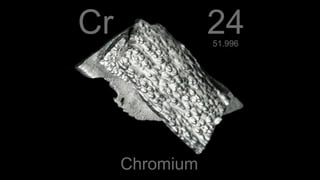
 Chromium Cr (Z=24) 1s2 2s2 2p6 3s2 3p6 4s13d5
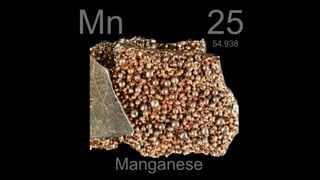
 Manganese Mn (Z=25) 1s2 2s2 2p6 3s2 3p6 4s23d5
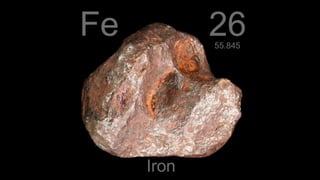
 Iron Fe (Z=26) 1s2 2s2 2p6 3s2 3p6 4s23d6
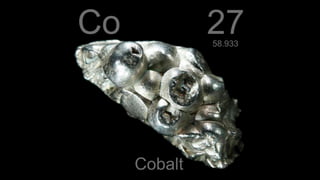
 Cobalt Co (Z=27) 1s2 2s2 2p6 3s2 3p6 4s23d7
 Nickel Ni (Z =28) 1s2 2s2 2p6 3s2 3p6 4s23d8
 Copper Cu (Z=29) 1s2 2s2 2p6 3s2 3p6 4s13d10
 Zinc Zn (Z=30) 1s2 2s2 2p6 3s2 3p6 4s23d10
METALLIC CHARACTER
All transition elements are generally metals and
good conductor of heat and electricity.
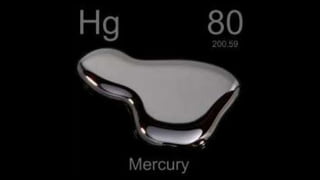
Mercury is the only metal found in liquid state.
ATOMIC SIZES
The atomic sizes of transition elements decrease
to a small extent from left to right.
It is due to increase in nuclear charge without the
increase in number of shells.
IONIZATION POTENTIAL
Ionization potential values of d block elements are
greater than s block elements and smaller than p block
elements.
These elements may form either ionic or covalent
compound depending on the conditions.
MELTING AND BOILING POINTS
Melting and boiling points of all transition elements are
high except that of Zinc due to complete d sub shell.
High Melting and Boiling points are due to small atomic
sizes which give strong inter atomic attraction.
OXIDATION STATES
Transition elements show variable oxidation states in
their compounds.
The variation is due to very small energy difference
between 3d and 4s orbitals.
As a result electrons of both 3d and 4s orbitals take part
in bonding.
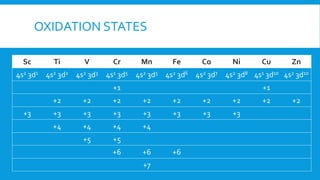
OXIDATION STATES
Sc Ti V Cr Mn Fe Co Ni Cu Zn
4s2 3d1 4s2 3d2 4s2 3d3 4s1 3d5 4s2 3d5 4s2 3d6 4s2 3d7 4s2 3d8 4s1 3d10 4s2 3d10
+1 +1
+2 +2 +2 +2 +2 +2 +2 +2 +2
+3 +3 +3 +3 +3 +3 +3 +3
+4 +4 +4 +4
+5 +5
+6 +6 +6
+7
COLOR
Transition metals forms colored complex compounds
except Zn.
A complex compound has all three types of bonds and
formed between a metal atom and one or more ligands.
Color of the complexes are explained by Crystal Field
theory.
CRYSTAL FIELDTHEORY
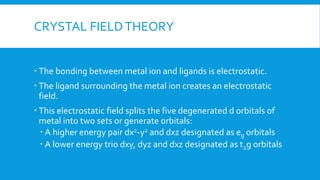
 The bonding between metal ion and ligands is electrostatic.
 The ligand surrounding the metal ion creates an electrostatic
field.
 This electrostatic field splits the five degenerated d orbitals of
metal into two sets or generate orbitals:
 A higher energy pair dx2-y2 and dxz designated as eg orbitals
 A lower energy trio dxy, dyz and dxz designated as t2g orbitals
CRYSTAL FIELDTHEORY
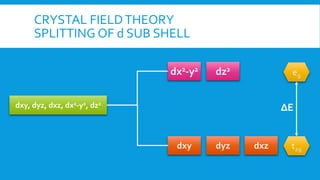
SPLITTING OF d SUB SHELL
dxy, dyz, dxz, dx2-y2, dz2
dz2dx2-y2
dyzdxy dxz
eg
t2g
∆E
CRYSTAL FIELDTHEORY
 The energy difference between eg and t2g orbitals is equal to the
wavelength in visible region.
 By absorbing visible light, an electron may move from lower to
higher energy level.The absorbed component of white light is
removed and the remaining components are reflected back
which gives the color to compound.
 For example Cu+2 absorbs red light, hence transmitted light
gives blue color
MAGNETIC PROPERTIES
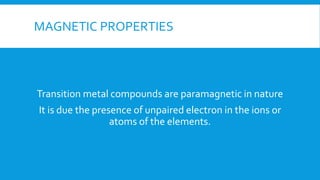
Transition metal compounds are paramagnetic in nature
It is due the presence of unpaired electron in the ions or
atoms of the elements.
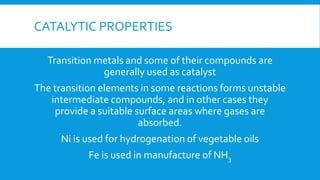
CATALYTIC PROPERTIES
Transition metals and some of their compounds are
generally used as catalyst
The transition elements in some reactions forms unstable
intermediate compounds, and in other cases they
provide a suitable surface areas where gases are
absorbed.
Ni is used for hydrogenation of vegetable oils
Fe is used in manufacture of NH3
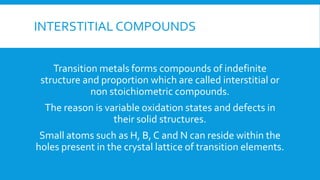
INTERSTITIAL COMPOUNDS
Transition metals forms compounds of indefinite
structure and proportion which are called interstitial or
non stoichiometric compounds.
The reason is variable oxidation states and defects in
their solid structures.
Small atoms such as H, B, C and N can reside within the
holes present in the crystal lattice of transition elements.
COMPLEX FORMATION
Transition metals form complex compounds which are
called coordination compounds
It is due to small and highly charged ions and vacant d
orbitals or suitable energies.
These vacant orbitals accepts lone pairs from atoms, ions
or molecules called ligand.
TRANSITION METAL COMPLEXES
A compound containing the complex ion or
complex molecule in which central metal atom is
surrounded by a number of oppositely charged
ions or neutral molecules called ligands, is known
as a Coordination Compound or Complex
Compound.
COORDINATION COMPOUND
[M(L)n]RTransition
metal
(Central Atom)
Ligand
Coordination number
Residual charge
COORDINATION COMPOUNDS
 The central atom is always a transition metal.
 A ligand may be an ion or neutral molecule which surrounds the
central atom and donates one or more lone pairs.
 The number of ligands surrounding the metal atom is called
coordination number.
 The residual charge on complex is the oxidation state of metal and
charge of ligands.
 To balance the Residual charge, cations or anions are attached to the
complex.
LIGANDS
Ligands are Lewis bases which donates
electrons to transition metal ion.
Ligands are classifies as:
i. Mono dentate or uni dentate ligands
ii. Poly dentate or multi dentate ligands
MONO DENTATE LIGANDS
Ligands which contain only one donor atom are called
mono dentate ligands.
Examples are:
H2O Aquo
NH3 Ammine
CN- Cyano
NO2
- Nitro
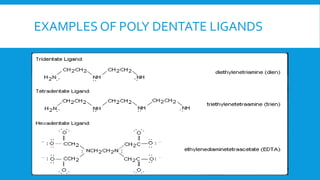
POLY DENTATE LIGANDS
Ligands which contain more than one donor atom are
called poly dentate ligands.
They can be classified as:
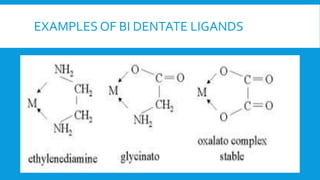
i. Bi dentate ligands
ii. Tri dentate ligands
iii. Tetra dentate ligands
iv. Hexa dentate ligands etc.
EXAMPLES OF BI DENTATE LIGANDS
EXAMPLES OF POLY DENTATE LIGANDS
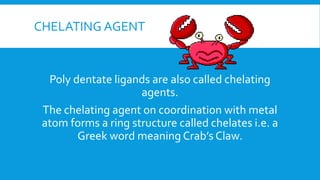
CHELATING AGENT
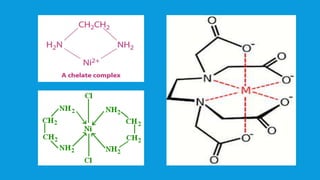
Poly dentate ligands are also called chelating
agents.
The chelating agent on coordination with metal
atom forms a ring structure called chelates i.e. a
Greek word meaning Crab’s Claw.
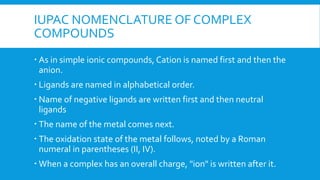
IUPAC NOMENCLATURE OF COMPLEX
COMPOUNDS
 As in simple ionic compounds, Cation is named first and then the
anion.
 Ligands are named in alphabetical order.
 Name of negative ligands are written first and then neutral
ligands
 The name of the metal comes next.
 The oxidation state of the metal follows, noted by a Roman
numeral in parentheses (II, IV).
 When a complex has an overall charge, "ion" is written after it.
RULE 1: IDENTIFYTHE COMPLEXTYPE
Complex Cation [Co(NH3)6]+3
Complex anion [Ni(CN)4]-2
Neutral complex [Pt(NH3)Cl4]
Coordination compound K4[Fe(CN)6]
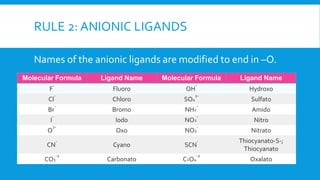
RULE 2: ANIONIC LIGANDS
Names of the anionic ligands are modified to end in –O.
Molecular Formula Ligand Name Molecular Formula Ligand Name
F
-
Fluoro OH
-
Hydroxo
Cl
-
Chloro SO4
2-
Sulfato
Br
-
Bromo NH2
-
Amido
I
-
Iodo NO2
-
Nitro
O
2-
Oxo NO3
-
Nitrato
CN
-
Cyano SCN
- Thiocyanato-S-;
Thiocyanato
CO3
-2
Carbonato C2O4
-2
Oxalato
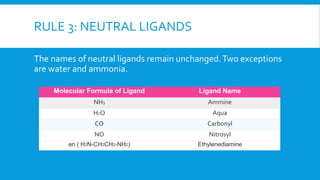
RULE 3: NEUTRAL LIGANDS
The names of neutral ligands remain unchanged.Two exceptions
are water and ammonia.
Molecular Formula of Ligand Ligand Name
NH3 Ammine
H2O Aqua
CO Carbonyl
NO Nitrosyl
en ( H2N-CH2CH2-NH2) Ethylenediamine
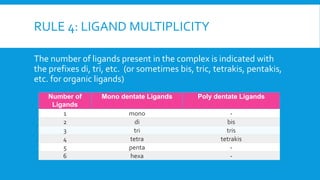
RULE 4: LIGAND MULTIPLICITY
The number of ligands present in the complex is indicated with
the prefixes di, tri, etc. (or sometimes bis, tric, tetrakis, pentakis,
etc. for organic ligands)
Number of
Ligands
Mono dentate Ligands Poly dentate Ligands
1 mono -
2 di bis
3 tri tris
4 tetra tetrakis
5 penta -
6 hexa -
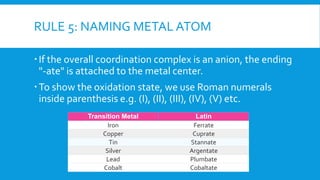
RULE 5: NAMING METAL ATOM
If the overall coordination complex is an anion, the ending
"-ate" is attached to the metal center.
To show the oxidation state, we use Roman numerals
inside parenthesis e.g. (I), (II), (III), (IV), (V) etc.
Transition Metal Latin
Iron Ferrate
Copper Cuprate
Tin Stannate
Silver Argentate
Lead Plumbate
Cobalt Cobaltate
NAMING THE COMPLEXES
GIVE IUPAC NAMES OFTHE FOLLOWING
TRANSITION METAL COMPLEXES
1. K3[Fe(CN)6]
2. K4[Fe(CN)6]
3. Na3[Co(NO2)6]
4. Na2[Zn(OH)4]
First write the
name of CationPotassium
Potassium
Sodium
Sodium
Write names of
Ligands
Hexa cyano
Hexa cyano
Hexa nitro
Tetra hydroxo
Write metal name
and oxidation
state
Ferrate (III)
Ferrate (II)
Cobaltate (III)
Zincate (II)
GIVE IUPAC NAMES OFTHE FOLLOWING
TRANSITION METAL COMPLEXES
6. Ni(CO)4
7. [Pt(NH3)2Cl2]
8. [Cr(NH3)3Cl3]
9. [Co(NH3)2(en)Cl3]
Write names of
Ligands
Write metal name
and oxidation
state
Tetra carbonyl
Dichloro diammine
Trichloro (ethylene diammine) diammine
Tri chloro tri ammine
nickel (0)
platinum (II)
cobalt (III)
chromium (III)
GIVE IUPAC NAMES OFTHE FOLLOWING
TRANSITION METAL COMPLEXES
10. [Co(NH3)6]Cl3
11. [Cr(H2O)5Br ]Br2
12. [Cu(NH3)4]SO4
13. [Cu(NH3)2(H2O)2](NO3)2
Write names of
Ligands
Write metal name
and oxidation
state
Write name of
anion
Hexa ammine
Bromo penta aquo
Tetra ammine
Diammine diaquo
Cobalt (III)
Chromium (III)
Copper (II)
Copper (II)
chloride
bromide
sulphate
nitrate
GIVE IUPAC NAMES OFTHE FOLLOWING
TRANSITION METAL COMPLEX IONS
1. [Zn(CN)4]-
2. [Co(NH3)6]+3
3. [Ni(CN)4]-2
4. [Co(en)2Cl2]+3
Write names of
Ligands
Write metal name
and oxidation
state
Tetra cyano
Hexa ammine
Tetra cyano
Dichloro bis ethylene diammine
zincate (II) ion
cobalt (III) ion
nickelate (II) ion
cobalt (III) ion
END OF LESSON
sidra.javedali@gmail.com

d-block elements

  • 1.
    d - BLOCKELEMENTS XII CHEMISTRY CHAPTER 5 SIDRA JAVED
  • 2.
    d – BLOCKELEMENTS Those elements with atoms in which there is a progressive filling of d sub shell are called d – block elements. OR Those elements with atoms in which last two shells are incomplete (i.e. n & n-1) are called d block elements.
  • 3.
  • 4.
    TRANSITION ELEMENTS The elementswhich show properties which are transitional between electropositive s – block elements and electronegative p – block elements. The transition elements include elements of d – block and f – block of periodic table.
  • 5.
    TRANSITION SERIES OFd – BLOCK ELEMENTS i. First transition series: Scandium (Z= 21) to Zinc (Z=30) ii. Second transition series:Yttrium (Z= 39) to Cadmium (Z=48) iii. Third transition series: Lanthanum (Z= 57) to Mercury (Z=80) except Lanthanide series
  • 6.
    OCCURRENCE OF d– BLOCK ELEMENTS IRON: Kohat Hazara Chagai Chitral Kalabagh
  • 7.
    OCCURRENCE OF d– BLOCK ELEMENTS CHROMIUM: Balochistan
  • 8.
    OCCURRENCE OF d– BLOCK ELEMENTS COPPER: Zhob Loralai Chagai NorthWaziristan Gilgit Dir Chitral
  • 9.
    OCCURRENCE OF d –BLOCK ELEMENTS
  • 10.
    ELECTRONIC CONFIGURATIONS ns2 (n-1)d1– ns2 (n-1)d10  Scandium Sc (Z=21) 1s2 2s2 2p6 3s2 3p6 4s23d1  Titanium Ti (Z=22) 1s2 2s2 2p6 3s2 3p6 4s23d2  Vanadium V (Z=23) 1s2 2s2 2p6 3s2 3p6 4s23d3  Chromium Cr (Z=24) 1s2 2s2 2p6 3s2 3p6 4s13d5  Manganese Mn (Z=25) 1s2 2s2 2p6 3s2 3p6 4s23d5  Iron Fe (Z=26) 1s2 2s2 2p6 3s2 3p6 4s23d6  Cobalt Co (Z=27) 1s2 2s2 2p6 3s2 3p6 4s23d7  Nickel Ni (Z =28) 1s2 2s2 2p6 3s2 3p6 4s23d8  Copper Cu (Z=29) 1s2 2s2 2p6 3s2 3p6 4s13d10  Zinc Zn (Z=30) 1s2 2s2 2p6 3s2 3p6 4s23d10
  • 11.
    METALLIC CHARACTER All transitionelements are generally metals and good conductor of heat and electricity. Mercury is the only metal found in liquid state.
  • 26.
    ATOMIC SIZES The atomicsizes of transition elements decrease to a small extent from left to right. It is due to increase in nuclear charge without the increase in number of shells.
  • 27.
    IONIZATION POTENTIAL Ionization potentialvalues of d block elements are greater than s block elements and smaller than p block elements. These elements may form either ionic or covalent compound depending on the conditions.
  • 28.
    MELTING AND BOILINGPOINTS Melting and boiling points of all transition elements are high except that of Zinc due to complete d sub shell. High Melting and Boiling points are due to small atomic sizes which give strong inter atomic attraction.
  • 29.
    OXIDATION STATES Transition elementsshow variable oxidation states in their compounds. The variation is due to very small energy difference between 3d and 4s orbitals. As a result electrons of both 3d and 4s orbitals take part in bonding.
  • 30.
    OXIDATION STATES Sc TiV Cr Mn Fe Co Ni Cu Zn 4s2 3d1 4s2 3d2 4s2 3d3 4s1 3d5 4s2 3d5 4s2 3d6 4s2 3d7 4s2 3d8 4s1 3d10 4s2 3d10 +1 +1 +2 +2 +2 +2 +2 +2 +2 +2 +2 +3 +3 +3 +3 +3 +3 +3 +3 +4 +4 +4 +4 +5 +5 +6 +6 +6 +7
  • 31.
    COLOR Transition metals formscolored complex compounds except Zn. A complex compound has all three types of bonds and formed between a metal atom and one or more ligands. Color of the complexes are explained by Crystal Field theory.
  • 32.
    CRYSTAL FIELDTHEORY  Thebonding between metal ion and ligands is electrostatic.  The ligand surrounding the metal ion creates an electrostatic field.  This electrostatic field splits the five degenerated d orbitals of metal into two sets or generate orbitals:  A higher energy pair dx2-y2 and dxz designated as eg orbitals  A lower energy trio dxy, dyz and dxz designated as t2g orbitals
  • 33.
    CRYSTAL FIELDTHEORY SPLITTING OFd SUB SHELL dxy, dyz, dxz, dx2-y2, dz2 dz2dx2-y2 dyzdxy dxz eg t2g ∆E
  • 34.
    CRYSTAL FIELDTHEORY  Theenergy difference between eg and t2g orbitals is equal to the wavelength in visible region.  By absorbing visible light, an electron may move from lower to higher energy level.The absorbed component of white light is removed and the remaining components are reflected back which gives the color to compound.  For example Cu+2 absorbs red light, hence transmitted light gives blue color
  • 35.
    MAGNETIC PROPERTIES Transition metalcompounds are paramagnetic in nature It is due the presence of unpaired electron in the ions or atoms of the elements.
  • 36.
    CATALYTIC PROPERTIES Transition metalsand some of their compounds are generally used as catalyst The transition elements in some reactions forms unstable intermediate compounds, and in other cases they provide a suitable surface areas where gases are absorbed. Ni is used for hydrogenation of vegetable oils Fe is used in manufacture of NH3
  • 37.
    INTERSTITIAL COMPOUNDS Transition metalsforms compounds of indefinite structure and proportion which are called interstitial or non stoichiometric compounds. The reason is variable oxidation states and defects in their solid structures. Small atoms such as H, B, C and N can reside within the holes present in the crystal lattice of transition elements.
  • 38.
    COMPLEX FORMATION Transition metalsform complex compounds which are called coordination compounds It is due to small and highly charged ions and vacant d orbitals or suitable energies. These vacant orbitals accepts lone pairs from atoms, ions or molecules called ligand.
  • 39.
    TRANSITION METAL COMPLEXES Acompound containing the complex ion or complex molecule in which central metal atom is surrounded by a number of oppositely charged ions or neutral molecules called ligands, is known as a Coordination Compound or Complex Compound.
  • 40.
  • 41.
    COORDINATION COMPOUNDS  Thecentral atom is always a transition metal.  A ligand may be an ion or neutral molecule which surrounds the central atom and donates one or more lone pairs.  The number of ligands surrounding the metal atom is called coordination number.  The residual charge on complex is the oxidation state of metal and charge of ligands.  To balance the Residual charge, cations or anions are attached to the complex.
  • 42.
    LIGANDS Ligands are Lewisbases which donates electrons to transition metal ion. Ligands are classifies as: i. Mono dentate or uni dentate ligands ii. Poly dentate or multi dentate ligands
  • 43.
    MONO DENTATE LIGANDS Ligandswhich contain only one donor atom are called mono dentate ligands. Examples are: H2O Aquo NH3 Ammine CN- Cyano NO2 - Nitro
  • 44.
    POLY DENTATE LIGANDS Ligandswhich contain more than one donor atom are called poly dentate ligands. They can be classified as: i. Bi dentate ligands ii. Tri dentate ligands iii. Tetra dentate ligands iv. Hexa dentate ligands etc.
  • 45.
    EXAMPLES OF BIDENTATE LIGANDS
  • 46.
    EXAMPLES OF POLYDENTATE LIGANDS
  • 47.
    CHELATING AGENT Poly dentateligands are also called chelating agents. The chelating agent on coordination with metal atom forms a ring structure called chelates i.e. a Greek word meaning Crab’s Claw.
  • 49.
    IUPAC NOMENCLATURE OFCOMPLEX COMPOUNDS  As in simple ionic compounds, Cation is named first and then the anion.  Ligands are named in alphabetical order.  Name of negative ligands are written first and then neutral ligands  The name of the metal comes next.  The oxidation state of the metal follows, noted by a Roman numeral in parentheses (II, IV).  When a complex has an overall charge, "ion" is written after it.
  • 50.
    RULE 1: IDENTIFYTHECOMPLEXTYPE Complex Cation [Co(NH3)6]+3 Complex anion [Ni(CN)4]-2 Neutral complex [Pt(NH3)Cl4] Coordination compound K4[Fe(CN)6]
  • 51.
    RULE 2: ANIONICLIGANDS Names of the anionic ligands are modified to end in –O. Molecular Formula Ligand Name Molecular Formula Ligand Name F - Fluoro OH - Hydroxo Cl - Chloro SO4 2- Sulfato Br - Bromo NH2 - Amido I - Iodo NO2 - Nitro O 2- Oxo NO3 - Nitrato CN - Cyano SCN - Thiocyanato-S-; Thiocyanato CO3 -2 Carbonato C2O4 -2 Oxalato
  • 52.
    RULE 3: NEUTRALLIGANDS The names of neutral ligands remain unchanged.Two exceptions are water and ammonia. Molecular Formula of Ligand Ligand Name NH3 Ammine H2O Aqua CO Carbonyl NO Nitrosyl en ( H2N-CH2CH2-NH2) Ethylenediamine
  • 53.
    RULE 4: LIGANDMULTIPLICITY The number of ligands present in the complex is indicated with the prefixes di, tri, etc. (or sometimes bis, tric, tetrakis, pentakis, etc. for organic ligands) Number of Ligands Mono dentate Ligands Poly dentate Ligands 1 mono - 2 di bis 3 tri tris 4 tetra tetrakis 5 penta - 6 hexa -
  • 54.
    RULE 5: NAMINGMETAL ATOM If the overall coordination complex is an anion, the ending "-ate" is attached to the metal center. To show the oxidation state, we use Roman numerals inside parenthesis e.g. (I), (II), (III), (IV), (V) etc. Transition Metal Latin Iron Ferrate Copper Cuprate Tin Stannate Silver Argentate Lead Plumbate Cobalt Cobaltate
  • 55.
  • 56.
    GIVE IUPAC NAMESOFTHE FOLLOWING TRANSITION METAL COMPLEXES 1. K3[Fe(CN)6] 2. K4[Fe(CN)6] 3. Na3[Co(NO2)6] 4. Na2[Zn(OH)4] First write the name of CationPotassium Potassium Sodium Sodium Write names of Ligands Hexa cyano Hexa cyano Hexa nitro Tetra hydroxo Write metal name and oxidation state Ferrate (III) Ferrate (II) Cobaltate (III) Zincate (II)
  • 57.
    GIVE IUPAC NAMESOFTHE FOLLOWING TRANSITION METAL COMPLEXES 6. Ni(CO)4 7. [Pt(NH3)2Cl2] 8. [Cr(NH3)3Cl3] 9. [Co(NH3)2(en)Cl3] Write names of Ligands Write metal name and oxidation state Tetra carbonyl Dichloro diammine Trichloro (ethylene diammine) diammine Tri chloro tri ammine nickel (0) platinum (II) cobalt (III) chromium (III)
  • 58.
    GIVE IUPAC NAMESOFTHE FOLLOWING TRANSITION METAL COMPLEXES 10. [Co(NH3)6]Cl3 11. [Cr(H2O)5Br ]Br2 12. [Cu(NH3)4]SO4 13. [Cu(NH3)2(H2O)2](NO3)2 Write names of Ligands Write metal name and oxidation state Write name of anion Hexa ammine Bromo penta aquo Tetra ammine Diammine diaquo Cobalt (III) Chromium (III) Copper (II) Copper (II) chloride bromide sulphate nitrate
  • 59.
    GIVE IUPAC NAMESOFTHE FOLLOWING TRANSITION METAL COMPLEX IONS 1. [Zn(CN)4]- 2. [Co(NH3)6]+3 3. [Ni(CN)4]-2 4. [Co(en)2Cl2]+3 Write names of Ligands Write metal name and oxidation state Tetra cyano Hexa ammine Tetra cyano Dichloro bis ethylene diammine zincate (II) ion cobalt (III) ion nickelate (II) ion cobalt (III) ion
  • 60.