Linear Inequalities
Graphs of Inequalities; Interval Notation 
There are infinitely many solutions to the 
inequality x > -4, namely all real numbers 
that are greater than -4. Although we 
cannot list all the solutions, we can make a 
drawing on a number line that represents 
these solutions. Such a drawing is called the 
graph of the inequality.
Graphs of Inequalities; Interval Notation 
• Graphs of solutions to linear inequalities 
are shown on a number line by shading all 
points representing numbers that are 
solutions. Parentheses indicate endpoints 
that are not solutions. Square brackets 
indicate endpoints that are solutions.
Text Example 
Graph the solutions of 
a. x < 3 b. x  -1 c. -1< x  3. 
Solution: 
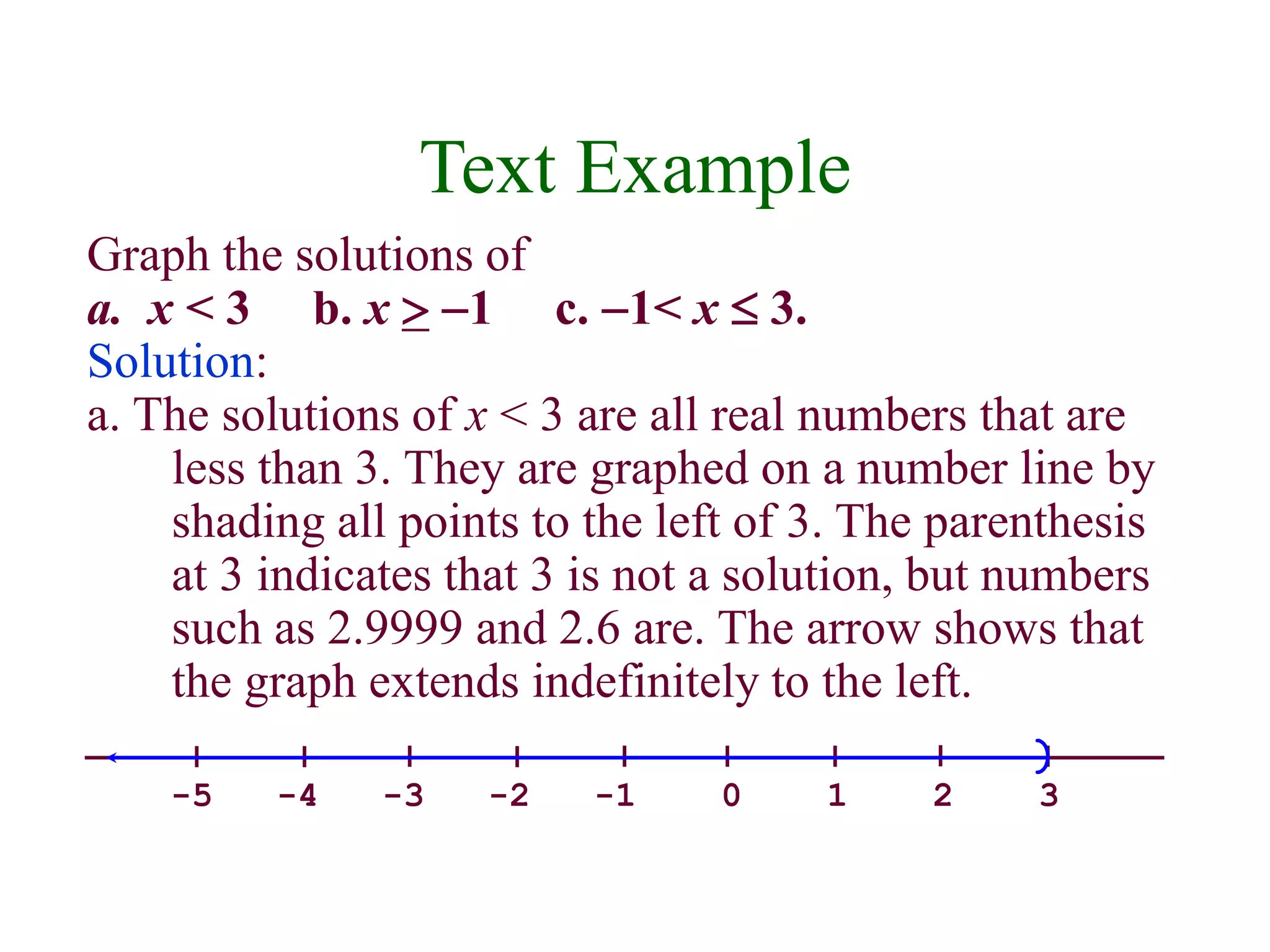
a. The solutions of x < 3 are all real numbers that are 
less than 3. They are graphed on a number line by 
shading all points to the left of 3. The parenthesis 
at 3 indicates that 3 is not a solution, but numbers 
such as 2.9999 and 2.6 are. The arrow shows that 
the graph extends indefinitely to the left. 
-5 -4 -3 -2 -1 0 1 2 3
Text Example cont. 
Graph the solutions of 
a. x < 3 b. x  -1 c. -1< x  3. 
Solution: 
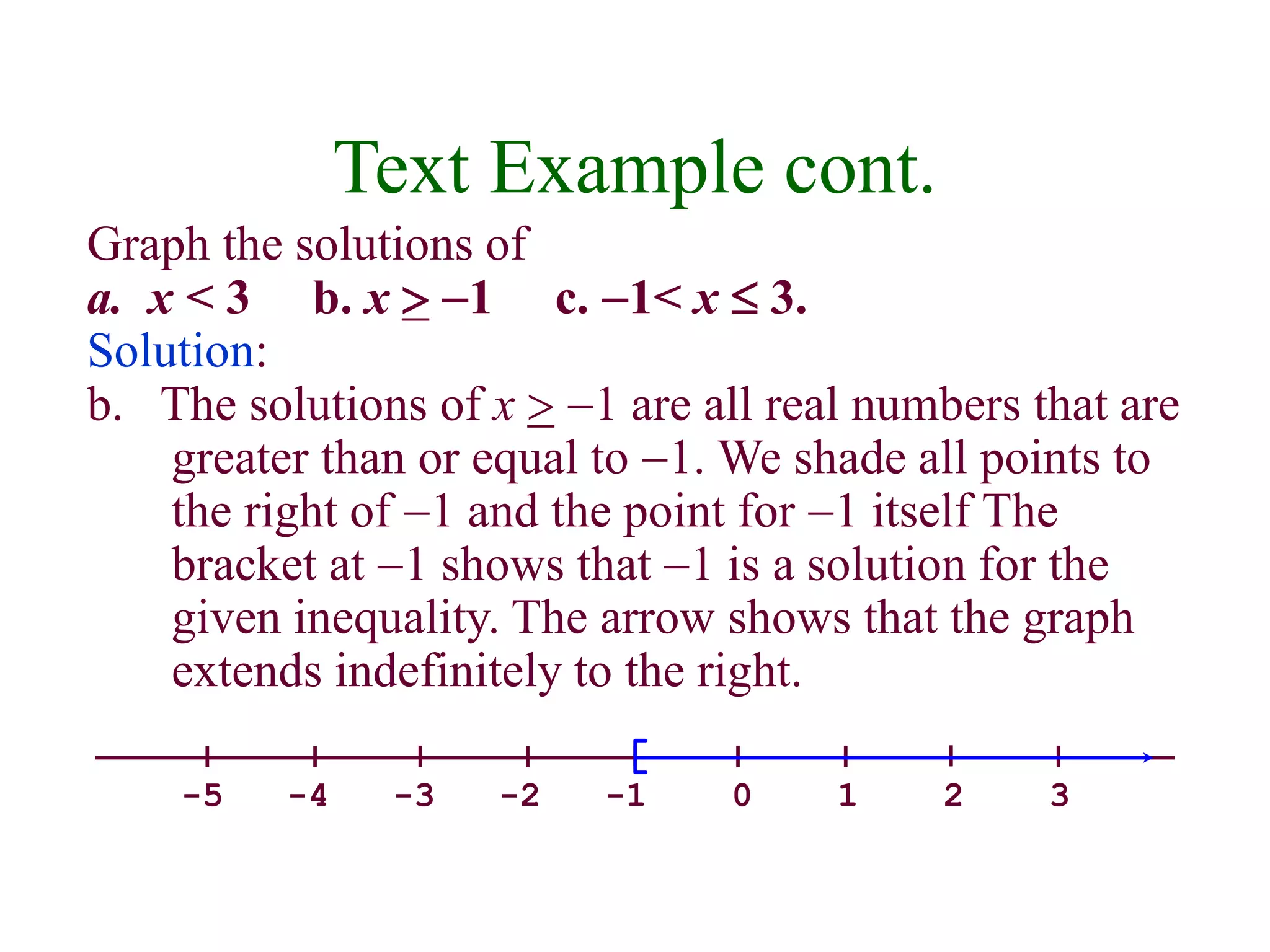
b. The solutions of x  -1 are all real numbers that are 
greater than or equal to -1. We shade all points to 
the right of -1 and the point for -1 itself The 
bracket at -1 shows that -1 is a solution for the 
given inequality. The arrow shows that the graph 
extends indefinitely to the right. 
-5 -4 -3 -2 -1 0 1 2 3
Text Example cont. 
Graph the solutions of 
a. x < 3 b. x  -1 c. -1< x  3. 
Solution: 
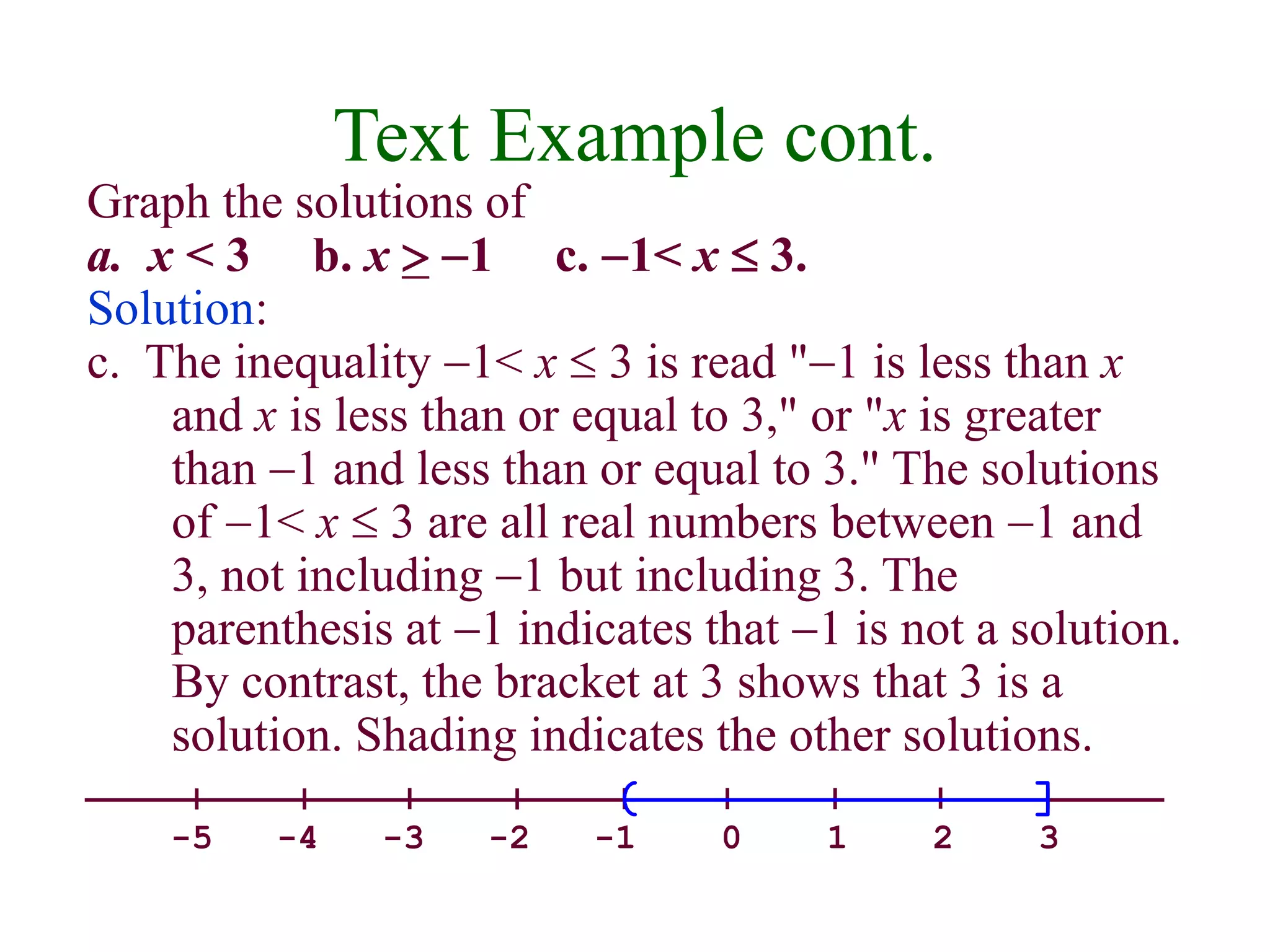
c. The inequality -1< x  3 is read "-1 is less than x 
and x is less than or equal to 3," or "x is greater 
than -1 and less than or equal to 3." The solutions 
of -1< x  3 are all real numbers between -1 and 
3, not including -1 but including 3. The 
parenthesis at -1 indicates that -1 is not a solution. 
By contrast, the bracket at 3 shows that 3 is a 
solution. Shading indicates the other solutions. 
-5 -4 -3 -2 -1 0 1 2 3
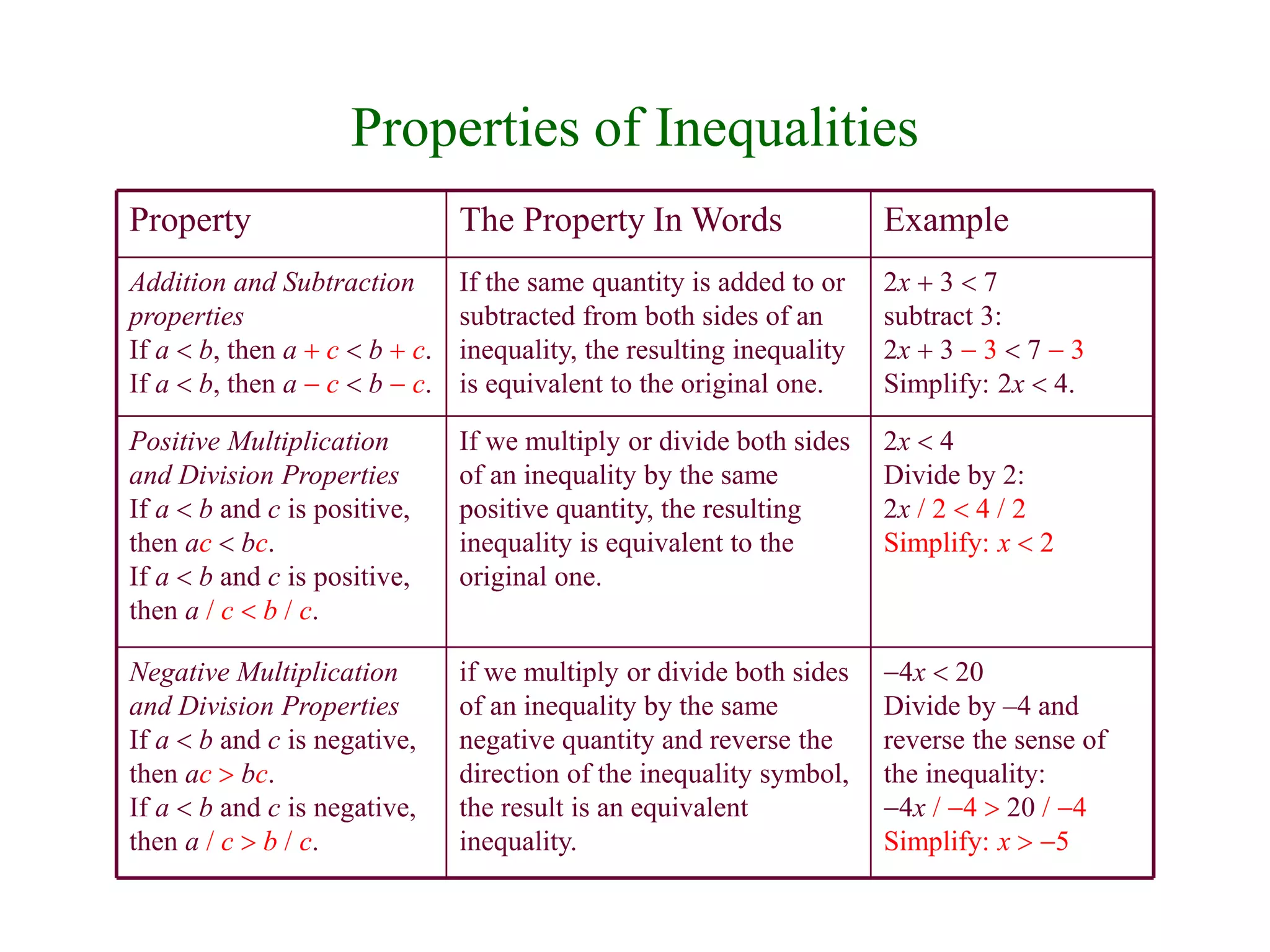
Properties of Inequalities 
Property The Property In Words Example 
-4x < 20 
Divide by –4 and 
reverse the sense of 
the inequality: 
-4x  -4  20  -4 
Simplify: x  -5 
if we multiply or divide both sides 
of an inequality by the same 
negative quantity and reverse the 
direction of the inequality symbol, 
the result is an equivalent 
inequality. 
Negative Multiplication 
and Division Properties 
If a < b and c is negative, 
then ac  bc. 
If a < b and c is negative, 
then a  c  b  c. 
2x < 4 
Divide by 2: 
2x  2 < 4  2 
Simplify: x < 2 
If we multiply or divide both sides 
of an inequality by the same 
positive quantity, the resulting 
inequality is equivalent to the 
original one. 
Positive Multiplication 
and Division Properties 
If a < b and c is positive, 
then ac < bc. 
If a < b and c is positive, 
then a  c < b  c. 
2x + 3 < 7 
subtract 3: 
2x + 3 - 3 < 7 - 3 
Simplify: 2x < 4. 
If the same quantity is added to or 
subtracted from both sides of an 
inequality, the resulting inequality 
is equivalent to the original one. 
Addition and Subtraction 
properties 
If a < b, then a + c < b + c. 
If a < b, then a - c < b - c.
Example 
Solve and graph the solution set on a number line: 
4x + 5  9x - 10. 
Solution We will collect variable terms on the left and constant terms on 
the right. 
4x + 5  9x - 10 This is the given inequality. 
4x + 5 – 9x  9x - 10 - 9x Subtract 9x from both sides. 
-5x + 5  -10 Simplify. 
-5x + 5 - 5  -10 - 5 Subtract 5 from both sides. 
-5x  -15 Simplify. 
-5x/5 > -15/5 Divide both sides by -5 and reverse the sense 
of the inequality. 
x  3 Simplify. 
The solution set consists of all real numbers that are greater than or equal to 
3, expressed in interval notation as (-, 3]. The graph of the solution set is 
shown as follows:
Solving an Absolute Value 
Inequality 
If X is an algebraic expression and c is a 
positive number, 
1. The solutions of |X| < c are the numbers that 
satisfy -c < X < c. 
2. The solutions of |X| > c are the numbers that 
satisfy X < -c or X > c. 
These rules are valid if < is replaced by  and 
> is replaced by .
Text Example 
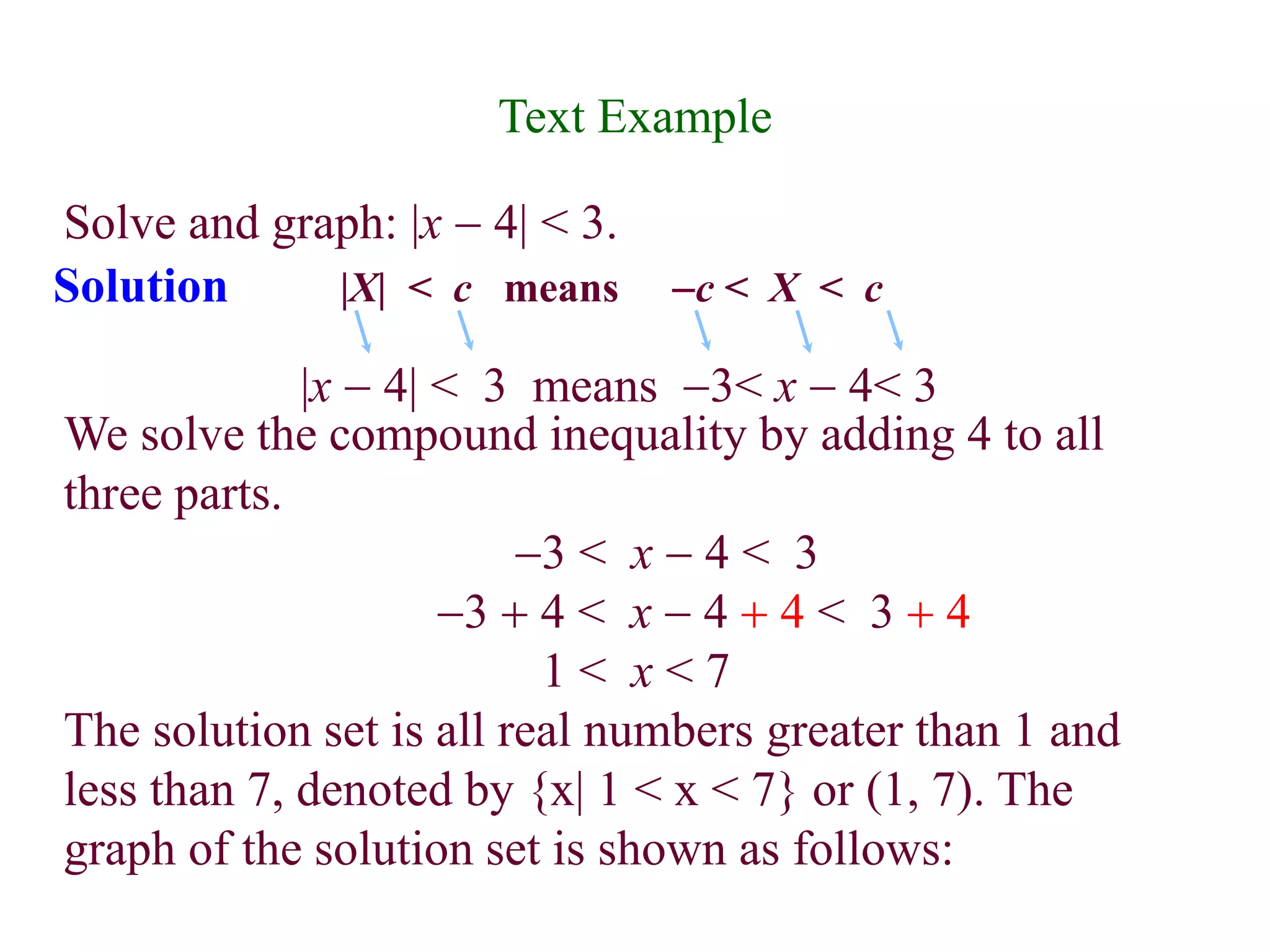
Solve and graph: |x - 4| < 3. 
Solution 
|X| < c means -c < X < c 
|x - 4| < 3 means -3< x - 4< 3 
We solve the compound inequality by adding 4 to all 
three parts. 
-3 < x - 4 < 3 
-3 + 4 < x - 4 + 4 < 3 + 4 
1 < x < 7 
The solution set is all real numbers greater than 1 and 
less than 7, denoted by {x| 1 < x < 7} or (1, 7). The 
graph of the solution set is shown as follows:
Linear Inequalities

Linear inequalities

  • 1.
  • 2.
    Graphs of Inequalities;Interval Notation There are infinitely many solutions to the inequality x > -4, namely all real numbers that are greater than -4. Although we cannot list all the solutions, we can make a drawing on a number line that represents these solutions. Such a drawing is called the graph of the inequality.
  • 3.
    Graphs of Inequalities;Interval Notation • Graphs of solutions to linear inequalities are shown on a number line by shading all points representing numbers that are solutions. Parentheses indicate endpoints that are not solutions. Square brackets indicate endpoints that are solutions.
  • 4.
    Text Example Graphthe solutions of a. x < 3 b. x  -1 c. -1< x  3. Solution: a. The solutions of x < 3 are all real numbers that are less than 3. They are graphed on a number line by shading all points to the left of 3. The parenthesis at 3 indicates that 3 is not a solution, but numbers such as 2.9999 and 2.6 are. The arrow shows that the graph extends indefinitely to the left. -5 -4 -3 -2 -1 0 1 2 3
  • 5.
    Text Example cont. Graph the solutions of a. x < 3 b. x  -1 c. -1< x  3. Solution: b. The solutions of x  -1 are all real numbers that are greater than or equal to -1. We shade all points to the right of -1 and the point for -1 itself The bracket at -1 shows that -1 is a solution for the given inequality. The arrow shows that the graph extends indefinitely to the right. -5 -4 -3 -2 -1 0 1 2 3
  • 6.
    Text Example cont. Graph the solutions of a. x < 3 b. x  -1 c. -1< x  3. Solution: c. The inequality -1< x  3 is read "-1 is less than x and x is less than or equal to 3," or "x is greater than -1 and less than or equal to 3." The solutions of -1< x  3 are all real numbers between -1 and 3, not including -1 but including 3. The parenthesis at -1 indicates that -1 is not a solution. By contrast, the bracket at 3 shows that 3 is a solution. Shading indicates the other solutions. -5 -4 -3 -2 -1 0 1 2 3
  • 7.
    Properties of Inequalities Property The Property In Words Example -4x < 20 Divide by –4 and reverse the sense of the inequality: -4x  -4  20  -4 Simplify: x  -5 if we multiply or divide both sides of an inequality by the same negative quantity and reverse the direction of the inequality symbol, the result is an equivalent inequality. Negative Multiplication and Division Properties If a < b and c is negative, then ac  bc. If a < b and c is negative, then a  c  b  c. 2x < 4 Divide by 2: 2x  2 < 4  2 Simplify: x < 2 If we multiply or divide both sides of an inequality by the same positive quantity, the resulting inequality is equivalent to the original one. Positive Multiplication and Division Properties If a < b and c is positive, then ac < bc. If a < b and c is positive, then a  c < b  c. 2x + 3 < 7 subtract 3: 2x + 3 - 3 < 7 - 3 Simplify: 2x < 4. If the same quantity is added to or subtracted from both sides of an inequality, the resulting inequality is equivalent to the original one. Addition and Subtraction properties If a < b, then a + c < b + c. If a < b, then a - c < b - c.
  • 8.
    Example Solve andgraph the solution set on a number line: 4x + 5  9x - 10. Solution We will collect variable terms on the left and constant terms on the right. 4x + 5  9x - 10 This is the given inequality. 4x + 5 – 9x  9x - 10 - 9x Subtract 9x from both sides. -5x + 5  -10 Simplify. -5x + 5 - 5  -10 - 5 Subtract 5 from both sides. -5x  -15 Simplify. -5x/5 > -15/5 Divide both sides by -5 and reverse the sense of the inequality. x  3 Simplify. The solution set consists of all real numbers that are greater than or equal to 3, expressed in interval notation as (-, 3]. The graph of the solution set is shown as follows:
  • 9.
    Solving an AbsoluteValue Inequality If X is an algebraic expression and c is a positive number, 1. The solutions of |X| < c are the numbers that satisfy -c < X < c. 2. The solutions of |X| > c are the numbers that satisfy X < -c or X > c. These rules are valid if < is replaced by  and > is replaced by .
  • 10.
    Text Example Solveand graph: |x - 4| < 3. Solution |X| < c means -c < X < c |x - 4| < 3 means -3< x - 4< 3 We solve the compound inequality by adding 4 to all three parts. -3 < x - 4 < 3 -3 + 4 < x - 4 + 4 < 3 + 4 1 < x < 7 The solution set is all real numbers greater than 1 and less than 7, denoted by {x| 1 < x < 7} or (1, 7). The graph of the solution set is shown as follows:
  • 11.