MATHEMATICS 8
Quarter 2 Week 4
Linear
Functions
MR. CARLO JUSTINO J. LUNA
MALABANIAS INTEGRATED SCHOOL
Angeles City
Learning Competency
2
✘ Graphs and illustrates a linear function and
its (a) domain; (b) range; (c) table of values;
(d) intercepts; and (e) slope (M8AL-IId-1)
Linear Function
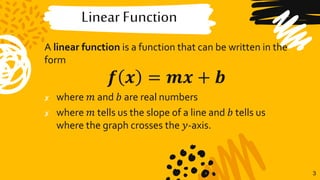
A linear function is a function that can be written in the
form
𝒇 𝒙 = 𝒎𝒙 + 𝒃
✘ where 𝑚 and 𝑏 are real numbers
✘ where 𝑚 tells us the slope of a line and 𝑏 tells us
where the graph crosses the 𝑦-axis.
3
Linear Function
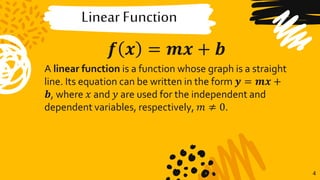
𝒇 𝒙 = 𝒎𝒙 + 𝒃
A linear function is a function whose graph is a straight
line. Its equation can be written in the form 𝒚 = 𝒎𝒙 +
𝒃, where 𝑥 and 𝑦 are used for the independent and
dependent variables, respectively, 𝑚 ≠ 0.
4
Linear Function
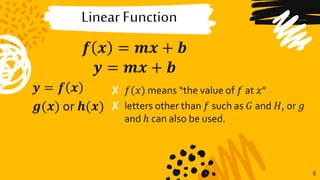
𝒇 𝒙 = 𝒎𝒙 + 𝒃
𝒚 = 𝒎𝒙 + 𝒃
𝒚 = 𝒇 𝒙
𝒈(𝒙) or 𝒉(𝒙)
5
✘ 𝑓(𝑥) means “the value of 𝑓 at 𝑥”
✘ letters other than 𝑓 such as 𝐺 and 𝐻, or 𝑔
and ℎ can also be used.
6
Linear Functionas an Equation
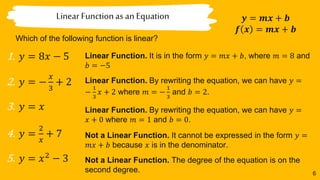
Which of the following function is linear?
𝒚 = 𝒎𝒙 + 𝒃
𝒇 𝒙 = 𝒎𝒙 + 𝒃
1. 𝑦 = 8𝑥 − 5
2. 𝑦 = −
𝑥
3
+ 2
3. 𝑦 = 𝑥
4. 𝑦 =
2
𝑥
+ 7
5. 𝑦 = 𝑥2
− 3
Linear Function. It is in the form 𝑦 = 𝑚𝑥 + 𝑏, where 𝑚 = 8 and
𝑏 = −5
Linear Function. By rewriting the equation, we can have 𝑦 =
−
1
3
𝑥 + 2 where 𝑚 = −
1
3
and 𝑏 = 2.
Linear Function. By rewriting the equation, we can have 𝑦 =
𝑥 + 0 where 𝑚 = 1 and 𝑏 = 0.
Not a Linear Function. It cannot be expressed in the form 𝑦 =
𝑚𝑥 + 𝑏 because 𝑥 is in the denominator.
Not a Linear Function. The degree of the equation is on the
second degree.
7
A linear function can alsobe describedusing its
graph.
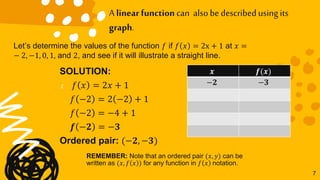
Let’s determine the values of the function 𝑓 if 𝑓 𝑥 = 2x + 1 at 𝑥 =
− 2, −1, 0, 1, and 2, and see if it will illustrate a straight line.
SOLUTION:
1. 𝑓 𝑥 = 2𝑥 + 1
𝑓 −2 = 2 −2 + 1
𝑓 −2 = −4 + 1
𝒇 −𝟐 = −𝟑
Ordered pair: (−𝟐, −𝟑)
𝒙 𝒇(𝒙)
−𝟐 −𝟑
REMEMBER: Note that an ordered pair (𝑥, 𝑦) can be
written as (𝑥, 𝑓 𝑥 ) for any function in 𝑓 𝑥 notation.
8
A linear function can alsobe describedusing its
graph.
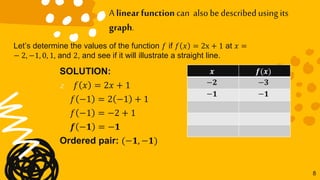
Let’s determine the values of the function 𝑓 if 𝑓 𝑥 = 2x + 1 at 𝑥 =
− 2, −1, 0, 1, and 2, and see if it will illustrate a straight line.
SOLUTION:
2. 𝑓 𝑥 = 2𝑥 + 1
𝑓 −1 = 2 −1 + 1
𝑓 −1 = −2 + 1
𝒇 −𝟏 = −𝟏
Ordered pair: (−𝟏, −𝟏)
𝒙 𝒇(𝒙)
−𝟐 −𝟑
−𝟏 −𝟏
9
A linear function can alsobe describedusing its
graph.
Let’s determine the values of the function 𝑓 if 𝑓 𝑥 = 2x + 1 at 𝑥 =
− 2, −1, 0, 1, and 2, and see if it will illustrate a straight line.
SOLUTION:
3. 𝑓 𝑥 = 2𝑥 + 1
𝑓 0 = 2 0 + 1
𝑓 0 = 0 + 1
𝒇 𝟎 = 𝟏
Ordered pair: (𝟎, 𝟏)
𝒙 𝒇(𝒙)
−𝟐 −𝟑
−𝟏 −𝟏
𝟎 𝟏
10
A linear function can alsobe describedusing its
graph.
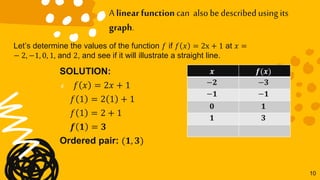
Let’s determine the values of the function 𝑓 if 𝑓 𝑥 = 2x + 1 at 𝑥 =
− 2, −1, 0, 1, and 2, and see if it will illustrate a straight line.
SOLUTION:
4. 𝑓 𝑥 = 2𝑥 + 1
𝑓 1 = 2 1 + 1
𝑓 1 = 2 + 1
𝒇 𝟏 = 𝟑
Ordered pair: (𝟏, 𝟑)
𝒙 𝒇(𝒙)
−𝟐 −𝟑
−𝟏 −𝟏
𝟎 𝟏
𝟏 𝟑
11
A linear function can alsobe describedusing its
graph.
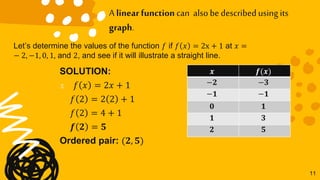
Let’s determine the values of the function 𝑓 if 𝑓 𝑥 = 2x + 1 at 𝑥 =
− 2, −1, 0, 1, and 2, and see if it will illustrate a straight line.
SOLUTION:
5. 𝑓 𝑥 = 2𝑥 + 1
𝑓 2 = 2 2 + 1
𝑓 2 = 4 + 1
𝒇 𝟐 = 𝟓
Ordered pair: (𝟐, 𝟓)
𝒙 𝒇(𝒙)
−𝟐 −𝟑
−𝟏 −𝟏
𝟎 𝟏
𝟏 𝟑
𝟐 𝟓
12
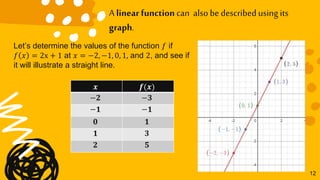
A linear function can alsobe describedusing its
graph.
Let’s determine the values of the function 𝑓 if
𝑓 𝑥 = 2x + 1 at 𝑥 = −2, −1, 0, 1, and 2, and see if
it will illustrate a straight line.
𝒙 𝒇(𝒙)
−𝟐 −𝟑
−𝟏 −𝟏
𝟎 𝟏
𝟏 𝟑
𝟐 𝟓
13
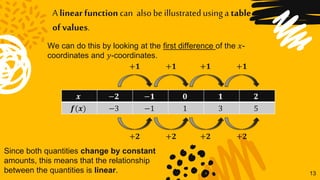
A linear function can alsobe illustratedusinga table
of values.
We can do this by looking at the first difference of the 𝑥-
coordinates and 𝑦-coordinates.
𝒙 −𝟐 −𝟏 𝟎 𝟏 𝟐
𝒇(𝒙) −3 −1 1 3 5
+𝟏 +𝟏 +𝟏 +𝟏
+𝟐 +𝟐 +𝟐 +𝟐
Since both quantities change by constant
amounts, this means that the relationship
between the quantities is linear.
14
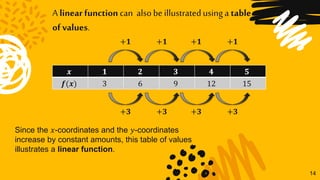
A linear function can alsobe illustratedusinga table
of values.
𝒙 𝟏 𝟐 𝟑 𝟒 𝟓
𝒇(𝒙) 3 6 9 12 15
+𝟏 +𝟏 +𝟏 +𝟏
+𝟑 +𝟑 +𝟑 +𝟑
Since the 𝑥-coordinates and the 𝑦-coordinates
increase by constant amounts, this table of values
illustrates a linear function.
15
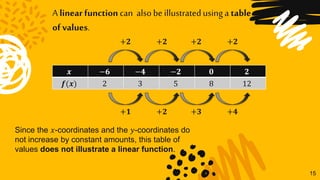
A linear function can alsobe illustratedusinga table
of values.
𝒙 −𝟔 −𝟒 −𝟐 𝟎 𝟐
𝒇(𝒙) 2 3 5 8 12
+𝟐 +𝟐 +𝟐 +𝟐
+𝟏 +𝟐 +𝟑 +𝟒
Since the 𝑥-coordinates and the 𝑦-coordinates do
not increase by constant amounts, this table of
values does not illustrate a linear function.
16
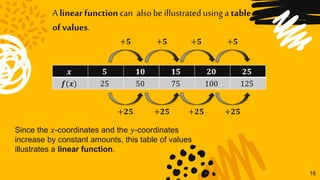
A linear function can alsobe illustratedusinga table
of values.
𝒙 𝟓 𝟏𝟎 𝟏𝟓 𝟐𝟎 𝟐𝟓
𝒇(𝒙) 25 50 75 100 125
+𝟓 +𝟓 +𝟓 +𝟓
+𝟐𝟓 +𝟐𝟓 +𝟐𝟓 +𝟐𝟓
Since the 𝑥-coordinates and the 𝑦-coordinates
increase by constant amounts, this table of values
illustrates a linear function.
MATHEMATICS 8
Quarter 2 Week 4
Thank
you!
MR. CARLO JUSTINO J. LUNA
MALABANIAS INTEGRATED SCHOOL
Angeles City

Math 8 - Linear Functions

  • 1.
    MATHEMATICS 8 Quarter 2Week 4 Linear Functions MR. CARLO JUSTINO J. LUNA MALABANIAS INTEGRATED SCHOOL Angeles City
  • 2.
    Learning Competency 2 ✘ Graphsand illustrates a linear function and its (a) domain; (b) range; (c) table of values; (d) intercepts; and (e) slope (M8AL-IId-1)
  • 3.
    Linear Function A linearfunction is a function that can be written in the form 𝒇 𝒙 = 𝒎𝒙 + 𝒃 ✘ where 𝑚 and 𝑏 are real numbers ✘ where 𝑚 tells us the slope of a line and 𝑏 tells us where the graph crosses the 𝑦-axis. 3
  • 4.
    Linear Function 𝒇 𝒙= 𝒎𝒙 + 𝒃 A linear function is a function whose graph is a straight line. Its equation can be written in the form 𝒚 = 𝒎𝒙 + 𝒃, where 𝑥 and 𝑦 are used for the independent and dependent variables, respectively, 𝑚 ≠ 0. 4
  • 5.
    Linear Function 𝒇 𝒙= 𝒎𝒙 + 𝒃 𝒚 = 𝒎𝒙 + 𝒃 𝒚 = 𝒇 𝒙 𝒈(𝒙) or 𝒉(𝒙) 5 ✘ 𝑓(𝑥) means “the value of 𝑓 at 𝑥” ✘ letters other than 𝑓 such as 𝐺 and 𝐻, or 𝑔 and ℎ can also be used.
  • 6.
    6 Linear Functionas anEquation Which of the following function is linear? 𝒚 = 𝒎𝒙 + 𝒃 𝒇 𝒙 = 𝒎𝒙 + 𝒃 1. 𝑦 = 8𝑥 − 5 2. 𝑦 = − 𝑥 3 + 2 3. 𝑦 = 𝑥 4. 𝑦 = 2 𝑥 + 7 5. 𝑦 = 𝑥2 − 3 Linear Function. It is in the form 𝑦 = 𝑚𝑥 + 𝑏, where 𝑚 = 8 and 𝑏 = −5 Linear Function. By rewriting the equation, we can have 𝑦 = − 1 3 𝑥 + 2 where 𝑚 = − 1 3 and 𝑏 = 2. Linear Function. By rewriting the equation, we can have 𝑦 = 𝑥 + 0 where 𝑚 = 1 and 𝑏 = 0. Not a Linear Function. It cannot be expressed in the form 𝑦 = 𝑚𝑥 + 𝑏 because 𝑥 is in the denominator. Not a Linear Function. The degree of the equation is on the second degree.
  • 7.
    7 A linear functioncan alsobe describedusing its graph. Let’s determine the values of the function 𝑓 if 𝑓 𝑥 = 2x + 1 at 𝑥 = − 2, −1, 0, 1, and 2, and see if it will illustrate a straight line. SOLUTION: 1. 𝑓 𝑥 = 2𝑥 + 1 𝑓 −2 = 2 −2 + 1 𝑓 −2 = −4 + 1 𝒇 −𝟐 = −𝟑 Ordered pair: (−𝟐, −𝟑) 𝒙 𝒇(𝒙) −𝟐 −𝟑 REMEMBER: Note that an ordered pair (𝑥, 𝑦) can be written as (𝑥, 𝑓 𝑥 ) for any function in 𝑓 𝑥 notation.
  • 8.
    8 A linear functioncan alsobe describedusing its graph. Let’s determine the values of the function 𝑓 if 𝑓 𝑥 = 2x + 1 at 𝑥 = − 2, −1, 0, 1, and 2, and see if it will illustrate a straight line. SOLUTION: 2. 𝑓 𝑥 = 2𝑥 + 1 𝑓 −1 = 2 −1 + 1 𝑓 −1 = −2 + 1 𝒇 −𝟏 = −𝟏 Ordered pair: (−𝟏, −𝟏) 𝒙 𝒇(𝒙) −𝟐 −𝟑 −𝟏 −𝟏
  • 9.
    9 A linear functioncan alsobe describedusing its graph. Let’s determine the values of the function 𝑓 if 𝑓 𝑥 = 2x + 1 at 𝑥 = − 2, −1, 0, 1, and 2, and see if it will illustrate a straight line. SOLUTION: 3. 𝑓 𝑥 = 2𝑥 + 1 𝑓 0 = 2 0 + 1 𝑓 0 = 0 + 1 𝒇 𝟎 = 𝟏 Ordered pair: (𝟎, 𝟏) 𝒙 𝒇(𝒙) −𝟐 −𝟑 −𝟏 −𝟏 𝟎 𝟏
  • 10.
    10 A linear functioncan alsobe describedusing its graph. Let’s determine the values of the function 𝑓 if 𝑓 𝑥 = 2x + 1 at 𝑥 = − 2, −1, 0, 1, and 2, and see if it will illustrate a straight line. SOLUTION: 4. 𝑓 𝑥 = 2𝑥 + 1 𝑓 1 = 2 1 + 1 𝑓 1 = 2 + 1 𝒇 𝟏 = 𝟑 Ordered pair: (𝟏, 𝟑) 𝒙 𝒇(𝒙) −𝟐 −𝟑 −𝟏 −𝟏 𝟎 𝟏 𝟏 𝟑
  • 11.
    11 A linear functioncan alsobe describedusing its graph. Let’s determine the values of the function 𝑓 if 𝑓 𝑥 = 2x + 1 at 𝑥 = − 2, −1, 0, 1, and 2, and see if it will illustrate a straight line. SOLUTION: 5. 𝑓 𝑥 = 2𝑥 + 1 𝑓 2 = 2 2 + 1 𝑓 2 = 4 + 1 𝒇 𝟐 = 𝟓 Ordered pair: (𝟐, 𝟓) 𝒙 𝒇(𝒙) −𝟐 −𝟑 −𝟏 −𝟏 𝟎 𝟏 𝟏 𝟑 𝟐 𝟓
  • 12.
    12 A linear functioncan alsobe describedusing its graph. Let’s determine the values of the function 𝑓 if 𝑓 𝑥 = 2x + 1 at 𝑥 = −2, −1, 0, 1, and 2, and see if it will illustrate a straight line. 𝒙 𝒇(𝒙) −𝟐 −𝟑 −𝟏 −𝟏 𝟎 𝟏 𝟏 𝟑 𝟐 𝟓
  • 13.
    13 A linear functioncan alsobe illustratedusinga table of values. We can do this by looking at the first difference of the 𝑥- coordinates and 𝑦-coordinates. 𝒙 −𝟐 −𝟏 𝟎 𝟏 𝟐 𝒇(𝒙) −3 −1 1 3 5 +𝟏 +𝟏 +𝟏 +𝟏 +𝟐 +𝟐 +𝟐 +𝟐 Since both quantities change by constant amounts, this means that the relationship between the quantities is linear.
  • 14.
    14 A linear functioncan alsobe illustratedusinga table of values. 𝒙 𝟏 𝟐 𝟑 𝟒 𝟓 𝒇(𝒙) 3 6 9 12 15 +𝟏 +𝟏 +𝟏 +𝟏 +𝟑 +𝟑 +𝟑 +𝟑 Since the 𝑥-coordinates and the 𝑦-coordinates increase by constant amounts, this table of values illustrates a linear function.
  • 15.
    15 A linear functioncan alsobe illustratedusinga table of values. 𝒙 −𝟔 −𝟒 −𝟐 𝟎 𝟐 𝒇(𝒙) 2 3 5 8 12 +𝟐 +𝟐 +𝟐 +𝟐 +𝟏 +𝟐 +𝟑 +𝟒 Since the 𝑥-coordinates and the 𝑦-coordinates do not increase by constant amounts, this table of values does not illustrate a linear function.
  • 16.
    16 A linear functioncan alsobe illustratedusinga table of values. 𝒙 𝟓 𝟏𝟎 𝟏𝟓 𝟐𝟎 𝟐𝟓 𝒇(𝒙) 25 50 75 100 125 +𝟓 +𝟓 +𝟓 +𝟓 +𝟐𝟓 +𝟐𝟓 +𝟐𝟓 +𝟐𝟓 Since the 𝑥-coordinates and the 𝑦-coordinates increase by constant amounts, this table of values illustrates a linear function.
  • 17.
    MATHEMATICS 8 Quarter 2Week 4 Thank you! MR. CARLO JUSTINO J. LUNA MALABANIAS INTEGRATED SCHOOL Angeles City