LINEAR EQUATIONS and INEQUALITIES in ONE VARIABLE
Linear equations and Inequalities in One Variable Equation and Inequalities are relations  between two quantities.
Equation  is a mathematical sentence indicating that two expressions are equal. The symbol “=“ is used to indicate equality. Ex.  2x + 5 = 9  is a conditional equation   since its truth or falsity depends on  the value of x 2 + 9 = 11 is identity  equation since both of its  sides are identical to the same  number 11.
Inequality  is a mathematical sentence indicating that two expressions are not equal. The symbols <, >, are used to denote inequality. Ex. 3 + 2 ≠ 4 is an inequality If two expressions are unequal, then their relationship can be any of the following, >, ≥, < or ≤.
Linear equation in one variable  is an equation which can be written in the form of ax + b = 0, where a and b are real-number constants and a ≠ 0. Ex. x + 7 = 12
Solution Set of a Linear Equation Example 4x + 2 = 10  this statement is either true of  false If x = 1, then  4x + 2 = 10  is false because 4(1) + 2 is ≠ 10 If x = 2, then  4x + 2 = 10  is true because 4(2) + 2 = 10
B. x – 4 < 3  this statement is either true or false If x =6, then x – 4 is true because 6 – 4 < 3 If x = 10 , then x – 4 is false because 6 – 4 is not < 3 When a number replaces a variable in an equation (or inequality) to result in a true statement, that number is a  solution  of the equation (or inequality). The set of all solutions for a given equation (or inequality) as called the solution set of the equation (or inequality).
Solution Set of Simple Equations and Inequalities in One Variable by Inspection To solve an equation of inequality means to find its solution set. There are three(3) ways to solve an equation or inequality by inspection
A. Guess-and-Check In this method, one guesses and substitutes values into an equation of inequality to see if a true statement will result.
Consider the inequality x – 12 < 4 If x = 18, then 18 – 12 is not < 4 If x = 17, then 17 – 12 is not < 4 If x = 16, then 16 – 12 is not < 4 If x = 15, then 15 – 12  < 4 If x = 14, then 14 – 12  < 4 Inequality x - 12 < 4 is true for all values of x which are less than 16. Therefore, solution set of the given inequality is x < 16.
Another example X + 3 = 7 If x = 6, then 6 + 3 ≠ 7 If x = 5, then 5 + 3 ≠ 7 If x = 4, then 4 + 3 = 7 Therefore x = 4
B. Cover-up In this method , one covers up the term with the variable.
Example Consider equation x + 9 = 15 x + 9 = 15   + 9 = 15 To result in a true statement, the  must be 6. Therefore x = 6
Another example X – 1 = 3   –  1 = 3   x = 4
C. Working Backwards In this method, the reverse procedure is used
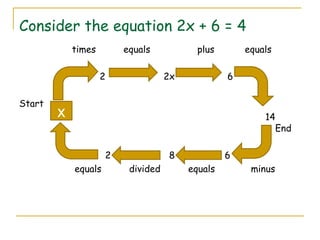
Consider the equation 2x + 6 = 4 times  equals  plus  equals 2  2x  6 Start      14  End 2  8  6  equals  divided  equals  minus x
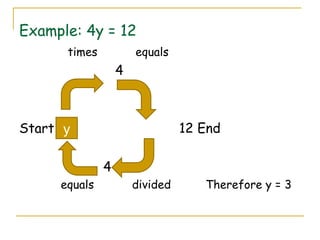
Example: 4y = 12 times  equals 4 Start    12 End     4 equals  divided  Therefore y = 3 y
Properties of Equality and Inequality
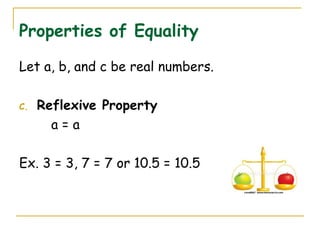
Properties of Equality Let a, b, and c be real numbers. Reflexive Property a = a Ex. 3 = 3, 7 = 7 or 10.5 = 10.5
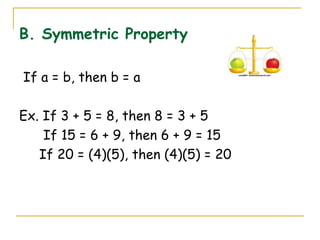
B. Symmetric Property If a = b, then b = a Ex. If 3 + 5 = 8, then 8 = 3 + 5 If 15 = 6 + 9, then 6 + 9 = 15   If 20 = (4)(5), then (4)(5) = 20
C. Transitive Property If a = b and b = c, then a = c Ex. If 8 + 5 = 13 and 13 = 6 + 7 then 8 + 5 = 6 + 7   If (8)(5) = 40 and 40 = (4)(10) then (8)(5) = (4)(10)
D. Addition Property If  a = b, then a + c = b + c Ex. If 3 + 5 = 8, then (3 + 5) = 3 = 8 +3
E. Subtraction Property If a = b, then a – c = b – c Ex. 3 + 5 = 8, then (3 + 5) – 3 = 8 - 3
F. Multiplication Property If a = b, then ac = bc Ex. (4)(6) = 24, then (4)(6)(3) = (24)(3)
G. Division Property If a = b, and c ≠ 0, then a/c = b/c Ex. If (4)(6) = 24, then (4)(6)/3 =  24/3
Properties of Inequality Let a, b and c be real numbers. Note: The properties of inequalities will still hold true using the relation symbol ≤ and ≥.
A. Addition Property If a < b, then a + c < b + c Ex. If 2 < 3, then 2 + 1 < 3 + 1
B. Subtraction Property If a < b, then a – c < b – c Ex. If 2 < 3, then 2 – 1 < 3 – 1
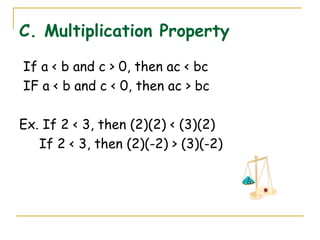
C. Multiplication Property If a < b and c > 0, then ac < bc IF a < b and c < 0, then ac > bc Ex. If 2 < 3, then (2)(2) < (3)(2)   If 2 < 3, then (2)(-2) > (3)(-2)
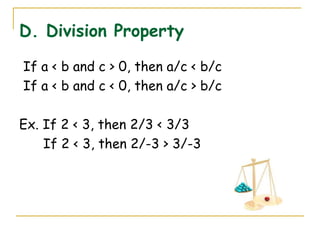
D. Division Property If a < b and c > 0, then a/c < b/c If a < b and c < 0, then a/c > b/c Ex. If 2 < 3, then 2/3 < 3/3 If 2 < 3, then 2/-3 > 3/-3
Solving Linear Equations in One Variable
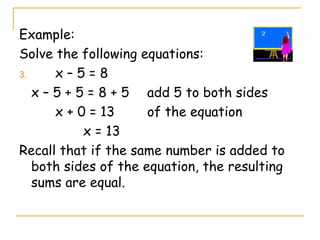
Example: Solve the following equations: x – 5 = 8 x – 5 + 5 = 8 + 5  add 5 to both sides   x + 0 = 13 of the equation   x = 13 Recall that if the same number is added to both sides of the equation, the resulting sums are equal.
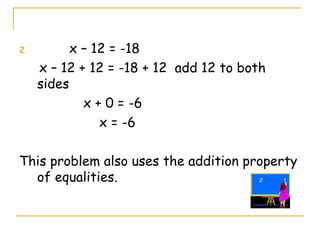
x – 12 = -18  x – 12 + 12 = -18 + 12  add 12 to both sides x + 0 = -6   x = -6 This problem also uses the addition property of equalities.
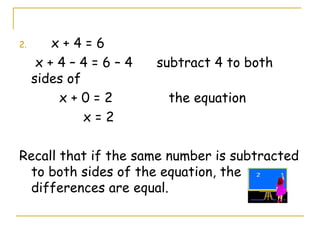
x + 4 = 6 x + 4 – 4 = 6 – 4  subtract 4 to both sides of  x + 0 = 2  the equation x = 2 Recall that if the same number is subtracted to both sides of the equation, the differences are equal.
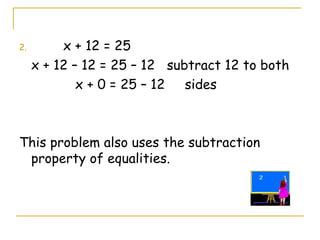
x + 12 = 25 x + 12 – 12 = 25 – 12  subtract 12 to both    x + 0 = 25 – 12  sides This problem also uses the subtraction property of equalities.
x/2 = 3   x/2 . 2 = 3 . 2  multiply both sides by 2   x = 6 Recall that if the same number is multiplied to both sides of the equation, the products are equal.
6.  x/7 = -5 x/7 . 7 = -5 .7  multiply  both sides by 7 x = -35 This problem also uses multiplication property of equalities.
7.  5 x = 35 5x/5 = 35/5  both sides of the equation is  X = 7  divided by the numerical  coefficient of x to make    the coefficient of x equals to 1 Recall the if both sides of the equation is divided by a non-zero number, the quotients are equal.
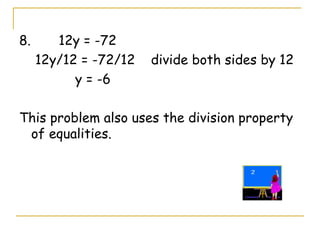
8.  12y = -72   12y/12 = -72/12  divide both sides by 12   y = -6 This problem also uses the division property of equalities.
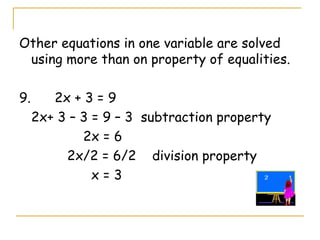
Other equations in one variable are solved using more than on property of equalities. 9.  2x + 3 = 9 2x+ 3 – 3 = 9 – 3  subtraction property 2x = 6 2x/2 = 6/2  division property x = 3
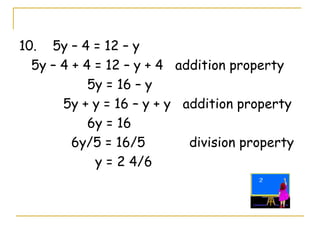
10.  5y – 4 = 12 – y 5y – 4 + 4 = 12 – y + 4  addition property 5y = 16 – y 5y + y = 16 – y + y  addition property 6y = 16 6y/5 = 16/5  division property y = 2 4/6
Solving Linear Inequalities in One Variable
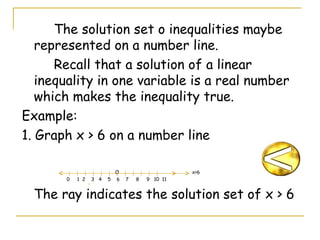
The solution set o inequalities maybe represented on a number line.  Recall that a solution of a linear inequality in one variable is a real number which makes the inequality true. Example: 1. Graph x > 6 on a number line   O  x>6 0  1  2  3  4  5  6  7  8  9  10  11  The ray indicates the solution set of x > 6
The ray indicates the that he solution set, x > 6 consist of all numbers greater than 6. The open circle of 6 indicates that 6 is not included.
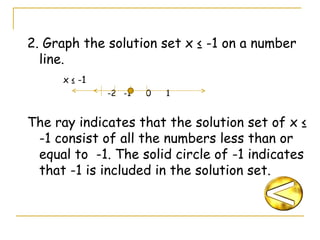
2. Graph the solution set x ≤ -1 on a number line. x ≤ -1   -2  -1  0  1 The ray indicates that the solution set of x ≤ -1 consist of all the numbers less than or equal to  -1. The solid circle of -1 indicates that -1 is included in the solution set.
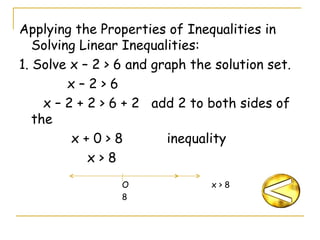
Applying the Properties of Inequalities in Solving Linear Inequalities: 1. Solve x – 2 > 6 and graph the solution set.   x – 2 > 6   x – 2 + 2 > 6 + 2  add 2 to both sides of the x + 0 > 8  inequality   x > 8 O  x > 8 8
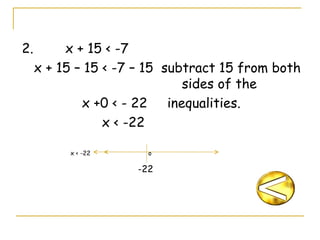
2.  x + 15 < -7 x + 15 – 15 < -7 – 15  subtract 15 from both    sides of the x +0 < - 22  inequalities. x < -22 x < -22  o -22
Solving Word Problems Involving Linear Equations
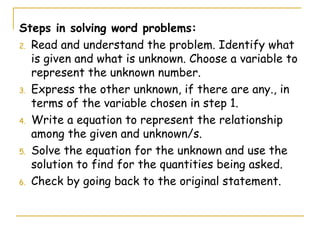
Steps in solving word problems: Read and understand the problem. Identify what is given and what is unknown. Choose a variable to represent the unknown number. Express the other unknown, if there are any., in terms of the variable chosen in step 1. Write a equation to represent the relationship among the given and unknown/s. Solve the equation for the unknown and use the solution to find for the quantities being asked. Check by going back to the original statement.
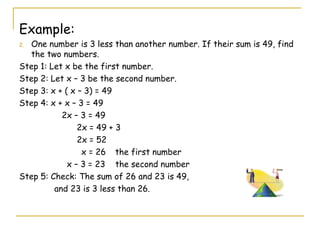
Example: One number is 3 less than another number. If their sum is 49, find the two numbers. Step 1: Let x be the first number. Step 2: Let x – 3 be the second number. Step 3: x + ( x – 3) = 49 Step 4: x + x – 3 = 49 2x – 3 = 49 2x = 49 + 3 2x = 52   x = 26 the first number x – 3 = 23  the second number Step 5: Check: The sum of 26 and 23 is 49,  and 23 is 3 less than 26.
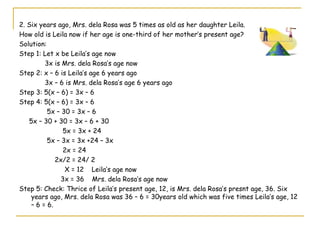
2. Six years ago, Mrs. dela Rosa was 5 times as old as her daughter Leila.  How old is Leila now if her age is one-third of her mother’s present age? Solution: Step 1: Let x be Leila’s age now 3x is Mrs. dela Rosa’s age now Step 2: x – 6 is Leila’s age 6 years ago 3x – 6 is Mrs. dela Rosa’s age 6 years ago Step 3: 5(x – 6) = 3x – 6 Step 4: 5(x – 6) = 3x – 6 5x – 30 = 3x – 6 5x – 30 + 30 = 3x – 6 + 30 5x = 3x + 24 5x – 3x = 3x +24 – 3x 2x = 24 2x/2 = 24/ 2 X = 12  Leila’s age now 3x = 36  Mrs. dela Rosa’s age now Step 5: Check: Thrice of Leila’s present age, 12, is Mrs. dela Rosa’s presnt age, 36. Six years ago, Mrs. dela Rosa was 36 – 6 = 30years old which was five times Leila’s age, 12 – 6 = 6.

Linear Equations and Inequalities in One Variable

  • 1.
    LINEAR EQUATIONS andINEQUALITIES in ONE VARIABLE
  • 2.
    Linear equations andInequalities in One Variable Equation and Inequalities are relations between two quantities.
  • 3.
    Equation isa mathematical sentence indicating that two expressions are equal. The symbol “=“ is used to indicate equality. Ex. 2x + 5 = 9 is a conditional equation since its truth or falsity depends on the value of x 2 + 9 = 11 is identity equation since both of its sides are identical to the same number 11.
  • 4.
    Inequality isa mathematical sentence indicating that two expressions are not equal. The symbols <, >, are used to denote inequality. Ex. 3 + 2 ≠ 4 is an inequality If two expressions are unequal, then their relationship can be any of the following, >, ≥, < or ≤.
  • 5.
    Linear equation inone variable is an equation which can be written in the form of ax + b = 0, where a and b are real-number constants and a ≠ 0. Ex. x + 7 = 12
  • 6.
    Solution Set ofa Linear Equation Example 4x + 2 = 10 this statement is either true of false If x = 1, then 4x + 2 = 10 is false because 4(1) + 2 is ≠ 10 If x = 2, then 4x + 2 = 10 is true because 4(2) + 2 = 10
  • 7.
    B. x –4 < 3 this statement is either true or false If x =6, then x – 4 is true because 6 – 4 < 3 If x = 10 , then x – 4 is false because 6 – 4 is not < 3 When a number replaces a variable in an equation (or inequality) to result in a true statement, that number is a solution of the equation (or inequality). The set of all solutions for a given equation (or inequality) as called the solution set of the equation (or inequality).
  • 8.
    Solution Set ofSimple Equations and Inequalities in One Variable by Inspection To solve an equation of inequality means to find its solution set. There are three(3) ways to solve an equation or inequality by inspection
  • 9.
    A. Guess-and-Check Inthis method, one guesses and substitutes values into an equation of inequality to see if a true statement will result.
  • 10.
    Consider the inequalityx – 12 < 4 If x = 18, then 18 – 12 is not < 4 If x = 17, then 17 – 12 is not < 4 If x = 16, then 16 – 12 is not < 4 If x = 15, then 15 – 12 < 4 If x = 14, then 14 – 12 < 4 Inequality x - 12 < 4 is true for all values of x which are less than 16. Therefore, solution set of the given inequality is x < 16.
  • 11.
    Another example X+ 3 = 7 If x = 6, then 6 + 3 ≠ 7 If x = 5, then 5 + 3 ≠ 7 If x = 4, then 4 + 3 = 7 Therefore x = 4
  • 12.
    B. Cover-up Inthis method , one covers up the term with the variable.
  • 13.
    Example Consider equationx + 9 = 15 x + 9 = 15 + 9 = 15 To result in a true statement, the must be 6. Therefore x = 6
  • 14.
    Another example X– 1 = 3 – 1 = 3 x = 4
  • 15.
    C. Working BackwardsIn this method, the reverse procedure is used
  • 16.
    Consider the equation2x + 6 = 4 times equals plus equals 2 2x 6 Start 14 End 2 8 6 equals divided equals minus x
  • 17.
    Example: 4y =12 times equals 4 Start 12 End 4 equals divided Therefore y = 3 y
  • 18.
    Properties of Equalityand Inequality
  • 19.
    Properties of EqualityLet a, b, and c be real numbers. Reflexive Property a = a Ex. 3 = 3, 7 = 7 or 10.5 = 10.5
  • 20.
    B. Symmetric PropertyIf a = b, then b = a Ex. If 3 + 5 = 8, then 8 = 3 + 5 If 15 = 6 + 9, then 6 + 9 = 15 If 20 = (4)(5), then (4)(5) = 20
  • 21.
    C. Transitive PropertyIf a = b and b = c, then a = c Ex. If 8 + 5 = 13 and 13 = 6 + 7 then 8 + 5 = 6 + 7 If (8)(5) = 40 and 40 = (4)(10) then (8)(5) = (4)(10)
  • 22.
    D. Addition PropertyIf a = b, then a + c = b + c Ex. If 3 + 5 = 8, then (3 + 5) = 3 = 8 +3
  • 23.
    E. Subtraction PropertyIf a = b, then a – c = b – c Ex. 3 + 5 = 8, then (3 + 5) – 3 = 8 - 3
  • 24.
    F. Multiplication PropertyIf a = b, then ac = bc Ex. (4)(6) = 24, then (4)(6)(3) = (24)(3)
  • 25.
    G. Division PropertyIf a = b, and c ≠ 0, then a/c = b/c Ex. If (4)(6) = 24, then (4)(6)/3 = 24/3
  • 26.
    Properties of InequalityLet a, b and c be real numbers. Note: The properties of inequalities will still hold true using the relation symbol ≤ and ≥.
  • 27.
    A. Addition PropertyIf a < b, then a + c < b + c Ex. If 2 < 3, then 2 + 1 < 3 + 1
  • 28.
    B. Subtraction PropertyIf a < b, then a – c < b – c Ex. If 2 < 3, then 2 – 1 < 3 – 1
  • 29.
    C. Multiplication PropertyIf a < b and c > 0, then ac < bc IF a < b and c < 0, then ac > bc Ex. If 2 < 3, then (2)(2) < (3)(2) If 2 < 3, then (2)(-2) > (3)(-2)
  • 30.
    D. Division PropertyIf a < b and c > 0, then a/c < b/c If a < b and c < 0, then a/c > b/c Ex. If 2 < 3, then 2/3 < 3/3 If 2 < 3, then 2/-3 > 3/-3
  • 31.
    Solving Linear Equationsin One Variable
  • 32.
    Example: Solve thefollowing equations: x – 5 = 8 x – 5 + 5 = 8 + 5 add 5 to both sides x + 0 = 13 of the equation x = 13 Recall that if the same number is added to both sides of the equation, the resulting sums are equal.
  • 33.
    x – 12= -18 x – 12 + 12 = -18 + 12 add 12 to both sides x + 0 = -6 x = -6 This problem also uses the addition property of equalities.
  • 34.
    x + 4= 6 x + 4 – 4 = 6 – 4 subtract 4 to both sides of x + 0 = 2 the equation x = 2 Recall that if the same number is subtracted to both sides of the equation, the differences are equal.
  • 35.
    x + 12= 25 x + 12 – 12 = 25 – 12 subtract 12 to both x + 0 = 25 – 12 sides This problem also uses the subtraction property of equalities.
  • 36.
    x/2 = 3 x/2 . 2 = 3 . 2 multiply both sides by 2 x = 6 Recall that if the same number is multiplied to both sides of the equation, the products are equal.
  • 37.
    6. x/7= -5 x/7 . 7 = -5 .7 multiply both sides by 7 x = -35 This problem also uses multiplication property of equalities.
  • 38.
    7. 5x = 35 5x/5 = 35/5 both sides of the equation is X = 7 divided by the numerical coefficient of x to make the coefficient of x equals to 1 Recall the if both sides of the equation is divided by a non-zero number, the quotients are equal.
  • 39.
    8. 12y= -72 12y/12 = -72/12 divide both sides by 12 y = -6 This problem also uses the division property of equalities.
  • 40.
    Other equations inone variable are solved using more than on property of equalities. 9. 2x + 3 = 9 2x+ 3 – 3 = 9 – 3 subtraction property 2x = 6 2x/2 = 6/2 division property x = 3
  • 41.
    10. 5y– 4 = 12 – y 5y – 4 + 4 = 12 – y + 4 addition property 5y = 16 – y 5y + y = 16 – y + y addition property 6y = 16 6y/5 = 16/5 division property y = 2 4/6
  • 42.
  • 43.
    The solution seto inequalities maybe represented on a number line. Recall that a solution of a linear inequality in one variable is a real number which makes the inequality true. Example: 1. Graph x > 6 on a number line O x>6 0 1 2 3 4 5 6 7 8 9 10 11 The ray indicates the solution set of x > 6
  • 44.
    The ray indicatesthe that he solution set, x > 6 consist of all numbers greater than 6. The open circle of 6 indicates that 6 is not included.
  • 45.
    2. Graph thesolution set x ≤ -1 on a number line. x ≤ -1 -2 -1 0 1 The ray indicates that the solution set of x ≤ -1 consist of all the numbers less than or equal to -1. The solid circle of -1 indicates that -1 is included in the solution set.
  • 46.
    Applying the Propertiesof Inequalities in Solving Linear Inequalities: 1. Solve x – 2 > 6 and graph the solution set. x – 2 > 6 x – 2 + 2 > 6 + 2 add 2 to both sides of the x + 0 > 8 inequality x > 8 O x > 8 8
  • 47.
    2. x+ 15 < -7 x + 15 – 15 < -7 – 15 subtract 15 from both sides of the x +0 < - 22 inequalities. x < -22 x < -22 o -22
  • 48.
    Solving Word ProblemsInvolving Linear Equations
  • 49.
    Steps in solvingword problems: Read and understand the problem. Identify what is given and what is unknown. Choose a variable to represent the unknown number. Express the other unknown, if there are any., in terms of the variable chosen in step 1. Write a equation to represent the relationship among the given and unknown/s. Solve the equation for the unknown and use the solution to find for the quantities being asked. Check by going back to the original statement.
  • 50.
    Example: One numberis 3 less than another number. If their sum is 49, find the two numbers. Step 1: Let x be the first number. Step 2: Let x – 3 be the second number. Step 3: x + ( x – 3) = 49 Step 4: x + x – 3 = 49 2x – 3 = 49 2x = 49 + 3 2x = 52 x = 26 the first number x – 3 = 23 the second number Step 5: Check: The sum of 26 and 23 is 49, and 23 is 3 less than 26.
  • 51.
    2. Six yearsago, Mrs. dela Rosa was 5 times as old as her daughter Leila. How old is Leila now if her age is one-third of her mother’s present age? Solution: Step 1: Let x be Leila’s age now 3x is Mrs. dela Rosa’s age now Step 2: x – 6 is Leila’s age 6 years ago 3x – 6 is Mrs. dela Rosa’s age 6 years ago Step 3: 5(x – 6) = 3x – 6 Step 4: 5(x – 6) = 3x – 6 5x – 30 = 3x – 6 5x – 30 + 30 = 3x – 6 + 30 5x = 3x + 24 5x – 3x = 3x +24 – 3x 2x = 24 2x/2 = 24/ 2 X = 12 Leila’s age now 3x = 36 Mrs. dela Rosa’s age now Step 5: Check: Thrice of Leila’s present age, 12, is Mrs. dela Rosa’s presnt age, 36. Six years ago, Mrs. dela Rosa was 36 – 6 = 30years old which was five times Leila’s age, 12 – 6 = 6.