Solving Systems of Linear Inequalities
              Warm Up
              Lesson Presentation
              Lesson Quiz
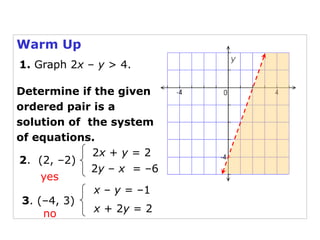
Warm Up
1. Graph 2x – y > 4.

Determine if the given
ordered pair is a
solution of the system
of equations.
             2x + y = 2
2. (2, –2)
             2y – x = –6
     yes
             x – y = –1
 3. (–4, 3)
     no      x + 2y = 2
Objective
Solve systems of linear inequalities.
Vocabulary
system of linear inequalities
When a problem uses phrases like “greater than”
or “no more than,” you can model the situation
using a system of linear inequalities.

A system of linear inequalities is a set of two or
more linear inequalities with the same variables.
The solution to a system of inequalities is often an
infinite set of points that can be represented
graphically by shading.

When you graph multiple inequalities on the same
graph, the region where the shadings overlap is the
solution region.
Example 1A: Graphing Systems of Inequalities
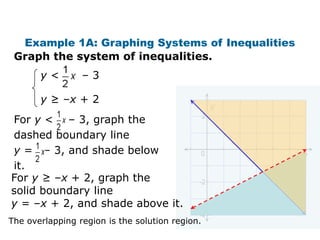
 Graph the system of inequalities.
       y<        –3

       y ≥ –x + 2
For y < – 3, graph the
dashed boundary line
y = – 3, and shade below
it.
For y ≥ –x + 2, graph the
solid boundary line
y = –x + 2, and shade above it.
The overlapping region is the solution region.
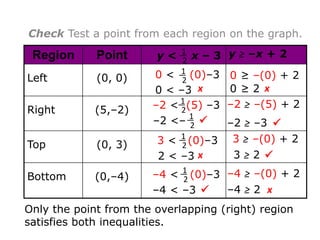
Check Test a point from each region on the graph.

 Region      Point      y< 1 x–3       y ≥ –x + 2
                            2

Left         (0, 0)    0 < 1 (0)–3
                            2          0 ≥ –(0) + 2
                       0 < –3 x        0≥2 x
Right        (5,–2)    –2 < 1 (5) –3
                            2
                                       –2 ≥ –(5) + 2
                       –2 <– 1 
                               2    –2 ≥ –3 

Top          (0, 3)     3 < 1 (0)–3 3 ≥ –(0) + 2
                            2
                        2 < –3 x     3≥2 

Bottom       (0,–4)    –4 < 1 (0)–3 –4 ≥ –(0) + 2
                            2
                       –4 < –3     –4 ≥ 2 x
Only the point from the overlapping (right) region
satisfies both inequalities.
Helpful Hint
If you are unsure which direction to shade, use
the origin as a test point.
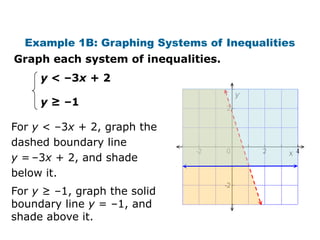
Example 1B: Graphing Systems of Inequalities
Graph each system of inequalities.
     y < –3x + 2

     y ≥ –1

For y < –3x + 2, graph the
dashed boundary line
y = –3x + 2, and shade
below it.
For y ≥ –1, graph the solid
boundary line y = –1, and
shade above it.
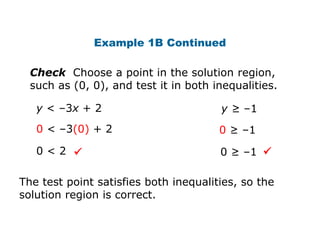
Example 1B Continued

  Check Choose a point in the solution region,
  such as (0, 0), and test it in both inequalities.

   y < –3x + 2                         y ≥ –1
   0 < –3(0) + 2                       0 ≥ –1
   0<2                                0 ≥ –1 

The test point satisfies both inequalities, so the
solution region is correct.
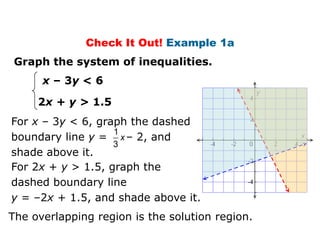
Check It Out! Example 1a
 Graph the system of inequalities.
      x – 3y < 6
     2x + y > 1.5
For x – 3y < 6, graph the dashed
                   1
boundary line y = x – 2, and
                   3
shade above it.
For 2x + y > 1.5, graph the
dashed boundary line
y = –2x + 1.5, and shade above it.
The overlapping region is the solution region.
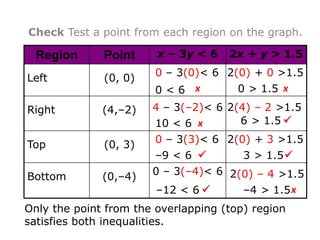
Check Test a point from each region on the graph.

  Region      Point     x – 3y < 6   2x + y > 1.5
                        0 – 3(0)< 6 2(0) + 0 >1.5
Left          (0, 0)
                        0<6 x         0 > 1.5 x
Right         (4,–2)   4 – 3(–2)< 6 2(4) – 2 >1.5
                       10 < 6 x       6 > 1.5 

Top           (0, 3)   0 – 3(3)< 6 2(0) + 3 >1.5
                       –9 < 6        3 > 1.5 
Bottom        (0,–4)   0 – 3(–4)< 6 2(0) – 4 >1.5
                        –12 < 6      –4 > 1.5 x
Only the point from the overlapping (top) region
satisfies both inequalities.
Check It Out! Example 1b
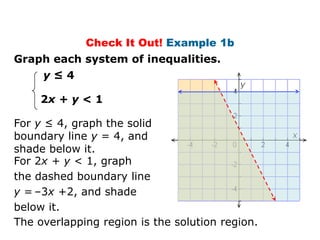
Graph each system of inequalities.
     y≤4

     2x + y < 1

For y ≤ 4, graph the solid
boundary line y = 4, and
shade below it.
For 2x + y < 1, graph
the dashed boundary line
y = –3x +2, and shade
below it.
The overlapping region is the solution region.
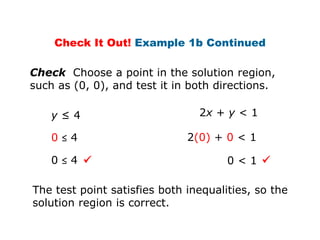
Check It Out! Example 1b Continued

Check Choose a point in the solution region,
such as (0, 0), and test it in both directions.

    y≤4                         2x + y < 1

    0≤4                       2(0) + 0 < 1

    0≤4                              0<1 

The test point satisfies both inequalities, so the
solution region is correct.
Example 2: Art Application

Lauren wants to paint no more than 70
plates for the art show. It costs her at least
$50 plus $2 per item to produce red plates
and $3 per item to produce gold plates. She
wants to spend no more than $215. Write
and graph a system of inequalities that can
be used to determine the number of each
plate that Lauren can make.
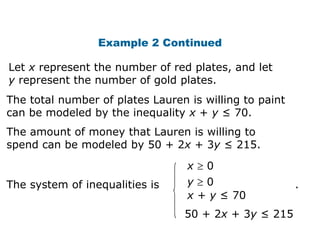
Example 2 Continued

Let x represent the number of red plates, and let
y represent the number of gold plates.
The total number of plates Lauren is willing to paint
can be modeled by the inequality x + y ≤ 70.
The amount of money that Lauren is willing to
spend can be modeled by 50 + 2x + 3y ≤ 215.
                                  x 0
The system of inequalities is     y 0                   .
                                  x + y ≤ 70
                                 50 + 2x + 3y ≤ 215
Example 2 Continued


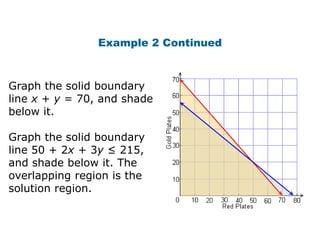
Graph the solid boundary
line x + y = 70, and shade
below it.

Graph the solid boundary
line 50 + 2x + 3y ≤ 215,
and shade below it. The
overlapping region is the
solution region.
Example 2 Continued

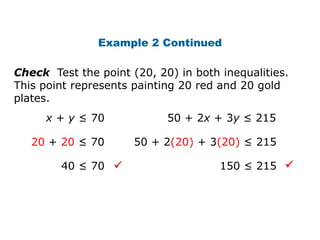
Check Test the point (20, 20) in both inequalities.
This point represents painting 20 red and 20 gold
plates.
     x + y ≤ 70             50 + 2x + 3y ≤ 215

   20 + 20 ≤ 70       50 + 2(20) + 3(20) ≤ 215

        40 ≤ 70                      150 ≤ 215 
Check It Out! Example 2

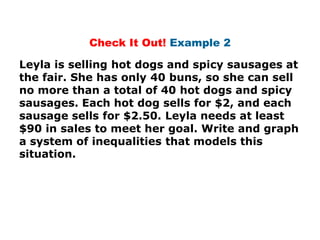
Leyla is selling hot dogs and spicy sausages at
the fair. She has only 40 buns, so she can sell
no more than a total of 40 hot dogs and spicy
sausages. Each hot dog sells for $2, and each
sausage sells for $2.50. Leyla needs at least
$90 in sales to meet her goal. Write and graph
a system of inequalities that models this
situation.
Check It Out! Example 2 Continued

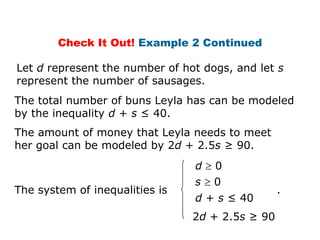
Let d represent the number of hot dogs, and let s
represent the number of sausages.
The total number of buns Leyla has can be modeled
by the inequality d + s ≤ 40.
The amount of money that Leyla needs to meet
her goal can be modeled by 2d + 2.5s ≥ 90.
                                d   0
                                s   0
The system of inequalities is                    .
                                d + s ≤ 40
                                2d + 2.5s ≥ 90
Check It Out! Example 2 Continued


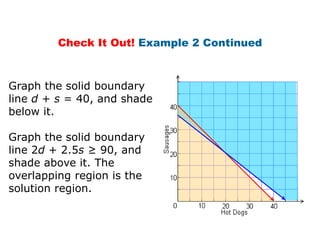
Graph the solid boundary
line d + s = 40, and shade
below it.

Graph the solid boundary
line 2d + 2.5s ≥ 90, and
shade above it. The
overlapping region is the
solution region.
Check It Out! Example 2 Continued

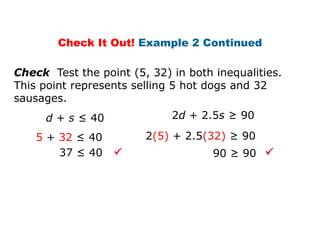
Check Test the point (5, 32) in both inequalities.
This point represents selling 5 hot dogs and 32
sausages.
     d + s ≤ 40              2d + 2.5s ≥ 90

    5 + 32 ≤ 40         2(5) + 2.5(32) ≥ 90
        37 ≤ 40                     90 ≥ 90 
Systems of inequalities may contain more
than two inequalities.
Example 3: Geometry Application

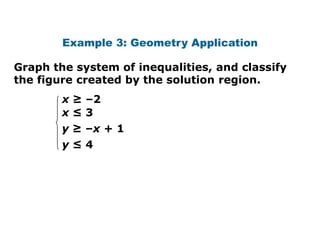
Graph the system of inequalities, and classify
the figure created by the solution region.
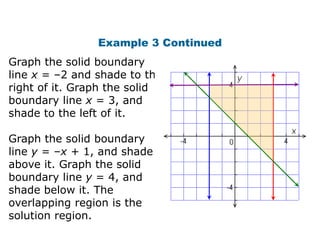
        x ≥ –2
        x≤3
        y ≥ –x + 1
        y≤4
Example 3 Continued
Graph the solid boundary
line x = –2 and shade to the
right of it. Graph the solid
boundary line x = 3, and
shade to the left of it.

Graph the solid boundary
line y = –x + 1, and shade
above it. Graph the solid
boundary line y = 4, and
shade below it. The
overlapping region is the
solution region.
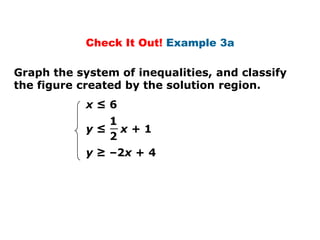
Check It Out! Example 3a

Graph the system of inequalities, and classify
the figure created by the solution region.
            x≤6

            y≤    x+1

            y ≥ –2x + 4
Check It Out! Example 3a Continued
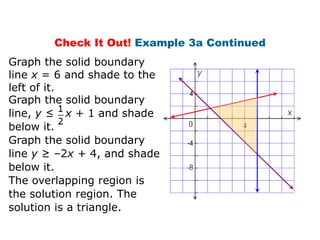
Graph the solid boundary
line x = 6 and shade to the
left of it.
Graph the solid boundary
line, y ≤ x + 1 and shade
below it.
Graph the solid boundary
line y ≥ –2x + 4, and shade
below it.
The overlapping region is
the solution region. The
solution is a triangle.
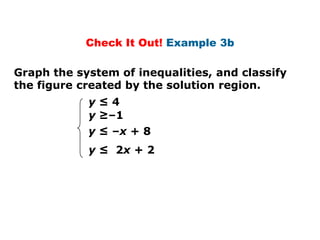
Check It Out! Example 3b

Graph the system of inequalities, and classify
the figure created by the solution region.
            y≤4
            y ≥–1
            y ≤ –x + 8
            y ≤ 2x + 2
Check It Out! Example 3b Continued
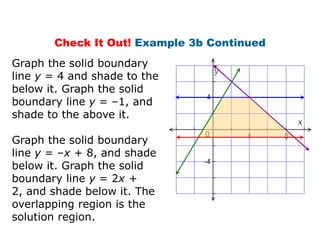
Graph the solid boundary
line y = 4 and shade to the
below it. Graph the solid
boundary line y = –1, and
shade to the above it.

Graph the solid boundary
line y = –x + 8, and shade
below it. Graph the solid
boundary line y = 2x +
2, and shade below it. The
overlapping region is the
solution region.
Check It Out! Example 3b Continued

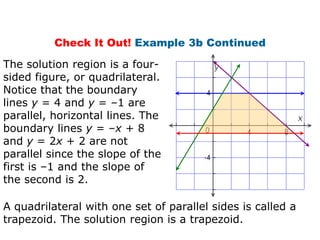
The solution region is a four-
sided figure, or quadrilateral.
Notice that the boundary
lines y = 4 and y = –1 are
parallel, horizontal lines. The
boundary lines y = –x + 8
and y = 2x + 2 are not
parallel since the slope of the
first is –1 and the slope of
the second is 2.

A quadrilateral with one set of parallel sides is called a
trapezoid. The solution region is a trapezoid.
Lesson Quiz: Part I
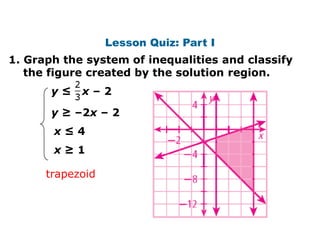
1. Graph the system of inequalities and classify
   the figure created by the solution region.
       y≤   x–2

       y ≥ –2x – 2
       x≤4
       x≥1

      trapezoid
Lesson Quiz: Part II
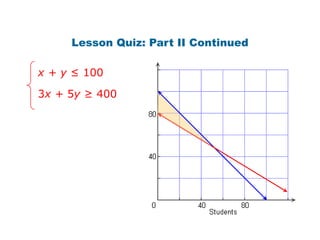
2. The cross-country team is selling water
   bottles to raise money for the team. The
   price of the water bottle is $3 for students
   and $5 for everyone else. The team needs
   to raise at least $400 and has 100 water
   bottles. Write and graph a system of
   inequalities that can be used to determine
   when the team will meet its goal.
Lesson Quiz: Part II Continued

x + y ≤ 100

3x + 5y ≥ 400

System of linear inequalities

  • 1.
    Solving Systems ofLinear Inequalities Warm Up Lesson Presentation Lesson Quiz
  • 2.
    Warm Up 1. Graph2x – y > 4. Determine if the given ordered pair is a solution of the system of equations. 2x + y = 2 2. (2, –2) 2y – x = –6 yes x – y = –1 3. (–4, 3) no x + 2y = 2
  • 3.
    Objective Solve systems oflinear inequalities.
  • 4.
  • 5.
    When a problemuses phrases like “greater than” or “no more than,” you can model the situation using a system of linear inequalities. A system of linear inequalities is a set of two or more linear inequalities with the same variables. The solution to a system of inequalities is often an infinite set of points that can be represented graphically by shading. When you graph multiple inequalities on the same graph, the region where the shadings overlap is the solution region.
  • 6.
    Example 1A: GraphingSystems of Inequalities Graph the system of inequalities. y< –3 y ≥ –x + 2 For y < – 3, graph the dashed boundary line y = – 3, and shade below it. For y ≥ –x + 2, graph the solid boundary line y = –x + 2, and shade above it. The overlapping region is the solution region.
  • 7.
    Check Test apoint from each region on the graph. Region Point y< 1 x–3 y ≥ –x + 2 2 Left (0, 0) 0 < 1 (0)–3 2 0 ≥ –(0) + 2 0 < –3 x 0≥2 x Right (5,–2) –2 < 1 (5) –3 2 –2 ≥ –(5) + 2 –2 <– 1  2 –2 ≥ –3  Top (0, 3) 3 < 1 (0)–3 3 ≥ –(0) + 2 2 2 < –3 x 3≥2  Bottom (0,–4) –4 < 1 (0)–3 –4 ≥ –(0) + 2 2 –4 < –3  –4 ≥ 2 x Only the point from the overlapping (right) region satisfies both inequalities.
  • 8.
    Helpful Hint If youare unsure which direction to shade, use the origin as a test point.
  • 9.
    Example 1B: GraphingSystems of Inequalities Graph each system of inequalities. y < –3x + 2 y ≥ –1 For y < –3x + 2, graph the dashed boundary line y = –3x + 2, and shade below it. For y ≥ –1, graph the solid boundary line y = –1, and shade above it.
  • 10.
    Example 1B Continued Check Choose a point in the solution region, such as (0, 0), and test it in both inequalities. y < –3x + 2 y ≥ –1 0 < –3(0) + 2 0 ≥ –1 0<2  0 ≥ –1  The test point satisfies both inequalities, so the solution region is correct.
  • 11.
    Check It Out!Example 1a Graph the system of inequalities. x – 3y < 6 2x + y > 1.5 For x – 3y < 6, graph the dashed 1 boundary line y = x – 2, and 3 shade above it. For 2x + y > 1.5, graph the dashed boundary line y = –2x + 1.5, and shade above it. The overlapping region is the solution region.
  • 12.
    Check Test apoint from each region on the graph. Region Point x – 3y < 6 2x + y > 1.5 0 – 3(0)< 6 2(0) + 0 >1.5 Left (0, 0) 0<6 x 0 > 1.5 x Right (4,–2) 4 – 3(–2)< 6 2(4) – 2 >1.5 10 < 6 x 6 > 1.5  Top (0, 3) 0 – 3(3)< 6 2(0) + 3 >1.5 –9 < 6  3 > 1.5  Bottom (0,–4) 0 – 3(–4)< 6 2(0) – 4 >1.5 –12 < 6  –4 > 1.5 x Only the point from the overlapping (top) region satisfies both inequalities.
  • 13.
    Check It Out!Example 1b Graph each system of inequalities. y≤4 2x + y < 1 For y ≤ 4, graph the solid boundary line y = 4, and shade below it. For 2x + y < 1, graph the dashed boundary line y = –3x +2, and shade below it. The overlapping region is the solution region.
  • 14.
    Check It Out!Example 1b Continued Check Choose a point in the solution region, such as (0, 0), and test it in both directions. y≤4 2x + y < 1 0≤4 2(0) + 0 < 1 0≤4  0<1  The test point satisfies both inequalities, so the solution region is correct.
  • 15.
    Example 2: ArtApplication Lauren wants to paint no more than 70 plates for the art show. It costs her at least $50 plus $2 per item to produce red plates and $3 per item to produce gold plates. She wants to spend no more than $215. Write and graph a system of inequalities that can be used to determine the number of each plate that Lauren can make.
  • 16.
    Example 2 Continued Letx represent the number of red plates, and let y represent the number of gold plates. The total number of plates Lauren is willing to paint can be modeled by the inequality x + y ≤ 70. The amount of money that Lauren is willing to spend can be modeled by 50 + 2x + 3y ≤ 215. x 0 The system of inequalities is y 0 . x + y ≤ 70 50 + 2x + 3y ≤ 215
  • 17.
    Example 2 Continued Graphthe solid boundary line x + y = 70, and shade below it. Graph the solid boundary line 50 + 2x + 3y ≤ 215, and shade below it. The overlapping region is the solution region.
  • 18.
    Example 2 Continued CheckTest the point (20, 20) in both inequalities. This point represents painting 20 red and 20 gold plates. x + y ≤ 70 50 + 2x + 3y ≤ 215 20 + 20 ≤ 70 50 + 2(20) + 3(20) ≤ 215 40 ≤ 70  150 ≤ 215 
  • 19.
    Check It Out!Example 2 Leyla is selling hot dogs and spicy sausages at the fair. She has only 40 buns, so she can sell no more than a total of 40 hot dogs and spicy sausages. Each hot dog sells for $2, and each sausage sells for $2.50. Leyla needs at least $90 in sales to meet her goal. Write and graph a system of inequalities that models this situation.
  • 20.
    Check It Out!Example 2 Continued Let d represent the number of hot dogs, and let s represent the number of sausages. The total number of buns Leyla has can be modeled by the inequality d + s ≤ 40. The amount of money that Leyla needs to meet her goal can be modeled by 2d + 2.5s ≥ 90. d 0 s 0 The system of inequalities is . d + s ≤ 40 2d + 2.5s ≥ 90
  • 21.
    Check It Out!Example 2 Continued Graph the solid boundary line d + s = 40, and shade below it. Graph the solid boundary line 2d + 2.5s ≥ 90, and shade above it. The overlapping region is the solution region.
  • 22.
    Check It Out!Example 2 Continued Check Test the point (5, 32) in both inequalities. This point represents selling 5 hot dogs and 32 sausages. d + s ≤ 40 2d + 2.5s ≥ 90 5 + 32 ≤ 40 2(5) + 2.5(32) ≥ 90 37 ≤ 40  90 ≥ 90 
  • 23.
    Systems of inequalitiesmay contain more than two inequalities.
  • 24.
    Example 3: GeometryApplication Graph the system of inequalities, and classify the figure created by the solution region. x ≥ –2 x≤3 y ≥ –x + 1 y≤4
  • 25.
    Example 3 Continued Graphthe solid boundary line x = –2 and shade to the right of it. Graph the solid boundary line x = 3, and shade to the left of it. Graph the solid boundary line y = –x + 1, and shade above it. Graph the solid boundary line y = 4, and shade below it. The overlapping region is the solution region.
  • 26.
    Check It Out!Example 3a Graph the system of inequalities, and classify the figure created by the solution region. x≤6 y≤ x+1 y ≥ –2x + 4
  • 27.
    Check It Out!Example 3a Continued Graph the solid boundary line x = 6 and shade to the left of it. Graph the solid boundary line, y ≤ x + 1 and shade below it. Graph the solid boundary line y ≥ –2x + 4, and shade below it. The overlapping region is the solution region. The solution is a triangle.
  • 28.
    Check It Out!Example 3b Graph the system of inequalities, and classify the figure created by the solution region. y≤4 y ≥–1 y ≤ –x + 8 y ≤ 2x + 2
  • 29.
    Check It Out!Example 3b Continued Graph the solid boundary line y = 4 and shade to the below it. Graph the solid boundary line y = –1, and shade to the above it. Graph the solid boundary line y = –x + 8, and shade below it. Graph the solid boundary line y = 2x + 2, and shade below it. The overlapping region is the solution region.
  • 30.
    Check It Out!Example 3b Continued The solution region is a four- sided figure, or quadrilateral. Notice that the boundary lines y = 4 and y = –1 are parallel, horizontal lines. The boundary lines y = –x + 8 and y = 2x + 2 are not parallel since the slope of the first is –1 and the slope of the second is 2. A quadrilateral with one set of parallel sides is called a trapezoid. The solution region is a trapezoid.
  • 31.
    Lesson Quiz: PartI 1. Graph the system of inequalities and classify the figure created by the solution region. y≤ x–2 y ≥ –2x – 2 x≤4 x≥1 trapezoid
  • 32.
    Lesson Quiz: PartII 2. The cross-country team is selling water bottles to raise money for the team. The price of the water bottle is $3 for students and $5 for everyone else. The team needs to raise at least $400 and has 100 water bottles. Write and graph a system of inequalities that can be used to determine when the team will meet its goal.
  • 33.
    Lesson Quiz: PartII Continued x + y ≤ 100 3x + 5y ≥ 400