QUADRATIC FUNCTIONS
*Quadratic Function
*The Graph of Quadratic Functions
*Graph of the Quadratic Function f(x)=ax2+k
QUADRATIC FUNCTION


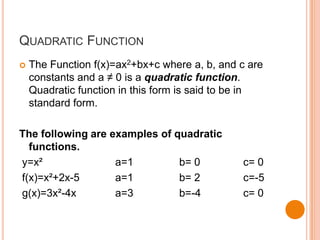
The Function f(x)=ax2+bx+c where a, b, and c are
constants and a ≠ 0 is a quadratic function.
Quadratic function in this form is said to be in
standard form.

The following are examples of quadratic
functions.
y=x²
a=1
b= 0
f(x)=x²+2x-5
a=1
b= 2
g(x)=3x²-4x
a=3
b=-4

c= 0
c=-5
c= 0
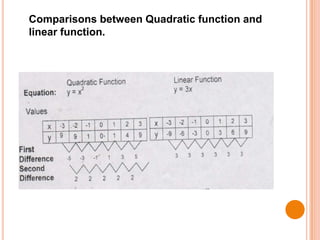
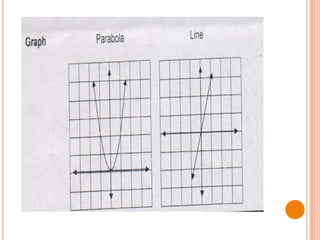
Comparisons between Quadratic function and
linear function.
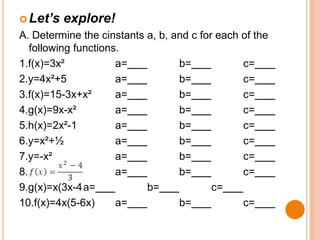
 Let’s

explore!

A. Determine the cinstants a, b, and c for each of the
following functions.
1.f(x)=3x²
a=
b=
c=
2.y=4x²+5
a=
b=
c=
3.f(x)=15-3x+x²
a=
b=
c=
4.g(x)=9x-x²
a=
b=
c=
5.h(x)=2x²-1
a=
b=
c=
6.y=x²+½
a=
b=
c=
7.y=-x²
a=
b=
c=
8.
a=
b=
c=
9.g(x)=x(3x-4a=
b=
c=
10.f(x)=4x(5-6x)
a=
b=
c=
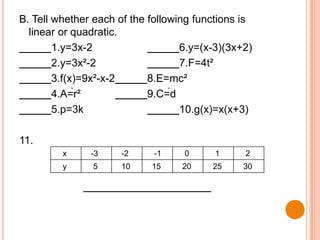
B. Tell whether each of the following functions is
linear or quadratic.
1.y=3x-2
6.y=(x-3)(3x+2)
2.y=3x²-2
7.F=4t²
3.f(x)=9x²-x-2
8.E=mc²
4.A=r²
9.C=d
5.p=3k
10.g(x)=x(x+3)

11.
x

-3

-2

-1

0

1

2

y

5

10

15

20

25

30
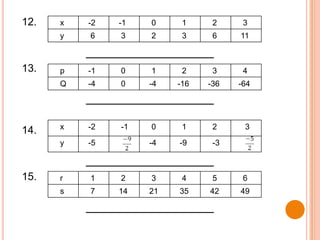
12.

0

1

2

3

6

3

2

3

6

11

p

-1

0

1

2

3

4

-4

0

-4

-16

-36

-64

x

-2

-1

0

1

2

y

15.

-1

Q

14.

-2

y

13.

x

-5

-4

-9

-3

r

1

2

3

4

5

6

s

7

14

21

35

42

49

3
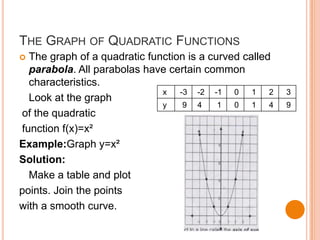
THE GRAPH OF QUADRATIC FUNCTIONS
The graph of a quadratic function is a curved called
parabola. All parabolas have certain common
characteristics.
x
-3 -2 -1
0
1
2
Look at the graph
y
9 4
1
0
1
4
of the quadratic
function f(x)=x²
Example:Graph y=x²
Solution:
Make a table and plot
points. Join the points
with a smooth curve.


3
9
Characteristics of the graph:
a. The graph is symmetrical with respect to a line
called the axis of symmetry. In this example, the
axis of symmetryis x=0, the y-axis.
b. The graph has a turning point called the vertex.
The vertex is either the lowest (minimum) point or
the highest (maximum) point of the function. The
vertex is the minimum of the function when the
graph opens upward. The vertex is the maximum
when the graph opens downward. In this example,
the vertex is the point (0,0), the origin.
 Let’s

explore!

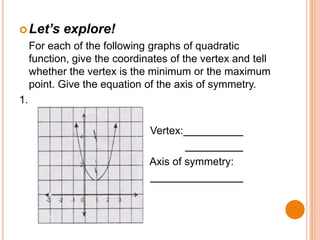
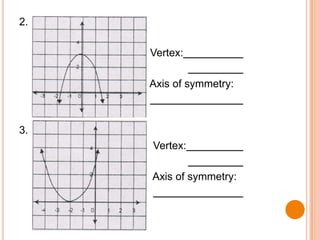
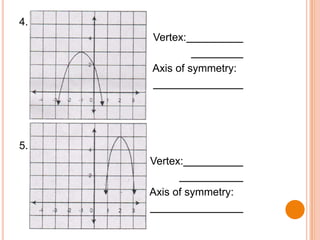
For each of the following graphs of quadratic
function, give the coordinates of the vertex and tell
whether the vertex is the minimum or the maximum
point. Give the equation of the axis of symmetry.
1.
Vertex:
Axis of symmetry:
2.
Vertex:

Axis of symmetry:

3.
Vertex:
Axis of symmetry:
4.
Vertex:
Axis of symmetry:

5.
Vertex:

Axis of symmetry:
GRAPH OF THE QUADRATIC FUNCTION
f(x)=ax2+k


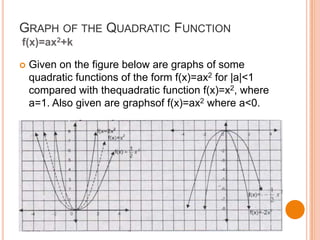
Given on the figure below are graphs of some
quadratic functions of the form f(x)=ax2 for |a|<1
compared with thequadratic function f(x)=x2, where
a=1. Also given are graphsof f(x)=ax2 where a<0.
The graph of the function f(x)=ax2 has the following
properties:
1. The vertex is at (0,0).
2. The line of symmetry is the y-axis, x=0.
3. If a is positive, the graph opens upward and the
vertex is a minimum point.
4. If a is negative, the graph opens downward and the
vertex is the maximum point.
5. If |a|<0, the graph is wider than the graph of
f(x)=x2.
6. If |a|>0, the graph is narrower than the graph of
f(x)=x2.
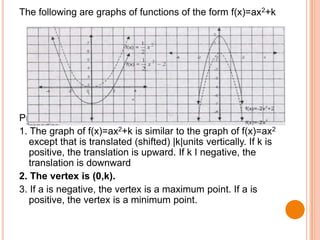
The following are graphs of functions of the form f(x)=ax2+k

Properties:
1. The graph of f(x)=ax2+k is similar to the graph of f(x)=ax2
except that is translated (shifted) |k|units vertically. If k is
positive, the translation is upward. If k I negative, the
translation is downward
2. The vertex is (0,k).
3. If a is negative, the vertex is a maximum point. If a is
positive, the vertex is a minimum point.
 Let’s

explore!

A.For each of the following quadratic functions,
determine the coordinates of the vertex, tell
whether th graph opens upward or downward, tell
whether the vertex is a minimum or maximum
point.
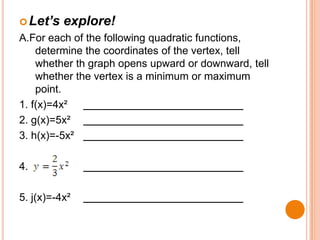
1. f(x)=4x²
2. g(x)=5x²
3. h(x)=-5x²
4.

5. j(x)=-4x²
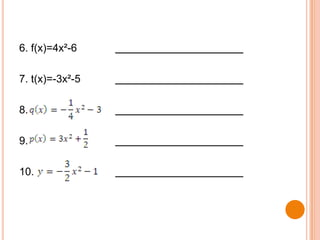
6. f(x)=4x²-6
7. t(x)=-3x²-5
8.

9.
10.
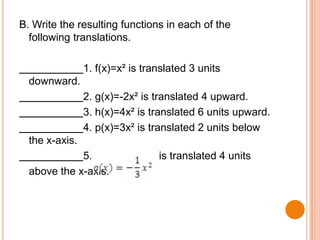
B. Write the resulting functions in each of the
following translations.
1. f(x)=x² is translated 3 units

downward.
2. g(x)=-2x² is translated 4 upward.
3. h(x)=4x² is translated 6 units upward.
4. p(x)=3x² is translated 2 units below

the x-axis.
5.
above the x-axis.

is translated 4 units
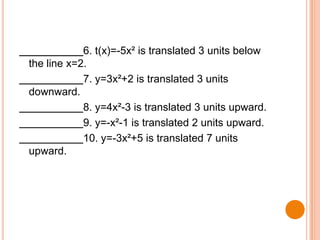
6. t(x)=-5x² is translated 3 units below
the line x=2.
7. y=3x²+2 is translated 3 units
downward.
8. y=4x²-3 is translated 3 units upward.
9. y=-x²-1 is translated 2 units upward.
10. y=-3x²+5 is translated 7 units
upward.
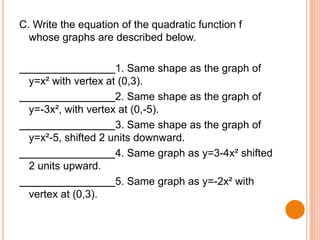
C. Write the equation of the quadratic function f
whose graphs are described below.
1. Same shape as the graph of
y=x² with vertex at (0,3).
2. Same shape as the graph of
y=-3x², with vertex at (0,-5).
3. Same shape as the graph of
y=x²-5, shifted 2 units downward.
4. Same graph as y=3-4x² shifted
2 units upward.
5. Same graph as y=-2x² with
vertex at (0,3).

Quadratic functions

  • 1.
    QUADRATIC FUNCTIONS *Quadratic Function *TheGraph of Quadratic Functions *Graph of the Quadratic Function f(x)=ax2+k
  • 2.
    QUADRATIC FUNCTION  The Functionf(x)=ax2+bx+c where a, b, and c are constants and a ≠ 0 is a quadratic function. Quadratic function in this form is said to be in standard form. The following are examples of quadratic functions. y=x² a=1 b= 0 f(x)=x²+2x-5 a=1 b= 2 g(x)=3x²-4x a=3 b=-4 c= 0 c=-5 c= 0
  • 3.
    Comparisons between Quadraticfunction and linear function.
  • 5.
     Let’s explore! A. Determinethe cinstants a, b, and c for each of the following functions. 1.f(x)=3x² a= b= c= 2.y=4x²+5 a= b= c= 3.f(x)=15-3x+x² a= b= c= 4.g(x)=9x-x² a= b= c= 5.h(x)=2x²-1 a= b= c= 6.y=x²+½ a= b= c= 7.y=-x² a= b= c= 8. a= b= c= 9.g(x)=x(3x-4a= b= c= 10.f(x)=4x(5-6x) a= b= c=
  • 6.
    B. Tell whethereach of the following functions is linear or quadratic. 1.y=3x-2 6.y=(x-3)(3x+2) 2.y=3x²-2 7.F=4t² 3.f(x)=9x²-x-2 8.E=mc² 4.A=r² 9.C=d 5.p=3k 10.g(x)=x(x+3) 11. x -3 -2 -1 0 1 2 y 5 10 15 20 25 30
  • 7.
  • 8.
    THE GRAPH OFQUADRATIC FUNCTIONS The graph of a quadratic function is a curved called parabola. All parabolas have certain common characteristics. x -3 -2 -1 0 1 2 Look at the graph y 9 4 1 0 1 4 of the quadratic function f(x)=x² Example:Graph y=x² Solution: Make a table and plot points. Join the points with a smooth curve.  3 9
  • 9.
    Characteristics of thegraph: a. The graph is symmetrical with respect to a line called the axis of symmetry. In this example, the axis of symmetryis x=0, the y-axis. b. The graph has a turning point called the vertex. The vertex is either the lowest (minimum) point or the highest (maximum) point of the function. The vertex is the minimum of the function when the graph opens upward. The vertex is the maximum when the graph opens downward. In this example, the vertex is the point (0,0), the origin.
  • 10.
     Let’s explore! For eachof the following graphs of quadratic function, give the coordinates of the vertex and tell whether the vertex is the minimum or the maximum point. Give the equation of the axis of symmetry. 1. Vertex: Axis of symmetry:
  • 11.
  • 12.
  • 13.
    GRAPH OF THEQUADRATIC FUNCTION f(x)=ax2+k  Given on the figure below are graphs of some quadratic functions of the form f(x)=ax2 for |a|<1 compared with thequadratic function f(x)=x2, where a=1. Also given are graphsof f(x)=ax2 where a<0.
  • 14.
    The graph ofthe function f(x)=ax2 has the following properties: 1. The vertex is at (0,0). 2. The line of symmetry is the y-axis, x=0. 3. If a is positive, the graph opens upward and the vertex is a minimum point. 4. If a is negative, the graph opens downward and the vertex is the maximum point. 5. If |a|<0, the graph is wider than the graph of f(x)=x2. 6. If |a|>0, the graph is narrower than the graph of f(x)=x2.
  • 15.
    The following aregraphs of functions of the form f(x)=ax2+k Properties: 1. The graph of f(x)=ax2+k is similar to the graph of f(x)=ax2 except that is translated (shifted) |k|units vertically. If k is positive, the translation is upward. If k I negative, the translation is downward 2. The vertex is (0,k). 3. If a is negative, the vertex is a maximum point. If a is positive, the vertex is a minimum point.
  • 16.
     Let’s explore! A.For eachof the following quadratic functions, determine the coordinates of the vertex, tell whether th graph opens upward or downward, tell whether the vertex is a minimum or maximum point. 1. f(x)=4x² 2. g(x)=5x² 3. h(x)=-5x² 4. 5. j(x)=-4x²
  • 17.
  • 18.
    B. Write theresulting functions in each of the following translations. 1. f(x)=x² is translated 3 units downward. 2. g(x)=-2x² is translated 4 upward. 3. h(x)=4x² is translated 6 units upward. 4. p(x)=3x² is translated 2 units below the x-axis. 5. above the x-axis. is translated 4 units
  • 19.
    6. t(x)=-5x² istranslated 3 units below the line x=2. 7. y=3x²+2 is translated 3 units downward. 8. y=4x²-3 is translated 3 units upward. 9. y=-x²-1 is translated 2 units upward. 10. y=-3x²+5 is translated 7 units upward.
  • 20.
    C. Write theequation of the quadratic function f whose graphs are described below. 1. Same shape as the graph of y=x² with vertex at (0,3). 2. Same shape as the graph of y=-3x², with vertex at (0,-5). 3. Same shape as the graph of y=x²-5, shifted 2 units downward. 4. Same graph as y=3-4x² shifted 2 units upward. 5. Same graph as y=-2x² with vertex at (0,3).