Download as PDF, PPTX


![- 175 -
4. Solve the following inequality and express the solution on the
number line:
(1) 2( 3) 4x − > ; (2) 2 3 5( 3)x x− ≤ − ;
(3)
1 2
( 2)
5 5
x x− ≤ − ; (4)
1
1
3 2
x x −
− < .
5. Is the following solution correct? Why?
(1) 6x− = , multiplying both sides by 1− , then we have 6x = − ;
(2) 6x− > , multiplying both sides by 1− , then we have 6x > − ;
(3) 6x− ≤ , multiplying both sides by 1− , then we have 6x ≤ − .
6. Is the following solution correct? Why?
(1) 7 5 8 6
7 8 6 5
1
1
x x
x x
x
x
+ > +
− > −
− >
> −
(2) 6 3 4 4
6 4 4 3
2 1
1
2
x x
x x
x
x
− < −
− < − +
< −
>
7. Solve the following inequality:
(1) 2(3 1) 3(4 5) 4( 7)x x x x− − + > − − ;
(2) 3[ 2( 1)] 4x x x− − ≤ ;
(3)
1
(3 1) 7 10.1
2 5
x
x x− + < + ;
(4)
1 4 1
5 3
3 2 8
x x +
+ ≥ −
−
.
8. What value of a should be taken such that the value of the
expression 3 2a− is:
(1) greater than 1? (2) equal to 1? (3) less than 1?
9. What value of y should be taken such that the value of the
expression 3
3
y
− is:
(1) greater than 3
2
y
− ? (2) less than 3
2
y
− ?
- 176 -
10. (1) Is it correct that 5 4a a> ?
(2) Is it correct that
3
a
is less than a?
(3) Comparing a and –a, which one is greater?
11. Adding 5 to two times of an unknown is not greater than
subtracting 4 from three times of the unknown. Find the solution
set of this unknown.
12. Find the number of positive integral solutions of the inequality
64 3 4x− > .
13. The sum of three consecutive natural numbers is less than 15.
How many such groups of consecutive natural numbers are there?
14. (1) If a positive number is greater than another positive
number, then which number has a greater absolute value? Explain
your answer with an example.
(2) If a negative number is greater than another negative
number, then which number has a greater absolute value? Explain
your answer with an example.
(3) If a number is greater than another number, then which
number has a greater opposite number? Explain your answer with
an example.
*15. Fill in the blanks with the correct '<' or '>' sign:
(1) If a b< , then ___ 0a b− ;
(2) If a b= , then ___ 0a b− ;
(3) If a b> , then ___ 0a b− .
*16. Fill in the blanks with the correct '<' or '>' sign:
(1) If 0a b− < , then ___a b;
(2) If 0a b− = , then ___a b;
(3) If 0a b− > , then ___a b.
*17. Fill in the blanks with the correct '<' or '>' sig:
(1) If 0a > and ___b , then 0ab > ;
(2) If 0a > and ___b , then 0ab < .](https://image.slidesharecdn.com/algebrach4-150809130622-lva1-app6891/85/Algebra-9-320.jpg)


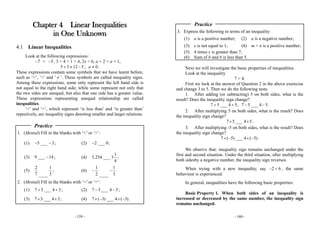
This document discusses linear inequalities in one unknown. It begins by introducing linear inequalities and their properties. It explains that the solution set of an inequality is the set of all numbers that satisfy the inequality. It then discusses how to solve linear inequalities in one unknown by using the same steps as solving linear equations, with the additional property that reversing the inequality sign when multiplying or dividing both sides by a negative number. Examples are provided to illustrate these concepts and solving methods. The key steps in solving linear inequalities in one unknown are removing brackets, collecting like terms, and determining the resulting inequality sign.


![Linear Equations Slide Share Version Exploded[1]](https://cdn.slidesharecdn.com/ss_thumbnails/linear-equations-slide-share-version-exploded1-8331-thumbnail.jpg?width=640&height=640&fit=bounds)


