1
Human Anatomy
Chondrology & Arthrology
6-2
Cartilage Connective Tissue
Characteristics:
 Weaker than bone
 More flexible than bone
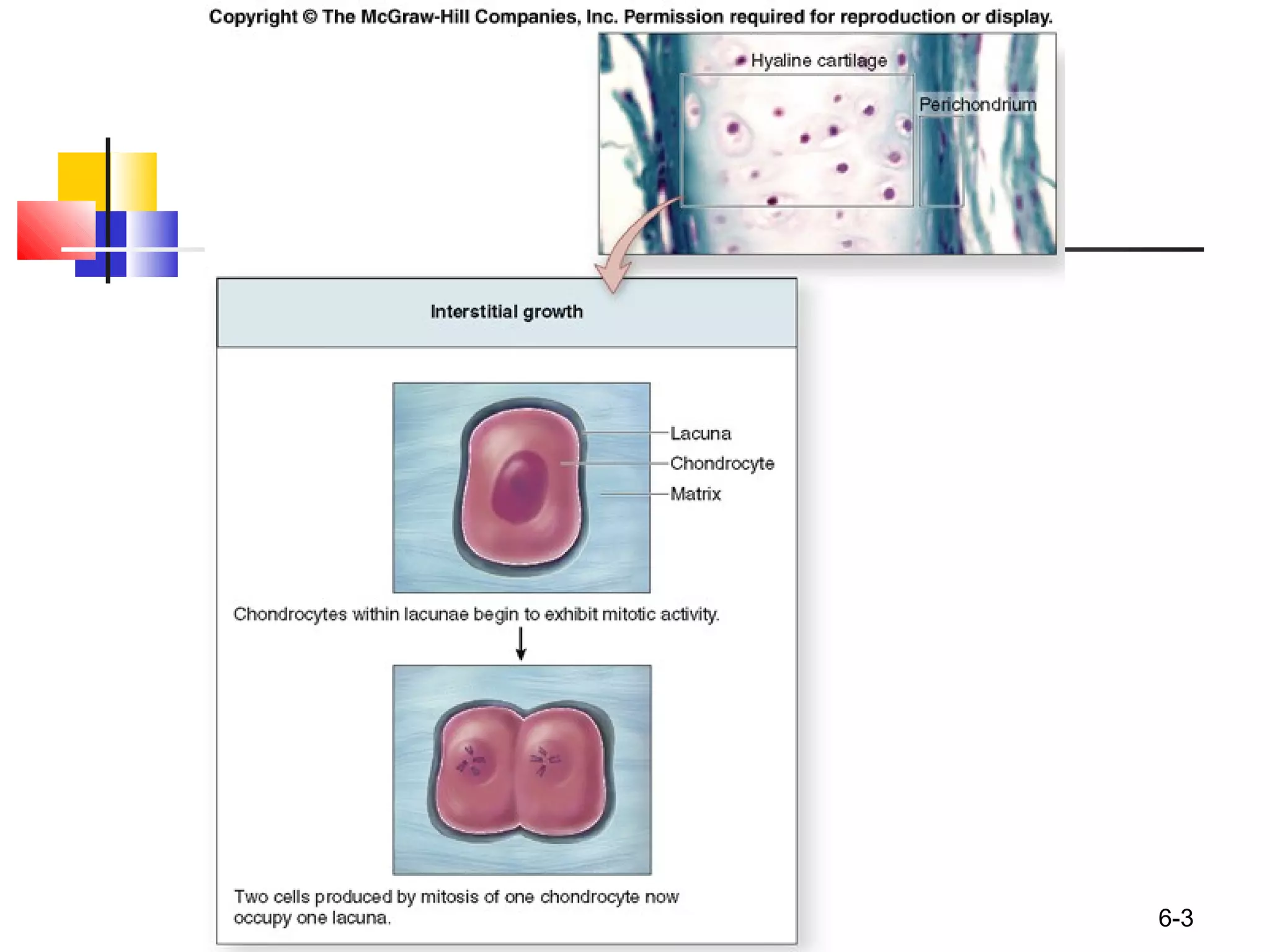
 Cells in an abundant matrix.
 Cell Types
 Chondroblasts
 Chondrocytes in lacunae
 Avascular
6-3
6-4
3 Major Functions of Cartilage
 Supporting soft tissues.
 Providing a gliding surface at
articulations (joints)
 Providing a model for the formation of
most of the bones in the body.
6-5
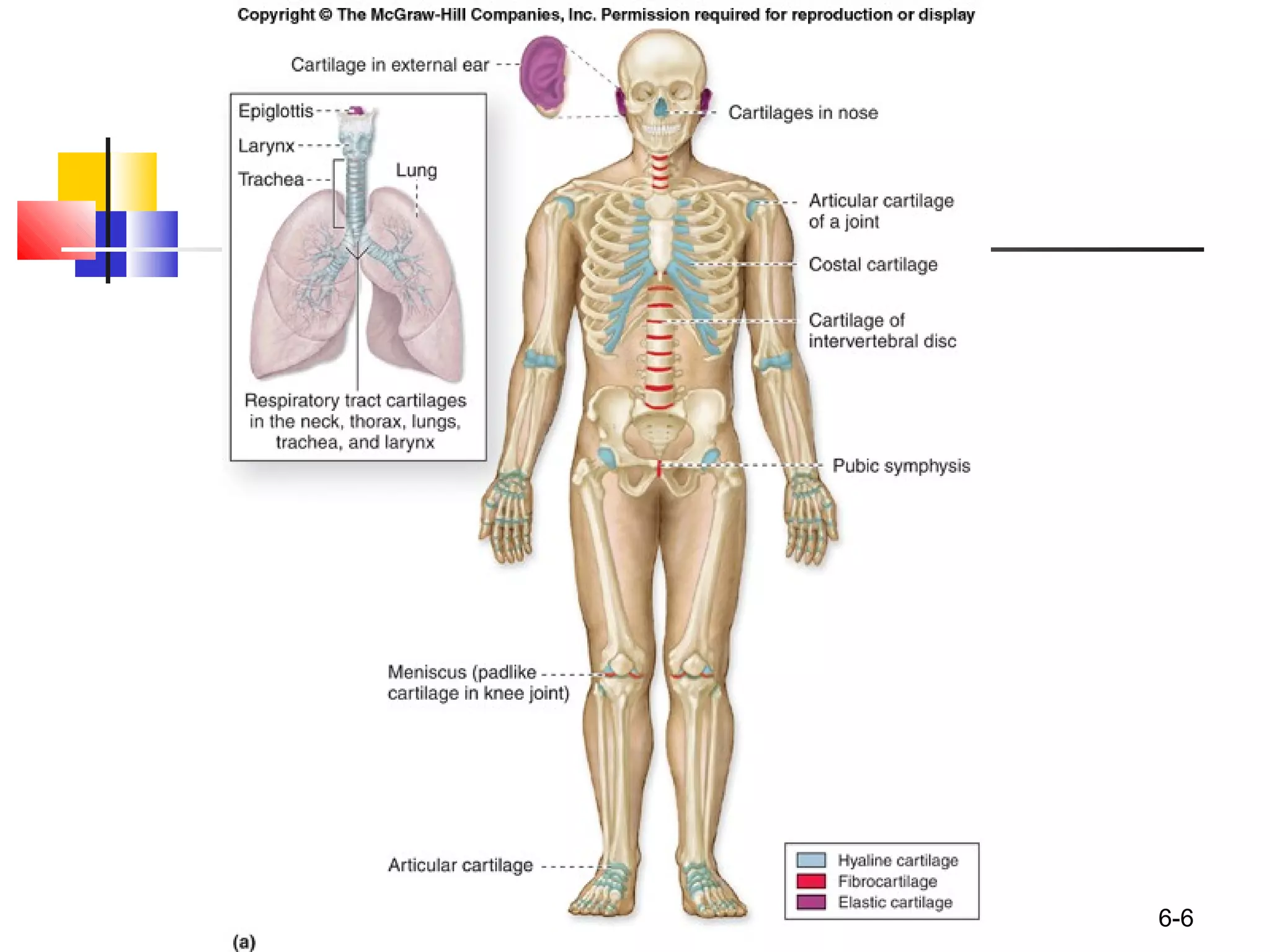
Types of Cartilage
 Three types of cartilage:
 Hyaline cartilage

Most abundant kind

Has a perichondrium (membrane)

Associated with synovial joints

Most bones first modeled in hyaline cartilage
 Fibrocartilage

Has collagen fibers

Intervertebral discs, pubic symphysis
 Elastic cartilage

Has elastic fibers

Ear, respiratory tubing
6-6
9-7
Articulations
 A joint, or articulation, is the place of contact
between bones, between bone and cartilage,
or between bones and teeth.
9-8
Naming of Joints
 Usually derived from the names of the
articulating bones.
9-9
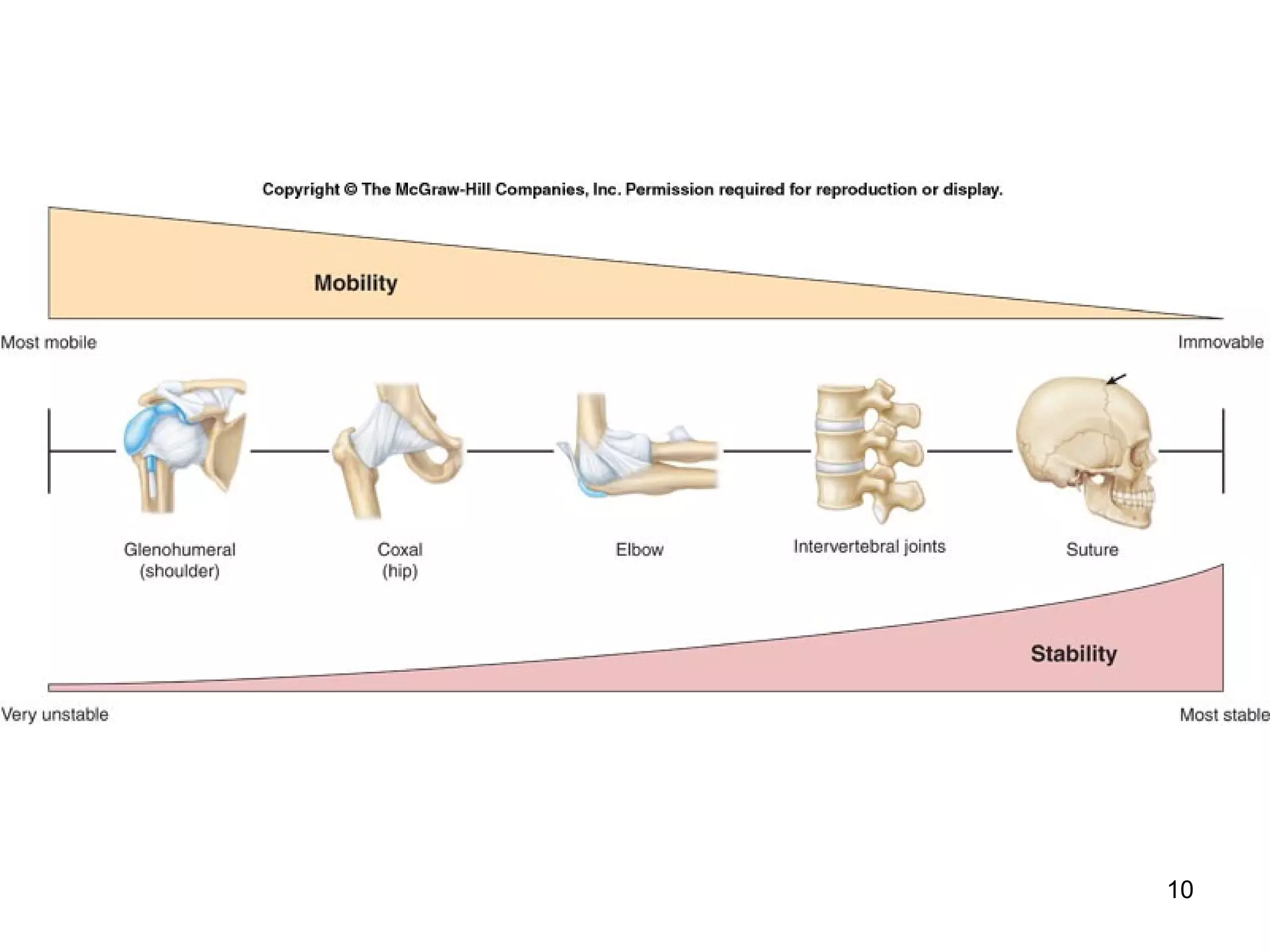
Mobility and Stability in Joints
 Motion permitted ranges from none to various
extensive motions.

Structure determines both its mobility and its stability.
 more mobile = less stable
10
9-11
Structural
Classification of Joints
 A fibrous joint occurs where bones are held together
by dense regular (fibrous) connective tissue.
 A cartilaginous joint occurs where bones are joined
by cartilage.
 A synovial joint
 has a fluid-filled synovial cavity
 bones are enclosed within a capsule
 bones are joined by various ligaments
9-12
Classification of Joints
 Functionally based on the extent of movement they
permit:
 Synarthrosis is an immovable joint.
 Amphiarthrosis is a slightly movable joint.

Diarthrosis is a freely movable joint.
9-13
Fibrous Joints
 Union is due to dense fibrous tissue.
 Most are immovable or only slightly
movable.
 Have no joint cavity.
 Three types.
 Gomphosis
 sutures
 syndesmosis
14
Sutures
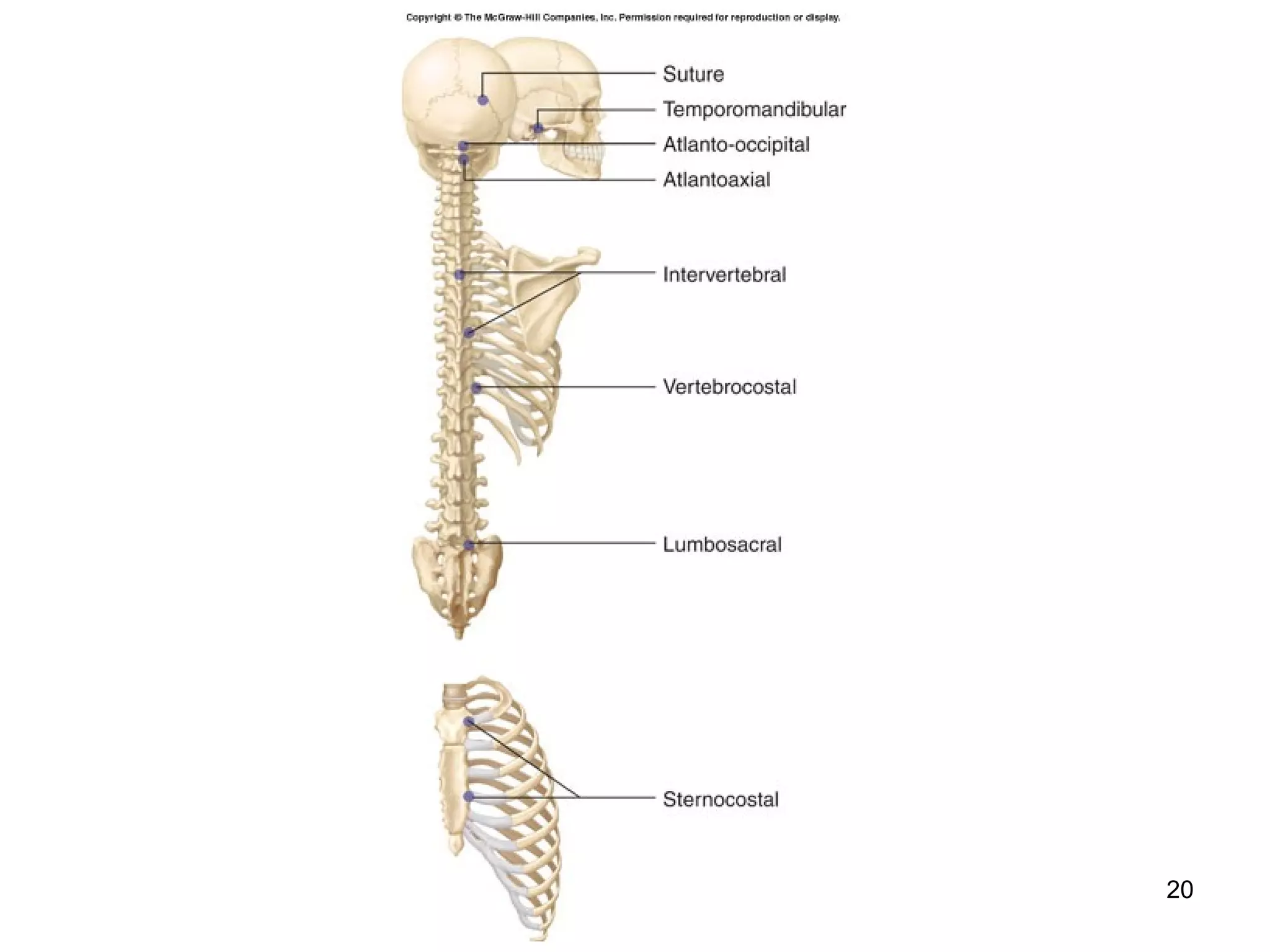
 Joints of skull bone
 Fixed
 Affected by sutural ligaments
 Sites of active bone growth
 Process of obliteration of sutures is
called synostosis.
9-15
Gomphosis
(peg & socket joints)
 Fibrous joints in which teeth fit into their
sockets.
 Periodontal ligament connects the tooth
with socket or alveolus.
9-16
Varieties of sutures.
 Depends on shape of articulating surfaces and mode
of fusion of articulating bones.
 Serrate sutures (sagittal suture).
 Denticulate suture (lambdoid suture).
 Squamous Plane sutures (temporo parietal suture).
 Limbus suture
 Plane sutures ( inter palantine suture).
 Wedge and groove suture(vomero sphenoid suture)
9-17
9-18
Cartilaginous Joints
 Bones are attached to each other by cartilage.
 Lack a joint cavity.
 Two types.
 Primary cartilaginous joint or synchondrosis

Symphyses, secondary cartilaginous joints.
19
20
9-21
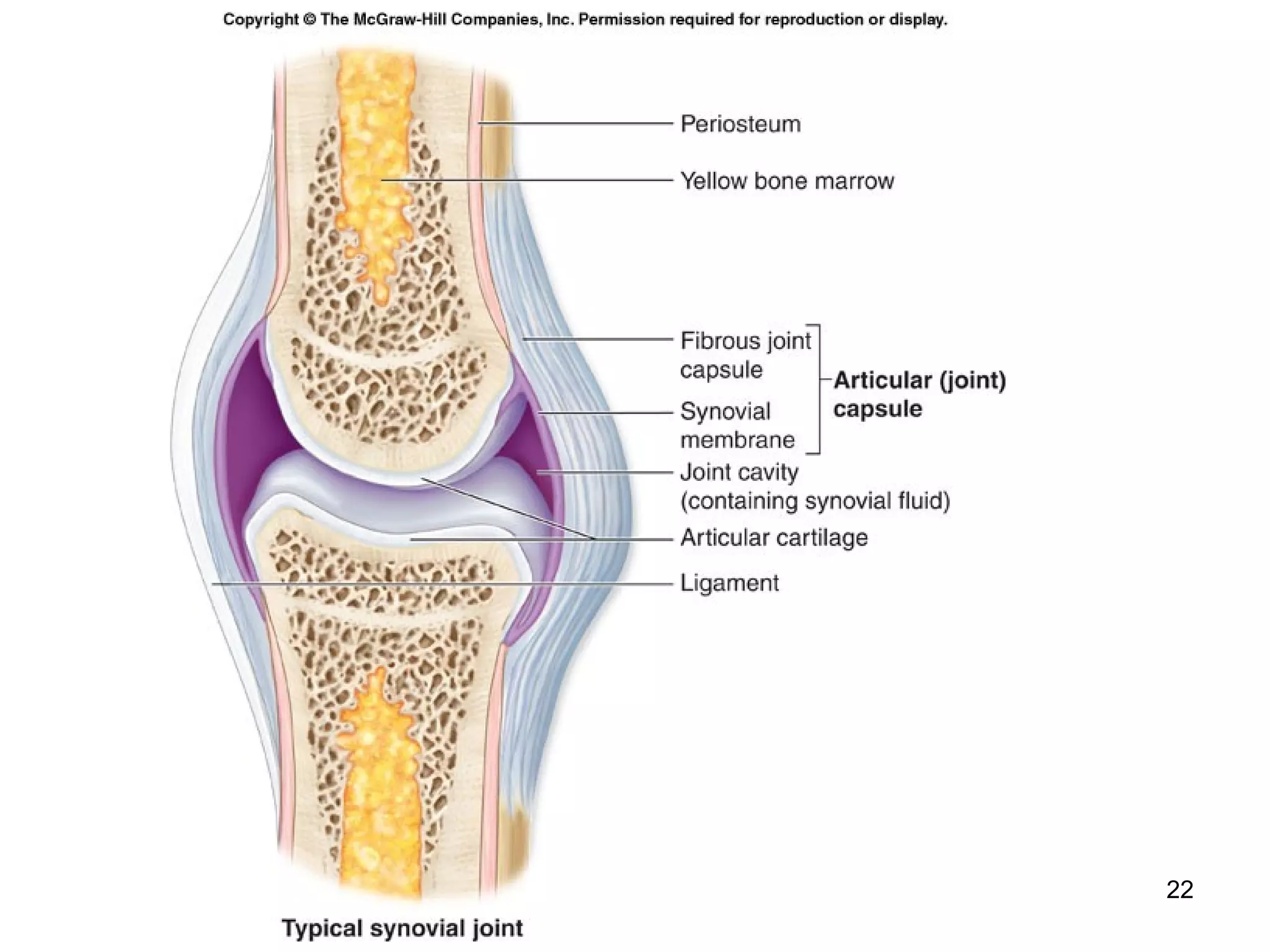
Synovial Joints
 Freely movable articulations
 Classified as diarthroses
 Bones are separated by a space called a joint
cavity
 Most of the commonly known joints in the
body
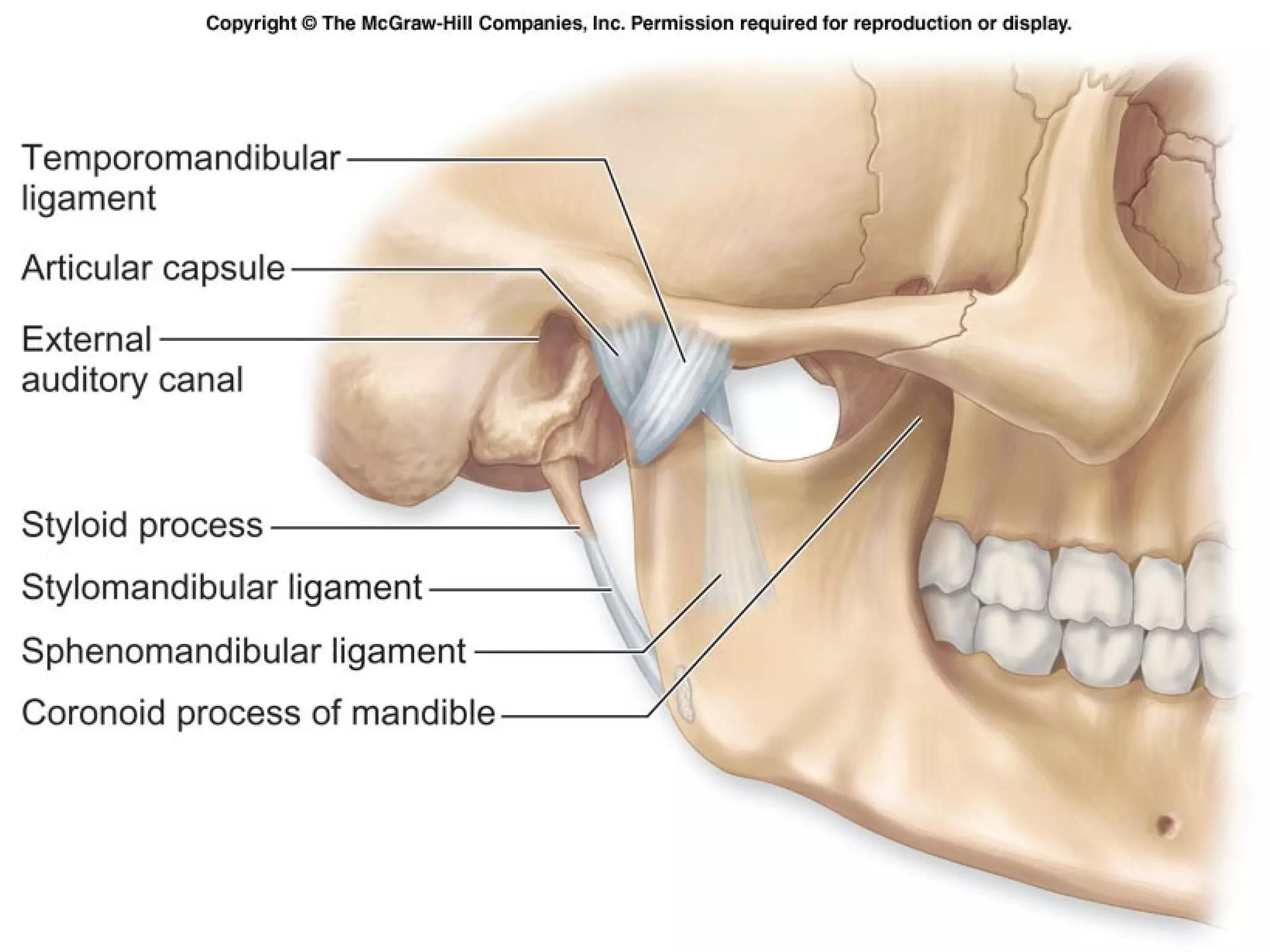
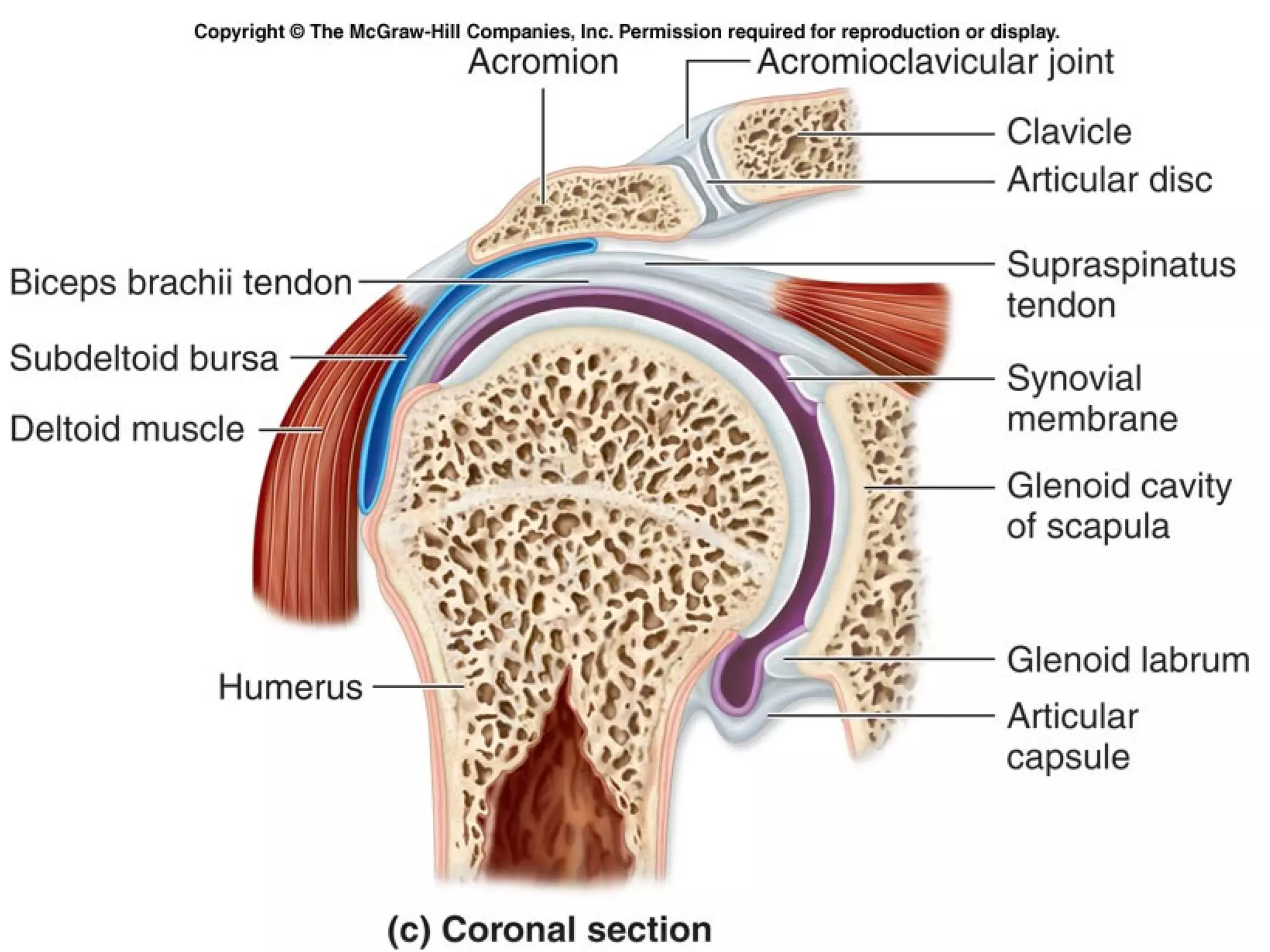
 glenohumeral (shoulder) joint
 temporomandibular joint
 elbow joint
 knee joint
22
Insert Fig. 9.4 Synovial Joints
9-23
General Anatomy of Synovial
Joints
 Basic features:
 articular capsule
 joint cavity
 synovial fluid
 articular cartilage
 ligaments
 nerves
 blood vessels
9-24
General Anatomy of Synovial
Joints – Accessory Structures
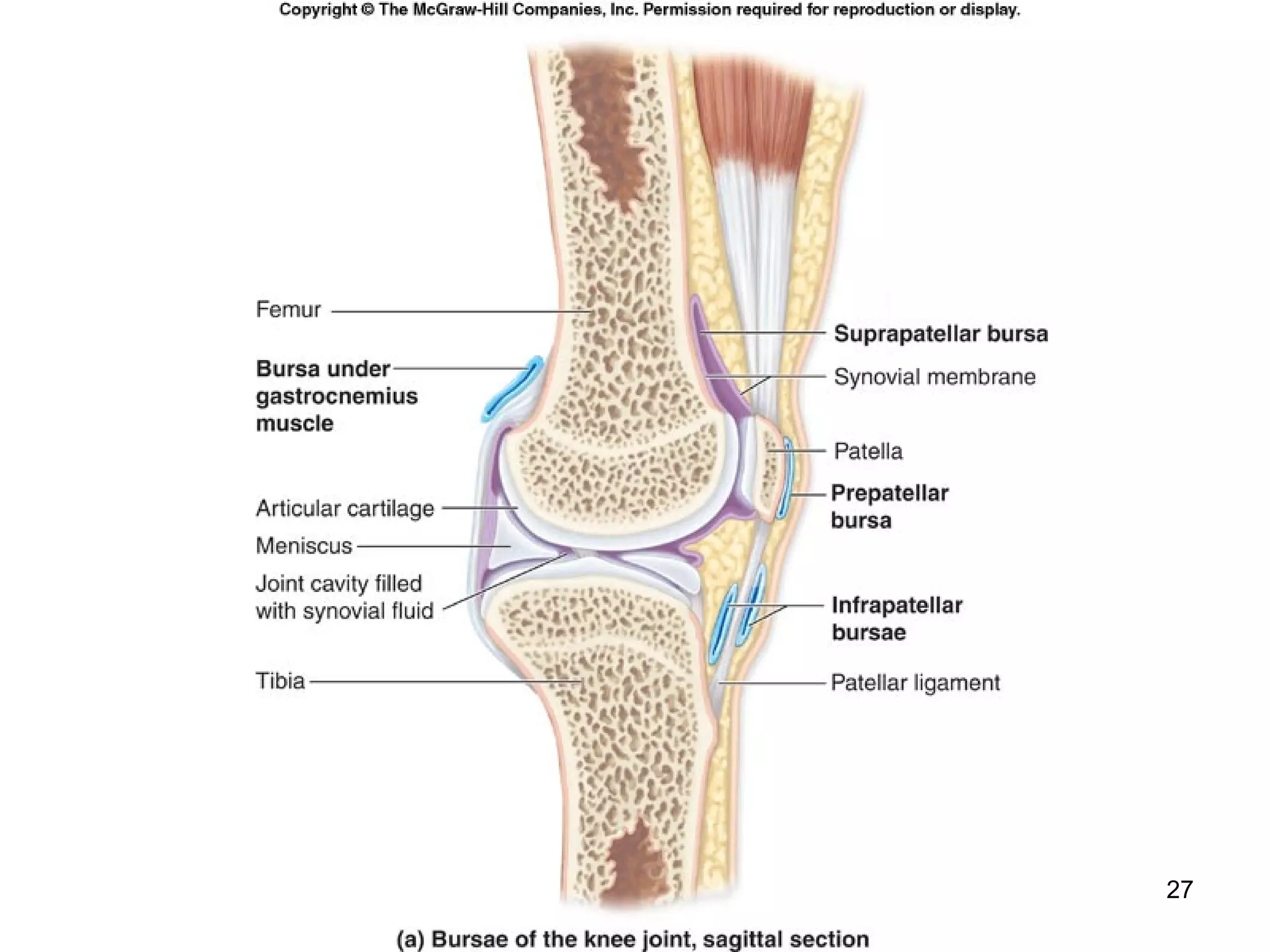
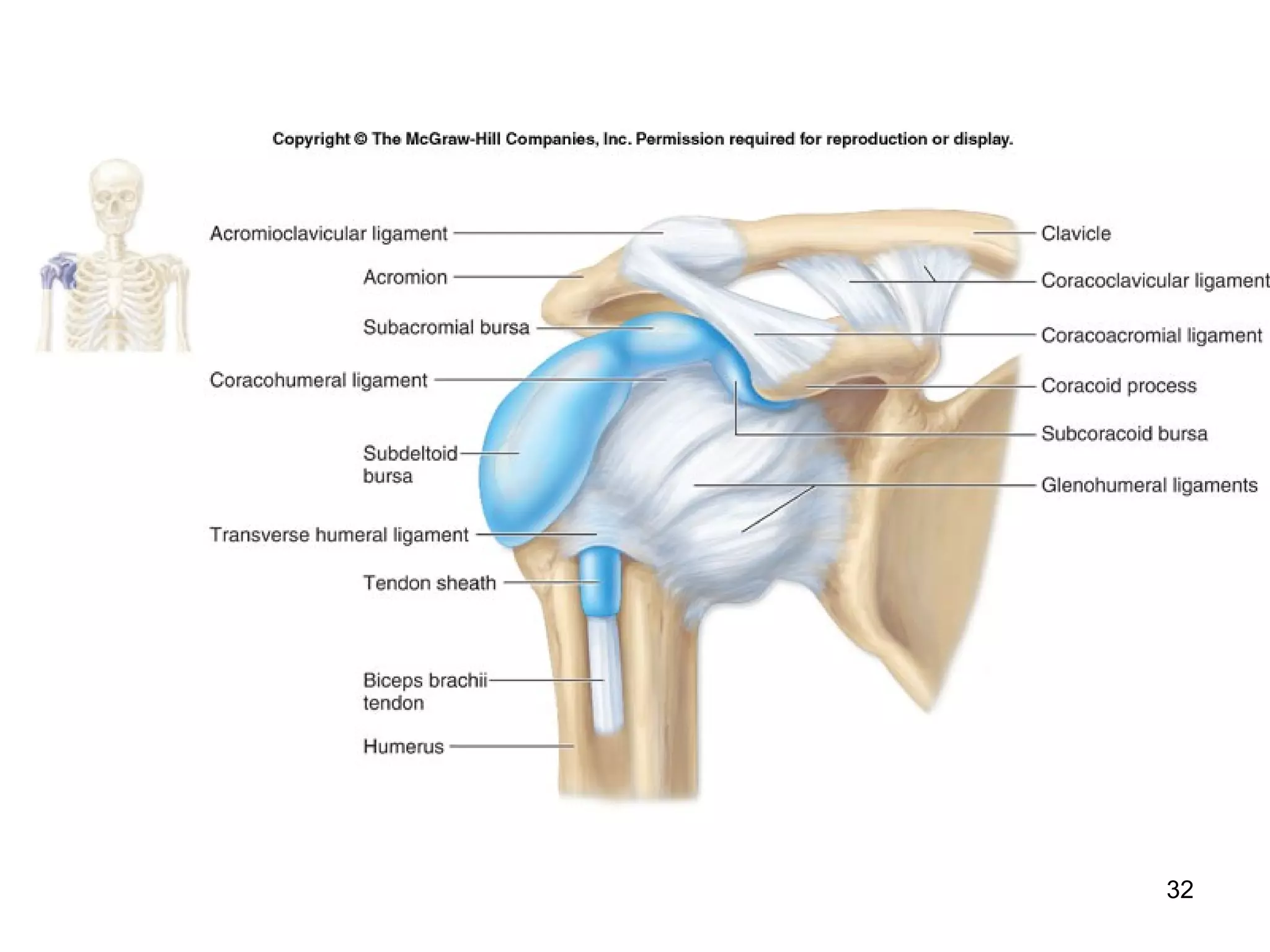
 Bursae
 fibrous, saclike structure that contains synovial fluid and is
lined by a synovial membrane
 Fatpads
 often distributed along the periphery of a synovial joint
 act as packing material and provide some protection for the
joint
 fill the spaces that form when bones move and the joint
cavity changes shape
 Tendons
 attaches a muscle to a bone
 help to stabilize joints
25
STRUCTURES COMPRISING A
SYNOVIAL JOINT 
• ARTICULAR BONY SURFACES:
• THE CONTIGUOUS BONY SURFACES, WHICH ARE TAKING 
PART IN THE FORMATION OF A JOINT, ARE CALLED ARTICULAR 
BONY SURFACES. THESE SURFACES ARE NOT IN CONTINUITY 
WITH EACH OTHER BUT ARE RATHER WELL ADAPTED TO 
EACH OTHER. 
• EACH BONY ARTICULAR SURFACE IS COVERED BY BLUISH-
WHITE ARTICULAR-WHICH IS AVASCULAR, ANERVOUS AND 
DEVOID OF PERICHONDRIUM.
•  IT DERIVES ITS NUTRITION BY DIFFUSION FROM THREE 
SOURCES:
• SYNOVIAL FLUID.
• EPIPHYSEAL VESSELS.
• SYNOVIAL VESSELS (CIRCULUS VASCULOSUS ARTICULI)
26
27
JOINT CAVITY (SYNOVIAL CAVITY)
•  EVERY SYNOVIAL JOINT HAS A 
SPECIAL CAVITY LINED BY SYNOVIAL 
MEMBRANE. THIS CAVITY IS NOT AN 
EMPTY SPACE, BUT IS FILLED WITH A 
LUBRICATING FLUID CALLED 
SYNOVIAL FLUID.
28
ARTICULAR CAPSULE AND ITS
THICKENINGS (CAPSULAR LIGAMENTS) 
• EACH JOINT IS SURROUNDED BY A TUBULAR DENSE 
FIBROUS CAPSULE, WHICH IS ATTACHED TO THE ARTICULAR 
LINES OF THE PARTICIPATING BONES.
•   EXAMPLES
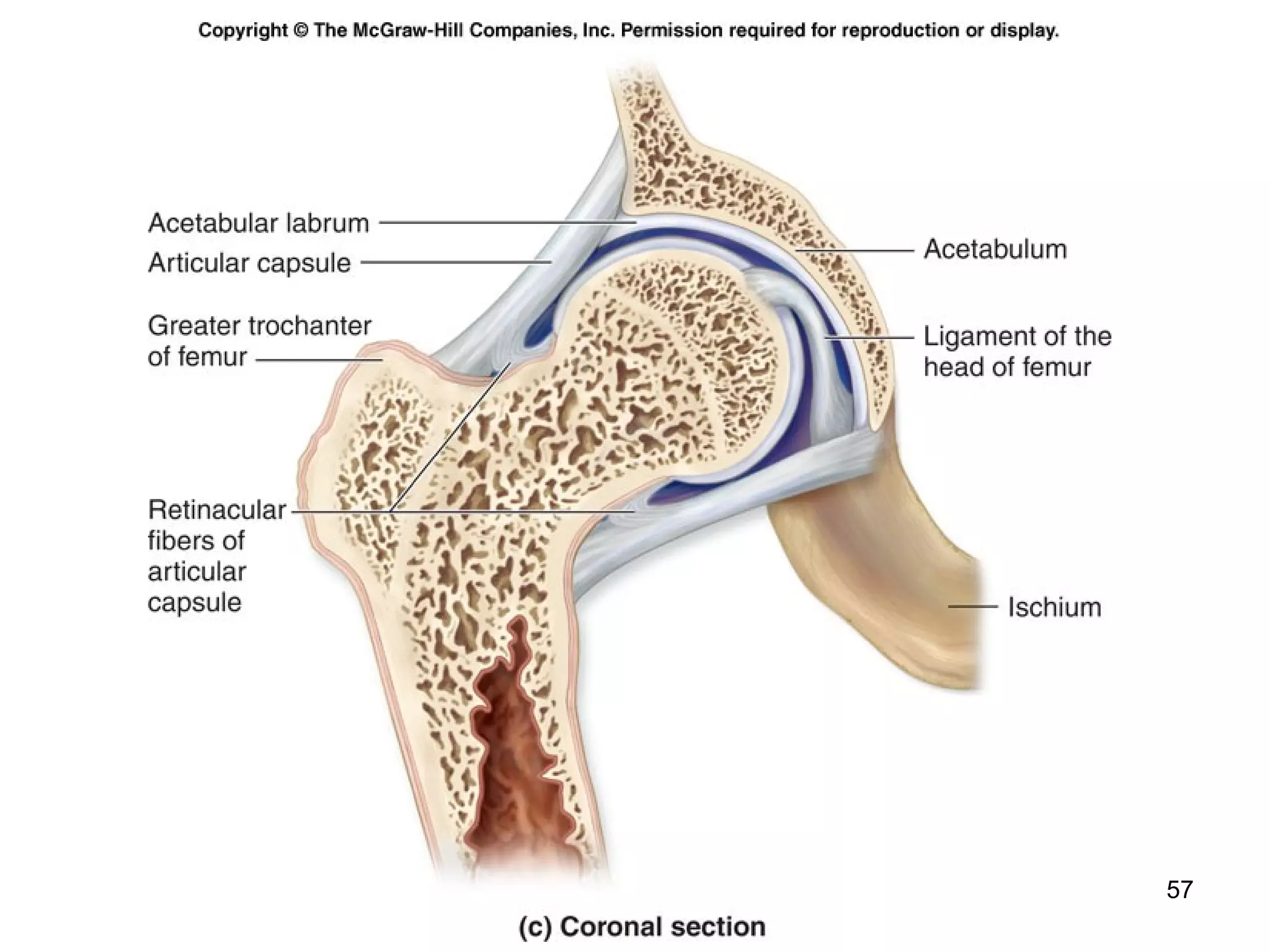
– EPIPHYSEAL LINE OF HEAD OF FEMUR IS COMPLETELY 
INTRACAPSULAR.
– EPIPHYSEAL LINE OF LOWER END OF FEMUR IS 
COMPLETELY EXTRA CAPSULAR.
– EPIPHYSEAL LINE OF UPPER END PARTLY EXTRA 
CAPSULAR.
29
ARTICULAR CAPSULE
• THE FIBROUS CAPSULE OF THE JOINT MAY BE 
STRENGTHENED BY ADJACENT MUSCLES, TENDONS AND 
ACCESSORY LIGAMENTS OR TRUE LIGAMENTS.
• SMALL NERVES AND VESSELS ARE PIERCING THE CAPSULE. 
THE SYNOVIAI MEMBRANE MAY PROTRUDE OUT OF THE 
CAPSULE THROUGH HOLES AND FORM BURSAE, WHICH 
REDUCE FRICTION DURING MOVEMENTS. 
30
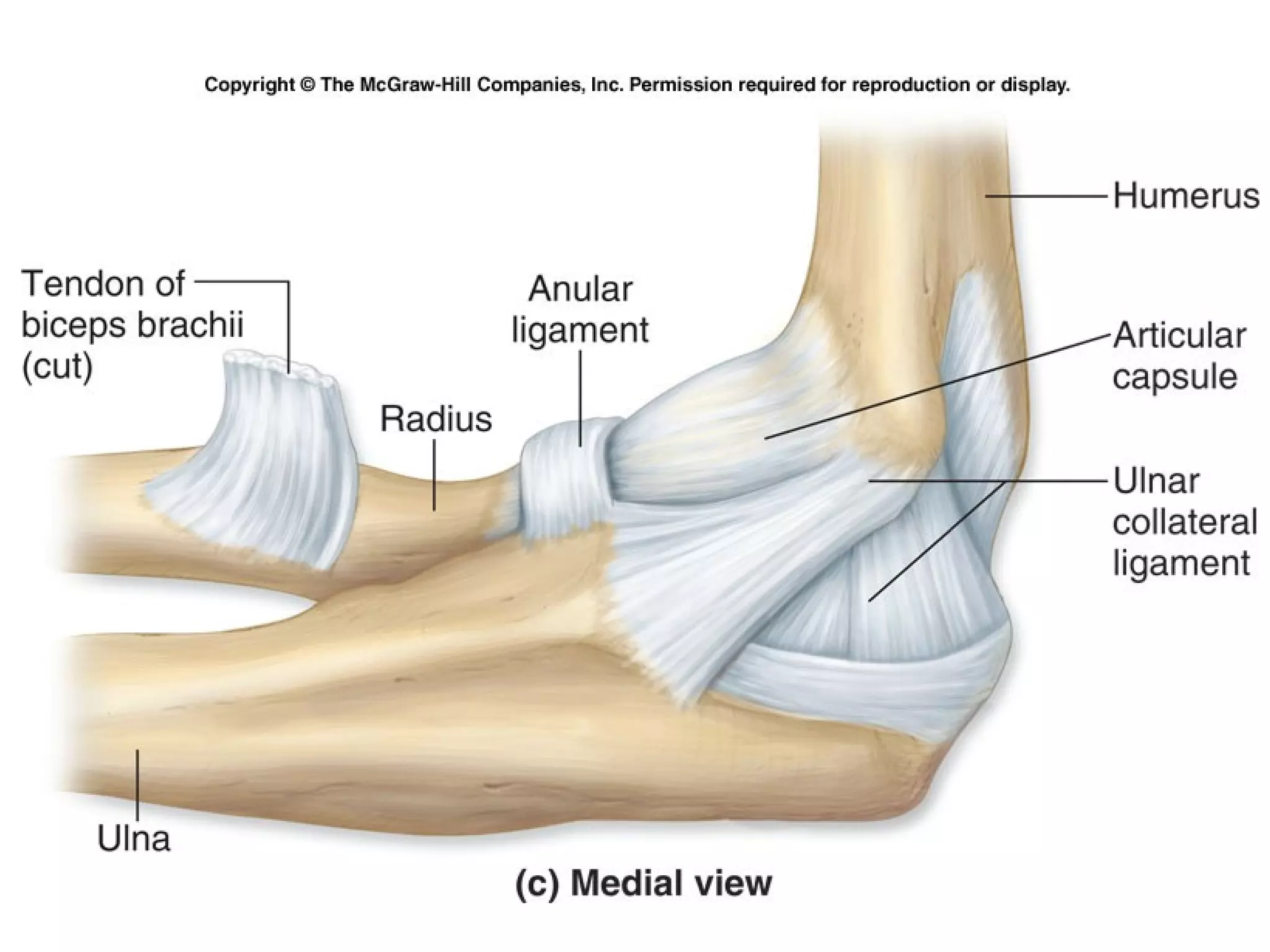
ARTICULAR CAPSULE EXAMPLE
31
32
33
34
35
9-36
Types of Synovial Joints
 Classified by the shapes of their articulating surfaces
 Types of movement they allow
 uniaxial if the bone moves in just one plane
 biaxial if the bone moves in two planes
 multiaxial (or triaxial) if the bone moves in multiple
planes
9-37
Types of Synovial Joints
 From least movable to most freely movable, the six
specific types of synovial joints are:
 Plane (gliding) joints intercarpal joint.
 hinge joints Elbow joint.
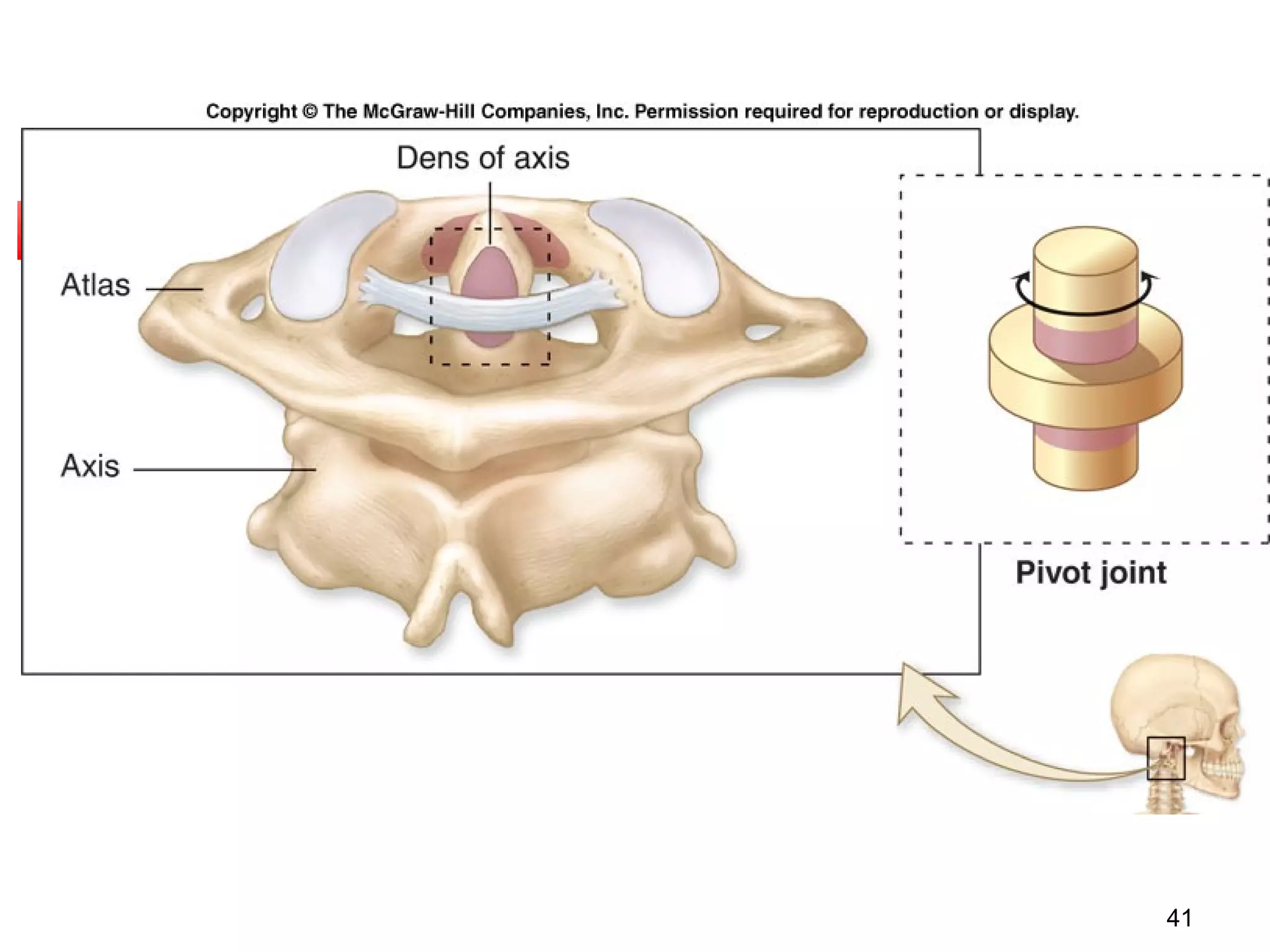
 pivot joints ,atlanto axial ,proximal radio ulnar joint
 condyloid (ellipsoid) joints , knee
joint,metacarpophalangeal joint.
 saddle joints.ankle joint,carpometacarpal joint.
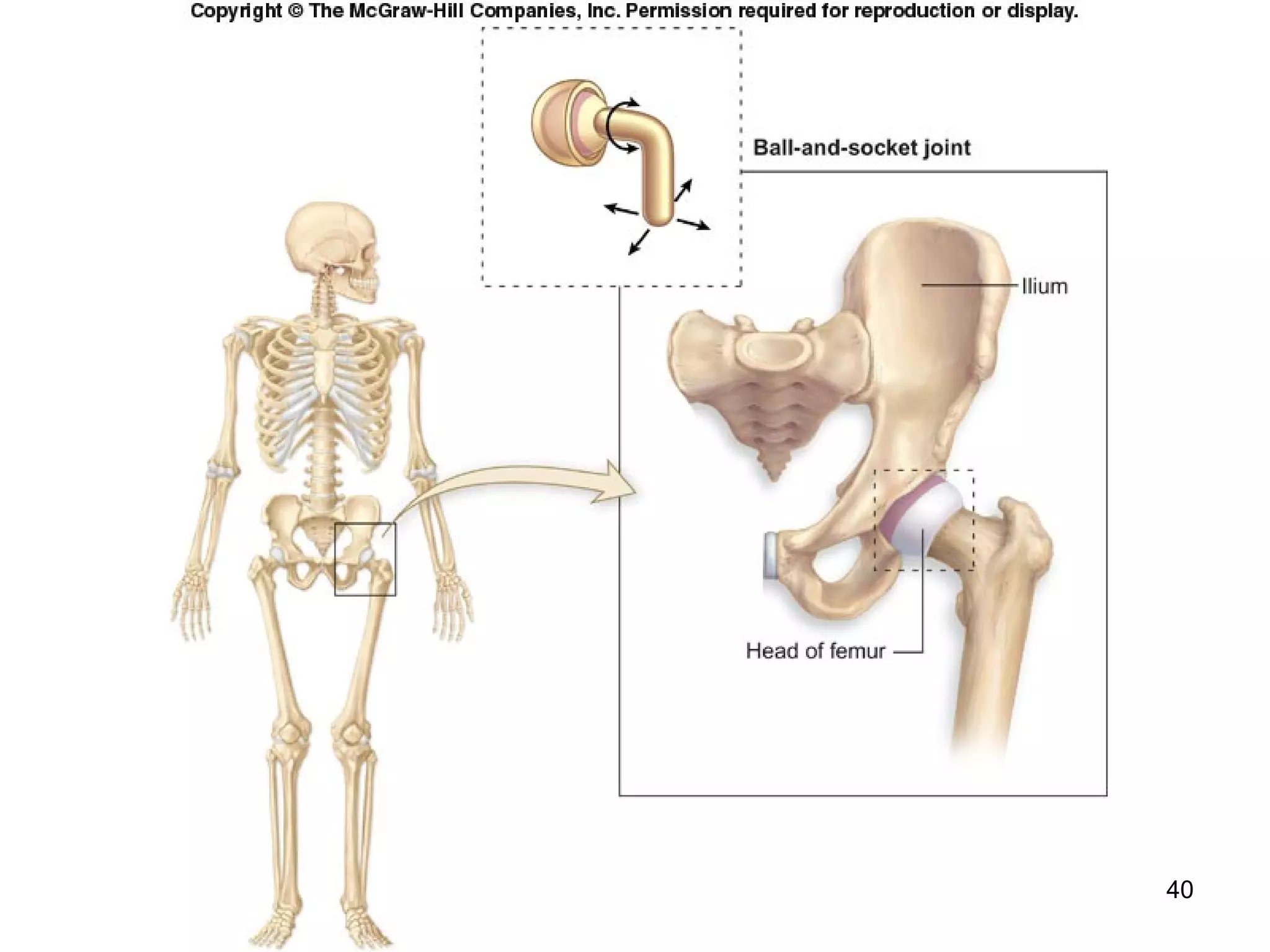
 ball-and-socket joints.shoulder joint ,hip joint.
38
39
40
41
MOVEMENTS OF THE SYNOVIAL
JOINTS
 THE MOVEMENTS PERMITTED AT A JOINT (e.g.,
SYNOVIAL) ARE OF FOLLOWING TYPES:-
 GLIDING.
 ANGULAR.
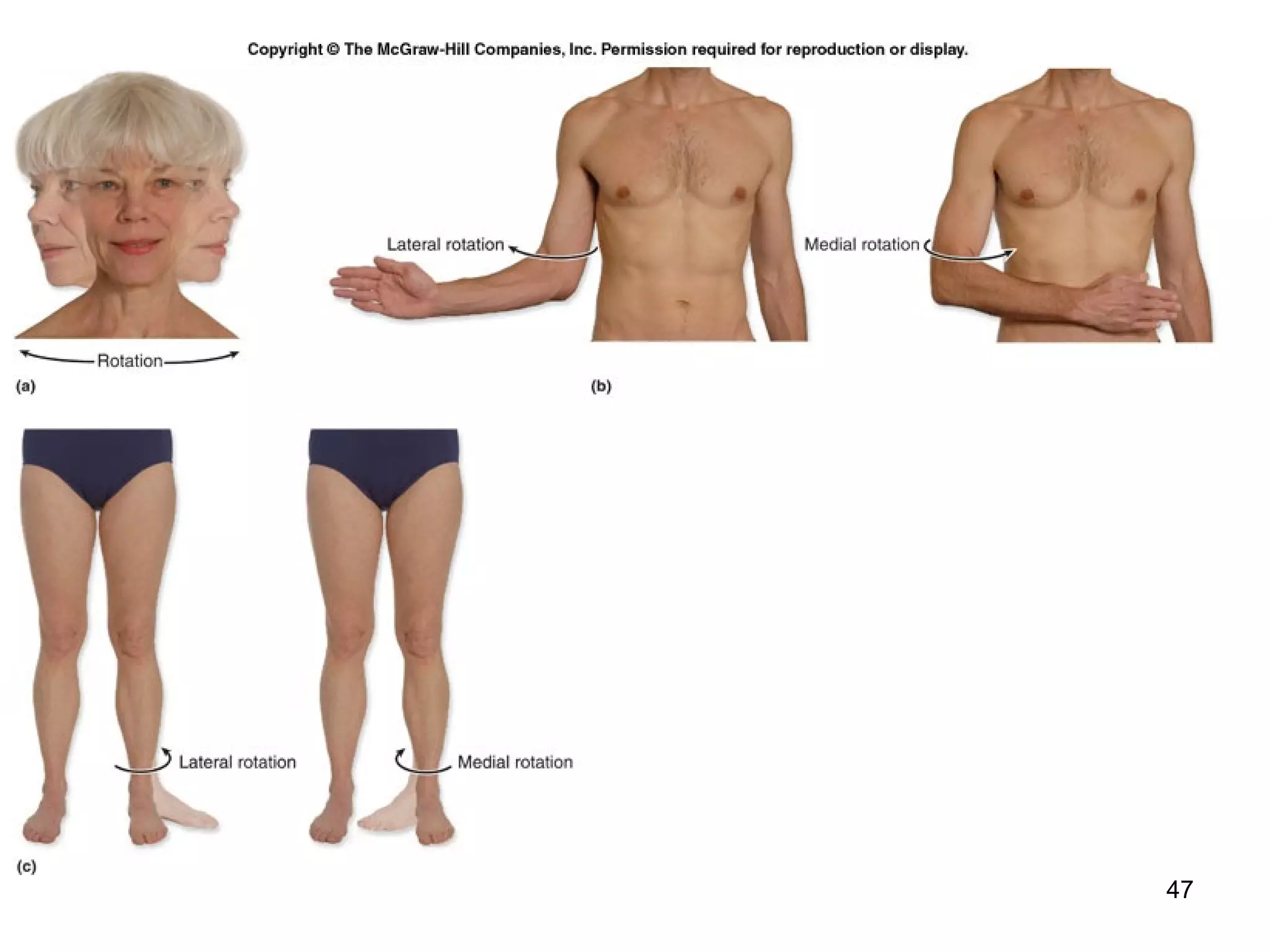
 ROTATION.
 CIRCUMDUCTION.
 MISCELLANEOUS.
 
9-42
I.GLIDING MOVEMENTS
 IT IS THE SIMPLEST KIND OF MOVEMENTS IN
WHICH ONE SURFACE CRAWLS OVER THE
OTHER WITHOUT ANY ANGULAR OR ROTATORY
MOVEMENTS.
EXAMPLES:
 INTER CARPAL JOINTS
 INTER TARSAL JOINTS (ONLY GLIDING IS
POSSIBLE)
 MANY SYNOVIAL JOINTS
9-43
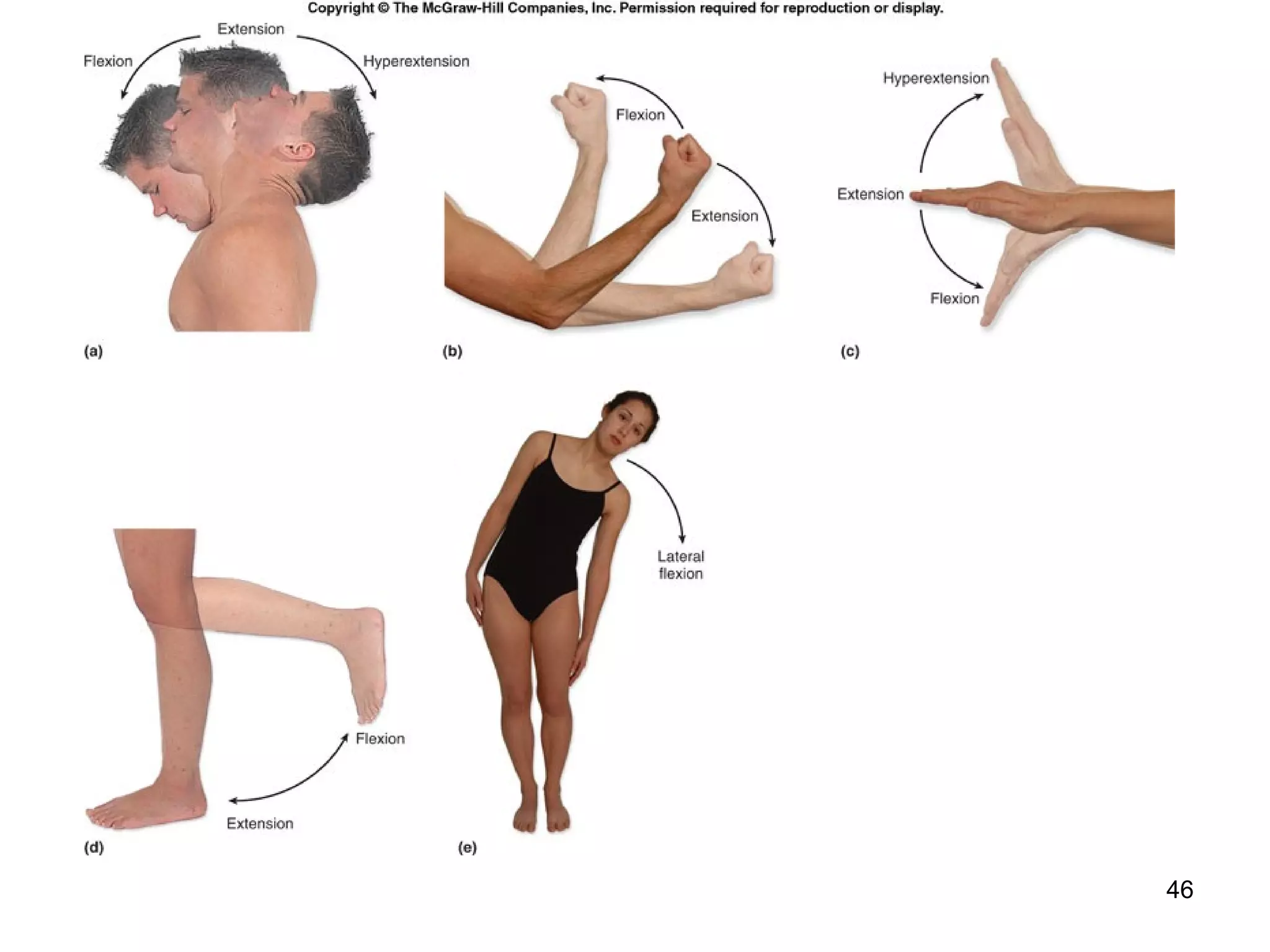
II.ANGULAR MOVEMENTS
 IT IMPLIES DECREASE OR INCREASE IN
ANGLE BETWEEN THE ADJOINING
BONES. 
 THE ANGULAR MOVEMENTS ARE OF
FOUR TYPES:
 A) FLEXION
 B) EXTENSION
 C) ADDUCTION
 D) ABDUCTION
9-44
45
46
47
48
49
50
51
52
53
54
55
56
57
58
59
60
61
9-62
Arthritis
 A group of inflammatory or degenerative
diseases of joints that occur in various forms.
 swelling of the joint
 pain
 stiffness
 Most prevalent crippling disease in the United
States.
 gouty arthritis
 osteoarthritis

rheumatoid arthritis

Joints

  • 1.
  • 2.
    6-2 Cartilage Connective Tissue Characteristics: Weaker than bone  More flexible than bone  Cells in an abundant matrix.  Cell Types  Chondroblasts  Chondrocytes in lacunae  Avascular
  • 3.
  • 4.
    6-4 3 Major Functionsof Cartilage  Supporting soft tissues.  Providing a gliding surface at articulations (joints)  Providing a model for the formation of most of the bones in the body.
  • 5.
    6-5 Types of Cartilage Three types of cartilage:  Hyaline cartilage  Most abundant kind  Has a perichondrium (membrane)  Associated with synovial joints  Most bones first modeled in hyaline cartilage  Fibrocartilage  Has collagen fibers  Intervertebral discs, pubic symphysis  Elastic cartilage  Has elastic fibers  Ear, respiratory tubing
  • 6.
  • 7.
    9-7 Articulations  A joint,or articulation, is the place of contact between bones, between bone and cartilage, or between bones and teeth.
  • 8.
    9-8 Naming of Joints Usually derived from the names of the articulating bones.
  • 9.
    9-9 Mobility and Stabilityin Joints  Motion permitted ranges from none to various extensive motions.  Structure determines both its mobility and its stability.  more mobile = less stable
  • 10.
  • 11.
    9-11 Structural Classification of Joints A fibrous joint occurs where bones are held together by dense regular (fibrous) connective tissue.  A cartilaginous joint occurs where bones are joined by cartilage.  A synovial joint  has a fluid-filled synovial cavity  bones are enclosed within a capsule  bones are joined by various ligaments
  • 12.
    9-12 Classification of Joints Functionally based on the extent of movement they permit:  Synarthrosis is an immovable joint.  Amphiarthrosis is a slightly movable joint.  Diarthrosis is a freely movable joint.
  • 13.
    9-13 Fibrous Joints  Unionis due to dense fibrous tissue.  Most are immovable or only slightly movable.  Have no joint cavity.  Three types.  Gomphosis  sutures  syndesmosis
  • 14.
  • 15.
    Sutures  Joints ofskull bone  Fixed  Affected by sutural ligaments  Sites of active bone growth  Process of obliteration of sutures is called synostosis. 9-15
  • 16.
    Gomphosis (peg & socketjoints)  Fibrous joints in which teeth fit into their sockets.  Periodontal ligament connects the tooth with socket or alveolus. 9-16
  • 17.
    Varieties of sutures. Depends on shape of articulating surfaces and mode of fusion of articulating bones.  Serrate sutures (sagittal suture).  Denticulate suture (lambdoid suture).  Squamous Plane sutures (temporo parietal suture).  Limbus suture  Plane sutures ( inter palantine suture).  Wedge and groove suture(vomero sphenoid suture) 9-17
  • 18.
    9-18 Cartilaginous Joints  Bonesare attached to each other by cartilage.  Lack a joint cavity.  Two types.  Primary cartilaginous joint or synchondrosis  Symphyses, secondary cartilaginous joints.
  • 19.
  • 20.
  • 21.
    9-21 Synovial Joints  Freelymovable articulations  Classified as diarthroses  Bones are separated by a space called a joint cavity  Most of the commonly known joints in the body  glenohumeral (shoulder) joint  temporomandibular joint  elbow joint  knee joint
  • 22.
    22 Insert Fig. 9.4Synovial Joints
  • 23.
    9-23 General Anatomy ofSynovial Joints  Basic features:  articular capsule  joint cavity  synovial fluid  articular cartilage  ligaments  nerves  blood vessels
  • 24.
    9-24 General Anatomy ofSynovial Joints – Accessory Structures  Bursae  fibrous, saclike structure that contains synovial fluid and is lined by a synovial membrane  Fatpads  often distributed along the periphery of a synovial joint  act as packing material and provide some protection for the joint  fill the spaces that form when bones move and the joint cavity changes shape  Tendons  attaches a muscle to a bone  help to stabilize joints
  • 25.
  • 26.
    STRUCTURES COMPRISING A SYNOVIALJOINT  • ARTICULAR BONY SURFACES: • THE CONTIGUOUS BONY SURFACES, WHICH ARE TAKING  PART IN THE FORMATION OF A JOINT, ARE CALLED ARTICULAR  BONY SURFACES. THESE SURFACES ARE NOT IN CONTINUITY  WITH EACH OTHER BUT ARE RATHER WELL ADAPTED TO  EACH OTHER.  • EACH BONY ARTICULAR SURFACE IS COVERED BY BLUISH- WHITE ARTICULAR-WHICH IS AVASCULAR, ANERVOUS AND  DEVOID OF PERICHONDRIUM. •  IT DERIVES ITS NUTRITION BY DIFFUSION FROM THREE  SOURCES: • SYNOVIAL FLUID. • EPIPHYSEAL VESSELS. • SYNOVIAL VESSELS (CIRCULUS VASCULOSUS ARTICULI) 26
  • 27.
  • 28.
    JOINT CAVITY (SYNOVIALCAVITY) •  EVERY SYNOVIAL JOINT HAS A  SPECIAL CAVITY LINED BY SYNOVIAL  MEMBRANE. THIS CAVITY IS NOT AN  EMPTY SPACE, BUT IS FILLED WITH A  LUBRICATING FLUID CALLED  SYNOVIAL FLUID. 28
  • 29.
    ARTICULAR CAPSULE ANDITS THICKENINGS (CAPSULAR LIGAMENTS)  • EACH JOINT IS SURROUNDED BY A TUBULAR DENSE  FIBROUS CAPSULE, WHICH IS ATTACHED TO THE ARTICULAR  LINES OF THE PARTICIPATING BONES. •   EXAMPLES – EPIPHYSEAL LINE OF HEAD OF FEMUR IS COMPLETELY  INTRACAPSULAR. – EPIPHYSEAL LINE OF LOWER END OF FEMUR IS  COMPLETELY EXTRA CAPSULAR. – EPIPHYSEAL LINE OF UPPER END PARTLY EXTRA  CAPSULAR. 29
  • 30.
    ARTICULAR CAPSULE • THE FIBROUS CAPSULE OF THE JOINT MAY BE  STRENGTHENED BY ADJACENT MUSCLES, TENDONS AND  ACCESSORY LIGAMENTS OR TRUE LIGAMENTS. •SMALL NERVES AND VESSELS ARE PIERCING THE CAPSULE.  THE SYNOVIAI MEMBRANE MAY PROTRUDE OUT OF THE  CAPSULE THROUGH HOLES AND FORM BURSAE, WHICH  REDUCE FRICTION DURING MOVEMENTS.  30
  • 31.
  • 32.
  • 33.
  • 34.
  • 35.
  • 36.
    9-36 Types of SynovialJoints  Classified by the shapes of their articulating surfaces  Types of movement they allow  uniaxial if the bone moves in just one plane  biaxial if the bone moves in two planes  multiaxial (or triaxial) if the bone moves in multiple planes
  • 37.
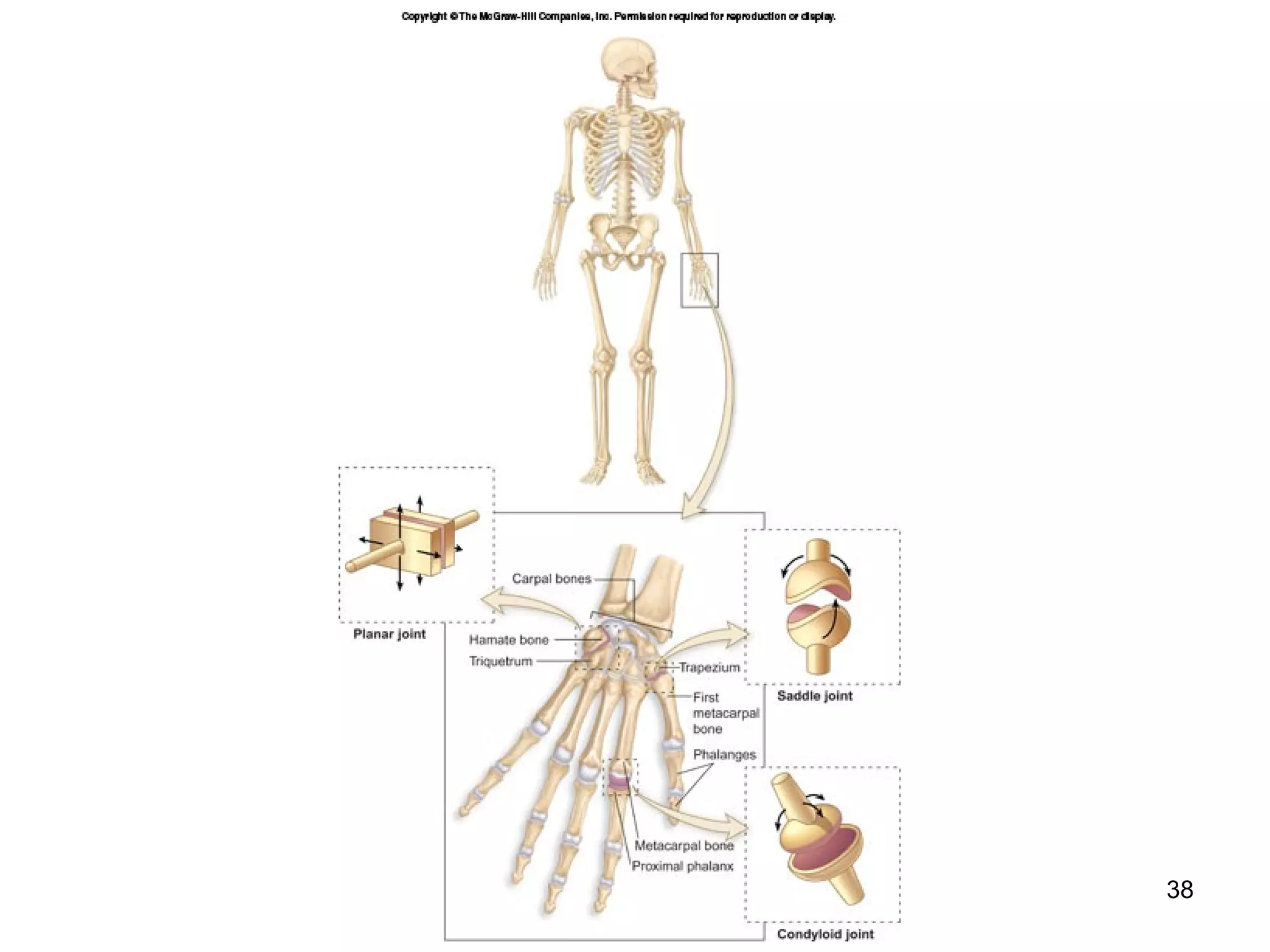
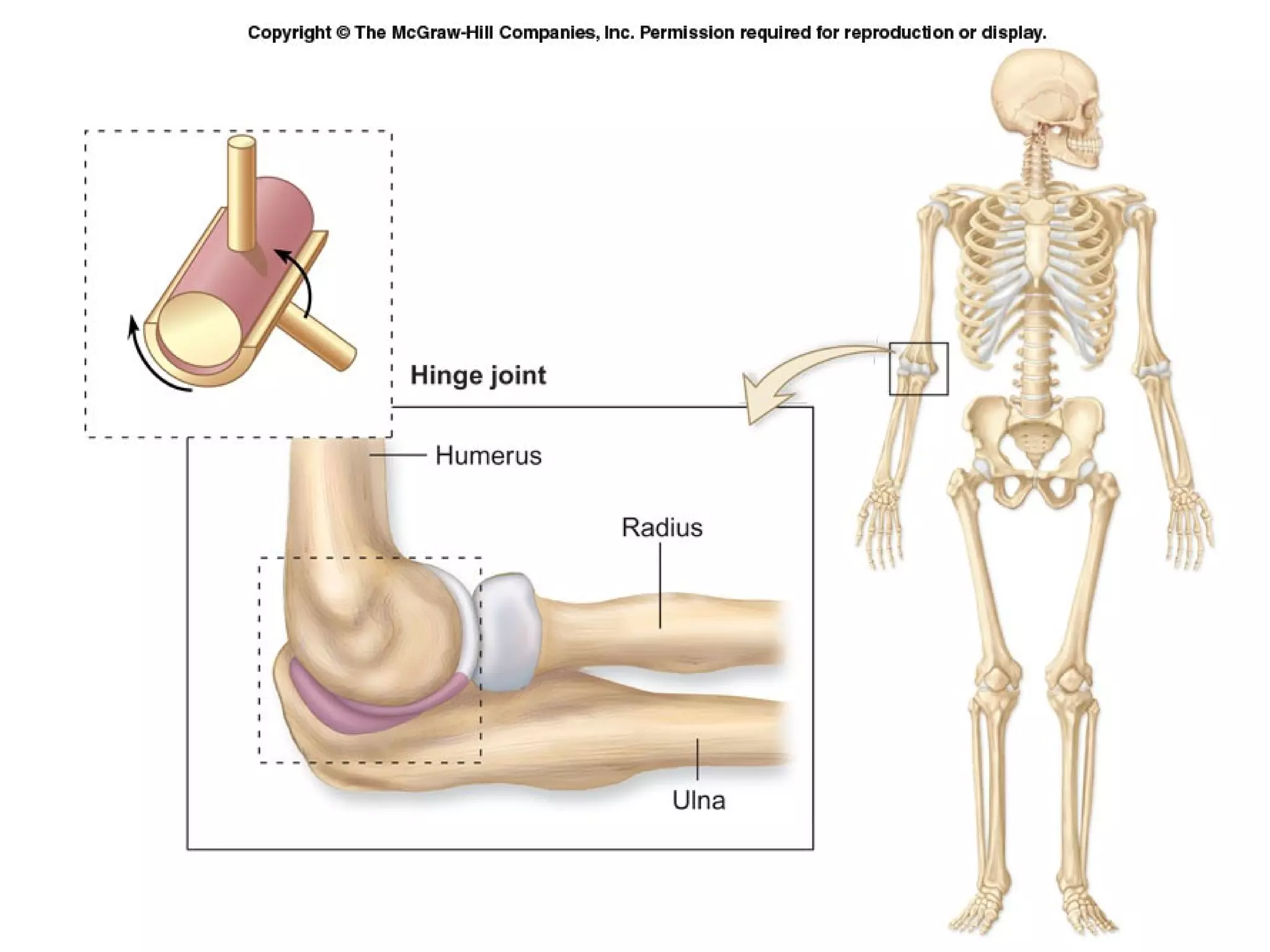
    9-37 Types of SynovialJoints  From least movable to most freely movable, the six specific types of synovial joints are:  Plane (gliding) joints intercarpal joint.  hinge joints Elbow joint.  pivot joints ,atlanto axial ,proximal radio ulnar joint  condyloid (ellipsoid) joints , knee joint,metacarpophalangeal joint.  saddle joints.ankle joint,carpometacarpal joint.  ball-and-socket joints.shoulder joint ,hip joint.
  • 38.
  • 39.
  • 40.
  • 41.
  • 42.
    MOVEMENTS OF THESYNOVIAL JOINTS  THE MOVEMENTS PERMITTED AT A JOINT (e.g., SYNOVIAL) ARE OF FOLLOWING TYPES:-  GLIDING.  ANGULAR.  ROTATION.  CIRCUMDUCTION.  MISCELLANEOUS.   9-42
  • 43.
    I.GLIDING MOVEMENTS  ITIS THE SIMPLEST KIND OF MOVEMENTS IN WHICH ONE SURFACE CRAWLS OVER THE OTHER WITHOUT ANY ANGULAR OR ROTATORY MOVEMENTS. EXAMPLES:  INTER CARPAL JOINTS  INTER TARSAL JOINTS (ONLY GLIDING IS POSSIBLE)  MANY SYNOVIAL JOINTS 9-43
  • 44.
    II.ANGULAR MOVEMENTS  ITIMPLIES DECREASE OR INCREASE IN ANGLE BETWEEN THE ADJOINING BONES.   THE ANGULAR MOVEMENTS ARE OF FOUR TYPES:  A) FLEXION  B) EXTENSION  C) ADDUCTION  D) ABDUCTION 9-44
  • 45.
  • 46.
  • 47.
  • 48.
  • 49.
  • 50.
  • 51.
  • 52.
  • 53.
  • 54.
  • 55.
  • 56.
  • 57.
  • 58.
  • 59.
  • 60.
  • 61.
  • 62.
    9-62 Arthritis  A groupof inflammatory or degenerative diseases of joints that occur in various forms.  swelling of the joint  pain  stiffness  Most prevalent crippling disease in the United States.  gouty arthritis  osteoarthritis  rheumatoid arthritis