1	
  
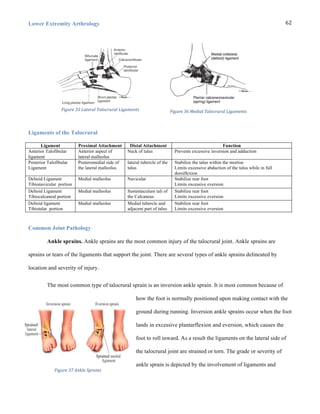
Arthrology	
  Guide	
  
of	
  the	
  Lower	
  Extremity	
  
Kylie	
  Bauman,	
  Jessie	
  Brown,	
  Sivan	
  Fogel,	
  Mariah	
  Granzella,	
  
Michael	
  Kaspin,	
  Kelsey	
  Poos-­‐Benson,	
  Megan	
  Smith,	
  Allie	
  Stone	
  
Lower Extremity Arthrology
	
  
2	
  
Table of Contents
Hip Joint Complex	
  _________________________________________________________________________________________	
  6	
  
Introduction	
  _____________________________________________________________________________________________________	
  6	
  
Muscles	
  of	
  the	
  Hip	
  Joint	
  Complex	
  ______________________________________________________________________________	
  6	
  
Symphysis Pubis Joint	
  ____________________________________________________________________________________________	
  8	
  
Overview	
  ________________________________________________________________________________________________________	
  8	
  
Tissue	
  Layers	
   ___________________________________________________________________________________________________	
  8	
  
Joint	
  Motion	
  _____________________________________________________________________________________________________	
  9	
  
Biomechanics	
  ___________________________________________________________________________________________________	
  9	
  
Joint	
  Configuration	
  ____________________________________________________________________________________________	
  10	
  
Ligaments	
  of	
  the	
  Symphysis	
  Pubis	
  ___________________________________________________________________________	
  10	
  
Common	
  Joint	
  Pathology	
  ______________________________________________________________________________________	
  11	
  
Sacroiliac Joint	
  ___________________________________________________________________________________________________	
  11	
  
Overview	
  _______________________________________________________________________________________________________	
  11	
  
Tissue	
  Layers	
   __________________________________________________________________________________________________	
  13	
  
Joint	
  Motions	
  ___________________________________________________________________________________________________	
  13	
  
Biomechanics	
  __________________________________________________________________________________________________	
  13	
  
Joint	
  Configuration	
  ____________________________________________________________________________________________	
  17	
  
Ligaments	
  of	
  the	
  Sacroiliac	
  ___________________________________________________________________________________	
  18	
  
Common	
  Joint	
  Pathology	
  ______________________________________________________________________________________	
  18	
  
Femoroacetabular Joint	
  _________________________________________________________________________________________	
  19	
  
Overview	
  _______________________________________________________________________________________________________	
  19	
  
Tissue	
  Layers	
   __________________________________________________________________________________________________	
  20	
  
Joint	
  Motions	
  ___________________________________________________________________________________________________	
  21	
  
Biomechanics	
  __________________________________________________________________________________________________	
  21	
  
Joint	
  Configuration	
  ____________________________________________________________________________________________	
  25	
  
Ligaments	
  of	
  the	
  Femoral	
  Acetabular	
  ________________________________________________________________________	
  27	
  
Common	
  Joint	
  Pathology	
  ______________________________________________________________________________________	
  28	
  
Knee Joint Complex	
  ______________________________________________________________________________________	
  30	
  
Introduction	
  ____________________________________________________________________________________________________	
  30	
  
Muscles	
  of	
  the	
  Knee	
  Joint	
  Complex	
  ___________________________________________________________________________	
  31	
  
Tibiofemoral Joint	
  _______________________________________________________________________________________________	
  32	
  
Overview	
  _______________________________________________________________________________________________________	
  32	
  
Tissue	
  Layers	
   __________________________________________________________________________________________________	
  32	
  
Joint	
  Motions	
  ___________________________________________________________________________________________________	
  34	
  
Biomechanics	
  and	
  Joint	
  Configuration	
  _______________________________________________________________________	
  34	
  
Ligaments	
  of	
  the	
  Tibiofemoral	
  ________________________________________________________________________________	
  37	
  
Common	
  Joint	
  Pathology	
  ______________________________________________________________________________________	
  38	
  
Patellofemoral Joint	
  ______________________________________________________________________________________________	
  40	
  
Overview	
  _______________________________________________________________________________________________________	
  40	
  
Tissue	
  Layers	
   __________________________________________________________________________________________________	
  41	
  
Joint	
  Motion	
  ____________________________________________________________________________________________________	
  42	
  
Biomechanics	
  __________________________________________________________________________________________________	
  42	
  
Ligaments	
  of	
  the	
  Patellofemoral	
  Joint	
  ________________________________________________________________________	
  45	
  
Common	
  Joint	
  Pathology	
  ______________________________________________________________________________________	
  45	
  
Lower Extremity Arthrology Guide 3	
  
Foot and Ankle Joint Complex	
  __________________________________________________________________________	
  48	
  
Overview	
  _______________________________________________________________________________________________________	
  48	
  
Muscles	
  of	
  the	
  Ankle	
  Joint	
  Complex	
  __________________________________________________________________________	
  49	
  
Muscles	
  of	
  the	
  Foot	
  Joint	
  Complex	
  ___________________________________________________________________________	
  50	
  
Proximal Tibiofibular Joint	
  _____________________________________________________________________________________	
  51	
  
Overview	
  _______________________________________________________________________________________________________	
  51	
  
Tissue	
  Layers	
   __________________________________________________________________________________________________	
  52	
  
Joint	
  Motion	
  ____________________________________________________________________________________________________	
  53	
  
Biomechanics	
  __________________________________________________________________________________________________	
  53	
  
Joint	
  Configuration	
  ____________________________________________________________________________________________	
  54	
  
Ligaments	
  of	
  the	
  Proximal	
  Tibiofibular	
  ______________________________________________________________________	
  55	
  
Common	
  Pathology	
  ____________________________________________________________________________________________	
  55	
  
Distal Tibiofibular joint	
  _________________________________________________________________________________________	
  56	
  
Overview	
  _______________________________________________________________________________________________________	
  56	
  
Tissue	
  Layers	
   __________________________________________________________________________________________________	
  56	
  
Joint	
  Motions	
  ___________________________________________________________________________________________________	
  57	
  
Biomechanics	
  and	
  Joint	
  Configuration	
  _______________________________________________________________________	
  57	
  
Ligaments	
  of	
  the	
  Distal	
  Tibiofibular	
  __________________________________________________________________________	
  58	
  
Common	
  Joint	
  Pathology	
  ______________________________________________________________________________________	
  58	
  
The Talocrural Joint	
  _____________________________________________________________________________________________	
  59	
  
Overview	
  _______________________________________________________________________________________________________	
  59	
  
Tissue	
  Layers	
   __________________________________________________________________________________________________	
  59	
  
Joint	
  Motions	
  ___________________________________________________________________________________________________	
  60	
  
Biomechanics	
  and	
  Joint	
  Configuration	
  _______________________________________________________________________	
  60	
  
Ligaments	
  of	
  the	
  Talocrural	
   __________________________________________________________________________________	
  62	
  
Common	
  Joint	
  Pathology	
  ______________________________________________________________________________________	
  62	
  
Subtalar Joint	
  ____________________________________________________________________________________________________	
  63	
  
Overview	
  _______________________________________________________________________________________________________	
  63	
  
Tissue	
  Layers	
   __________________________________________________________________________________________________	
  64	
  
Joint	
  Motions	
  ___________________________________________________________________________________________________	
  65	
  
Biomechanics	
  __________________________________________________________________________________________________	
  65	
  
Joint	
  Configuration	
  ____________________________________________________________________________________________	
  66	
  
Ligaments	
  of	
  the	
  Subtalar	
  _____________________________________________________________________________________	
  67	
  
Common	
  Joint	
  Pathology	
  ______________________________________________________________________________________	
  67	
  
Transverse Tarsal Joint (Calcaneocuboid Joint and Talonavicular joint)	
  __________________________________	
  69	
  
Overview	
  _______________________________________________________________________________________________________	
  69	
  
Tissue	
  Layers	
   __________________________________________________________________________________________________	
  69	
  
Joint	
  Motions	
  ___________________________________________________________________________________________________	
  70	
  
Biomechanics	
  __________________________________________________________________________________________________	
  70	
  
Joint	
  Configuration	
  ____________________________________________________________________________________________	
  72	
  
Ligaments	
  of	
  the	
  Transverse	
  tarsal	
  joint	
  (Calcaneocuboid	
  Joint	
  and	
  Talonavicular	
  joint)	
  ______________	
  73	
  
Common	
  Joint	
  Pathology	
  ______________________________________________________________________________________	
  73	
  
Cuneonavicular joint (Distal intertarsal joint)	
  ________________________________________________________________	
  74	
  
Overview	
  _______________________________________________________________________________________________________	
  74	
  
Tissue	
  Layers	
   __________________________________________________________________________________________________	
  74	
  
Joint	
  Motions	
  ___________________________________________________________________________________________________	
  75	
  
Lower Extremity Arthrology
	
  
4	
  
Biomechanics	
  __________________________________________________________________________________________________	
  75	
  
Joint	
  Configuration	
  ____________________________________________________________________________________________	
  76	
  
Ligaments	
  of	
  the	
  Cuneonavicular	
  or	
  Distal	
  Intertarsal	
  _____________________________________________________	
  77	
  
Common	
  Pathology	
  ____________________________________________________________________________________________	
  77	
  
Cuboideonavicular Joint	
  ________________________________________________________________________________________	
  78	
  
Overview	
  _______________________________________________________________________________________________________	
  78	
  
Tissue	
  Layers	
   __________________________________________________________________________________________________	
  78	
  
Joint	
  Motions	
  ___________________________________________________________________________________________________	
  79	
  
Biomechanics	
  __________________________________________________________________________________________________	
  79	
  
Joint	
  Configuration	
  ____________________________________________________________________________________________	
  80	
  
Ligaments	
  of	
  the	
  Cuboideonavicular	
  _________________________________________________________________________	
  80	
  
Common	
  Joint	
  Pathology	
  ______________________________________________________________________________________	
  80	
  
Intercuneiform and Cuneocuboid Joints	
  _______________________________________________________________________	
  80	
  
Overview	
  _______________________________________________________________________________________________________	
  80	
  
Tissue	
  Layers	
   __________________________________________________________________________________________________	
  81	
  
Joint	
  Motions	
  ___________________________________________________________________________________________________	
  82	
  
Biomechanics	
  __________________________________________________________________________________________________	
  82	
  
Joint	
  Configuration	
  ____________________________________________________________________________________________	
  82	
  
Ligaments	
  of	
  the	
  Intercuneiform	
  and	
  Cuneocuboid	
  ________________________________________________________	
  83	
  
Common	
  Joint	
  Pathology	
  ______________________________________________________________________________________	
  83	
  
Tarsometatarsal Joints	
  __________________________________________________________________________________________	
  84	
  
Overview	
  _______________________________________________________________________________________________________	
  84	
  
Tissue	
  Layers	
   __________________________________________________________________________________________________	
  85	
  
Joint	
  Motions	
  ___________________________________________________________________________________________________	
  86	
  
Biomechanics	
  __________________________________________________________________________________________________	
  86	
  
Joint	
  Configuration	
  ____________________________________________________________________________________________	
  88	
  
Ligaments	
  of	
  the	
  Tarsometatarsals	
  __________________________________________________________________________	
  89	
  
Common	
  Joint	
  Pathology	
  ______________________________________________________________________________________	
  90	
  
Intermetatarsal Joints	
  ___________________________________________________________________________________________	
  90	
  
Overview	
  _______________________________________________________________________________________________________	
  90	
  
Tissue	
  Layers	
   __________________________________________________________________________________________________	
  91	
  
Joint	
  Motions	
  ___________________________________________________________________________________________________	
  92	
  
Biomechanics	
  __________________________________________________________________________________________________	
  92	
  
Joint	
  Configuration	
  ____________________________________________________________________________________________	
  93	
  
Ligaments	
  of	
  the	
  Intermetatarsal	
  Joints	
  _____________________________________________________________________	
  93	
  
Common	
  Joint	
  Pathology	
  ______________________________________________________________________________________	
  93	
  
Metatarsophalangeal Joint (MTP joints)	
  ______________________________________________________________________	
  95	
  
Overview	
  _______________________________________________________________________________________________________	
  95	
  
Tissue	
  Layers	
   __________________________________________________________________________________________________	
  95	
  
Joint	
  Motions	
  ___________________________________________________________________________________________________	
  96	
  
Biomechanics	
  __________________________________________________________________________________________________	
  96	
  
Joint	
  Configuration	
  ____________________________________________________________________________________________	
  97	
  
Ligaments	
  of	
  the	
  Metatarsophalangeal	
  ______________________________________________________________________	
  98	
  
Common	
  Joint	
  Pathology	
  ______________________________________________________________________________________	
  98	
  
Interphalangeal Joints	
  ___________________________________________________________________________________________	
  99	
  
Overview	
  _______________________________________________________________________________________________________	
  99	
  
Lower Extremity Arthrology Guide 5	
  
Tissue	
  Layers	
   __________________________________________________________________________________________________	
  99	
  
Joint	
  Motions	
  _________________________________________________________________________________________________	
  100	
  
Biomechanics	
  ________________________________________________________________________________________________	
  100	
  
Joint	
  Configuration	
  __________________________________________________________________________________________	
  101	
  
Ligaments	
  of	
  the	
  Interphalangeals	
  _________________________________________________________________________	
  101	
  
Common	
  Pathology	
  __________________________________________________________________________________________	
  101	


Lower Extremity Arthrology
	
  
6	
  
Hip Joint Complex
Introduction
	
   The hip joint complex is the critical link between the lower extremity and the trunk. This system must
absorb and transmit enormous forces while also allowing a large arc of motion. The hip joint complex is made up
of four joints: the femoroacetabular joint, the right and left sacroiliac (SI) joints, and the pubic symphysis.
Typically, the femoroacetabular joint is referred to as the hip joint. This is the ball and socket articulation where
most of our lower extremity range of motion comes from. However; the SI joints and the pubic symphysis create
the stable ring of the pelvis and may affect how the hip can function in open and closed kinetic chain. The pelvis
is made up of two innominates created by the ileum, ischium and pubis, which are connected anteriorly at the
symphysis pubis and posterior at the right and left sacroiliac (SI) joints. The innominate bones fuse together
forming the acetabulum where the head of the femur articulates wit the pelvis. The SI joint is an articulation
between the sacrum of the spinal column and the ileum bones of the pelvis. The pubic symphysis is the
articulation between the two pubic bones of the pelvis. The common hip joint complex has three distinct
functions, it acts as attachment site for various muscles and connective tissues, supports the organs such as the
urinary bladder and intestines, and helps transmit weight from the appendicular to axial skeleton.
Muscles of the Hip Joint Complex
Category Muscle Function Origin Insertion Nerve Blood Supply
Gluteal
Region
Gluteus maximus Hip extensor
External rotator
(H)
Surface of ilium,
sacrum and coccyx
Iliotibial tract and
gluteal tuberosity
of the femur
Inferior
gluteal
(L5, S1,
S2)
Inf. & Sup. Gluteal
Gluteus medius Hip abductor
Internal rotator (H)
Surface of ilium Greater
trochanter
Superior
gluteal
Superior gluteal
Gluteus minimus Hip abductor
Internal rotator (H)
Surface of ilium Greater
trochanter
Superior
gluteal
Superior gluteal
Tensor Fascia
Latae
Med rotation,
flexion of the hip.
Abduction
Outer surface of
ilium
Iliotibial tract Superior
gluteal
Superior gluteal
Pelvic
Region
Gluteus maximus Hip extensor
External rotator
(H)
Surface of ilium,
sacrum and coccyx
Iliotibial tract and
gluteal tuberosity
of femur
Inferior
gluteal
Inf. & Sup. Gluteal
Piriformis External rotator
(H)
Sacrum Greater
trochanter
Sacral
plexus
Inf. & Sup. Gluteal
Superior gemellus External rotator
(H)
Ischial spine Greater
trochanter
Sacral
plexus
Inf. Gluteal
Lower Extremity Arthrology Guide 7	
  
Inferior gemellus External rotator
(H)
Ischial tuberosity Greater
trochanter
Sacral
plexus
Inf. Gluteal
Obturator internus External rotator
(H)
Inner surface of
obturator foramen
Greater
trochanter
Sacral
plexus
Inf. Gluteal
Obturator externus External rotator
(H)
Outer surface of
obturator foramen
Greater
trochanter
Obturator Med. circumflex
femoral & Obturator
Anterior
Thigh
Pectineus Hip Flexor
Hip Adductor
Pubic ramus Upper medial
femur
Femoral Med. Circumflex
femoral & Obturator
Sartorius Hip Flexor
Hip Abductor
External rotator
(H)
Knee extensor
Anterior superior
iliac spine
Upper medial
tibia
Femoral Femoral
Rectus femoris Hip Flexor
Hip Extensor
External rotator
(H)
Upper shaft of
femur
Patellar ligament Femoral Lateral circumflex
femoral
Vastus medialis Hip Extensor
External rotator
(H)
Upper shaft of
femur
Patellar ligament Femoral Femoral
Vastus lateralis Hip Extensor
External rotator
(H)
Upper shaft of
femur
Patellar ligament Femoral Lateral circumflex
femoral
Vastus
intermedius
Hip Extensor
External rotator
(H)
Upper shaft of
femur
Patellar ligament Femoral Lateral circumflex
femoral
Category Muscle Function Origin Insertion Nerve Blood Supply
Medial
Thigh
Gracilis Knee Flexor
Hip Adductor
Pubic ramus Upper medial
tibia
Obturator Med circumflex
femoral & obturator
Adductor magnus Hip Adductor
External rotator
(H)
Pubic ramus Posterior surface
of shaft of femur
Obturator Med circumflex
femoral & obturator
Adductor brevis Hip Adductor
External rotator
(H)
Pubic ramus Posterior surface
of shaft of femur
Obturator Med circumflex
femoral & obturator
Adductor Longus Hip Adductor
External rotator
(H)
Pubic ramus Posterior surface
of shaft of femur
Obturator Med circumflex
femoral & obturator
Posterior
Thigh
Semitendinosus Hip Extensor
Knee Flexor
Ischial tuberosity Medial condyle
of tibia
Tibial Perforating br. Of
deep femoral
Semimembranosus Hip Extensor
Knee Flexor
Ischial tuberosity Medial condyle
of tibia
Tibial Perforating br. Of
deep femoral
Long head of
biceps femoris
Hip Extensor
Knee Flexor
External rotator
(H)
Ischial tuberosity Fibular head Tibial Perforating br. Of
deep femoral
Short head of
biceps femoris
Knee Flexor
External rotator
(H)
Lateral shaft of
femur
Fibular head Fibular Perforating br. Of
deep femoral
Hamstring part of
adductor magnus
Hip Extensor Ischial Tuberosity Medial shaft of
femur (adductor
tubercle)
Tibial Perforating br. Of
deep femoral
Lower Extremity Arthrology
	
  
8	
  
Symphysis Pubis Joint
Overview
The symphysis pubis joint primarily acts as a stabilizer to allow some mobility in the pelvic ring without
compromising stability of the lower extremity and trunk. It is a
synarthrosis fibrocartilaginous joint, joined together by a fibrocartilaginous
disc; called the interpubic disc. The interpubic disc is situated between two
layers of hyaline cartilage that line the medial articular surfaces of the two
pubic bones. The joint is further reinforced by a series of ligaments and
tendinous sheaths that stabilize the symphysis pubis and prevent excessive
separation, compression, shift, or rotation from occurring.
The symphysis pubis helps to disperse force transmitted from the lower extremity up through the pelvic
ring to the axial skeleton during gait and impact activity. It is not commonly injured, but joint laxity during
pregnancy and postpartum can result in pelvic dysfunction and symphysis pubis pain. As it is not a synovial joint,
no joint capsule exists and instead the joint articulates via the interpubic disc. This joint does not act in
physiological kinematics and arthrokinematics beyond a few degrees of shift or rotation are indicative of
dysfunction and may lead to pain. Even so, the symphysis pubis is key to allowing pelvic ring pliability during
childbirth while maintaining a stable structure for large force distribution in everyday activity.
Tissue Layers
• Skin
o Epidermis
o Dermis
o Hypodermis
• Subcutaneous tissue
o Camper’s Fascia
o Scarpa’s Fascia
• Rectus Abdominis Sheath
o External Oblique mm. and aponeurosis
o Internal Oblique mm. and aponeurosis
o Transversus Abdominis mm. and aponeurosis
o Rectus abdominis mm.
o Transversalis Fascia
Figure	
  1	
  Interpubic	
  disc
Lower Extremity Arthrology Guide 9	
  
• Tendons
o Adductor Brevis
o Adductor Longus
o Pectineus
o Gracilis
o Adductor magnus
o Quadratus
o Obturator externus
• Neurovasculature
o Obturator aa. and vv.
o Inferior epigastric aa. and vv.
o Pudendal nn.
o Genital branch of genitofemoral nn.
o Iliohypogastric/ilioinguinal nn.
• Ligaments
o Superior pubic ligament
o Anterior pubic ligament
o Inferior pubic (arcuate) ligament
o Posterior pubic ligament
o Inguinal Ligament
• Bones
o Pubic Bones
• Interpubic disc
Joint Motion
Joint Motion* Primary Movers Secondary Movers
2mm Shift (inferior/superior) Gravity, ground reaction force through LE
Adductor brevis, longus, gracilis, rectus abdominis,
external oblique aponeurosis
N/A
1° Rotation Same* N/A
*Due to the stability of the pubic symphysis, no muscles act directly on it. Rather, gravity and ground reaction forces indirectly shift and
rotate its approximation as well as conjunct movement of muscles that attach here.
Biomechanics
The two pubic bones have medial hyaline cartilage-covered articulating surfaces. They articulate at
midline as reinforced by many ligaments and fibrocartilage connections. The articulating surfaces contain small
ridges to increase stability and resist shear forces. The interpubic
disc lies in between the joint surfaces providing a binding surface.
The joint is primarily subject to compression forces at its superior
border and tensile forces at its inferior border with everyday
activity of sitting and walking; especially during single limb
stance due to activity of the rectus sheath superiorly and the Figure	
  2	
  Muscular	
  reinforcement	
  of	
  pubic	
  symphysis
Lower Extremity Arthrology
	
  
10	
  
adductor tendons inferiorly as Figure 2 illustrates. The joint allows up to 2mm of translation in the sagittal plane
and 1° of rotation. The average displacement of the pubic bones in any direction (most prominently during single
limb stance) is 1-2mm higher in women who have bore children compared to both men and nulliparous women.
The joint is strongly reinforced via four ligamentous structures. According to Ibrahim & El-Sherbini in 1961, the
ligaments from strongest to weakest were anterior: inferior: superior; with no data provided on the posterior pubic
ligament. The strength of these ligaments were strongest in men, then nulliparous women, then women who had
children, and weakest in women during their third trimester of pregnancy.
Joint Configuration
According to Becker et al. the most current anatomical and arthrodial evidence reported on the symphysis
pubis is from 1990. In Becker et al.’s 2010 systematic review, they concluded that the articular surfaces of the
pubic bones are slightly convex, oval shaped and running posteroinferiorly in a craniocaudal direction.
Posteriorly the surfaces are parallel but separate anterior and superiorly. The subchondral bone begins rough and
uneven in childhood, but is relatively smooth by 30 years of age. As degenerative changes occur in late adulthood,
the subchondral bone surface roughens again by age 60.
Ligaments of the Symphysis Pubis
Ligament Attachments Function Other constraints
Superior Pubic Ligament Bilateral pubic crests as far laterally as pubic
tubercles, interpubic disc, pectineal ligament,
linea alba
Controversial but most likely
reinforcement of superior
portion of joint
Stability
Inferior Pubic Ligament
(subpubic, arcuate)
Inferior pubic rami bilaterally, interpubic disc Reinforce inferior portion of
joint
Stability
Anterior Pubic Ligament Anterior pereosteum of pubic bones bilaterally.
Interpubic disc
Reinforce anterior symphysis
pubis
Strongest ligament
of symphysis pubis.
Posterior pubic ligament A few thin fibers spanning posterior symphysis
pubis, blending with pubic rami pereosteum and
superior and inferior pubic ligaments.
Reinforce symphysis pubis
joint
Stability
Interpubic Disc
(fibrocartilaginous)
Medial articular surfaces of bilateral pubic bones,
fused with superior, inferior, anterior, posterior
pubic ligaments
Withstand compressive and
tensile stresses
Stability, maintain
pelvic ring integrity
Figure	
  3	
  Bony	
  features	
  of	
  symphysis	
  pubis
Lower Extremity Arthrology Guide 11	
  
Common Joint Pathology
Parturition-Induced Pelvic Instability. The symphysis pubis is relatively immobile and so most
pathologies related to its anatomy are due to excessive mobility. The most common pathology of the symphysis
itself is parturition-induced pelvic instability. This is excessive mobility and pain of the symphysis pubis due to
increases in relaxin and progesterone hormones during and after childbirth in women. The symphysis can widen
in women after childbirth 3-7mm and is treated conservatively with a brace to promote compression of the
symphysis, muscular strengthening to increase dynamic stability and modified activity.
Pelvic Fracture. In addition to childbirth, acute trauma can cause mass instability of the symphysis pubis.
An open book pelvic fracture is a fracture to the pelvic ring induced from an anterior to posterior compression
force. This causes the symphysis pubis to separate and open the pelvis up like a book. This fracture is often
accompanied by sacroiliac joint pain and pathology. This is a devastating injury necessitating surgery to repair
arteries and manage blood loss as well as reapproximate the symphysis pubis.
Osteitis Pubis. An additional common pathology of the symphysis pubis is osteitis pubis. This is
inflammation of the symphysis pubis due to a variety of irritants. The most common causes of osteitis pubis are
high level of athletic activity disrupting adductor tendon attachments to the pubis, childbirth disruption of the
joint, or secondary effects of urologic or gynecologic surgery.
Sacroiliac Joint
Overview
Sacroiliac (SI) joint is the articulation between the ilium and the sacrum. This joint is designed for
stability and transfer of either light loads or heavy loads. These loads are
transferred through vertebral column, lower extremities, and the ground.
The SI joint is made up of the articulation of the sacrum with the
ilium on each side. The articular surfaces are ear shaped, containing
irregular ridges and depressions. The concave sacral surface is
Figure	
  4	
  Sacroiliac	
  bony	
  structure
Lower Extremity Arthrology
	
  
12	
  
covered with thick hyaline cartilage and the convex iliac surface is lined with thin fibrocartilage. The joint
is comprised of strong and dense ligamentous structures that contribute to the SI joint being one of the
most stable joints in the body. Numerous muscles also attach to the SI joint that assist in stabilizing the
joint.
The SI joint configuration undergoes changes during aging that are related to dysfunction. In
adolescence the SI joint is mostly synovial with smooth articular surfaces. This smooth surface of the joint
in early childhood permits gliding motions in all directions. Through puberty and entering adulthood, the joint
characteristics change. The joint becomes part syndesmosis and part synovial. The articular surfaces also
change from smooth to more rough and irregular between puberty and adulthood. The irregular and rough
surface changes happen on both the articular surfaces and the subchondral bone. The joint also becomes
less mobile through the aging process. The ligaments that cover the joint become more fibrotic and less
elastic. The hyaline cartilage that covers the concave sacral surface thins and may cause adhesions to occur
between the sacrum and the ilium. Due to these changes, motion (primarily rotation) becomes minimal and
the joint becomes more mature and stable.
Anatomical features of the joint also differ with gender. The female sacrum is shorter, wider, and
more posteriorly curved than the male sacrum to provide more room for the passage of the newborn through the
birth canal during childbirth. The male sacrum is long, narrow, straighter, and has a more pronounced sacral
promontory. These differences are due to greater imposed forces on the joint in males compared to females
according to Vleeming et al. The sacroiliac ligaments in women are more elastic than men’s, allowing the
mobility necessary for childbirth.
Neurovasculature. Blood supply to the joint is derived from iliolumbar, superior gluteal, and lateral
sacral arteries. The sacroiliac joint is also well innervated. According to Forst SL; histological analysis of the
sacroiliac joint has verified the presence of nerve fibers within the joint capsule and adjoining ligaments. It has
been variously described that the sacroiliac joint receives its innervations from the ventral rami of L4 and L5, the
superior gluteal nerve, and the dorsal rami of L5, S1, and S2.
Lower Extremity Arthrology Guide 13	
  
Tissue Layers
• Integumentary
o Epidermis
o Dermis
o Hypodermis
• Superficial fascia
o Subcutaneous tissue
o Stored fat
o Loose connective tissue
o Neurovasculature
• Muscles/Fascia
o Thoracolumbar fascia
§ Posterior layer
§ Lateral raphe
§ Middle layer
§ Anterior Layer
o Erector Spinae
§ Iliocostalis
§ Longissimus
o Gluteus maximus
o Gluteus medius
o Gluteus minimus
o Piriformis
o Iliacus
o Psoas Major
• Ligaments
• Joint articular surfaces
Joint Motions
Joint Motion* Associated Muscles
Stability Biceps femoris, Gluteus maximus, Latissimus dorsi, Iliacus, Piriformis Erector spinae, Lumbar multifidi, Rectus
abdominis, Internal abdominal obliques, Transversus abdominis
Nutation Biceps femoris, Erector spinae, Rectus abdominis
Counternutation Rectus femoris, Tensor fascia latae, Adductor longus, Pectineus
* It should be noted that movement at the SI joint occurs secondarily due to movement of the innominate bones. No muscle directly acts on
the SI joint.
Biomechanics
The articular surface of the ilium is convex and the articular surface of the sacrum is slightly concave.
The SI joint permits a small amount of motion that varies among individuals. The smooth SI joint surfaces in
early childhood permit gliding motions in all directions, which is typical of a synovial plane joint. However, after
puberty, the joint surfaces change their configuration and motion in the adult is restricted to a few millimeters.
Due to the congruency of the joint, movement is described as the concave sacrum moving on the convex ilium.
Lower Extremity Arthrology
	
  
14	
  
When the movement does occur at the ilium, the movement that describes the movement at the sacrum is
described as nutation and counternutation.
These motions occur around its mediolateral
axis at the level of S2 and are limited to the
near sagittal plane. Nutation occurs as the
sacrum moves anteriorly and inferiorly while
the coccyx moves posteriorly relative to the ilium.
Nutation occurs with a posterior iliac tilt. Counternutation is simply the opposite and occurs when the sacrum
moves posteriorly and superiorly while the coccyx moves anteriorly relative to the ilium. Counternutation occurs
with anterior pelvic tilt. Ilium-on-sacral rotation, sacral-on ilium rotation, or complimentary motion of both can
accomplish nutation and counternutation. These motions help transfer the forces between the axial skeleton and
lower extremities.
During gait, the SI joint is very important as it is the location for force transmission from the trunk to the
ground and from the ground to the trunk. In order for the forces to be transferred efficiently the joint has to be
stable. Stability of the joint comes from strong, fibrous ligaments, the irregular articular surfaces of the ilium and
sacrum, and muscular stabilizers. Stability of the SIJs is extremely important because these joints must support a
large portion of the body weight. In normal erect posture, the weight of head, arms, and trunk (HAT) is
transmitted through the fifth lumbar vertebra and lumbosacral disk to the first sacral segment. The joint must
support significantly more than the weight of the body if an individual is lifting or carrying weighted objects
As noted earlier the SI joint is very stable joint with minimal movement. The movement that does occur
at the joint is very important for stress relief during walking, running, and during childbirth in women. During
walking, the pelvis rotates from side to side as the lower extremity changes from a position of flexion to
extension. In normal gait with typical speed, the heel of advancing lower limb strikes the ground as the toes of the
opposite limb are still in contact with the support. It is this point in gait that the ligaments and muscles at the hips
create oppositely directed torsions on the right and left iliac crests. Torsions are most notable in sagittal and
Figure	
  5	
  Nutation	
  and	
  Counternutation	
  of	
  SI	
  joint
Lower Extremity Arthrology Guide 15	
  
horizontal plane. If the SI joint was a solid and continues structure, the SI joint would not be able to dissipate
damaging stress and the pelvic ring would be damaged with everyday activity.
Gravity is the first line of stability for the SI joint. In an upright position the bodies center of mass is just
anterior to S2, which is the midpoint between an imaginary line connecting the two SI joints The downward force
of gravity that is a result from the body weight passing through the vertebra forces the trunk downwards on the
sacrum while the joint transfers weight from the lower extremity to the spine. This creates a nutation moment
about the joint. At the same time, ground reaction forces act on the femoral head, causing an upward directed
compression force through the acetabulum. This forces the ilium to rotate posteriorly. The nutation moment
created by gravity and the ground reaction force causing the ilium to rotate posteriorly creates a locking
mechanism. This locking mechanism relies primarily on gravity and congruity of the joint surfaces rather than the
extra-articular structures such as ligaments and muscles.
Ligaments also provide stability to the joint as the ligaments
of the sacrum are some of the strongest and toughest ligaments in the
body that are difficult to tear, stretch, and mobilize. The primary
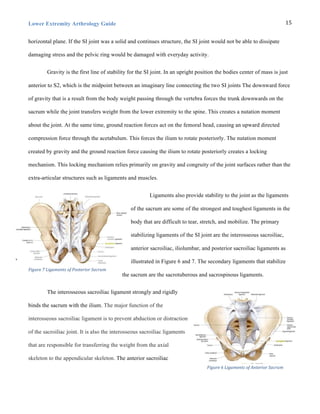
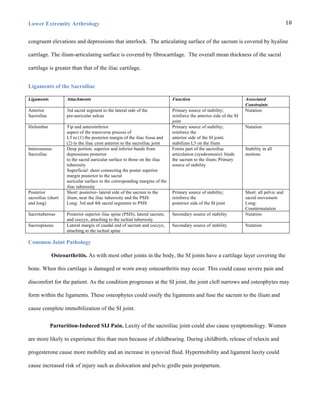
stabilizing ligaments of the SI joint are the interosseous sacroiliac,
anterior sacroiliac, iliolumbar, and posterior sacroiliac ligaments as
illustrated in Figure 6 and 7. The secondary ligaments that stabilize
the sacrum are the sacrotuberous and sacrospinous ligaments.
The interosseous sacroiliac ligament strongly and rigidly
binds the sacrum with the ilium. The major function of the
interosseous sacroiliac ligament is to prevent abduction or distraction
of the sacroiliac joint. It is also the interosseous sacroiliac ligaments
that are responsible for transferring the weight from the axial
skeleton to the appendicular skeleton. The anterior sacroiliac
Figure	
  7	
  Ligaments	
  of	
  Posterior	
  Sacrum
Figure	
  6	
  Ligaments	
  of	
  Anterior	
  Sacrum
Lower Extremity Arthrology
	
  
16	
  
ligaments are thin anterior parts of the fibrous capsule of the synovial part of the joint. Iliolumbar ligaments blend
in with the anterior sacrospinous ligaments and radiate from transverse processes of L5 vertebra to the ilia.
Posterior sacroiliac ligaments connect the PSIS with the lateral crests of the third and fourth segments of the
sacrum and are very strong and tough. The short band of the posterior sacroiliac ligament also provides stability
against all movements. Due to the posterior sacroiliac and interosseous sacroiliac ligaments running obliquely
upward and outward from the sacrum, the axial weight pushing downward on the sacrum forces the ilia medially.
This causes the sacrum to be compressed between the ilia and locks the irregular but congruent surfaces of the
sacroiliac joints together. Iliolumbar ligaments act as accessory ligaments and assist in this mechanism.
Sacrotuberous and sacrospinous ligaments offer secondary support posteriorly. They do not actually cross the
joint, but they indirectly assist stabilization by resisting nutation.
Stability is adequate for activities that involve relatively low static loading such as sitting and standing.
For larger more dynamic loading, the SI joint is reinforced by ligaments and muscles. Nutation torque stretches
many of the connective tissues at the SI joint. Increased tension in these ligaments further compresses the surface
of the SI joint and thereby adds to their transarticular stability.
In addition to ligaments, several hip and trunk muscles reinforce and stabilize the sacroiliac joints. Such
muscles are erector spinae, lumbar multifidi, rectus abdominis, obliques abdominis internus and externus,
transversus abdominis, gluteus maximus, latissimus dorsi, iliacus and piriformis. These muscles stabilize the SI
joint by (1) generating active compressive forces against the articular surfaces, (2) increasing magnitude of
nutation torque and subsequently engaging the active locking mechanism, and (3) pulling on connective tissues
that reinforce the joints. As an example, let's consider erector spinae and bicep femoris. Erector spinae muscle
will rotate the sacrum anteriorly and biceps femoris will rotate the ileum posteriorly and thus both of these actions
create nutation. It is then safe to assume that anterior tilt of the pelvis will create counternutation. The muscles
that create anterior tilt at the pelvis could create counternutation at the sacrum. Some of these muscles include
iliopsoas, rectus femoris, tensor fascia latae, adductor longus, and pectineus.
Lower Extremity Arthrology Guide 17	
  
Mechanical stability of the SI joint is provided by thoracolumbar fascia. Thoracolumbar fascia consists of
three different layers that surround the posterior muscles of the lower back. Those layers are anterior, middle, and
posterior. The anterior and middle layers are anchored medially to the transverse processes of the lumbar
vertebrae and inferiorly to the iliac crest. The posterior layer covers the posterior surface of the erector spinae and
latissimus dorsi muscle. The posterior layer attaches to the spinous processes of lumbar vertebrae, the sacrum, and
the ilium, adding stability to the SI joint. Posterior layer stability to the joint is provided by erector spinae muscle
creating a nutation torque by rotating the sacrum anteriorly and thus locking the joint and stabilizing it. Medial
and posterior layers of thoracolumbar fascia fuse at their lateral margins and thus blend with internal oblique and
transversus abdominis musculature. The internal oblique and transversus abdominis muscles compress the ilia
toward the sacrum, increasing joint stability. Stability is further enhanced by the superficial attachments of
latissimus dorsi and gluteus maximus to thoracolumbar fascia resulting in an increased compression of the SI
joint. The iliacus and piriformis muscles provide secondary stability at the SIJ articulation by attaching directly to
the capsule or margins of the SI joint.
Pregnancy plays a large role in SI joint biomechanics in women. The release of relaxin during pregnancy
decreases the intrinsic strength and rigidity of collagen. The action of relaxin is responsible for the softening of
the ligaments supporting the SI joint and the symphysis pubis. This causes the joint to become more mobile, less
stable and increase the size of pelvic outlet during childbirth. There is less resistance to these hormonal-induced
changes due to the smoother articular surfaces of the SI joints of women being pregnant.
Joint Configuration
The SI joint is the articulation between the auricular surface of the sacrum and the ilium. SI joint is
formed within sacral segments S1, S2 and S3. As mentioned previously the articular surface of the ilium is
convex and faces anteriorly and inferiorly. The articulating surface of the sacrum is concave and faces more
posterior and inferiorly compared to the ilium. The articulating surfaces on the sacrum are C-shaped and are
located on the sides of the fused sacral vertebrae lateral to the sacral foramina. The SI joint consists of an anterior
synovial joint and a posterior syndesmosis. The articular surfaces of this synovial joint have irregular but
Lower Extremity Arthrology
	
  
18	
  
congruent elevations and depressions that interlock. The articulating surface of the sacrum is covered by hyaline
cartilage. The ilium-articulating surface is covered by fibrocartilage. The overall mean thickness of the sacral
cartilage is greater than that of the iliac cartilage.
Ligaments of the Sacroiliac
Ligaments Attachments Function Associated
Constraints
Anterior
Sacroiliac
3rd sacral segment to the lateral side of the
pre-auricular sulcus
Primary source of stability;
reinforce the anterior side of the SI
joint
Nutation
Iliolumbar Tip and anteroinferior
aspect of the transverse process of
L5 to (1) the posterior margin of the iliac fossa and
(2) to the iliac crest anterior to the sacroiliac joint
Primary source of stability;
reinforce the
anterior side of the SI joint;
stabilizes L5 on the ilium
Nutation
Interosseous
Sacroiliac
Deep portion: superior and inferior bands from
depressions posterior
to the sacral auricular surface to those on the iliac
tuberosity
Superficial: sheet connecting the poster superior
margin posterior to the sacral
auricular surface to the corresponding margins of the
iliac tuberosity
Forms part of the sacroiliac
articulation (syndesmosis): binds
the sacrum to the ilium; Primary
source of stability
Stability in all
motions
Posterior
sacroiliac (short
and long)
Short: posterior- lateral side of the sacrum to the
ilium, near the iliac tuberosity and the PSIS
Long: 3rd and 4th sacral segments to PSIS
Primary source of stability;
reinforce the
posterior side of the SI joint
Short: all pelvic and
sacral movement
Long:
Counternutation
Sacrotuberous Posterior superior iliac spine (PSIS), lateral sacrum,
and coccyx, attaching to the ischial tuberosity
Secondary source of stability Nutation
Sacrospinous Lateral margin of caudal end of sacrum and coccyx,
attaching to the ischial spine
Secondary source of stability Nutation
Common Joint Pathology
Osteoarthritis. As with most other joints in the body, the SI joints have a cartilage layer covering the
bone. When this cartilage is damaged or worn away osteoarthritis may occur. This could cause severe pain and
discomfort for the patient. As the condition progresses at the SI joint, the joint cleft narrows and osteophytes may
form within the ligaments. These osteophytes could ossify the ligaments and fuse the sacrum to the ilium and
cause complete immobilization of the SI joint.
Parturition-Induced SIJ Pain. Laxity of the sacroiliac joint could also cause symptomology. Women
are more likely to experience this than men because of childbearing. During childbirth, release of relaxin and
progesterone cause more mobility and an increase in synovial fluid. Hypermobility and ligament laxity could
cause increased risk of injury such as dislocation and pelvic girdle pain postpartum.
Lower Extremity Arthrology Guide 19	
  
Ankylosing spondylitis. Ankylosing spondylitis is an inflammatory condition of the joints, especially in
the spinal column. Inflammation within joints can lead to severe pain and discomfort. In very severe cases the
inflammation can induce fibrosis and cause the bones to fuse, resulting in massive restrictions to mobility. Typical
patient complaints are persistent low back pain and stiffness that is worse in the morning and night, but improves
with activity. Patients often complain of unilateral or alternating buttock pain. Also, patients tend to complain of
pain during the second half of sleep only. Differential diagnosis for ankylosing spondylitis include stress fracture,
muscle spasm, lumbar disk herniation, osteoarthritis, gout, cancer, infection, and rheumatoid arthritis. The disease
most commonly presents in young males, ages 15-30 years old.
Femoroacetabular Joint
Overview
The femoroacetabular (FA) joint, more commonly known as the hip joint is a ball and socket joint and is
created with an articulation between the femoral head and the socket of the
acetabulum on the pelvis with three degrees of freedom. Three bones of the pelvis;
the ischium, ilium, and pubis form the acetabulum. The femur is the longest and
strongest bone in the body. The femoral head projects medially and slightly
anteriorly for an articulation with the acetabulum. The femoral head is secured
within the acetabulum by an extensive set of connective tissues and muscles. Thick
layers of articular cartilage, muscle, and cancellous bone in the proximal femur help reduce the large forces that
cross the joint. The hip is required to operate in both open and close kinetic chain and so stability is very
important at this joint. The stability to the joint mostly comes from the joint configuration as well as the
ligamentous design. Muscles also contribute to joint stability as the joint must
withstand high loads during activity such as running, jumping, and walking.
Neurovasculature. The femoroacetabular joint receives its blood supply
from the artery to the head of the femur, but the primary blood supply to the joint
Figure	
  8	
  Femoroacetabular	
  
Joint	
  Surfaces
Figure	
  9	
  Bones	
  of	
  Acetabulum
Lower Extremity Arthrology
	
  
20	
  
comes from the medial and lateral circumflex femoral arteries, which come off the deep femoral artery. The joint
is also highly innervated as the sacral and lumbar plexus are close in proximity to it and provide numerous
innervating branches. The joint gets innervations from femoral nerve (anteriorly), obturator nerve (inferiorly),
nerve to quadratus femoris (posterior), and the superior gluteal nerve (superior).
Tissue Layers
• Integumentary
o Epidermis
o Dermis
o Hypodermis
• Subcutaneous tissue
o Fascia lata
o Subcutaneous adipose tissue
• Muscle
o Anterior compartment
§ Pectineus
§ Iliopsoas
§ Rectus femoris
§ Sartorius
o Medial compartment
§ Adductor longus
§ Adductor brevis
§ Adductor magnus
§ Gracilis
§ Obturator externus
o Posterior compartment
§ Semitendinosus
§ Semimembranosus
§ Biceps femoris (long head)
o Gluteal region
§ Gluteus maximus
§ Gluteus medius
§ Gluteus minimus
§ Tensor fasciae latae
§ Piriformis
§ Obturator internus
§ Superior gemellus
§ Inferior gemellus
§ Quadratus femoris
• Ligaments and joint capsule
• Joint articular surfaces and deep ligaments


Lower Extremity Arthrology Guide 21	
  
Joint Motions
Biomechanics
Since the hip is a ball and socket joint, it is capable of a variety of motions in different planes. The
femoral head is convex and the acetabular socket is concave. The hip joint is capable of working in both open
chain and closed chain positions. In open chain, the femur tends to move on the pelvis in order to create motion.
Since the femur is moving on the pelvis, the convex is moving on the concave, the roll and glide of the femoral
head are in opposite directions. The hip has 120 degrees of flexion in the sagittal plane when the femur spins
around the mediolateral axis. In the frontal plane of open chain movement, the hip has about 40 degrees of
abduction and 25 degrees beyond the neutral line of adduction around the anteroposterior axis. The femur will roll
superior and glide inferior for abduction
and will roll inferior and glide superior for
adduction. In the sagittal plane, the hip also
has 20 degrees of extension with the femur
spinning around the mediolateral axis.
Finally, in the transverse plane, the femur
Joint
Motion
Primary Movers Secondary Movers
Flexion Iliopsoas, Sartorius, Tensor fasciae latae, Rectus
femoris, Adductor longus, Pectineus
Adductor brevis, Gracilis, Gluteus minimus (anterior fibers)
Extension Gluteus maximus, Biceps femoris (long head),
Semitendinosus, Semimembranosus, Adductor magnus
(posterior head)
Gluteus medius (posterior fibers), Adductor magnus (anterior
head)
Abduction Gluteus medius, Gluteus minimus, Tensor fasciae latae Piriformis, Sartorius
Adduction Pectineus, Adductor longus, Gracilis, Adductor brevis,
Adductor magnus
Biceps femoris (long head), Gluteus maximus (lower fibers),
Quadratus femoris
Internal
rotation
NA Gluteus minimus (anterior fibers), Gluteus medius (anterior
fibers), Tensor fasciae latae, Adductor longus, Adductor
brevis, Pectineus
External
rotation
Gluteus maximus, Piriformis, Obturator internus,
Superior gemellus, Inferior gemellus, Quadratus
femoris
Gluteus medius (posterior fibers), Gluteus minimus (posterior
fibers), Obturator externus, Sartorius, Biceps femoris (long
head)
Figure	
  10	
  Muscle	
  Actions	
  at	
  Sacroiliac	
  Joint
Lower Extremity Arthrology
	
  
22	
  
can rotate internally about 35 degrees and externally about 45 degrees around the long axis of the femur. During
external rotation, the femoral head rolls posteriorly and glides anteriorly and during internal rotation the femoral
head rolls anterior and glides posterior. In closed chain, the arthrokinematics flip as the roll and glide of the
acetabulum on the femur are in the same direction because the concave surface is moving on the convex surface.
The pelvis may also move in all three planes around all three axes, although the motions have different
names, and there is a smaller range available. In the frontal plane in closed chain, the pelvis can abduct away from
the femur about 30 degrees and adduct toward the femur about 20 degrees from neutral around the anteroposterior
axis. In closed chain, a superior roll and glide creates abduction, while an inferior roll and glide creates adduction.
In the sagittal plane, the pelvis is capable of anteriorly tilting 30 degrees, and posteriorly tilting 15 degrees by
spinning around the mediolateral axis. Finally, in the horizontal plane, the pelvis can internally and externally
rotate about 15 degrees in each direction, with a total arc of 30 degrees of motion around the transverse axis.
During internal rotation, the acetabulum must anteriorly roll and glide. The opposite is true to create external
rotation
The FA joint has very complex biomechanics. Motion that occurs at the hip joint occurs either in open
chain or in closed chain. In open chain the femur moves on the acetabulum, but in closed chain the acetabulum
moves on the femur. Let's take hip flexion for example, we can take our thigh into flexion while keeping the
pelvis stable, this constitutes as open chain. Closed chain hip flexion would occur when the trunk moves into
flexion while keeping the lower limb stable. When considering movement done on a stable pelvis, we must
consider lumbopelvic rhythm due to the close relationship between the hip and the lumbar spine. The movement
that occurs is in the sagittal plane and is considered to be either ipsidirectional lumbopelvic rhythm or
contradirectional rhythm. Ipsidirectional lumbopelvic rhythm describes a movement in which the lumbar spine
and pelvis rotate in the same direction amplifying overall trunk motion. An example of this motion would be
reaching down to pick something from the ground. Contradirectional rhythm describes a movement in which the
lumbar spine and pelvis rotate in opposite direction. This type of movement is important as it allows for
separation of the pelvis and lumbar spine during activities where the head and neck need to maintain neutral
Lower Extremity Arthrology Guide 23	
  
position. Other motions that occur in closed chain are anterior and posterior pelvic movements. Pelvic tilting is
defined based on the position of the anterior superior iliac spine (ASIS) of the pelvis. When the ASIS moves
anterior and inferior, it is considered an anterior pelvic tilt and results in hip flexion. When the ASIS moves
posterior and superior, it is considered a posterior pelvic tilt and results in hip extension.
Since the hip is a ball and socket joint there is three degrees of freedom and thus mobility will be
influenced by muscular activation. We will first discuss hip flexion of the joint. Iliopsoas, sartorius, tensor fascia
latae, rectus femoris, adductor longus, and pectineus are all considered to be primary hip flexors in an open chain
position. The main hip flexor muscles out of these would have to be iliopsoas due to its large size, line of pull,
and cross-sectional area. The iliopsoas tendon averts posteriorly to its distal attachment. In full hip extension, this
increases the tendon's angle of insertion creating an optimal line of pull. The secondary hip flexors (adductor
brevis, gracilis, and the anterior fibers of gluteus minimus) do not have direct lines of pull into hip flexion, but
they can produce some force in that direction. Additionally, any muscle that is considered a hip flexor in the open
chain position can also produce an anterior pelvic tilt in closed chain. An anterior pelvic tilt is also achieved by
force coupling that occurs between the hip flexors and back extensors on a fixed femur.
In the open chain position, gluteus maximus, the hamstrings (biceps femoris (long head), semitendinosus,
and semimembranosus), and the posterior head of the adductor magnus are considered to be primary hip
extensors. Gluteus maximus is considered to be the primary hip extensor due to its large cross sectional area, line
of pull, and moment arm. Adductor magnus (posterior part) is also considered to be a primary mover due to its
large moment arm. It is at 70 degrees at hip flexion and beyond that most adductors (exception to pectineus) are
capable of assisting with hip extension. The hamstring group is also primary mover due to the line of pull and
large moment arm. All three of those muscles are considered to be the primary movers for hip extension. The
posterior fibers of the gluteus medius and the anterior head of the adductor magnus are secondary movers into hip
extension. Neither one of these muscles has a great line of pull into extension from the anatomical position.
Additionally, the posterior fibers of gluteus medius do not have as much cross sectional area as the other hip
extensor muscles. Similar to the hip flexors, the hip extensors in open chain are all capable of producing a
Lower Extremity Arthrology
	
  
24	
  
posterior pelvic tilt in closed chain. A force couple between the abdominal muscles and the hip extensors creates
this motion. Additionally, the hip extensors are responsible for eccentrically controlling a forward lean of the
body. The primary extensor muscle group that is responsible for this is the hamstrings. As the body leans forward
the displacement of body weight moves farther in front of the hips requiring a greater activation from the
hamstrings. This is because the moment arm of the gluteus maximus is decreased as the hip flexes, but the
moment arm of the hamstrings is increased.
The primary movers into hip adduction are pectineus, adductor longus, gracilis, adductor brevis, and
adductor magnus. The adductors also are able to work in all three planes; not just the frontal plane. This largely
has to do with their distal attachment not being located precisely in midline. The biceps femoris (long head),
gluteus maximus (lower fibers), and quadratus femoris are all considered to be secondary movers into adduction
because some of their fibers have a line of pull in this direction so they can produce some amount of force into
adduction. Adductors also assist in internal rotation of the hip joint.
The primary hip abductors are the gluteus medius, gluteus minimus, and tensor fasciae latae. The
secondary abductors of the hip joint are considered to be the piriformis and sartorius. Gluteus medius is
considered the main hip abductor. The distal attachment of gluteus medius causes it to have the largest moment
arm of all the other abductors. Gluteus medius also has the largest cross sectional area out of all the other
abductors making it the primary mover in abduction. Gluteus minimus occupies 20% of the total abductor
moment. Tensor fasciae latae occupies 11% of total abductor moment. The hip abductors also contribute to hip
internal rotation. The abductor torque produced by the hip abductor muscles is essential to the control of the
frontal plane pelvic-on-femoral kinematics during walking. During the
stance phase the hip is stabilized over the relative fixed femur by the hip
abductors. The hip abductors also play a crucial role during the single-limb
support phase of gait. Without adequate torque on the stance limb, the
pelvis and the trunk may drop toward the side of the swinging limb. The
Figure	
  11	
  Trendelenburg	
  Sign
Lower Extremity Arthrology Guide 25	
  
observation of a contralateral hip drop during gait is known as a Trendelenburg gait pattern, and is due to lack of
strength or control of the abductor muscles.
External rotation of the hip is done by gluteus maximus, piriformis, obturator internus, superior gemellus,
inferior gemellus, and quadratus femoris. Gluteus maximus has the largest cross-sectional area and so is
considered the primary external rotator of the hip. The others have fairly small cross-sectional areas but have a
direct line of pull and they provide stability to the posterior aspect of the joint. The gluteus medius (posterior
fibers), gluteus minimus (posterior fibers), obturator externus, sartorius, and biceps femoris (long head) are all
secondary movers into external rotation, due to their indirect lines of pull. Hip external rotators are most
functional during closed chain movements such as cutting, pivoting, and changing direction very rapidly. The
external rotators can also function in open chain movements. Open chain external rotation of the hip will rotate
the foot so the toes point more laterally and the heel is more medial.
The last motion produced by the hip is internal rotation. There are no primary internal rotators of the hip.
This is due to the need of muscles to be oriented in a horizontal plane of motion during standing and that does not
occur. There are many secondary hip internal rotators, though. Secondary movers are gluteus minimus (anterior
fibers), gluteus medius (anterior fibers), tensor fasciae latae, adductor longus, adductor brevis, and pectineus. As
the hip moves from 0 degrees to 90 degrees of flexion, the line of pull and moment arm of many of these muscles
becomes more optimally oriented to create internal rotation at the hip. As the hip moves into 90 degrees of
flexion, some external rotators change their action and assist with internal rotation.
Joint Configuration
During weight bearing the hip must translate immense loads; its closed kinetic chain kinematics help it
provide stability. To promote congruency and stability the acetabular socket of the hip joint is fairly deep. The
acetabular labrum also helps promote stability as it deepens the socket of the joint by an additional 30%. The
labrum also forms a seal around the joint to maintain negative intra-articular pressure and thus create suction that
prevents distraction of the joint. The seal also holds the synovial fluid within the joint and enhances the
Lower Extremity Arthrology
	
  
26	
  
lubrication of the joint and its ability to dissipate load. The acetabulum and the femoral head also have thick
layers of articular cartilage to prevent wear and tear of the joint surfaces.
The bony anatomy of the hip is somewhat variable and may affect how the
joint can function. Two measurements of the femur are considered: the angle of
inclination and femoral torsion. The angle of inclination occurs in the frontal plane
between an axis through the femoral head and neck and the longitudinal axis of the
femoral shaft. At birth, the angle of inclination is about 140 to 150 degrees. Due to loading across the femoral
neck, the angle reduces to 125 degrees near adulthood. When the angle of inclination varies greatly from typical,
it is referred to either as coxa vara or coxa valga. When the angle is less than 125 degrees it is described as coxa
vara and can lead to genu valgum at the knee. An angle greater than 125 degrees is considered to be coxa valga
and can lead to genu varum at the knee. These varying conditions of the angle of inclination are illustrated in
Figure 12. Femoral torsion occurs in the transverse plane between an axis through the femoral head and neck and
an axis through the distal femoral condyles. At birth, the healthy infant is born with about 40 degrees of femoral
torsion. By age 16 this angle decreases due to bone growth, muscular activity, and weight bearing. Typically, the
femoral head sits 15 degrees anterior to the mediolateral axis, running through the femoral condyles. This is
known as normal anteversion. Any rotation greater than 15 degrees
anterior to the mediolateral axis is described as excessive
anteversion, and is associated with in toeing at the foot.
Conversely, an femoral torsion less than 15 degrees is described as
retroversion and is associated with toe-out at the foot.
Measurements at the acetabulum should also be noted. There are
two commonly used measurements to describe the extent to which the acetabulum covers and secures the femoral
head: center-edge angle and acetabular anteversion angle. The center-edge angle describes the position of the
acetabulum and the amount of coverage it provides over the femoral head. A normal center-edge angle is
approximately 35 degrees. Any significant decrease in this angle will decrease the coverage of the femoral head,
Figure	
  13	
  Angle	
  of	
  Inclination
Figure	
  12	
  Femoral	
  Torsion
Lower Extremity Arthrology Guide 27	
  
and therefore predispose the hip to dislocations. The acetabular anteversion angle measures the extent to which
the acetabulum projects anteriorly in relation to the pelvis. Normally, acetabular anteversion is about 20 degrees.
When a hip demonstrates excessive acetabular anteversion, the anterior portion of the femoral head is exposed.
When the angle is severe, the hip is more prone to dislocation and labral lesions. The open packed position of the
hip joint is in 30 degrees of flexion, 30 degrees of abduction, and slight external rotation. The closed packed
position is with the hip in full extension, combined with slight external rotation and abduction.
The hip also has a variety of ligaments that attach to restrain certain movements and help keep the joint
stable. The primary ligaments of the joint are iliofemoral, pubofemoral, and ischiofemoral ligaments. All three of
these ligaments blend with the joint capsule and are taut in extension. Out of the three, the iliofemoral ligament is
the strongest. In standing posture, the femoral head moves anteriorly and pushes against the iliofemoral ligament.
Iliofemoral ligament is also taut in external rotation. The pubofemoral ligament is taut in hip abduction and
external rotation. The ischiofemoral ligament is the opposite, and is taut in hip adduction and internal rotation.
Knowledge of these ligaments is useful therapeutically during attempts to stretch the entirely of the hip capsule.
With full hip extension, combined with slight internal rotation and abduction, twists most of the ligaments into
their taut position and so this is called closed packed position. The opposite of this position would be to the open
packed position of the hip joint is in 30 degrees of flexion, 30 degrees of abduction, and slight external rotation.
The ligamentum teres and transverse acetabular ligament also stabilize the hip. The ligamentum teres runs from
the head of the femur directly to the acetabular fossa, which helps to maintain the alignment of the femoral head
in the fossa. The transverse acetabular ligament completes the acetabular ring, reinforcing the inferior aspect of
the joint.
Ligaments of the Femoral Acetabular
Ligaments Attachments Function Associated constraints of the joint
Iliofemoral Anterior inferior iliac spine,
intertrochanteric line of the femur
Reinforces the joint capsule Limits extension of the femur
Ischiofemoral Ischium posterior to the acetabulum,
greater trochanter, iliofemoral
ligament
Reinforces the joint Assists iliofemoral ligament in limiting
extension of the femur
Pubofemoral Iliopubic eminence,
superior pubic ramus, fibrous joint
capsule
Reinforces the joint capsule Limits abduction of the femur
Lower Extremity Arthrology
	
  
28	
  
Ligamentum
teres
Fovea of the femoral head,
acetabular notch
Attaches the femoral head to
the acetabular fossa
Prevents distraction/dislocation of the femoral
head from the acetabulum
Transverse
acetabular
Margins of the acetabular notch Completes the inferior part of
the acetabulum
Resists caudal translation of the femoral head
Common Joint Pathology
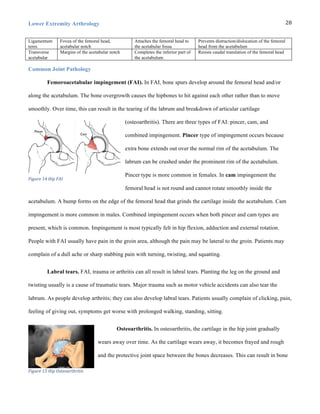
Femoroacetabular impingement (FAI). In FAI, bone spurs develop around the femoral head and/or
along the acetabulum. The bone overgrowth causes the hipbones to hit against each other rather than to move
smoothly. Over time, this can result in the tearing of the labrum and breakdown of articular cartilage
(osteoarthritis). There are three types of FAI: pincer, cam, and
combined impingement. Pincer type of impingement occurs because
extra bone extends out over the normal rim of the acetabulum. The
labrum can be crushed under the prominent rim of the acetabulum.
Pincer type is more common in females. In cam impingement the
femoral head is not round and cannot rotate smoothly inside the
acetabulum. A bump forms on the edge of the femoral head that grinds the cartilage inside the acetabulum. Cam
impingement is more common in males. Combined impingement occurs when both pincer and cam types are
present, which is common. Impingement is most typically felt in hip flexion, adduction and external rotation.
People with FAI usually have pain in the groin area, although the pain may be lateral to the groin. Patients may
complain of a dull ache or sharp stabbing pain with turning, twisting, and squatting.
Labral tears. FAI, trauma or arthritis can all result in labral tears. Planting the leg on the ground and
twisting usually is a cause of traumatic tears. Major trauma such as motor vehicle accidents can also tear the
labrum. As people develop arthritis; they can also develop labral tears. Patients usually complain of clicking, pain,
feeling of giving out, symptoms get worse with prolonged walking, standing, sitting.
Osteoarthritis. In osteoarthritis, the cartilage in the hip joint gradually
wears away over time. As the cartilage wears away, it becomes frayed and rough
and the protective joint space between the bones decreases. This can result in bone
Figure	
  14	
  Hip	
  FAI
Figure	
  15	
  Hip	
  Osteoarthritis
Lower Extremity Arthrology Guide 29	
  
rubbing on bone. To make up for the lost cartilage, the damaged bones may start to grow outward and form bone
spurs (osteophytes). Osteoarthritis develops slowly and the pain worsens over time and is most common in people
over the age of 50, though younger people are affected by it also. The most common symptom of hip
osteoarthritis is pain around the hip joint. Usually pain has a slow onset, but it may have a sudden onset. Pain and
stiffness may be worse in the morning or after sitting for a long period of time. Over time, painful symptoms may
occur more frequently including during rest or at night. Patients with OA can also present with limited range of
motion especially into internal rotation and flexion.
Hip fractures. Fractures are a very serious and common issue in the United States. The most common
mechanisms of injury for hip fractures are falls and collisions. The older population is more affected by this and
unfortunately the incidence may continue to rise due to the increased life expectancy. The patient with a hip
fracture will have pain over the outer upper thigh or in the groin. There will be significant discomfort with any
attempt to flex or rotate the hip. Fractures are usually treated with surgery. The type of surgery used to treat a hip
fracture is primarily based on the bones and soft tissues affected or on the level of the fracture. Approximately
40% of those with a hip fracture are able to perform their daily functioning needs however; about half will
continue to use an assisted device for walking.
Lower Extremity Arthrology
	
  
30	
  
Knee Joint Complex
Introduction
The knee joint is formed by articulations between the patella, femur and tibia (Figure 16). The knee is the
largest joint and the most frequently injured joint in the body.
The tibiofemoral portion of the knee joint is a hinge type
synovial joint. It is the most complex diarthrosis of the body.
The knee primary motions include flexion and extension with
some external and internal rotation. The knee is overall
mechanically referred to as a weak joint. The stability and
strength of this joint is fully dependent on the strength of the
muscles and tendons surrounding joint entirety, as well as the
ligaments connecting the tibia and the femur.
The knee has up to 14 bursae of various sizes in and around the knee joint complex. Bursae help provide
an extra amount of friction control for the joint to move fluidly. Bursae around the patella include the prepatellar
bursa, the superficial and deep infrapatellar bursae, and the suprapatellar bursa. Bursae of the complex that are not
in close anatomical proximity to the patella include the pes anserine bursa, the iliotibial bursa, the tibial and
fibular collateral ligament bursae and the gastrocnemius-semimembranosus bursa. These fluid filled sacs cushion
the joint and reduce friction between muscles, bones, tendons and ligaments.
The knee is important biomechanically during walking. In the stance phase, the knee is slightly flexed.
This allows shock absorption, energy conservation, and transmission of forces to the lower limb. In swing phase,
the knee is flexed in order to shorten the functional length of the lower limb, which helps the foot clear the
ground. Gait has functional requirements of both stability and mobility for the knee to allow proper energy-
efficient and safe propulsion over ground.
Figure	
  16	
  Knee	
  Joint	
  Articulations
Lower Extremity Arthrology Guide 31	
  
Muscles of the Knee Joint Complex
Muscles Proximal attachment Distal attachment Action Segmental
Innervation
Peripheral
innervation
Sartorius anterior superior iliac
spine
medial aspect of the proximal
tibia
flexes and assists internal
rotation of the knee
(L2-3 [4]) Femoral nerve
Rectus
femoris
anterior inferior iliac spine
and groove superior to the
acetabulum
the base of the patella extends knee (L2-3-4) Femoral nerve
Vastus
intermedius
anterior aspect of the
proximal 2/3rds of the
femoral shaft
lateral border of the patella
actions- extends knee
Extends knee (L2-3-4) Femoral nerve
Vastus
lateralis
Intertrochanteric line,
greater trochanter, gluteal
tuberosity and linea aspera
Base and lateral border of the
patella
Extends knee (L2-3-4) Femoral nerve
Vastus
medialis
Intertrochanteric line,
spiral line, linea aspera
and medial supracondylar
line
Base and medial border of the
patella
Extends knee (L2-3-4) Femoral nerve
Tensor
fasciae latae
ASIS & external lip iliac
crest
iliotibial tract assists in maintaining
knee extension
(L4-5-S1) Superior
gluteal nerve
Gracilis body of the pubis &
inferior pubic ramus
medial surface of tibia, distal
to condyle, proximal
to insertion of semitendinosus,
lateral to insertion of sartorius
flexes & medially rotates
the knee
(L2-3-4) Obturator
nerve
Biceps
femoris
ischial tuberosity &
sacrotuberous lig. (long
head) ; lateral lip of linea
aspera & lateral
supracondylar line (short
head)
lateral side of fibular head Both heads: Flex knee
Long Head: Extends hip
Long head:
(L5-S1-2-3)
Short head:
(L5-S1-2)
Long head:
tibial branch of
sciatic nerve
Short head:
Fibular branch
of sciatic nerve
Semimembr
anosus
Posterior aspect of the
medial tibial condyle
posterior aspect of the medial
tibial condyle
Ischial tuberosity (L4-5-S1-2) Tibial division
of the sciatic
Semitendin
osus
ischial tuberosity proximal, medial tibia flexes & medially rotates
knee
(L4-5-S1-2) Tibial division
of the sciatic
Gastrocnem
ius
posterior aspect of the
condyles and joint capsule
Posterior calcaneal surface flexes knee (S1-2) Tibial nerve
Popliteus lateral femoral condyle
and oblique popliteal
ligament
Soleal line of the tibia In NWB, IR of tibia and
knee flexion; in WB
insertion is fixed:
ER of femur and knee
flexion; unlocks the knee
from extension into early
flexion
(L4-5-S1) Tibial nerve
Articularis
Genu
Distal anterior shaft of
femur
Proximal portion of synovial
membrane of knee joint
Pulls articular capsule
proximally
(L2-3-4) Femoral
Lower Extremity Arthrology
	
  
32	
  
Tibiofemoral Joint
Overview
The tibiofemoral joint is formed by the condyles of the femur and the tibial plateau. The joint is a
modified hinge joint with two degrees of freedom. The primary motion is flexion and extension in the sagittal
plane. Some internal and external rotation can occur with slight flexion of the knee. The quadriceps femoris is
considered to be the most important muscle for stabilization of the tibiofemoral joint. The knee is considered
most stable in a fully extended position. This is the position where the femur’s contact on the tibia, is most
congruent and the ligaments associated with the tibiofemoral joint are the most taut. In this position, many of the
tendons surrounding the joint act as supporting structures as well.
Neurovasculature. There are 10 vessels that come together to form the periarticular genicular
anastomoses around the knee to supply blood to the knee joint. These 10 vessels include: genicular branches of
the femoral, popliteal, and anterior and posterior recurrent branches of the anterior tibial recurrent and circumflex
fibular arteries. Other supporting features of the tibiofemoral joint including the joint capsule, the cruciate
ligaments, the outer portions of the menisci, and the synovial membrane are supplied by the middle genicular
branches of the popliteal artery. The tibiofemoral is innervated by all the nerves supplying the muscles that cross
the knee joint. Branches from the femoral nerve innervate the anterior aspect of the knee. The tibial nerve supplies
the posterior aspect, and the common fibular nerve innervates the lateral aspect. Articular branches from both the
obturator and saphenous nerves supply the medial aspect of the knee.
Tissue Layers
• Skin
o Epidermis
o Dermis
o Hypodermis
• Superficial fascia (fascia lata)
o Subcutaneous tissue
• Deep fascia
• Muscles and tendons
o Quadriceps femoris
§ Rectus femoris
§ Vastus lateralis
§ Vastus medialis
§ Vastus intermediate
Lower Extremity Arthrology Guide 33	
  
o Hamstrings
§ Biceps femoris
§ Semimembranosus
§ Semitendinosus
o Gracilis
o Sartorius
o Gastrocnemius
o Popliteus
o Iliotibial band
• Vascular supply
o Popliteal artery
o Descending genicular
o Anterior tibial recurrent artery
o Posterior tibial recurrent artery
o Circumflex fibular artery
o Inferior medial genicular artery
o Inferior lateral genicular artery
o Middle genicular artery
o Superior medial genicular artery
o Superior lateral genicular artery
• Innervation
o Obturator
o Femoral
o Tibial
o Common fibular
o Saphenous
o Nerve to the popliteus
o Nerve to gastrocnemius
• Ligaments
o Medial collateral ligament
o Lateral collateral ligament
o Oblique popliteal ligament
o Arcuate popliteal ligament
o Coronary ligament
o Transverse ligament of the knee
o Meniscofemoral ligament
• Fibrous joint capsule
o Synovial membrane
o Ligaments
§ Anterior cruciate ligament
§ Posterior cruciate ligament
o Menisci
§ Medial menisci
§ Lateral menisci
o Bursa
§ Prepatellar bursa
§ Suprapatellar bursa
§ Superficial infrapatellar bursa
§ Deep infrapatellar bursa
§ Semimembranosus bursa
§ Pes anserine bursa
Lower Extremity Arthrology
	
  
34	
  
o Plicae
§ Suprapatellar plica
§ Infrapatellar plica
§ Medial plica
o Fat pads
§ Infrapatellar fad pad
o Synovial fluid
o Articular cartilage
Joint Motions
Motion Primary Movers Secondary Movers Degrees Possible
Knee
flexion
Hamstrings (semitendinosus, semimembranosus,
long head of the biceps); short head of the biceps
Gracilis, sartorius,
gastrocnemius, popliteus
135 degrees
Knee
extension
Quadriceps femoris Weakly: tensor of fascia
lata
0 degrees, hyperextension may be
available up to 10-15 degrees
Knee
external
rotation
Biceps femoris when the knee is in a flexed
position
NA 40 degrees; may be difficult to
establish neutral rotation
Knee
internal
rotation
Semitendinosus and semimembranosus when knee
is flexed; popliteus when non-weight bearing and
with the knee extended
Gracilis, sartorius 30 degrees; may be difficult to
establish neutral rotation
Biomechanics and Joint Configuration
The tibiofemoral joint primary motions are flexion and extension; which occur about the mediolateral axis
of rotation. The range of motion of the knee is 130 to 150 degrees of knee flexion and 5 to 10 degrees of knee
extension beyond neutral position. External and internal rotation of the knee occurs about a longitudinal axis of
rotation. These rotations increase with knee flexion. At 90 degrees of knee flexion, the knee can rotate internally
about 30 degrees and externally at about 45 degrees. Beyond 90 degrees of flexion, rotation decreases due to
limitations by soft tissues.
An important concept, which helps with the stability of the knee, is the screw home mechanism. During
the last portion of active range of motion into extension a rotation between the tibia and the femur occurs. This
rotation produces the screw home mechanism, or “locking” of the knee. The rotation happens during the last 30
degrees of knee extension. Anterior tibial glide persists on the tibia's medial condyle because its articular surface
is longer in that dimension than the lateral condyle. Prolonged anterior glide on the medial side produces external
Lower Extremity Arthrology Guide 35	
  
tibial rotation. There are three factors that affect the rotation mechanism; the shape of the medial femoral condyle,
the passive tension of the anterior cruciate ligament, and the lateral pull of the quadriceps muscle. This rotation is
not under voluntary control. This helps the knee’s stability for standing upright. The screw-home mechanism
decreases the work of the quadriceps femoris muscle. The muscle can relax once the knee joint is fully extended.
To unlock the extended knee, the joint internally rotates first. The popliteal muscle rotates the femur externally or
rotates the tibia internally to initiate flexion from a fully extended starting position.
The distal femoral condyles create a convex surface and the proximal tibial plateau creates concave
surface. The tibial condyles slide posteriorly on the femoral condyles during flexion, and slide anteriorly during
extension. In unloaded movement, open chain, the concave surface will glide in the same direction of the rotation.
In loaded movement, closed chain, the convex surface will glide in the opposite direction of the rotation.
The medial meniscus has an oval shape (Figure 17) and it
attaches to the deep layer of the medial collateral ligament and
capsule. The lateral meniscus has circular shape and it attaches only
to adjacent capsule. The quadriceps and semimembranosus attach to
both menisci and the popliteus attaches only to the lateral meniscus.
These muscles help to stabilize the menisci.
Neurovasculature supply of the menisci is greatest at the
external borders, while the internal border has no blood and nerve supply. The menisci are designed to absorb
shock, therefore, they reduce the compressive stress across the joint. During walking the compressive forces at the
joint reach 2.5-3x the body weight and increase to 4x the body weight with stair climbing. The menisci help to
reduce the pressure on the articular cartilage by increasing the contact area, which protects the knee joint. In
addition, it also increases stability of the knee by deepening the tibial plateaus, decreasing friction by 20%, and
increasing contact area by 70%. Increasing the contact area helps to disperse force over a greater surface area, and
decrease the total force experienced by any one point in the joint. The menisci serve a vital role in maintaining the
integrity and functionality of the tibiofemoral joint.
Figure	
  17	
  Tibial	
  Plateau	
  Anatomy
Lower Extremity Arthrology
	
  
36	
  
The ligaments that surround the knee are
important in stabilizing the knee. The cruciate
ligaments also guide the knee in natural
arthrokinematics by creating tension, and contribute to
the proprioception of the knee. The anterior cruciate
ligament (ACL) runs from posterior femur to anterior
side of the tibia (Figure 18). Its tension changes as the
knee flexes and extends. The anteromedial bundle is taut in
flexion and the posterolateral bundle is taut in extension. It is mainly taut as the knee reaches to full extension.
The posterior cruciate ligament (PCL) runs from the posterior intercondylar area of the tibia to the lateral side of
the medial femoral condyle (Figure 18). Most fibers of this ligament become taught with increasing knee flexion.
Tension peaks between 90 and 120 degrees of knee flexion. The primary role of the collateral ligaments is to limit
excessive motion of the knee in the frontal plane. The ligaments also play a role in
providing resistance to extreme external and internal rotation of the knee. The
medial collateral ligament (MCL) is a flat, broad ligament (Figure 19). It had two
layers, superficial and deep, the run from the femur to the tibia and the medial
meniscus. The superficial fibers blend with the medial patellar retinaculum fibers.
The deep fibers attach to the posterior-medial joint capsule, medial meniscus, and
tendon of the semimembranosus muscle.
The MCL resists valgus force. Since the
deeper fibers are shorter, they are more commonly injured than the
superficial fibers during excessive valgus trauma. The lateral collateral
ligament (LCL) is a round ligament that runs from the lateral epicondyle
of the femur and the head of the fibula (Figure 20). The LCL does not
attach to the lateral meniscus. It resists varus force.
Figure	
  18	
  Ligamentous	
  Contribution	
  to	
  Knee
Figure	
  19	
  Medial	
  Collateral	
  
Ligaments
Figure	
  20	
  Lateral	
  Collateral	
  Ligament
Lower Extremity Arthrology Guide 37	
  
The knee has a crucial role during gait. During heel contact, the knee is in 5 degrees of flexion and it
continues to flex to 15 or 20 degrees during loading response. The quadriceps eccentrically control this flexion.
This helps with weight acceptance as the weight of the body shifts to the lower extremity. After slight flexion, the
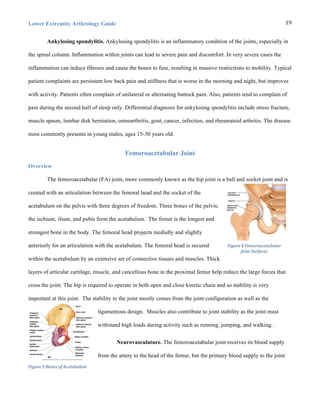
knee extends until heel off. The knee then begins to flex again to 35 degrees during toe off. By mid swing knee
flexion reaches a maximum knee flexion of 60 degrees. This knee flexion is to shorten the length of the lower
limb and assist toe clearance. In mid and terminal swing the knee extends again. During gait, the knee requires
range of motion from full knee extension to 60 degrees of knee flexion. Gait impairments are noted when a lack
of knee range is available. A lack of knee flexion and extension will impair toe clearance and functional length.
Ligaments of the Tibiofemoral
Ligament Proximal attachment Distal attachment Function
Anterior cruciate ligament
(ACL)
posterior femur anterior side of the tibia Resist extension
Resist extremes of varus, valgus,
and axial rotation
Posterior cruciate ligament
(PCL)
anteroinferior femur posterior side of the tibia Resist knee flexion
Resist extremes of varus, valgus,
and axial rotation
Lateral collateral Ligament
(LCL)
Femur Fibula resist varus resist knee extension
resist extremes of axial rotation
Medial collateral ligament
(MCL)
Femur
*Two layers (deep and superficial)
Tibia and the medial meniscus Resist valgus
Resist knee extension
Resists extremes of axial rotation
Oblique popliteal ligament Tendon of the Semimembranosus Posterior lateral condyle of the
femur
Stabilizes the posterior aspect of
the knee joint
Limits external rotation of the
tibia
Transverse ligament of the
knee
Anterior edge of menisci crosses anterior intercondylar
area
holds menisci together during
knee movement
Coronary ligament of the
knee
Inferior edges of the medial lateral menisci to the joint
capsule of the knee
limiting rotation of the knee
stabilizes medial and lateral
menisci
Arcuate popliteal ligament Posterior fibular head posterior surface of the knee reinforces posterior lateral joint
capsule
Meniscofemoral ligament:
1. Anterior
2. Posterior
Posterior horn of the lateral meniscus
Extends from the posterior horn of
lateral meniscus
Distal edge of the femoral
PCL
Medial femoral condyle
Stabilizes the lateral meniscus
Lower Extremity Arthrology
	
  
38	
  
Common Joint Pathology
Knee Fracture. With injury to the knee, it is important to rule out a suspected fracture. There are two
prediction rules for use in determining the need for a radiograph of the knee; the Ottawa Knee Rules, and the
Pittsburgh Knee Rules.
Ottawa Knee Rules
• age 55 or older
• isolated tenderness of the patella
• tenderness over the fibular head
• inability to flex knee >90 degrees
• inability to weight bear immediately, or in the emergency room for 4 steps
Pittsburgh Knee Rules
• Blunt trauma or fall as the mechanism of injury as well as either of the following:
• older than 50 years or younger than 12 years
• inability to walk 4 weight bearing steps in the emergency department
Medial Collateral Ligament Injuries (MCL). The most common mechanism of injury to MCL is a force to
the lateral aspect of the knee, creating a valgus force and placing strain on the MCL. This ligament may also be
injured by a rotational stress at the knee. In order to test for this injury, a valgus stress test can be completed in
both full extension and in 25-30 degrees of knee flexion. If there is laxity in the full extension position, this
indicates a possible sprain of the MCL, the cruciate ligaments, or the medial capsule. If there is laxity in 25-30
degrees of flexion, this indicates an MCL sprain specifically. Most injuries to the MCL can be managed non-
operatively with bracing due to the good blood supply to the MCL.
Lateral Collateral Ligament Injuries (LCL). This ligamentous injury is much less common than injury
to the MCL. The most common mechanism of injury is a force to the medial aspect of the knee, creating a varus
force and placing strain on the LCL. This injury is rarely isolated and may also cause injury to the cruciate
ligaments and knee joint capsule. In order to test for this injury, a varus stress test can be completed in both full
extension and in 25-30 degrees of knee flexion. If there is laxity in knee full extension, it may indicate damage to
Lower Extremity Arthrology Guide 39	
  
the LCL, cruciate ligaments, or lateral capsule. If there is laxity of 25-30 degrees of knee flexion, it indicates
specifically an LCL sprain. Apley’s distraction test and the dial test are other tests that can also be completed.
With this injury, it is important to rule out fibular nerve injury due to the close location of the fibular nerve. The
LCL does not have a good blood supply and may need surgical repair.
Anterior Cruciate Ligament Injuries (ACL). Most injuries to the ACL are non-contact rotational forces
to the knee or the knee being put into a position of hyperextension. This may be an isolated injury or other
structures such as the joint capsule, the menisci, or the MCL may also be injured. With injury to the ACL, the
patient may state there was a “pop” or state “my knee gave out”. This injury is often accompanied by immediate
onset of swelling in the knee and is often treated surgically depending on the level of performance of the patient.
An injury to the ACL is more common in women than men due to specific anatomical differences. In order to test
for injury to the ACL, and anterior drawer test and Lachman’s test can be completed in order to look for excess
anterior displacement of the tibia on the femur. A pivot shift test is also used to determine if there is injury to the
ACL. For post-surgical rehabilitation, open chain knee extension is contraindicated.
Posterior Cruciate Ligament Injuries (PCL). The PCL is one of the strongest ligaments in the body.
The most common mechanism of injury to the PCL is hitting the dashboard in a motor vehicle accident or falling
on a bent knee, placing a posterior force on the tibia. This ligament can also be damaged as the result of a
rotational force or hyperextension. Special tests used in order to test for injury to this joint include, posterior
drawer test and the sag sign, looking for posterior displacement of the tibia on the femur. Depending on the
severity of the injury, injury to the PCL may be treated surgically or nonsurgically. For post-surgical
rehabilitation, open chain knee flexion is contraindicated.
Medial and Lateral Meniscus Injuries. The outer ⅓ of the menisci is the only area of the menisci that
has a good blood supply and a good potential to heal without surgery. The middle ⅓ of the menisci may have
healing potential and the inner ⅓ of the menisci has no blood supply and will not heal, requiring surgical
management. The most common mechanism of injury to the menisci is a forced rotation while flexing or
extending the knee. Forced tibia external rotation usually results in injury to the medial meniscus, and forced
tibial internal rotation usually results in injury to the lateral meniscus. With a meniscal injury, the patient may
Lower Extremity Arthrology
	
  
40	
  
complain of a “locking” feeling in the knee and a slower onset of swelling. Four clinical features suggestive of a
meniscal injury include: joint line tenderness, mild to moderate effusion that occurs over 1-2 days, positive
McMurray’s, Apley’s, Thessaly’s test, or functional squat, and quadriceps atrophy over the first week or two
following the injury.
Patellofemoral Joint
Overview
The patellofemoral joint is between the articular side of the patella and the intercondylar groove of the
femur. This joint is arthrodial (plane), non-axial, multiplanar. The movement of the joint is dictated by the
trochlear groove. The patellofemoral joint slides superiorly when the knee extends and inferiorly when the knee
flexes. A slight amount of medial and lateral deviation, as well as tilting, takes place during normal movement.
The joint is stabilized by the forces produced by the quadriceps muscle, the fit of the joint surfaces, and passive
restraint from the surrounding retinacular fibers and capsule.
The patella is the largest sesamoid bone in the body. The patella is attached to the tibial tuberosity by the
patellar tendon and is buried within the quadriceps tendon superiorly. Two facets exist on the posterior articular
surface of the patella (Figure 21). The lateral facet is larger and slightly concave and it moves along the lateral
condyle of the femur. The medial facet has different variations. It moves along the medial condyle of the femur.
Most patellae also have an odd facet, which is a
second vertical ridge between the medial border
that separates the medial facet from an extreme
medial edge. An important stabilizer of the
patella is the vastus medialis obliquus muscle,
which helps with the patella alignment.
Neurovasculature. The circulatory blood supply to the patella is made up of branches of six main
arteries: the descending genicular, the superior medial and lateral genicular, the inferior medial and lateral
genicular, and the anterior genicular. These branches anastomose, forming the prepatellar arterial network and,
Figure	
  21	
  Patellar	
  Anatomy
Lower Extremity Arthrology Guide 41	
  
with the transverse infrapatellar artery, form the extraosseous patellar supply. Other smaller arteries originating
from the popliteal and quadriceps arteries supply the patella entering at the base and the lateral sides. The
infrapatellar branch of the saphenous nerve innervates the anterior aspect of the knee, which is a sensory nerve.
Tissue Layers
• Skin
o Epidermis
o Dermis
o Hypodermis
• Superficial fascia- fascia lata
o Subcutaneous tissue
• Deep fascia
• Muscles and tendons
o Quadriceps tendon
• Arterial supply
o Descending genicular artery
o superior medial genicular artery
o lateral genicular artery
o Inferior medial genicular artery
o Anterior genicular artery
o Popliteal artery
• Innervation
o Saphenous nerve
o Posterior tibial nerve
o Obturator nerve
o Femoral nerve
• Ligaments
o Patellar ligament
• Fibrous joint capsule
o Synovial membrane
o Ligaments
§ Medial patellofemoral ligament
§ Lateral patellofemoral ligament
§ Medial patellar retinaculum
§ Lateral patellar retinaculum
§ Iliotibial tract
o Bursa
§ prepatellar bursa
§ suprapatellar bursa
§ superficial infrapatellar bursa
§ deep infrapatellar bursa
o Plicae
§ suprapatellar plica
§ infrapatellar plica
§ medial plica
o Fat pads
Lower Extremity Arthrology
	
  
42	
  
§ Infrapatellar fad pad
o Synovial fluid
Joint Motion
Joint motion Primary Movers Secondary Movers Degrees Possible
Superior glide Quadriceps muscle NA
Inferior glide (with knee flexion) Passive as quadriceps relax Hamstring to flexion the knee and
thereby allow glide of the patella
NA
Biomechanics
The contact area of patellofemoral joint is different among the different arcs of motion at the knee. At 135
degrees of knee flexion, the contact area of the patella on the femur is mostly at the superior pole. At this position,
the patellar lateral and “odd” facet contact the femur. At 90 degrees of knee flexion, the contact area of the patella
starts to shift to its inferior pole (Figure 22). Between 90 and 60 degrees of knee flexion, the contact area is the
greatest since the patella is within the
intercondylar groove of the femur (Figure 22).
Even though the patella is in its greatest contact
area within this arc motion, only one third of the
patella surface area is in contact with the femur.
At 20 to 30 degrees of knee flexion, the contact
area of the patella migrates to the inferior pole as
illustrated in Figure 22. This leads to a decrease in the mechanical engagement with the intercondylar groove. In
full knee extension, the patella rests against the suprapatellar fat pad. In this position, the quadriceps muscle is
relaxed and the patella can move easily, which makes this position the least stable for the patella.
The patella glides inferiorly and superiorly with knee flexion and superiorly extension. During flexion,
the posterior motion of the tibia causes the patellar ligament to pull the patella inferiorly. During extension, the
quadriceps muscle pulls the patella superiorly. Lateral and medial glides are not directly associated with knee
joint motion. From extension to flexion, the patella glides slightly medially and then laterally. The patella laterally
Figure	
  22	
  Patellar	
  Force-­‐Angle	
  Relationships
Lower Extremity Arthrology Guide 43	
  
rotates approximately 5 degrees as the knee flexes from 20 to 90 degrees due to the asymmetrical configuration of
the femoral condyles. Since there is a variation of the patella and femur among the population, it is hard to state
the concave/convex relationship of this bone. Also, the patella has the medial, lateral, and sometimes the odd facet
that have varying degrees of convexity and concavity. All these facets do not have maximal contact with the
femur at once throughout the knee range of motion, which adds another factor for the conclusive understanding of
the joint relationship.
Interposed between the quadriceps tendon and the femoral condyles the
patella acts as a “spacer”. This helps to protect the tendon by reducing the
friction and compressive stress and minimizes the concentration of stress by
transmitting forces evenly to the underlying bone. The “spacer” between the
femur and quadriceps muscle increases the internal moment arm of the knee
extensor mechanism, shown in Figure 23. This allows more effective knee
flexion and increased quadriceps strength by 33–50%. The internal moment arm
refers to the perpendicular distance between the mediolateral axis of rotation and the line of force of the muscle.
The internal moment arm of the extensor muscles change throughout the flexion-extension arc of motion of the
knee. The internal moment arm is the greatest between 20 and 60 degrees of knee flexion. Few factors affect the
moment arm length: the shape of the patella, the position of the patella, the shape of the distal femur, and the
migrating mediolateral axis of rotation at the knee.
One of the main functional roles of the patella is to protect the knee from high
compressive forces. The patellofemoral contact pressure is 0.5 times body weight while
walking. It increases to 2.5 to 3.3 times body weight with stair ascending and
descending and up to 7 times body weight with running. The magnitude of the force is
affected by the amount of knee flexion with quadriceps muscle activation. With knee
flexion, the quadriceps tendon and the patellar tendon pull the patella, as Figure 24
illustrates. The combination of the forces leads to joint compression force at the
Figure	
  23	
  Quadriceps	
  Moment	
  Arm
Figure	
  24	
  Forces	
  Acting	
  on	
  
Patella
Lower Extremity Arthrology
	
  
44	
  
intercondylar groove of the femur. With an increase in knee flexion, the force demands increase throughout the
extensor mechanism and on the patellofemoral joint. The joint distributes compressive stress on the femur by
increasing contact between patellar tendon and femur. The compressive forces and the contact area are at
maximum between 60 and 90 degrees of knee flexion. Since the contact area of the patellofemoral joint is the
greatest when the compression force is the highest, the joint is protected from stress induced cartilage
degeneration.
Abnormal “tracking” of the patella will occur when the forces are not
distributed evenly and with structural abnormalities. This can increase the joint
contact stress and lead to degenerative lesions and pain. Excessive lateral
tracking of the patella can be caused due to lateral line of pull of the quadriceps
muscle relative to the patella. This line of pull is clinically meaningful and often
measured. This is referred to as the Q angle. The Q Angle is the angle between
the quadriceps muscle and the patellar tendon (Figure 25). It is from the ASIS to
the midpoint of the patella and from the tibial tuberosity to the midpoint of the
patella. It tends to be greater in females, typically 15-17 degrees, due to wider
pelvis. The typical Q angle of the male is 10-14 degrees.
The knee is normally in 5-10 degrees of slight valgus. Any
deviation from the normal alignment is either genu valgum or genu
varum. Genu valgum refers to a frontal deviation of the position of the
knee (Figure 26). Commonly referred to as “knock-knee” due to the
distal segments being positioned more laterally. Genu varum refers to
a frontal deviation of the position of the knee (Figure 27). Excessive
valgus can cause excessive stress on the patellofemoral joint and the
ACL. Genu varum, referred to as “bow-leg” is the opposite condition.
During the loading phase of the gait cycle with genu varum, the
Figure	
  26	
  Genu	
  Valgum
Figure	
  25	
  Q-­‐Angle	
  Measure
Figure	
  27	
  Genu	
  Varum	
  
Lower Extremity Arthrology Guide 45	
  
ground reaction force passes medially to the knee. This ground reaction forces creates varus torque at the knee .
This creates tension in the lateral collateral ligament and iliotibial band. This asymmetrical load on the knee can
also cause wear of the articular cartilage, which can lead to osteoarthritis of the medial knee.
Abnormal alignment of the knee in the sagittal plane is referred to as genu recurvatum. This is
hyperextension of the tibiofemoral joint beyond 10 degrees of neutral placing excessive stress on the structures in
the popliteal space. The main cause of genu recurvatum is a great knee extensor torque that stretches the posterior
structures of the knee over time.
Ligaments of the Patellofemoral Joint
Ligament Proximal
attachment
Distal attachment Function
Medial patellofemoral ligament Femoral medial
epicondyle
Medial edge of patella Restraint to lateral patellar displacement.
Lateral patellofemoral ligament Femoral lateral
epicondyle
Lateral edge of patella Restraint to medial patellar displacement.
Patellar ligament (patellar
tendon)
Apex of the patella Tibial tuberosity Work with the quadriceps muscle to extend
the knee
Medial patellar retinaculum Medial edge of the
patella
medial epicondyle of the tibia Stabilizes patella in transverse plane;
lateral translation of the patella
Lateral patellar retinaculum Iliotibial band Longitudinal fibers of vastus
lateralis
Stabilizes patella in transverse plane;
medial translation of the patella
Iliotibial tract Tensor fascia latae Fibular head Resists medial displacement of patella
Common Joint Pathology
Patellar subluxation/dislocation. Patellar subluxation/dislocation is the slippage of the patella out of the
trochlear groove. It usually presents with significant swelling and often involves tearing of the VMO in addition
to medial retinaculum/medial patellofemoral ligament. Lateral displacement is the most common. It commonly
occurs with the knee in 20 to 30 degrees of flexion and may also have valgus load at the knee. Some risk factors
include: patellar hypermobility, tight lateral retinaculum, flattened posterior patella or shallow trochlear groove
between femoral condyles, increased Q angle, tibial torsion and faulty movement pattern. Treatment usually
involves immobilization of the knee between 1 to 6 weeks. The initial need is to reduce inflammation, then restore
Lower Extremity Arthrology
	
  
46	
  
range of motion and strengthen quads, hamstrings, and hips. It may be necessary to use a brace if the knee is
unstable. Subluxation is treated as patellofemoral pain while being aware of instability. With repeated
subluxation/ dislocation of the patella may need a surgery to repair the medial patellofemoral ligament.
Patellar tendinitis/tendinosis. Patellar tendinitis is an acute injury to the patellar tendon accompanied by
inflammation. Tendinosis is chronic degeneration without inflammation, beyond 10-15 days. Tendinosis is an
accumulation over time of microscopic injuries that don't heal properly. Inflammation is involved in the initial
stages of the injury. The injury is usually at the inferior pole of the tendon. The site of irritation may also be at the
tibial insertion, superior pole of the patella or in tendon mid-substance. It is usually an overuse injury caused by
repetitive strain or eccentric activity. It is more common in running and jumping activities. It occurs with
decreased quadriceps flexibility and occasionally with strength deficits. There are three phases that may occur:
pain after activity, pain during and after functional activity, pain leading to functional disability. Treatment
usually involves conservative management. Rest and activity modification are necessary.
Osgood-schlatter’s disease (apophysitis). Osgood-Schlatter’s disease is the traction of the patella tendon
on immature bone. It involves pain and inflammation at the tendon-bone interface below the kneecap in children
and adolescents experiencing growth spurts during puberty. It usually occurs in children between the ages of 12
and 16. It is more common in boys. It usually occurs in children who participate in activities that involve running,
jumping and change in direction. Treatment involves rest and activity modification, gentle stretching of extensor
mechanism, correction of muscle imbalances and alignment issues, and modalities for pain and inflammation.
Patellofemoral pain syndrome. The patellofemoral pain syndrome is pain in the anterior portion of the
knee around the patella or kneecap. The pain may also involve inflammation and instability of the muscles that
surround the knee. It can be caused by congenital, traumatic, or mechanical stress. For instance, the pain can be
caused by overuse, injury, excess weight, incorrect alignment of the kneecap (patellar tracking disorder), or
changes under the kneecap. The pain is aggravated especially when the knees are bent during sitting, squatting,
jumping, and descending stairs. Intervention includes restoring muscle balance within the quadriceps and hip
groups, improving range of motion, and modifying pain-inducing activities.
Lower Extremity Arthrology Guide 47	
  
Bursitis. Knee bursitis is inflammation of the prepatellar, suprapatellar and infrapatellar bursa of the
knee. The symptoms may include pain with activity, rapid swelling on the front of the kneecap, tenderness and
warmth to touch. Bursitis can occur when the bursa becomes irritated and produces too much fluid. This causes
the bursa to swell and put pressure on the adjacent parts of the knee. Bursitis is usually caused by repetitive,
minor impact on the area, or from a sudden, more serious injury. It is most often caused by pressure from constant
kneeling. bursitis can also be caused by a bacterial infection. Treatment includes discontinue of activities that
worsen symptoms, modalities, elevation, patient education and anti-inflammatory medications.


Lower Extremity Arthrology
	
  
48	
  
Foot and Ankle Joint Complex
Overview
The ankle and foot, as an integrated complex, serve the crucial role of being a dynamic interface between the
lower extremity and the ground. The complex is a fascinating structure because it is capable of being pliable
enough to absorb repetitive loading and irregular ground forces, yet also be rigid enough to support body weight
and to propel the body during gait and movement. The three major joints of the ankle are the talocrural, subtalar,
and transverse tarsal joints. The talocrural joint permits motion primarily in the sagittal plane (dorsiflexion and
plantarflexion), the subtalar joint permits motion in an oblique axis (pronation and supination), and the transverse
tarsal joint also takes an oblique path of motion, cutting nearly equally through all three cardinal planes in a true
pronation/supination motion. The talus is mechanically involved in all three of these joints. Thus, the unique
shape of the talus is critical to the mechanics of the ankle joint as a whole. During closed chain motion, the leg
and talus as a single unit must rotate over the relatively stationary calcaneus. These three joints work together in
order to accommodate for the unique patterns of movement that a person must make on a daily basis. Motion
from all three joints of the ankle is critical in order to manage the unique task of gait.
The foot also contributes largely to the mobile and stable characteristics of the foot and ankle complex. The
foot must have pliability in order to adapt to various surfaces, as well as stability to form a rigid lever for push off
during gait. The ankle and foot have numerous joints and ligaments. The foot is divided into the hindfoot, midfoot
and forefoot. The hindfoot is comprised of the calcaneous and talus; creating the subtalar joint. The midfoot
contains the navicular, cuboid, and cuneiforms; creating the transverse tarsal, distal intertarsals and
tarsometatarsal joints. The forefoot consists of the metatarsals and phalanges; comprising the intermetatarsal,
metatarsophalangeal, and interphalangeal joints. The primary motions of this region are supination and pronation
of the foot, which are dynamic movements with multiple components. The motions and arthrokinematics required
at these joints for gait will be discussed in detail throughout this section. The extrinsic muscles in this region cross
multiple joints and therefore produce multiple actions. Other muscles have more localized actions, such as the
intrinsic muscles of the foot.
Lower Extremity Arthrology Guide 49	
  
Muscles of the Ankle Joint Complex
Muscle Proximal Attachment Distal Attachment Innervation Action
Anterior Crural Muscles
Extensor
Digitorum
Longus
Lateral tibial condyle,
proximal ¾ of the fibula and
interosseus mem
Dorsal digital
expansions of toes 2-
5
Deep fibular nerve (L4-
5-S1)
Dorsiflexes ankle, and extends
digits 2-5 (IP and MP)
Extensor
Hallucis
Longus
Middle ½ of fibular surface &
interosseous mem
Distal phalangeal
base of the 1st toe
Deep fibular nerve (L4-
5-S1)
Dorsiflexes ankle and extends
great toe (MP and IP)
Fibularis
Tertius
Distal fibula and interosseus
membrane
Base of the 5th
metatarsal
Deep fibular nerve (L4-
5-S1)
Dorsiflexes ankle and everts
foot
Tibialis
Anterior
Lateral condyle and proximal
2/3 of the tibia’s lateral
surface and interosseus
membrane
Medial cuneiform
and adjacent 1st
metatarsal
Deep fibular nerve (L4-
5-S1)
Dorsiflexes ankle and inverts
foot
Lateral Crural Muscles
Fibularis
Longus
Head and proximal 2/3 of the
fibula
Lateral aspects of the
1st metatarsal and
adjacent medial
cuneiform
Superficial fibular
(fibular) nerve (L4-5-S1)
Everts foot, plantarflexes
ankle and depresses 1st
metatarsal head
Fibularis
Brevis
Distal 2/3 of the fibula Lateral base of the
5th metatarsal
Superficial fibular
(fibular) nerve (L4-5-S1)
Everts foot and plantarflexes
ankle
Posterior Crural Muscles
Flexor
Digitorum
Longus
Posterior tibia distal to the
soleal line
Plantar surfaces of
the distal phalangeal
bases
Tibial nerve (L5-S1 [2]) Plantarflexes ankle and flexes
digits 2-5 (MP and IP)
Flexor
Hallucis
Longus
Distal 2/3 of the posterior
fibular surface and interosseus
membrane
Plantar aspect of the
distal phalangeal base
of the 1st toe
Tibial nerve (L5-S1-2) Plantarflexes ankle and flexes
great toe (MP and IP)
Gastrocnemius Posterior aspect of the
femoral condyles and joint
capsule
Posterior calcaneal
surface
Tibial nerve (S1-2) Flexes knee and plantarflexes
ankle
Plantaris Lateral supracondylar line Posterior calcaneal
surface
Tibial nerve (L4-5-S1
[2])
Flexes knee and plantarflexes
ankle
Popliteus Lateral femoral condyle and
oblique popliteal ligament
Soleal line of the
tibia
Tibial nerve (L4-5-S1) In NWB, IR of tibia and knee
flexion; In WB insertion is
fixed: ER of femur and knee
flexion; Unlocks knee
extension to early flexion
Soleus Post aspect of the head &
proximal ¼ of the fibula and
tibial soleal line
Posterior calcaneal
surface
Tibial nerve (L5-S1-2) Plantarflexes ankle
Tibialis
Posterior
Interosseous membrane,
lateral tibial surface and
medial fibular surface
Navicular,
intermediate
cuneiform and bases
of metatarsals 2-4
Tibial nerve ([L4]L5-S1) Inverts foot and plantarflexes
ankle
Lower Extremity Arthrology
	
  
50	
  
Muscles of the Foot Joint Complex
Muscle Proximal Attachment Distal Attachment Innervation Action
Muscles of the Foot
Extensor
digitorum
brevis
Anterolateral surface of the
calcaneus, lateral talocalcaneal
ligament, and apex of the inferior
extensor mechanism
By four tendons to the first through
fourth digits via the lateral sides of the
extensor digitorum longus tendons to
the second, third and fourth digits.
The medial slip is the extensor hallucis
brevis.
Deep fibular
Nerve (L4,
L5, S1)
Extension of the
second through fifth
digits at the
metatarsophalangeal
and interphalangeal
joints
Extensor
hallucis
brevis
Anterolateral surface of the
calcaneus, lateral talocalcaneal
ligament, and apex of the inferior
extensor retinaculum
Dorsal surface of the base of the
proximal phalanx of the great toe
Deep fibular
nerve (L4, L5,
S1)
Extension of the
great toe at the
metatarsophalangeal
and interphalangeal
joints
Flexor
digitorum
brevis
Medial process of the tuberosity of
the calcaneus, central part of the
plantar aponeurosis, and adjacent
intermuscular septa
Middle phalanx of the second though
fifth digits
Medial
plantar nerve
(L4, L5, S1)
Flexion of the second
through fifth digits at
the proximal
interphalangeal joint
Flexor
hallucis
brevis
Medial part of the plantar surface of
the cuboid bone, adjacent part of the
lateral cuneiform bone, and tendon
of the tibialis posterior
Medial and lateral sides of the base of
the proximal phalanx of the great toe
Medial
plantar nerve
(L4, L5, S1)
Flexion of the great
toe at the
metatarsophalangeal
joint
Quadratus
plantae –
medial
head
(flexor
accessoriu
s)
Medial surface of the calcaneus and
medial border of the long plantar
ligament
Tendon of the flexor digitorum longus Lateral
plantar nerve
(S1, S2)
Assists flexor
digitorum longus in
flexion of the digits
Quadratus
plantae –
lateral
head
(flexor
accessoriu
s)
Lateral process of calcaneal
tuberosity and lateral border of the
longer plantar ligament
Tendon of the flexor digitorum longus Lateral
plantar nerve
(S1, S2)
Assists flexor
digitorum longus in
flexion of the digits
Flexor
digiti
minimi
Base of the fifth metatarsal bone,
and from the sheath of fibularis
longus
Lateral side of the base of the proximal
phalanx of the fifth digit
Blends with tendon of abductor digiti
minimi
Lateral
plantar nerve
(S1, S2)
Flexion of the fifth
digit at the
metatarsophalangeal
joint
Abductor
digiti
minimi
Calcaneal tuberosity Lateral side of proximal phalangeal
base of the fifth digit
Lateral
plantar nerve
(S1, S2)
Abducts and flexes
the fifth digit
Abductor
hallucis
Medial process of calcaneal
tuberosity, flexor retinaculum,
plantar aponeurosis, and adjacent
intermuscular septum
Medial side of the base of the proximal
phalanx of the great toe.
Some fibers attach to the medial
sesamoid bone, and a tendinous slip
may extend to the base of the proximal
phalanx of the great toe
Medial
plantar nerve
(L4, L5, S1)
Abducts and flexes
the great toe
Adductor
hallucis –
oblique
head
From the bases of the second
through fourth metatarsal bones and
the sheath of the tendon of the
fibularis longus
Lateral side of the base of the proximal
phalanx of the great toe
Lateral
plantar nerve
(S1, S2)
Adducts the great toe
Adductor
hallucis –
transverse
head
From the plantar
metatarsophalangeal ligaments of
the third through fifth digits and the
deep transverse metatarsal ligament
Lateral side of the base of the proximal
phalanx of the great toe
Lateral
plantar nerve
(S1, S2)
Adducts the great toe
Lumbrical
s – first
From the medial side of the first
flexor digitorum longus tendon
Medial side of the proximal phalanx
and dorsal expansion of the extensor
Tibial Nerve
(L4, L5, S1)
Flexes the proximal
phalanges at the
Lower Extremity Arthrology Guide 51	
  
Proximal Tibiofibular Joint
Overview
The tibia and the fibula are connected with involvement of three components: the proximal tibiofibular
joint, the distal tibiofibular joint, as well as an interosseous membrane that spans the full length of the space
between the tibia and the fibula. The proximal tibiofibular joint is classified as a plane type synovial joint. This
joint is formed by the flat facet of the fibular head articulating with the lateral aspect of the lateral condyle of the
tibia as shown in Figure 28. A joint capsule surrounds this joint and is
reinforced by both anterior and posterior ligaments of the fibular head.
The tendon of the popliteus strengthens the joint posteriorly. The fibula
has very little weight bearing function and is only responsible for about
10% of the weight transmitted through the femur. Due to limited weight
bearing, the hyaline cartilage of the proximal tibiofibular joint is
dependent on joint motion to maintain nutrition of the cartilage. There is
little motion that occurs at this joint. Stability is needed to ensure forces
digitorum longus tendon of the second
through fifth digits
metatarsophalangeal
joint, and extends the
interphalangeal joint
Lumbrical
s - second
From the adjacent side sides of the
first and second flexor digitorum
longus tendons
Medial side of the proximal phalanx
and dorsal expansion of the extensor
digitorum longus tendon of the second
through fifth digits
Tibial Nerve
(L4, L5), S1,
S2
Flexes the proximal
phalanges at the
metatarsophalangeal
joint, and extends the
interphalangeal joint
Lumbrical
s – third
From the adjacent sides of second
and third flexor digitorum longus
tendons
Medial side of the proximal phalanx
and dorsal expansion of the extensor
digitorum longus tendon of the second
through fifth digits
Tibial Nerve
(L4, L5), S1,
S2
Flexes the proximal
phalanges at the
metatarsophalangeal
joint, and extends the
interphalangeal joint
Lumbrical
s - fourth
From the adjacent sides of the third
and fourth flexor digitorum longus
tendons
Medial side of the proximal phalanx
and dorsal expansion of the extensor
digitorum longus tendon of the second
through fifth digits
Tibial Nerve
(L4, L5), S1,
S2
Flexes the
metatarsophalangeal
joint of the digits,
and extends the
interphalangeal joints
Plantar
interossei
Base and medial side of bodies of
metatarsals 3-5
Dorsal digital expansions of digits 3-5 Lateral
plantar nerve
(S1, S2)
Adducts and flexes
the
metatarsophalangeal
joints of digits 3-5
Dorsal
Interossei
Metatarsal shafts, each with two
heads originating from adjacent
metatarsals
Proximal phalangeal bases and dorsal
digital expansion of digits 2-4
Lateral
plantar nerve
(S1, S2)
Abducts and flexes
the
metatarsophalangeal
joints of digits 3-5
Figure	
  28	
  Articulation	
  of	
  Tibia	
  and	
  Fibula	
  
Lower Extremity Arthrology
	
  
52	
  
from the biceps femoris muscle and the lateral collateral ligament of the knee are efficiently transferred from the
fibula to the tibia. Movement at the proximal tibiofibular joint occurs in combination with movement at the distal
tibiofibular joint. Most movement that does take place, occurs as a result of dorsiflexion of the ankle. With
dorsiflexion, the trochlea of the talus wedges between the medial and lateral malleoli, resulting in movement at
both the proximal tibiofibular and distal tibiofibular joints. The main blood supply of the proximal tibiofibular
joint is from the inferior lateral genicular and anterior tibial recurrent arteries. The common fibular nerve and the
nerve to the popliteus innervate this joint.
Tissue Layers
• Integumentary
o Epidermis
o Dermis
o Hypodermis
§ Adipose tissue
§ Loose connective tissue
• Superficial Fascia
o Small saphenous vein
o Sural nerve
o Great saphenous vein
• Deep Fascia
• Muscles and Tendons
o Anterior Compartment near proximal joint
§ Extensor digitorum longus muscle
§ Tibialis anterior muscle
o Lateral Compartment near proximal joint
§ Fibularis longus muscle
§ Biceps femoris tendon
o Posterior Compartment near proximal joint
§ Gastrocnemius muscle
§ Soleus muscle
§ Tibialis posterior muscle
§ Popliteus muscle and tendon
• Nerves
o Common fibular nerve (close approximation to fibular head)
o Nerve to popliteus
• Veins
o Posterior tibial vein
• Arteries
o Posterior tibial recurrent artery
o Anterior tibial artery
o Inferior lateral genicular artery
• Ligaments
Lower Extremity Arthrology Guide 53	
  
o Lateral collateral ligament
o Arcuate popliteal ligament
o Posterior ligament of the head of the fibula
o Anterior ligament of the head of the fibula
• Articular capsule of Proximal Tibiofibular Joint
o Outer fibrous layer of capsule
o Inner synovial membrane of capsule
o Articular cartilage covering surface of tibia and fibula
o Fibular head and tibia articulation
Joint Motion
Motion Primary Movers Secondary Movers
Anterior Glide: with knee flexion and
with dorsiflexion of the ankle
There are no primary movers that
function to provide motion to the
proximal tibiofibular joint
independently
There are no muscles that act directly on the
proximal tibiofibular joint to move the joint
independently. Motion that occurs at this joint
occurs secondary to knee flexion/ extension and
ankle dorsiflexion/ plantarflexion.
Muscles that function to flex/extend the knee and
muscles that function to dorsiflex/ plantarflex the
ankle contribute to the motion at the proximal
tibiofibular joint
Posterior Glide: with knee extension
and with plantarflexion of the ankle
Biomechanics
Stability at the proximal tibiofibular joint is needed to ensure forces from the biceps femoris muscle and
the lateral collateral ligament of the knee are efficiently transferred from the fibula to the tibia. The proximal
tibiofibular joint is enclosed by a joint capsule that is thicker anteriorly than it is posteriorly. The anterior and
posterior ligaments of the fibular head, as well as the tendon of the popliteus muscle, cross over the joint
surrounding the joint capsule to provide stability to the joint and allow for the forces discussed to be transferred
from the fibula to the tibia. These ligaments also assist in resistance to the downward pull placed on the fibula by
8 of the 9 muscles that attach to it. Although the proximal tibiofibular joint is in closer relation to the knee joint,
this joint is most closely related to ankle biomechanics. Mobility must be maintained in both proximal and distal
tibiofibular joints to ensure proper ankle function. The distal tibia along with the malleoli creates a structure in the
ankle referred to as the ankle mortise. This is an adjustable anatomical structure that changes in size in correlation
with dorsiflexion or plantar flexion of the ankle. With dorsiflexion, the mortise expands to allow the talus to move
within the ankle mortise. With plantarflexion, there does not need to be as much movement within the mortise due
Lower Extremity Arthrology
	
  
54	
  
to the posterior aspect of the talus being narrower than the anterior portion. The
proximal tibiofibular and distal tibiofibular joints work in combination to allow this
change of the mortise to take place. These three joints are not able to move
independently of one another. Fusion of either tibiofibular joint may limit the range
of motion of the ankle into dorsiflexion by affecting the ability of the talus to move
within the ankle mortise. For proper gait, 10 degrees of dorsiflexion is required. In
phases of gait, dorsiflexion is required to allow the critical event of forefoot rocker
to take place in terminal stance, and the critical event of dorsiflexion to neutral in
the mid swing phase of gait. Therefore, although the proximal joint has a function
in stability, it also must maintain mobility for adequate ankle motion as illustrated
in Figure 29. The open pack position for this joint where most motion occurs is
with 25 degrees of knee flexion and 10 degrees of plantarflexion.
Joint Configuration
The articulations between the tibia and the fibula can be separated into the proximal tibiofibular joint, the
interosseous membrane, and the distal tibiofibular joint. The main focus of this section will be on the proximal
tibiofibular joint. The distal tibiofibular joint along with the interosseous membrane will be discussed in a later
section. The proximal tibiofibular joint is formed by the flat facet of the fibular head articulating with the lateral
aspect of the lateral condyle of the tibia. The tibial facet is slightly concave and the fibula is slightly convex.
Although, due to the fact this joint does
not have muscles that function to move
it, it does not follow the typical
concave and convex rules. This joint
moves in the anterior posterior
direction along the sagittal plane
around coronal axis with both movement
Figure	
  29	
  Forefoot	
  Rocker:	
  
Critical	
  Event	
  of	
  Gait
Figure	
  30	
  Concave	
  fibular	
  facet	
  of	
  tibia	
  and	
  convex	
  fibular	
  head
Lower Extremity Arthrology Guide 55	
  
at the knee as well as movement at the ankle. As the knee flexes, the proximal fibula glides anteriorly and with
knee extension, the proximal fibula glides posteriorly. This motion is also seen with dorsiflexion and
plantarflexion of the ankle. As the fibular malleolus moves posteriorly as with dorsiflexion, the head of the fibula
glides anteriorly and vice versa.
Ligaments of the Proximal Tibiofibular
Ligament Proximal Attachment Distal Attachment Function
Anterior Ligament
of the Fibular Head
Anterior portion of the lateral
condyle of the tibia
Anterior portion of the
head of fibula
Stability of the mortise, therefore stability of the
ankle
Posterior Ligament
of the Fibular Head
Posterior portion of the lateral
condyle of the tibia
Posterior portion of the
head of the fibula
Assist in ability to resist downward pull placed on
the fibula by 8 of the 9 muscles attached to it.
Allow slight upward movement of the fibula with
dorsiflexion of the ankle
Tendon of Popliteus Lateral femoral condyle Soleal Line of tibia Provide stability to ensure forces from the biceps
femoris muscle and LCL are efficiently transferred
from fibula to tibia
Crural Interosseous
Membrane
Interosseous border of the
tibia
Interosseous border of
fibula
Provides stabilization to the posterior aspect of the
joint
Common Pathology
The proximal tibiofibular joint is susceptible to mostly indirect trauma
as a result of any severe ankle stress on the weight bearing extremity. If there is
direct trauma to the joint itself, it may result in dislocation, subluxation, sprain
or fracture. For a direct trauma injury to take place, the main mechanism of
injury is the result of a lateral force to the knee while in a flexed weight bearing
position. With initial examination, if there is tenderness over the fibular head, a
radiograph should be recommended in suspicion of a possible fracture to the
proximal fibula.
Dislocation. Dislocation of the proximal tibiofibular joint is considered
to be a rare injury. This injury is in relation to direct trauma and is mostly seen in athletes or those whom are very
active. Anterolateral dislocation is the most common of this joint. The mechanism of injury resulting in
dislocation is sudden internal rotation and plantar flexion of the foot, with external rotation of the leg and flexion
Figure	
  31	
  Close	
  approximation	
  of	
  
common	
  fibular	
  nerve	
  and	
  fibular	
  head	
  
Lower Extremity Arthrology
	
  
56	
  
of the knee. Fibular palsy can be a side effect of this injury due to the close relation of the fibular nerve to the
head of the fibula. Currently there are no clear guidelines for best treatment in the acute phase, although in most
cases it is stated that reduction can be achieved with application of force over the joint. If open reduction is not
successful, closed reduction may be necessary (Goldstein et al, 2011).
Distal Tibiofibular joint
Overview
The distal tibiofibular joint is made up of medial convex fibula and the concave fibular notch of the tibia.
It is a syndesmosis joint, which is a synarthrodial joint that is closely bound by an interosseous membrane. The
two bones do not actually come into contact with each other but are separated by fibroadipose tissue. There is no
capsule but rather the interosseous membrane, interosseous ligament as well as the anterior and posterior
tibiofibular ligaments that function together to create a stable
joint and allow minimal movement.
Neurovasculature. This joint receives blood supply from
the perforating branch of the fibular artery and the medial
malleolar branches of the anterior and posterior tibial arteries. It
receives its nerve supply from the deep fibular and tibial nerves.
Tissue Layers
• Skin
o Epidermis
§ Stratum corneum
§ Stratum lucidum
§ Stratum granulosum
§ Stratum spinosum
§ Stratum Basale
o Dermis
§ Stratum papillae
§ Reticular layer
• Subcutaneous
o Adipose
• Fascia and retinacula
o Super extensor retinaculum
o Infer extensor retinaculum
o Flexor retinaculum
Figure	
  32	
  Distal	
  Tibiofibular	
  Joint
Lower Extremity Arthrology Guide 57	
  
• Muscles and associated ligaments
o Anterior compartment (dorsiflexors)
§ Tibialis anterior
§ Extensor digitorum longus
§ Extensor hallicus longus
§ Fibularis tertius
o Lateral compartment (everters)
§ Fibularis longus
§ Fibularis brevis
o Posterior compartment (plantarflexors)
§ Superficial
§ Gastrocnemius
§ Soleus
§ Plantaris
o Deep (invertors)
§ Tibialis posterior
§ Flexor digitorum longus
§ Flexor halluces longus
• Bone
o Tibia
o Syndesmosis
o Fibula
o Talus
o Calcaneus
Joint Motions
* Motion at the distal tibiofibular joint cannot be created without associated motion at the talocrural joint. The main function of this joint is
to move minimally in order to maximize stability of the talocrural joint.
Biomechanics and Joint Configuration
The main function of the distal tibiofibular joint is to provide stability for the talocrural joint during
activity and therefore it is not intended to have much mobility. The little mobility that is allowed within this joint
comes from a mobile fibula on a stable tibia. The joint has one degree of freedom in rotation through the
transverse plane. Slight anteroposterior gliding in the sagittal plane occurs as well.
During dorsiflexion the fibula must glide superiorly and rotate laterally. This motion is pertinent to
allowing the wider anterior talus to become wedged in between the distal tibia and fibula. During wedging the
fibula spreads from the tibia anywhere between 1-4mm apart. This wedging along with resistance from the
Distal Tibiofibular Joint motion* Talocrural motion Associated Muscles
Superior glide and external rotation Dorsiflexion at the talocrural joint Tibialis anterior , Extensor digitorum longus,
Extensor Hallucis Longus, Fibularis tertius
Inferior glide and internal rotation Plantarflexion at the talocrural joint Gastrocnemius,	
  Soleus,	
  Plantaris,	
  Tibialis	
  
posterior,	
  Flexor	
  digitorum	
  longus,	
  Flexor	
  
Hallucis Longus,	
  Fibularis	
  longus,	
  Fibularis brevis
Lower Extremity Arthrology
	
  
58	
  
interosseous membrane and tibiofibular ligaments allows for optimal stability of the ankle and acceptance of high
compression forces throughout the stance phase of gait. During plantarflexion the fibula glides inferiorly and
rotates internally. This allows for effective push of at the end of the gait cycle.
Ligaments of the Distal Tibiofibular
Ligament Proximal Attachment Distal Attachment Function
Interosseous
ligament
Interosseous crest of the distal tibia
An extension of the interosseous
membrane just thicker banding
Interosseous crest of the distal
fibula
An extension of the interosseous
membrane just thicker banding
Binds the tibia and fibula together
– it is the strongest bond between
the distal end of the tibia and fibula
Anterior tibiofibular Anterior distal medial tibia Anterior distal medial fibula Joint stabilization
Posterior tibiofibular Posterior distal medial tibia Posterior distal medial fibula Joint stabilization
Inferior transverse
ligament
medial surface of the upper part of
lateral malleolus
Posterior border of the lower end
of the tibia
Joint stabilization
Common Joint Pathology
High ankle sprains are the most common pathology of the distal tibiofibular joint. A high ankle sprain is
also known as a syndesmosis sprain because it damages the syndesmosis and all of the ligaments associated with
the distal tibiofibular joint. It is the least common form of an ankle sprain and takes much more time to recover
from. It is caused by hyper dorsiflexion in combination with extreme external rotation. They often co-occur with
other ligament damage and/or distal tibia and fibula fractures. A person that sustains this type of injury therefore
needs to seek radiographs to eliminate the need for surgery. The patient will present with proximal ankle pain that
is elicited during dorsiflexion and external rotation (because the talus will be separate the tibiofibular joint at
maximal dorsiflexion). The most common tests are the talar tilt test, tib/fib squeeze test and Klieger's test.
Immediate treatment consists of immobilization to limit dorsiflexion and possibly a period of non-weight bearing
depending on the severity.
Lower Extremity Arthrology Guide 59	
  
The Talocrural Joint
Overview
The talocrural joint is comprised of the articulation between the tibia and fibula proximally and three
articular surfaces of the talus distally. Tibial and fibular portion of the joint is often referred to as the mortise
because of its resemblance to a mortise used by carpenters. Superiorly the trochlear surface of the talus articulates
with the base of the tibia. The lateral fibular facet of
the talus articulates with the lateral malleolus of the
fibula. The medial tibial facet articulates with the
medial malleolus of the tibia. Together these three
articulations create a hinge joint with one degree of
freedom allowing for only dorsiflexion and
plantarflexion in the sagittal plane. The joint is
surrounded by a weak and thin capsule and therefore
requires extensive ligamentous support in all directions.
Neurovasculature. The tibial nerve and the deep branch of the fibular nerve innervate the talocrural joint.
It receives its blood supply from the anterior and posterior tibial and fibular arteries.
Tissue Layers
• Skin
o Epidermis
§ Stratum corneum
§ Stratum lucidum
§ Stratum granulosum
§ Stratum spinosum
§ Stratum Basale
o Dermis
§ Stratum papillae
§ Reticular layer
• Subcutaneous
o Adipose
• Fascia and retinacula
o Super extensor retinaculum
Figure	
  33	
  Talocrural	
  Joint
Lower Extremity Arthrology
	
  
60	
  
o Infer extensor retinaculum
o Flexor retinaculum
• Muscles and associated ligaments
o Anterior compartment (dorsiflexors)
§ Tibialis anterior
§ Extensor digitorum longus
§ Extensor hallicus longus
§ Fibularis tertius
o Lateral compartment (everters)
§ Fibularis longus
§ Fibularis brevis
o Posterior compartment (plantarflexors)
§ Superficial
§ Gastrocnemius
§ Soleus
§ Plantaris
o Deep (invertors)
§ Tibialis posterior
§ Flexor digitorum longus
§ Flexor halluces longus
• Bone
o Tibia
o Syndesmosis
o Fibula
o Talus
o Calcaneus
Joint Motions
Joint Motion Primary Movers Secondary Movers
Dorsiflexion Tibialis anterior Extensor digitorum longus
Extensor hallucis longus
Fibularis tertius
Plantarflexion Gastrocnemius
Soleus
Plantaris
Tibialis posterior
Flexor digitorum longus
Flexor hallucis longus
Fibularis longus
Fibularis brevis
Biomechanics and Joint Configuration
The shape of the talus largely depicts the biomechanics and kinematics of the talocrural joint. The talus
forms a rounded dome superiorly and it is much wider anteriorly than it is posteriorly. Anteriorly the head of the
talus projects forward at approximately 23-30 degrees from the sagittal plane. The axis of motion passes through
the body of the talus and the ends of both malleoli. As the axis passes from lateral to medial it is slightly anterior
and superior to the true medial to lateral axis as depicted in Figure 34. The lateral malleolus is posterior and
inferior to the medial malleolus resulting in a 10-degree deviation from to the frontal plane and 6 degree deviation
Lower Extremity Arthrology Guide 61	
  
from the horizontal plane. Due to this axial alignment the two true
movements of the talocrural joint are also associated with some accessory
motion. Dorsiflexion is associated with pronation (abduction and eversion)
and plantarflexion is associated with supination (adduction and inversion).
The talus is a convex bone that articulates with a concave mortise
(tibia and fibula). The talocrural joint possess one degree of freedom of
movement in the sagittal plane. Those motions are dorsiflexion and
plantarflexion. The normal range of motions for dorsiflexion and
plantarflexion are 10 to 20 degrees and 20 to 50 degrees respectively. Closed
pack position of the joint occurs during maximal dorsiflexion and open pack
occurs at 10 degrees of plantarflexion.
During open chain activity the convex talus moves on a concave mortise. This means that the roll and
slide/glide will occur in opposite directions. When the ankle moves into dorsiflexion the talus rolls anteriorly and
glides posteriorly while plantarflexion causes the talus roll posteriorly and glide anteriorly. However, this is the
opposite during closed chain activity where the talus is fixed and the tibia and fibula move on it. In this case the
concave mortise moves on the convex tibia creating roll and slide in the same direction. Therefore during
dorsiflexion the roll and glide both occur in the anterior direction and during plantarflexion in the posterior
direction.
During gait and weight bearing the talus moves from plantarflexion to dorsiflexion. At initial contact the
talocrural joint facilitates rapid plantarflexion to firmly plant the foot on the ground. After this point the mortise
advances over the talus into dorsiflexion. This causes the ligaments and plantarflexor muscles to become taut
allowing for optimal stability of the joint. As the mortise advances it moves to the widest anterior portion of the
talus and creates a wedge in between the tibia and fibula ultimately spreading them apart and enhancing joint
stability. This increased stability allows the joint to withstand compression forces up to 450% of a person’s body
weight.
Figure	
  34	
  Axis	
  of	
  Motion	
  of	
  
Talocrural	
  Joint
Lower Extremity Arthrology
	
  
62	
  
Ligaments of the Talocrural
Ligament Proximal Attachment Distal Attachment Function
Anterior Talofibular
ligament
Anterior aspect of
lateral malleolus
Neck of talus Prevents excessive inversion and adduction
Posterior Talofibular
Ligament
Posteromedial side of
the lateral malleolus
lateral tubercle of the
talus
Stabilize the talus within the mortise
Limits excessive abduction of the talus while in full
dorsiflexion
Deltoid Ligament
Tibionavicular portion
Medial malleolus Navicular Stabilize rear foot
Limits excessive eversion
Deltoid Ligament
Tibiocalcaneal portion
Medial malleolus Sustentaculum tali of
the Calcaneus
Stabilize rear foot
Limits excessive eversion
Deltoid ligament
Tibiotalar portion
Medial malleolus Medial tubercle and
adjacent part of talus
Stabilize rear foot
Limits excessive eversion
Common Joint Pathology
Ankle sprains. Ankle sprains are the most common injury of the talocrural joint. Ankle sprains are
sprains or tears of the ligaments that support the joint. There are several types of ankle sprains delineated by
location and severity of injury.
The most common type of talocrural sprain is an inversion ankle sprain. It is most common because of
how the foot is normally positioned upon making contact with the
ground during running. Inversion ankle sprains occur when the foot
lands in excessive plantarflexion and eversion, which causes the
foot to roll inward. As a result the ligaments on the lateral side of
the talocrural joint are strained or torn. The grade or severity of
ankle sprain is depicted by the involvement of ligaments and
Figure	
  35	
  Lateral	
  Talocrural	
  Ligaments Figure	
  36	
  Medial	
  Talocrural	
  Ligaments
Figure	
  37	
  Ankle	
  Sprains
Lower Extremity Arthrology Guide 63	
  
amount of secondary symptoms. Grade 1 involves a stretching of only the ATFL and might be associated with
slight edema but not instability. Grade 2 is considered when there is partial tearing to the ATFL and CFL, slight
instability upon testing and moderate edema. Grade 3 involves complete tears to the ATFL, CFL, and PTFL,
definite instability and significant diffuse edema. A person with a grade 3 will not be able to bear weight without
significant pain.
The other type of sprain associated with the talocrural joint is called a medial or eversion ankle sprain. It
is similar to the lateral ankle sprain but occurs when forces are applied in plantarflexion and eversion. This
scenario damages the medial collateral ligaments (deltoid ligaments). These ligaments are very strong and
therefore this type of injury is commonly seen with an avulsion fracture to the medial malleolus (Potts fracture).
The same grades listed above apply to the eversion ankle sprain but instead involve the deltoid ligament.
Treatment of ankle sprains varies from physical therapy to surgical fixation depending on the severity of
the sprain. Typically eversion ankle sprains take longer to heal than inversion and require surgery more
frequently.
Subtalar Joint
Overview
The subtalar joint (Figure 38), also referred to as the talocalcaneal joint, lies underneath the talus and
consists of three articulations between the calcaneus and the talus. These articulations are the posterior, middle,
and anterior articulations. The mobility of the subtalar joint is crucial during all aspects the gait cycle. During
gait, the calcaneus remains relatively fixed, therefore, the leg and the talus, as a
unit, must find a way to rotate over the fixed calcaneus in order for supination and
pronation to occur. The mobility at the subtalar joint allows for this to occur by
letting the foot assume positions that are independent of the orientation of the
ankle and leg, which is essential to many daily activities such as walking on
uneven surfaces and maintaining balance. The subtalar joint is also unique in that
it is designed to quickly transition from a “flexible shock-absorbing structure to a
Figure	
  38	
  Subtalar	
  Joint	
  Structure	
  
Lower Extremity Arthrology
	
  
64	
  
rigid propulsive one” (Maceira & Monteagudo, 2015). The orientation of the axis, which can be viewed in
Figures 39 and 40, of the subtalar joint makes pronation and supination triplanar, meaning that the movements cut
through each of the three cardinal planes. Pronation and supination occur in one
plane about an oblique axis.
Neurovasculature. The subtalar joint receives its blood supply from the
posterior tibial and fibular arteries. It is innervated on the plantar aspect by the
medial or lateral plantar nerve, and on the dorsal aspect by the deep fibular nerve.
Tissue Layers
— Epidermis and dermis
— Subcutaneous tissue
o Adipose
o Retinaculum (inferior extensor retinaculum)
— Fascia
o Crural fascia
— Muscles
o Dorsum (lateral to medial)
§ Tendon of fibularis brevis
§ Muscle of extensor digitorum brevis
§ Tendon of fibularis tertius
§ Tendon of extensor digitorum longus
§ Tendon of extensor hallucis longus
§ Tendon of tibialis anterior
o Plantar (lateral to medial)
§ Plantar aponeurosis
§ Superficial
• Muscle of abductor digiti minimi
• Muscle of flexor digitorum brevis
• Muscle of abductor hallucis
§ Second Layer
• Muscle of abductor digiti minimi
• Muscle of flexor digiti minimi brevis
• Muscle of quadratus plantae
• Tendon of flexor digitorum longus
• Lumbricals
• Tendon of flexor hallucis longus
§ Deep Layer
• Tendon of fibularis brevis
• Tendon of fibularis longus
• Tendon of flexor hallucis longus
• Tendon of tibialis posterior
— Ligamentous Layer
Figure	
  39	
  Subtalar	
  Axis	
  
Lower Extremity Arthrology Guide 65	
  
o Long plantar ligament (plantar surface)
— Joint capsule
— Synovial membrane
— Joint articular surfaces
Joint Motions
Joint Motion Primary Movers Secondary Movers
Pronation Components:
Eversion Fibularis Longus Fibularis Brevis
Abduction Fibularis Longus Fibularis Brevis
Dorsiflexion (minimal) Tibialis Anterior Extensor Digitorum Longus, Fibularis Tertius
Supination Components:
Inversion Posterior Tibialis Tibialis Anterior, Flexor Digitorum Longus,
Flexor Hallucis Longus, Triceps Suralis
Adduction Posterior Tibialis Tibialis Anterior, Flexor Digitorum Longus,
Flexor Hallucis Longus
Plantarflexion (minimal) Fibularis Longus Fibularis Brevis
Biomechanics
The kinematics of the subtalar joint is considerably different in
the open and closed chain positions. In the open chain position, a
muscle acts on the joint it crosses (Maceira & Monteagudo, 2015).
Pronation and supination during non-weight bearing activities occur as
the calcaneus moves relative to the fixed talus. Muscle action during closed
kinetic chain; as seen when the foot supports the body weight, is more complicated than in the open chain
situation. Motion of the subtalar joint during walking and weight bearing is restrained by external moments from
gravity and ground reaction forces (Maceira & Monteagudo, 2015). If the external moment acting on the joint is
higher than the internal moment generated by any muscle acting on that joint, then the fixed end of the muscle
will be the distal attachment and the proximal end of the muscle will move (Maceira & Monteagudo, 2015).
There are no muscles that insert directly onto the talus, so in the open chain situation when the talus is not fixed,
the talus moves because peritalar structures move (Maceira & Monteagudo, 2015). In closed chain conditions, the
force applied is not great enough to overcome the resistance of the external forces acting on the joint. The axis of
rotation for the subtalar joint is an oblique axis about which pronation and supination occur, as demonstrated in
Figure 40. The axis is typically described as a line that pierces the lateral-posterior inferior aspect of the heel and
courses through the subtalar joint in an anterior, medial, and superior direction, and is oriented 42 degrees from
Figure	
  40	
  Subtalar	
  Joint	
  Motion
Lower Extremity Arthrology
	
  
66	
  
the transverse plane and 16 degrees from the sagittal plane. While the motion at the subtalar joint is described as
tri-planar because the motions of supination and pronation involve motions in all three planes, only two of the
three main components of pronation and supination are strongly evident. Inversion, eversion, abduction and
adduction are strongly relevant, while dorsiflexion and plantarflexion moments at this joint are relatively small
and thus typically considered clinically irrelevant. During walking, as briefly mentioned earlier, the subtalar joint
serves initially as a shock absorbing structure and then is converted into a rigid lever during the second and third
rockers of gait, allowing the foot to have the optimal mechanical efficiency for push off (Maceira and
Monteagudo, 2015). During the shock absorption stage, which lasts for approximately the first 30 to 35% of the
gait cycle, the subtalar joint pronates, which lowers the medial plantar arch enough to add flexibility to the
midfoot. In preparation for push off, the foot supinates and the arch rises, thus adding rigidity to the midfoot.
This “rigid-lever” action prepares the foot to support the large loads produced at push off.
Joint Configuration
As mentioned earlier, the subtalar joint consists of three articulating facets between the calcaneus and the
talus: the posterior, anterior, and middle facets, which can be observed in Figure 41. The posterior articulation of
the subtalar joint is the largest of the articulating facets, occupying approximately 70% of the total articular
surface area. The posterior facet of the talus is concave, and rests
on the convex posterior facet of the calcaneus. While there are
three facets that articulate at the STJ that all contribute to the
mechanics of the joint, the posterior facet is often considered to be
the most clinically relevant and the focus of intervention in
treating mobility of the hindfoot because of its extensive size.
During closed chain activity, the concave surface of the posterior
facet of the talus will roll and glide in the same direction over the
relatively fixed convex posterior facet of the calcaneus. In the open chain situation, the convex facet of the
calcaneus will roll and glide in opposite directions. The anterior and middle facets are much smaller and together
Figure	
  41	
  Subtalar	
  Joint	
  Configuration
Lower Extremity Arthrology Guide 67	
  
form the Anterior Subtalar joint. The Anterior Subtalar Joint is comprised of nearly flat, yet slightly concave facet
at the calcaneus articulating with the slightly convex facets of the talus (Maceira & Monteagudo, 2015).
Ligaments of the Subtalar
Ligament Proximal
Attachment
Distal Attachment Function
Calcaneofibular Ligament Lateral Malleolus Calcaneus Limits excessive inversion
Tibiocalcaneal fibers of
the Deltoid Ligament
Medial Malleolus Sustentaculum Tali of the Calcaneus Limits excessive eversion
Interosseous
(talocalcaneal) Ligament
Talar Sulcus Calcaneal Sulcus Bind talus with Calcaneus.
Limits the extremes of all motions,
especially inversion
Cervical Ligament Inferior-lateral
surface of the
neck of the talus
Calcaneal Sulcus (lateral to
interosseous ligament attachment)
Bind talus with Calcaneus.
Limits the extremes of all motions,
especially inversion
Medial Talocalcaneal
Ligament
Medial tuberosity
of the posterior
Talar Process
Talar Shelf Secondary stabilizers of Joint; Blend with
capsule
Lateral Talocalcaneal
Ligament
Lateral Surface of
the Talus
Calcaneal Tarsal Bones Secondary stabilizers of Joint; Blend with
capsule
Posterior Talocalcaneal
Ligament
Lateral Tubercle
of the Talus
Superomedial portion of the Calcaneus Secondary stabilizers of Joint; Blend with
capsule
Common Joint Pathology
Excessive pronation and supination can contribute to symptom development at the subtalar joint. In
situations with excessive pronation, often referred to as adult acquired flatfoot deformity, signs and symptoms are
typically related to increased medial tensile soft tissue stress and/or increased lateral bony compression (Maceira
& Monteagudo, 2015). Increased medial tensile stress can lead to inflammation of the posterior tibialis, flexor
digitorum longus, and/or flexor halluces longus tendons. Additionally, over-pronation of the subtalar joint can
lead to plantar fasciitis, as the excessive pronation adds additional stress to the plantar fascia. Pain at the sinus
tarsi frequently occurs as a result of lateral bony compression stemming from excessive pronation. At initial
onset, the pain at the sinus tarsi is often due to compression of structures contained in the sinus tarsi (Maceira &
Monteagudo, 2015). Adequate supination is important during the gait cycle for preparing and stabilizing the foot
for the forces impacted upon it during push off. Excessive pronation during the late stance phase, therefore, often
creates difficulties with stabilizing the midfoot at a time when it is necessary. In an act of compensation, the
extrinsic and intrinsic muscles of the foot often become hyperactive in order to reinforce the medial longitudinal
arch, which may eventually lead to muscle fatigue and overuse syndromes throughout the foot and ankle. Further,
Lower Extremity Arthrology
	
  
68	
  
excessive pronation of the foot can cause atypical stresses
up the kinematic chain to the knee and hip joints,
increasing the risk of developing patellofemoral pain
syndrome.
In cases of excessive supination, signs and
symptoms are typically consequence of increased lateral
tensile soft tissue stress and/or increased medial bony
compression (Maceira & Monteagudo, 2015). Figure 42
gives a visual perspective on how excessive supination can cause atypical stress and pain to bony structures as
well as the plantar fascia. Lateral ankle instability is a common pathology associated with excessive supination,
as the lateral ligaments of the ankle are subjected to constant strain. Tendonitis and tendinopathy of the fibularis
brevis and longus tendons are common presentations of excessive supination. Bony pathologies associated with
excessive supination frequently include stress fractures of the proximal tibia due to increase compression on the
medial aspect of the subtalar joint. As discussed earlier, adequate pronation is necessary during the initial stage of
the gait cycle in order to act as a shock absorber. Over supination, therefore, can cause a chain reaction of stresses
and compensations up the kinematic chain. These compensations and stresses often result in higher risk of
developing patellofemoral pain syndrome or instability of the knee due to the knee being forced to absorb
additional shock at initial contact of the gait cycle. Further, keratosis of the skin often occurs at the fifth
metatarsal (Maceira & Monteagudo, 2015).


Figure	
  43	
  Joint	
  Articulations	
  of	
  the	
  Foot	
  
Figure	
  42	
  Excessive	
  Supination
Lower Extremity Arthrology Guide 69	


Transverse Tarsal Joint (Calcaneocuboid Joint and Talonavicular joint)
Overview
The transverse tarsal joint also known as the midtarsal joint is made up by the calcaneocuboid joint
laterally and talonavicular medially. The transverse tarsal joint is the boundary separating the hindfoot from the
midfoot. These joints are both synovial joints.
The convex head of the talus and concave
surface of navicular forms the talonavicular joint. This
joint congruity allows for significant joint rotation on
medial side of the midfoot. A thin capsule and
ligaments support the joint posteriorly and medially.
The calcaneocuboid joint is a planar, saddle shaped joint formed by the anterior surface of the calcaneus
and the posterior surface of the cuboid. Both joint surfaces have concave and convex parts of their surfaces that
create an interlocking joint that resists sliding and much motion to occur at this joint. A thin capsule also supports
this joint with additional support from ligaments on the dorsal and lateral surfaces.
Neurovasculature. The joints are both innervated by the medial and lateral plantar nerves, branches of
tibial nerve and branches of fibular/fibular nerve on the plantar aspect and deep fibular nerve on the dorsal aspect.
The medial and lateral plantar arteries supply both joints.
Tissue Layers
— Epidermis and dermis
— Subcutaneous tissue
o Adipose
o Retinaculum (inferior extensor retinaculum)
— Fascia
o Crural fascia
— Muscles
o Dorsum (lateral to medial)
§ Tendon of fibularis brevis
§ Muscle of extensor digitorum brevis
§ Tendon of fibularis tertius
§ Tendon of extensor digitorum longus
Figure	
  44	
  Transverse	
  Tarsal	
  Joint	
  Location
Lower Extremity Arthrology
	
  
70	
  
§ Tendon of extensor hallucis longus
§ Tendon of tibialis anterior
o Plantar (lateral to medial)
§ Plantar aponeurosis
§ Superficial
• Muscle of abductor digiti minimi
• Muscle of flexor digitorum brevis
• Muscle of abductor hallucis
§ Second Layer
• Muscle of abductor digiti minimi
• Muscle of flexor digiti minimi brevis
• Muscle of quadratus plantae
• Tendon of flexor digitorum longus
• Lumbricals
• Tendon of flexor hallucis longus
§ Deep Layer
• Tendon of fibularis brevis
• Tendon of fibularis longus
• Tendon of flexor hallucis longus
• Tendon of tibialis posterior
— Ligamentous Layer
o Long plantar ligament (plantar surface)
— Joint capsule
— Synovial membrane
— Joint articular surfaces
Joint Motions
Joint Motion Primary Muscle(s) Secondary Muscle(s)
Eversion Fibularis longus
Fibularis brevis
Extensor digitorum longus Fibularis tertius
Inversion Tibialis posterior
Tibialis anterior
Extensor hallucis longus
Flexor hallucis longus
Flexor digitorum longus
Biomechanics
Due to accessory motions of the subtalar joints and other surrounding joints of the foot it is difficult to
measure the amount of specific inversion and eversion coming solely from the transverse tarsal joint. Measured as
a whole, including the subtalar joint, range of motion into eversion is 10-15 degrees and 20-25 degrees of
inversion. Functionally, the transverse tarsal joint works with the subtalar joint in blending all the cardinal planes
mentioned above to produce pronation and supination of the foot.
The closed pack position for the transverse tarsal joint is supination. In supination the joints of the
midfoot and hindfoot twist in opposite directions and arranging planes of motion of the subtalar joint and
Lower Extremity Arthrology Guide 71	
  
transverse tarsal joint to become more perpendicular to one another. This causes the foot to become a rigid lever
allowing for power during push-off during the gait cycle. Open-packed position for the transverse tarsal joint is
midway between extremes of range of motion. In open-packed position the plane of the transverse tarsal joint and
the plane of the subtalar joint become parallel to one another, returning the foot to its loosely articulated
arrangement creating a more flexible foot. The capsular pattern of the joint is dorsiflexion, plantarflexion,
adduction and internal rotation.
During unloaded supination, the tibialis posterior produces a majority of the motion due to its multiple
attachments, including the direct pull of its navicular attachment. Tibialis posterior also has a larger cross
sectional area compared to the other supinator muscles. Pronation is primarily created by the pull of the fibularis
longus elevating the lateral side of the foot and lowering the medial side. This is a primary mover due to a direct
line of pull and large cross sectional area. Eccentric pronation and controlled lowering of the medial longitudinal
arch is provided by the tibialis posterior. Controlled pronation is important during weight bearing and gait so the
foot can have relative flexibility to accommodate uneven walking surfaces. The talonavicular joint is a key pivot
point during these motions. The tibialis posterior pulls up on the concave navicular causing it to spin in its
articulation with the convex head of talus and raise the medial longitudinal arch. The medial longitudinal arch is
an imperative structure for shock absorption during weight bearing and gait. At the rigid calcaneocuboid joint, the
calcaneus inverts and adducts bringing the lateral column of the foot under the medial column, which allows for
the spinning motion of the navicular bone.
To further support the transverse tarsal joint, an irregular shaped capsule as well as ligaments surround
the joint. The spring ligament forms the floor and the medial wall of the talonavicular joint while preventing the
head of the talus from depressing during weight acceptance. The dorsal calcaneocuboid ligament and bifurcated
ligament help to form a strong connection between calcaneous and cuboids. Many other ligaments as seen in the
chart also help provide the stability needed to the transverse tarsal joint.
Lower Extremity Arthrology
	
  
72	
  
Joint Configuration
The transverse tarsal joint seldom moves without concomitant movements of the subtalar joint or other
nearby joints. It is one of the most versatile joints in the foot and moves in an oblique axis that cuts equally
through all three cardinal planes of motion. The primary motions that occur at the transverse tarsal joint about the
anteroposterior longitudinal axis are inversion and eversion of the foot. While inversion and eversion are the
main osteokinematic motions of the transverse tarsal joint, it is referred to as supination and pronation with
regards to arthrokinematic motions along with subtalar joint during gait. The main component of supination is
inversion and the main component of pronation is eversion. Together, the subtalar joint and transverse tarsal joints
make up the majority of pronation and supination that occurs at the foot.
The talonavicular joint on the medial side of the transverse tarsal joint is made up by the articulation of
the convex head of the talus and the concave surface of the navicular bone. This portion of the transverse tarsal
joint resembles a ball and socket joint providing most of the motion of the mid-foot. The motion occurring here is
inversion and eversion.
The calcaneocuboid joint is a saddle-shaped joint made up of both convex and concave surfaces on both
articular surfaces creating a wedge. There is minimal motion occurring at this joint. The purpose of this is to resist
sliding movements and provide stability of the lateral portion of the foot. The movement that does occur at this
joint is about the anteroposterior axis allowing for eversion and inversion of the transverse tarsal joint.
All together the transverse tarsal joint motion of eversion and inversion are accompanied by joint motions
at the subtalar joints that allow for pronation and supination of the ankle and foot. Supination is defined at the
combined movement of inversion, plantarflexion and adduction. Pronation is the combination of eversion,
dorsiflexion and abduction. During these movements the navicular spins within the talonavicular joint. During
open chain supination, the pull of tibialis posterior causes the concave navicular bone to spin around the convex
head of the talus elevating the medial longitudinal arch. With open chain pronation the talonavicular joint is still
the pivot point but the lateral column of foot is elevated above the medial column due to pull of the fibularis
longus muscle.
Lower Extremity Arthrology Guide 73	
  
Ligaments of the Transverse tarsal joint (Calcaneocuboid Joint and Talonavicular joint)
Ligament Attachment Action/Resisted Motion
Talonavicular Joint
Plantar calcaneonavicular
“spring” ligament
Anterior margin of the sustentaculum tali of the calcaneus to
the plantar surface of the navicular
Maintains the medial longitudinal arch,
connects calcaneus and navicular and
supports the head of the talus
Dorsal talonavicualr ligament Talus to dorsal surface of neck of the navicular bone Reinforces the dorsal side of joint
Bifurcated ligament Calcaneus to lateral side of the talonavicualr joint Reinforces the dorsal, lateral side of joint
Anterior fibers of the deltoid
ligament
Talus to the tuberosity of the navicular bone and medial
margin of the “spring” ligament
Reinforces the medial side of the joint
Calcaneocuboid Joint
Dorsal calcaneocuboid
ligament
Medial side of the cuboid to the 1st
and 2nd
rows of the tarsal
bones
Reinforces the dorsal surface of the joint
Long Plantar ligament Plantar surface of the calcaneus, anterior to the calcaneal
tuberosity, to the plantar surface of the bases of the lateral 3
or 4 metatarsal bones
Provides stability to the plantar side of
the joint
Short Plantar ligament (plantar
calcaneocuboid ligament)
Anterior and deep to the long plantar ligament from the
plantar surface of the calcaneous to the plantar surface of
the cuboid
Provides stability to the lateral side of the
foot
Bifurcated ligament Calcaneus to lateral side of the talonavicualr joint Reinforces the dorsal, lateral side of joint
Common Joint Pathology
Accessory navicular syndrome. Accessory Navicular Syndrome is a condition where there is an extra
tiny bone located on the medial side of the foot. The extra bone is referred to as an accessory navicular bone. It is
asymptomatic for some people and therefore remains unnoticed throughout their lives. Other people report a
primary symptom of medial foot pain. With this syndrome there can be
aggravation of the posterior tibial tendon or bone and can be cause by
overuse, improper footwear or ankle sprains. For some, there can be a
visible bony prominence on the medial side of foot, while others it can
just be red and swollen. Often this can be treated conservatively with
orthotics or strengthening once the swelling has decreased.
Flat foot deformity/Pes planus. Pes planus is a common pathology of the foot. It can be describes as
both rigid and flexible. The loss of an arch in the foot changes the mechanics of the foot during gait and how the
foot absorbs and transfers loads. Due to these changes, many overuse injuries can occur. One example would be
posterior tibialis tendinitis. Intervention is important and can include the use of orthotics, supportive footwear,
foot intrinsic strengthening, stretching of gastrocnemius/soleus complex and much more.
Figure	
  45	
  Accessory	
  Navicular	
  Syndrome
Lower Extremity Arthrology
	
  
74	
  
Pes cavus. Pes cavus is used to describe an abnormally high medial longitudinal arch. Pes cavus tends to
not get as much attention compared to pes planus but can cause issues equally due to changes in mechanics of the
foot during gait. Pes cavus can be described as fixed or progressive and can be considered idiopathic with a strong
genetic correlation. The effect of pes cavus is an increase in pressure placed on metatarsals, which can lead to
metatarsalgia. With more severe cases of pes cavus typically have a known cause such at clubfoot or may be
associated with other neurological diseases. Treatment of pes cavus varies depending on severity. Conservative
management includes stretching of tight muscles and use of orthotics or other specialized footwear. Surgery may
be indicated if it is more severe.
Cuneonavicular joint (Distal intertarsal joint)
Overview
The cuneonavicular joint is classified as a synovial plane joint. This joint is made up of the articulation
between the anterior surface of the navicular and the posterior surfaces of the medial, middle and lateral
cuneiform bones. The navicular bone has three slightly convex facets on the anterior side that articulate with the
concave surfaces of the cuneiform bones. The cuneonavicular joint is one of three joints that make up the distal
intertarsal joints of the midfoot. The other two distal intertarsal joints are the intercuneiform/cuneocuboid
complex and the cuboideonavicular joint. These joints contribute to the medial longitudinal arch of the foot. The
main function of the cuneonavicular joint is to distribute the movements of supination and pronation to the medial
midfoot and forefoot.
Neurovasculature. On the dorsal aspect of the cuneonavicular joint blood supply is from the branching
of the dorsalis pedis artery, the medial and lateral tarsal arteries. The medial plantar artery branch of posterior
tibial artery supplies the plantar aspect of the joint. The innervation of this joint is supplied by the medial and
lateral plantar nerves on the plantar aspect and the deep fibular nerve on the dorsal aspect of the joint.
Tissue Layers
— Epidermis
— Dermis
— Subcutaneous
Lower Extremity Arthrology Guide 75	
  
o Adipose
o Fascia
— Inferior extensor retinaculum on dorsal surface and plantar aponeurosis on ventral surface
— Muscles and Tendons
o Ventral surface
§ Flexor digitorum longus
§ Flexor hallucis longus
§ Tibialis posterior
§ Flexor digitorum brevis
§ Quadratus plantae
o Dorsal surface
§ Tibialis anterior
§ Extensor hallucis longus
§ Extensor digitorum longus
§ Extensor hallucis brevis
— Joint capsule/ligaments
— Synovial membrane
— Joint articular surfaces
Joint Motions
Joint Motion* Primary muscles Secondary muscles
Supination Tibialis posterior Flexor hallucis longus
Flexor digitorum longus
Pronation Fibularis longus (does not cross joint but is the primary influence on pronation of joint)
*Only slight gliding occurs at the cuneonavicular joint, as its role is to provide stability for the mid-foot and to absorb and dissipate forces.
Joint motions and associated muscles in table below act primarily at the subtalar joint, but in order for pronation and supination to occur the
cuneonavicular joint must adjust to transmit pronation and supination forces from the rear-foot to forefoot.
Biomechanics
The cuneonavicular joint helps to provide both stability and adaptability to the mid-foot to allow for
dissipation of stresses from the rear-foot to the forefoot during loading. The cuneonavicular joint plays a small
role in the bigger picture of joint motions occurring at the talocrural, subtalar, and transverse tarsal joints, which
all have unique axes of rotation. The cuneonavicular joint function is to transfer pronation and supination
motions of other joints through the mid-foot. When the component motions are combined to create pronation and
supination they act perpendicular to the oblique axes of rotation. The cuneonavicular joint supports the medial
longitudinal arch of the foot along with the calcaneus, talus and three medial metatarsals. The medial longitudinal
arch provides the main support for the foot during load bearing and helps with shock absorption during impact.
During loading response of the gait cycle, the ankle and foot pronate, achieved by subtalar, transverse
tarsal and distal intertarsal joints, increasing the flexibility of the mid-foot. Although little motion occurs in the
cuneonavicular joint, during pronation there is slight gliding motion of the joint to help with the absorption of
Lower Extremity Arthrology
	
  
76	
  
forces and increase the flexibility of foot to adjust to a contoured surface. During pronation cuneiforms are
depressed by the body weight and the medial longitudinal arch drops; thus body weight is distributed throughout
foot during early to mid-stance phase. The primary muscle at the cuneonavicular joint that creates pronation is the
fibularis longus. This muscle wraps around the lateral malleolus directing the tendon of the muscle behind the
axis of rotation providing an ideal line of pull to produce plantar flexion and eversion. Tibialis anterior and
posterior attach to the medial side of the foot and also provide eccentric control of the degree of pronation that
occurs at these joints.
The open packed position of the cuneonavicular joint is midway between extremes of pronation and
supination, while closed pack position is during the second half of the stance phase of gait when the foot becomes
supinated. Supination decreases the flexibility of the mid-foot. The primary mover that causes supination of the
ankle/foot is the tibialis posterior. The medial malleolus and flexor retinaculum act as a pulley to tibialis posterior
and flexor digitorum longus to aide with supination. With the help of gastrocnemius and soleus, these muscles act
concentrically to supinate and plantar flex at the subtalar joint which is transmitted through the midfoot via the
cuneonavicular joint. With supination, the medial longitudinal arch rises, creating a rigid lever across the midfoot
to allow for an effective push off phase of gait. Cuneonavicular bony alignment, the cuneonavicular ligaments,
and the plantar fascia support the rigid lever. The tendons of the extrinsic
foot musculature (fibularis longus, tibialis posterior and flexor hallucis
longus) also support the medial longitudinal arch.
Joint Configuration
The cuneonavicular joint is classified as synovial planar and is
enclosed in a common fibrous capsule. The posterior surfaces of the cuneiforms are slightly concave and the
anterior surface of the navicular has three slightly convex surfaces for each cuneiform as shown in Figure 46. Due
to the limited amount of motion that occurs at this joint the arthrokinematic convex-concave relationship does not
apply and is not considered to have a plane of motion or axis of rotation. Slight gliding motion is the only motion
occurring at the cuneonavicular joint to allow for redistribution of forces from rear-foot to forefoot during gait.
Figure	
  46	
  Navicular	
  Articular	
  Surfaces
Lower Extremity Arthrology Guide 77	
  
Ligaments of the Cuneonavicular or Distal Intertarsal
Ligament Proximal Attachment Distal Attachment Function Other associated constraints of
joint
Dorsal cuneonavicular
Ligaments
Distal aspect of the
dorsal surface of
navicular
Dorsum of the
corresponding
cuneiform
Stabilizes
cuneonavicular joint
resists excessive gliding;
maintains integrity of medial
longitudinal arch
Plantar
cuneonavicular
Ligaments
1st
:Anterior/plantar
aspect of the navicular
tuberosity
2nd
&3rd
: Adjacent to
the navicular
tuberosity on the
plantar aspect
1st
:Plantar tuberosity
of the medial
cuneiform
2nd
& 3rd
: Posterior
aspect of the
corresponding
cuneiform
(intermediate and
lateral)
Reinforces the joint resists excessive gliding;
maintains integrity of medial
longitudinal arch
Medial
cuneonavicular
Medial aspect of the
navicular tuberosity
Medial aspect of the
medial cuneiform
Stabilizes
cuneonavicular joint
resists shear forces; resists
excessive gliding; maintains
integrity of medial longitudinal
arch
Common Pathology
Navicular fractures. Navicular fractures are the most common type of fracture of the midfoot. The most
common type of navicular fracture is an avulsion fracture occurring at the insertion of the posterior tibial tendon.
Stress fractures of the navicular bone also occur due to overuse, commonly associated with running on hard
surfaces and for long distances. Finally, there can be navicular fractures of the body due to excessive axial
loading. Most navicular fractures are treated conservatively, but this fracture may need to be internally fixated.
Mueller-Weiss Syndrome. While not very common, Mueller-Weiss Syndrome is characterized by
spontaneous osteonecrosis of the navicular bone. This is more common in adult females. This syndrome can cause
chronic deformation of the midfoot with lateral collapse of the navicular and medial protrusion of the talar head.
The syndrome leads to significant deformity, pain and disability.
Koehler’s Disease. Koehler’s disease is a rare condition characterized by avascular necrosis of the
navicular bone in children. It is the childhood version of Mueller-Weiss Syndrome.
Pes planus/cavus. A overstretched plantar fascia or ruptured posterior tibialis tendons can lead to a
dropped medial longitudinal arch leading to pes planus/”flat foot” deformity. Pes planus can also lead to tibialis
posterior strain/tendinitis. Pes planus can affect joints up the chain like the knee and hip. Pes cavus is the
opposite, it is an abnormal high medial longitudinal arch. Pes cavus can cause secondary issues such as plantar
fasciitis or “clawing of toes”.
Lower Extremity Arthrology
	
  
78	
  
Cuboideonavicular Joint
Overview
The cuboideonavicular joint is a very small, fibrous joint that links the lateral and medial aspect of the
transverse tarsal joint. It is part of the distal intertarsal joint complex.
Neurovascular supply. Branches from medial and lateral plantar nerves supply the plantar aspect of the
joint. The deep fibular nerve supplies the dorsal aspect of the joint. The dorsal surface of navicular receives blood
supply from dorsalis pedis, and the plantar surface receives blood from the medial plantar artery. The navicular
also receives blood supply from the posterior tibialis tendon that inserts on its plantar surface. The central portion
of navicular is relatively avascular and therefore at risk for necrosis following an injury to the bone. Cuboid
receives blood from the lateral plantar artery, which arises from the posterior tibial artery.
Tissue Layers
Dorsal
• Skin
o Epidermis
o Dermis
• Inferior extensor retinaculum
• Deep dorsal fascia
• Dorsal artery and nerve network
• Muscles
o Extensor digitorum longus
o Fibularis tertius
o Tendinous sheath
o Extensor digitorum brevis
o Extensor hallucis brevis
• Ligaments
o Dorsal talonavicular ligament
o Bifurcate ligament
o Dorsal cuboideonavicular ligament
• Bones
o Navicular
o Cuboid
Plantar
• Skin
o Epidermis
o Dermis
• Subcutaneous tissue
o Adipose
• Plantar aponeurosis
o Medial Plantar Fascia over Navicular
Lower Extremity Arthrology Guide 79	
  
o Lateral Plantar Fascia over Cuboid
• Plantar arteries and nerves
• Muscles
o Flexor digitorum brevis
o Abductor hallucis
o Abductor digiti minimi
o Flexor digitorum longus tendon
o Quadratus plantae
o Flexor hallicus brevis
o Tibialis posterior tendon
• Ligaments
o Long plantar ligament
o Plantar Calcaneonavicular (spring)
o Short plantar ligament
• Bones
o Navicular
o Cuboid
Joint Motions
Joint Motion* Primary muscles Secondary muscles
Supination Tibialis posterior Flexor hallucis longus
Flexor digitorum longus
Pronation Fibularis longus (does not cross joint but is the primary influence on pronation of joint)
*Minimal gliding occurs to translate supination and pronation across the transverse arch. Most mobility here is secondary to other foot
motion.
Biomechanics
The cuboideonavicular may have some gliding and rotation but movement at this joint is very minimal.
The cuboideonavicular, along with the other distal intertarsal joints, transfers supination and pronation
movements across the proximal midfoot.
The primary function of the distal intertarsal group is to create the
transverse arch of the foot, which provides stability to the foot. The distal
intertarsal complex assists in pronation and supination, however, the
kinematics of the midfoot during these movements may not apply to the
cuboideonavicular joint due to its syndesmosis classification and lack of
mobility. The closed pack position for the midfoot is supination and open
pack position is mid-range between supination and pronation.
Figure	
  47	
  Plantar	
  Ligaments	
  of	
  
Cuboideonavicular
Figure	
  48	
  Lateral	
  Ligaments	
  of	
  
Cuboideonavicular
Lower Extremity Arthrology
	
  
80	
  
Joint Configuration
The lateral side of the navicular tarsal bone and medial 1/5 of cuboid
form a fibrous joint, rather than the typical synovial joint. The navicular is
convex while the cuboid is concave, however, their articulation does not
exhibit typical arthrokinematics.
Ligaments of the Cuboideonavicular
Ligament Proximal Attachment Distal Attachment Function Other constraints
Dorsal ligaments
(Figure 48)
1. Dorsal
cuboideonavicular
2.Bifurcated
3. Dorsal
calcaneonavicular
1. Cuboid
2. Calcaneus (dorsal
surface)
3. Calcaneus (dorsal
surface)
1.Navicular
2.Navicular (medial
branch) and cuboid
(lateral branch)
3. Navicular (lateral
surface)
-Support and connect
tarsal bones with
hindfoot
-Prevent excess
midfoot supination
and pronation
Plantar Fascia:
Provides primary
support to medial
longitudinal arch
Plantar ligaments
(Figure 49)
1. Plantar
cuboideonavicular
2. Plantar
calcaneonavicular
(spring)
3.Long plantar
4.Short plantar
1. Cuboid (plantar
surface)
2. Calcaneus
(sustentaculum talus)
3. calcaneus- plantar
surface
4. Calcaneous
1. Navicular (plantar
surface)
2. Navicular(plantar
surface)
3. Plantar surface of 3rd
,
4th
and 5th
metatarsals
4. Cuboid-plantar
surface
1.Supports the head of
talus
2. Supports lateral
longitudinal arch
3. Supports
longitudinal and
transverse arches
4. Same as above
Interosseous
ligament
Fibrous ligament that joins the articular surfaces
of navicular and cuboid3
Prevents motion at
this joint
Common Joint Pathology
No known pathology specific to this joint
Intercuneiform and Cuneocuboid Joints
Overview
Three articulations comprise this joint complex: Two between medial, intermediate and lateral
cuneiforms, and one between the lateral cuneiform and cuboid. These joints again act to position the foot in a
proper place by translating hindfoot supination and pronation forces through the midfoot towards the forefoot.
Neurovascular. The cuneiforms as well as cuboid receive innervation from branches of medial and
lateral plantar nerves, and the deep fibular nerve. The cuneiforms and their joints receive blood from medial and
Figure	
  49	
  Cuboideonavicular	
  
Joint
Lower Extremity Arthrology Guide 81	
  
lateral tarsal arteries, which arise from dorsalis pedis artery, as well as their anastomoses over the dorsal surface
of the foot. The plantar aspect of the cuneiforms receives blood from medial or lateral plantar arteries, branches of
the posterior tibialis artery. Cuboid receives blood from the lateral plantar artery, which arises from the posterior
tibial artery.
Tissue Layers
Dorsal
• Skin
o Epidermis
o Dermis
• Fascia
o Inferior extensor retinaculum
o Deep dorsal fascia
• Dorsal artery and nerve network
• Muscles and Tendons
o Extensor digitorum longus tendon
o Fibularis tertius
o Tendinous sheath
o Extensor hallucis longus tendon
o Extensor digitorum brevis
o Extensor hallucis brevis
• Ligamentous layer
o Dorsal cuneonavicular ligament
o Intercuneiform ligaments
o Dorsal cuneocuboid ligaments
o Dorsal tarsometatarsal ligaments
• Bones
o Medial Cuneiform
o Intermediate Cuneiform
o Lateral Cuneiform
o Cuboid
Plantar
• Skin
o Epidermis
o Dermis
• Subcutaneous tissue
o Adipose
• Fascia
o Plantar aponeurosis
o Medial and lateral plantar fascia
• Muscles and Tendons 1st
Layer
o Flexor digitorum brevis
o abductor hallucis
o abductor digiti minimi
• Plantar arteries and nerves
Lower Extremity Arthrology
	
  
82	
  
• Muscles Deep Layers
o Flexor digitorum longus tendon and quadratus plantae
o Flexor hallicus brevis
o Tibialis posterior tendon
• Ligaments
o Long plantar ligament
o Plantar calcaneonavicular (spring)
o Short plantar ligament
• Bones
o Medial Cuneiform
o Intermediate Cuneiform
o Lateral Cuneiforms
o Cuboid
Joint Motions
Joint Motion* Primary muscles
Gliding produced during supination/pronation/
plantarflexion/dorsiflexion
Tibialis posterior, flexors, extensors, fibularis longus
*The limited gliding or rotation available at the intercuneiform joints may occur during supination, pronation, dorsiflexion and
plantar flexion. In response to an uneven surface the cuneiforms and cuboid may glide past one another as they mold the transverse arch to
the given surface, however any motion at these joints
Biomechanics
There is very little motion at these joints, but some sliding movement is available. The intercuneiform and
cuneocuboid complex forms the transverse arch of the foot, which provides stability to the midfoot. During
weight bearing, the transverse arch depresses and allows distribution of body weight across all five metatarsals.
The primary function of the distal intertarsal group is to create the transverse
arch of the foot, which provides stability to the foot. The distal intertarsal complex
assists in producing pronation and supination at the midfoot. During the stance phase of
gait, the hindfoot (subtalar joint) supinates and the midfoot must twist into pronation,
creating a rigid lever for push off. The closed pack position for the midfoot is
supination and open pack position is mid-range between supination and pronation.
Joint Configuration
All three joints in the complex have flat surfaces with synovial, planar joint
articulations that allow some gliding in the horizontal and sagittal planes, but have minimal range of motion. The
planar articulations are parallel with the long axis of the metatarsals.
Figure	
  50	
  Cuboideonavicular	
  
Complex
Lower Extremity Arthrology Guide 83	
  
Ligaments of the Intercuneiform and Cuneocuboid
Ligament Proximal
Attachment
Distal Attachment Function Other associated constraints
of joint
Dorsal intercuneiform
ligaments 1. Medial
cuneiform
2. Intermediate
cuneiform
3. Lateral
cuneiform
1.Intermediate cuneiform
2. Lateral cuneiform
3. Cuboid
-Support and
connect tarsal
bones with
hindfoot
-Prevent
excess midfoot
supination and
pronation
Lateral plantar fascia and
plantar aponeurosis:
Provides primary support to
medial longitudinal arch and
supports plantar surface of
tarsal bones.
The tibialis posterior tendon
attaches to the medial and
intermediate cuneiforms, and
provides support to the
cuneiforms on their plantar
surface
The first metatarsal has one
ligament, the second has three,
one from each cuneiform, the
third metatarsal has one
attachment to the lateral
cuneiform, the fourth
metatarsal has one from
cuboid and one from lateral
cuneiform, and the fifth
metatarsal has one ligament
from the cuboid
Plantar intercuneiform
ligaments
Same as
above, but on
plantar surface
Plantar
calcaneonavicular
(spring)
Calcaneus
(sustentaculum
talus)
Navicular (plantar surface) Supports the
head of talus
and supports
lateral
longitudinal
arch
Long plantar Calcaneus-
plantar surface
Plantar surface of 3rd
, 4th
and 5th
metatarsals
Supports
longitudinal
and transverse
arches
Short plantar Calcaneous-
plantar surface
Cuboid-plantar surface Same as above
Dorsal tarsometatarsal
ligaments
Dorsal surface
of the three
cuneiforms
Dorsal aspect of the base of metatarsals
1-5
Stabilizes
tarsometatarsal
joints
Common Joint Pathology
An article by Davies and Saxby discusses intercuneiform instability and states that isolated injuries to
intercuneiform joints are rare. However, an injury to the midfoot, such as damage to any dorsal or plantar
tarsometatarsal or intercuneiform ligament may disrupt the articulations between tarsal bones, leading to gaps
between the cuneiforms. According to Davies and Saxby, this gapping should be recognized as a sign of injury.
Damage to tarsometatarsal ligaments or joints are called Lisfranc injuries, and may impact the integrity of the
intercuneiform joint complex. If a Lisfranc injury presents with concurrent intercuneiform instability, fixation of
the joint may be indicated. Injuries to the Lisfranc joint are also rare. See “Tarsometatarsal Joints” for more on
this injury.
The joint between medial and intermediate cuneiforms can become arthritic. Passive flexion of the first
ray will produce pain in the midfoot if this joint is arthritic. A fusion of the cuneiforms may be indicated.
Lower Extremity Arthrology
	
  
84	
  
Cuboid subluxation may cause pain or impair arthrokinematics of the cuneocuboid joint. According to a case
study and literature review by Adams and Madden in 2009, most cuboid subluxations often involve plantar and
medial dislocation of the bone, and the incidence of the injury is highest in ballet dancers. The calcaneocuboid
joint is often disrupted by the subluxation, resulting in a widening of the joint space, while the cuneocuboid joint
space narrows due to medial displacement of the cuboid. A patient with this injury usually presents with pain at
the calcaneocuboid joint, but can present with pain at the cuneocuboid joint.
Tarsometatarsal Joints
Overview
The tarsometatarsal joints, frequently called the Lisfranc joints, are joints separating the midfoot from the
forefoot. They articulate the metatarsals to the cuneiforms and cuboid bone to provide a rigid central pillar for
propulsion and strategies to increase foot contact with support during gait. Five joints belong to the grouped
tarsometatarsal (TMT) joints. The first metatarsal articulates
with the medial cuneiform, the second metatarsal with the
intermediate cuneiform, the third with the lateral cuneiform, and
the fourth and fifth metatarsals both articulate with the cuboid
as illustrated in Figure 51. Three joint capsules separate the
TMTs. The first TMT is contained within its own capsule, while the second and third share, and the fourth and
fifth share one.
The second and third TMT joints primarily provide stability for propulsion in gait, while the first, fourth,
and fifth provide more mobility in plantarflexion, dorsiflexion and rotation. As a group the TMT joints provide
stability and mobility where necessary to achieve normalized gait despite hindfoot restriction. When a Lisfranc
injury occurs, it is usually the result of ligamentous damage from excessive force localized over the forefoot and
midfoot junction. Mobility occurring at the Lisfranc joints is usually a result of a restriction in mobility in the
hindfoot and/or tarsometatarsal joints.
Figure	
  51	
  Articulation	
  of	
  Tarsals	
  and	
  Metatarsals
Lower Extremity Arthrology Guide 85	
  
Neurovasculature. The neurovascular supply to the joint is provided by the superficial branch of the
fibular nerve for the median TMT joints, the deep fibular sends information of the medial TMT joints and the
sural nerve gives information from the lateral TMT joints. Arterial blood supply to these joints is provided
through the arcuate and lateral tarsal arteries on the dorsal side and the deep plantar arch on the plantar side.
Penetrating branches of these arteries give specific joints their blood supply including the posterior perforating
branches and the plantar metatarsal arteries from the deep plantar arch and the dorsal metatarsal arteries from the
arcuate artery.
Tissue Layers
• Integumentary
o Epidermis
o Dermis
o Hypodermis
• Subcutaneous Fascia
• Subcutaneous Tissue
o Neurovascular Supply
o Loose Connective Tissue
• Extensor Tendons
o Tendons of tibialis anterior, extensor hallucis longus, extensor digitorum longus, fibularis longus,
and tertius
o Extensor digitorum brevis
o Dorsal interossei mm.
• Neurovasculature
o Anterior tibial artery
o Deep fibular artery
o Medial tarsal artery
o Lateral tarsal artery
o Dorsal artery of the foot
o Deep fibular nerve
o Saphenous nerve
o Sural nerve
• Joint
o Joint Capsule
o Dorsal tarsometatarsal ligament
o Plantar tarsometatarsal ligament
o Interosseous tarsometatarsal ligament
o Synovial Fluid
• Bones
o Medial Cuneiform
o Intermediate Cuneiform
o Lateral Cuneiform
o Cuboid
o 1st
metatarsal
Lower Extremity Arthrology
	
  
86	
  
o 2nd
metatarsal
o 3rd
metatarsal
o 4th
metatarsal
o 5th
metatarsal
• Plantar surface muscles fourth layer
o Plantar interossei
• Plantar surface muscles third layer
o Adductor hallucis (oblique head)
o Flexor hallucis brevis
o Flexor digiti minimi
o Fibularis longus tendon
o Tibialis posterior tendon
• Plantar surface muscles second layer
o Flexor digitorum longus tendon
o Quadratus plantae mm.
o Flexor hallucis longus tendon
o Lumbricals mm.
• Plantar surface muscles first layer (superficial)
o Abductor digiti minimi mm.
o Flexor digitorum brevis mm.
o Abductor hallucis mm.
• Plantar aponeurosis
	
  
Joint Motions
Joint Joint Motion Primary Movers Secondary Movers
1st
TMT Plantarflexion, Eversion, Abduction Gravity, GRF, JRF Fibularis Longus mm.
1st
TMT Dorsiflexion, Inversion, Adduction GRF N/A
4th
/5th
TMT Plantarflexion, Inversion, Adduction Gravity N/A
4th
/5th
TMT Dorsiflexion, Eversion, Abduction GRF N/A
Biomechanics
The five TMT joints join the midfoot and forefoot together with varying degrees of mobility. Their main
function is to transmit force from the hindfoot through the forefoot during gait and weight bearing activities. They
provide additional mobility when hindfoot and transverse tarsal motion in inadequate for maintaining forefoot
contact with a support surface in weight bearing. As such, each joint has variable roles and joint motions to
provide the stability or mobility necessary at that portion of the foot.
At the first TMT joint mobility is key to allow compression of the medial longitudinal arch during early
stance phase, followed by raising the medial longitudinal arch during push off. The first TMT joint has the most
mobility of the five joints and incorporates more rotation than the other TMTs. As opposed to the typical foot and
ankle combinations of dorsiflexion/eversion and plantarflexion/inversion, the first tarsometatarsal joint has
Lower Extremity Arthrology Guide 87	
  
coupled motion of plantarflexion/eversion/abduction and dorsiflexion/inversion/adduction. Five degrees of
dorsiflexion is achieved at the first TMT during gait as body weight pushes the cuneiforms towards the supporting
surface, while the supporting surface pushes the first ray up. This corresponds to the lowering of the medial arch
during early and mid stance of gait.
During late stance phase of gait the first TMT joint achieves five degrees of
rapid plantarflexion in part due to activity of the fibularis longus tendon (Figure
52). This functionally shortens the medial arch, allowing propulsion of the hindfoot
off of the ground and maintaining stability of the medial arch during a phase of
gait with increased loads on the midfoot and forefoot.
The second TMT joint is the least mobile because of its anatomical position wedged in between the
intermediate and lateral cuneiform at its base. The third TMT joint is also highly immobile due to its anatomical
position in the center of the midfoot. The second and third TMT joints act as longitudinal stabilizers for the mid
and forefoot.
The fourth and fifth TMT joints provide increased lateral mobility, primarily in plantarflexion,
dorsiflexion, and rotation. During push off as the heel comes off the ground, the fourth and fifth TMT joints invert
about a longitudinal axis to maintain contact with the ground for stability. Increased plantarflexion occurs during
push off at the fifth tarsometatarsal joint (4-12 degrees) compared to the third tarsometatarsal joint (1-2 degrees).
The lateral metatarsals must rotate more to maintain contact with the ground due to their shorter length than their
medial counterparts (Scott, 1993).
The TMT joints work interdependently to allow hollowing and flattening of the plantar surface of the
foot. In weight bearing this is evidenced by the TMT joint attempt to regulate position of the metatarsal heads and
phalanges on the weight-bearing surface to allow proper transverse tarsal movement. Transverse tarsal joints
should account for a majority of weight acceptance from the hindfoot. The TMT joints should not require much
range of motion assuming the hindfoot and forefoot have adequate range. The TMTs primarily function to adjust
Figure	
  52	
  Fibularis	
  Longus	
  
Contribution	
  to	
  TMT	
  Function
Lower Extremity Arthrology
	
  
88	
  
metatarsal position in weight bearing when transverse tarsal mobility is insufficient to account for hindfoot
position. When in unusual circumstances of uneven surfaces or excessive hindfoot range, the TMT joints
accommodate the foot position into further rotation.
The transverse tarsal joint attempts to correct for excessive hindfoot positioning. The TMT joint will then
use its range of motion to provide additional compensation, only if necessary. When the hindfoot is in excessive
pronation in weight bearing, the transverse tarsal joint will undergo a supination twist to maintain forefoot contact
with the support surface. If transverse tarsal joint motion is insufficient to maintain forefoot contact, the first and
second TMT joint will dorsiflex, while the fourth and
fifth TMT joints plantarflex to maintain metatarsal head
contact with the ground. The first and second TMT
dorsiflexion and the fourth and fifth TMT plantarflexion
both contribute to forefoot inversion around the longitudinal axis of the second ray, this is called supination twist.
If the hindfoot is in excessive supination during weight bearing, the transverse tarsal joints will be locked
into a supination position as well. This leaves the TMT joints to make up for the restricted mobility and adapts to
allow forefoot contact with the support surface. The first
and second TMT joints will plantarflex and evert, while
the fourth and fifth TMT joints dorsiflex and evert. The
muscles in contact with the first and second TMTs will actively
plantarflex those rays to maintain contact, while the ground will forcefully push the fourth and fifth metatarsals
into dorsiflexion. This creates a forefoot eversion motion called the pronation twist.
Joint Configuration
The TMT joints are all considered planar joints with little concavity or convexity contributing to their
arthrodial movement. Therefore they do not follow typical concave/convex rules. They do, however, glide a few
degrees in any direction due to ground reaction forces. The distal cuneiforms and cuboid are slightly convex,
articulating with the slightly concave metatarsal bases, although this is controversial. Three columns form the
Figure	
  53	
  Supination	
  Twist
Figure	
  54	
  Pronation	
  Twist
Lower Extremity Arthrology Guide 89	
  
joint capsules for the TMT joints. The first column consists of the first metatarsal and the medial cuneiform. The
second column consists of the second and third metatarsal and the intermediate and lateral cuneiforms. The third
column consists of the fourth and fifth metatarsals and the cuboid bone.
The TMT joints have unique, although interdependent joint axes. The first and fifth joint axes are
triplanar and the greatest range of motion is allowed at the first TMT joint about an oblique axis of motion. At the
first TMT joint plantarflexion is accompanied by abduction and eversion while dorsiflexion is accompanied by
inversion and adduction. The abduction and adduction components are minimal compared to plantarflexion,
dorsiflexion, inversion, and eversion. The fifth TMT joint has opposite associated motions; plantarflexion is
associated with inversion and adduction, yet dorsiflexion is accompanied by eversion and abduction. These
associated movements within the triplanar configuration allow for pronation and supination twist, especially
during gait on convex surfaces.
The third TMT joint has minimal motion and the joint axis coincides with a coronal axis. Therefore the
third TMT joint primarily acts in the sagittal plane with plantarflexion and dorsiflexion. The second and fourth
TMT joints are oriented in between the coronal axis of the third and the oblique axes of the first and fifth. The
fourth TMT joint moves within the triplanar axis similar to the fifth TMT but with less total range. The second
TMT is wedged in between the medial and lateral cuneiforms and therefore is the least mobile of the five TMTs,
but has a similar axis as the first TMT.
Ligaments of the Tarsometatarsals
Ligament Proximal Attachment Distal Attachment Function Other associated constraints of
joint
Deep Transverse
Metatarsal
Medial metatarsal heads Lateral metatarsal
heads
Prevent splaying of
metatarsal heads
Reinforce plantar stability of
TMT joints
Dorsal
Tarsometatarsal
Dorsal aspect of medial,
intermediate, lateral
cuneiforms and cuboid
Dorsal aspect of
base of
metatarsals
Prevent excessive
plantarflexion at TMT
Prevent hyperplantarflexion of
midfoot over forefoot
Plantar Transverse
Metatarsal
Plantar aspect of medial,
intermediate, lateral
cuneiforms and cuboid
Plantar aspect of
base of
metatarsals
Prevent excessive
dorsiflexion at TMT
Prevent hyperdorsiflexion of
midfoot on forefoot.
Lower Extremity Arthrology
	
  
90	
  
Common Joint Pathology
Lisfranc injury. Lisfranc injuries are the most common subset of injuries that occur at the
tarsometatarsal joints. A Lisfranc injury is any injury of these joint complexes and
can include ligamentous disruption, fracture, or dislocation. These are commonly
low energy injuries that occur during sporting activities when a foot lands on an
uneven surface without proper contact. Bruising on the bottom of the foot in the
region of the Lisfranc joints is highly suggestive of Lisfranc injury, but bruising on
the dorsal foot and swelling of the midfoot may accompany as well. Plain
radiographs may show dislocation or disruption of the TMT joint alignment. This
injury results in one or more metatarsal bones being displaced from the tarsus. Most
commonly, these injuries involve the tarsometatarsal joints although occasionally
occur near the intermetatarsal joints as well. These injuries can be classified as direct or indirect. A direct injury
may be the result of a crush injury or a heavy object falling on the midfoot, and an indirect injury can be the result
of a sudden rotational force on a plantar flexed
foot. This injury can often be diagnosed through
the use of X-ray and operative verses non-
operative treatment is determined based on
severity of the injury.
Intermetatarsal Joints
Overview
The bases of the four lateral metatarsals have points of contact between one another, which create three
small synovial joints referred to as intermetatarsal joints. These joints are classified as plane joints due to their
relatively flat articulating surfaces. Plantar, dorsal, and interosseous ligaments span the articulations between the
Figure	
  55	
  Mechanism	
  for	
  
Lisfranc	
  Injury
Figure	
  56	
  Lisfranc	
  Injury	
  Location
Lower Extremity Arthrology Guide 91	
  
bases of the four lateral metatarsals. The deep transverse metatarsal ligaments attach
the distal ends of all five metatarsals. Although interconnected by ligaments, there is
not a true joint that forms between the base of the first and second metatarsals,
resulting in increased movement of the first ray. There is very little individual motion
that occurs at the intermetatarsal joints. Motion that is available at these joints is
primarily a gliding motion and allows for flexibility at the tarsometatarsal joints.
Neurovasculature. The main blood supply to the intermetatarsal joints
comes from the lateral metatarsal artery, which is a branch of the dorsal artery of the foot. Digital nerves innervate
the intermetatarsal joints.
Tissue Layers
• Integumentary
o Epidermis
o Dermis
o Hypodermis
§ Adipose tissue
§ Loose connective tissue
• Superficial fascia
• Deep fascia
• Muscles and tendons
o Dorsal surface
§ Extensor digitorum longus tendon
§ Extensor digitorum brevis muscle
§ Extensor hallucis longus tendon
§ Extensor hallucis brevis muscle
o Plantar surface (from 1st
layer à deep)
§ Plantar aponeurosis
§ flexor digitorum brevis muscle
§ abductor hallucis muscle
§ abductor digiti minimi muscle
§ quadratus plantae muscle
§ flexor digitorum longus tendons
§ flexor hallucis brevis muscle
§ flexor digiti minimi brevis muscle
§ adductor hallucis muscle (transverse and oblique heads)
• Nerve
o Digital nerves
• Arteries
o Lateral metatarsal artery
• Ligaments
o Dorsal metatarsal ligaments
Figure	
  57	
  Metatarsal	
  Names	
  
Figure	
  58	
  Sagittal	
  cut	
  of	
  foot	
  showing	
  tissue	
  layers
Lower Extremity Arthrology
	
  
92	
  
o Plantar metatarsal ligaments
o Interosseous ligaments
• Articular capsule of Intermetatarsal joints
o Outer fibrous layer of capsule
o Inner synovial membrane of capsule
o Articular cartilage covering surface of metatarsal bases 2-5
o Metatarsal bases articulating surfaces
Joint Motions
Joint Motion Primary Movers Secondary Movers
Gliding motion: to enhance motion
at the tarsometatarsal joint
There are no primary movers at the
intermetatarsal joint independently.
Muscles that act on the tarsometatarsal joint are also
responsible for gliding motion that occurs at the
intermetatarsal joint
There are no muscles that attach to the intermetatarsal
joints specifically
Biomechanics
Overall, there is very little information about the biomechanics of the intermetatarsal joints individually
due to the limited motion available in the joint and the joints overall function of stability.
The intermetatarsal joints overall assist in stability of foot complex. There are three main ligaments that
interconnect the bases of the metatarsals and one ligament that interconnects the distal ends of the metatarsals.
These ligaments include: plantar metatarsal ligaments, dorsal metatarsal ligaments, interosseous metatarsal
ligaments, and the deep transverse metatarsal ligament. Together, these ligaments bind each metatarsal to one
another, limit the motion available to only gliding motions and assist to create a stable foot. Muscles that have
function in the foot do not directly act on the intermetatarsal joints for individual specific motion. The muscles
that act on the tarsometatarsal joints are the same that act on the intermetatarsal joints and will be discussed with
discussion of the biomechanics of
the tarsometatarsal joint. The closed
packed position for the
intermetatarsal joints is supination
of the foot and open pack position
of the intermetatarsal joints is
pronation of the foot.
Figure	
  59	
  Close	
  relation	
  of	
  joints	
  in	
  foot.	
  Intermetatarsals	
  contribute	
  to	
  stability
Lower Extremity Arthrology Guide 93	
  
Joint Configuration
The intermetatarsal joints are formed by the articulation of the bases of metatarsals 2-5. Although
ligaments also interconnect the 1st metatarsal; it is stated that a true joint does not form between the first and
second metatarsals. The lack of articulation and joint formation between the 1st and 2nd metatarsal, increases the
movement available at the first ray. The intermetatarsal joints are classified as plane joints. The definition of a
plane joint is a synovial joint that only allows gliding movements in the plane of articular surfaces. Due to the
relative flat articulations of the intermetatarsal joints, these joints do not follow the concave or convex rule. There
is very little motion that occurs among these joints. Most motion that does occur, occurs at the tarsal end of the
metatarsals. This motion is limited to anterior and posterior gliding motions of the articular surfaces among one
another. Anterior and posterior gliding occurs around a coronal axis in the sagittal plane. This gliding motion
allows for flexibility at the tarsometatarsal joints.
Ligaments of the Intermetatarsal Joints
Ligament Proximal Attachment Distal Attachment Function
Plantar Metatarsal
Ligament
Plantar surfaces of the
medial bases of the
metatarsals
Plantar surfaces of the
lateral bases of the
metatarsals
-binds metatarsals to one another
Dorsal Metatarsal
Ligament
Dorsal surfaces of the
medial bases of the
metatarsals
Dorsal surfaces of the
lateral bases of the
metatarsals
-limits motion available at the intermetatarsal joint,
allowing only gliding motion amount the joints
Interosseous
Metatarsal Ligament
Medial surfaces of the
bases of the metatarsals
Lateral surfaces of the
bases of the metatarsals
-assists to stabilize the foot
Deep Transverse
Metatarsal Ligament
Spans the distal surface of
metatarsal bones
Heads of metatarsal bones
Common Joint Pathology
Intermetatarsal neuroma. This type of injury is also referred to as Morton’s neuroma and is caused by
the compression of a nerve between two metatarsal heads. The most common nerve to be involved is the third
common digital nerve, which is the main intervention to the intermetatarsal joint. Degenerative neuropathy and
the formation of edema and fibrotic nodules around the nerve result from increased pressure on a nerve for a
Lower Extremity Arthrology
	
  
94	
  
prolonged period of time. Activities that increase weight bearing and compressive pressure in the forefoot can
trigger signs and symptoms of intermetatarsal neuroma to form. Common symptoms include pain along the
anterior transverse arch that may radiate into the toes, pain on the plantar aspect of the foot, which can radiate up
into the ankle and lower leg, and possible tingling or numbness. Also, increase in intermetatarsal pressure and
pain during weight bearing and donning of tight-fitting shoes. Usually a patient will state symptoms to be relieved
when no longer weight bearing or with the removal of shoe wear. Mulder's sign can be used to test for
intermetatarsal neuromas and also the patient will have point tenderness to the area with the neuroma. A positive
diagnosis is made with presentation of clinical symptoms in combination with
imaging. Some initial treatment options include shoe modification, orthotics
or a corticosteroid injection. For more severe neuromas, a surgical excision of
the neuroma may need to take place although there is the risk of a stump
neuroma where the neuroma may return.
Jones fracture. The fifth metatarsal is the most common metatarsal to
be fractured; this is referred to as a Jones fracture. This injury is most commonly seen as the metaphyseal-
diaphyseal junction. The mechanism of injury is usually excess stress placed across the metatarsal when the heel
is off the ground and the forefoot is planted. This type of injury can also be the
result of an old stress fracture progressing to a complete fracture. Blood supply
to the fifth metatarsal is less than adequate in this area, which can impact the
healing of the injury. Treatment options may vary based on the mechanism of
injury and the severity of the injury. Other injuries that can occur at the base of
the fifth metatarsal include a stress fracture, or an avulsion fracture.
Figure	
  60	
  Morton's	
  Neuroma	
  between	
  
3rd	
  and	
  4th	
  metatarsals	
  
Figure	
  61	
  Base	
  of	
  5th	
  metatarsal	
  
affected	
  by	
  multiple	
  fracture	
  types	
  
Lower Extremity Arthrology Guide 95	
  
Metatarsophalangeal Joint (MTP joints)
Overview
The 5 metatarsophalangeal (MTP) joints of the foot are formed by the articulation between the head of the
5 metatarsals and the corresponding proximal end of each proximal phalanx. The MTP joints are condyloid
synovial joints with separate joint capsules enclosing each joint.
Neurovasculature. The MTP joints receive their blood supply from the lateral metatarsal artery, which is
a branch of the dorsalis pedis artery and are innervated by the digital nerves. The MTP joints are important during
the gait cycle via their roles in creating the Windlass effect to create a rigid lever for push off and for extending
enough to allow for rapid plantar flexion and heel rise.
Tissue Layers
• Integumentary
o Epidermis
o Dermis
o Hypodermis
• Subcutaneous Fascia
• Subcutaneous Tissue
o Neurovascular Supply
o Loose Connective Tissue
• Extensor Tendons
o Tendons of tibialis anterior, extensor hallucis longus, extensor digitorum longus, fibularis longus,
and tertius
o Extensor digitorum brevis
o Dorsal interossei mm.
• Neurovasculature
o Anterior tibial artery
o Deep fibular artery
o Medial tarsal artery
o Lateral tarsal artery
o Dorsal artery of the foot
o Deep fibular nerve
o Saphenous nerve
o Sural nerve
• Joint
o Joint Capsule
o Dorsal tarsometatarsal ligament
o Plantar tarsometatarsal ligament
o Interosseous tarsometatarsal ligament
o Synovial Fluid
• Bones
Lower Extremity Arthrology
	
  
96	
  
o Medial Cuneiform
o Intermediate Cuneiform
o Lateral Cuneiform
o Cuboid
o 1st
metatarsal
o 2nd
metatarsal
o 3rd
metatarsal
o 4th
metatarsal
o 5th
metatarsal
• Plantar surface muscles fourth layer
o Plantar interossei
• Plantar surface muscles third layer
o Adductor hallucis (oblique head)
o Flexor hallucis brevis
o Flexor digiti minimi
o Fibularis longus tendon
o Tibialis posterior tendon
• Plantar surface muscles second layer
o Flexor digitorum longus tendon
o Quadratus plantae mm.
o Flexor hallucis longus tendon
o Lumbricals mm.
• Plantar surface muscles first layer (superficial)
o Abductor digiti minimi mm.
o Flexor digitorum brevis mm.
o Abductor hallucis mm.
• Plantar aponeurosis
Joint Motions
Joint Motion Primary Movers Secondary Movers
1st
MTP Extension Extensor Hallucis Brevis Flexor Hallucis Longus
2-5th
MTP Extension Extensor Digitorum Brevis Extensor Digitorum Longus
1st
MTP Flexion Flexor Hallucis Brevis Abductor Hallucis
2-5th
MTP Flexion Flexor Digitorum Brevis Flexor Digitorum Longus, Quadratus Plantae, Plantar interossei 3-5, Lumbricals
5th
MTP Flexion Flexor digiti minimi Abductor Digiti Minimi
1st
MTP Abduction Abductor Hallucis
2nd
-4th
MTP Abduction Dorsal interossei
5th
MTP Abduction Abductor digiti minimi
1st
MTP Adduction Adductor Hallucis
3rd
-5th
MTP Adduction Plantar interossei
Biomechanics
The metatarsophalangeal joints demonstrate movement in two degrees of freedom. Movement occurs in
the transverse plane and sagittal planes, extension and flexion occurring in the sagittal plane, and abduction and
adduction occurring in the transverse plane. In describing motion, the second digit serves as the reference digit
for naming adduction and abduction in the toes, which differs from the reference system of the hand being the 3rd
Lower Extremity Arthrology Guide 97	
  
digit. The axes of rotation for all voluntary motions of the MTP joints are through the center of each metatarsal
head. From neutral the toes can be extended to 65 degrees and flexed 30 to 40 degrees. The great toe; however,
allows approximately 85 degrees of extension. During mid to late
stance, the MTP joints extend, and through the windlass effect,
raise the medial longitudinal arch and stabilize the midfoot and
forefoot for push off as demonstrated in Figure 62. This action at
the MTP joint is crucial for creating the rigid lever effect of the
foot during push off, thus preparing and protecting the foot from
the great amount of force during push off. A common problem
presented in clinic is foot and lower extremity pain due to wearing
flip-flop sandals. A common walking strategy while wearing flip-flops is to flex the MTP joints, particularly the
great toe, in order keep the flip flop on the foot. Because of this lack of extension of the Hallux, the Windlass
effect is muted and the plantar fascia does not rise adequately in order to act as a shock absorber during initial
contact and the early phase of gait, causing symptoms in the foot and lower extremity.
Joint Configuration
The head of each metatarsal is convex, which articulates with the shallow concave surface of the proximal
end of each proximal phalanx. In closed chain motion, as demonstrated in walking, the convex surface of the
metatarsal head will roll and glide in opposite directions over the relatively fixed concave surface of the proximal
phalanx. In open chain motion, the concave surface of the phalanx moves on the convex surface of the metatarsal
head, meaning that the roll and glide motion will be in the same direction. The transverse metatarsal ligaments
blend with and join the plantar plates of one MTP joint to its adjacent MTP joint. By connecting all five plates,
the transverse metatarsal ligaments maintain some similarities in planar motion between the first ray and the
lesser rays, thereby suiting the foot for weight bearing and propulsion. This differs from the hand, which is suited
for manipulation and opposition because the MTP joints can move independently of the thumb.
Figure	
  62	
  Medial	
  Longitudinal	
  Arch
Lower Extremity Arthrology
	
  
98	
  
Ligaments of the Metatarsophalangeal
Ligament Proximal Attachment Distal Attachment Function
Collateral ligaments Posterior tubercle
metatarsal head
Plantar Plate on plantar aspect and Sesamoid
Bones
Support capsule on each side
Transverse metatarsal
ligaments
Metatarsal head
(1-5)
Plantar Plates of Transverse Metatarsal
Ligaments 1-5
Associates motion between the 5
MTP joints
Common Joint Pathology
Hallux limitus. Hallux limitus is a posttraumatic condition, frequently caused by forced hyperextension
of the metatarsophalangeal joint of the great toe. It is characterized by gradual limitation of motion, pain at the
metatarsophalangeal joint of the great toe, and articular degeneration. Hallux limitus is diagnosed, regardless of
mechanism of injury, by the clinical presentation of great toe extension limited to 55 degrees or less as well as
pain at the metatarsophalangeal joint. Hallux limitus can have a significant affect on the mechanics of walking, as
65 degrees of great toe extension is typically needed during heel rise in the late stance phase of the gait cycle. To
avoid pain, a person with hallux limitus will often alter their gait pattern, frequently walking on the lateral surface
of the affected foot. Addressing pain, joint mobility, and gait training are all important aspects of treatment for
hallux limitus.
Hallux valgus. Hallux valgus, commonly referred to as a bunion, is typically associated with adduction
of the first metatarsal towards the midline of the body about the tarsometatarsal
joint. The adducted position of the first metatarsal can lead to lateral dislocation
of the metatarsophalangeal joint. It is this dislocation of the joint that can lead to
the complete exposure of the first metatarsal head as a “bunion”. In some cases,
the deviation is so great that the 1st
toe overlaps the second toe. In this case the
1st
toe cannot be moved away from the 2nd
digit because the sesamoid bones,
which typically lie under the head of the first metatarsal, displace and migrate to
the space between the heads of the 1st
and 2nd
metatarsals. While hallux valgus is
often thought of as pathology of only the great toe, it is actually a pathology that affects the entire first ray.
According to a study by Lee et al., there is a strong correlation between the hallux valgus angle, illustrated in
Figure 63, and development of osteoarthritis of the second MTP joint. Additionally, the study found that as the
Figure	
  63	
  Hallux	
  Valgus
Lower Extremity Arthrology Guide 99	
  
intermetatarsal angle, also illustrated in Figure 63, between the first and second digit increases, the likelihood of
developing OA in the second MTP joint increased as well.
Interphalangeal Joints
Overview
There are nine interphalangeal joints, five proximal and four distal. All interphalangeal joints are similar
and differences will be discussed if needed. The articulations
of the proximal interphalangeal joint (PIP) are made up of the
heads of the proximal phalanges and the bases of the middle
phalanges. The articular surfaces of the distal interphalangeal
joints (DIP) are made up of the head of the middle phalanges
and the bases of the distal phalanges. The reason for one less
DIP compared to PIP is there is no middle phalange in the first
toe. The interphalangeal joints are characterized as synovial hinges joints. A hinge joint has only one degree a
freedom. The interphalangeal joints move within the sagittal plane about the horizontal axis allowing for the
primary motion of flexion and extension. A joint capsule, collateral and plantar ligaments reinforce each
interphalangeal joint.
Neurovasculature. The interphalangeal joints are innervated by the digital nerves and receive blood
supply from the digital branches of the plantar arch.
Tissue Layers
— Epidermis
— Dermis
— Hypodermis
— Fascia (superficial and deep)
— Adipose tissue
— Dorsal:
o Extensor digitorum Longus tendon (digits 2-5)
o Extensor Digitorum brevis tendons (digits 2-4)
o Extensor Hallucis Longus tendon
o Extensor Hallucis brevis tendon
— Plantar:
Figure	
  64	
  Bones	
  of	
  forefoot
Lower Extremity Arthrology
	
  
100	
  
o Plantar aponeurosis
o Flexor Digitorum Brevis Tendons
o Flexor hallucis longus tendon
o Flexor digitorum Longus tendons
— Joint Capsule
— Synovial membrane
— Synovial fluid
— Articular cartilage
— Pereosteum
— Bone
o Heads of the proximal phalanges
o Bases of middle phalanges
o Heads of middle phalanges
o Bases of distal phalanges
— Ligament
o Collateral ligaments
o Plantar ligaments (plantar surface)
Joint Motions
Joint Motion Primary Movers Secondary Movers
Flexion Flexor hallucis longus, flexor digitorum longus, flexor
digitorum brevis
Flexor Hallucis Brevis, Flexor digiti minimi,
Quadratus plantae, lumbricals
Extension Extensor hallucis longus, extensor digitorum longus, extensor
digitorum brevis
NA
Biomechanics
Motions that occur at these joints are flexion and extension. The closed pack position is in full extension
and open packed position is in slight flexion. The capsular pattern for the interphalangeal joints is more limitation
of flexion than extension. The interphalangeal joints relaxed position is in slight flexion.
The proximal interphalangeal joints flexion range of motion is 35 degrees whereas the distal
interphalangeal joints flexion range of motion is 60 degrees. The flexion range of the interphalangeal joint of the
first digit is 90 degrees. The primary flexor with the greatest cross-sectional area, direct line of pull and greatest
moment arm of digits 2-5 is flexor digitorum longus, which attaches to the distal phalanx. Flexion of digits 2-5 is
also completed by flexor digitorum brevis but it does not cross the distal interphalangeal joint. This is a similar
relationship to the extensor digitorum longus and brevis on the dorsal surface of the foot.
The proximal interphalangeal joints (2-5) have 0 degrees of extension and the distal interphalangeal joints
have 30 degrees of extension. The primary extensor of the IP joints is the extensor digitorum longus because it
has the greatest cross-sectional area, direct line of pull and greatest moment arm. Extensor digitorum brevis is a
Lower Extremity Arthrology Guide 101	
  
primary extensor due to its direct line of pull but its moment arm is shorter and has a smaller cross sectional area.
Similar to the flexors, extensor digitorum longus only crosses the distal interphalangeal joint.
The primary muscle responsible for flexion of interphalangeal joint of the hallux is flexor hallucis
longus and the primary extensor in extensor hallucis longus. They are both primary movers due to their direct line
of pull. The collateral and plantar ligaments both provide joint stability in addition to the joint capsules. The
collateral ligaments restrict medial and lateral translation.
Joint Configuration
Interphalangeal joints only have one degree of freedom acting about the sagittal plane of motion about the
medial-lateral axis. The articulations of the proximal interphalangeal joint (PIP) are made up of the heads of the
proximal phalanges and the bases of the middle phalanges. The articular surfaces of the distal interphalangeal
joints (DIP) are made up of the head of the middle phalanges and the bases of the distal phalanges. The concave
bases of the middle and distal phalanges move on the convex heads of the proximal and middle phalanges,
therefore roll and glide will occur in the same direction. During extension, the bases of the proximal and middle
phalanges roll and glide in the dorsal direction. With flexion, bases of middle and distal phalanges roll and glide
in the plantar direction.
Ligaments of the Interphalangeals
Ligament Proximal Attachment Distal Attachment Function Other constraints
Plantar
Ligaments
Plantar, medial surfaces of the
interphalangeal joints
Plantar, lateral surfaces of the
interphalangeal joints
Support plantar aspects
of joint capsules
NA
Collateral
Ligaments
Both the medial and lateral
aspects of the heads of the
proximal and middle phalanges
Both the medial and lateral
aspects of the bases of the
middle and distal phalanges
Support joint capsules
on each side
Prevents lateral and medial
translation of the phalanges
Common Pathology
Hammertoe. Hammertoe is a condition of the proximal
interphalangeal joints in an abnormal flexion posture and
metatarsophalangeal joints and distal interphalangeal joints in an
Figure	
  65	
  Hammertoe
Lower Extremity Arthrology
	
  
102	
  
abnormal extension posture. Any toe can be affected and it is common to have more than one. Hammertoes can be
defined as flexible or rigid
Fractures. Fractures of phalanges can occur. One can have non-displaces fractures, which are treated
conservatively with tape or one can have displaced fractures that are treated with surgery.
Dislocations. Dislocation is among the most common injury to the interphalangeal joints. This most
commonly occurs with the hallux. The mechanism of injury involves axial loading with stubbing or jamming the
toe. Commonly the distal phalanx gets displaced dorsally. Surgical intervention is rare.
Lower Extremity Arthrology Guide 103	
  
Reference List
Adams E, Madden C. Cuboid subluxation: a case study and review of the literature. Current sports medicine
reports. Nov-Dec 2009;8(6):300-307.
Adams, T., Band-Entrup, D., Kuhn, S., Legere, L., Mace, K., Paggi, A. and Penney, M. (2013). Physical Therapy
Management of Knee Osteoarthritis in the Middle-aged Athlete. Sports Medicine and Arthroscopy
Review, 21 (1), p.2–10. [Online]. Available at: doi:10.1097/jsa.0b013e318272f530.
Becker I, Woodley SJ, Stringer MD. The adult human pubic symphysis: a systematic review. Journal of anatomy.
Nov 2010;217(5):475-487.
Bookstein, N. 2014. Lower Extremity Study Guide
Brunnstrom S, Lehmkuhl LD, Smith LK. Brunnstrom's Clinical kinesiology. 4th ed. Philadelphia: F.A. Davis Co.;
1983.
Christiansen, C. (2015). Knee Joint Functional Anatomy.
Christiansen, C. (2015). Fundamentals of Gait.
Cook, Orthopedic Manual Therapy: An Evidence-Based Approach, 2/E © 2012 by Pearson Education, Inc.,
Upper Saddle River, NJ
Davies MS, Saxby TS. Intercuneiform instability and the "gap" sign. Foot & ankle international. Sep
1999;20(9):606-609.
DiDomenico LA, Cross D. Tarsometatarsal/Lisfranc joint. Clinics in podiatric medicine and surgery. Apr
2012;29(2):221-242, vii-viii.
Foley BS, Buschbacher RM. Sacroiliac joint pain: anatomy, biomechanics, diagnosis, and treatment. Am J Phys
Med Rehabil. 2006;85(12):997-1006.
Forst SL, Wheeler MT, Fortin JD, Vilensky JA. The sacroiliac joint: anatomy, physiology and clinical
significance. Pain Physician. 2006;9(1):61-7.
Gilroy AM, MacPherson BR, Ross LM et al. Atlas of Anatomy. Thieme Medical Pub; 2012: 406-423.
Glasoe WM, Yack HJ, Saltzman CL. Anatomy and biomechanics of the first ray. Phys Ther. Sep 1999;79(9):854-
859.
Goldstein Y, Gold A, Chechik O, Drexler M. Dislocation of the proximal tibiofibular joint: a rare sports-related
injury. The Israel Medical Association journal : IMAJ. 2011;13(1):62-63.
Grant’s Atlas of Anatomy, Thirteenth Edition.
	
  
Ibrahim A, El-Sherbini A (1961) The different ligaments of the	
  symphysis	
  pubis	
  in	
  the	
  pregnant	
  and the non-
pregnant state.	
  
J Obstet Gynaecol Br Emp 68, 592–596.
Lower Extremity Arthrology
	
  
104	
  
J K Loudon SLB. The foot and ankle: an overview of arthrokinematics and selected joint techniques. Journal of
athletic training. 1996;31(2):173-178.
James, D. (2015). Knee Soft Tissue Pathology 2015
Kendall, FP. Muscles: testing and function with posture and pain. 5th ed. Baltimore, MD: Lippincott Williams &
Wilkins; 2005.
Kura H, Luo ZP, Kitaoka HB, Smutz WP, An KN. Mechanical behavior of the Lisfranc and dorsal
cuneometatarsal ligaments: in vitro biomechanical study. Journal of orthopaedic trauma. Feb
2001;15(2):107-110.
Lee, K., Park., Y, Jegal, H., Young, K., Kim, J., Lim, S. Osteoarthritis of the second metatarsophalangeal joint
associated with hallux valgus deformity. Foot Ankle Int. 2014 35(12):1329-33.
Maceira E, Monteagudo M. Subtalar Anatomy and Mechanics. Foot Ankle Clin. 2015. 20(2):195-221.
Mintken, P. (2015). Knee Ligamentous Injuries.
Mintken, P. (2015). Meniscal Injuries
Moore, K. L., Dally, A. F. and Agur, A. M. R. (2010). Clinically Oriented Anatomy. 6th edition. Montalbano, J.
(ed.). Lippincott Williams & Wilkins.
Moore, K., Dalley, A., Agur, A. Clinically Oriented Anatomy. Seventh Edition.
Morelli, V., Bright, C. and Fields, A. (2013). Ligamentous Injuries of the Knee. Primary Care: Clinics in Office
Practice, 40 (2), p.335–356. [Online]. Available at: doi:10.1016/j.pop.2013.02.004
Neumann, D. A. and Kelly, E. R. (2010). Kinesiology of the Musculoskeletal System: Foundations for
Rehabilitation. 2nd ed. United States: Elsevier Health Sciences.
Netter FH. Atlas of human anatomy. 5th ed. Philadelphia, PA: Saunders/Elsevier; 2010.
Norkin CC, White DJ. Measurement of Joint Motion, A Guide to Goniometry. F A Davis Company; 2009: 241-
242.
Scott SH, Winter DA. Biomechanical model of the human foot: kinematics and kinetics during the stance phase of
walking. Journal of biomechanics. Sep 1993;26(9):1091-1104.
Solan MC, Moorman CT, 3rd, Miyamoto RG, Jasper LE, Belkoff SM. Ligamentous restraints of the second
tarsometatarsal joint: a biomechanical evaluation. Foot & ankle international. Aug 2001;22(8):637-641.
Vleeming A, Schuenke MD, Masi AT, Carreiro JE, Danneels L, Willard FH. The sacroiliac joint: an overview of
its anatomy, function and potential clinical implications. J Anat. 2012;221(6):537-67.

Final le arthrology guide table 25

  • 1.
        1   Arthrology  Guide   of  the  Lower  Extremity   Kylie  Bauman,  Jessie  Brown,  Sivan  Fogel,  Mariah  Granzella,   Michael  Kaspin,  Kelsey  Poos-­‐Benson,  Megan  Smith,  Allie  Stone  
  • 2.
    Lower Extremity Arthrology   2   Table of Contents Hip Joint Complex  _________________________________________________________________________________________  6   Introduction  _____________________________________________________________________________________________________  6   Muscles  of  the  Hip  Joint  Complex  ______________________________________________________________________________  6   Symphysis Pubis Joint  ____________________________________________________________________________________________  8   Overview  ________________________________________________________________________________________________________  8   Tissue  Layers   ___________________________________________________________________________________________________  8   Joint  Motion  _____________________________________________________________________________________________________  9   Biomechanics  ___________________________________________________________________________________________________  9   Joint  Configuration  ____________________________________________________________________________________________  10   Ligaments  of  the  Symphysis  Pubis  ___________________________________________________________________________  10   Common  Joint  Pathology  ______________________________________________________________________________________  11   Sacroiliac Joint  ___________________________________________________________________________________________________  11   Overview  _______________________________________________________________________________________________________  11   Tissue  Layers   __________________________________________________________________________________________________  13   Joint  Motions  ___________________________________________________________________________________________________  13   Biomechanics  __________________________________________________________________________________________________  13   Joint  Configuration  ____________________________________________________________________________________________  17   Ligaments  of  the  Sacroiliac  ___________________________________________________________________________________  18   Common  Joint  Pathology  ______________________________________________________________________________________  18   Femoroacetabular Joint  _________________________________________________________________________________________  19   Overview  _______________________________________________________________________________________________________  19   Tissue  Layers   __________________________________________________________________________________________________  20   Joint  Motions  ___________________________________________________________________________________________________  21   Biomechanics  __________________________________________________________________________________________________  21   Joint  Configuration  ____________________________________________________________________________________________  25   Ligaments  of  the  Femoral  Acetabular  ________________________________________________________________________  27   Common  Joint  Pathology  ______________________________________________________________________________________  28   Knee Joint Complex  ______________________________________________________________________________________  30   Introduction  ____________________________________________________________________________________________________  30   Muscles  of  the  Knee  Joint  Complex  ___________________________________________________________________________  31   Tibiofemoral Joint  _______________________________________________________________________________________________  32   Overview  _______________________________________________________________________________________________________  32   Tissue  Layers   __________________________________________________________________________________________________  32   Joint  Motions  ___________________________________________________________________________________________________  34   Biomechanics  and  Joint  Configuration  _______________________________________________________________________  34   Ligaments  of  the  Tibiofemoral  ________________________________________________________________________________  37   Common  Joint  Pathology  ______________________________________________________________________________________  38   Patellofemoral Joint  ______________________________________________________________________________________________  40   Overview  _______________________________________________________________________________________________________  40   Tissue  Layers   __________________________________________________________________________________________________  41   Joint  Motion  ____________________________________________________________________________________________________  42   Biomechanics  __________________________________________________________________________________________________  42   Ligaments  of  the  Patellofemoral  Joint  ________________________________________________________________________  45   Common  Joint  Pathology  ______________________________________________________________________________________  45  
  • 3.
    Lower Extremity ArthrologyGuide 3   Foot and Ankle Joint Complex  __________________________________________________________________________  48   Overview  _______________________________________________________________________________________________________  48   Muscles  of  the  Ankle  Joint  Complex  __________________________________________________________________________  49   Muscles  of  the  Foot  Joint  Complex  ___________________________________________________________________________  50   Proximal Tibiofibular Joint  _____________________________________________________________________________________  51   Overview  _______________________________________________________________________________________________________  51   Tissue  Layers   __________________________________________________________________________________________________  52   Joint  Motion  ____________________________________________________________________________________________________  53   Biomechanics  __________________________________________________________________________________________________  53   Joint  Configuration  ____________________________________________________________________________________________  54   Ligaments  of  the  Proximal  Tibiofibular  ______________________________________________________________________  55   Common  Pathology  ____________________________________________________________________________________________  55   Distal Tibiofibular joint  _________________________________________________________________________________________  56   Overview  _______________________________________________________________________________________________________  56   Tissue  Layers   __________________________________________________________________________________________________  56   Joint  Motions  ___________________________________________________________________________________________________  57   Biomechanics  and  Joint  Configuration  _______________________________________________________________________  57   Ligaments  of  the  Distal  Tibiofibular  __________________________________________________________________________  58   Common  Joint  Pathology  ______________________________________________________________________________________  58   The Talocrural Joint  _____________________________________________________________________________________________  59   Overview  _______________________________________________________________________________________________________  59   Tissue  Layers   __________________________________________________________________________________________________  59   Joint  Motions  ___________________________________________________________________________________________________  60   Biomechanics  and  Joint  Configuration  _______________________________________________________________________  60   Ligaments  of  the  Talocrural   __________________________________________________________________________________  62   Common  Joint  Pathology  ______________________________________________________________________________________  62   Subtalar Joint  ____________________________________________________________________________________________________  63   Overview  _______________________________________________________________________________________________________  63   Tissue  Layers   __________________________________________________________________________________________________  64   Joint  Motions  ___________________________________________________________________________________________________  65   Biomechanics  __________________________________________________________________________________________________  65   Joint  Configuration  ____________________________________________________________________________________________  66   Ligaments  of  the  Subtalar  _____________________________________________________________________________________  67   Common  Joint  Pathology  ______________________________________________________________________________________  67   Transverse Tarsal Joint (Calcaneocuboid Joint and Talonavicular joint)  __________________________________  69   Overview  _______________________________________________________________________________________________________  69   Tissue  Layers   __________________________________________________________________________________________________  69   Joint  Motions  ___________________________________________________________________________________________________  70   Biomechanics  __________________________________________________________________________________________________  70   Joint  Configuration  ____________________________________________________________________________________________  72   Ligaments  of  the  Transverse  tarsal  joint  (Calcaneocuboid  Joint  and  Talonavicular  joint)  ______________  73   Common  Joint  Pathology  ______________________________________________________________________________________  73   Cuneonavicular joint (Distal intertarsal joint)  ________________________________________________________________  74   Overview  _______________________________________________________________________________________________________  74   Tissue  Layers   __________________________________________________________________________________________________  74   Joint  Motions  ___________________________________________________________________________________________________  75  
  • 4.
    Lower Extremity Arthrology   4   Biomechanics  __________________________________________________________________________________________________  75   Joint  Configuration  ____________________________________________________________________________________________  76   Ligaments  of  the  Cuneonavicular  or  Distal  Intertarsal  _____________________________________________________  77   Common  Pathology  ____________________________________________________________________________________________  77   Cuboideonavicular Joint  ________________________________________________________________________________________  78   Overview  _______________________________________________________________________________________________________  78   Tissue  Layers   __________________________________________________________________________________________________  78   Joint  Motions  ___________________________________________________________________________________________________  79   Biomechanics  __________________________________________________________________________________________________  79   Joint  Configuration  ____________________________________________________________________________________________  80   Ligaments  of  the  Cuboideonavicular  _________________________________________________________________________  80   Common  Joint  Pathology  ______________________________________________________________________________________  80   Intercuneiform and Cuneocuboid Joints  _______________________________________________________________________  80   Overview  _______________________________________________________________________________________________________  80   Tissue  Layers   __________________________________________________________________________________________________  81   Joint  Motions  ___________________________________________________________________________________________________  82   Biomechanics  __________________________________________________________________________________________________  82   Joint  Configuration  ____________________________________________________________________________________________  82   Ligaments  of  the  Intercuneiform  and  Cuneocuboid  ________________________________________________________  83   Common  Joint  Pathology  ______________________________________________________________________________________  83   Tarsometatarsal Joints  __________________________________________________________________________________________  84   Overview  _______________________________________________________________________________________________________  84   Tissue  Layers   __________________________________________________________________________________________________  85   Joint  Motions  ___________________________________________________________________________________________________  86   Biomechanics  __________________________________________________________________________________________________  86   Joint  Configuration  ____________________________________________________________________________________________  88   Ligaments  of  the  Tarsometatarsals  __________________________________________________________________________  89   Common  Joint  Pathology  ______________________________________________________________________________________  90   Intermetatarsal Joints  ___________________________________________________________________________________________  90   Overview  _______________________________________________________________________________________________________  90   Tissue  Layers   __________________________________________________________________________________________________  91   Joint  Motions  ___________________________________________________________________________________________________  92   Biomechanics  __________________________________________________________________________________________________  92   Joint  Configuration  ____________________________________________________________________________________________  93   Ligaments  of  the  Intermetatarsal  Joints  _____________________________________________________________________  93   Common  Joint  Pathology  ______________________________________________________________________________________  93   Metatarsophalangeal Joint (MTP joints)  ______________________________________________________________________  95   Overview  _______________________________________________________________________________________________________  95   Tissue  Layers   __________________________________________________________________________________________________  95   Joint  Motions  ___________________________________________________________________________________________________  96   Biomechanics  __________________________________________________________________________________________________  96   Joint  Configuration  ____________________________________________________________________________________________  97   Ligaments  of  the  Metatarsophalangeal  ______________________________________________________________________  98   Common  Joint  Pathology  ______________________________________________________________________________________  98   Interphalangeal Joints  ___________________________________________________________________________________________  99   Overview  _______________________________________________________________________________________________________  99  
  • 5.
    Lower Extremity ArthrologyGuide 5   Tissue  Layers   __________________________________________________________________________________________________  99   Joint  Motions  _________________________________________________________________________________________________  100   Biomechanics  ________________________________________________________________________________________________  100   Joint  Configuration  __________________________________________________________________________________________  101   Ligaments  of  the  Interphalangeals  _________________________________________________________________________  101   Common  Pathology  __________________________________________________________________________________________  101        
  • 6.
    Lower Extremity Arthrology   6   Hip Joint Complex Introduction   The hip joint complex is the critical link between the lower extremity and the trunk. This system must absorb and transmit enormous forces while also allowing a large arc of motion. The hip joint complex is made up of four joints: the femoroacetabular joint, the right and left sacroiliac (SI) joints, and the pubic symphysis. Typically, the femoroacetabular joint is referred to as the hip joint. This is the ball and socket articulation where most of our lower extremity range of motion comes from. However; the SI joints and the pubic symphysis create the stable ring of the pelvis and may affect how the hip can function in open and closed kinetic chain. The pelvis is made up of two innominates created by the ileum, ischium and pubis, which are connected anteriorly at the symphysis pubis and posterior at the right and left sacroiliac (SI) joints. The innominate bones fuse together forming the acetabulum where the head of the femur articulates wit the pelvis. The SI joint is an articulation between the sacrum of the spinal column and the ileum bones of the pelvis. The pubic symphysis is the articulation between the two pubic bones of the pelvis. The common hip joint complex has three distinct functions, it acts as attachment site for various muscles and connective tissues, supports the organs such as the urinary bladder and intestines, and helps transmit weight from the appendicular to axial skeleton. Muscles of the Hip Joint Complex Category Muscle Function Origin Insertion Nerve Blood Supply Gluteal Region Gluteus maximus Hip extensor External rotator (H) Surface of ilium, sacrum and coccyx Iliotibial tract and gluteal tuberosity of the femur Inferior gluteal (L5, S1, S2) Inf. & Sup. Gluteal Gluteus medius Hip abductor Internal rotator (H) Surface of ilium Greater trochanter Superior gluteal Superior gluteal Gluteus minimus Hip abductor Internal rotator (H) Surface of ilium Greater trochanter Superior gluteal Superior gluteal Tensor Fascia Latae Med rotation, flexion of the hip. Abduction Outer surface of ilium Iliotibial tract Superior gluteal Superior gluteal Pelvic Region Gluteus maximus Hip extensor External rotator (H) Surface of ilium, sacrum and coccyx Iliotibial tract and gluteal tuberosity of femur Inferior gluteal Inf. & Sup. Gluteal Piriformis External rotator (H) Sacrum Greater trochanter Sacral plexus Inf. & Sup. Gluteal Superior gemellus External rotator (H) Ischial spine Greater trochanter Sacral plexus Inf. Gluteal
  • 7.
    Lower Extremity ArthrologyGuide 7   Inferior gemellus External rotator (H) Ischial tuberosity Greater trochanter Sacral plexus Inf. Gluteal Obturator internus External rotator (H) Inner surface of obturator foramen Greater trochanter Sacral plexus Inf. Gluteal Obturator externus External rotator (H) Outer surface of obturator foramen Greater trochanter Obturator Med. circumflex femoral & Obturator Anterior Thigh Pectineus Hip Flexor Hip Adductor Pubic ramus Upper medial femur Femoral Med. Circumflex femoral & Obturator Sartorius Hip Flexor Hip Abductor External rotator (H) Knee extensor Anterior superior iliac spine Upper medial tibia Femoral Femoral Rectus femoris Hip Flexor Hip Extensor External rotator (H) Upper shaft of femur Patellar ligament Femoral Lateral circumflex femoral Vastus medialis Hip Extensor External rotator (H) Upper shaft of femur Patellar ligament Femoral Femoral Vastus lateralis Hip Extensor External rotator (H) Upper shaft of femur Patellar ligament Femoral Lateral circumflex femoral Vastus intermedius Hip Extensor External rotator (H) Upper shaft of femur Patellar ligament Femoral Lateral circumflex femoral Category Muscle Function Origin Insertion Nerve Blood Supply Medial Thigh Gracilis Knee Flexor Hip Adductor Pubic ramus Upper medial tibia Obturator Med circumflex femoral & obturator Adductor magnus Hip Adductor External rotator (H) Pubic ramus Posterior surface of shaft of femur Obturator Med circumflex femoral & obturator Adductor brevis Hip Adductor External rotator (H) Pubic ramus Posterior surface of shaft of femur Obturator Med circumflex femoral & obturator Adductor Longus Hip Adductor External rotator (H) Pubic ramus Posterior surface of shaft of femur Obturator Med circumflex femoral & obturator Posterior Thigh Semitendinosus Hip Extensor Knee Flexor Ischial tuberosity Medial condyle of tibia Tibial Perforating br. Of deep femoral Semimembranosus Hip Extensor Knee Flexor Ischial tuberosity Medial condyle of tibia Tibial Perforating br. Of deep femoral Long head of biceps femoris Hip Extensor Knee Flexor External rotator (H) Ischial tuberosity Fibular head Tibial Perforating br. Of deep femoral Short head of biceps femoris Knee Flexor External rotator (H) Lateral shaft of femur Fibular head Fibular Perforating br. Of deep femoral Hamstring part of adductor magnus Hip Extensor Ischial Tuberosity Medial shaft of femur (adductor tubercle) Tibial Perforating br. Of deep femoral
  • 8.
    Lower Extremity Arthrology   8   Symphysis Pubis Joint Overview The symphysis pubis joint primarily acts as a stabilizer to allow some mobility in the pelvic ring without compromising stability of the lower extremity and trunk. It is a synarthrosis fibrocartilaginous joint, joined together by a fibrocartilaginous disc; called the interpubic disc. The interpubic disc is situated between two layers of hyaline cartilage that line the medial articular surfaces of the two pubic bones. The joint is further reinforced by a series of ligaments and tendinous sheaths that stabilize the symphysis pubis and prevent excessive separation, compression, shift, or rotation from occurring. The symphysis pubis helps to disperse force transmitted from the lower extremity up through the pelvic ring to the axial skeleton during gait and impact activity. It is not commonly injured, but joint laxity during pregnancy and postpartum can result in pelvic dysfunction and symphysis pubis pain. As it is not a synovial joint, no joint capsule exists and instead the joint articulates via the interpubic disc. This joint does not act in physiological kinematics and arthrokinematics beyond a few degrees of shift or rotation are indicative of dysfunction and may lead to pain. Even so, the symphysis pubis is key to allowing pelvic ring pliability during childbirth while maintaining a stable structure for large force distribution in everyday activity. Tissue Layers • Skin o Epidermis o Dermis o Hypodermis • Subcutaneous tissue o Camper’s Fascia o Scarpa’s Fascia • Rectus Abdominis Sheath o External Oblique mm. and aponeurosis o Internal Oblique mm. and aponeurosis o Transversus Abdominis mm. and aponeurosis o Rectus abdominis mm. o Transversalis Fascia Figure  1  Interpubic  disc
  • 9.
    Lower Extremity ArthrologyGuide 9   • Tendons o Adductor Brevis o Adductor Longus o Pectineus o Gracilis o Adductor magnus o Quadratus o Obturator externus • Neurovasculature o Obturator aa. and vv. o Inferior epigastric aa. and vv. o Pudendal nn. o Genital branch of genitofemoral nn. o Iliohypogastric/ilioinguinal nn. • Ligaments o Superior pubic ligament o Anterior pubic ligament o Inferior pubic (arcuate) ligament o Posterior pubic ligament o Inguinal Ligament • Bones o Pubic Bones • Interpubic disc Joint Motion Joint Motion* Primary Movers Secondary Movers 2mm Shift (inferior/superior) Gravity, ground reaction force through LE Adductor brevis, longus, gracilis, rectus abdominis, external oblique aponeurosis N/A 1° Rotation Same* N/A *Due to the stability of the pubic symphysis, no muscles act directly on it. Rather, gravity and ground reaction forces indirectly shift and rotate its approximation as well as conjunct movement of muscles that attach here. Biomechanics The two pubic bones have medial hyaline cartilage-covered articulating surfaces. They articulate at midline as reinforced by many ligaments and fibrocartilage connections. The articulating surfaces contain small ridges to increase stability and resist shear forces. The interpubic disc lies in between the joint surfaces providing a binding surface. The joint is primarily subject to compression forces at its superior border and tensile forces at its inferior border with everyday activity of sitting and walking; especially during single limb stance due to activity of the rectus sheath superiorly and the Figure  2  Muscular  reinforcement  of  pubic  symphysis
  • 10.
    Lower Extremity Arthrology   10   adductor tendons inferiorly as Figure 2 illustrates. The joint allows up to 2mm of translation in the sagittal plane and 1° of rotation. The average displacement of the pubic bones in any direction (most prominently during single limb stance) is 1-2mm higher in women who have bore children compared to both men and nulliparous women. The joint is strongly reinforced via four ligamentous structures. According to Ibrahim & El-Sherbini in 1961, the ligaments from strongest to weakest were anterior: inferior: superior; with no data provided on the posterior pubic ligament. The strength of these ligaments were strongest in men, then nulliparous women, then women who had children, and weakest in women during their third trimester of pregnancy. Joint Configuration According to Becker et al. the most current anatomical and arthrodial evidence reported on the symphysis pubis is from 1990. In Becker et al.’s 2010 systematic review, they concluded that the articular surfaces of the pubic bones are slightly convex, oval shaped and running posteroinferiorly in a craniocaudal direction. Posteriorly the surfaces are parallel but separate anterior and superiorly. The subchondral bone begins rough and uneven in childhood, but is relatively smooth by 30 years of age. As degenerative changes occur in late adulthood, the subchondral bone surface roughens again by age 60. Ligaments of the Symphysis Pubis Ligament Attachments Function Other constraints Superior Pubic Ligament Bilateral pubic crests as far laterally as pubic tubercles, interpubic disc, pectineal ligament, linea alba Controversial but most likely reinforcement of superior portion of joint Stability Inferior Pubic Ligament (subpubic, arcuate) Inferior pubic rami bilaterally, interpubic disc Reinforce inferior portion of joint Stability Anterior Pubic Ligament Anterior pereosteum of pubic bones bilaterally. Interpubic disc Reinforce anterior symphysis pubis Strongest ligament of symphysis pubis. Posterior pubic ligament A few thin fibers spanning posterior symphysis pubis, blending with pubic rami pereosteum and superior and inferior pubic ligaments. Reinforce symphysis pubis joint Stability Interpubic Disc (fibrocartilaginous) Medial articular surfaces of bilateral pubic bones, fused with superior, inferior, anterior, posterior pubic ligaments Withstand compressive and tensile stresses Stability, maintain pelvic ring integrity Figure  3  Bony  features  of  symphysis  pubis
  • 11.
    Lower Extremity ArthrologyGuide 11   Common Joint Pathology Parturition-Induced Pelvic Instability. The symphysis pubis is relatively immobile and so most pathologies related to its anatomy are due to excessive mobility. The most common pathology of the symphysis itself is parturition-induced pelvic instability. This is excessive mobility and pain of the symphysis pubis due to increases in relaxin and progesterone hormones during and after childbirth in women. The symphysis can widen in women after childbirth 3-7mm and is treated conservatively with a brace to promote compression of the symphysis, muscular strengthening to increase dynamic stability and modified activity. Pelvic Fracture. In addition to childbirth, acute trauma can cause mass instability of the symphysis pubis. An open book pelvic fracture is a fracture to the pelvic ring induced from an anterior to posterior compression force. This causes the symphysis pubis to separate and open the pelvis up like a book. This fracture is often accompanied by sacroiliac joint pain and pathology. This is a devastating injury necessitating surgery to repair arteries and manage blood loss as well as reapproximate the symphysis pubis. Osteitis Pubis. An additional common pathology of the symphysis pubis is osteitis pubis. This is inflammation of the symphysis pubis due to a variety of irritants. The most common causes of osteitis pubis are high level of athletic activity disrupting adductor tendon attachments to the pubis, childbirth disruption of the joint, or secondary effects of urologic or gynecologic surgery. Sacroiliac Joint Overview Sacroiliac (SI) joint is the articulation between the ilium and the sacrum. This joint is designed for stability and transfer of either light loads or heavy loads. These loads are transferred through vertebral column, lower extremities, and the ground. The SI joint is made up of the articulation of the sacrum with the ilium on each side. The articular surfaces are ear shaped, containing irregular ridges and depressions. The concave sacral surface is Figure  4  Sacroiliac  bony  structure
  • 12.
    Lower Extremity Arthrology   12   covered with thick hyaline cartilage and the convex iliac surface is lined with thin fibrocartilage. The joint is comprised of strong and dense ligamentous structures that contribute to the SI joint being one of the most stable joints in the body. Numerous muscles also attach to the SI joint that assist in stabilizing the joint. The SI joint configuration undergoes changes during aging that are related to dysfunction. In adolescence the SI joint is mostly synovial with smooth articular surfaces. This smooth surface of the joint in early childhood permits gliding motions in all directions. Through puberty and entering adulthood, the joint characteristics change. The joint becomes part syndesmosis and part synovial. The articular surfaces also change from smooth to more rough and irregular between puberty and adulthood. The irregular and rough surface changes happen on both the articular surfaces and the subchondral bone. The joint also becomes less mobile through the aging process. The ligaments that cover the joint become more fibrotic and less elastic. The hyaline cartilage that covers the concave sacral surface thins and may cause adhesions to occur between the sacrum and the ilium. Due to these changes, motion (primarily rotation) becomes minimal and the joint becomes more mature and stable. Anatomical features of the joint also differ with gender. The female sacrum is shorter, wider, and more posteriorly curved than the male sacrum to provide more room for the passage of the newborn through the birth canal during childbirth. The male sacrum is long, narrow, straighter, and has a more pronounced sacral promontory. These differences are due to greater imposed forces on the joint in males compared to females according to Vleeming et al. The sacroiliac ligaments in women are more elastic than men’s, allowing the mobility necessary for childbirth. Neurovasculature. Blood supply to the joint is derived from iliolumbar, superior gluteal, and lateral sacral arteries. The sacroiliac joint is also well innervated. According to Forst SL; histological analysis of the sacroiliac joint has verified the presence of nerve fibers within the joint capsule and adjoining ligaments. It has been variously described that the sacroiliac joint receives its innervations from the ventral rami of L4 and L5, the superior gluteal nerve, and the dorsal rami of L5, S1, and S2.
  • 13.
    Lower Extremity ArthrologyGuide 13   Tissue Layers • Integumentary o Epidermis o Dermis o Hypodermis • Superficial fascia o Subcutaneous tissue o Stored fat o Loose connective tissue o Neurovasculature • Muscles/Fascia o Thoracolumbar fascia § Posterior layer § Lateral raphe § Middle layer § Anterior Layer o Erector Spinae § Iliocostalis § Longissimus o Gluteus maximus o Gluteus medius o Gluteus minimus o Piriformis o Iliacus o Psoas Major • Ligaments • Joint articular surfaces Joint Motions Joint Motion* Associated Muscles Stability Biceps femoris, Gluteus maximus, Latissimus dorsi, Iliacus, Piriformis Erector spinae, Lumbar multifidi, Rectus abdominis, Internal abdominal obliques, Transversus abdominis Nutation Biceps femoris, Erector spinae, Rectus abdominis Counternutation Rectus femoris, Tensor fascia latae, Adductor longus, Pectineus * It should be noted that movement at the SI joint occurs secondarily due to movement of the innominate bones. No muscle directly acts on the SI joint. Biomechanics The articular surface of the ilium is convex and the articular surface of the sacrum is slightly concave. The SI joint permits a small amount of motion that varies among individuals. The smooth SI joint surfaces in early childhood permit gliding motions in all directions, which is typical of a synovial plane joint. However, after puberty, the joint surfaces change their configuration and motion in the adult is restricted to a few millimeters. Due to the congruency of the joint, movement is described as the concave sacrum moving on the convex ilium.
  • 14.
    Lower Extremity Arthrology   14   When the movement does occur at the ilium, the movement that describes the movement at the sacrum is described as nutation and counternutation. These motions occur around its mediolateral axis at the level of S2 and are limited to the near sagittal plane. Nutation occurs as the sacrum moves anteriorly and inferiorly while the coccyx moves posteriorly relative to the ilium. Nutation occurs with a posterior iliac tilt. Counternutation is simply the opposite and occurs when the sacrum moves posteriorly and superiorly while the coccyx moves anteriorly relative to the ilium. Counternutation occurs with anterior pelvic tilt. Ilium-on-sacral rotation, sacral-on ilium rotation, or complimentary motion of both can accomplish nutation and counternutation. These motions help transfer the forces between the axial skeleton and lower extremities. During gait, the SI joint is very important as it is the location for force transmission from the trunk to the ground and from the ground to the trunk. In order for the forces to be transferred efficiently the joint has to be stable. Stability of the joint comes from strong, fibrous ligaments, the irregular articular surfaces of the ilium and sacrum, and muscular stabilizers. Stability of the SIJs is extremely important because these joints must support a large portion of the body weight. In normal erect posture, the weight of head, arms, and trunk (HAT) is transmitted through the fifth lumbar vertebra and lumbosacral disk to the first sacral segment. The joint must support significantly more than the weight of the body if an individual is lifting or carrying weighted objects As noted earlier the SI joint is very stable joint with minimal movement. The movement that does occur at the joint is very important for stress relief during walking, running, and during childbirth in women. During walking, the pelvis rotates from side to side as the lower extremity changes from a position of flexion to extension. In normal gait with typical speed, the heel of advancing lower limb strikes the ground as the toes of the opposite limb are still in contact with the support. It is this point in gait that the ligaments and muscles at the hips create oppositely directed torsions on the right and left iliac crests. Torsions are most notable in sagittal and Figure  5  Nutation  and  Counternutation  of  SI  joint
  • 15.
    Lower Extremity ArthrologyGuide 15   horizontal plane. If the SI joint was a solid and continues structure, the SI joint would not be able to dissipate damaging stress and the pelvic ring would be damaged with everyday activity. Gravity is the first line of stability for the SI joint. In an upright position the bodies center of mass is just anterior to S2, which is the midpoint between an imaginary line connecting the two SI joints The downward force of gravity that is a result from the body weight passing through the vertebra forces the trunk downwards on the sacrum while the joint transfers weight from the lower extremity to the spine. This creates a nutation moment about the joint. At the same time, ground reaction forces act on the femoral head, causing an upward directed compression force through the acetabulum. This forces the ilium to rotate posteriorly. The nutation moment created by gravity and the ground reaction force causing the ilium to rotate posteriorly creates a locking mechanism. This locking mechanism relies primarily on gravity and congruity of the joint surfaces rather than the extra-articular structures such as ligaments and muscles. Ligaments also provide stability to the joint as the ligaments of the sacrum are some of the strongest and toughest ligaments in the body that are difficult to tear, stretch, and mobilize. The primary stabilizing ligaments of the SI joint are the interosseous sacroiliac, anterior sacroiliac, iliolumbar, and posterior sacroiliac ligaments as illustrated in Figure 6 and 7. The secondary ligaments that stabilize the sacrum are the sacrotuberous and sacrospinous ligaments. The interosseous sacroiliac ligament strongly and rigidly binds the sacrum with the ilium. The major function of the interosseous sacroiliac ligament is to prevent abduction or distraction of the sacroiliac joint. It is also the interosseous sacroiliac ligaments that are responsible for transferring the weight from the axial skeleton to the appendicular skeleton. The anterior sacroiliac Figure  7  Ligaments  of  Posterior  Sacrum Figure  6  Ligaments  of  Anterior  Sacrum
  • 16.
    Lower Extremity Arthrology   16   ligaments are thin anterior parts of the fibrous capsule of the synovial part of the joint. Iliolumbar ligaments blend in with the anterior sacrospinous ligaments and radiate from transverse processes of L5 vertebra to the ilia. Posterior sacroiliac ligaments connect the PSIS with the lateral crests of the third and fourth segments of the sacrum and are very strong and tough. The short band of the posterior sacroiliac ligament also provides stability against all movements. Due to the posterior sacroiliac and interosseous sacroiliac ligaments running obliquely upward and outward from the sacrum, the axial weight pushing downward on the sacrum forces the ilia medially. This causes the sacrum to be compressed between the ilia and locks the irregular but congruent surfaces of the sacroiliac joints together. Iliolumbar ligaments act as accessory ligaments and assist in this mechanism. Sacrotuberous and sacrospinous ligaments offer secondary support posteriorly. They do not actually cross the joint, but they indirectly assist stabilization by resisting nutation. Stability is adequate for activities that involve relatively low static loading such as sitting and standing. For larger more dynamic loading, the SI joint is reinforced by ligaments and muscles. Nutation torque stretches many of the connective tissues at the SI joint. Increased tension in these ligaments further compresses the surface of the SI joint and thereby adds to their transarticular stability. In addition to ligaments, several hip and trunk muscles reinforce and stabilize the sacroiliac joints. Such muscles are erector spinae, lumbar multifidi, rectus abdominis, obliques abdominis internus and externus, transversus abdominis, gluteus maximus, latissimus dorsi, iliacus and piriformis. These muscles stabilize the SI joint by (1) generating active compressive forces against the articular surfaces, (2) increasing magnitude of nutation torque and subsequently engaging the active locking mechanism, and (3) pulling on connective tissues that reinforce the joints. As an example, let's consider erector spinae and bicep femoris. Erector spinae muscle will rotate the sacrum anteriorly and biceps femoris will rotate the ileum posteriorly and thus both of these actions create nutation. It is then safe to assume that anterior tilt of the pelvis will create counternutation. The muscles that create anterior tilt at the pelvis could create counternutation at the sacrum. Some of these muscles include iliopsoas, rectus femoris, tensor fascia latae, adductor longus, and pectineus.
  • 17.
    Lower Extremity ArthrologyGuide 17   Mechanical stability of the SI joint is provided by thoracolumbar fascia. Thoracolumbar fascia consists of three different layers that surround the posterior muscles of the lower back. Those layers are anterior, middle, and posterior. The anterior and middle layers are anchored medially to the transverse processes of the lumbar vertebrae and inferiorly to the iliac crest. The posterior layer covers the posterior surface of the erector spinae and latissimus dorsi muscle. The posterior layer attaches to the spinous processes of lumbar vertebrae, the sacrum, and the ilium, adding stability to the SI joint. Posterior layer stability to the joint is provided by erector spinae muscle creating a nutation torque by rotating the sacrum anteriorly and thus locking the joint and stabilizing it. Medial and posterior layers of thoracolumbar fascia fuse at their lateral margins and thus blend with internal oblique and transversus abdominis musculature. The internal oblique and transversus abdominis muscles compress the ilia toward the sacrum, increasing joint stability. Stability is further enhanced by the superficial attachments of latissimus dorsi and gluteus maximus to thoracolumbar fascia resulting in an increased compression of the SI joint. The iliacus and piriformis muscles provide secondary stability at the SIJ articulation by attaching directly to the capsule or margins of the SI joint. Pregnancy plays a large role in SI joint biomechanics in women. The release of relaxin during pregnancy decreases the intrinsic strength and rigidity of collagen. The action of relaxin is responsible for the softening of the ligaments supporting the SI joint and the symphysis pubis. This causes the joint to become more mobile, less stable and increase the size of pelvic outlet during childbirth. There is less resistance to these hormonal-induced changes due to the smoother articular surfaces of the SI joints of women being pregnant. Joint Configuration The SI joint is the articulation between the auricular surface of the sacrum and the ilium. SI joint is formed within sacral segments S1, S2 and S3. As mentioned previously the articular surface of the ilium is convex and faces anteriorly and inferiorly. The articulating surface of the sacrum is concave and faces more posterior and inferiorly compared to the ilium. The articulating surfaces on the sacrum are C-shaped and are located on the sides of the fused sacral vertebrae lateral to the sacral foramina. The SI joint consists of an anterior synovial joint and a posterior syndesmosis. The articular surfaces of this synovial joint have irregular but
  • 18.
    Lower Extremity Arthrology   18   congruent elevations and depressions that interlock. The articulating surface of the sacrum is covered by hyaline cartilage. The ilium-articulating surface is covered by fibrocartilage. The overall mean thickness of the sacral cartilage is greater than that of the iliac cartilage. Ligaments of the Sacroiliac Ligaments Attachments Function Associated Constraints Anterior Sacroiliac 3rd sacral segment to the lateral side of the pre-auricular sulcus Primary source of stability; reinforce the anterior side of the SI joint Nutation Iliolumbar Tip and anteroinferior aspect of the transverse process of L5 to (1) the posterior margin of the iliac fossa and (2) to the iliac crest anterior to the sacroiliac joint Primary source of stability; reinforce the anterior side of the SI joint; stabilizes L5 on the ilium Nutation Interosseous Sacroiliac Deep portion: superior and inferior bands from depressions posterior to the sacral auricular surface to those on the iliac tuberosity Superficial: sheet connecting the poster superior margin posterior to the sacral auricular surface to the corresponding margins of the iliac tuberosity Forms part of the sacroiliac articulation (syndesmosis): binds the sacrum to the ilium; Primary source of stability Stability in all motions Posterior sacroiliac (short and long) Short: posterior- lateral side of the sacrum to the ilium, near the iliac tuberosity and the PSIS Long: 3rd and 4th sacral segments to PSIS Primary source of stability; reinforce the posterior side of the SI joint Short: all pelvic and sacral movement Long: Counternutation Sacrotuberous Posterior superior iliac spine (PSIS), lateral sacrum, and coccyx, attaching to the ischial tuberosity Secondary source of stability Nutation Sacrospinous Lateral margin of caudal end of sacrum and coccyx, attaching to the ischial spine Secondary source of stability Nutation Common Joint Pathology Osteoarthritis. As with most other joints in the body, the SI joints have a cartilage layer covering the bone. When this cartilage is damaged or worn away osteoarthritis may occur. This could cause severe pain and discomfort for the patient. As the condition progresses at the SI joint, the joint cleft narrows and osteophytes may form within the ligaments. These osteophytes could ossify the ligaments and fuse the sacrum to the ilium and cause complete immobilization of the SI joint. Parturition-Induced SIJ Pain. Laxity of the sacroiliac joint could also cause symptomology. Women are more likely to experience this than men because of childbearing. During childbirth, release of relaxin and progesterone cause more mobility and an increase in synovial fluid. Hypermobility and ligament laxity could cause increased risk of injury such as dislocation and pelvic girdle pain postpartum.
  • 19.
    Lower Extremity ArthrologyGuide 19   Ankylosing spondylitis. Ankylosing spondylitis is an inflammatory condition of the joints, especially in the spinal column. Inflammation within joints can lead to severe pain and discomfort. In very severe cases the inflammation can induce fibrosis and cause the bones to fuse, resulting in massive restrictions to mobility. Typical patient complaints are persistent low back pain and stiffness that is worse in the morning and night, but improves with activity. Patients often complain of unilateral or alternating buttock pain. Also, patients tend to complain of pain during the second half of sleep only. Differential diagnosis for ankylosing spondylitis include stress fracture, muscle spasm, lumbar disk herniation, osteoarthritis, gout, cancer, infection, and rheumatoid arthritis. The disease most commonly presents in young males, ages 15-30 years old. Femoroacetabular Joint Overview The femoroacetabular (FA) joint, more commonly known as the hip joint is a ball and socket joint and is created with an articulation between the femoral head and the socket of the acetabulum on the pelvis with three degrees of freedom. Three bones of the pelvis; the ischium, ilium, and pubis form the acetabulum. The femur is the longest and strongest bone in the body. The femoral head projects medially and slightly anteriorly for an articulation with the acetabulum. The femoral head is secured within the acetabulum by an extensive set of connective tissues and muscles. Thick layers of articular cartilage, muscle, and cancellous bone in the proximal femur help reduce the large forces that cross the joint. The hip is required to operate in both open and close kinetic chain and so stability is very important at this joint. The stability to the joint mostly comes from the joint configuration as well as the ligamentous design. Muscles also contribute to joint stability as the joint must withstand high loads during activity such as running, jumping, and walking. Neurovasculature. The femoroacetabular joint receives its blood supply from the artery to the head of the femur, but the primary blood supply to the joint Figure  8  Femoroacetabular   Joint  Surfaces Figure  9  Bones  of  Acetabulum
  • 20.
    Lower Extremity Arthrology   20   comes from the medial and lateral circumflex femoral arteries, which come off the deep femoral artery. The joint is also highly innervated as the sacral and lumbar plexus are close in proximity to it and provide numerous innervating branches. The joint gets innervations from femoral nerve (anteriorly), obturator nerve (inferiorly), nerve to quadratus femoris (posterior), and the superior gluteal nerve (superior). Tissue Layers • Integumentary o Epidermis o Dermis o Hypodermis • Subcutaneous tissue o Fascia lata o Subcutaneous adipose tissue • Muscle o Anterior compartment § Pectineus § Iliopsoas § Rectus femoris § Sartorius o Medial compartment § Adductor longus § Adductor brevis § Adductor magnus § Gracilis § Obturator externus o Posterior compartment § Semitendinosus § Semimembranosus § Biceps femoris (long head) o Gluteal region § Gluteus maximus § Gluteus medius § Gluteus minimus § Tensor fasciae latae § Piriformis § Obturator internus § Superior gemellus § Inferior gemellus § Quadratus femoris • Ligaments and joint capsule • Joint articular surfaces and deep ligaments    
  • 21.
    Lower Extremity ArthrologyGuide 21   Joint Motions Biomechanics Since the hip is a ball and socket joint, it is capable of a variety of motions in different planes. The femoral head is convex and the acetabular socket is concave. The hip joint is capable of working in both open chain and closed chain positions. In open chain, the femur tends to move on the pelvis in order to create motion. Since the femur is moving on the pelvis, the convex is moving on the concave, the roll and glide of the femoral head are in opposite directions. The hip has 120 degrees of flexion in the sagittal plane when the femur spins around the mediolateral axis. In the frontal plane of open chain movement, the hip has about 40 degrees of abduction and 25 degrees beyond the neutral line of adduction around the anteroposterior axis. The femur will roll superior and glide inferior for abduction and will roll inferior and glide superior for adduction. In the sagittal plane, the hip also has 20 degrees of extension with the femur spinning around the mediolateral axis. Finally, in the transverse plane, the femur Joint Motion Primary Movers Secondary Movers Flexion Iliopsoas, Sartorius, Tensor fasciae latae, Rectus femoris, Adductor longus, Pectineus Adductor brevis, Gracilis, Gluteus minimus (anterior fibers) Extension Gluteus maximus, Biceps femoris (long head), Semitendinosus, Semimembranosus, Adductor magnus (posterior head) Gluteus medius (posterior fibers), Adductor magnus (anterior head) Abduction Gluteus medius, Gluteus minimus, Tensor fasciae latae Piriformis, Sartorius Adduction Pectineus, Adductor longus, Gracilis, Adductor brevis, Adductor magnus Biceps femoris (long head), Gluteus maximus (lower fibers), Quadratus femoris Internal rotation NA Gluteus minimus (anterior fibers), Gluteus medius (anterior fibers), Tensor fasciae latae, Adductor longus, Adductor brevis, Pectineus External rotation Gluteus maximus, Piriformis, Obturator internus, Superior gemellus, Inferior gemellus, Quadratus femoris Gluteus medius (posterior fibers), Gluteus minimus (posterior fibers), Obturator externus, Sartorius, Biceps femoris (long head) Figure  10  Muscle  Actions  at  Sacroiliac  Joint
  • 22.
    Lower Extremity Arthrology   22   can rotate internally about 35 degrees and externally about 45 degrees around the long axis of the femur. During external rotation, the femoral head rolls posteriorly and glides anteriorly and during internal rotation the femoral head rolls anterior and glides posterior. In closed chain, the arthrokinematics flip as the roll and glide of the acetabulum on the femur are in the same direction because the concave surface is moving on the convex surface. The pelvis may also move in all three planes around all three axes, although the motions have different names, and there is a smaller range available. In the frontal plane in closed chain, the pelvis can abduct away from the femur about 30 degrees and adduct toward the femur about 20 degrees from neutral around the anteroposterior axis. In closed chain, a superior roll and glide creates abduction, while an inferior roll and glide creates adduction. In the sagittal plane, the pelvis is capable of anteriorly tilting 30 degrees, and posteriorly tilting 15 degrees by spinning around the mediolateral axis. Finally, in the horizontal plane, the pelvis can internally and externally rotate about 15 degrees in each direction, with a total arc of 30 degrees of motion around the transverse axis. During internal rotation, the acetabulum must anteriorly roll and glide. The opposite is true to create external rotation The FA joint has very complex biomechanics. Motion that occurs at the hip joint occurs either in open chain or in closed chain. In open chain the femur moves on the acetabulum, but in closed chain the acetabulum moves on the femur. Let's take hip flexion for example, we can take our thigh into flexion while keeping the pelvis stable, this constitutes as open chain. Closed chain hip flexion would occur when the trunk moves into flexion while keeping the lower limb stable. When considering movement done on a stable pelvis, we must consider lumbopelvic rhythm due to the close relationship between the hip and the lumbar spine. The movement that occurs is in the sagittal plane and is considered to be either ipsidirectional lumbopelvic rhythm or contradirectional rhythm. Ipsidirectional lumbopelvic rhythm describes a movement in which the lumbar spine and pelvis rotate in the same direction amplifying overall trunk motion. An example of this motion would be reaching down to pick something from the ground. Contradirectional rhythm describes a movement in which the lumbar spine and pelvis rotate in opposite direction. This type of movement is important as it allows for separation of the pelvis and lumbar spine during activities where the head and neck need to maintain neutral
  • 23.
    Lower Extremity ArthrologyGuide 23   position. Other motions that occur in closed chain are anterior and posterior pelvic movements. Pelvic tilting is defined based on the position of the anterior superior iliac spine (ASIS) of the pelvis. When the ASIS moves anterior and inferior, it is considered an anterior pelvic tilt and results in hip flexion. When the ASIS moves posterior and superior, it is considered a posterior pelvic tilt and results in hip extension. Since the hip is a ball and socket joint there is three degrees of freedom and thus mobility will be influenced by muscular activation. We will first discuss hip flexion of the joint. Iliopsoas, sartorius, tensor fascia latae, rectus femoris, adductor longus, and pectineus are all considered to be primary hip flexors in an open chain position. The main hip flexor muscles out of these would have to be iliopsoas due to its large size, line of pull, and cross-sectional area. The iliopsoas tendon averts posteriorly to its distal attachment. In full hip extension, this increases the tendon's angle of insertion creating an optimal line of pull. The secondary hip flexors (adductor brevis, gracilis, and the anterior fibers of gluteus minimus) do not have direct lines of pull into hip flexion, but they can produce some force in that direction. Additionally, any muscle that is considered a hip flexor in the open chain position can also produce an anterior pelvic tilt in closed chain. An anterior pelvic tilt is also achieved by force coupling that occurs between the hip flexors and back extensors on a fixed femur. In the open chain position, gluteus maximus, the hamstrings (biceps femoris (long head), semitendinosus, and semimembranosus), and the posterior head of the adductor magnus are considered to be primary hip extensors. Gluteus maximus is considered to be the primary hip extensor due to its large cross sectional area, line of pull, and moment arm. Adductor magnus (posterior part) is also considered to be a primary mover due to its large moment arm. It is at 70 degrees at hip flexion and beyond that most adductors (exception to pectineus) are capable of assisting with hip extension. The hamstring group is also primary mover due to the line of pull and large moment arm. All three of those muscles are considered to be the primary movers for hip extension. The posterior fibers of the gluteus medius and the anterior head of the adductor magnus are secondary movers into hip extension. Neither one of these muscles has a great line of pull into extension from the anatomical position. Additionally, the posterior fibers of gluteus medius do not have as much cross sectional area as the other hip extensor muscles. Similar to the hip flexors, the hip extensors in open chain are all capable of producing a
  • 24.
    Lower Extremity Arthrology   24   posterior pelvic tilt in closed chain. A force couple between the abdominal muscles and the hip extensors creates this motion. Additionally, the hip extensors are responsible for eccentrically controlling a forward lean of the body. The primary extensor muscle group that is responsible for this is the hamstrings. As the body leans forward the displacement of body weight moves farther in front of the hips requiring a greater activation from the hamstrings. This is because the moment arm of the gluteus maximus is decreased as the hip flexes, but the moment arm of the hamstrings is increased. The primary movers into hip adduction are pectineus, adductor longus, gracilis, adductor brevis, and adductor magnus. The adductors also are able to work in all three planes; not just the frontal plane. This largely has to do with their distal attachment not being located precisely in midline. The biceps femoris (long head), gluteus maximus (lower fibers), and quadratus femoris are all considered to be secondary movers into adduction because some of their fibers have a line of pull in this direction so they can produce some amount of force into adduction. Adductors also assist in internal rotation of the hip joint. The primary hip abductors are the gluteus medius, gluteus minimus, and tensor fasciae latae. The secondary abductors of the hip joint are considered to be the piriformis and sartorius. Gluteus medius is considered the main hip abductor. The distal attachment of gluteus medius causes it to have the largest moment arm of all the other abductors. Gluteus medius also has the largest cross sectional area out of all the other abductors making it the primary mover in abduction. Gluteus minimus occupies 20% of the total abductor moment. Tensor fasciae latae occupies 11% of total abductor moment. The hip abductors also contribute to hip internal rotation. The abductor torque produced by the hip abductor muscles is essential to the control of the frontal plane pelvic-on-femoral kinematics during walking. During the stance phase the hip is stabilized over the relative fixed femur by the hip abductors. The hip abductors also play a crucial role during the single-limb support phase of gait. Without adequate torque on the stance limb, the pelvis and the trunk may drop toward the side of the swinging limb. The Figure  11  Trendelenburg  Sign
  • 25.
    Lower Extremity ArthrologyGuide 25   observation of a contralateral hip drop during gait is known as a Trendelenburg gait pattern, and is due to lack of strength or control of the abductor muscles. External rotation of the hip is done by gluteus maximus, piriformis, obturator internus, superior gemellus, inferior gemellus, and quadratus femoris. Gluteus maximus has the largest cross-sectional area and so is considered the primary external rotator of the hip. The others have fairly small cross-sectional areas but have a direct line of pull and they provide stability to the posterior aspect of the joint. The gluteus medius (posterior fibers), gluteus minimus (posterior fibers), obturator externus, sartorius, and biceps femoris (long head) are all secondary movers into external rotation, due to their indirect lines of pull. Hip external rotators are most functional during closed chain movements such as cutting, pivoting, and changing direction very rapidly. The external rotators can also function in open chain movements. Open chain external rotation of the hip will rotate the foot so the toes point more laterally and the heel is more medial. The last motion produced by the hip is internal rotation. There are no primary internal rotators of the hip. This is due to the need of muscles to be oriented in a horizontal plane of motion during standing and that does not occur. There are many secondary hip internal rotators, though. Secondary movers are gluteus minimus (anterior fibers), gluteus medius (anterior fibers), tensor fasciae latae, adductor longus, adductor brevis, and pectineus. As the hip moves from 0 degrees to 90 degrees of flexion, the line of pull and moment arm of many of these muscles becomes more optimally oriented to create internal rotation at the hip. As the hip moves into 90 degrees of flexion, some external rotators change their action and assist with internal rotation. Joint Configuration During weight bearing the hip must translate immense loads; its closed kinetic chain kinematics help it provide stability. To promote congruency and stability the acetabular socket of the hip joint is fairly deep. The acetabular labrum also helps promote stability as it deepens the socket of the joint by an additional 30%. The labrum also forms a seal around the joint to maintain negative intra-articular pressure and thus create suction that prevents distraction of the joint. The seal also holds the synovial fluid within the joint and enhances the
  • 26.
    Lower Extremity Arthrology   26   lubrication of the joint and its ability to dissipate load. The acetabulum and the femoral head also have thick layers of articular cartilage to prevent wear and tear of the joint surfaces. The bony anatomy of the hip is somewhat variable and may affect how the joint can function. Two measurements of the femur are considered: the angle of inclination and femoral torsion. The angle of inclination occurs in the frontal plane between an axis through the femoral head and neck and the longitudinal axis of the femoral shaft. At birth, the angle of inclination is about 140 to 150 degrees. Due to loading across the femoral neck, the angle reduces to 125 degrees near adulthood. When the angle of inclination varies greatly from typical, it is referred to either as coxa vara or coxa valga. When the angle is less than 125 degrees it is described as coxa vara and can lead to genu valgum at the knee. An angle greater than 125 degrees is considered to be coxa valga and can lead to genu varum at the knee. These varying conditions of the angle of inclination are illustrated in Figure 12. Femoral torsion occurs in the transverse plane between an axis through the femoral head and neck and an axis through the distal femoral condyles. At birth, the healthy infant is born with about 40 degrees of femoral torsion. By age 16 this angle decreases due to bone growth, muscular activity, and weight bearing. Typically, the femoral head sits 15 degrees anterior to the mediolateral axis, running through the femoral condyles. This is known as normal anteversion. Any rotation greater than 15 degrees anterior to the mediolateral axis is described as excessive anteversion, and is associated with in toeing at the foot. Conversely, an femoral torsion less than 15 degrees is described as retroversion and is associated with toe-out at the foot. Measurements at the acetabulum should also be noted. There are two commonly used measurements to describe the extent to which the acetabulum covers and secures the femoral head: center-edge angle and acetabular anteversion angle. The center-edge angle describes the position of the acetabulum and the amount of coverage it provides over the femoral head. A normal center-edge angle is approximately 35 degrees. Any significant decrease in this angle will decrease the coverage of the femoral head, Figure  13  Angle  of  Inclination Figure  12  Femoral  Torsion
  • 27.
    Lower Extremity ArthrologyGuide 27   and therefore predispose the hip to dislocations. The acetabular anteversion angle measures the extent to which the acetabulum projects anteriorly in relation to the pelvis. Normally, acetabular anteversion is about 20 degrees. When a hip demonstrates excessive acetabular anteversion, the anterior portion of the femoral head is exposed. When the angle is severe, the hip is more prone to dislocation and labral lesions. The open packed position of the hip joint is in 30 degrees of flexion, 30 degrees of abduction, and slight external rotation. The closed packed position is with the hip in full extension, combined with slight external rotation and abduction. The hip also has a variety of ligaments that attach to restrain certain movements and help keep the joint stable. The primary ligaments of the joint are iliofemoral, pubofemoral, and ischiofemoral ligaments. All three of these ligaments blend with the joint capsule and are taut in extension. Out of the three, the iliofemoral ligament is the strongest. In standing posture, the femoral head moves anteriorly and pushes against the iliofemoral ligament. Iliofemoral ligament is also taut in external rotation. The pubofemoral ligament is taut in hip abduction and external rotation. The ischiofemoral ligament is the opposite, and is taut in hip adduction and internal rotation. Knowledge of these ligaments is useful therapeutically during attempts to stretch the entirely of the hip capsule. With full hip extension, combined with slight internal rotation and abduction, twists most of the ligaments into their taut position and so this is called closed packed position. The opposite of this position would be to the open packed position of the hip joint is in 30 degrees of flexion, 30 degrees of abduction, and slight external rotation. The ligamentum teres and transverse acetabular ligament also stabilize the hip. The ligamentum teres runs from the head of the femur directly to the acetabular fossa, which helps to maintain the alignment of the femoral head in the fossa. The transverse acetabular ligament completes the acetabular ring, reinforcing the inferior aspect of the joint. Ligaments of the Femoral Acetabular Ligaments Attachments Function Associated constraints of the joint Iliofemoral Anterior inferior iliac spine, intertrochanteric line of the femur Reinforces the joint capsule Limits extension of the femur Ischiofemoral Ischium posterior to the acetabulum, greater trochanter, iliofemoral ligament Reinforces the joint Assists iliofemoral ligament in limiting extension of the femur Pubofemoral Iliopubic eminence, superior pubic ramus, fibrous joint capsule Reinforces the joint capsule Limits abduction of the femur
  • 28.
    Lower Extremity Arthrology   28   Ligamentum teres Fovea of the femoral head, acetabular notch Attaches the femoral head to the acetabular fossa Prevents distraction/dislocation of the femoral head from the acetabulum Transverse acetabular Margins of the acetabular notch Completes the inferior part of the acetabulum Resists caudal translation of the femoral head Common Joint Pathology Femoroacetabular impingement (FAI). In FAI, bone spurs develop around the femoral head and/or along the acetabulum. The bone overgrowth causes the hipbones to hit against each other rather than to move smoothly. Over time, this can result in the tearing of the labrum and breakdown of articular cartilage (osteoarthritis). There are three types of FAI: pincer, cam, and combined impingement. Pincer type of impingement occurs because extra bone extends out over the normal rim of the acetabulum. The labrum can be crushed under the prominent rim of the acetabulum. Pincer type is more common in females. In cam impingement the femoral head is not round and cannot rotate smoothly inside the acetabulum. A bump forms on the edge of the femoral head that grinds the cartilage inside the acetabulum. Cam impingement is more common in males. Combined impingement occurs when both pincer and cam types are present, which is common. Impingement is most typically felt in hip flexion, adduction and external rotation. People with FAI usually have pain in the groin area, although the pain may be lateral to the groin. Patients may complain of a dull ache or sharp stabbing pain with turning, twisting, and squatting. Labral tears. FAI, trauma or arthritis can all result in labral tears. Planting the leg on the ground and twisting usually is a cause of traumatic tears. Major trauma such as motor vehicle accidents can also tear the labrum. As people develop arthritis; they can also develop labral tears. Patients usually complain of clicking, pain, feeling of giving out, symptoms get worse with prolonged walking, standing, sitting. Osteoarthritis. In osteoarthritis, the cartilage in the hip joint gradually wears away over time. As the cartilage wears away, it becomes frayed and rough and the protective joint space between the bones decreases. This can result in bone Figure  14  Hip  FAI Figure  15  Hip  Osteoarthritis
  • 29.
    Lower Extremity ArthrologyGuide 29   rubbing on bone. To make up for the lost cartilage, the damaged bones may start to grow outward and form bone spurs (osteophytes). Osteoarthritis develops slowly and the pain worsens over time and is most common in people over the age of 50, though younger people are affected by it also. The most common symptom of hip osteoarthritis is pain around the hip joint. Usually pain has a slow onset, but it may have a sudden onset. Pain and stiffness may be worse in the morning or after sitting for a long period of time. Over time, painful symptoms may occur more frequently including during rest or at night. Patients with OA can also present with limited range of motion especially into internal rotation and flexion. Hip fractures. Fractures are a very serious and common issue in the United States. The most common mechanisms of injury for hip fractures are falls and collisions. The older population is more affected by this and unfortunately the incidence may continue to rise due to the increased life expectancy. The patient with a hip fracture will have pain over the outer upper thigh or in the groin. There will be significant discomfort with any attempt to flex or rotate the hip. Fractures are usually treated with surgery. The type of surgery used to treat a hip fracture is primarily based on the bones and soft tissues affected or on the level of the fracture. Approximately 40% of those with a hip fracture are able to perform their daily functioning needs however; about half will continue to use an assisted device for walking.
  • 30.
    Lower Extremity Arthrology   30   Knee Joint Complex Introduction The knee joint is formed by articulations between the patella, femur and tibia (Figure 16). The knee is the largest joint and the most frequently injured joint in the body. The tibiofemoral portion of the knee joint is a hinge type synovial joint. It is the most complex diarthrosis of the body. The knee primary motions include flexion and extension with some external and internal rotation. The knee is overall mechanically referred to as a weak joint. The stability and strength of this joint is fully dependent on the strength of the muscles and tendons surrounding joint entirety, as well as the ligaments connecting the tibia and the femur. The knee has up to 14 bursae of various sizes in and around the knee joint complex. Bursae help provide an extra amount of friction control for the joint to move fluidly. Bursae around the patella include the prepatellar bursa, the superficial and deep infrapatellar bursae, and the suprapatellar bursa. Bursae of the complex that are not in close anatomical proximity to the patella include the pes anserine bursa, the iliotibial bursa, the tibial and fibular collateral ligament bursae and the gastrocnemius-semimembranosus bursa. These fluid filled sacs cushion the joint and reduce friction between muscles, bones, tendons and ligaments. The knee is important biomechanically during walking. In the stance phase, the knee is slightly flexed. This allows shock absorption, energy conservation, and transmission of forces to the lower limb. In swing phase, the knee is flexed in order to shorten the functional length of the lower limb, which helps the foot clear the ground. Gait has functional requirements of both stability and mobility for the knee to allow proper energy- efficient and safe propulsion over ground. Figure  16  Knee  Joint  Articulations
  • 31.
    Lower Extremity ArthrologyGuide 31   Muscles of the Knee Joint Complex Muscles Proximal attachment Distal attachment Action Segmental Innervation Peripheral innervation Sartorius anterior superior iliac spine medial aspect of the proximal tibia flexes and assists internal rotation of the knee (L2-3 [4]) Femoral nerve Rectus femoris anterior inferior iliac spine and groove superior to the acetabulum the base of the patella extends knee (L2-3-4) Femoral nerve Vastus intermedius anterior aspect of the proximal 2/3rds of the femoral shaft lateral border of the patella actions- extends knee Extends knee (L2-3-4) Femoral nerve Vastus lateralis Intertrochanteric line, greater trochanter, gluteal tuberosity and linea aspera Base and lateral border of the patella Extends knee (L2-3-4) Femoral nerve Vastus medialis Intertrochanteric line, spiral line, linea aspera and medial supracondylar line Base and medial border of the patella Extends knee (L2-3-4) Femoral nerve Tensor fasciae latae ASIS & external lip iliac crest iliotibial tract assists in maintaining knee extension (L4-5-S1) Superior gluteal nerve Gracilis body of the pubis & inferior pubic ramus medial surface of tibia, distal to condyle, proximal to insertion of semitendinosus, lateral to insertion of sartorius flexes & medially rotates the knee (L2-3-4) Obturator nerve Biceps femoris ischial tuberosity & sacrotuberous lig. (long head) ; lateral lip of linea aspera & lateral supracondylar line (short head) lateral side of fibular head Both heads: Flex knee Long Head: Extends hip Long head: (L5-S1-2-3) Short head: (L5-S1-2) Long head: tibial branch of sciatic nerve Short head: Fibular branch of sciatic nerve Semimembr anosus Posterior aspect of the medial tibial condyle posterior aspect of the medial tibial condyle Ischial tuberosity (L4-5-S1-2) Tibial division of the sciatic Semitendin osus ischial tuberosity proximal, medial tibia flexes & medially rotates knee (L4-5-S1-2) Tibial division of the sciatic Gastrocnem ius posterior aspect of the condyles and joint capsule Posterior calcaneal surface flexes knee (S1-2) Tibial nerve Popliteus lateral femoral condyle and oblique popliteal ligament Soleal line of the tibia In NWB, IR of tibia and knee flexion; in WB insertion is fixed: ER of femur and knee flexion; unlocks the knee from extension into early flexion (L4-5-S1) Tibial nerve Articularis Genu Distal anterior shaft of femur Proximal portion of synovial membrane of knee joint Pulls articular capsule proximally (L2-3-4) Femoral
  • 32.
    Lower Extremity Arthrology   32   Tibiofemoral Joint Overview The tibiofemoral joint is formed by the condyles of the femur and the tibial plateau. The joint is a modified hinge joint with two degrees of freedom. The primary motion is flexion and extension in the sagittal plane. Some internal and external rotation can occur with slight flexion of the knee. The quadriceps femoris is considered to be the most important muscle for stabilization of the tibiofemoral joint. The knee is considered most stable in a fully extended position. This is the position where the femur’s contact on the tibia, is most congruent and the ligaments associated with the tibiofemoral joint are the most taut. In this position, many of the tendons surrounding the joint act as supporting structures as well. Neurovasculature. There are 10 vessels that come together to form the periarticular genicular anastomoses around the knee to supply blood to the knee joint. These 10 vessels include: genicular branches of the femoral, popliteal, and anterior and posterior recurrent branches of the anterior tibial recurrent and circumflex fibular arteries. Other supporting features of the tibiofemoral joint including the joint capsule, the cruciate ligaments, the outer portions of the menisci, and the synovial membrane are supplied by the middle genicular branches of the popliteal artery. The tibiofemoral is innervated by all the nerves supplying the muscles that cross the knee joint. Branches from the femoral nerve innervate the anterior aspect of the knee. The tibial nerve supplies the posterior aspect, and the common fibular nerve innervates the lateral aspect. Articular branches from both the obturator and saphenous nerves supply the medial aspect of the knee. Tissue Layers • Skin o Epidermis o Dermis o Hypodermis • Superficial fascia (fascia lata) o Subcutaneous tissue • Deep fascia • Muscles and tendons o Quadriceps femoris § Rectus femoris § Vastus lateralis § Vastus medialis § Vastus intermediate
  • 33.
    Lower Extremity ArthrologyGuide 33   o Hamstrings § Biceps femoris § Semimembranosus § Semitendinosus o Gracilis o Sartorius o Gastrocnemius o Popliteus o Iliotibial band • Vascular supply o Popliteal artery o Descending genicular o Anterior tibial recurrent artery o Posterior tibial recurrent artery o Circumflex fibular artery o Inferior medial genicular artery o Inferior lateral genicular artery o Middle genicular artery o Superior medial genicular artery o Superior lateral genicular artery • Innervation o Obturator o Femoral o Tibial o Common fibular o Saphenous o Nerve to the popliteus o Nerve to gastrocnemius • Ligaments o Medial collateral ligament o Lateral collateral ligament o Oblique popliteal ligament o Arcuate popliteal ligament o Coronary ligament o Transverse ligament of the knee o Meniscofemoral ligament • Fibrous joint capsule o Synovial membrane o Ligaments § Anterior cruciate ligament § Posterior cruciate ligament o Menisci § Medial menisci § Lateral menisci o Bursa § Prepatellar bursa § Suprapatellar bursa § Superficial infrapatellar bursa § Deep infrapatellar bursa § Semimembranosus bursa § Pes anserine bursa
  • 34.
    Lower Extremity Arthrology   34   o Plicae § Suprapatellar plica § Infrapatellar plica § Medial plica o Fat pads § Infrapatellar fad pad o Synovial fluid o Articular cartilage Joint Motions Motion Primary Movers Secondary Movers Degrees Possible Knee flexion Hamstrings (semitendinosus, semimembranosus, long head of the biceps); short head of the biceps Gracilis, sartorius, gastrocnemius, popliteus 135 degrees Knee extension Quadriceps femoris Weakly: tensor of fascia lata 0 degrees, hyperextension may be available up to 10-15 degrees Knee external rotation Biceps femoris when the knee is in a flexed position NA 40 degrees; may be difficult to establish neutral rotation Knee internal rotation Semitendinosus and semimembranosus when knee is flexed; popliteus when non-weight bearing and with the knee extended Gracilis, sartorius 30 degrees; may be difficult to establish neutral rotation Biomechanics and Joint Configuration The tibiofemoral joint primary motions are flexion and extension; which occur about the mediolateral axis of rotation. The range of motion of the knee is 130 to 150 degrees of knee flexion and 5 to 10 degrees of knee extension beyond neutral position. External and internal rotation of the knee occurs about a longitudinal axis of rotation. These rotations increase with knee flexion. At 90 degrees of knee flexion, the knee can rotate internally about 30 degrees and externally at about 45 degrees. Beyond 90 degrees of flexion, rotation decreases due to limitations by soft tissues. An important concept, which helps with the stability of the knee, is the screw home mechanism. During the last portion of active range of motion into extension a rotation between the tibia and the femur occurs. This rotation produces the screw home mechanism, or “locking” of the knee. The rotation happens during the last 30 degrees of knee extension. Anterior tibial glide persists on the tibia's medial condyle because its articular surface is longer in that dimension than the lateral condyle. Prolonged anterior glide on the medial side produces external
  • 35.
    Lower Extremity ArthrologyGuide 35   tibial rotation. There are three factors that affect the rotation mechanism; the shape of the medial femoral condyle, the passive tension of the anterior cruciate ligament, and the lateral pull of the quadriceps muscle. This rotation is not under voluntary control. This helps the knee’s stability for standing upright. The screw-home mechanism decreases the work of the quadriceps femoris muscle. The muscle can relax once the knee joint is fully extended. To unlock the extended knee, the joint internally rotates first. The popliteal muscle rotates the femur externally or rotates the tibia internally to initiate flexion from a fully extended starting position. The distal femoral condyles create a convex surface and the proximal tibial plateau creates concave surface. The tibial condyles slide posteriorly on the femoral condyles during flexion, and slide anteriorly during extension. In unloaded movement, open chain, the concave surface will glide in the same direction of the rotation. In loaded movement, closed chain, the convex surface will glide in the opposite direction of the rotation. The medial meniscus has an oval shape (Figure 17) and it attaches to the deep layer of the medial collateral ligament and capsule. The lateral meniscus has circular shape and it attaches only to adjacent capsule. The quadriceps and semimembranosus attach to both menisci and the popliteus attaches only to the lateral meniscus. These muscles help to stabilize the menisci. Neurovasculature supply of the menisci is greatest at the external borders, while the internal border has no blood and nerve supply. The menisci are designed to absorb shock, therefore, they reduce the compressive stress across the joint. During walking the compressive forces at the joint reach 2.5-3x the body weight and increase to 4x the body weight with stair climbing. The menisci help to reduce the pressure on the articular cartilage by increasing the contact area, which protects the knee joint. In addition, it also increases stability of the knee by deepening the tibial plateaus, decreasing friction by 20%, and increasing contact area by 70%. Increasing the contact area helps to disperse force over a greater surface area, and decrease the total force experienced by any one point in the joint. The menisci serve a vital role in maintaining the integrity and functionality of the tibiofemoral joint. Figure  17  Tibial  Plateau  Anatomy
  • 36.
    Lower Extremity Arthrology   36   The ligaments that surround the knee are important in stabilizing the knee. The cruciate ligaments also guide the knee in natural arthrokinematics by creating tension, and contribute to the proprioception of the knee. The anterior cruciate ligament (ACL) runs from posterior femur to anterior side of the tibia (Figure 18). Its tension changes as the knee flexes and extends. The anteromedial bundle is taut in flexion and the posterolateral bundle is taut in extension. It is mainly taut as the knee reaches to full extension. The posterior cruciate ligament (PCL) runs from the posterior intercondylar area of the tibia to the lateral side of the medial femoral condyle (Figure 18). Most fibers of this ligament become taught with increasing knee flexion. Tension peaks between 90 and 120 degrees of knee flexion. The primary role of the collateral ligaments is to limit excessive motion of the knee in the frontal plane. The ligaments also play a role in providing resistance to extreme external and internal rotation of the knee. The medial collateral ligament (MCL) is a flat, broad ligament (Figure 19). It had two layers, superficial and deep, the run from the femur to the tibia and the medial meniscus. The superficial fibers blend with the medial patellar retinaculum fibers. The deep fibers attach to the posterior-medial joint capsule, medial meniscus, and tendon of the semimembranosus muscle. The MCL resists valgus force. Since the deeper fibers are shorter, they are more commonly injured than the superficial fibers during excessive valgus trauma. The lateral collateral ligament (LCL) is a round ligament that runs from the lateral epicondyle of the femur and the head of the fibula (Figure 20). The LCL does not attach to the lateral meniscus. It resists varus force. Figure  18  Ligamentous  Contribution  to  Knee Figure  19  Medial  Collateral   Ligaments Figure  20  Lateral  Collateral  Ligament
  • 37.
    Lower Extremity ArthrologyGuide 37   The knee has a crucial role during gait. During heel contact, the knee is in 5 degrees of flexion and it continues to flex to 15 or 20 degrees during loading response. The quadriceps eccentrically control this flexion. This helps with weight acceptance as the weight of the body shifts to the lower extremity. After slight flexion, the knee extends until heel off. The knee then begins to flex again to 35 degrees during toe off. By mid swing knee flexion reaches a maximum knee flexion of 60 degrees. This knee flexion is to shorten the length of the lower limb and assist toe clearance. In mid and terminal swing the knee extends again. During gait, the knee requires range of motion from full knee extension to 60 degrees of knee flexion. Gait impairments are noted when a lack of knee range is available. A lack of knee flexion and extension will impair toe clearance and functional length. Ligaments of the Tibiofemoral Ligament Proximal attachment Distal attachment Function Anterior cruciate ligament (ACL) posterior femur anterior side of the tibia Resist extension Resist extremes of varus, valgus, and axial rotation Posterior cruciate ligament (PCL) anteroinferior femur posterior side of the tibia Resist knee flexion Resist extremes of varus, valgus, and axial rotation Lateral collateral Ligament (LCL) Femur Fibula resist varus resist knee extension resist extremes of axial rotation Medial collateral ligament (MCL) Femur *Two layers (deep and superficial) Tibia and the medial meniscus Resist valgus Resist knee extension Resists extremes of axial rotation Oblique popliteal ligament Tendon of the Semimembranosus Posterior lateral condyle of the femur Stabilizes the posterior aspect of the knee joint Limits external rotation of the tibia Transverse ligament of the knee Anterior edge of menisci crosses anterior intercondylar area holds menisci together during knee movement Coronary ligament of the knee Inferior edges of the medial lateral menisci to the joint capsule of the knee limiting rotation of the knee stabilizes medial and lateral menisci Arcuate popliteal ligament Posterior fibular head posterior surface of the knee reinforces posterior lateral joint capsule Meniscofemoral ligament: 1. Anterior 2. Posterior Posterior horn of the lateral meniscus Extends from the posterior horn of lateral meniscus Distal edge of the femoral PCL Medial femoral condyle Stabilizes the lateral meniscus
  • 38.
    Lower Extremity Arthrology   38   Common Joint Pathology Knee Fracture. With injury to the knee, it is important to rule out a suspected fracture. There are two prediction rules for use in determining the need for a radiograph of the knee; the Ottawa Knee Rules, and the Pittsburgh Knee Rules. Ottawa Knee Rules • age 55 or older • isolated tenderness of the patella • tenderness over the fibular head • inability to flex knee >90 degrees • inability to weight bear immediately, or in the emergency room for 4 steps Pittsburgh Knee Rules • Blunt trauma or fall as the mechanism of injury as well as either of the following: • older than 50 years or younger than 12 years • inability to walk 4 weight bearing steps in the emergency department Medial Collateral Ligament Injuries (MCL). The most common mechanism of injury to MCL is a force to the lateral aspect of the knee, creating a valgus force and placing strain on the MCL. This ligament may also be injured by a rotational stress at the knee. In order to test for this injury, a valgus stress test can be completed in both full extension and in 25-30 degrees of knee flexion. If there is laxity in the full extension position, this indicates a possible sprain of the MCL, the cruciate ligaments, or the medial capsule. If there is laxity in 25-30 degrees of flexion, this indicates an MCL sprain specifically. Most injuries to the MCL can be managed non- operatively with bracing due to the good blood supply to the MCL. Lateral Collateral Ligament Injuries (LCL). This ligamentous injury is much less common than injury to the MCL. The most common mechanism of injury is a force to the medial aspect of the knee, creating a varus force and placing strain on the LCL. This injury is rarely isolated and may also cause injury to the cruciate ligaments and knee joint capsule. In order to test for this injury, a varus stress test can be completed in both full extension and in 25-30 degrees of knee flexion. If there is laxity in knee full extension, it may indicate damage to
  • 39.
    Lower Extremity ArthrologyGuide 39   the LCL, cruciate ligaments, or lateral capsule. If there is laxity of 25-30 degrees of knee flexion, it indicates specifically an LCL sprain. Apley’s distraction test and the dial test are other tests that can also be completed. With this injury, it is important to rule out fibular nerve injury due to the close location of the fibular nerve. The LCL does not have a good blood supply and may need surgical repair. Anterior Cruciate Ligament Injuries (ACL). Most injuries to the ACL are non-contact rotational forces to the knee or the knee being put into a position of hyperextension. This may be an isolated injury or other structures such as the joint capsule, the menisci, or the MCL may also be injured. With injury to the ACL, the patient may state there was a “pop” or state “my knee gave out”. This injury is often accompanied by immediate onset of swelling in the knee and is often treated surgically depending on the level of performance of the patient. An injury to the ACL is more common in women than men due to specific anatomical differences. In order to test for injury to the ACL, and anterior drawer test and Lachman’s test can be completed in order to look for excess anterior displacement of the tibia on the femur. A pivot shift test is also used to determine if there is injury to the ACL. For post-surgical rehabilitation, open chain knee extension is contraindicated. Posterior Cruciate Ligament Injuries (PCL). The PCL is one of the strongest ligaments in the body. The most common mechanism of injury to the PCL is hitting the dashboard in a motor vehicle accident or falling on a bent knee, placing a posterior force on the tibia. This ligament can also be damaged as the result of a rotational force or hyperextension. Special tests used in order to test for injury to this joint include, posterior drawer test and the sag sign, looking for posterior displacement of the tibia on the femur. Depending on the severity of the injury, injury to the PCL may be treated surgically or nonsurgically. For post-surgical rehabilitation, open chain knee flexion is contraindicated. Medial and Lateral Meniscus Injuries. The outer ⅓ of the menisci is the only area of the menisci that has a good blood supply and a good potential to heal without surgery. The middle ⅓ of the menisci may have healing potential and the inner ⅓ of the menisci has no blood supply and will not heal, requiring surgical management. The most common mechanism of injury to the menisci is a forced rotation while flexing or extending the knee. Forced tibia external rotation usually results in injury to the medial meniscus, and forced tibial internal rotation usually results in injury to the lateral meniscus. With a meniscal injury, the patient may
  • 40.
    Lower Extremity Arthrology   40   complain of a “locking” feeling in the knee and a slower onset of swelling. Four clinical features suggestive of a meniscal injury include: joint line tenderness, mild to moderate effusion that occurs over 1-2 days, positive McMurray’s, Apley’s, Thessaly’s test, or functional squat, and quadriceps atrophy over the first week or two following the injury. Patellofemoral Joint Overview The patellofemoral joint is between the articular side of the patella and the intercondylar groove of the femur. This joint is arthrodial (plane), non-axial, multiplanar. The movement of the joint is dictated by the trochlear groove. The patellofemoral joint slides superiorly when the knee extends and inferiorly when the knee flexes. A slight amount of medial and lateral deviation, as well as tilting, takes place during normal movement. The joint is stabilized by the forces produced by the quadriceps muscle, the fit of the joint surfaces, and passive restraint from the surrounding retinacular fibers and capsule. The patella is the largest sesamoid bone in the body. The patella is attached to the tibial tuberosity by the patellar tendon and is buried within the quadriceps tendon superiorly. Two facets exist on the posterior articular surface of the patella (Figure 21). The lateral facet is larger and slightly concave and it moves along the lateral condyle of the femur. The medial facet has different variations. It moves along the medial condyle of the femur. Most patellae also have an odd facet, which is a second vertical ridge between the medial border that separates the medial facet from an extreme medial edge. An important stabilizer of the patella is the vastus medialis obliquus muscle, which helps with the patella alignment. Neurovasculature. The circulatory blood supply to the patella is made up of branches of six main arteries: the descending genicular, the superior medial and lateral genicular, the inferior medial and lateral genicular, and the anterior genicular. These branches anastomose, forming the prepatellar arterial network and, Figure  21  Patellar  Anatomy
  • 41.
    Lower Extremity ArthrologyGuide 41   with the transverse infrapatellar artery, form the extraosseous patellar supply. Other smaller arteries originating from the popliteal and quadriceps arteries supply the patella entering at the base and the lateral sides. The infrapatellar branch of the saphenous nerve innervates the anterior aspect of the knee, which is a sensory nerve. Tissue Layers • Skin o Epidermis o Dermis o Hypodermis • Superficial fascia- fascia lata o Subcutaneous tissue • Deep fascia • Muscles and tendons o Quadriceps tendon • Arterial supply o Descending genicular artery o superior medial genicular artery o lateral genicular artery o Inferior medial genicular artery o Anterior genicular artery o Popliteal artery • Innervation o Saphenous nerve o Posterior tibial nerve o Obturator nerve o Femoral nerve • Ligaments o Patellar ligament • Fibrous joint capsule o Synovial membrane o Ligaments § Medial patellofemoral ligament § Lateral patellofemoral ligament § Medial patellar retinaculum § Lateral patellar retinaculum § Iliotibial tract o Bursa § prepatellar bursa § suprapatellar bursa § superficial infrapatellar bursa § deep infrapatellar bursa o Plicae § suprapatellar plica § infrapatellar plica § medial plica o Fat pads
  • 42.
    Lower Extremity Arthrology   42   § Infrapatellar fad pad o Synovial fluid Joint Motion Joint motion Primary Movers Secondary Movers Degrees Possible Superior glide Quadriceps muscle NA Inferior glide (with knee flexion) Passive as quadriceps relax Hamstring to flexion the knee and thereby allow glide of the patella NA Biomechanics The contact area of patellofemoral joint is different among the different arcs of motion at the knee. At 135 degrees of knee flexion, the contact area of the patella on the femur is mostly at the superior pole. At this position, the patellar lateral and “odd” facet contact the femur. At 90 degrees of knee flexion, the contact area of the patella starts to shift to its inferior pole (Figure 22). Between 90 and 60 degrees of knee flexion, the contact area is the greatest since the patella is within the intercondylar groove of the femur (Figure 22). Even though the patella is in its greatest contact area within this arc motion, only one third of the patella surface area is in contact with the femur. At 20 to 30 degrees of knee flexion, the contact area of the patella migrates to the inferior pole as illustrated in Figure 22. This leads to a decrease in the mechanical engagement with the intercondylar groove. In full knee extension, the patella rests against the suprapatellar fat pad. In this position, the quadriceps muscle is relaxed and the patella can move easily, which makes this position the least stable for the patella. The patella glides inferiorly and superiorly with knee flexion and superiorly extension. During flexion, the posterior motion of the tibia causes the patellar ligament to pull the patella inferiorly. During extension, the quadriceps muscle pulls the patella superiorly. Lateral and medial glides are not directly associated with knee joint motion. From extension to flexion, the patella glides slightly medially and then laterally. The patella laterally Figure  22  Patellar  Force-­‐Angle  Relationships
  • 43.
    Lower Extremity ArthrologyGuide 43   rotates approximately 5 degrees as the knee flexes from 20 to 90 degrees due to the asymmetrical configuration of the femoral condyles. Since there is a variation of the patella and femur among the population, it is hard to state the concave/convex relationship of this bone. Also, the patella has the medial, lateral, and sometimes the odd facet that have varying degrees of convexity and concavity. All these facets do not have maximal contact with the femur at once throughout the knee range of motion, which adds another factor for the conclusive understanding of the joint relationship. Interposed between the quadriceps tendon and the femoral condyles the patella acts as a “spacer”. This helps to protect the tendon by reducing the friction and compressive stress and minimizes the concentration of stress by transmitting forces evenly to the underlying bone. The “spacer” between the femur and quadriceps muscle increases the internal moment arm of the knee extensor mechanism, shown in Figure 23. This allows more effective knee flexion and increased quadriceps strength by 33–50%. The internal moment arm refers to the perpendicular distance between the mediolateral axis of rotation and the line of force of the muscle. The internal moment arm of the extensor muscles change throughout the flexion-extension arc of motion of the knee. The internal moment arm is the greatest between 20 and 60 degrees of knee flexion. Few factors affect the moment arm length: the shape of the patella, the position of the patella, the shape of the distal femur, and the migrating mediolateral axis of rotation at the knee. One of the main functional roles of the patella is to protect the knee from high compressive forces. The patellofemoral contact pressure is 0.5 times body weight while walking. It increases to 2.5 to 3.3 times body weight with stair ascending and descending and up to 7 times body weight with running. The magnitude of the force is affected by the amount of knee flexion with quadriceps muscle activation. With knee flexion, the quadriceps tendon and the patellar tendon pull the patella, as Figure 24 illustrates. The combination of the forces leads to joint compression force at the Figure  23  Quadriceps  Moment  Arm Figure  24  Forces  Acting  on   Patella
  • 44.
    Lower Extremity Arthrology   44   intercondylar groove of the femur. With an increase in knee flexion, the force demands increase throughout the extensor mechanism and on the patellofemoral joint. The joint distributes compressive stress on the femur by increasing contact between patellar tendon and femur. The compressive forces and the contact area are at maximum between 60 and 90 degrees of knee flexion. Since the contact area of the patellofemoral joint is the greatest when the compression force is the highest, the joint is protected from stress induced cartilage degeneration. Abnormal “tracking” of the patella will occur when the forces are not distributed evenly and with structural abnormalities. This can increase the joint contact stress and lead to degenerative lesions and pain. Excessive lateral tracking of the patella can be caused due to lateral line of pull of the quadriceps muscle relative to the patella. This line of pull is clinically meaningful and often measured. This is referred to as the Q angle. The Q Angle is the angle between the quadriceps muscle and the patellar tendon (Figure 25). It is from the ASIS to the midpoint of the patella and from the tibial tuberosity to the midpoint of the patella. It tends to be greater in females, typically 15-17 degrees, due to wider pelvis. The typical Q angle of the male is 10-14 degrees. The knee is normally in 5-10 degrees of slight valgus. Any deviation from the normal alignment is either genu valgum or genu varum. Genu valgum refers to a frontal deviation of the position of the knee (Figure 26). Commonly referred to as “knock-knee” due to the distal segments being positioned more laterally. Genu varum refers to a frontal deviation of the position of the knee (Figure 27). Excessive valgus can cause excessive stress on the patellofemoral joint and the ACL. Genu varum, referred to as “bow-leg” is the opposite condition. During the loading phase of the gait cycle with genu varum, the Figure  26  Genu  Valgum Figure  25  Q-­‐Angle  Measure Figure  27  Genu  Varum  
  • 45.
    Lower Extremity ArthrologyGuide 45   ground reaction force passes medially to the knee. This ground reaction forces creates varus torque at the knee . This creates tension in the lateral collateral ligament and iliotibial band. This asymmetrical load on the knee can also cause wear of the articular cartilage, which can lead to osteoarthritis of the medial knee. Abnormal alignment of the knee in the sagittal plane is referred to as genu recurvatum. This is hyperextension of the tibiofemoral joint beyond 10 degrees of neutral placing excessive stress on the structures in the popliteal space. The main cause of genu recurvatum is a great knee extensor torque that stretches the posterior structures of the knee over time. Ligaments of the Patellofemoral Joint Ligament Proximal attachment Distal attachment Function Medial patellofemoral ligament Femoral medial epicondyle Medial edge of patella Restraint to lateral patellar displacement. Lateral patellofemoral ligament Femoral lateral epicondyle Lateral edge of patella Restraint to medial patellar displacement. Patellar ligament (patellar tendon) Apex of the patella Tibial tuberosity Work with the quadriceps muscle to extend the knee Medial patellar retinaculum Medial edge of the patella medial epicondyle of the tibia Stabilizes patella in transverse plane; lateral translation of the patella Lateral patellar retinaculum Iliotibial band Longitudinal fibers of vastus lateralis Stabilizes patella in transverse plane; medial translation of the patella Iliotibial tract Tensor fascia latae Fibular head Resists medial displacement of patella Common Joint Pathology Patellar subluxation/dislocation. Patellar subluxation/dislocation is the slippage of the patella out of the trochlear groove. It usually presents with significant swelling and often involves tearing of the VMO in addition to medial retinaculum/medial patellofemoral ligament. Lateral displacement is the most common. It commonly occurs with the knee in 20 to 30 degrees of flexion and may also have valgus load at the knee. Some risk factors include: patellar hypermobility, tight lateral retinaculum, flattened posterior patella or shallow trochlear groove between femoral condyles, increased Q angle, tibial torsion and faulty movement pattern. Treatment usually involves immobilization of the knee between 1 to 6 weeks. The initial need is to reduce inflammation, then restore
  • 46.
    Lower Extremity Arthrology   46   range of motion and strengthen quads, hamstrings, and hips. It may be necessary to use a brace if the knee is unstable. Subluxation is treated as patellofemoral pain while being aware of instability. With repeated subluxation/ dislocation of the patella may need a surgery to repair the medial patellofemoral ligament. Patellar tendinitis/tendinosis. Patellar tendinitis is an acute injury to the patellar tendon accompanied by inflammation. Tendinosis is chronic degeneration without inflammation, beyond 10-15 days. Tendinosis is an accumulation over time of microscopic injuries that don't heal properly. Inflammation is involved in the initial stages of the injury. The injury is usually at the inferior pole of the tendon. The site of irritation may also be at the tibial insertion, superior pole of the patella or in tendon mid-substance. It is usually an overuse injury caused by repetitive strain or eccentric activity. It is more common in running and jumping activities. It occurs with decreased quadriceps flexibility and occasionally with strength deficits. There are three phases that may occur: pain after activity, pain during and after functional activity, pain leading to functional disability. Treatment usually involves conservative management. Rest and activity modification are necessary. Osgood-schlatter’s disease (apophysitis). Osgood-Schlatter’s disease is the traction of the patella tendon on immature bone. It involves pain and inflammation at the tendon-bone interface below the kneecap in children and adolescents experiencing growth spurts during puberty. It usually occurs in children between the ages of 12 and 16. It is more common in boys. It usually occurs in children who participate in activities that involve running, jumping and change in direction. Treatment involves rest and activity modification, gentle stretching of extensor mechanism, correction of muscle imbalances and alignment issues, and modalities for pain and inflammation. Patellofemoral pain syndrome. The patellofemoral pain syndrome is pain in the anterior portion of the knee around the patella or kneecap. The pain may also involve inflammation and instability of the muscles that surround the knee. It can be caused by congenital, traumatic, or mechanical stress. For instance, the pain can be caused by overuse, injury, excess weight, incorrect alignment of the kneecap (patellar tracking disorder), or changes under the kneecap. The pain is aggravated especially when the knees are bent during sitting, squatting, jumping, and descending stairs. Intervention includes restoring muscle balance within the quadriceps and hip groups, improving range of motion, and modifying pain-inducing activities.
  • 47.
    Lower Extremity ArthrologyGuide 47   Bursitis. Knee bursitis is inflammation of the prepatellar, suprapatellar and infrapatellar bursa of the knee. The symptoms may include pain with activity, rapid swelling on the front of the kneecap, tenderness and warmth to touch. Bursitis can occur when the bursa becomes irritated and produces too much fluid. This causes the bursa to swell and put pressure on the adjacent parts of the knee. Bursitis is usually caused by repetitive, minor impact on the area, or from a sudden, more serious injury. It is most often caused by pressure from constant kneeling. bursitis can also be caused by a bacterial infection. Treatment includes discontinue of activities that worsen symptoms, modalities, elevation, patient education and anti-inflammatory medications.      
  • 48.
    Lower Extremity Arthrology   48   Foot and Ankle Joint Complex Overview The ankle and foot, as an integrated complex, serve the crucial role of being a dynamic interface between the lower extremity and the ground. The complex is a fascinating structure because it is capable of being pliable enough to absorb repetitive loading and irregular ground forces, yet also be rigid enough to support body weight and to propel the body during gait and movement. The three major joints of the ankle are the talocrural, subtalar, and transverse tarsal joints. The talocrural joint permits motion primarily in the sagittal plane (dorsiflexion and plantarflexion), the subtalar joint permits motion in an oblique axis (pronation and supination), and the transverse tarsal joint also takes an oblique path of motion, cutting nearly equally through all three cardinal planes in a true pronation/supination motion. The talus is mechanically involved in all three of these joints. Thus, the unique shape of the talus is critical to the mechanics of the ankle joint as a whole. During closed chain motion, the leg and talus as a single unit must rotate over the relatively stationary calcaneus. These three joints work together in order to accommodate for the unique patterns of movement that a person must make on a daily basis. Motion from all three joints of the ankle is critical in order to manage the unique task of gait. The foot also contributes largely to the mobile and stable characteristics of the foot and ankle complex. The foot must have pliability in order to adapt to various surfaces, as well as stability to form a rigid lever for push off during gait. The ankle and foot have numerous joints and ligaments. The foot is divided into the hindfoot, midfoot and forefoot. The hindfoot is comprised of the calcaneous and talus; creating the subtalar joint. The midfoot contains the navicular, cuboid, and cuneiforms; creating the transverse tarsal, distal intertarsals and tarsometatarsal joints. The forefoot consists of the metatarsals and phalanges; comprising the intermetatarsal, metatarsophalangeal, and interphalangeal joints. The primary motions of this region are supination and pronation of the foot, which are dynamic movements with multiple components. The motions and arthrokinematics required at these joints for gait will be discussed in detail throughout this section. The extrinsic muscles in this region cross multiple joints and therefore produce multiple actions. Other muscles have more localized actions, such as the intrinsic muscles of the foot.
  • 49.
    Lower Extremity ArthrologyGuide 49   Muscles of the Ankle Joint Complex Muscle Proximal Attachment Distal Attachment Innervation Action Anterior Crural Muscles Extensor Digitorum Longus Lateral tibial condyle, proximal ¾ of the fibula and interosseus mem Dorsal digital expansions of toes 2- 5 Deep fibular nerve (L4- 5-S1) Dorsiflexes ankle, and extends digits 2-5 (IP and MP) Extensor Hallucis Longus Middle ½ of fibular surface & interosseous mem Distal phalangeal base of the 1st toe Deep fibular nerve (L4- 5-S1) Dorsiflexes ankle and extends great toe (MP and IP) Fibularis Tertius Distal fibula and interosseus membrane Base of the 5th metatarsal Deep fibular nerve (L4- 5-S1) Dorsiflexes ankle and everts foot Tibialis Anterior Lateral condyle and proximal 2/3 of the tibia’s lateral surface and interosseus membrane Medial cuneiform and adjacent 1st metatarsal Deep fibular nerve (L4- 5-S1) Dorsiflexes ankle and inverts foot Lateral Crural Muscles Fibularis Longus Head and proximal 2/3 of the fibula Lateral aspects of the 1st metatarsal and adjacent medial cuneiform Superficial fibular (fibular) nerve (L4-5-S1) Everts foot, plantarflexes ankle and depresses 1st metatarsal head Fibularis Brevis Distal 2/3 of the fibula Lateral base of the 5th metatarsal Superficial fibular (fibular) nerve (L4-5-S1) Everts foot and plantarflexes ankle Posterior Crural Muscles Flexor Digitorum Longus Posterior tibia distal to the soleal line Plantar surfaces of the distal phalangeal bases Tibial nerve (L5-S1 [2]) Plantarflexes ankle and flexes digits 2-5 (MP and IP) Flexor Hallucis Longus Distal 2/3 of the posterior fibular surface and interosseus membrane Plantar aspect of the distal phalangeal base of the 1st toe Tibial nerve (L5-S1-2) Plantarflexes ankle and flexes great toe (MP and IP) Gastrocnemius Posterior aspect of the femoral condyles and joint capsule Posterior calcaneal surface Tibial nerve (S1-2) Flexes knee and plantarflexes ankle Plantaris Lateral supracondylar line Posterior calcaneal surface Tibial nerve (L4-5-S1 [2]) Flexes knee and plantarflexes ankle Popliteus Lateral femoral condyle and oblique popliteal ligament Soleal line of the tibia Tibial nerve (L4-5-S1) In NWB, IR of tibia and knee flexion; In WB insertion is fixed: ER of femur and knee flexion; Unlocks knee extension to early flexion Soleus Post aspect of the head & proximal ¼ of the fibula and tibial soleal line Posterior calcaneal surface Tibial nerve (L5-S1-2) Plantarflexes ankle Tibialis Posterior Interosseous membrane, lateral tibial surface and medial fibular surface Navicular, intermediate cuneiform and bases of metatarsals 2-4 Tibial nerve ([L4]L5-S1) Inverts foot and plantarflexes ankle
  • 50.
    Lower Extremity Arthrology   50   Muscles of the Foot Joint Complex Muscle Proximal Attachment Distal Attachment Innervation Action Muscles of the Foot Extensor digitorum brevis Anterolateral surface of the calcaneus, lateral talocalcaneal ligament, and apex of the inferior extensor mechanism By four tendons to the first through fourth digits via the lateral sides of the extensor digitorum longus tendons to the second, third and fourth digits. The medial slip is the extensor hallucis brevis. Deep fibular Nerve (L4, L5, S1) Extension of the second through fifth digits at the metatarsophalangeal and interphalangeal joints Extensor hallucis brevis Anterolateral surface of the calcaneus, lateral talocalcaneal ligament, and apex of the inferior extensor retinaculum Dorsal surface of the base of the proximal phalanx of the great toe Deep fibular nerve (L4, L5, S1) Extension of the great toe at the metatarsophalangeal and interphalangeal joints Flexor digitorum brevis Medial process of the tuberosity of the calcaneus, central part of the plantar aponeurosis, and adjacent intermuscular septa Middle phalanx of the second though fifth digits Medial plantar nerve (L4, L5, S1) Flexion of the second through fifth digits at the proximal interphalangeal joint Flexor hallucis brevis Medial part of the plantar surface of the cuboid bone, adjacent part of the lateral cuneiform bone, and tendon of the tibialis posterior Medial and lateral sides of the base of the proximal phalanx of the great toe Medial plantar nerve (L4, L5, S1) Flexion of the great toe at the metatarsophalangeal joint Quadratus plantae – medial head (flexor accessoriu s) Medial surface of the calcaneus and medial border of the long plantar ligament Tendon of the flexor digitorum longus Lateral plantar nerve (S1, S2) Assists flexor digitorum longus in flexion of the digits Quadratus plantae – lateral head (flexor accessoriu s) Lateral process of calcaneal tuberosity and lateral border of the longer plantar ligament Tendon of the flexor digitorum longus Lateral plantar nerve (S1, S2) Assists flexor digitorum longus in flexion of the digits Flexor digiti minimi Base of the fifth metatarsal bone, and from the sheath of fibularis longus Lateral side of the base of the proximal phalanx of the fifth digit Blends with tendon of abductor digiti minimi Lateral plantar nerve (S1, S2) Flexion of the fifth digit at the metatarsophalangeal joint Abductor digiti minimi Calcaneal tuberosity Lateral side of proximal phalangeal base of the fifth digit Lateral plantar nerve (S1, S2) Abducts and flexes the fifth digit Abductor hallucis Medial process of calcaneal tuberosity, flexor retinaculum, plantar aponeurosis, and adjacent intermuscular septum Medial side of the base of the proximal phalanx of the great toe. Some fibers attach to the medial sesamoid bone, and a tendinous slip may extend to the base of the proximal phalanx of the great toe Medial plantar nerve (L4, L5, S1) Abducts and flexes the great toe Adductor hallucis – oblique head From the bases of the second through fourth metatarsal bones and the sheath of the tendon of the fibularis longus Lateral side of the base of the proximal phalanx of the great toe Lateral plantar nerve (S1, S2) Adducts the great toe Adductor hallucis – transverse head From the plantar metatarsophalangeal ligaments of the third through fifth digits and the deep transverse metatarsal ligament Lateral side of the base of the proximal phalanx of the great toe Lateral plantar nerve (S1, S2) Adducts the great toe Lumbrical s – first From the medial side of the first flexor digitorum longus tendon Medial side of the proximal phalanx and dorsal expansion of the extensor Tibial Nerve (L4, L5, S1) Flexes the proximal phalanges at the
  • 51.
    Lower Extremity ArthrologyGuide 51   Proximal Tibiofibular Joint Overview The tibia and the fibula are connected with involvement of three components: the proximal tibiofibular joint, the distal tibiofibular joint, as well as an interosseous membrane that spans the full length of the space between the tibia and the fibula. The proximal tibiofibular joint is classified as a plane type synovial joint. This joint is formed by the flat facet of the fibular head articulating with the lateral aspect of the lateral condyle of the tibia as shown in Figure 28. A joint capsule surrounds this joint and is reinforced by both anterior and posterior ligaments of the fibular head. The tendon of the popliteus strengthens the joint posteriorly. The fibula has very little weight bearing function and is only responsible for about 10% of the weight transmitted through the femur. Due to limited weight bearing, the hyaline cartilage of the proximal tibiofibular joint is dependent on joint motion to maintain nutrition of the cartilage. There is little motion that occurs at this joint. Stability is needed to ensure forces digitorum longus tendon of the second through fifth digits metatarsophalangeal joint, and extends the interphalangeal joint Lumbrical s - second From the adjacent side sides of the first and second flexor digitorum longus tendons Medial side of the proximal phalanx and dorsal expansion of the extensor digitorum longus tendon of the second through fifth digits Tibial Nerve (L4, L5), S1, S2 Flexes the proximal phalanges at the metatarsophalangeal joint, and extends the interphalangeal joint Lumbrical s – third From the adjacent sides of second and third flexor digitorum longus tendons Medial side of the proximal phalanx and dorsal expansion of the extensor digitorum longus tendon of the second through fifth digits Tibial Nerve (L4, L5), S1, S2 Flexes the proximal phalanges at the metatarsophalangeal joint, and extends the interphalangeal joint Lumbrical s - fourth From the adjacent sides of the third and fourth flexor digitorum longus tendons Medial side of the proximal phalanx and dorsal expansion of the extensor digitorum longus tendon of the second through fifth digits Tibial Nerve (L4, L5), S1, S2 Flexes the metatarsophalangeal joint of the digits, and extends the interphalangeal joints Plantar interossei Base and medial side of bodies of metatarsals 3-5 Dorsal digital expansions of digits 3-5 Lateral plantar nerve (S1, S2) Adducts and flexes the metatarsophalangeal joints of digits 3-5 Dorsal Interossei Metatarsal shafts, each with two heads originating from adjacent metatarsals Proximal phalangeal bases and dorsal digital expansion of digits 2-4 Lateral plantar nerve (S1, S2) Abducts and flexes the metatarsophalangeal joints of digits 3-5 Figure  28  Articulation  of  Tibia  and  Fibula  
  • 52.
    Lower Extremity Arthrology   52   from the biceps femoris muscle and the lateral collateral ligament of the knee are efficiently transferred from the fibula to the tibia. Movement at the proximal tibiofibular joint occurs in combination with movement at the distal tibiofibular joint. Most movement that does take place, occurs as a result of dorsiflexion of the ankle. With dorsiflexion, the trochlea of the talus wedges between the medial and lateral malleoli, resulting in movement at both the proximal tibiofibular and distal tibiofibular joints. The main blood supply of the proximal tibiofibular joint is from the inferior lateral genicular and anterior tibial recurrent arteries. The common fibular nerve and the nerve to the popliteus innervate this joint. Tissue Layers • Integumentary o Epidermis o Dermis o Hypodermis § Adipose tissue § Loose connective tissue • Superficial Fascia o Small saphenous vein o Sural nerve o Great saphenous vein • Deep Fascia • Muscles and Tendons o Anterior Compartment near proximal joint § Extensor digitorum longus muscle § Tibialis anterior muscle o Lateral Compartment near proximal joint § Fibularis longus muscle § Biceps femoris tendon o Posterior Compartment near proximal joint § Gastrocnemius muscle § Soleus muscle § Tibialis posterior muscle § Popliteus muscle and tendon • Nerves o Common fibular nerve (close approximation to fibular head) o Nerve to popliteus • Veins o Posterior tibial vein • Arteries o Posterior tibial recurrent artery o Anterior tibial artery o Inferior lateral genicular artery • Ligaments
  • 53.
    Lower Extremity ArthrologyGuide 53   o Lateral collateral ligament o Arcuate popliteal ligament o Posterior ligament of the head of the fibula o Anterior ligament of the head of the fibula • Articular capsule of Proximal Tibiofibular Joint o Outer fibrous layer of capsule o Inner synovial membrane of capsule o Articular cartilage covering surface of tibia and fibula o Fibular head and tibia articulation Joint Motion Motion Primary Movers Secondary Movers Anterior Glide: with knee flexion and with dorsiflexion of the ankle There are no primary movers that function to provide motion to the proximal tibiofibular joint independently There are no muscles that act directly on the proximal tibiofibular joint to move the joint independently. Motion that occurs at this joint occurs secondary to knee flexion/ extension and ankle dorsiflexion/ plantarflexion. Muscles that function to flex/extend the knee and muscles that function to dorsiflex/ plantarflex the ankle contribute to the motion at the proximal tibiofibular joint Posterior Glide: with knee extension and with plantarflexion of the ankle Biomechanics Stability at the proximal tibiofibular joint is needed to ensure forces from the biceps femoris muscle and the lateral collateral ligament of the knee are efficiently transferred from the fibula to the tibia. The proximal tibiofibular joint is enclosed by a joint capsule that is thicker anteriorly than it is posteriorly. The anterior and posterior ligaments of the fibular head, as well as the tendon of the popliteus muscle, cross over the joint surrounding the joint capsule to provide stability to the joint and allow for the forces discussed to be transferred from the fibula to the tibia. These ligaments also assist in resistance to the downward pull placed on the fibula by 8 of the 9 muscles that attach to it. Although the proximal tibiofibular joint is in closer relation to the knee joint, this joint is most closely related to ankle biomechanics. Mobility must be maintained in both proximal and distal tibiofibular joints to ensure proper ankle function. The distal tibia along with the malleoli creates a structure in the ankle referred to as the ankle mortise. This is an adjustable anatomical structure that changes in size in correlation with dorsiflexion or plantar flexion of the ankle. With dorsiflexion, the mortise expands to allow the talus to move within the ankle mortise. With plantarflexion, there does not need to be as much movement within the mortise due
  • 54.
    Lower Extremity Arthrology   54   to the posterior aspect of the talus being narrower than the anterior portion. The proximal tibiofibular and distal tibiofibular joints work in combination to allow this change of the mortise to take place. These three joints are not able to move independently of one another. Fusion of either tibiofibular joint may limit the range of motion of the ankle into dorsiflexion by affecting the ability of the talus to move within the ankle mortise. For proper gait, 10 degrees of dorsiflexion is required. In phases of gait, dorsiflexion is required to allow the critical event of forefoot rocker to take place in terminal stance, and the critical event of dorsiflexion to neutral in the mid swing phase of gait. Therefore, although the proximal joint has a function in stability, it also must maintain mobility for adequate ankle motion as illustrated in Figure 29. The open pack position for this joint where most motion occurs is with 25 degrees of knee flexion and 10 degrees of plantarflexion. Joint Configuration The articulations between the tibia and the fibula can be separated into the proximal tibiofibular joint, the interosseous membrane, and the distal tibiofibular joint. The main focus of this section will be on the proximal tibiofibular joint. The distal tibiofibular joint along with the interosseous membrane will be discussed in a later section. The proximal tibiofibular joint is formed by the flat facet of the fibular head articulating with the lateral aspect of the lateral condyle of the tibia. The tibial facet is slightly concave and the fibula is slightly convex. Although, due to the fact this joint does not have muscles that function to move it, it does not follow the typical concave and convex rules. This joint moves in the anterior posterior direction along the sagittal plane around coronal axis with both movement Figure  29  Forefoot  Rocker:   Critical  Event  of  Gait Figure  30  Concave  fibular  facet  of  tibia  and  convex  fibular  head
  • 55.
    Lower Extremity ArthrologyGuide 55   at the knee as well as movement at the ankle. As the knee flexes, the proximal fibula glides anteriorly and with knee extension, the proximal fibula glides posteriorly. This motion is also seen with dorsiflexion and plantarflexion of the ankle. As the fibular malleolus moves posteriorly as with dorsiflexion, the head of the fibula glides anteriorly and vice versa. Ligaments of the Proximal Tibiofibular Ligament Proximal Attachment Distal Attachment Function Anterior Ligament of the Fibular Head Anterior portion of the lateral condyle of the tibia Anterior portion of the head of fibula Stability of the mortise, therefore stability of the ankle Posterior Ligament of the Fibular Head Posterior portion of the lateral condyle of the tibia Posterior portion of the head of the fibula Assist in ability to resist downward pull placed on the fibula by 8 of the 9 muscles attached to it. Allow slight upward movement of the fibula with dorsiflexion of the ankle Tendon of Popliteus Lateral femoral condyle Soleal Line of tibia Provide stability to ensure forces from the biceps femoris muscle and LCL are efficiently transferred from fibula to tibia Crural Interosseous Membrane Interosseous border of the tibia Interosseous border of fibula Provides stabilization to the posterior aspect of the joint Common Pathology The proximal tibiofibular joint is susceptible to mostly indirect trauma as a result of any severe ankle stress on the weight bearing extremity. If there is direct trauma to the joint itself, it may result in dislocation, subluxation, sprain or fracture. For a direct trauma injury to take place, the main mechanism of injury is the result of a lateral force to the knee while in a flexed weight bearing position. With initial examination, if there is tenderness over the fibular head, a radiograph should be recommended in suspicion of a possible fracture to the proximal fibula. Dislocation. Dislocation of the proximal tibiofibular joint is considered to be a rare injury. This injury is in relation to direct trauma and is mostly seen in athletes or those whom are very active. Anterolateral dislocation is the most common of this joint. The mechanism of injury resulting in dislocation is sudden internal rotation and plantar flexion of the foot, with external rotation of the leg and flexion Figure  31  Close  approximation  of   common  fibular  nerve  and  fibular  head  
  • 56.
    Lower Extremity Arthrology   56   of the knee. Fibular palsy can be a side effect of this injury due to the close relation of the fibular nerve to the head of the fibula. Currently there are no clear guidelines for best treatment in the acute phase, although in most cases it is stated that reduction can be achieved with application of force over the joint. If open reduction is not successful, closed reduction may be necessary (Goldstein et al, 2011). Distal Tibiofibular joint Overview The distal tibiofibular joint is made up of medial convex fibula and the concave fibular notch of the tibia. It is a syndesmosis joint, which is a synarthrodial joint that is closely bound by an interosseous membrane. The two bones do not actually come into contact with each other but are separated by fibroadipose tissue. There is no capsule but rather the interosseous membrane, interosseous ligament as well as the anterior and posterior tibiofibular ligaments that function together to create a stable joint and allow minimal movement. Neurovasculature. This joint receives blood supply from the perforating branch of the fibular artery and the medial malleolar branches of the anterior and posterior tibial arteries. It receives its nerve supply from the deep fibular and tibial nerves. Tissue Layers • Skin o Epidermis § Stratum corneum § Stratum lucidum § Stratum granulosum § Stratum spinosum § Stratum Basale o Dermis § Stratum papillae § Reticular layer • Subcutaneous o Adipose • Fascia and retinacula o Super extensor retinaculum o Infer extensor retinaculum o Flexor retinaculum Figure  32  Distal  Tibiofibular  Joint
  • 57.
    Lower Extremity ArthrologyGuide 57   • Muscles and associated ligaments o Anterior compartment (dorsiflexors) § Tibialis anterior § Extensor digitorum longus § Extensor hallicus longus § Fibularis tertius o Lateral compartment (everters) § Fibularis longus § Fibularis brevis o Posterior compartment (plantarflexors) § Superficial § Gastrocnemius § Soleus § Plantaris o Deep (invertors) § Tibialis posterior § Flexor digitorum longus § Flexor halluces longus • Bone o Tibia o Syndesmosis o Fibula o Talus o Calcaneus Joint Motions * Motion at the distal tibiofibular joint cannot be created without associated motion at the talocrural joint. The main function of this joint is to move minimally in order to maximize stability of the talocrural joint. Biomechanics and Joint Configuration The main function of the distal tibiofibular joint is to provide stability for the talocrural joint during activity and therefore it is not intended to have much mobility. The little mobility that is allowed within this joint comes from a mobile fibula on a stable tibia. The joint has one degree of freedom in rotation through the transverse plane. Slight anteroposterior gliding in the sagittal plane occurs as well. During dorsiflexion the fibula must glide superiorly and rotate laterally. This motion is pertinent to allowing the wider anterior talus to become wedged in between the distal tibia and fibula. During wedging the fibula spreads from the tibia anywhere between 1-4mm apart. This wedging along with resistance from the Distal Tibiofibular Joint motion* Talocrural motion Associated Muscles Superior glide and external rotation Dorsiflexion at the talocrural joint Tibialis anterior , Extensor digitorum longus, Extensor Hallucis Longus, Fibularis tertius Inferior glide and internal rotation Plantarflexion at the talocrural joint Gastrocnemius,  Soleus,  Plantaris,  Tibialis   posterior,  Flexor  digitorum  longus,  Flexor   Hallucis Longus,  Fibularis  longus,  Fibularis brevis
  • 58.
    Lower Extremity Arthrology   58   interosseous membrane and tibiofibular ligaments allows for optimal stability of the ankle and acceptance of high compression forces throughout the stance phase of gait. During plantarflexion the fibula glides inferiorly and rotates internally. This allows for effective push of at the end of the gait cycle. Ligaments of the Distal Tibiofibular Ligament Proximal Attachment Distal Attachment Function Interosseous ligament Interosseous crest of the distal tibia An extension of the interosseous membrane just thicker banding Interosseous crest of the distal fibula An extension of the interosseous membrane just thicker banding Binds the tibia and fibula together – it is the strongest bond between the distal end of the tibia and fibula Anterior tibiofibular Anterior distal medial tibia Anterior distal medial fibula Joint stabilization Posterior tibiofibular Posterior distal medial tibia Posterior distal medial fibula Joint stabilization Inferior transverse ligament medial surface of the upper part of lateral malleolus Posterior border of the lower end of the tibia Joint stabilization Common Joint Pathology High ankle sprains are the most common pathology of the distal tibiofibular joint. A high ankle sprain is also known as a syndesmosis sprain because it damages the syndesmosis and all of the ligaments associated with the distal tibiofibular joint. It is the least common form of an ankle sprain and takes much more time to recover from. It is caused by hyper dorsiflexion in combination with extreme external rotation. They often co-occur with other ligament damage and/or distal tibia and fibula fractures. A person that sustains this type of injury therefore needs to seek radiographs to eliminate the need for surgery. The patient will present with proximal ankle pain that is elicited during dorsiflexion and external rotation (because the talus will be separate the tibiofibular joint at maximal dorsiflexion). The most common tests are the talar tilt test, tib/fib squeeze test and Klieger's test. Immediate treatment consists of immobilization to limit dorsiflexion and possibly a period of non-weight bearing depending on the severity.
  • 59.
    Lower Extremity ArthrologyGuide 59   The Talocrural Joint Overview The talocrural joint is comprised of the articulation between the tibia and fibula proximally and three articular surfaces of the talus distally. Tibial and fibular portion of the joint is often referred to as the mortise because of its resemblance to a mortise used by carpenters. Superiorly the trochlear surface of the talus articulates with the base of the tibia. The lateral fibular facet of the talus articulates with the lateral malleolus of the fibula. The medial tibial facet articulates with the medial malleolus of the tibia. Together these three articulations create a hinge joint with one degree of freedom allowing for only dorsiflexion and plantarflexion in the sagittal plane. The joint is surrounded by a weak and thin capsule and therefore requires extensive ligamentous support in all directions. Neurovasculature. The tibial nerve and the deep branch of the fibular nerve innervate the talocrural joint. It receives its blood supply from the anterior and posterior tibial and fibular arteries. Tissue Layers • Skin o Epidermis § Stratum corneum § Stratum lucidum § Stratum granulosum § Stratum spinosum § Stratum Basale o Dermis § Stratum papillae § Reticular layer • Subcutaneous o Adipose • Fascia and retinacula o Super extensor retinaculum Figure  33  Talocrural  Joint
  • 60.
    Lower Extremity Arthrology   60   o Infer extensor retinaculum o Flexor retinaculum • Muscles and associated ligaments o Anterior compartment (dorsiflexors) § Tibialis anterior § Extensor digitorum longus § Extensor hallicus longus § Fibularis tertius o Lateral compartment (everters) § Fibularis longus § Fibularis brevis o Posterior compartment (plantarflexors) § Superficial § Gastrocnemius § Soleus § Plantaris o Deep (invertors) § Tibialis posterior § Flexor digitorum longus § Flexor halluces longus • Bone o Tibia o Syndesmosis o Fibula o Talus o Calcaneus Joint Motions Joint Motion Primary Movers Secondary Movers Dorsiflexion Tibialis anterior Extensor digitorum longus Extensor hallucis longus Fibularis tertius Plantarflexion Gastrocnemius Soleus Plantaris Tibialis posterior Flexor digitorum longus Flexor hallucis longus Fibularis longus Fibularis brevis Biomechanics and Joint Configuration The shape of the talus largely depicts the biomechanics and kinematics of the talocrural joint. The talus forms a rounded dome superiorly and it is much wider anteriorly than it is posteriorly. Anteriorly the head of the talus projects forward at approximately 23-30 degrees from the sagittal plane. The axis of motion passes through the body of the talus and the ends of both malleoli. As the axis passes from lateral to medial it is slightly anterior and superior to the true medial to lateral axis as depicted in Figure 34. The lateral malleolus is posterior and inferior to the medial malleolus resulting in a 10-degree deviation from to the frontal plane and 6 degree deviation
  • 61.
    Lower Extremity ArthrologyGuide 61   from the horizontal plane. Due to this axial alignment the two true movements of the talocrural joint are also associated with some accessory motion. Dorsiflexion is associated with pronation (abduction and eversion) and plantarflexion is associated with supination (adduction and inversion). The talus is a convex bone that articulates with a concave mortise (tibia and fibula). The talocrural joint possess one degree of freedom of movement in the sagittal plane. Those motions are dorsiflexion and plantarflexion. The normal range of motions for dorsiflexion and plantarflexion are 10 to 20 degrees and 20 to 50 degrees respectively. Closed pack position of the joint occurs during maximal dorsiflexion and open pack occurs at 10 degrees of plantarflexion. During open chain activity the convex talus moves on a concave mortise. This means that the roll and slide/glide will occur in opposite directions. When the ankle moves into dorsiflexion the talus rolls anteriorly and glides posteriorly while plantarflexion causes the talus roll posteriorly and glide anteriorly. However, this is the opposite during closed chain activity where the talus is fixed and the tibia and fibula move on it. In this case the concave mortise moves on the convex tibia creating roll and slide in the same direction. Therefore during dorsiflexion the roll and glide both occur in the anterior direction and during plantarflexion in the posterior direction. During gait and weight bearing the talus moves from plantarflexion to dorsiflexion. At initial contact the talocrural joint facilitates rapid plantarflexion to firmly plant the foot on the ground. After this point the mortise advances over the talus into dorsiflexion. This causes the ligaments and plantarflexor muscles to become taut allowing for optimal stability of the joint. As the mortise advances it moves to the widest anterior portion of the talus and creates a wedge in between the tibia and fibula ultimately spreading them apart and enhancing joint stability. This increased stability allows the joint to withstand compression forces up to 450% of a person’s body weight. Figure  34  Axis  of  Motion  of   Talocrural  Joint
  • 62.
    Lower Extremity Arthrology   62   Ligaments of the Talocrural Ligament Proximal Attachment Distal Attachment Function Anterior Talofibular ligament Anterior aspect of lateral malleolus Neck of talus Prevents excessive inversion and adduction Posterior Talofibular Ligament Posteromedial side of the lateral malleolus lateral tubercle of the talus Stabilize the talus within the mortise Limits excessive abduction of the talus while in full dorsiflexion Deltoid Ligament Tibionavicular portion Medial malleolus Navicular Stabilize rear foot Limits excessive eversion Deltoid Ligament Tibiocalcaneal portion Medial malleolus Sustentaculum tali of the Calcaneus Stabilize rear foot Limits excessive eversion Deltoid ligament Tibiotalar portion Medial malleolus Medial tubercle and adjacent part of talus Stabilize rear foot Limits excessive eversion Common Joint Pathology Ankle sprains. Ankle sprains are the most common injury of the talocrural joint. Ankle sprains are sprains or tears of the ligaments that support the joint. There are several types of ankle sprains delineated by location and severity of injury. The most common type of talocrural sprain is an inversion ankle sprain. It is most common because of how the foot is normally positioned upon making contact with the ground during running. Inversion ankle sprains occur when the foot lands in excessive plantarflexion and eversion, which causes the foot to roll inward. As a result the ligaments on the lateral side of the talocrural joint are strained or torn. The grade or severity of ankle sprain is depicted by the involvement of ligaments and Figure  35  Lateral  Talocrural  Ligaments Figure  36  Medial  Talocrural  Ligaments Figure  37  Ankle  Sprains
  • 63.
    Lower Extremity ArthrologyGuide 63   amount of secondary symptoms. Grade 1 involves a stretching of only the ATFL and might be associated with slight edema but not instability. Grade 2 is considered when there is partial tearing to the ATFL and CFL, slight instability upon testing and moderate edema. Grade 3 involves complete tears to the ATFL, CFL, and PTFL, definite instability and significant diffuse edema. A person with a grade 3 will not be able to bear weight without significant pain. The other type of sprain associated with the talocrural joint is called a medial or eversion ankle sprain. It is similar to the lateral ankle sprain but occurs when forces are applied in plantarflexion and eversion. This scenario damages the medial collateral ligaments (deltoid ligaments). These ligaments are very strong and therefore this type of injury is commonly seen with an avulsion fracture to the medial malleolus (Potts fracture). The same grades listed above apply to the eversion ankle sprain but instead involve the deltoid ligament. Treatment of ankle sprains varies from physical therapy to surgical fixation depending on the severity of the sprain. Typically eversion ankle sprains take longer to heal than inversion and require surgery more frequently. Subtalar Joint Overview The subtalar joint (Figure 38), also referred to as the talocalcaneal joint, lies underneath the talus and consists of three articulations between the calcaneus and the talus. These articulations are the posterior, middle, and anterior articulations. The mobility of the subtalar joint is crucial during all aspects the gait cycle. During gait, the calcaneus remains relatively fixed, therefore, the leg and the talus, as a unit, must find a way to rotate over the fixed calcaneus in order for supination and pronation to occur. The mobility at the subtalar joint allows for this to occur by letting the foot assume positions that are independent of the orientation of the ankle and leg, which is essential to many daily activities such as walking on uneven surfaces and maintaining balance. The subtalar joint is also unique in that it is designed to quickly transition from a “flexible shock-absorbing structure to a Figure  38  Subtalar  Joint  Structure  
  • 64.
    Lower Extremity Arthrology   64   rigid propulsive one” (Maceira & Monteagudo, 2015). The orientation of the axis, which can be viewed in Figures 39 and 40, of the subtalar joint makes pronation and supination triplanar, meaning that the movements cut through each of the three cardinal planes. Pronation and supination occur in one plane about an oblique axis. Neurovasculature. The subtalar joint receives its blood supply from the posterior tibial and fibular arteries. It is innervated on the plantar aspect by the medial or lateral plantar nerve, and on the dorsal aspect by the deep fibular nerve. Tissue Layers — Epidermis and dermis — Subcutaneous tissue o Adipose o Retinaculum (inferior extensor retinaculum) — Fascia o Crural fascia — Muscles o Dorsum (lateral to medial) § Tendon of fibularis brevis § Muscle of extensor digitorum brevis § Tendon of fibularis tertius § Tendon of extensor digitorum longus § Tendon of extensor hallucis longus § Tendon of tibialis anterior o Plantar (lateral to medial) § Plantar aponeurosis § Superficial • Muscle of abductor digiti minimi • Muscle of flexor digitorum brevis • Muscle of abductor hallucis § Second Layer • Muscle of abductor digiti minimi • Muscle of flexor digiti minimi brevis • Muscle of quadratus plantae • Tendon of flexor digitorum longus • Lumbricals • Tendon of flexor hallucis longus § Deep Layer • Tendon of fibularis brevis • Tendon of fibularis longus • Tendon of flexor hallucis longus • Tendon of tibialis posterior — Ligamentous Layer Figure  39  Subtalar  Axis  
  • 65.
    Lower Extremity ArthrologyGuide 65   o Long plantar ligament (plantar surface) — Joint capsule — Synovial membrane — Joint articular surfaces Joint Motions Joint Motion Primary Movers Secondary Movers Pronation Components: Eversion Fibularis Longus Fibularis Brevis Abduction Fibularis Longus Fibularis Brevis Dorsiflexion (minimal) Tibialis Anterior Extensor Digitorum Longus, Fibularis Tertius Supination Components: Inversion Posterior Tibialis Tibialis Anterior, Flexor Digitorum Longus, Flexor Hallucis Longus, Triceps Suralis Adduction Posterior Tibialis Tibialis Anterior, Flexor Digitorum Longus, Flexor Hallucis Longus Plantarflexion (minimal) Fibularis Longus Fibularis Brevis Biomechanics The kinematics of the subtalar joint is considerably different in the open and closed chain positions. In the open chain position, a muscle acts on the joint it crosses (Maceira & Monteagudo, 2015). Pronation and supination during non-weight bearing activities occur as the calcaneus moves relative to the fixed talus. Muscle action during closed kinetic chain; as seen when the foot supports the body weight, is more complicated than in the open chain situation. Motion of the subtalar joint during walking and weight bearing is restrained by external moments from gravity and ground reaction forces (Maceira & Monteagudo, 2015). If the external moment acting on the joint is higher than the internal moment generated by any muscle acting on that joint, then the fixed end of the muscle will be the distal attachment and the proximal end of the muscle will move (Maceira & Monteagudo, 2015). There are no muscles that insert directly onto the talus, so in the open chain situation when the talus is not fixed, the talus moves because peritalar structures move (Maceira & Monteagudo, 2015). In closed chain conditions, the force applied is not great enough to overcome the resistance of the external forces acting on the joint. The axis of rotation for the subtalar joint is an oblique axis about which pronation and supination occur, as demonstrated in Figure 40. The axis is typically described as a line that pierces the lateral-posterior inferior aspect of the heel and courses through the subtalar joint in an anterior, medial, and superior direction, and is oriented 42 degrees from Figure  40  Subtalar  Joint  Motion
  • 66.
    Lower Extremity Arthrology   66   the transverse plane and 16 degrees from the sagittal plane. While the motion at the subtalar joint is described as tri-planar because the motions of supination and pronation involve motions in all three planes, only two of the three main components of pronation and supination are strongly evident. Inversion, eversion, abduction and adduction are strongly relevant, while dorsiflexion and plantarflexion moments at this joint are relatively small and thus typically considered clinically irrelevant. During walking, as briefly mentioned earlier, the subtalar joint serves initially as a shock absorbing structure and then is converted into a rigid lever during the second and third rockers of gait, allowing the foot to have the optimal mechanical efficiency for push off (Maceira and Monteagudo, 2015). During the shock absorption stage, which lasts for approximately the first 30 to 35% of the gait cycle, the subtalar joint pronates, which lowers the medial plantar arch enough to add flexibility to the midfoot. In preparation for push off, the foot supinates and the arch rises, thus adding rigidity to the midfoot. This “rigid-lever” action prepares the foot to support the large loads produced at push off. Joint Configuration As mentioned earlier, the subtalar joint consists of three articulating facets between the calcaneus and the talus: the posterior, anterior, and middle facets, which can be observed in Figure 41. The posterior articulation of the subtalar joint is the largest of the articulating facets, occupying approximately 70% of the total articular surface area. The posterior facet of the talus is concave, and rests on the convex posterior facet of the calcaneus. While there are three facets that articulate at the STJ that all contribute to the mechanics of the joint, the posterior facet is often considered to be the most clinically relevant and the focus of intervention in treating mobility of the hindfoot because of its extensive size. During closed chain activity, the concave surface of the posterior facet of the talus will roll and glide in the same direction over the relatively fixed convex posterior facet of the calcaneus. In the open chain situation, the convex facet of the calcaneus will roll and glide in opposite directions. The anterior and middle facets are much smaller and together Figure  41  Subtalar  Joint  Configuration
  • 67.
    Lower Extremity ArthrologyGuide 67   form the Anterior Subtalar joint. The Anterior Subtalar Joint is comprised of nearly flat, yet slightly concave facet at the calcaneus articulating with the slightly convex facets of the talus (Maceira & Monteagudo, 2015). Ligaments of the Subtalar Ligament Proximal Attachment Distal Attachment Function Calcaneofibular Ligament Lateral Malleolus Calcaneus Limits excessive inversion Tibiocalcaneal fibers of the Deltoid Ligament Medial Malleolus Sustentaculum Tali of the Calcaneus Limits excessive eversion Interosseous (talocalcaneal) Ligament Talar Sulcus Calcaneal Sulcus Bind talus with Calcaneus. Limits the extremes of all motions, especially inversion Cervical Ligament Inferior-lateral surface of the neck of the talus Calcaneal Sulcus (lateral to interosseous ligament attachment) Bind talus with Calcaneus. Limits the extremes of all motions, especially inversion Medial Talocalcaneal Ligament Medial tuberosity of the posterior Talar Process Talar Shelf Secondary stabilizers of Joint; Blend with capsule Lateral Talocalcaneal Ligament Lateral Surface of the Talus Calcaneal Tarsal Bones Secondary stabilizers of Joint; Blend with capsule Posterior Talocalcaneal Ligament Lateral Tubercle of the Talus Superomedial portion of the Calcaneus Secondary stabilizers of Joint; Blend with capsule Common Joint Pathology Excessive pronation and supination can contribute to symptom development at the subtalar joint. In situations with excessive pronation, often referred to as adult acquired flatfoot deformity, signs and symptoms are typically related to increased medial tensile soft tissue stress and/or increased lateral bony compression (Maceira & Monteagudo, 2015). Increased medial tensile stress can lead to inflammation of the posterior tibialis, flexor digitorum longus, and/or flexor halluces longus tendons. Additionally, over-pronation of the subtalar joint can lead to plantar fasciitis, as the excessive pronation adds additional stress to the plantar fascia. Pain at the sinus tarsi frequently occurs as a result of lateral bony compression stemming from excessive pronation. At initial onset, the pain at the sinus tarsi is often due to compression of structures contained in the sinus tarsi (Maceira & Monteagudo, 2015). Adequate supination is important during the gait cycle for preparing and stabilizing the foot for the forces impacted upon it during push off. Excessive pronation during the late stance phase, therefore, often creates difficulties with stabilizing the midfoot at a time when it is necessary. In an act of compensation, the extrinsic and intrinsic muscles of the foot often become hyperactive in order to reinforce the medial longitudinal arch, which may eventually lead to muscle fatigue and overuse syndromes throughout the foot and ankle. Further,
  • 68.
    Lower Extremity Arthrology   68   excessive pronation of the foot can cause atypical stresses up the kinematic chain to the knee and hip joints, increasing the risk of developing patellofemoral pain syndrome. In cases of excessive supination, signs and symptoms are typically consequence of increased lateral tensile soft tissue stress and/or increased medial bony compression (Maceira & Monteagudo, 2015). Figure 42 gives a visual perspective on how excessive supination can cause atypical stress and pain to bony structures as well as the plantar fascia. Lateral ankle instability is a common pathology associated with excessive supination, as the lateral ligaments of the ankle are subjected to constant strain. Tendonitis and tendinopathy of the fibularis brevis and longus tendons are common presentations of excessive supination. Bony pathologies associated with excessive supination frequently include stress fractures of the proximal tibia due to increase compression on the medial aspect of the subtalar joint. As discussed earlier, adequate pronation is necessary during the initial stage of the gait cycle in order to act as a shock absorber. Over supination, therefore, can cause a chain reaction of stresses and compensations up the kinematic chain. These compensations and stresses often result in higher risk of developing patellofemoral pain syndrome or instability of the knee due to the knee being forced to absorb additional shock at initial contact of the gait cycle. Further, keratosis of the skin often occurs at the fifth metatarsal (Maceira & Monteagudo, 2015).       Figure  43  Joint  Articulations  of  the  Foot   Figure  42  Excessive  Supination
  • 69.
    Lower Extremity ArthrologyGuide 69     Transverse Tarsal Joint (Calcaneocuboid Joint and Talonavicular joint) Overview The transverse tarsal joint also known as the midtarsal joint is made up by the calcaneocuboid joint laterally and talonavicular medially. The transverse tarsal joint is the boundary separating the hindfoot from the midfoot. These joints are both synovial joints. The convex head of the talus and concave surface of navicular forms the talonavicular joint. This joint congruity allows for significant joint rotation on medial side of the midfoot. A thin capsule and ligaments support the joint posteriorly and medially. The calcaneocuboid joint is a planar, saddle shaped joint formed by the anterior surface of the calcaneus and the posterior surface of the cuboid. Both joint surfaces have concave and convex parts of their surfaces that create an interlocking joint that resists sliding and much motion to occur at this joint. A thin capsule also supports this joint with additional support from ligaments on the dorsal and lateral surfaces. Neurovasculature. The joints are both innervated by the medial and lateral plantar nerves, branches of tibial nerve and branches of fibular/fibular nerve on the plantar aspect and deep fibular nerve on the dorsal aspect. The medial and lateral plantar arteries supply both joints. Tissue Layers — Epidermis and dermis — Subcutaneous tissue o Adipose o Retinaculum (inferior extensor retinaculum) — Fascia o Crural fascia — Muscles o Dorsum (lateral to medial) § Tendon of fibularis brevis § Muscle of extensor digitorum brevis § Tendon of fibularis tertius § Tendon of extensor digitorum longus Figure  44  Transverse  Tarsal  Joint  Location
  • 70.
    Lower Extremity Arthrology   70   § Tendon of extensor hallucis longus § Tendon of tibialis anterior o Plantar (lateral to medial) § Plantar aponeurosis § Superficial • Muscle of abductor digiti minimi • Muscle of flexor digitorum brevis • Muscle of abductor hallucis § Second Layer • Muscle of abductor digiti minimi • Muscle of flexor digiti minimi brevis • Muscle of quadratus plantae • Tendon of flexor digitorum longus • Lumbricals • Tendon of flexor hallucis longus § Deep Layer • Tendon of fibularis brevis • Tendon of fibularis longus • Tendon of flexor hallucis longus • Tendon of tibialis posterior — Ligamentous Layer o Long plantar ligament (plantar surface) — Joint capsule — Synovial membrane — Joint articular surfaces Joint Motions Joint Motion Primary Muscle(s) Secondary Muscle(s) Eversion Fibularis longus Fibularis brevis Extensor digitorum longus Fibularis tertius Inversion Tibialis posterior Tibialis anterior Extensor hallucis longus Flexor hallucis longus Flexor digitorum longus Biomechanics Due to accessory motions of the subtalar joints and other surrounding joints of the foot it is difficult to measure the amount of specific inversion and eversion coming solely from the transverse tarsal joint. Measured as a whole, including the subtalar joint, range of motion into eversion is 10-15 degrees and 20-25 degrees of inversion. Functionally, the transverse tarsal joint works with the subtalar joint in blending all the cardinal planes mentioned above to produce pronation and supination of the foot. The closed pack position for the transverse tarsal joint is supination. In supination the joints of the midfoot and hindfoot twist in opposite directions and arranging planes of motion of the subtalar joint and
  • 71.
    Lower Extremity ArthrologyGuide 71   transverse tarsal joint to become more perpendicular to one another. This causes the foot to become a rigid lever allowing for power during push-off during the gait cycle. Open-packed position for the transverse tarsal joint is midway between extremes of range of motion. In open-packed position the plane of the transverse tarsal joint and the plane of the subtalar joint become parallel to one another, returning the foot to its loosely articulated arrangement creating a more flexible foot. The capsular pattern of the joint is dorsiflexion, plantarflexion, adduction and internal rotation. During unloaded supination, the tibialis posterior produces a majority of the motion due to its multiple attachments, including the direct pull of its navicular attachment. Tibialis posterior also has a larger cross sectional area compared to the other supinator muscles. Pronation is primarily created by the pull of the fibularis longus elevating the lateral side of the foot and lowering the medial side. This is a primary mover due to a direct line of pull and large cross sectional area. Eccentric pronation and controlled lowering of the medial longitudinal arch is provided by the tibialis posterior. Controlled pronation is important during weight bearing and gait so the foot can have relative flexibility to accommodate uneven walking surfaces. The talonavicular joint is a key pivot point during these motions. The tibialis posterior pulls up on the concave navicular causing it to spin in its articulation with the convex head of talus and raise the medial longitudinal arch. The medial longitudinal arch is an imperative structure for shock absorption during weight bearing and gait. At the rigid calcaneocuboid joint, the calcaneus inverts and adducts bringing the lateral column of the foot under the medial column, which allows for the spinning motion of the navicular bone. To further support the transverse tarsal joint, an irregular shaped capsule as well as ligaments surround the joint. The spring ligament forms the floor and the medial wall of the talonavicular joint while preventing the head of the talus from depressing during weight acceptance. The dorsal calcaneocuboid ligament and bifurcated ligament help to form a strong connection between calcaneous and cuboids. Many other ligaments as seen in the chart also help provide the stability needed to the transverse tarsal joint.
  • 72.
    Lower Extremity Arthrology   72   Joint Configuration The transverse tarsal joint seldom moves without concomitant movements of the subtalar joint or other nearby joints. It is one of the most versatile joints in the foot and moves in an oblique axis that cuts equally through all three cardinal planes of motion. The primary motions that occur at the transverse tarsal joint about the anteroposterior longitudinal axis are inversion and eversion of the foot. While inversion and eversion are the main osteokinematic motions of the transverse tarsal joint, it is referred to as supination and pronation with regards to arthrokinematic motions along with subtalar joint during gait. The main component of supination is inversion and the main component of pronation is eversion. Together, the subtalar joint and transverse tarsal joints make up the majority of pronation and supination that occurs at the foot. The talonavicular joint on the medial side of the transverse tarsal joint is made up by the articulation of the convex head of the talus and the concave surface of the navicular bone. This portion of the transverse tarsal joint resembles a ball and socket joint providing most of the motion of the mid-foot. The motion occurring here is inversion and eversion. The calcaneocuboid joint is a saddle-shaped joint made up of both convex and concave surfaces on both articular surfaces creating a wedge. There is minimal motion occurring at this joint. The purpose of this is to resist sliding movements and provide stability of the lateral portion of the foot. The movement that does occur at this joint is about the anteroposterior axis allowing for eversion and inversion of the transverse tarsal joint. All together the transverse tarsal joint motion of eversion and inversion are accompanied by joint motions at the subtalar joints that allow for pronation and supination of the ankle and foot. Supination is defined at the combined movement of inversion, plantarflexion and adduction. Pronation is the combination of eversion, dorsiflexion and abduction. During these movements the navicular spins within the talonavicular joint. During open chain supination, the pull of tibialis posterior causes the concave navicular bone to spin around the convex head of the talus elevating the medial longitudinal arch. With open chain pronation the talonavicular joint is still the pivot point but the lateral column of foot is elevated above the medial column due to pull of the fibularis longus muscle.
  • 73.
    Lower Extremity ArthrologyGuide 73   Ligaments of the Transverse tarsal joint (Calcaneocuboid Joint and Talonavicular joint) Ligament Attachment Action/Resisted Motion Talonavicular Joint Plantar calcaneonavicular “spring” ligament Anterior margin of the sustentaculum tali of the calcaneus to the plantar surface of the navicular Maintains the medial longitudinal arch, connects calcaneus and navicular and supports the head of the talus Dorsal talonavicualr ligament Talus to dorsal surface of neck of the navicular bone Reinforces the dorsal side of joint Bifurcated ligament Calcaneus to lateral side of the talonavicualr joint Reinforces the dorsal, lateral side of joint Anterior fibers of the deltoid ligament Talus to the tuberosity of the navicular bone and medial margin of the “spring” ligament Reinforces the medial side of the joint Calcaneocuboid Joint Dorsal calcaneocuboid ligament Medial side of the cuboid to the 1st and 2nd rows of the tarsal bones Reinforces the dorsal surface of the joint Long Plantar ligament Plantar surface of the calcaneus, anterior to the calcaneal tuberosity, to the plantar surface of the bases of the lateral 3 or 4 metatarsal bones Provides stability to the plantar side of the joint Short Plantar ligament (plantar calcaneocuboid ligament) Anterior and deep to the long plantar ligament from the plantar surface of the calcaneous to the plantar surface of the cuboid Provides stability to the lateral side of the foot Bifurcated ligament Calcaneus to lateral side of the talonavicualr joint Reinforces the dorsal, lateral side of joint Common Joint Pathology Accessory navicular syndrome. Accessory Navicular Syndrome is a condition where there is an extra tiny bone located on the medial side of the foot. The extra bone is referred to as an accessory navicular bone. It is asymptomatic for some people and therefore remains unnoticed throughout their lives. Other people report a primary symptom of medial foot pain. With this syndrome there can be aggravation of the posterior tibial tendon or bone and can be cause by overuse, improper footwear or ankle sprains. For some, there can be a visible bony prominence on the medial side of foot, while others it can just be red and swollen. Often this can be treated conservatively with orthotics or strengthening once the swelling has decreased. Flat foot deformity/Pes planus. Pes planus is a common pathology of the foot. It can be describes as both rigid and flexible. The loss of an arch in the foot changes the mechanics of the foot during gait and how the foot absorbs and transfers loads. Due to these changes, many overuse injuries can occur. One example would be posterior tibialis tendinitis. Intervention is important and can include the use of orthotics, supportive footwear, foot intrinsic strengthening, stretching of gastrocnemius/soleus complex and much more. Figure  45  Accessory  Navicular  Syndrome
  • 74.
    Lower Extremity Arthrology   74   Pes cavus. Pes cavus is used to describe an abnormally high medial longitudinal arch. Pes cavus tends to not get as much attention compared to pes planus but can cause issues equally due to changes in mechanics of the foot during gait. Pes cavus can be described as fixed or progressive and can be considered idiopathic with a strong genetic correlation. The effect of pes cavus is an increase in pressure placed on metatarsals, which can lead to metatarsalgia. With more severe cases of pes cavus typically have a known cause such at clubfoot or may be associated with other neurological diseases. Treatment of pes cavus varies depending on severity. Conservative management includes stretching of tight muscles and use of orthotics or other specialized footwear. Surgery may be indicated if it is more severe. Cuneonavicular joint (Distal intertarsal joint) Overview The cuneonavicular joint is classified as a synovial plane joint. This joint is made up of the articulation between the anterior surface of the navicular and the posterior surfaces of the medial, middle and lateral cuneiform bones. The navicular bone has three slightly convex facets on the anterior side that articulate with the concave surfaces of the cuneiform bones. The cuneonavicular joint is one of three joints that make up the distal intertarsal joints of the midfoot. The other two distal intertarsal joints are the intercuneiform/cuneocuboid complex and the cuboideonavicular joint. These joints contribute to the medial longitudinal arch of the foot. The main function of the cuneonavicular joint is to distribute the movements of supination and pronation to the medial midfoot and forefoot. Neurovasculature. On the dorsal aspect of the cuneonavicular joint blood supply is from the branching of the dorsalis pedis artery, the medial and lateral tarsal arteries. The medial plantar artery branch of posterior tibial artery supplies the plantar aspect of the joint. The innervation of this joint is supplied by the medial and lateral plantar nerves on the plantar aspect and the deep fibular nerve on the dorsal aspect of the joint. Tissue Layers — Epidermis — Dermis — Subcutaneous
  • 75.
    Lower Extremity ArthrologyGuide 75   o Adipose o Fascia — Inferior extensor retinaculum on dorsal surface and plantar aponeurosis on ventral surface — Muscles and Tendons o Ventral surface § Flexor digitorum longus § Flexor hallucis longus § Tibialis posterior § Flexor digitorum brevis § Quadratus plantae o Dorsal surface § Tibialis anterior § Extensor hallucis longus § Extensor digitorum longus § Extensor hallucis brevis — Joint capsule/ligaments — Synovial membrane — Joint articular surfaces Joint Motions Joint Motion* Primary muscles Secondary muscles Supination Tibialis posterior Flexor hallucis longus Flexor digitorum longus Pronation Fibularis longus (does not cross joint but is the primary influence on pronation of joint) *Only slight gliding occurs at the cuneonavicular joint, as its role is to provide stability for the mid-foot and to absorb and dissipate forces. Joint motions and associated muscles in table below act primarily at the subtalar joint, but in order for pronation and supination to occur the cuneonavicular joint must adjust to transmit pronation and supination forces from the rear-foot to forefoot. Biomechanics The cuneonavicular joint helps to provide both stability and adaptability to the mid-foot to allow for dissipation of stresses from the rear-foot to the forefoot during loading. The cuneonavicular joint plays a small role in the bigger picture of joint motions occurring at the talocrural, subtalar, and transverse tarsal joints, which all have unique axes of rotation. The cuneonavicular joint function is to transfer pronation and supination motions of other joints through the mid-foot. When the component motions are combined to create pronation and supination they act perpendicular to the oblique axes of rotation. The cuneonavicular joint supports the medial longitudinal arch of the foot along with the calcaneus, talus and three medial metatarsals. The medial longitudinal arch provides the main support for the foot during load bearing and helps with shock absorption during impact. During loading response of the gait cycle, the ankle and foot pronate, achieved by subtalar, transverse tarsal and distal intertarsal joints, increasing the flexibility of the mid-foot. Although little motion occurs in the cuneonavicular joint, during pronation there is slight gliding motion of the joint to help with the absorption of
  • 76.
    Lower Extremity Arthrology   76   forces and increase the flexibility of foot to adjust to a contoured surface. During pronation cuneiforms are depressed by the body weight and the medial longitudinal arch drops; thus body weight is distributed throughout foot during early to mid-stance phase. The primary muscle at the cuneonavicular joint that creates pronation is the fibularis longus. This muscle wraps around the lateral malleolus directing the tendon of the muscle behind the axis of rotation providing an ideal line of pull to produce plantar flexion and eversion. Tibialis anterior and posterior attach to the medial side of the foot and also provide eccentric control of the degree of pronation that occurs at these joints. The open packed position of the cuneonavicular joint is midway between extremes of pronation and supination, while closed pack position is during the second half of the stance phase of gait when the foot becomes supinated. Supination decreases the flexibility of the mid-foot. The primary mover that causes supination of the ankle/foot is the tibialis posterior. The medial malleolus and flexor retinaculum act as a pulley to tibialis posterior and flexor digitorum longus to aide with supination. With the help of gastrocnemius and soleus, these muscles act concentrically to supinate and plantar flex at the subtalar joint which is transmitted through the midfoot via the cuneonavicular joint. With supination, the medial longitudinal arch rises, creating a rigid lever across the midfoot to allow for an effective push off phase of gait. Cuneonavicular bony alignment, the cuneonavicular ligaments, and the plantar fascia support the rigid lever. The tendons of the extrinsic foot musculature (fibularis longus, tibialis posterior and flexor hallucis longus) also support the medial longitudinal arch. Joint Configuration The cuneonavicular joint is classified as synovial planar and is enclosed in a common fibrous capsule. The posterior surfaces of the cuneiforms are slightly concave and the anterior surface of the navicular has three slightly convex surfaces for each cuneiform as shown in Figure 46. Due to the limited amount of motion that occurs at this joint the arthrokinematic convex-concave relationship does not apply and is not considered to have a plane of motion or axis of rotation. Slight gliding motion is the only motion occurring at the cuneonavicular joint to allow for redistribution of forces from rear-foot to forefoot during gait. Figure  46  Navicular  Articular  Surfaces
  • 77.
    Lower Extremity ArthrologyGuide 77   Ligaments of the Cuneonavicular or Distal Intertarsal Ligament Proximal Attachment Distal Attachment Function Other associated constraints of joint Dorsal cuneonavicular Ligaments Distal aspect of the dorsal surface of navicular Dorsum of the corresponding cuneiform Stabilizes cuneonavicular joint resists excessive gliding; maintains integrity of medial longitudinal arch Plantar cuneonavicular Ligaments 1st :Anterior/plantar aspect of the navicular tuberosity 2nd &3rd : Adjacent to the navicular tuberosity on the plantar aspect 1st :Plantar tuberosity of the medial cuneiform 2nd & 3rd : Posterior aspect of the corresponding cuneiform (intermediate and lateral) Reinforces the joint resists excessive gliding; maintains integrity of medial longitudinal arch Medial cuneonavicular Medial aspect of the navicular tuberosity Medial aspect of the medial cuneiform Stabilizes cuneonavicular joint resists shear forces; resists excessive gliding; maintains integrity of medial longitudinal arch Common Pathology Navicular fractures. Navicular fractures are the most common type of fracture of the midfoot. The most common type of navicular fracture is an avulsion fracture occurring at the insertion of the posterior tibial tendon. Stress fractures of the navicular bone also occur due to overuse, commonly associated with running on hard surfaces and for long distances. Finally, there can be navicular fractures of the body due to excessive axial loading. Most navicular fractures are treated conservatively, but this fracture may need to be internally fixated. Mueller-Weiss Syndrome. While not very common, Mueller-Weiss Syndrome is characterized by spontaneous osteonecrosis of the navicular bone. This is more common in adult females. This syndrome can cause chronic deformation of the midfoot with lateral collapse of the navicular and medial protrusion of the talar head. The syndrome leads to significant deformity, pain and disability. Koehler’s Disease. Koehler’s disease is a rare condition characterized by avascular necrosis of the navicular bone in children. It is the childhood version of Mueller-Weiss Syndrome. Pes planus/cavus. A overstretched plantar fascia or ruptured posterior tibialis tendons can lead to a dropped medial longitudinal arch leading to pes planus/”flat foot” deformity. Pes planus can also lead to tibialis posterior strain/tendinitis. Pes planus can affect joints up the chain like the knee and hip. Pes cavus is the opposite, it is an abnormal high medial longitudinal arch. Pes cavus can cause secondary issues such as plantar fasciitis or “clawing of toes”.
  • 78.
    Lower Extremity Arthrology   78   Cuboideonavicular Joint Overview The cuboideonavicular joint is a very small, fibrous joint that links the lateral and medial aspect of the transverse tarsal joint. It is part of the distal intertarsal joint complex. Neurovascular supply. Branches from medial and lateral plantar nerves supply the plantar aspect of the joint. The deep fibular nerve supplies the dorsal aspect of the joint. The dorsal surface of navicular receives blood supply from dorsalis pedis, and the plantar surface receives blood from the medial plantar artery. The navicular also receives blood supply from the posterior tibialis tendon that inserts on its plantar surface. The central portion of navicular is relatively avascular and therefore at risk for necrosis following an injury to the bone. Cuboid receives blood from the lateral plantar artery, which arises from the posterior tibial artery. Tissue Layers Dorsal • Skin o Epidermis o Dermis • Inferior extensor retinaculum • Deep dorsal fascia • Dorsal artery and nerve network • Muscles o Extensor digitorum longus o Fibularis tertius o Tendinous sheath o Extensor digitorum brevis o Extensor hallucis brevis • Ligaments o Dorsal talonavicular ligament o Bifurcate ligament o Dorsal cuboideonavicular ligament • Bones o Navicular o Cuboid Plantar • Skin o Epidermis o Dermis • Subcutaneous tissue o Adipose • Plantar aponeurosis o Medial Plantar Fascia over Navicular
  • 79.
    Lower Extremity ArthrologyGuide 79   o Lateral Plantar Fascia over Cuboid • Plantar arteries and nerves • Muscles o Flexor digitorum brevis o Abductor hallucis o Abductor digiti minimi o Flexor digitorum longus tendon o Quadratus plantae o Flexor hallicus brevis o Tibialis posterior tendon • Ligaments o Long plantar ligament o Plantar Calcaneonavicular (spring) o Short plantar ligament • Bones o Navicular o Cuboid Joint Motions Joint Motion* Primary muscles Secondary muscles Supination Tibialis posterior Flexor hallucis longus Flexor digitorum longus Pronation Fibularis longus (does not cross joint but is the primary influence on pronation of joint) *Minimal gliding occurs to translate supination and pronation across the transverse arch. Most mobility here is secondary to other foot motion. Biomechanics The cuboideonavicular may have some gliding and rotation but movement at this joint is very minimal. The cuboideonavicular, along with the other distal intertarsal joints, transfers supination and pronation movements across the proximal midfoot. The primary function of the distal intertarsal group is to create the transverse arch of the foot, which provides stability to the foot. The distal intertarsal complex assists in pronation and supination, however, the kinematics of the midfoot during these movements may not apply to the cuboideonavicular joint due to its syndesmosis classification and lack of mobility. The closed pack position for the midfoot is supination and open pack position is mid-range between supination and pronation. Figure  47  Plantar  Ligaments  of   Cuboideonavicular Figure  48  Lateral  Ligaments  of   Cuboideonavicular
  • 80.
    Lower Extremity Arthrology   80   Joint Configuration The lateral side of the navicular tarsal bone and medial 1/5 of cuboid form a fibrous joint, rather than the typical synovial joint. The navicular is convex while the cuboid is concave, however, their articulation does not exhibit typical arthrokinematics. Ligaments of the Cuboideonavicular Ligament Proximal Attachment Distal Attachment Function Other constraints Dorsal ligaments (Figure 48) 1. Dorsal cuboideonavicular 2.Bifurcated 3. Dorsal calcaneonavicular 1. Cuboid 2. Calcaneus (dorsal surface) 3. Calcaneus (dorsal surface) 1.Navicular 2.Navicular (medial branch) and cuboid (lateral branch) 3. Navicular (lateral surface) -Support and connect tarsal bones with hindfoot -Prevent excess midfoot supination and pronation Plantar Fascia: Provides primary support to medial longitudinal arch Plantar ligaments (Figure 49) 1. Plantar cuboideonavicular 2. Plantar calcaneonavicular (spring) 3.Long plantar 4.Short plantar 1. Cuboid (plantar surface) 2. Calcaneus (sustentaculum talus) 3. calcaneus- plantar surface 4. Calcaneous 1. Navicular (plantar surface) 2. Navicular(plantar surface) 3. Plantar surface of 3rd , 4th and 5th metatarsals 4. Cuboid-plantar surface 1.Supports the head of talus 2. Supports lateral longitudinal arch 3. Supports longitudinal and transverse arches 4. Same as above Interosseous ligament Fibrous ligament that joins the articular surfaces of navicular and cuboid3 Prevents motion at this joint Common Joint Pathology No known pathology specific to this joint Intercuneiform and Cuneocuboid Joints Overview Three articulations comprise this joint complex: Two between medial, intermediate and lateral cuneiforms, and one between the lateral cuneiform and cuboid. These joints again act to position the foot in a proper place by translating hindfoot supination and pronation forces through the midfoot towards the forefoot. Neurovascular. The cuneiforms as well as cuboid receive innervation from branches of medial and lateral plantar nerves, and the deep fibular nerve. The cuneiforms and their joints receive blood from medial and Figure  49  Cuboideonavicular   Joint
  • 81.
    Lower Extremity ArthrologyGuide 81   lateral tarsal arteries, which arise from dorsalis pedis artery, as well as their anastomoses over the dorsal surface of the foot. The plantar aspect of the cuneiforms receives blood from medial or lateral plantar arteries, branches of the posterior tibialis artery. Cuboid receives blood from the lateral plantar artery, which arises from the posterior tibial artery. Tissue Layers Dorsal • Skin o Epidermis o Dermis • Fascia o Inferior extensor retinaculum o Deep dorsal fascia • Dorsal artery and nerve network • Muscles and Tendons o Extensor digitorum longus tendon o Fibularis tertius o Tendinous sheath o Extensor hallucis longus tendon o Extensor digitorum brevis o Extensor hallucis brevis • Ligamentous layer o Dorsal cuneonavicular ligament o Intercuneiform ligaments o Dorsal cuneocuboid ligaments o Dorsal tarsometatarsal ligaments • Bones o Medial Cuneiform o Intermediate Cuneiform o Lateral Cuneiform o Cuboid Plantar • Skin o Epidermis o Dermis • Subcutaneous tissue o Adipose • Fascia o Plantar aponeurosis o Medial and lateral plantar fascia • Muscles and Tendons 1st Layer o Flexor digitorum brevis o abductor hallucis o abductor digiti minimi • Plantar arteries and nerves
  • 82.
    Lower Extremity Arthrology   82   • Muscles Deep Layers o Flexor digitorum longus tendon and quadratus plantae o Flexor hallicus brevis o Tibialis posterior tendon • Ligaments o Long plantar ligament o Plantar calcaneonavicular (spring) o Short plantar ligament • Bones o Medial Cuneiform o Intermediate Cuneiform o Lateral Cuneiforms o Cuboid Joint Motions Joint Motion* Primary muscles Gliding produced during supination/pronation/ plantarflexion/dorsiflexion Tibialis posterior, flexors, extensors, fibularis longus *The limited gliding or rotation available at the intercuneiform joints may occur during supination, pronation, dorsiflexion and plantar flexion. In response to an uneven surface the cuneiforms and cuboid may glide past one another as they mold the transverse arch to the given surface, however any motion at these joints Biomechanics There is very little motion at these joints, but some sliding movement is available. The intercuneiform and cuneocuboid complex forms the transverse arch of the foot, which provides stability to the midfoot. During weight bearing, the transverse arch depresses and allows distribution of body weight across all five metatarsals. The primary function of the distal intertarsal group is to create the transverse arch of the foot, which provides stability to the foot. The distal intertarsal complex assists in producing pronation and supination at the midfoot. During the stance phase of gait, the hindfoot (subtalar joint) supinates and the midfoot must twist into pronation, creating a rigid lever for push off. The closed pack position for the midfoot is supination and open pack position is mid-range between supination and pronation. Joint Configuration All three joints in the complex have flat surfaces with synovial, planar joint articulations that allow some gliding in the horizontal and sagittal planes, but have minimal range of motion. The planar articulations are parallel with the long axis of the metatarsals. Figure  50  Cuboideonavicular   Complex
  • 83.
    Lower Extremity ArthrologyGuide 83   Ligaments of the Intercuneiform and Cuneocuboid Ligament Proximal Attachment Distal Attachment Function Other associated constraints of joint Dorsal intercuneiform ligaments 1. Medial cuneiform 2. Intermediate cuneiform 3. Lateral cuneiform 1.Intermediate cuneiform 2. Lateral cuneiform 3. Cuboid -Support and connect tarsal bones with hindfoot -Prevent excess midfoot supination and pronation Lateral plantar fascia and plantar aponeurosis: Provides primary support to medial longitudinal arch and supports plantar surface of tarsal bones. The tibialis posterior tendon attaches to the medial and intermediate cuneiforms, and provides support to the cuneiforms on their plantar surface The first metatarsal has one ligament, the second has three, one from each cuneiform, the third metatarsal has one attachment to the lateral cuneiform, the fourth metatarsal has one from cuboid and one from lateral cuneiform, and the fifth metatarsal has one ligament from the cuboid Plantar intercuneiform ligaments Same as above, but on plantar surface Plantar calcaneonavicular (spring) Calcaneus (sustentaculum talus) Navicular (plantar surface) Supports the head of talus and supports lateral longitudinal arch Long plantar Calcaneus- plantar surface Plantar surface of 3rd , 4th and 5th metatarsals Supports longitudinal and transverse arches Short plantar Calcaneous- plantar surface Cuboid-plantar surface Same as above Dorsal tarsometatarsal ligaments Dorsal surface of the three cuneiforms Dorsal aspect of the base of metatarsals 1-5 Stabilizes tarsometatarsal joints Common Joint Pathology An article by Davies and Saxby discusses intercuneiform instability and states that isolated injuries to intercuneiform joints are rare. However, an injury to the midfoot, such as damage to any dorsal or plantar tarsometatarsal or intercuneiform ligament may disrupt the articulations between tarsal bones, leading to gaps between the cuneiforms. According to Davies and Saxby, this gapping should be recognized as a sign of injury. Damage to tarsometatarsal ligaments or joints are called Lisfranc injuries, and may impact the integrity of the intercuneiform joint complex. If a Lisfranc injury presents with concurrent intercuneiform instability, fixation of the joint may be indicated. Injuries to the Lisfranc joint are also rare. See “Tarsometatarsal Joints” for more on this injury. The joint between medial and intermediate cuneiforms can become arthritic. Passive flexion of the first ray will produce pain in the midfoot if this joint is arthritic. A fusion of the cuneiforms may be indicated.
  • 84.
    Lower Extremity Arthrology   84   Cuboid subluxation may cause pain or impair arthrokinematics of the cuneocuboid joint. According to a case study and literature review by Adams and Madden in 2009, most cuboid subluxations often involve plantar and medial dislocation of the bone, and the incidence of the injury is highest in ballet dancers. The calcaneocuboid joint is often disrupted by the subluxation, resulting in a widening of the joint space, while the cuneocuboid joint space narrows due to medial displacement of the cuboid. A patient with this injury usually presents with pain at the calcaneocuboid joint, but can present with pain at the cuneocuboid joint. Tarsometatarsal Joints Overview The tarsometatarsal joints, frequently called the Lisfranc joints, are joints separating the midfoot from the forefoot. They articulate the metatarsals to the cuneiforms and cuboid bone to provide a rigid central pillar for propulsion and strategies to increase foot contact with support during gait. Five joints belong to the grouped tarsometatarsal (TMT) joints. The first metatarsal articulates with the medial cuneiform, the second metatarsal with the intermediate cuneiform, the third with the lateral cuneiform, and the fourth and fifth metatarsals both articulate with the cuboid as illustrated in Figure 51. Three joint capsules separate the TMTs. The first TMT is contained within its own capsule, while the second and third share, and the fourth and fifth share one. The second and third TMT joints primarily provide stability for propulsion in gait, while the first, fourth, and fifth provide more mobility in plantarflexion, dorsiflexion and rotation. As a group the TMT joints provide stability and mobility where necessary to achieve normalized gait despite hindfoot restriction. When a Lisfranc injury occurs, it is usually the result of ligamentous damage from excessive force localized over the forefoot and midfoot junction. Mobility occurring at the Lisfranc joints is usually a result of a restriction in mobility in the hindfoot and/or tarsometatarsal joints. Figure  51  Articulation  of  Tarsals  and  Metatarsals
  • 85.
    Lower Extremity ArthrologyGuide 85   Neurovasculature. The neurovascular supply to the joint is provided by the superficial branch of the fibular nerve for the median TMT joints, the deep fibular sends information of the medial TMT joints and the sural nerve gives information from the lateral TMT joints. Arterial blood supply to these joints is provided through the arcuate and lateral tarsal arteries on the dorsal side and the deep plantar arch on the plantar side. Penetrating branches of these arteries give specific joints their blood supply including the posterior perforating branches and the plantar metatarsal arteries from the deep plantar arch and the dorsal metatarsal arteries from the arcuate artery. Tissue Layers • Integumentary o Epidermis o Dermis o Hypodermis • Subcutaneous Fascia • Subcutaneous Tissue o Neurovascular Supply o Loose Connective Tissue • Extensor Tendons o Tendons of tibialis anterior, extensor hallucis longus, extensor digitorum longus, fibularis longus, and tertius o Extensor digitorum brevis o Dorsal interossei mm. • Neurovasculature o Anterior tibial artery o Deep fibular artery o Medial tarsal artery o Lateral tarsal artery o Dorsal artery of the foot o Deep fibular nerve o Saphenous nerve o Sural nerve • Joint o Joint Capsule o Dorsal tarsometatarsal ligament o Plantar tarsometatarsal ligament o Interosseous tarsometatarsal ligament o Synovial Fluid • Bones o Medial Cuneiform o Intermediate Cuneiform o Lateral Cuneiform o Cuboid o 1st metatarsal
  • 86.
    Lower Extremity Arthrology   86   o 2nd metatarsal o 3rd metatarsal o 4th metatarsal o 5th metatarsal • Plantar surface muscles fourth layer o Plantar interossei • Plantar surface muscles third layer o Adductor hallucis (oblique head) o Flexor hallucis brevis o Flexor digiti minimi o Fibularis longus tendon o Tibialis posterior tendon • Plantar surface muscles second layer o Flexor digitorum longus tendon o Quadratus plantae mm. o Flexor hallucis longus tendon o Lumbricals mm. • Plantar surface muscles first layer (superficial) o Abductor digiti minimi mm. o Flexor digitorum brevis mm. o Abductor hallucis mm. • Plantar aponeurosis   Joint Motions Joint Joint Motion Primary Movers Secondary Movers 1st TMT Plantarflexion, Eversion, Abduction Gravity, GRF, JRF Fibularis Longus mm. 1st TMT Dorsiflexion, Inversion, Adduction GRF N/A 4th /5th TMT Plantarflexion, Inversion, Adduction Gravity N/A 4th /5th TMT Dorsiflexion, Eversion, Abduction GRF N/A Biomechanics The five TMT joints join the midfoot and forefoot together with varying degrees of mobility. Their main function is to transmit force from the hindfoot through the forefoot during gait and weight bearing activities. They provide additional mobility when hindfoot and transverse tarsal motion in inadequate for maintaining forefoot contact with a support surface in weight bearing. As such, each joint has variable roles and joint motions to provide the stability or mobility necessary at that portion of the foot. At the first TMT joint mobility is key to allow compression of the medial longitudinal arch during early stance phase, followed by raising the medial longitudinal arch during push off. The first TMT joint has the most mobility of the five joints and incorporates more rotation than the other TMTs. As opposed to the typical foot and ankle combinations of dorsiflexion/eversion and plantarflexion/inversion, the first tarsometatarsal joint has
  • 87.
    Lower Extremity ArthrologyGuide 87   coupled motion of plantarflexion/eversion/abduction and dorsiflexion/inversion/adduction. Five degrees of dorsiflexion is achieved at the first TMT during gait as body weight pushes the cuneiforms towards the supporting surface, while the supporting surface pushes the first ray up. This corresponds to the lowering of the medial arch during early and mid stance of gait. During late stance phase of gait the first TMT joint achieves five degrees of rapid plantarflexion in part due to activity of the fibularis longus tendon (Figure 52). This functionally shortens the medial arch, allowing propulsion of the hindfoot off of the ground and maintaining stability of the medial arch during a phase of gait with increased loads on the midfoot and forefoot. The second TMT joint is the least mobile because of its anatomical position wedged in between the intermediate and lateral cuneiform at its base. The third TMT joint is also highly immobile due to its anatomical position in the center of the midfoot. The second and third TMT joints act as longitudinal stabilizers for the mid and forefoot. The fourth and fifth TMT joints provide increased lateral mobility, primarily in plantarflexion, dorsiflexion, and rotation. During push off as the heel comes off the ground, the fourth and fifth TMT joints invert about a longitudinal axis to maintain contact with the ground for stability. Increased plantarflexion occurs during push off at the fifth tarsometatarsal joint (4-12 degrees) compared to the third tarsometatarsal joint (1-2 degrees). The lateral metatarsals must rotate more to maintain contact with the ground due to their shorter length than their medial counterparts (Scott, 1993). The TMT joints work interdependently to allow hollowing and flattening of the plantar surface of the foot. In weight bearing this is evidenced by the TMT joint attempt to regulate position of the metatarsal heads and phalanges on the weight-bearing surface to allow proper transverse tarsal movement. Transverse tarsal joints should account for a majority of weight acceptance from the hindfoot. The TMT joints should not require much range of motion assuming the hindfoot and forefoot have adequate range. The TMTs primarily function to adjust Figure  52  Fibularis  Longus   Contribution  to  TMT  Function
  • 88.
    Lower Extremity Arthrology   88   metatarsal position in weight bearing when transverse tarsal mobility is insufficient to account for hindfoot position. When in unusual circumstances of uneven surfaces or excessive hindfoot range, the TMT joints accommodate the foot position into further rotation. The transverse tarsal joint attempts to correct for excessive hindfoot positioning. The TMT joint will then use its range of motion to provide additional compensation, only if necessary. When the hindfoot is in excessive pronation in weight bearing, the transverse tarsal joint will undergo a supination twist to maintain forefoot contact with the support surface. If transverse tarsal joint motion is insufficient to maintain forefoot contact, the first and second TMT joint will dorsiflex, while the fourth and fifth TMT joints plantarflex to maintain metatarsal head contact with the ground. The first and second TMT dorsiflexion and the fourth and fifth TMT plantarflexion both contribute to forefoot inversion around the longitudinal axis of the second ray, this is called supination twist. If the hindfoot is in excessive supination during weight bearing, the transverse tarsal joints will be locked into a supination position as well. This leaves the TMT joints to make up for the restricted mobility and adapts to allow forefoot contact with the support surface. The first and second TMT joints will plantarflex and evert, while the fourth and fifth TMT joints dorsiflex and evert. The muscles in contact with the first and second TMTs will actively plantarflex those rays to maintain contact, while the ground will forcefully push the fourth and fifth metatarsals into dorsiflexion. This creates a forefoot eversion motion called the pronation twist. Joint Configuration The TMT joints are all considered planar joints with little concavity or convexity contributing to their arthrodial movement. Therefore they do not follow typical concave/convex rules. They do, however, glide a few degrees in any direction due to ground reaction forces. The distal cuneiforms and cuboid are slightly convex, articulating with the slightly concave metatarsal bases, although this is controversial. Three columns form the Figure  53  Supination  Twist Figure  54  Pronation  Twist
  • 89.
    Lower Extremity ArthrologyGuide 89   joint capsules for the TMT joints. The first column consists of the first metatarsal and the medial cuneiform. The second column consists of the second and third metatarsal and the intermediate and lateral cuneiforms. The third column consists of the fourth and fifth metatarsals and the cuboid bone. The TMT joints have unique, although interdependent joint axes. The first and fifth joint axes are triplanar and the greatest range of motion is allowed at the first TMT joint about an oblique axis of motion. At the first TMT joint plantarflexion is accompanied by abduction and eversion while dorsiflexion is accompanied by inversion and adduction. The abduction and adduction components are minimal compared to plantarflexion, dorsiflexion, inversion, and eversion. The fifth TMT joint has opposite associated motions; plantarflexion is associated with inversion and adduction, yet dorsiflexion is accompanied by eversion and abduction. These associated movements within the triplanar configuration allow for pronation and supination twist, especially during gait on convex surfaces. The third TMT joint has minimal motion and the joint axis coincides with a coronal axis. Therefore the third TMT joint primarily acts in the sagittal plane with plantarflexion and dorsiflexion. The second and fourth TMT joints are oriented in between the coronal axis of the third and the oblique axes of the first and fifth. The fourth TMT joint moves within the triplanar axis similar to the fifth TMT but with less total range. The second TMT is wedged in between the medial and lateral cuneiforms and therefore is the least mobile of the five TMTs, but has a similar axis as the first TMT. Ligaments of the Tarsometatarsals Ligament Proximal Attachment Distal Attachment Function Other associated constraints of joint Deep Transverse Metatarsal Medial metatarsal heads Lateral metatarsal heads Prevent splaying of metatarsal heads Reinforce plantar stability of TMT joints Dorsal Tarsometatarsal Dorsal aspect of medial, intermediate, lateral cuneiforms and cuboid Dorsal aspect of base of metatarsals Prevent excessive plantarflexion at TMT Prevent hyperplantarflexion of midfoot over forefoot Plantar Transverse Metatarsal Plantar aspect of medial, intermediate, lateral cuneiforms and cuboid Plantar aspect of base of metatarsals Prevent excessive dorsiflexion at TMT Prevent hyperdorsiflexion of midfoot on forefoot.
  • 90.
    Lower Extremity Arthrology   90   Common Joint Pathology Lisfranc injury. Lisfranc injuries are the most common subset of injuries that occur at the tarsometatarsal joints. A Lisfranc injury is any injury of these joint complexes and can include ligamentous disruption, fracture, or dislocation. These are commonly low energy injuries that occur during sporting activities when a foot lands on an uneven surface without proper contact. Bruising on the bottom of the foot in the region of the Lisfranc joints is highly suggestive of Lisfranc injury, but bruising on the dorsal foot and swelling of the midfoot may accompany as well. Plain radiographs may show dislocation or disruption of the TMT joint alignment. This injury results in one or more metatarsal bones being displaced from the tarsus. Most commonly, these injuries involve the tarsometatarsal joints although occasionally occur near the intermetatarsal joints as well. These injuries can be classified as direct or indirect. A direct injury may be the result of a crush injury or a heavy object falling on the midfoot, and an indirect injury can be the result of a sudden rotational force on a plantar flexed foot. This injury can often be diagnosed through the use of X-ray and operative verses non- operative treatment is determined based on severity of the injury. Intermetatarsal Joints Overview The bases of the four lateral metatarsals have points of contact between one another, which create three small synovial joints referred to as intermetatarsal joints. These joints are classified as plane joints due to their relatively flat articulating surfaces. Plantar, dorsal, and interosseous ligaments span the articulations between the Figure  55  Mechanism  for   Lisfranc  Injury Figure  56  Lisfranc  Injury  Location
  • 91.
    Lower Extremity ArthrologyGuide 91   bases of the four lateral metatarsals. The deep transverse metatarsal ligaments attach the distal ends of all five metatarsals. Although interconnected by ligaments, there is not a true joint that forms between the base of the first and second metatarsals, resulting in increased movement of the first ray. There is very little individual motion that occurs at the intermetatarsal joints. Motion that is available at these joints is primarily a gliding motion and allows for flexibility at the tarsometatarsal joints. Neurovasculature. The main blood supply to the intermetatarsal joints comes from the lateral metatarsal artery, which is a branch of the dorsal artery of the foot. Digital nerves innervate the intermetatarsal joints. Tissue Layers • Integumentary o Epidermis o Dermis o Hypodermis § Adipose tissue § Loose connective tissue • Superficial fascia • Deep fascia • Muscles and tendons o Dorsal surface § Extensor digitorum longus tendon § Extensor digitorum brevis muscle § Extensor hallucis longus tendon § Extensor hallucis brevis muscle o Plantar surface (from 1st layer à deep) § Plantar aponeurosis § flexor digitorum brevis muscle § abductor hallucis muscle § abductor digiti minimi muscle § quadratus plantae muscle § flexor digitorum longus tendons § flexor hallucis brevis muscle § flexor digiti minimi brevis muscle § adductor hallucis muscle (transverse and oblique heads) • Nerve o Digital nerves • Arteries o Lateral metatarsal artery • Ligaments o Dorsal metatarsal ligaments Figure  57  Metatarsal  Names   Figure  58  Sagittal  cut  of  foot  showing  tissue  layers
  • 92.
    Lower Extremity Arthrology   92   o Plantar metatarsal ligaments o Interosseous ligaments • Articular capsule of Intermetatarsal joints o Outer fibrous layer of capsule o Inner synovial membrane of capsule o Articular cartilage covering surface of metatarsal bases 2-5 o Metatarsal bases articulating surfaces Joint Motions Joint Motion Primary Movers Secondary Movers Gliding motion: to enhance motion at the tarsometatarsal joint There are no primary movers at the intermetatarsal joint independently. Muscles that act on the tarsometatarsal joint are also responsible for gliding motion that occurs at the intermetatarsal joint There are no muscles that attach to the intermetatarsal joints specifically Biomechanics Overall, there is very little information about the biomechanics of the intermetatarsal joints individually due to the limited motion available in the joint and the joints overall function of stability. The intermetatarsal joints overall assist in stability of foot complex. There are three main ligaments that interconnect the bases of the metatarsals and one ligament that interconnects the distal ends of the metatarsals. These ligaments include: plantar metatarsal ligaments, dorsal metatarsal ligaments, interosseous metatarsal ligaments, and the deep transverse metatarsal ligament. Together, these ligaments bind each metatarsal to one another, limit the motion available to only gliding motions and assist to create a stable foot. Muscles that have function in the foot do not directly act on the intermetatarsal joints for individual specific motion. The muscles that act on the tarsometatarsal joints are the same that act on the intermetatarsal joints and will be discussed with discussion of the biomechanics of the tarsometatarsal joint. The closed packed position for the intermetatarsal joints is supination of the foot and open pack position of the intermetatarsal joints is pronation of the foot. Figure  59  Close  relation  of  joints  in  foot.  Intermetatarsals  contribute  to  stability
  • 93.
    Lower Extremity ArthrologyGuide 93   Joint Configuration The intermetatarsal joints are formed by the articulation of the bases of metatarsals 2-5. Although ligaments also interconnect the 1st metatarsal; it is stated that a true joint does not form between the first and second metatarsals. The lack of articulation and joint formation between the 1st and 2nd metatarsal, increases the movement available at the first ray. The intermetatarsal joints are classified as plane joints. The definition of a plane joint is a synovial joint that only allows gliding movements in the plane of articular surfaces. Due to the relative flat articulations of the intermetatarsal joints, these joints do not follow the concave or convex rule. There is very little motion that occurs among these joints. Most motion that does occur, occurs at the tarsal end of the metatarsals. This motion is limited to anterior and posterior gliding motions of the articular surfaces among one another. Anterior and posterior gliding occurs around a coronal axis in the sagittal plane. This gliding motion allows for flexibility at the tarsometatarsal joints. Ligaments of the Intermetatarsal Joints Ligament Proximal Attachment Distal Attachment Function Plantar Metatarsal Ligament Plantar surfaces of the medial bases of the metatarsals Plantar surfaces of the lateral bases of the metatarsals -binds metatarsals to one another Dorsal Metatarsal Ligament Dorsal surfaces of the medial bases of the metatarsals Dorsal surfaces of the lateral bases of the metatarsals -limits motion available at the intermetatarsal joint, allowing only gliding motion amount the joints Interosseous Metatarsal Ligament Medial surfaces of the bases of the metatarsals Lateral surfaces of the bases of the metatarsals -assists to stabilize the foot Deep Transverse Metatarsal Ligament Spans the distal surface of metatarsal bones Heads of metatarsal bones Common Joint Pathology Intermetatarsal neuroma. This type of injury is also referred to as Morton’s neuroma and is caused by the compression of a nerve between two metatarsal heads. The most common nerve to be involved is the third common digital nerve, which is the main intervention to the intermetatarsal joint. Degenerative neuropathy and the formation of edema and fibrotic nodules around the nerve result from increased pressure on a nerve for a
  • 94.
    Lower Extremity Arthrology   94   prolonged period of time. Activities that increase weight bearing and compressive pressure in the forefoot can trigger signs and symptoms of intermetatarsal neuroma to form. Common symptoms include pain along the anterior transverse arch that may radiate into the toes, pain on the plantar aspect of the foot, which can radiate up into the ankle and lower leg, and possible tingling or numbness. Also, increase in intermetatarsal pressure and pain during weight bearing and donning of tight-fitting shoes. Usually a patient will state symptoms to be relieved when no longer weight bearing or with the removal of shoe wear. Mulder's sign can be used to test for intermetatarsal neuromas and also the patient will have point tenderness to the area with the neuroma. A positive diagnosis is made with presentation of clinical symptoms in combination with imaging. Some initial treatment options include shoe modification, orthotics or a corticosteroid injection. For more severe neuromas, a surgical excision of the neuroma may need to take place although there is the risk of a stump neuroma where the neuroma may return. Jones fracture. The fifth metatarsal is the most common metatarsal to be fractured; this is referred to as a Jones fracture. This injury is most commonly seen as the metaphyseal- diaphyseal junction. The mechanism of injury is usually excess stress placed across the metatarsal when the heel is off the ground and the forefoot is planted. This type of injury can also be the result of an old stress fracture progressing to a complete fracture. Blood supply to the fifth metatarsal is less than adequate in this area, which can impact the healing of the injury. Treatment options may vary based on the mechanism of injury and the severity of the injury. Other injuries that can occur at the base of the fifth metatarsal include a stress fracture, or an avulsion fracture. Figure  60  Morton's  Neuroma  between   3rd  and  4th  metatarsals   Figure  61  Base  of  5th  metatarsal   affected  by  multiple  fracture  types  
  • 95.
    Lower Extremity ArthrologyGuide 95   Metatarsophalangeal Joint (MTP joints) Overview The 5 metatarsophalangeal (MTP) joints of the foot are formed by the articulation between the head of the 5 metatarsals and the corresponding proximal end of each proximal phalanx. The MTP joints are condyloid synovial joints with separate joint capsules enclosing each joint. Neurovasculature. The MTP joints receive their blood supply from the lateral metatarsal artery, which is a branch of the dorsalis pedis artery and are innervated by the digital nerves. The MTP joints are important during the gait cycle via their roles in creating the Windlass effect to create a rigid lever for push off and for extending enough to allow for rapid plantar flexion and heel rise. Tissue Layers • Integumentary o Epidermis o Dermis o Hypodermis • Subcutaneous Fascia • Subcutaneous Tissue o Neurovascular Supply o Loose Connective Tissue • Extensor Tendons o Tendons of tibialis anterior, extensor hallucis longus, extensor digitorum longus, fibularis longus, and tertius o Extensor digitorum brevis o Dorsal interossei mm. • Neurovasculature o Anterior tibial artery o Deep fibular artery o Medial tarsal artery o Lateral tarsal artery o Dorsal artery of the foot o Deep fibular nerve o Saphenous nerve o Sural nerve • Joint o Joint Capsule o Dorsal tarsometatarsal ligament o Plantar tarsometatarsal ligament o Interosseous tarsometatarsal ligament o Synovial Fluid • Bones
  • 96.
    Lower Extremity Arthrology   96   o Medial Cuneiform o Intermediate Cuneiform o Lateral Cuneiform o Cuboid o 1st metatarsal o 2nd metatarsal o 3rd metatarsal o 4th metatarsal o 5th metatarsal • Plantar surface muscles fourth layer o Plantar interossei • Plantar surface muscles third layer o Adductor hallucis (oblique head) o Flexor hallucis brevis o Flexor digiti minimi o Fibularis longus tendon o Tibialis posterior tendon • Plantar surface muscles second layer o Flexor digitorum longus tendon o Quadratus plantae mm. o Flexor hallucis longus tendon o Lumbricals mm. • Plantar surface muscles first layer (superficial) o Abductor digiti minimi mm. o Flexor digitorum brevis mm. o Abductor hallucis mm. • Plantar aponeurosis Joint Motions Joint Motion Primary Movers Secondary Movers 1st MTP Extension Extensor Hallucis Brevis Flexor Hallucis Longus 2-5th MTP Extension Extensor Digitorum Brevis Extensor Digitorum Longus 1st MTP Flexion Flexor Hallucis Brevis Abductor Hallucis 2-5th MTP Flexion Flexor Digitorum Brevis Flexor Digitorum Longus, Quadratus Plantae, Plantar interossei 3-5, Lumbricals 5th MTP Flexion Flexor digiti minimi Abductor Digiti Minimi 1st MTP Abduction Abductor Hallucis 2nd -4th MTP Abduction Dorsal interossei 5th MTP Abduction Abductor digiti minimi 1st MTP Adduction Adductor Hallucis 3rd -5th MTP Adduction Plantar interossei Biomechanics The metatarsophalangeal joints demonstrate movement in two degrees of freedom. Movement occurs in the transverse plane and sagittal planes, extension and flexion occurring in the sagittal plane, and abduction and adduction occurring in the transverse plane. In describing motion, the second digit serves as the reference digit for naming adduction and abduction in the toes, which differs from the reference system of the hand being the 3rd
  • 97.
    Lower Extremity ArthrologyGuide 97   digit. The axes of rotation for all voluntary motions of the MTP joints are through the center of each metatarsal head. From neutral the toes can be extended to 65 degrees and flexed 30 to 40 degrees. The great toe; however, allows approximately 85 degrees of extension. During mid to late stance, the MTP joints extend, and through the windlass effect, raise the medial longitudinal arch and stabilize the midfoot and forefoot for push off as demonstrated in Figure 62. This action at the MTP joint is crucial for creating the rigid lever effect of the foot during push off, thus preparing and protecting the foot from the great amount of force during push off. A common problem presented in clinic is foot and lower extremity pain due to wearing flip-flop sandals. A common walking strategy while wearing flip-flops is to flex the MTP joints, particularly the great toe, in order keep the flip flop on the foot. Because of this lack of extension of the Hallux, the Windlass effect is muted and the plantar fascia does not rise adequately in order to act as a shock absorber during initial contact and the early phase of gait, causing symptoms in the foot and lower extremity. Joint Configuration The head of each metatarsal is convex, which articulates with the shallow concave surface of the proximal end of each proximal phalanx. In closed chain motion, as demonstrated in walking, the convex surface of the metatarsal head will roll and glide in opposite directions over the relatively fixed concave surface of the proximal phalanx. In open chain motion, the concave surface of the phalanx moves on the convex surface of the metatarsal head, meaning that the roll and glide motion will be in the same direction. The transverse metatarsal ligaments blend with and join the plantar plates of one MTP joint to its adjacent MTP joint. By connecting all five plates, the transverse metatarsal ligaments maintain some similarities in planar motion between the first ray and the lesser rays, thereby suiting the foot for weight bearing and propulsion. This differs from the hand, which is suited for manipulation and opposition because the MTP joints can move independently of the thumb. Figure  62  Medial  Longitudinal  Arch
  • 98.
    Lower Extremity Arthrology   98   Ligaments of the Metatarsophalangeal Ligament Proximal Attachment Distal Attachment Function Collateral ligaments Posterior tubercle metatarsal head Plantar Plate on plantar aspect and Sesamoid Bones Support capsule on each side Transverse metatarsal ligaments Metatarsal head (1-5) Plantar Plates of Transverse Metatarsal Ligaments 1-5 Associates motion between the 5 MTP joints Common Joint Pathology Hallux limitus. Hallux limitus is a posttraumatic condition, frequently caused by forced hyperextension of the metatarsophalangeal joint of the great toe. It is characterized by gradual limitation of motion, pain at the metatarsophalangeal joint of the great toe, and articular degeneration. Hallux limitus is diagnosed, regardless of mechanism of injury, by the clinical presentation of great toe extension limited to 55 degrees or less as well as pain at the metatarsophalangeal joint. Hallux limitus can have a significant affect on the mechanics of walking, as 65 degrees of great toe extension is typically needed during heel rise in the late stance phase of the gait cycle. To avoid pain, a person with hallux limitus will often alter their gait pattern, frequently walking on the lateral surface of the affected foot. Addressing pain, joint mobility, and gait training are all important aspects of treatment for hallux limitus. Hallux valgus. Hallux valgus, commonly referred to as a bunion, is typically associated with adduction of the first metatarsal towards the midline of the body about the tarsometatarsal joint. The adducted position of the first metatarsal can lead to lateral dislocation of the metatarsophalangeal joint. It is this dislocation of the joint that can lead to the complete exposure of the first metatarsal head as a “bunion”. In some cases, the deviation is so great that the 1st toe overlaps the second toe. In this case the 1st toe cannot be moved away from the 2nd digit because the sesamoid bones, which typically lie under the head of the first metatarsal, displace and migrate to the space between the heads of the 1st and 2nd metatarsals. While hallux valgus is often thought of as pathology of only the great toe, it is actually a pathology that affects the entire first ray. According to a study by Lee et al., there is a strong correlation between the hallux valgus angle, illustrated in Figure 63, and development of osteoarthritis of the second MTP joint. Additionally, the study found that as the Figure  63  Hallux  Valgus
  • 99.
    Lower Extremity ArthrologyGuide 99   intermetatarsal angle, also illustrated in Figure 63, between the first and second digit increases, the likelihood of developing OA in the second MTP joint increased as well. Interphalangeal Joints Overview There are nine interphalangeal joints, five proximal and four distal. All interphalangeal joints are similar and differences will be discussed if needed. The articulations of the proximal interphalangeal joint (PIP) are made up of the heads of the proximal phalanges and the bases of the middle phalanges. The articular surfaces of the distal interphalangeal joints (DIP) are made up of the head of the middle phalanges and the bases of the distal phalanges. The reason for one less DIP compared to PIP is there is no middle phalange in the first toe. The interphalangeal joints are characterized as synovial hinges joints. A hinge joint has only one degree a freedom. The interphalangeal joints move within the sagittal plane about the horizontal axis allowing for the primary motion of flexion and extension. A joint capsule, collateral and plantar ligaments reinforce each interphalangeal joint. Neurovasculature. The interphalangeal joints are innervated by the digital nerves and receive blood supply from the digital branches of the plantar arch. Tissue Layers — Epidermis — Dermis — Hypodermis — Fascia (superficial and deep) — Adipose tissue — Dorsal: o Extensor digitorum Longus tendon (digits 2-5) o Extensor Digitorum brevis tendons (digits 2-4) o Extensor Hallucis Longus tendon o Extensor Hallucis brevis tendon — Plantar: Figure  64  Bones  of  forefoot
  • 100.
    Lower Extremity Arthrology   100   o Plantar aponeurosis o Flexor Digitorum Brevis Tendons o Flexor hallucis longus tendon o Flexor digitorum Longus tendons — Joint Capsule — Synovial membrane — Synovial fluid — Articular cartilage — Pereosteum — Bone o Heads of the proximal phalanges o Bases of middle phalanges o Heads of middle phalanges o Bases of distal phalanges — Ligament o Collateral ligaments o Plantar ligaments (plantar surface) Joint Motions Joint Motion Primary Movers Secondary Movers Flexion Flexor hallucis longus, flexor digitorum longus, flexor digitorum brevis Flexor Hallucis Brevis, Flexor digiti minimi, Quadratus plantae, lumbricals Extension Extensor hallucis longus, extensor digitorum longus, extensor digitorum brevis NA Biomechanics Motions that occur at these joints are flexion and extension. The closed pack position is in full extension and open packed position is in slight flexion. The capsular pattern for the interphalangeal joints is more limitation of flexion than extension. The interphalangeal joints relaxed position is in slight flexion. The proximal interphalangeal joints flexion range of motion is 35 degrees whereas the distal interphalangeal joints flexion range of motion is 60 degrees. The flexion range of the interphalangeal joint of the first digit is 90 degrees. The primary flexor with the greatest cross-sectional area, direct line of pull and greatest moment arm of digits 2-5 is flexor digitorum longus, which attaches to the distal phalanx. Flexion of digits 2-5 is also completed by flexor digitorum brevis but it does not cross the distal interphalangeal joint. This is a similar relationship to the extensor digitorum longus and brevis on the dorsal surface of the foot. The proximal interphalangeal joints (2-5) have 0 degrees of extension and the distal interphalangeal joints have 30 degrees of extension. The primary extensor of the IP joints is the extensor digitorum longus because it has the greatest cross-sectional area, direct line of pull and greatest moment arm. Extensor digitorum brevis is a
  • 101.
    Lower Extremity ArthrologyGuide 101   primary extensor due to its direct line of pull but its moment arm is shorter and has a smaller cross sectional area. Similar to the flexors, extensor digitorum longus only crosses the distal interphalangeal joint. The primary muscle responsible for flexion of interphalangeal joint of the hallux is flexor hallucis longus and the primary extensor in extensor hallucis longus. They are both primary movers due to their direct line of pull. The collateral and plantar ligaments both provide joint stability in addition to the joint capsules. The collateral ligaments restrict medial and lateral translation. Joint Configuration Interphalangeal joints only have one degree of freedom acting about the sagittal plane of motion about the medial-lateral axis. The articulations of the proximal interphalangeal joint (PIP) are made up of the heads of the proximal phalanges and the bases of the middle phalanges. The articular surfaces of the distal interphalangeal joints (DIP) are made up of the head of the middle phalanges and the bases of the distal phalanges. The concave bases of the middle and distal phalanges move on the convex heads of the proximal and middle phalanges, therefore roll and glide will occur in the same direction. During extension, the bases of the proximal and middle phalanges roll and glide in the dorsal direction. With flexion, bases of middle and distal phalanges roll and glide in the plantar direction. Ligaments of the Interphalangeals Ligament Proximal Attachment Distal Attachment Function Other constraints Plantar Ligaments Plantar, medial surfaces of the interphalangeal joints Plantar, lateral surfaces of the interphalangeal joints Support plantar aspects of joint capsules NA Collateral Ligaments Both the medial and lateral aspects of the heads of the proximal and middle phalanges Both the medial and lateral aspects of the bases of the middle and distal phalanges Support joint capsules on each side Prevents lateral and medial translation of the phalanges Common Pathology Hammertoe. Hammertoe is a condition of the proximal interphalangeal joints in an abnormal flexion posture and metatarsophalangeal joints and distal interphalangeal joints in an Figure  65  Hammertoe
  • 102.
    Lower Extremity Arthrology   102   abnormal extension posture. Any toe can be affected and it is common to have more than one. Hammertoes can be defined as flexible or rigid Fractures. Fractures of phalanges can occur. One can have non-displaces fractures, which are treated conservatively with tape or one can have displaced fractures that are treated with surgery. Dislocations. Dislocation is among the most common injury to the interphalangeal joints. This most commonly occurs with the hallux. The mechanism of injury involves axial loading with stubbing or jamming the toe. Commonly the distal phalanx gets displaced dorsally. Surgical intervention is rare.
  • 103.
    Lower Extremity ArthrologyGuide 103   Reference List Adams E, Madden C. Cuboid subluxation: a case study and review of the literature. Current sports medicine reports. Nov-Dec 2009;8(6):300-307. Adams, T., Band-Entrup, D., Kuhn, S., Legere, L., Mace, K., Paggi, A. and Penney, M. (2013). Physical Therapy Management of Knee Osteoarthritis in the Middle-aged Athlete. Sports Medicine and Arthroscopy Review, 21 (1), p.2–10. [Online]. Available at: doi:10.1097/jsa.0b013e318272f530. Becker I, Woodley SJ, Stringer MD. The adult human pubic symphysis: a systematic review. Journal of anatomy. Nov 2010;217(5):475-487. Bookstein, N. 2014. Lower Extremity Study Guide Brunnstrom S, Lehmkuhl LD, Smith LK. Brunnstrom's Clinical kinesiology. 4th ed. Philadelphia: F.A. Davis Co.; 1983. Christiansen, C. (2015). Knee Joint Functional Anatomy. Christiansen, C. (2015). Fundamentals of Gait. Cook, Orthopedic Manual Therapy: An Evidence-Based Approach, 2/E © 2012 by Pearson Education, Inc., Upper Saddle River, NJ Davies MS, Saxby TS. Intercuneiform instability and the "gap" sign. Foot & ankle international. Sep 1999;20(9):606-609. DiDomenico LA, Cross D. Tarsometatarsal/Lisfranc joint. Clinics in podiatric medicine and surgery. Apr 2012;29(2):221-242, vii-viii. Foley BS, Buschbacher RM. Sacroiliac joint pain: anatomy, biomechanics, diagnosis, and treatment. Am J Phys Med Rehabil. 2006;85(12):997-1006. Forst SL, Wheeler MT, Fortin JD, Vilensky JA. The sacroiliac joint: anatomy, physiology and clinical significance. Pain Physician. 2006;9(1):61-7. Gilroy AM, MacPherson BR, Ross LM et al. Atlas of Anatomy. Thieme Medical Pub; 2012: 406-423. Glasoe WM, Yack HJ, Saltzman CL. Anatomy and biomechanics of the first ray. Phys Ther. Sep 1999;79(9):854- 859. Goldstein Y, Gold A, Chechik O, Drexler M. Dislocation of the proximal tibiofibular joint: a rare sports-related injury. The Israel Medical Association journal : IMAJ. 2011;13(1):62-63. Grant’s Atlas of Anatomy, Thirteenth Edition.   Ibrahim A, El-Sherbini A (1961) The different ligaments of the  symphysis  pubis  in  the  pregnant  and the non- pregnant state.   J Obstet Gynaecol Br Emp 68, 592–596.
  • 104.
    Lower Extremity Arthrology   104   J K Loudon SLB. The foot and ankle: an overview of arthrokinematics and selected joint techniques. Journal of athletic training. 1996;31(2):173-178. James, D. (2015). Knee Soft Tissue Pathology 2015 Kendall, FP. Muscles: testing and function with posture and pain. 5th ed. Baltimore, MD: Lippincott Williams & Wilkins; 2005. Kura H, Luo ZP, Kitaoka HB, Smutz WP, An KN. Mechanical behavior of the Lisfranc and dorsal cuneometatarsal ligaments: in vitro biomechanical study. Journal of orthopaedic trauma. Feb 2001;15(2):107-110. Lee, K., Park., Y, Jegal, H., Young, K., Kim, J., Lim, S. Osteoarthritis of the second metatarsophalangeal joint associated with hallux valgus deformity. Foot Ankle Int. 2014 35(12):1329-33. Maceira E, Monteagudo M. Subtalar Anatomy and Mechanics. Foot Ankle Clin. 2015. 20(2):195-221. Mintken, P. (2015). Knee Ligamentous Injuries. Mintken, P. (2015). Meniscal Injuries Moore, K. L., Dally, A. F. and Agur, A. M. R. (2010). Clinically Oriented Anatomy. 6th edition. Montalbano, J. (ed.). Lippincott Williams & Wilkins. Moore, K., Dalley, A., Agur, A. Clinically Oriented Anatomy. Seventh Edition. Morelli, V., Bright, C. and Fields, A. (2013). Ligamentous Injuries of the Knee. Primary Care: Clinics in Office Practice, 40 (2), p.335–356. [Online]. Available at: doi:10.1016/j.pop.2013.02.004 Neumann, D. A. and Kelly, E. R. (2010). Kinesiology of the Musculoskeletal System: Foundations for Rehabilitation. 2nd ed. United States: Elsevier Health Sciences. Netter FH. Atlas of human anatomy. 5th ed. Philadelphia, PA: Saunders/Elsevier; 2010. Norkin CC, White DJ. Measurement of Joint Motion, A Guide to Goniometry. F A Davis Company; 2009: 241- 242. Scott SH, Winter DA. Biomechanical model of the human foot: kinematics and kinetics during the stance phase of walking. Journal of biomechanics. Sep 1993;26(9):1091-1104. Solan MC, Moorman CT, 3rd, Miyamoto RG, Jasper LE, Belkoff SM. Ligamentous restraints of the second tarsometatarsal joint: a biomechanical evaluation. Foot & ankle international. Aug 2001;22(8):637-641. Vleeming A, Schuenke MD, Masi AT, Carreiro JE, Danneels L, Willard FH. The sacroiliac joint: an overview of its anatomy, function and potential clinical implications. J Anat. 2012;221(6):537-67.