JOINTS
JOINTS

Definition:
A place where two or more bones get articulated with one another is called a joint.

Joints help to connect different parts of skeleton and form a basic framework of body.

Study of structure and functions of various joints is called arthrology.

LIGAMENTS:

At a joint the bones are connected to each other by ligaments.
Ligaments are tough, elastic fibrous connective tissue bands or threads which connect bone
to bone at a joint.
Ligaments keep the bones in proper position and avoid dislocation of bones during the
movement.

SIGNIFICANCE OF JOINTS:

They help in locomotion.
Joints also help in desirable voluntary movements of body parts.
Joints bring flexibility in rigid skeleton.
Some joints are protective and act as shock absorbers.
                                                                                 dr. aarif
JOINTS


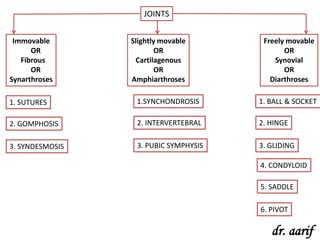
 Immovable       Slightly movable       Freely movable
      OR                 OR                   OR
   Fibrous        Cartilagenous            Synovial
      OR                 OR                   OR
Synarthroses     Amphiarthroses           Diarthroses

1. SUTURES        1.SYNCHONDROSIS      1. BALL & SOCKET

2. GOMPHOSIS      2. INTERVERTEBRAL    2. HINGE

3. SYNDESMOSIS    3. PUBIC SYMPHYSIS   3. GLIDING

                                       4. CONDYLOID

                                       5. SADDLE

                                       6. PIVOT

                                          dr. aarif
SYNARTHROSES

FEATURES :

• The bones are united at the joints by thin or dense layer of white fibrous connective
tissue.

• The white fibers are made up of a protein collagen.

• These joints are fixed i.e. cannot permit any movement of articulating bones.

• Short and thick fibers do not allow movement of articulating bones.

• The line of fusion at joint is called suture

FUNCTIONS:

• Fixed joints are primarily meant for growth and may permit molding during childbirth.

• Usually these joints are the places of growth. When growth period is over these joints
tend to ossify

                                                                                  dr. aarif
SUTURES OF SKULL
                                    (SERRATE SUTURES)

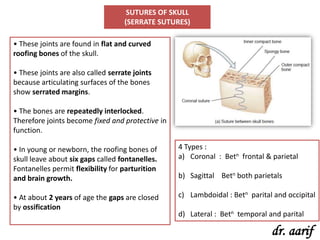
• These joints are found in flat and curved
roofing bones of the skull.

• These joints are also called serrate joints
because articulating surfaces of the bones
show serrated margins.

• The bones are repeatedly interlocked.
Therefore joints become fixed and protective in
function.

• In young or newborn, the roofing bones of       4 Types :
skull leave about six gaps called fontanelles.    a) Coronal : Betn frontal & parietal
Fontanelles permit flexibility for parturition
and brain growth.                                 b) Sagittal Betn both parietals

• At about 2 years of age the gaps are closed     c) Lambdoidal : Betn parital and occipital
by ossification
                                                  d) Lateral : Betn temporal and parital

                                                                              dr. aarif
SYNDESMOSIS


  It is the fibrous connective tissue that connects two
  bones. E.g. tibia and fibula


                                            dr. aarif
GOMPHOSIS
(Peg and Socket)


          It is the characteristic of thecodont teeth.

          The roots of the teeth are fixed in sockets
          (alveoli) of jaw bones.

          The fibrous connections in this case are many
          short periodontal ligaments.


                                              dr. aarif
AMPHIARTHROSES


These are called amphiarthroses because they are neither fixed nor freely
movable.

It is intermediate stage of joints when related to development and movement.

They allow some movement in response to compression, tension or twisting.

The line of fusion between articulating bones is called synchondrosis or
symphysis.


                                                                            dr. aarif
SYNCHONDROSIS


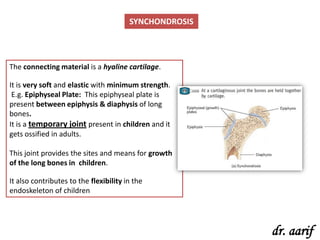
The connecting material is a hyaline cartilage.

It is very soft and elastic with minimum strength.
 E.g. Epiphyseal Plate: This epiphyseal plate is
present between epiphysis & diaphysis of long
bones.
It is a temporary joint present in children and it
gets ossified in adults.

This joint provides the sites and means for growth
of the long bones in children.

It also contributes to the flexibility in the
endoskeleton of children


                                                        dr. aarif
SYMPHYSIS
The connecting material is a fibrocartilage.

Fibrocartilage is an opaque, comparatively strong
but flexible structure, due to the presence of
numerous white fibers of collagen.

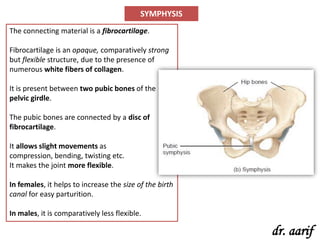
It is present between two pubic bones of the
pelvic girdle.

The pubic bones are connected by a disc of
fibrocartilage.

It allows slight movements as
compression, bending, twisting etc.
It makes the joint more flexible.

In females, it helps to increase the size of the birth
canal for easy parturition.

In males, it is comparatively less flexible.

                                                         dr. aarif
INTER VERTEBRAL
                                            JOINT


These joints are present between the
centers of adjacent vertebrae of
backbone.

The connecting discs are fibro-
cartilaginous.

These joints help in shock absorption and
protect the spinal cord from mechanical
injury.

These joints make the vertebral column
slightly flexible.


                                                         dr. aarif
DIARTHROSES


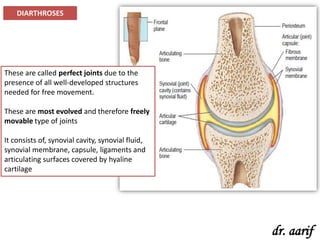
These are called perfect joints due to the
presence of all well-developed structures
needed for free movement.

These are most evolved and therefore freely
movable type of joints

It consists of, synovial cavity, synovial fluid,
synovial membrane, capsule, ligaments and
articulating surfaces covered by hyaline
cartilage


                                                   dr. aarif
dr. aarif
Synovial Membrane:
It lines the synovial cavity and forms a synovial capsule.
The synovial membrane secretes synovial fluid.
It encloses fluid filled synovial cavity and protects internal parts of joint.

Synovial fluid:
It is a clear, yellowish, slimy and viscous fluid similar to lymph.
The viscosity of fluid is due to hyaluronic acid secreted by the cells of the synovial
membrane.
It contains nutrients and mucus.
The fluid lubricates the joint and nourishes hyaline cartilage.
The fluid also contains phagocytes, which removes microorganisms and cellular debris.
Deficiency of this fluid causes arthrosclerosis.

Hyaline cartilage:
It covers the end of articulating surfaces of bone and avoids direct contact or friction
between bones.

Ligaments:
The joints are provided with capsular ligaments and numerous accessory ligaments.
Accessory ligament may be intra or extra capsular.
Ligaments avoid dislocation of bones and make the joints stronger.

                                                                                    dr. aarif
dr. aarif
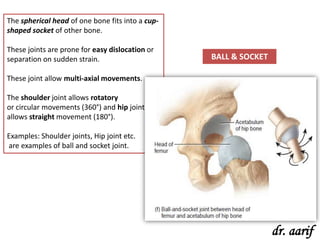
The spherical head of one bone fits into a cup-
shaped socket of other bone.

These joints are prone for easy dislocation or
separation on sudden strain.                      BALL & SOCKET

These joint allow multi-axial movements.

The shoulder joint allows rotatory
or circular movements (360°) and hip joint
allows straight movement (180°).

Examples: Shoulder joints, Hip joint etc.
are examples of ball and socket joint.


                                                                  dr. aarif
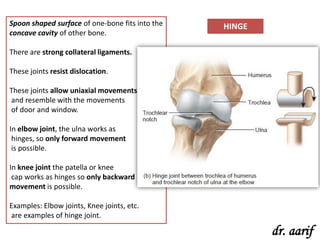
Spoon shaped surface of one-bone fits into the   HINGE
concave cavity of other bone.

There are strong collateral ligaments.

These joints resist dislocation.

These joints allow uniaxial movements
and resemble with the movements
of door and window.

In elbow joint, the ulna works as
 hinges, so only forward movement
 is possible.

In knee joint the patella or knee
 cap works as hinges so only backward
movement is possible.

Examples: Elbow joints, Knee joints, etc.
are examples of hinge joint.

                                                         dr. aarif
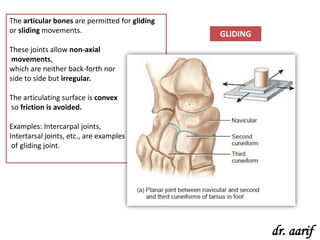
The articular bones are permitted for gliding
or sliding movements.                           GLIDING
These joints allow non-axial
 movements,
which are neither back-forth nor
side to side but irregular.

The articulating surface is convex
so friction is avoided.

Examples: Intercarpal joints,
Intertarsal joints, etc., are examples
 of gliding joint.


                                                          dr. aarif
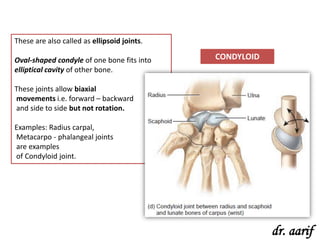
These are also called as ellipsoid joints.

Oval-shaped condyle of one bone fits into    CONDYLOID
elliptical cavity of other bone.

These joints allow biaxial
movements i.e. forward – backward
and side to side but not rotation.

Examples: Radius carpal,
Metacarpo - phalangeal joints
are examples
of Condyloid joint.


                                                         dr. aarif
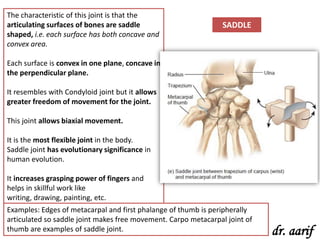
The characteristic of this joint is that the
articulating surfaces of bones are saddle                        SADDLE
shaped, i.e. each surface has both concave and
convex area.

Each surface is convex in one plane, concave in
the perpendicular plane.

It resembles with Condyloid joint but it allows
greater freedom of movement for the joint.

This joint allows biaxial movement.

It is the most flexible joint in the body.
Saddle joint has evolutionary significance in
human evolution.

It increases grasping power of fingers and
helps in skillful work like
writing, drawing, painting, etc.
Examples: Edges of metacarpal and first phalange of thumb is peripherally
articulated so saddle joint makes free movement. Carpo metacarpal joint of
thumb are examples of saddle joint.                                          dr. aarif
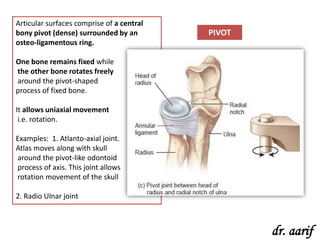
Articular surfaces comprise of a central
bony pivot (dense) surrounded by an        PIVOT
osteo-ligamentous ring.

One bone remains fixed while
the other bone rotates freely
around the pivot-shaped
process of fixed bone.

It allows uniaxial movement
 i.e. rotation.

Examples: 1. Atlanto-axial joint.
Atlas moves along with skull
around the pivot-like odontoid
process of axis. This joint allows
rotation movement of the skull

2. Radio Ulnar joint


                                                   dr. aarif
Joints

Joints

  • 1.
  • 2.
    JOINTS Definition: A place wheretwo or more bones get articulated with one another is called a joint. Joints help to connect different parts of skeleton and form a basic framework of body. Study of structure and functions of various joints is called arthrology. LIGAMENTS: At a joint the bones are connected to each other by ligaments. Ligaments are tough, elastic fibrous connective tissue bands or threads which connect bone to bone at a joint. Ligaments keep the bones in proper position and avoid dislocation of bones during the movement. SIGNIFICANCE OF JOINTS: They help in locomotion. Joints also help in desirable voluntary movements of body parts. Joints bring flexibility in rigid skeleton. Some joints are protective and act as shock absorbers. dr. aarif
  • 3.
    JOINTS Immovable Slightly movable Freely movable OR OR OR Fibrous Cartilagenous Synovial OR OR OR Synarthroses Amphiarthroses Diarthroses 1. SUTURES 1.SYNCHONDROSIS 1. BALL & SOCKET 2. GOMPHOSIS 2. INTERVERTEBRAL 2. HINGE 3. SYNDESMOSIS 3. PUBIC SYMPHYSIS 3. GLIDING 4. CONDYLOID 5. SADDLE 6. PIVOT dr. aarif
  • 4.
    SYNARTHROSES FEATURES : • Thebones are united at the joints by thin or dense layer of white fibrous connective tissue. • The white fibers are made up of a protein collagen. • These joints are fixed i.e. cannot permit any movement of articulating bones. • Short and thick fibers do not allow movement of articulating bones. • The line of fusion at joint is called suture FUNCTIONS: • Fixed joints are primarily meant for growth and may permit molding during childbirth. • Usually these joints are the places of growth. When growth period is over these joints tend to ossify dr. aarif
  • 5.
    SUTURES OF SKULL (SERRATE SUTURES) • These joints are found in flat and curved roofing bones of the skull. • These joints are also called serrate joints because articulating surfaces of the bones show serrated margins. • The bones are repeatedly interlocked. Therefore joints become fixed and protective in function. • In young or newborn, the roofing bones of 4 Types : skull leave about six gaps called fontanelles. a) Coronal : Betn frontal & parietal Fontanelles permit flexibility for parturition and brain growth. b) Sagittal Betn both parietals • At about 2 years of age the gaps are closed c) Lambdoidal : Betn parital and occipital by ossification d) Lateral : Betn temporal and parital dr. aarif
  • 6.
    SYNDESMOSIS Itis the fibrous connective tissue that connects two bones. E.g. tibia and fibula dr. aarif
  • 7.
    GOMPHOSIS (Peg and Socket) It is the characteristic of thecodont teeth. The roots of the teeth are fixed in sockets (alveoli) of jaw bones. The fibrous connections in this case are many short periodontal ligaments. dr. aarif
  • 8.
    AMPHIARTHROSES These are calledamphiarthroses because they are neither fixed nor freely movable. It is intermediate stage of joints when related to development and movement. They allow some movement in response to compression, tension or twisting. The line of fusion between articulating bones is called synchondrosis or symphysis. dr. aarif
  • 9.
    SYNCHONDROSIS The connecting materialis a hyaline cartilage. It is very soft and elastic with minimum strength. E.g. Epiphyseal Plate: This epiphyseal plate is present between epiphysis & diaphysis of long bones. It is a temporary joint present in children and it gets ossified in adults. This joint provides the sites and means for growth of the long bones in children. It also contributes to the flexibility in the endoskeleton of children dr. aarif
  • 10.
    SYMPHYSIS The connecting materialis a fibrocartilage. Fibrocartilage is an opaque, comparatively strong but flexible structure, due to the presence of numerous white fibers of collagen. It is present between two pubic bones of the pelvic girdle. The pubic bones are connected by a disc of fibrocartilage. It allows slight movements as compression, bending, twisting etc. It makes the joint more flexible. In females, it helps to increase the size of the birth canal for easy parturition. In males, it is comparatively less flexible. dr. aarif
  • 11.
    INTER VERTEBRAL JOINT These joints are present between the centers of adjacent vertebrae of backbone. The connecting discs are fibro- cartilaginous. These joints help in shock absorption and protect the spinal cord from mechanical injury. These joints make the vertebral column slightly flexible. dr. aarif
  • 12.
    DIARTHROSES These are calledperfect joints due to the presence of all well-developed structures needed for free movement. These are most evolved and therefore freely movable type of joints It consists of, synovial cavity, synovial fluid, synovial membrane, capsule, ligaments and articulating surfaces covered by hyaline cartilage dr. aarif
  • 13.
  • 14.
    Synovial Membrane: It linesthe synovial cavity and forms a synovial capsule. The synovial membrane secretes synovial fluid. It encloses fluid filled synovial cavity and protects internal parts of joint. Synovial fluid: It is a clear, yellowish, slimy and viscous fluid similar to lymph. The viscosity of fluid is due to hyaluronic acid secreted by the cells of the synovial membrane. It contains nutrients and mucus. The fluid lubricates the joint and nourishes hyaline cartilage. The fluid also contains phagocytes, which removes microorganisms and cellular debris. Deficiency of this fluid causes arthrosclerosis. Hyaline cartilage: It covers the end of articulating surfaces of bone and avoids direct contact or friction between bones. Ligaments: The joints are provided with capsular ligaments and numerous accessory ligaments. Accessory ligament may be intra or extra capsular. Ligaments avoid dislocation of bones and make the joints stronger. dr. aarif
  • 15.
  • 16.
    The spherical headof one bone fits into a cup- shaped socket of other bone. These joints are prone for easy dislocation or separation on sudden strain. BALL & SOCKET These joint allow multi-axial movements. The shoulder joint allows rotatory or circular movements (360°) and hip joint allows straight movement (180°). Examples: Shoulder joints, Hip joint etc. are examples of ball and socket joint. dr. aarif
  • 17.
    Spoon shaped surfaceof one-bone fits into the HINGE concave cavity of other bone. There are strong collateral ligaments. These joints resist dislocation. These joints allow uniaxial movements and resemble with the movements of door and window. In elbow joint, the ulna works as hinges, so only forward movement is possible. In knee joint the patella or knee cap works as hinges so only backward movement is possible. Examples: Elbow joints, Knee joints, etc. are examples of hinge joint. dr. aarif
  • 18.
    The articular bonesare permitted for gliding or sliding movements. GLIDING These joints allow non-axial movements, which are neither back-forth nor side to side but irregular. The articulating surface is convex so friction is avoided. Examples: Intercarpal joints, Intertarsal joints, etc., are examples of gliding joint. dr. aarif
  • 19.
    These are alsocalled as ellipsoid joints. Oval-shaped condyle of one bone fits into CONDYLOID elliptical cavity of other bone. These joints allow biaxial movements i.e. forward – backward and side to side but not rotation. Examples: Radius carpal, Metacarpo - phalangeal joints are examples of Condyloid joint. dr. aarif
  • 20.
    The characteristic ofthis joint is that the articulating surfaces of bones are saddle SADDLE shaped, i.e. each surface has both concave and convex area. Each surface is convex in one plane, concave in the perpendicular plane. It resembles with Condyloid joint but it allows greater freedom of movement for the joint. This joint allows biaxial movement. It is the most flexible joint in the body. Saddle joint has evolutionary significance in human evolution. It increases grasping power of fingers and helps in skillful work like writing, drawing, painting, etc. Examples: Edges of metacarpal and first phalange of thumb is peripherally articulated so saddle joint makes free movement. Carpo metacarpal joint of thumb are examples of saddle joint. dr. aarif
  • 21.
    Articular surfaces compriseof a central bony pivot (dense) surrounded by an PIVOT osteo-ligamentous ring. One bone remains fixed while the other bone rotates freely around the pivot-shaped process of fixed bone. It allows uniaxial movement i.e. rotation. Examples: 1. Atlanto-axial joint. Atlas moves along with skull around the pivot-like odontoid process of axis. This joint allows rotation movement of the skull 2. Radio Ulnar joint dr. aarif