The skeletal system consists of 206 bones that support the body and enable movement. The axial skeleton includes the skull, vertebrae, ribs, and sternum, while the appendicular skeleton comprises the shoulder and pelvic girdles and upper and lower limbs. Bones are living tissues composed of compact and spongy bone, and come in long, short, flat, and irregular shapes. Joints like the ball-and-socket hip and shoulder joints provide flexibility, while ligaments and tendons connect bones to muscles to facilitate movement. The three types of muscles - skeletal, cardiac, and smooth - work with the skeletal system to enable both voluntary and involuntary body functions.
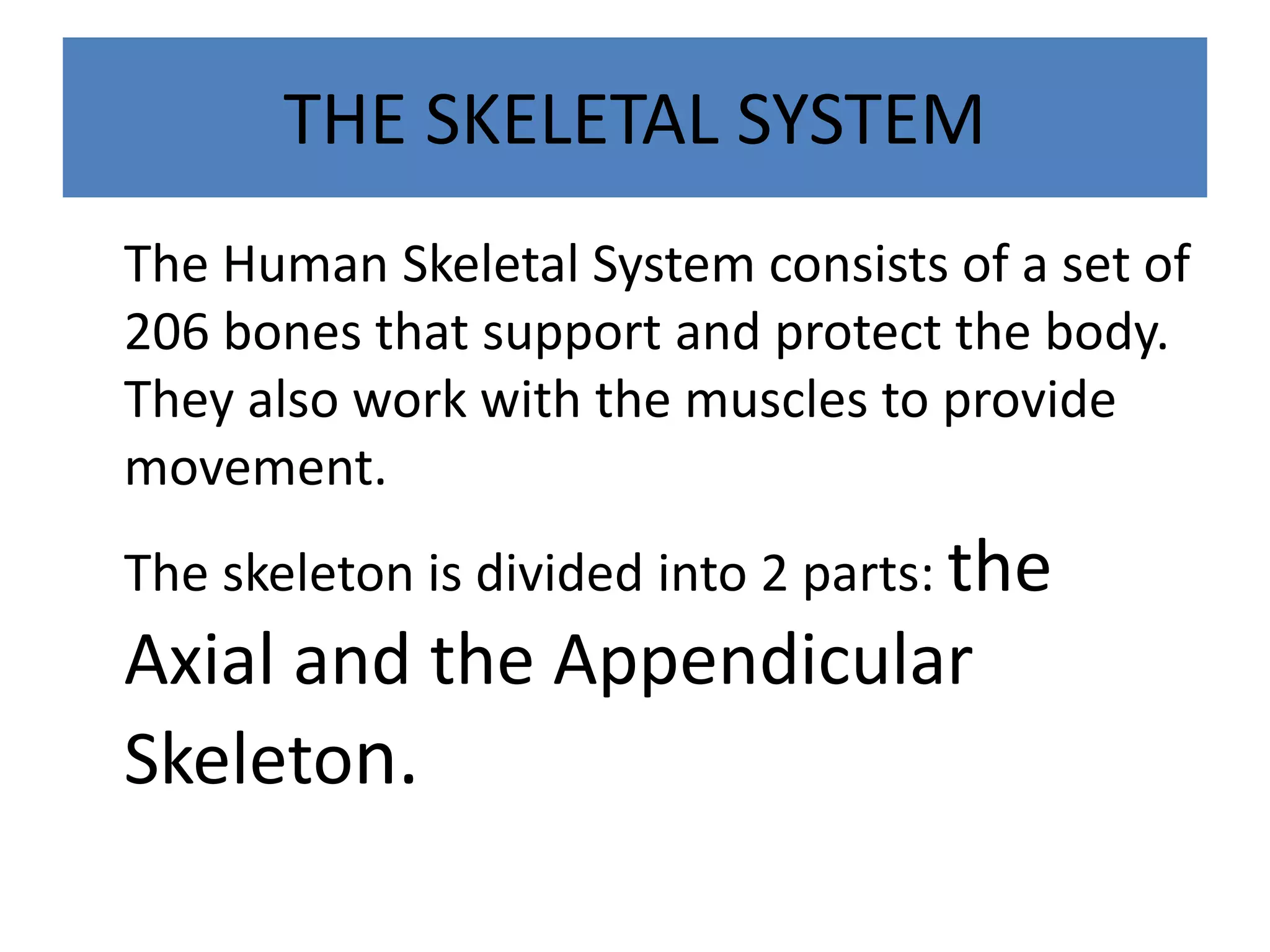
THE SKELETAL SYSTEM
TheHuman Skeletal System consists of a set of
206 bones that support and protect the body.
They also work with the muscles to provide
movement.
The skeleton is divided into 2 parts: the
Axial and the Appendicular
Skeleton.
3.
THE AXIAL SYSTEM
TheAxial System is made up with the Skull
bones, the Vertebrae, the Ribs and the
Sternum.
THE VERTEBRAE
The spineis divided into several
sections.
The cervical vertebrae make up the
neck.
The thoracic vertebrae comprise the
chest section and have ribs attached.
The lumbar vertebrae are the
remaining vertebrae below the last
thoracic bone and the top of the sacrum.
The sacral vertebrae are caged within
the bones of the pelvis, and the coccyx
represents the terminal vertebrae or
vestigial tail.
6.
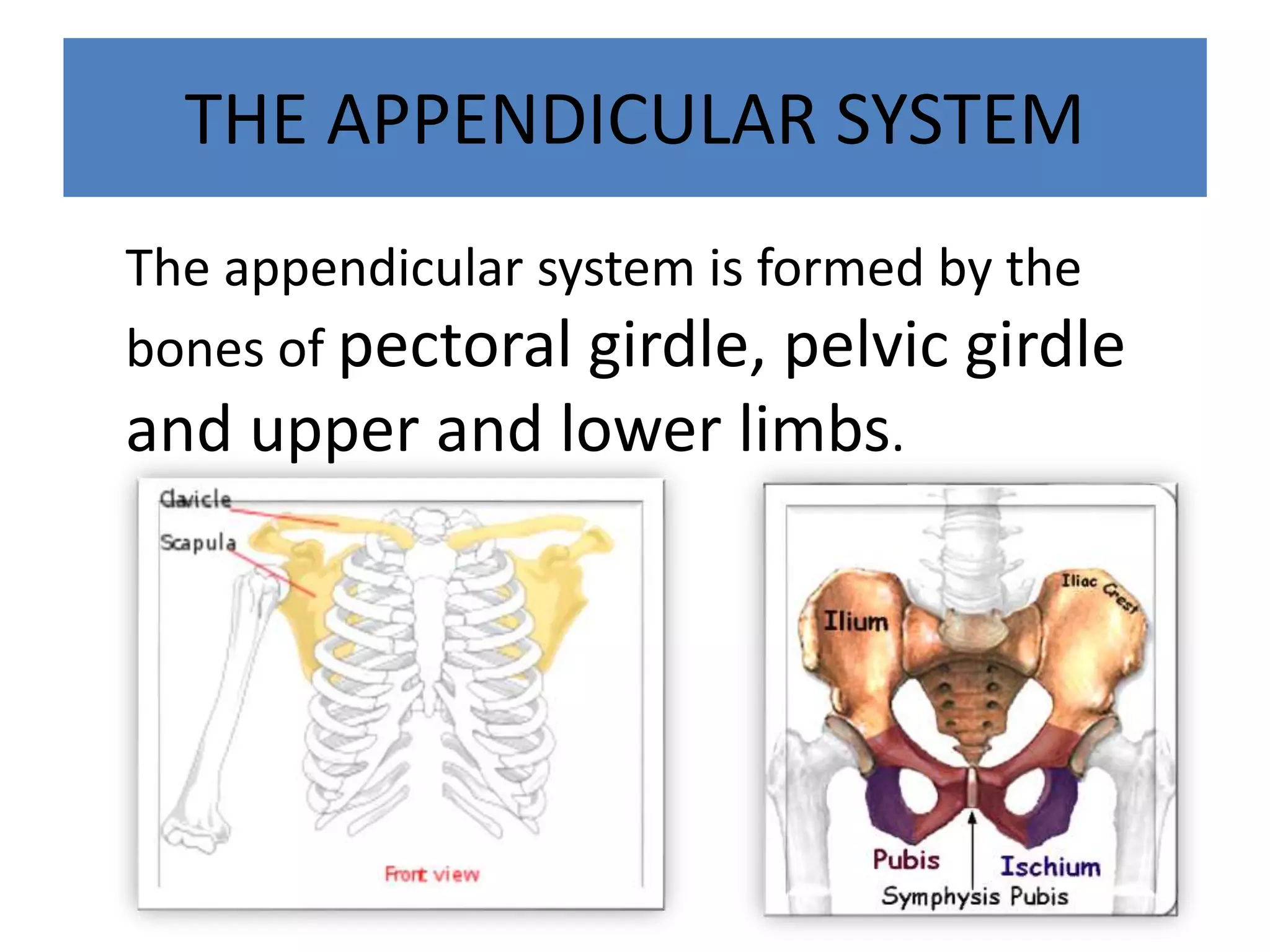
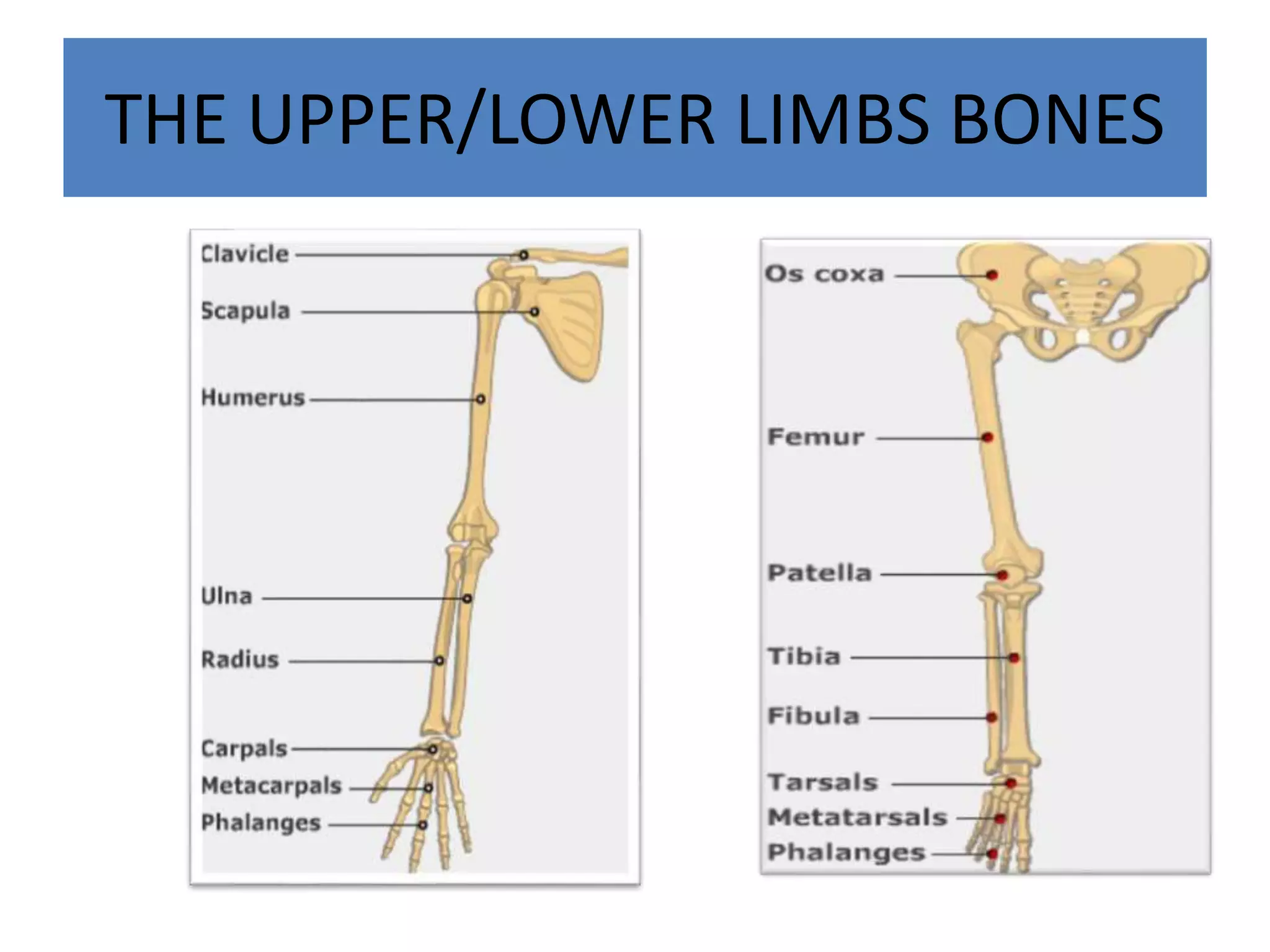
THE APPENDICULAR SYSTEM
Theappendicular system is formed by the
bones of pectoral girdle, pelvic girdle
and upper and lower limbs.
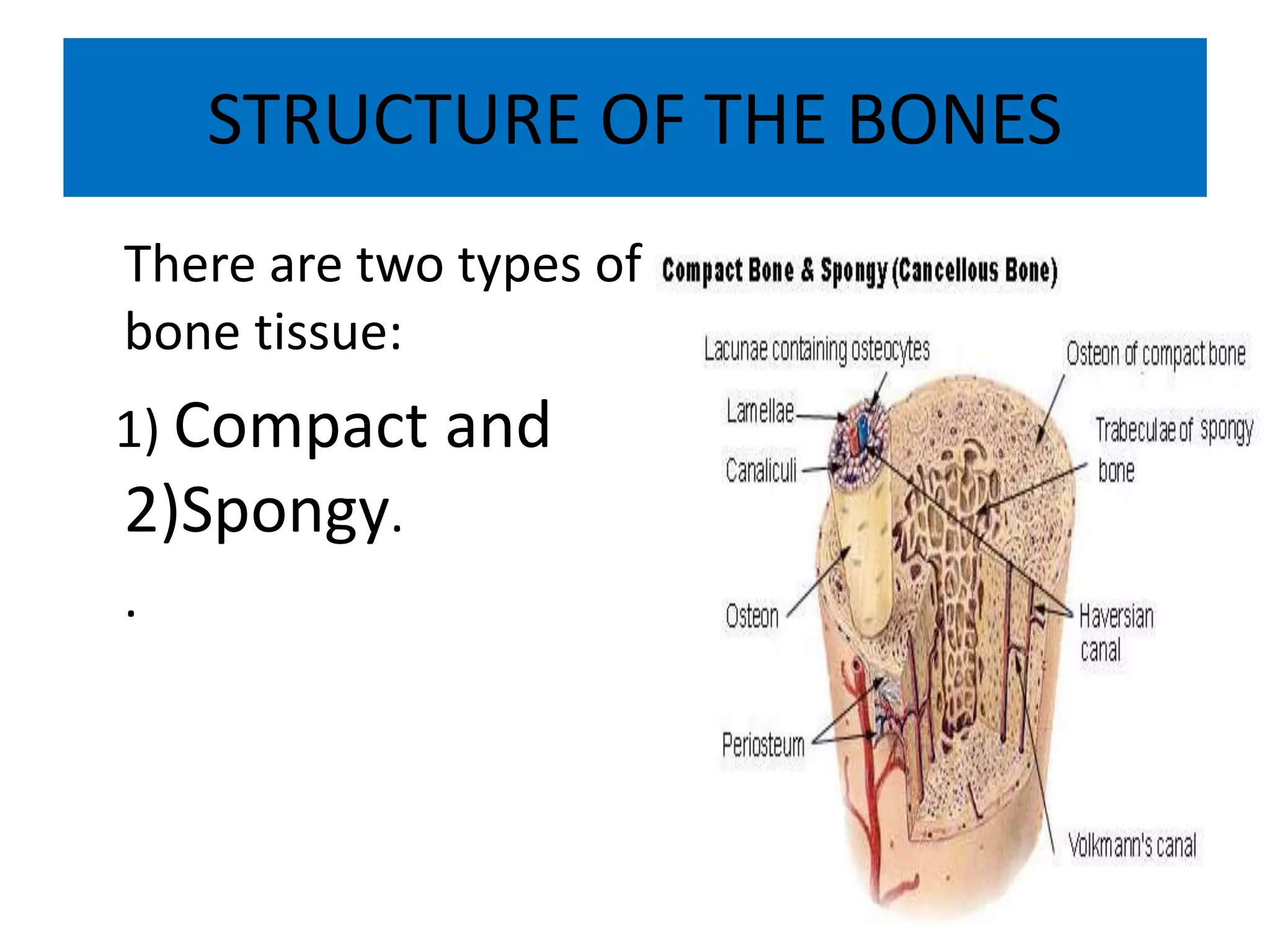
STRUCTURE OF THEBONES
There are two types of
bone tissue:
1) Compact and
2)Spongy.
.
10.
Compact Bone
• Thehard outer layer of bones is composed of
Compact bone tissue, so-called due to its
minimal gaps and spaces.
• This tissue gives bones their smooth, white,
and solid appearance, and accounts for 80% of
the total bone mass of an adult skeleton.
11.
Spongy Bone
Spongy bonefills the interior of the bone
which is composed of a network of rod- and
plate-like elements that make the overall
organ lighter and allowing room for blood
vessels and marrow.
Spongy bone accounts for the remaining 20% of
total bone mass, but has nearly ten times the
surface area of compact bone.
12.
CLASSIFICATION OF BONES
Thebones of the body come in a variety of
sizes and shapes. The four principal types of
bones are long, short, flat and irregular
13.
LONG BONES
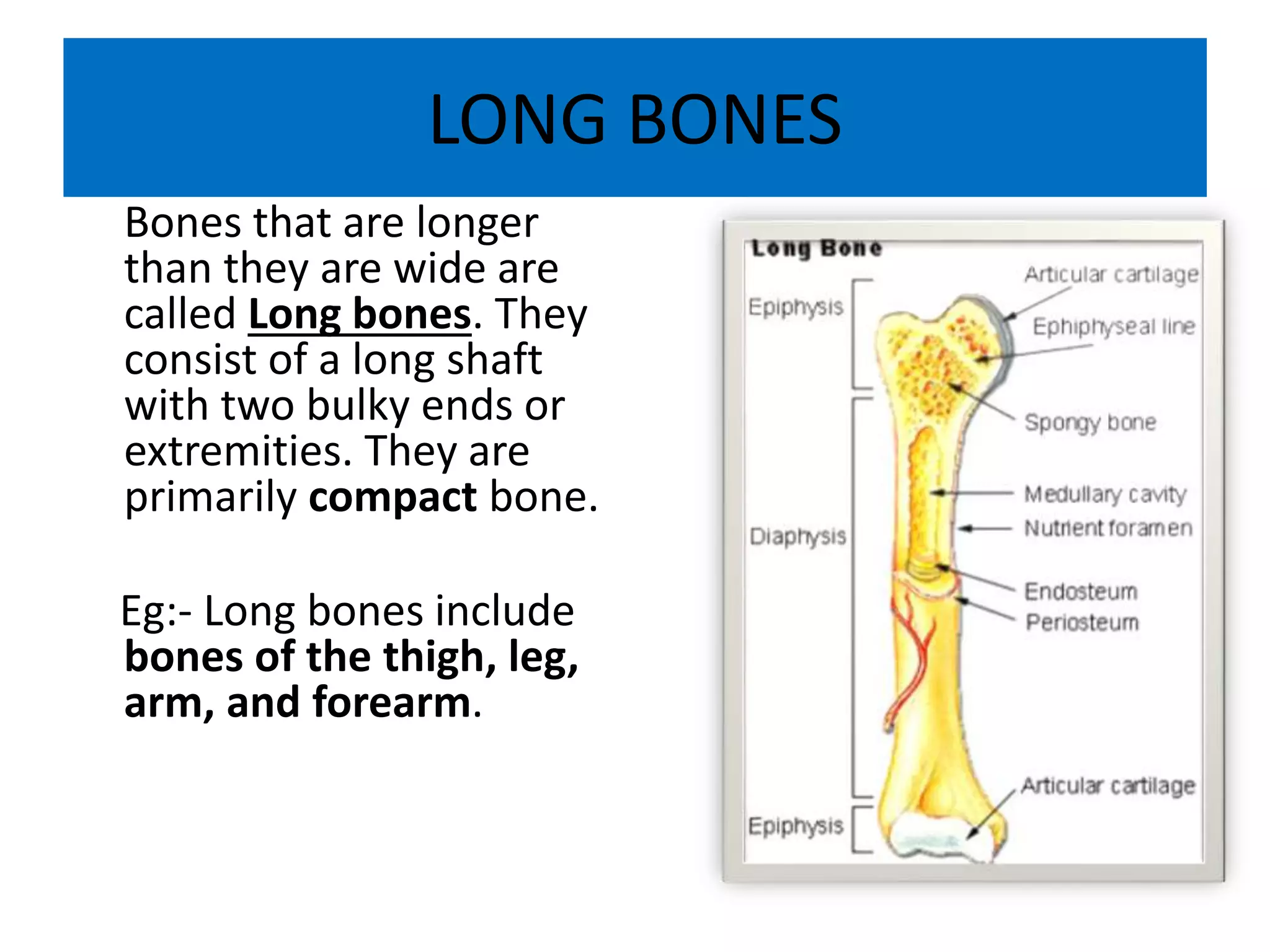
Bones thatare longer
than they are wide are
called Long bones. They
consist of a long shaft
with two bulky ends or
extremities. They are
primarily compact bone.
Eg:- Long bones include
bones of the thigh, leg,
arm, and forearm.
14.
SHORT BONES
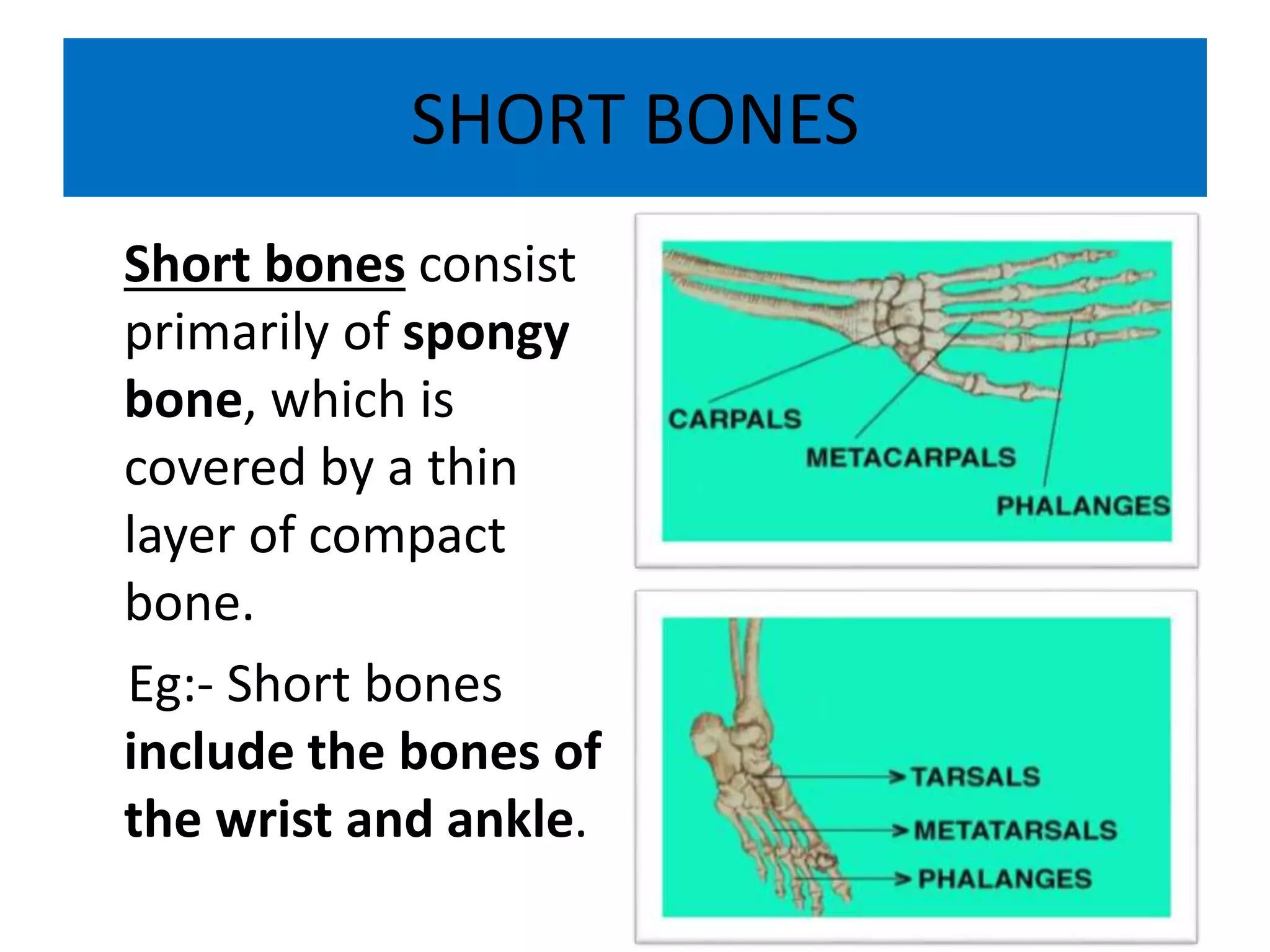
Short bonesconsist
primarily of spongy
bone, which is
covered by a thin
layer of compact
bone.
Eg:- Short bones
include the bones of
the wrist and ankle.
15.
FLAT BONES
Flat bonesare thin, flattened, and usually
curved.
Eg:- Flat bones include most of the bones of
the cranium and sternum.
16.
IRREGULAR BONES
Bones thatare not in any
of the above three
categories are classified
as Irregular bones. They
are primarily spongy
bone that is covered with
a thin layer of compact
bone.
Eg:- The vertebrae and
some of the bones in the
skull are irregular bones.
17.
BONE DEVELOPMENT &GROWTH
Osteoblasts, osteocytes and osteoclasts are
the three cell types involved in the
development, growth and remodeling of
bones.
Osteoblasts are bone-forming cells,
Osteocytes are mature bone cells and
Osteoclasts break down and reabsorb
bone.
18.
THE JOINTS
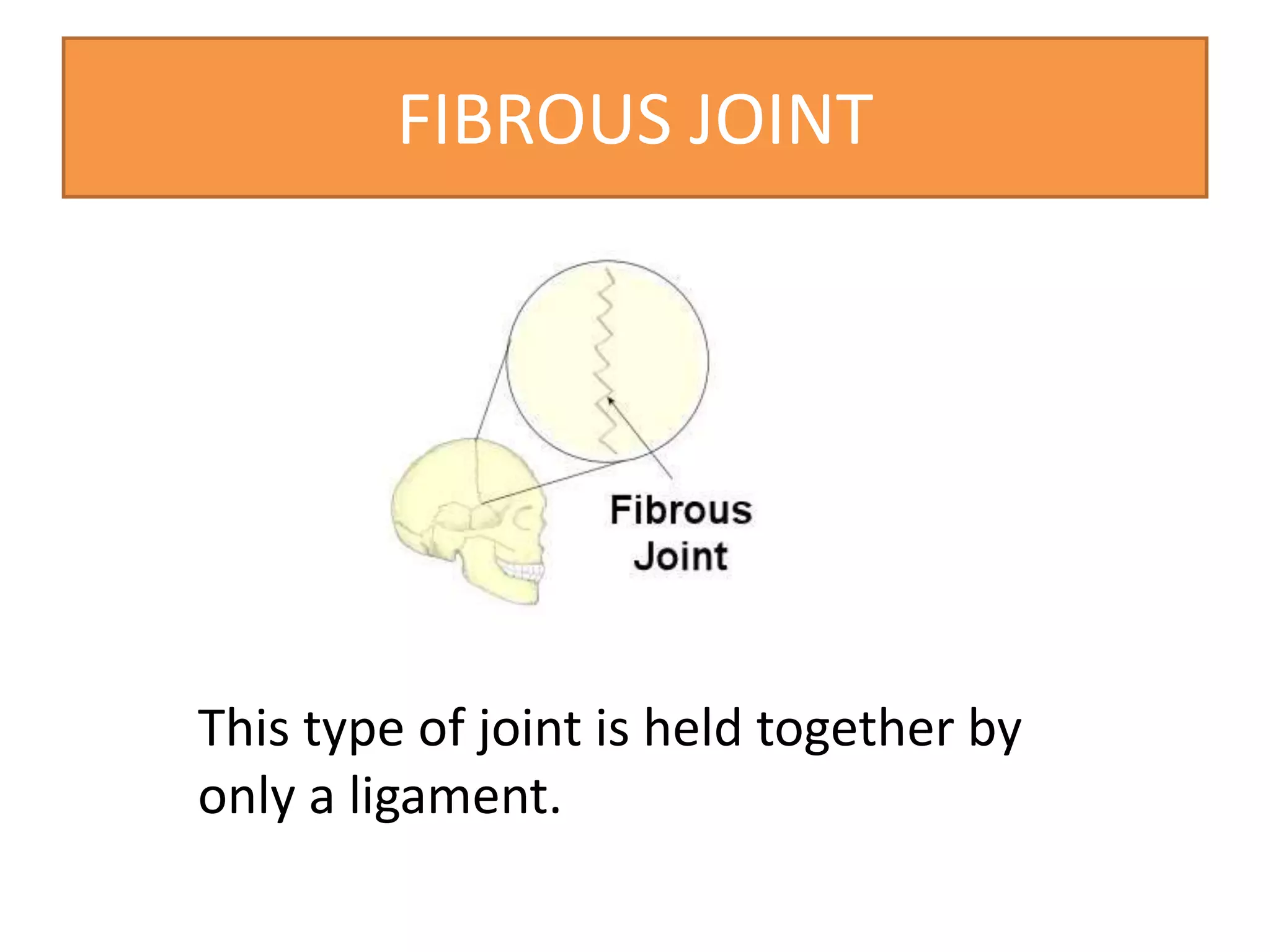
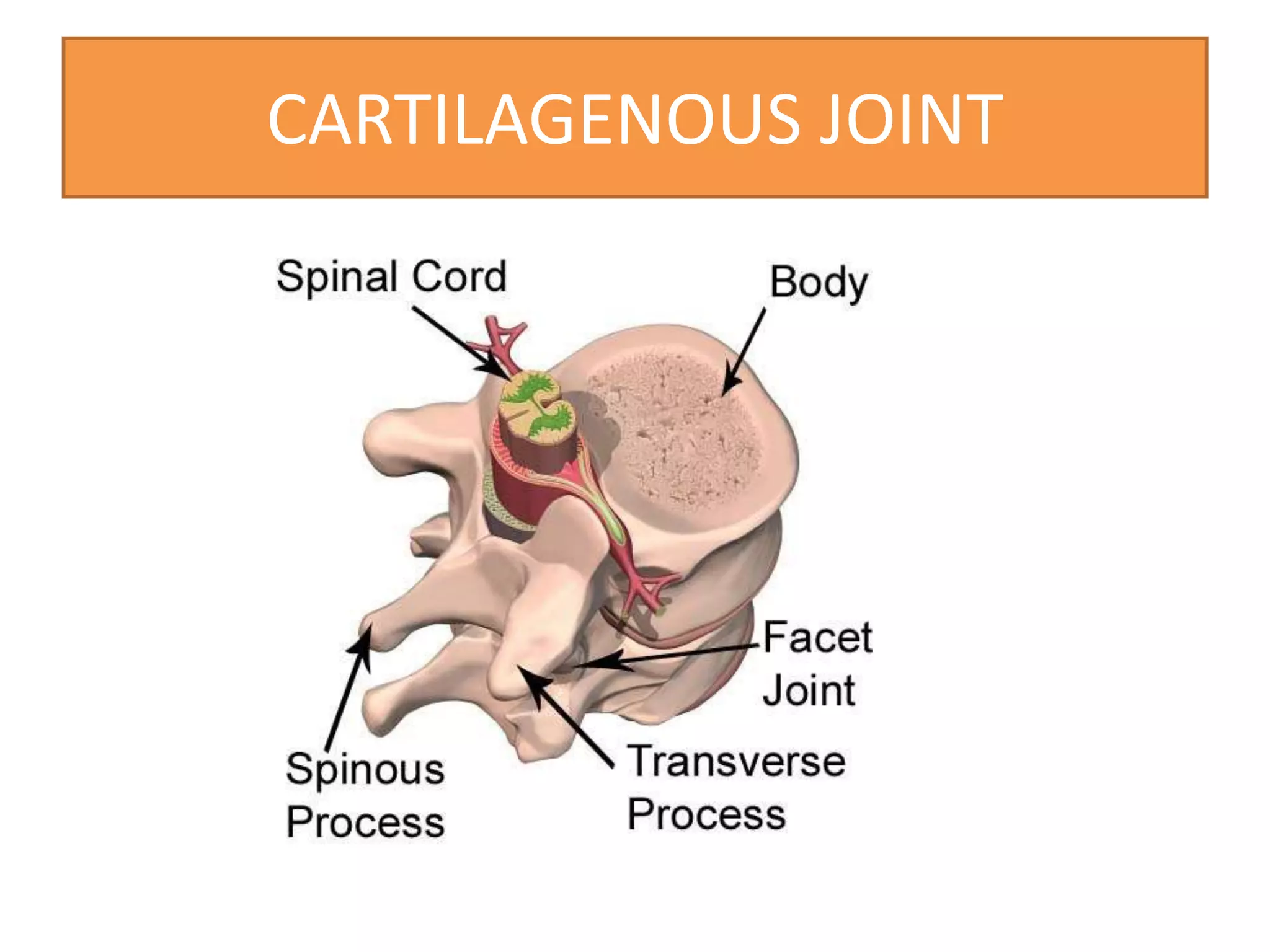
A Jointis the point where two or more bones
meet. There are three main types:
Fibrous (immoveable)- Eg:-Skull Joint.
Cartilagenous (partially moveable)-
Eg:- Intervertebral disc of spinal column.
Synovial (freely moveable) joint.
SYNOVIAL JOINT
There aresix types of synovial joints:
1) Pivot joint,
2) Ball-and-socket joint,
3) Hinge joint,
4) Condyloid joint,
5) Saddle joint,
6) Gliding joint.
22.
SYNOVIAL JOINT
• Pivotjoint
Enables rotation around a lengthwise axis: the cylindrical
terminal part of a bone is encased in a hollow cylinder.
Examples include the tibia and the fibula.
• Ball-and-socket joint
Allows movement along three axes, such as in the shoulder:
flexion and extension, rotation, and adduction (arm
drawing near the trunk) and abduction (arm drawing away
from the trunk). Eg:- Shoulder and Hip Joint.
• Hinge joint
Enables flexion and extension along a single axis.
Eg:- Elbow,Knee,Ankle joint.
24.
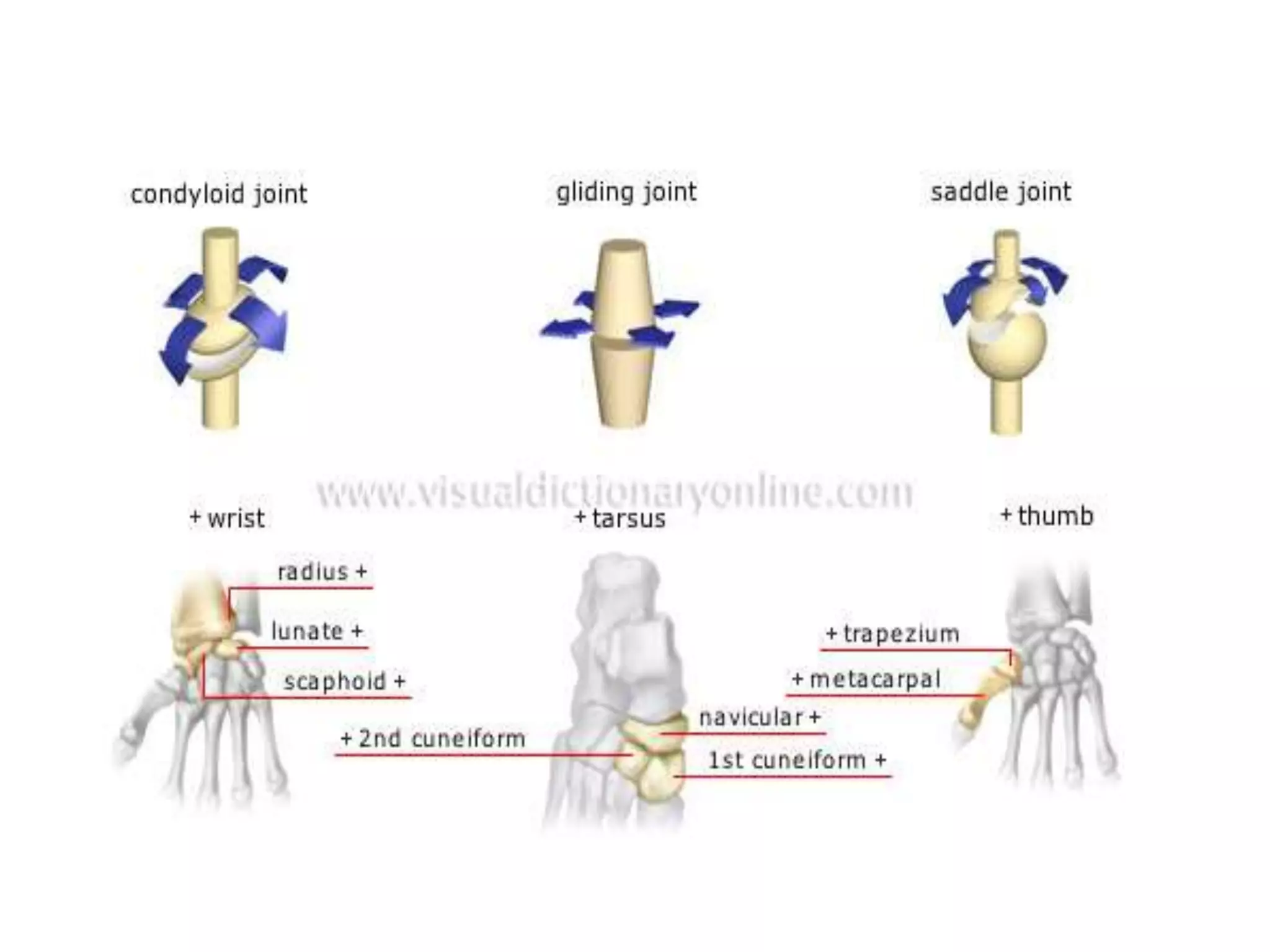
• Condyloid joint
Anexample is the wrist, which the hand can move on
two axes: flexion and extension; it can also be tilted
sideways. Eg:- Wrist joint.
• Saddle joint
Resembles the condyloid joint but allows a wider range
of motion; this type of joint is rare. Eg:- Thumb.
• Gliding joint
Surfaces of these joints are relatively flat and not very
mobile; they allow only a narrow gliding range.
Eg:- Vertebrae, certain bones of the wrist and ankle).
26.
THE TENDONS
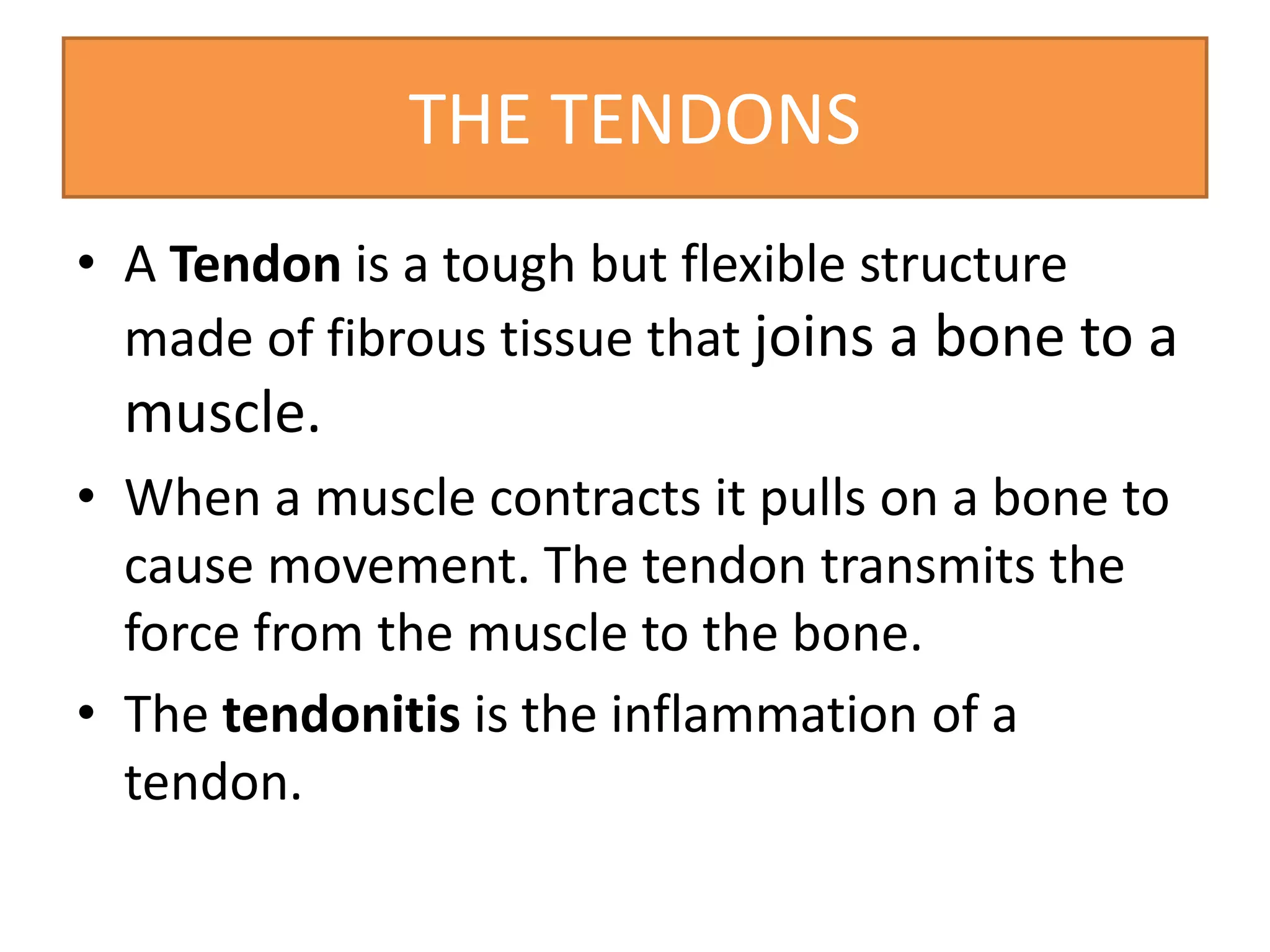
• ATendon is a tough but flexible structure
made of fibrous tissue that joins a bone to a
muscle.
• When a muscle contracts it pulls on a bone to
cause movement. The tendon transmits the
force from the muscle to the bone.
• The tendonitis is the inflammation of a
tendon.
28.
THE LIGAMENTS
Ligaments arebands of connective tissues that link
two or more bones to make joints stable and prevent
from excessive movements.
29.
THE MUSCULAR SYSTEM
•Our Skeletal has more than 650 muscles, most
of them disposed in pairs to provide
movement.
30.
THE MUSCULAR TISSUE
Muscularcells are called
Muscle fibers.
Every fibers contain thousand
of Myofibrils.
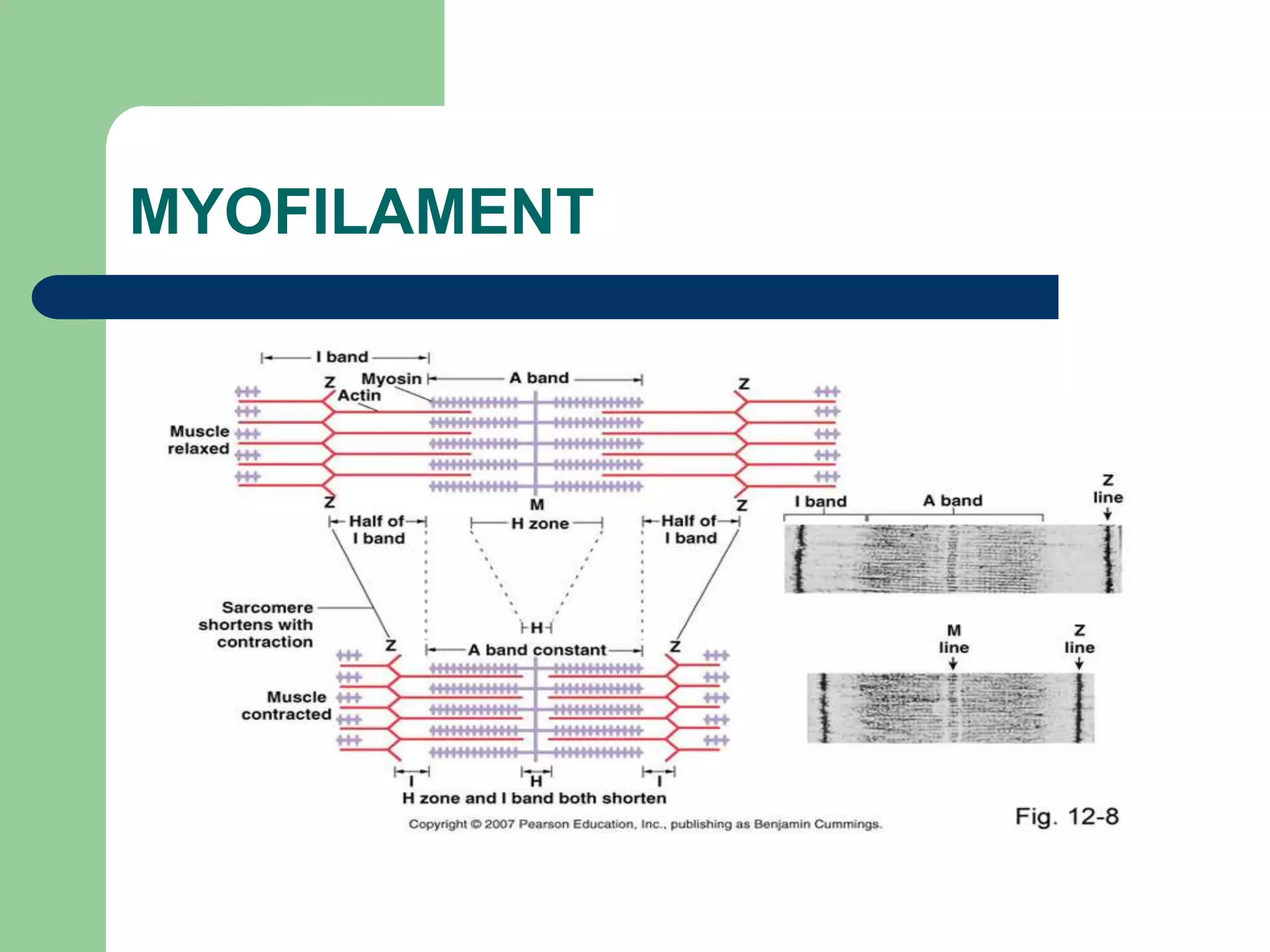
Inside each myofibril there
are many Myofilaments that
are made of two proteins:
the Actin and the Myosin.
The myofibrils are divided in
subunits called Sarcomeres.
TYPES OF MUSCLES
•There are three types of muscles:
• Skeletal Muscle
• Cardiac Muscle
• Smooth Muscle
34.
SKELETAL MUSCLE
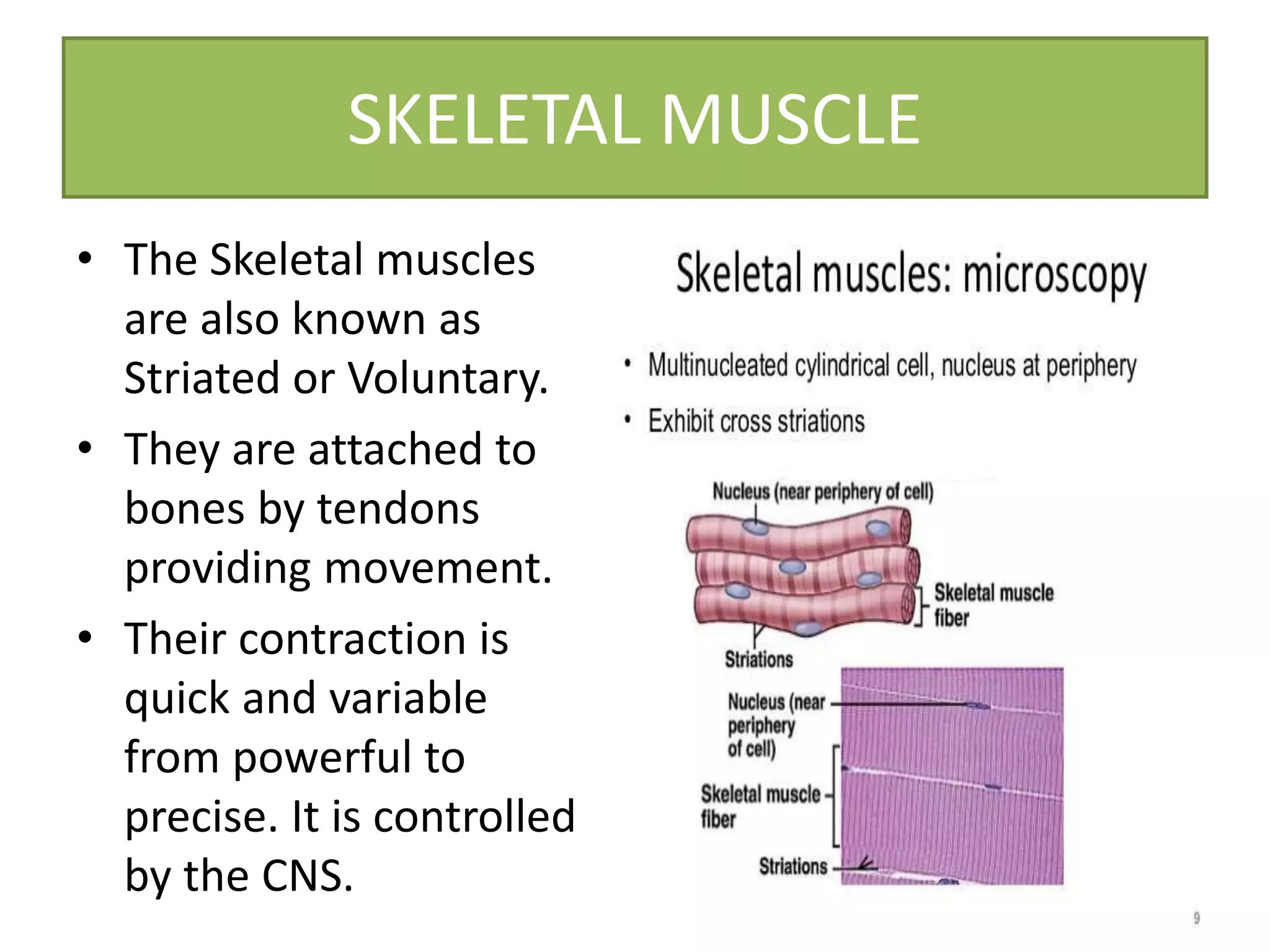
• TheSkeletal muscles
are also known as
Striated or Voluntary.
• They are attached to
bones by tendons
providing movement.
• Their contraction is
quick and variable
from powerful to
precise. It is controlled
by the CNS.
35.
CARDIAC MUSCLE
• CardiacMuscle is only
found in the Heart.
• It is made of striated fibers
and its contraction is
directed by the ANS.
• It contracts involuntarily
and rhythmically. It’s also
very resistant to fatigue
due to the large number of
mitochondria they have.
36.
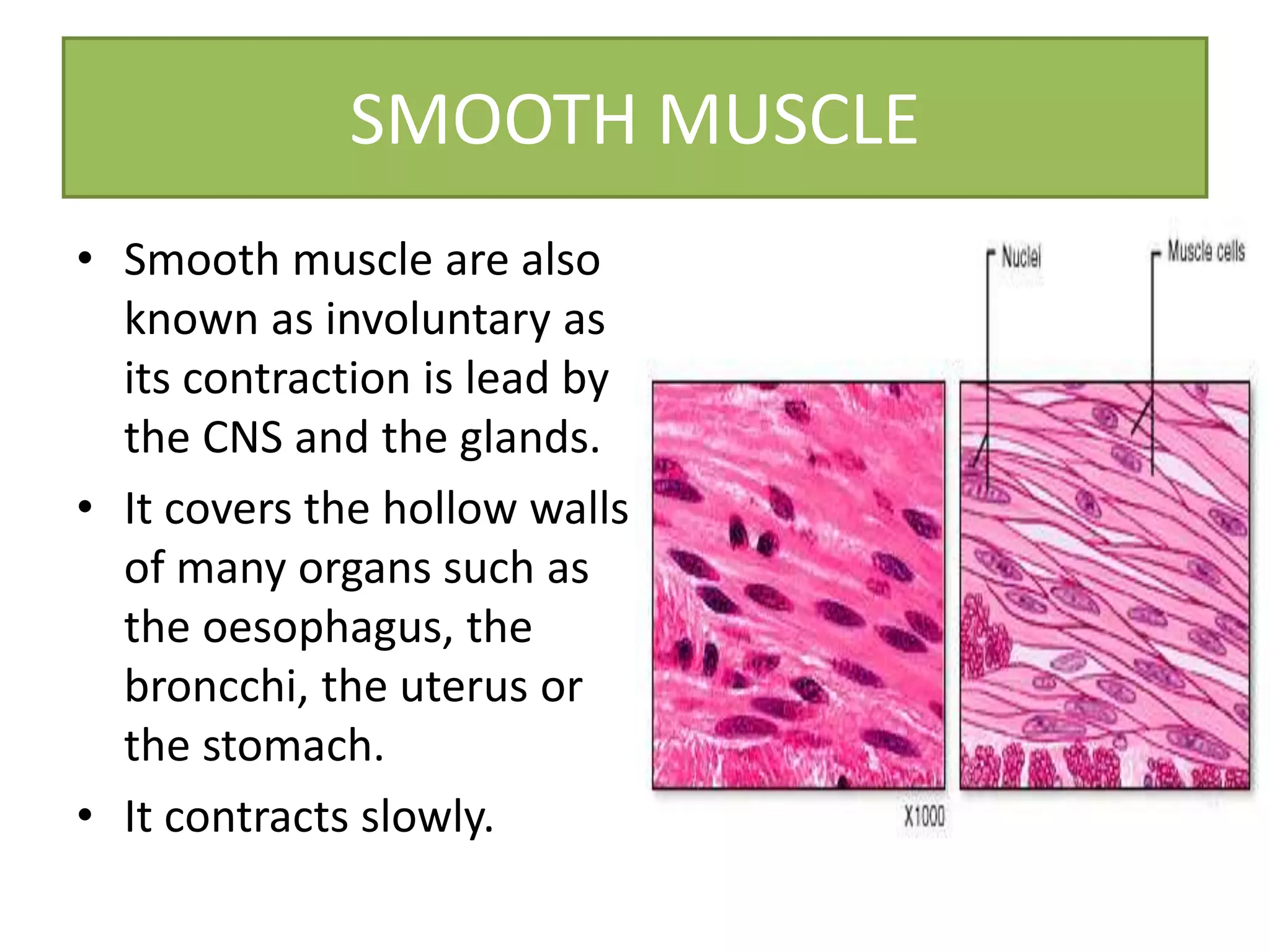
SMOOTH MUSCLE
• Smoothmuscle are also
known as involuntary as
its contraction is lead by
the CNS and the glands.
• It covers the hollow walls
of many organs such as
the oesophagus, the
broncchi, the uterus or
the stomach.
• It contracts slowly.