Professor Tariq Waseem
Dr. Hina Latif
Kohala Bridge AJK Pakistan
 A 28 yrs old PGR in medicine seeks consultant advice
for C/O low grade fever along with pain in throat and
myalgia for last 1 week.
 She also has difficulty in swallowing and hoarseness of
voice. Swelling and neck pain was initially on one side
of the neck but now involves both sides.
 Pain worsens on swallowing and coughing.
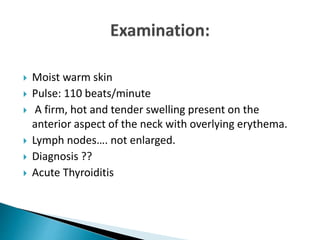
 Moist warm skin
 Pulse: 110 beats/minute
 A firm, hot and tender swelling present on the
anterior aspect of the neck with overlying erythema.
 Lymph nodes…. not enlarged.
 Diagnosis ??
 Acute Thyroiditis
 A group of individual disorders that all cause thyroidal
inflammation and, and result in different clinical
presentations.
 Can be acute, subacute or chronic.
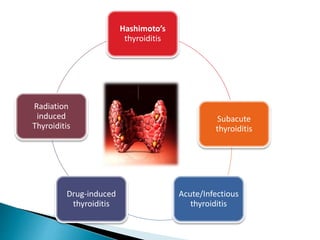
Hashimoto’s
thyroiditis
Subacute
thyroiditis
Acute/Infectious
thyroiditis
Drug-induced
thyroiditis
Radiation
induced
Thyroiditis
 Supprative thyroidits, Microbial inflammatory
thyroiditis, Pyogenic thyroiditis or Bacterial thyroidits
 Very rare 0.1-0.7 % of all the thyroiditis
 Mostly in children and young adults between the ages
of 20-40yrs.
 Causes
◦ Bacterial (S. aureus, S. pyogenes) : 68%
◦ Fungal : 15%
◦ Mycobacterial : 9%
◦ Viral
 May occur secondary to
◦ Pyriform sinus fistulae
◦ Pharyngeal space infections
◦ Persistent Thyroglossal remnants
◦ Thyroid surgery wound infections (rare)
◦ Repeated FNAs
◦ Upper RTI
 More common in HIV
 Systemic illness and constitutional symptoms
 Local symptoms…painful enlargement of the thyroid,
dysphagia, dysphonia and hoarseness of voice
(due to compression of esophagus and recurrent laryngeal nerve).
 Transient signs and symptoms of
Hyperthyroidism / Hypothyroidism.
 Symptoms usually resolve once the infection resolves
 ESR
 WBC count
 T3, T4, TSH…normal ?
 Elevated thyroglobulin levels.
 Decreased radioactive iodine uptake.
 USG neck…shows abscess or swelling in the thyroid
 Gallium scan will be positive.
 Barium Swallow ? fistula connection to pyriform sinus.
 Fine needle aspiration in case of abscess.
 Antibiotics.
 Surgical
Drainage of abscess….If required.
Removal of fistula
Lobectomy for antibiotic resistant.
 Usually from a viral infection
 Can be suppurative
 Presentation is a tender thyroid with fever and malaise
 Can have transient thyroid test abnormalities
 If transiently hyperthyroid (mild), sometimes managed
with beta-blockers
 Usually managed symptomatically
 A 46 years old female presents in OPD with C/O
 Painless midline neck swelling for last 6 months which
is gradually increasing in size, she has loss of appetite,
constipation, cold intolerance, low mood and
generalized weakness.
 Her elder sister, maternal cousin and two nieces have
been suffering from some thyroid disease.
 Diagnosis??
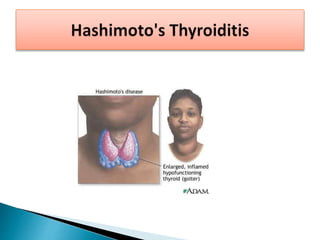
 Chronic autoimmune thyroiditis.
 Commonest cause of primary hypothyroidism in U.S
 Antithyroid antibodies are POSITIVE
Antithyroid peroxidase: 90%
Anti thyroglobulin
 “Spontaneous atrophic thyroiditis” term reserved for
those with positive TSH receptor-Blocking antibodies
 Anti Nuclear Factor(ANF) may be positive in those
under 20 years of age.
 Mostly in young and middle aged females
 Incidence 3.5 /1000 women vs 0.8/ 1000 men.
 Small, diffuse, firm or rubbery goitre.
 25% hypothyroid at presentation.
 Periodic follow up:
Since hypothyroidism may develop.
 For hypothyroidism:
levothyroxine Replacement
(0.05-0.2 mg orally daily).
 Surgery:
For compression symptoms.
 Self-limiting thyroid condition.
 A triphasic clinical course of hyperthyroidism,
hypothyroidism, and return to normal thyroid function.
 15-20% of patients presenting with thyrotoxicosis.
 10% of patients presenting with hypothyroidism.
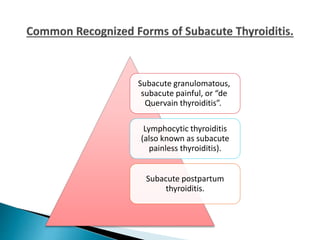
Subacute granulomatous,
subacute painful, or “de
Quervain thyroiditis”.
Lymphocytic thyroiditis
(also known as subacute
painless thyroiditis).
Subacute postpartum
thyroiditis.
 Self limited disease
 Mostly post viral (Coxackie, mumps or adenovirus)
 Enlarged Gland, Tender
 Initial thyrotoxicosis lasting 4- 6 weeks due to increased
release of stored T3 and T4 from preformed colloid due to
inflammation.
 A period of hypothyroidism follows for 4-6 months as stores
are depleted.
 Follicles then recover and Euthyroid state ensues.
 Diagnosis
◦ Elevated ESR
◦ Anemia (normochromic, normocytic)
◦ Low TSH, Elevated T4 > T3,
◦ Low Anti-Thyroid Peroxidase/Anti-Thyroglobulin antibodies.
◦ Low Radioactive Iodine uptake (same as silent thyroiditis)
 Treatment
◦ NSAID’s and salicylates.
◦ Oral steroids in severe cases(Prednisolone 40 mg OD for 3-4 weeks)
◦ Beta blockers for symptoms of hyperthyroidism, Iopanoic
acid for severe symptoms
◦ Symptoms can recur requiring repeat treatment
◦ Graves’ disease may occasionally develop as a late sequel
 Self limited disease
 CAUSE:
Anti-thyroid antibodies, autoimmune disease
 CLINICAL FEATURES:
Thyrotoxicosis followed by hypothyroidism.
 A 27 year old lady who delivered a live healthy baby 3
months ago presents with restlessness, palpitation,
fatigue. She reports 3 kg weight loss over past one
month.
 O/E
 Anxious looking young lady
 Pulse 100 bpm, BP 110/70 mmHg
 Mild diffuse goitre Non tender
Labs: Raised T4, Low TSH
Diagnosis??
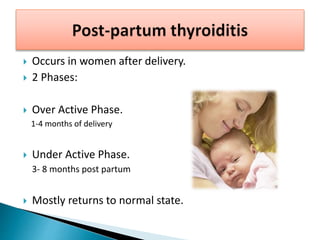
 Occurs in women after delivery.
 2 Phases:
 Over Active Phase.
1-4 months of delivery
 Under Active Phase.
3- 8 months post partum
 Mostly returns to normal state.
 May be unmasking of previously unrecognized subclinical
autoimmune thyroiditis.
 Antithyroid antibodies may be positive in early pregnancy.
 Negligible Radio Iodine uptake on thyroid scan.
 Likely to reccur with subsequent pregnancies
 Eventually progresses to permanent hypothyroidism.
 Rare disease involving fibrosis of the thyroid gland
 Diagnosis
◦ Thyroid antibodies are present in 2/3
◦ Painless goiter “woody”
◦ Open biopsy often needed
◦ Associated with focal sclerosis syndromes (retroperitoneal,
mediastinal, retroorbital, and sclerosing cholangitis)
 Treatment
◦ Resection for compressive symptoms
◦ Chemotherapy with Tamoxifen, Methotrexate, or steroids
may be effective
◦ Thyroid hormone only for symptoms of hypothyroidism
 A 65 year old male presents with unexplained weight
loss of 7 Kg over past 6 months, palpitation and
sweating. He had a transient ischemic attack 4 years
ago and was diagnosed to have lone atrial fibrillation
and is taking Amiodarone 200 mg OD, Aspirin 75 mg
OD and Warfarin 7.5 mg OD since then.
 ECG shows Atrial Fibrillation
 T3 and T4 are elevated while TSH is undetectable.
 Diagnosis??
 CAUSE:
Drugs include: amiodarone, lithium, interferons,
cytokines.
 CLINICAL FEATURES:
Either thyrotoxicosis or hypothyroidism.
 DURATION AND RESOLUTION:
Often continues as long as the drug is taken.
 Amiodarone has structural analogy to T4
 Each 200 mg tab has 75 mg of Iodine
 Normal daily requirement of Iodine is 125 microgram
 Cytotoxic to thyroid follicles
 20% of those taking Amiodarone develop either
hypothyriodism or Thyrotoxicosis.
 Thyrotoxicosis Classified as
 Type I : Iodine induced excess hormone synthesis
( Treated with Antithyroid drugs)
 Type II: Thyroiditis due to cytotoxic effect
( treated with Steroids)
 Half life 50- 60 days, effects lasts longer
 Levo thyroxine for Hypothyroidism
 CAUSE:
1. Follows treatment with radioactive iodine for
hyperthyroidism
2. external beam radiation therapy for certain cancers.
CLINICAL FEATURES:
1. Occasionally thyrotoxicosis
2. more frequently hypothyroidism.
Bosporus Channel Istanbul Turkey
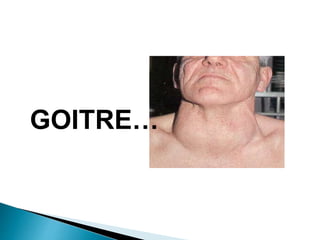
GOITRE…
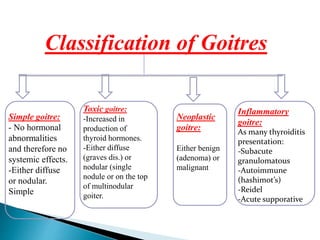
Classification of Goitres
Simple goitre:
- No hormonal
abnormalities
and therefore no
systemic effects.
-Either diffuse
or nodular.
Simple
Toxic goitre:
-Increased in
production of
thyroid hormones.
-Either diffuse
(graves dis.) or
nodular (single
nodule or on the top
of multinodular
goiter.
Neoplastic
goitre:
Either benign
(adenoma) or
malignant
Inflammatory
goitre:
As many thyroiditis
presentation:
-Subacute
granulomatous
-Autoimmune
(hashimot’s)
-Reidel
-Acute supporative
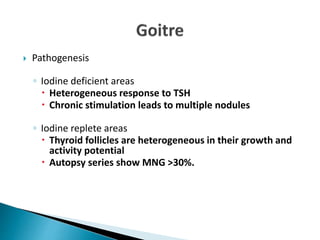
 Pathogenesis
◦ Iodine deficient areas
 Heterogeneous response to TSH
 Chronic stimulation leads to multiple nodules
◦ Iodine replete areas
 Thyroid follicles are heterogeneous in their growth and
activity potential
 Autopsy series show MNG >30%.
 Thyroid function evaluation
◦ TSH, T4, T3
◦ Overt hyperthyroidism (TSH low, T3/T4 high)
◦ Subclinical hyperthyroidism (TSH low, T3/T4 normal)
Determination of thyroid state is key in determining treatment
Clinical Assessment of Simple Goiter:
-Benign disease, colloid goiter, euthyroid , female (3rd -5th
decade )
-Presented as mild enlargement of the gland, most of the time
asymptomatic.
-Complication might develop due to mass effect like tracheal
compression or voice changes, but mostly asymptomatic.
-Acute development—Hemorrhage or cyst >> acute pain
1.Thyroid Function Tests
2. X-Ray Neck & Chest / CT scan
3.Ultrasound Neck
4. Isotope Scan
5. FNAC
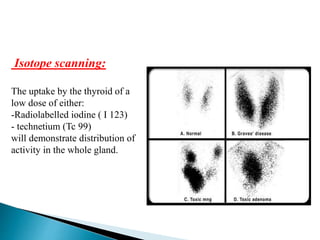
Isotope scanning:
The uptake by the thyroid of a
low dose of either:
-Radiolabelled iodine ( I 123)
- technetium (Tc 99)
will demonstrate distribution of
activity in the whole gland.
1) Iodine uptake: Iodination of salt Food
2) T4 administration.
3) Thyroidectomy
Topkopi Museum Istanbul
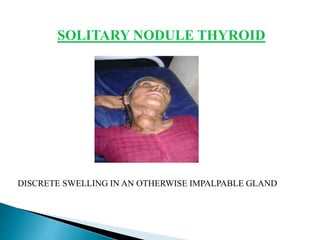
SOLITARY NODULE THYROID
DISCRETE SWELLING IN AN OTHERWISE IMPALPABLE GLAND
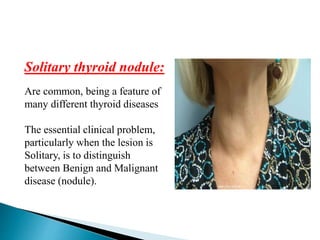
Solitary thyroid nodule:
Are common, being a feature of
many different thyroid diseases
The essential clinical problem,
particularly when the lesion is
Solitary, is to distinguish
between Benign and Malignant
disease (nodule).
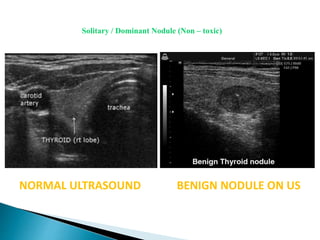
NORMAL ULTRASOUND BENIGN NODULE ON US
Solitary / Dominant Nodule (Non – toxic)
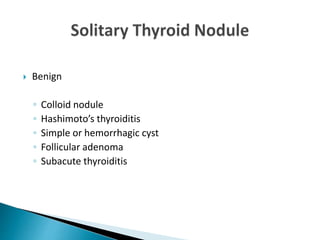
 Benign
◦ Colloid nodule
◦ Hashimoto’s thyroiditis
◦ Simple or hemorrhagic cyst
◦ Follicular adenoma
◦ Subacute thyroiditis
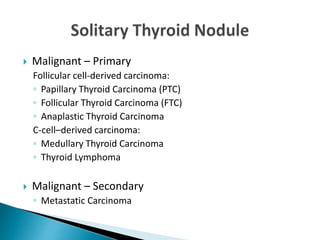
 Malignant – Primary
Follicular cell-derived carcinoma:
◦ Papillary Thyroid Carcinoma (PTC)
◦ Follicular Thyroid Carcinoma (FTC)
◦ Anaplastic Thyroid Carcinoma
C-cell–derived carcinoma:
◦ Medullary Thyroid Carcinoma
◦ Thyroid Lymphoma
 Malignant – Secondary
◦ Metastatic Carcinoma
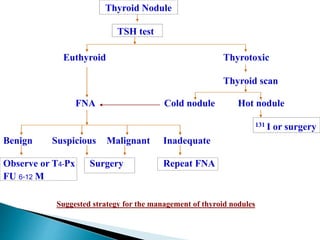
Thyroid Nodule
TSH test
Euthyroid Thyrotoxic
Thyroid scan
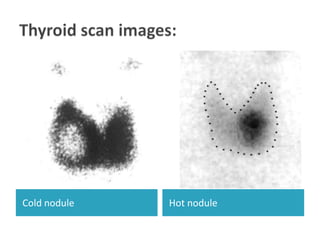
FNA Cold nodule Hot nodule
131 I or surgery
Benign Suspicious Malignant Inadequate
Observe or T4-Px Surgery Repeat FNA
FU 6-12 M
Suggested strategy for the management of thyroid nodules
Cold nodule Hot nodule
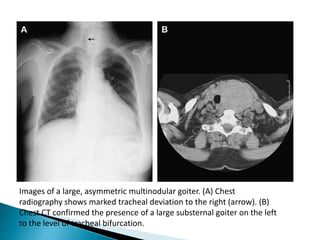
Images of a large, asymmetric multinodular goiter. (A) Chest
radiography shows marked tracheal deviation to the right (arrow). (B)
Chest CT confirmed the presence of a large substernal goiter on the left
to the level of tracheal bifurcation.
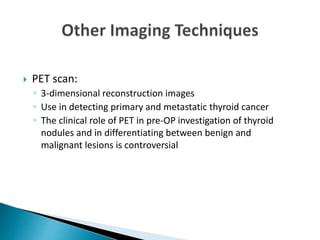
 PET scan:
◦ 3-dimensional reconstruction images
◦ Use in detecting primary and metastatic thyroid cancer
◦ The clinical role of PET in pre-OP investigation of thyroid
nodules and in differentiating between benign and
malignant lesions is controversial
 Indicated if:
◦ Palpation-guided FNA non diagnostic
◦ Complex (solid/cystic) nodule
◦ Palpable small nodule (<1.5 cm)
◦ Impalpable nodule
◦ Abnormal cervical nodes
◦ Nodule with suspicious US features
 Diagnosis cannot be made
 Inculdes:
◦ Follicular neoplasms,
◦ Hürthle cell neoplasms,
◦ Atypical PTC, or
◦ Lymphoma
Treatment
 Hormone administration Very little evidence to affect
benign nodule
 Indications for surgery
Clinical features and suspicious or definite FNAC
result.
If continue enlarge despite TSH suppression
Mechanical symptoms
Cosmetic
54
Emperor Jahangir Tomb
Lahore Pakistan

Thyroid disorders 1

  • 1.
  • 2.
  • 3.
     A 28yrs old PGR in medicine seeks consultant advice for C/O low grade fever along with pain in throat and myalgia for last 1 week.  She also has difficulty in swallowing and hoarseness of voice. Swelling and neck pain was initially on one side of the neck but now involves both sides.  Pain worsens on swallowing and coughing.
  • 4.
     Moist warmskin  Pulse: 110 beats/minute  A firm, hot and tender swelling present on the anterior aspect of the neck with overlying erythema.  Lymph nodes…. not enlarged.  Diagnosis ??  Acute Thyroiditis
  • 5.
     A groupof individual disorders that all cause thyroidal inflammation and, and result in different clinical presentations.  Can be acute, subacute or chronic.
  • 6.
  • 7.
     Supprative thyroidits,Microbial inflammatory thyroiditis, Pyogenic thyroiditis or Bacterial thyroidits  Very rare 0.1-0.7 % of all the thyroiditis  Mostly in children and young adults between the ages of 20-40yrs.
  • 8.
     Causes ◦ Bacterial(S. aureus, S. pyogenes) : 68% ◦ Fungal : 15% ◦ Mycobacterial : 9% ◦ Viral  May occur secondary to ◦ Pyriform sinus fistulae ◦ Pharyngeal space infections ◦ Persistent Thyroglossal remnants ◦ Thyroid surgery wound infections (rare) ◦ Repeated FNAs ◦ Upper RTI  More common in HIV
  • 9.
     Systemic illnessand constitutional symptoms  Local symptoms…painful enlargement of the thyroid, dysphagia, dysphonia and hoarseness of voice (due to compression of esophagus and recurrent laryngeal nerve).  Transient signs and symptoms of Hyperthyroidism / Hypothyroidism.  Symptoms usually resolve once the infection resolves
  • 10.
     ESR  WBCcount  T3, T4, TSH…normal ?  Elevated thyroglobulin levels.  Decreased radioactive iodine uptake.  USG neck…shows abscess or swelling in the thyroid  Gallium scan will be positive.  Barium Swallow ? fistula connection to pyriform sinus.  Fine needle aspiration in case of abscess.
  • 11.
     Antibiotics.  Surgical Drainageof abscess….If required. Removal of fistula Lobectomy for antibiotic resistant.
  • 12.
     Usually froma viral infection  Can be suppurative  Presentation is a tender thyroid with fever and malaise  Can have transient thyroid test abnormalities  If transiently hyperthyroid (mild), sometimes managed with beta-blockers  Usually managed symptomatically
  • 13.
     A 46years old female presents in OPD with C/O  Painless midline neck swelling for last 6 months which is gradually increasing in size, she has loss of appetite, constipation, cold intolerance, low mood and generalized weakness.  Her elder sister, maternal cousin and two nieces have been suffering from some thyroid disease.  Diagnosis??
  • 15.
     Chronic autoimmunethyroiditis.  Commonest cause of primary hypothyroidism in U.S  Antithyroid antibodies are POSITIVE Antithyroid peroxidase: 90% Anti thyroglobulin  “Spontaneous atrophic thyroiditis” term reserved for those with positive TSH receptor-Blocking antibodies  Anti Nuclear Factor(ANF) may be positive in those under 20 years of age.
  • 16.
     Mostly inyoung and middle aged females  Incidence 3.5 /1000 women vs 0.8/ 1000 men.  Small, diffuse, firm or rubbery goitre.  25% hypothyroid at presentation.
  • 17.
     Periodic followup: Since hypothyroidism may develop.  For hypothyroidism: levothyroxine Replacement (0.05-0.2 mg orally daily).  Surgery: For compression symptoms.
  • 18.
     Self-limiting thyroidcondition.  A triphasic clinical course of hyperthyroidism, hypothyroidism, and return to normal thyroid function.  15-20% of patients presenting with thyrotoxicosis.  10% of patients presenting with hypothyroidism.
  • 19.
    Subacute granulomatous, subacute painful,or “de Quervain thyroiditis”. Lymphocytic thyroiditis (also known as subacute painless thyroiditis). Subacute postpartum thyroiditis.
  • 20.
     Self limiteddisease  Mostly post viral (Coxackie, mumps or adenovirus)  Enlarged Gland, Tender  Initial thyrotoxicosis lasting 4- 6 weeks due to increased release of stored T3 and T4 from preformed colloid due to inflammation.  A period of hypothyroidism follows for 4-6 months as stores are depleted.  Follicles then recover and Euthyroid state ensues.
  • 21.
     Diagnosis ◦ ElevatedESR ◦ Anemia (normochromic, normocytic) ◦ Low TSH, Elevated T4 > T3, ◦ Low Anti-Thyroid Peroxidase/Anti-Thyroglobulin antibodies. ◦ Low Radioactive Iodine uptake (same as silent thyroiditis)
  • 22.
     Treatment ◦ NSAID’sand salicylates. ◦ Oral steroids in severe cases(Prednisolone 40 mg OD for 3-4 weeks) ◦ Beta blockers for symptoms of hyperthyroidism, Iopanoic acid for severe symptoms ◦ Symptoms can recur requiring repeat treatment ◦ Graves’ disease may occasionally develop as a late sequel
  • 23.
     Self limiteddisease  CAUSE: Anti-thyroid antibodies, autoimmune disease  CLINICAL FEATURES: Thyrotoxicosis followed by hypothyroidism.
  • 24.
     A 27year old lady who delivered a live healthy baby 3 months ago presents with restlessness, palpitation, fatigue. She reports 3 kg weight loss over past one month.  O/E  Anxious looking young lady  Pulse 100 bpm, BP 110/70 mmHg  Mild diffuse goitre Non tender Labs: Raised T4, Low TSH Diagnosis??
  • 25.
     Occurs inwomen after delivery.  2 Phases:  Over Active Phase. 1-4 months of delivery  Under Active Phase. 3- 8 months post partum  Mostly returns to normal state.
  • 26.
     May beunmasking of previously unrecognized subclinical autoimmune thyroiditis.  Antithyroid antibodies may be positive in early pregnancy.  Negligible Radio Iodine uptake on thyroid scan.  Likely to reccur with subsequent pregnancies  Eventually progresses to permanent hypothyroidism.
  • 27.
     Rare diseaseinvolving fibrosis of the thyroid gland  Diagnosis ◦ Thyroid antibodies are present in 2/3 ◦ Painless goiter “woody” ◦ Open biopsy often needed ◦ Associated with focal sclerosis syndromes (retroperitoneal, mediastinal, retroorbital, and sclerosing cholangitis)  Treatment ◦ Resection for compressive symptoms ◦ Chemotherapy with Tamoxifen, Methotrexate, or steroids may be effective ◦ Thyroid hormone only for symptoms of hypothyroidism
  • 28.
     A 65year old male presents with unexplained weight loss of 7 Kg over past 6 months, palpitation and sweating. He had a transient ischemic attack 4 years ago and was diagnosed to have lone atrial fibrillation and is taking Amiodarone 200 mg OD, Aspirin 75 mg OD and Warfarin 7.5 mg OD since then.  ECG shows Atrial Fibrillation  T3 and T4 are elevated while TSH is undetectable.  Diagnosis??
  • 29.
     CAUSE: Drugs include:amiodarone, lithium, interferons, cytokines.  CLINICAL FEATURES: Either thyrotoxicosis or hypothyroidism.  DURATION AND RESOLUTION: Often continues as long as the drug is taken.
  • 30.
     Amiodarone hasstructural analogy to T4  Each 200 mg tab has 75 mg of Iodine  Normal daily requirement of Iodine is 125 microgram  Cytotoxic to thyroid follicles  20% of those taking Amiodarone develop either hypothyriodism or Thyrotoxicosis.  Thyrotoxicosis Classified as  Type I : Iodine induced excess hormone synthesis ( Treated with Antithyroid drugs)  Type II: Thyroiditis due to cytotoxic effect ( treated with Steroids)  Half life 50- 60 days, effects lasts longer  Levo thyroxine for Hypothyroidism
  • 31.
     CAUSE: 1. Followstreatment with radioactive iodine for hyperthyroidism 2. external beam radiation therapy for certain cancers. CLINICAL FEATURES: 1. Occasionally thyrotoxicosis 2. more frequently hypothyroidism.
  • 33.
  • 34.
  • 35.
    Classification of Goitres Simplegoitre: - No hormonal abnormalities and therefore no systemic effects. -Either diffuse or nodular. Simple Toxic goitre: -Increased in production of thyroid hormones. -Either diffuse (graves dis.) or nodular (single nodule or on the top of multinodular goiter. Neoplastic goitre: Either benign (adenoma) or malignant Inflammatory goitre: As many thyroiditis presentation: -Subacute granulomatous -Autoimmune (hashimot’s) -Reidel -Acute supporative
  • 36.
     Pathogenesis ◦ Iodinedeficient areas  Heterogeneous response to TSH  Chronic stimulation leads to multiple nodules ◦ Iodine replete areas  Thyroid follicles are heterogeneous in their growth and activity potential  Autopsy series show MNG >30%.
  • 37.
     Thyroid functionevaluation ◦ TSH, T4, T3 ◦ Overt hyperthyroidism (TSH low, T3/T4 high) ◦ Subclinical hyperthyroidism (TSH low, T3/T4 normal) Determination of thyroid state is key in determining treatment
  • 38.
    Clinical Assessment ofSimple Goiter: -Benign disease, colloid goiter, euthyroid , female (3rd -5th decade ) -Presented as mild enlargement of the gland, most of the time asymptomatic. -Complication might develop due to mass effect like tracheal compression or voice changes, but mostly asymptomatic. -Acute development—Hemorrhage or cyst >> acute pain
  • 39.
    1.Thyroid Function Tests 2.X-Ray Neck & Chest / CT scan 3.Ultrasound Neck 4. Isotope Scan 5. FNAC
  • 40.
    Isotope scanning: The uptakeby the thyroid of a low dose of either: -Radiolabelled iodine ( I 123) - technetium (Tc 99) will demonstrate distribution of activity in the whole gland.
  • 41.
    1) Iodine uptake:Iodination of salt Food 2) T4 administration. 3) Thyroidectomy
  • 42.
  • 43.
    SOLITARY NODULE THYROID DISCRETESWELLING IN AN OTHERWISE IMPALPABLE GLAND
  • 44.
    Solitary thyroid nodule: Arecommon, being a feature of many different thyroid diseases The essential clinical problem, particularly when the lesion is Solitary, is to distinguish between Benign and Malignant disease (nodule).
  • 45.
    NORMAL ULTRASOUND BENIGNNODULE ON US Solitary / Dominant Nodule (Non – toxic)
  • 46.
     Benign ◦ Colloidnodule ◦ Hashimoto’s thyroiditis ◦ Simple or hemorrhagic cyst ◦ Follicular adenoma ◦ Subacute thyroiditis
  • 47.
     Malignant –Primary Follicular cell-derived carcinoma: ◦ Papillary Thyroid Carcinoma (PTC) ◦ Follicular Thyroid Carcinoma (FTC) ◦ Anaplastic Thyroid Carcinoma C-cell–derived carcinoma: ◦ Medullary Thyroid Carcinoma ◦ Thyroid Lymphoma  Malignant – Secondary ◦ Metastatic Carcinoma
  • 48.
    Thyroid Nodule TSH test EuthyroidThyrotoxic Thyroid scan FNA Cold nodule Hot nodule 131 I or surgery Benign Suspicious Malignant Inadequate Observe or T4-Px Surgery Repeat FNA FU 6-12 M Suggested strategy for the management of thyroid nodules
  • 49.
  • 50.
    Images of alarge, asymmetric multinodular goiter. (A) Chest radiography shows marked tracheal deviation to the right (arrow). (B) Chest CT confirmed the presence of a large substernal goiter on the left to the level of tracheal bifurcation.
  • 51.
     PET scan: ◦3-dimensional reconstruction images ◦ Use in detecting primary and metastatic thyroid cancer ◦ The clinical role of PET in pre-OP investigation of thyroid nodules and in differentiating between benign and malignant lesions is controversial
  • 52.
     Indicated if: ◦Palpation-guided FNA non diagnostic ◦ Complex (solid/cystic) nodule ◦ Palpable small nodule (<1.5 cm) ◦ Impalpable nodule ◦ Abnormal cervical nodes ◦ Nodule with suspicious US features
  • 53.
     Diagnosis cannotbe made  Inculdes: ◦ Follicular neoplasms, ◦ Hürthle cell neoplasms, ◦ Atypical PTC, or ◦ Lymphoma
  • 54.
    Treatment  Hormone administrationVery little evidence to affect benign nodule  Indications for surgery Clinical features and suspicious or definite FNAC result. If continue enlarge despite TSH suppression Mechanical symptoms Cosmetic 54
  • 55.