Prof. Tariq Waseem
Prof. Tariq Waseem
 A 22 years old male presents with c/o severe
headache off & on, palpitations and sweating
while carrying out his daily activities.
 He also complains of having a sense of
impending doom and generalized weakness
of his body along with trembling of his hands
 His co-workers also noticed marked blushing
of his face during such episodes.
 He was diagnosed HTN one year ago and is
using four antihpertensive drugs but his BP is
rarely on target.
Prof. Tariq Waseem
Prof. Tariq Waseem
 On physical examination:
 BP= 210/140
 Pulse…92/min regular
 Temp…98.6 F
 Other positive findings include:
 Pallor…+ve
 Tremors…present
 Systemic examination was unremarkable
Prof. Tariq Waseem
 CBC.showing Hb..15g/dl
 TLC…18000
 Serum Na+…139meq/l
 Random blood glucose..200 mg/dl
 Normal T3, T4, TSH
 Normal ECG and echo
Prof. Tariq Waseem
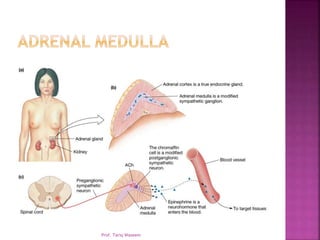
 Rare but fatal catecholamines producing
tumor
 Incidence: 2-8/million people/year
 Account for 5% of adrenal incidentaloma
 Rule of 10s:
 10% extra-adrenal, 10% bilateral, 10% familial,
10% malignant
 Aside from catecholamines, it can also
secrete dopamine, ACTH, PTH, calcitonin,
VIP
Prof. Tariq Waseem
 0.01-0.1% of HTN population
 Found in 0.5% of those screened
 M = F
 3rd to 5th decades of life
 Rare, investigate only if clinically
suspicion:
 Signs or Symptoms
 Severe HTN, HTN crisis
 Refractory HTN (> 3 drugs)
 HTN present @ age < 20 or > 50 ?
 Adrenal lesion found on imaging (ex. Incidentaloma)
Prof. Tariq Waseem
 The five P’s:
 Pressure (HTN) 90%
 Pain (Headache) 80%
 Perspiration 71%
 Palpitation 64%
 Pallor 42%
 Paroxysms
 The Classical Triad:
 Pain (Headache), Perspiration, Palpitations
 Lack of all 3 virtually excluded diagnosis of pheo in a
series of > 21,0000 patients
Prof. Tariq Waseem
 Plasma Fractionated free metanephrine
levels
 Urinary fractionated metanephrines and
metabolites
 Serum chromogranin A
 Clonidine suppression test
 Urinary VMA levels
 Additional tests
include…erythrocytosis,leukocytosis,hypergly
cemia,hypercalcemia,sometimes raised ESR
Prof. Tariq Waseem
 Physical or emotional stress
 Sleep apnea
 Drugs….MAO inhibitors, TCA’s, beta blockers,
amphetamine, levodopa, methyldopa,
labetalol,buspirone, phenoxybenzamine
Prof. Tariq Waseem
Prof. Tariq Waseem
Silent 8 cm pheo
 CT/ MRI abdomen
 Nuclear imaging….123 meta-iodobenzyl-
Guanidine
 PET scanning…18FDG-PET
 Somatostatin receptor imaging…111in-
labeled octreotide
Prof. Tariq Waseem
 SURGERY…treatment of choice for all
pheochromocytomas ( laproscopic
adrenalectomy, open laprotomy)
 Careful pre-operative management to control
blood pressure, correct fluid volume and
prevent intra-operative hypertensive crises
 MEDICATION therapy….for preop
management, acute hypertensive crises and
as a primary therapy for metastatic
pheochromocytoma.
Prof. Tariq Waseem
 Adrenergic blocking agents
 Minipress to BP
 Beta blocking agents
 Inderal to Heart Rate, BP & force of contraction
 Diet
 High in vitamin, Mineral, Calorie, No Caffeine
 Sedatives
Prof. Tariq Waseem
 Combined  +  blockade
 Phenoxybenzamine
 Selective 1-blocker (ex. Prazosin)
 Propanolol
 Metyrosine
 Calcium Channel Blocker (CCB)
 Nicardipine
Prof. Tariq Waseem
GIVE REGITINE AND NIPRIDE
TO PREVENT HYPERTENSIVE
CRISIS
Prof. Tariq Waseem
 Most cases can stop all BP meds postop
 Postop hypotension: IV crystalloid
 HTN free: 5 years 74% 10 years 45%
 24h urine collection 2 wk postop
 Surveillance:
 24h urine collections q1y for at least 10y
 Lifelong f/up
Prof. Tariq Waseem
 All the complications of severe hypertension
 Catecholamine induced cardiomyopathy
 Severe heart failure and cardiovascular
collapse
 Sudden death due to cardiac arrhythmias
 ARDS
 Hypertensive crises with sudden blindness
and CVA’s…not uncommon
Prof. Tariq Waseem
 -blockade
 Selective 1-blockers (Prazosin, Terazosin, Doxazosin)
1st line as less side-effects
 Phenoxybenzamine: more complete -blockade
 -blocker
 CCB, ACE-I, etc.
 Nuclear Medicine Rx:
 Hi dose 131I-MIBG or 111indium-octreotide depending on
MIBG scan or octreoscan pick-up
 Sensitize tumor with Carboplatin + 5-FU
Prof. Tariq Waseem
 Diagnosis with 24h urine collections and
MRI
 No stimulation tests, no MIBG if pregnant
 1st & 2nd trimester (< 24 weeks):
 Phenoxybenzamine + blocker prep
 Resect tumor ASAP laprascopically
 3rd trimester:
 Phenoxybenzamine + blocker prep
 When fetus large enough: cesarian section followed by
tumor resection
Prof. Tariq Waseem
 A 16 yr old girl was brought to medical OPD
with C/O increased facial hair and acne. Her
mother is concerned about delayed menarche
and not having a smart feminine figure. On her
last visit to physician she was told to watch her
BP which was recorded 140/95 mmHg.
 On examination, pt. is having male type hair
pattern along with ambiguous genitalia.
 Congenital adrenal hyperplasia (CAH) is a
group of inherited autosomal-recessive
disorders in which a genetic defect results in
the deficiency of an enzyme essential for
synthesis of cortisol and, at times,
aldosterone.
 Reduced cortisol secretion and resulting absence of
feedback pituitary inhibition increases ACTH to
maintain adequate cortisol causing adrenal
hyperplasia.
 There are several forms of CAH, the most common of
which is 21-hydroxylase (21-OH) deficiency, occurring
in over 90% of all cases.
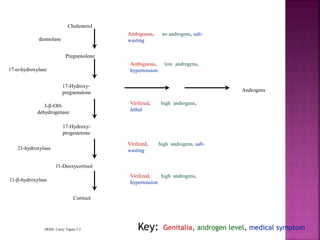
Cholesterol
Pregnenolone
17-Hydroxy-
pregnenalone
17-Hydroxy-
progesterone
11-Deoxycortisol
Cortisol
desmolase
17--hydroxylase
11--hydroxylase
21-hydroxylase
3--OH-
dehydrogenase
Androgens
Ambiguous, no androgens, salt-
wasting
Ambiguous, low androgens,
hypertension
Virilized, high androgens,
lethal
Virilized, high androgens, salt-
wasting
Virilized, high androgens,
hypertension
HGSS: Carey: Figure 5.2 Genitalia, androgen level, medical symptomKey:
Glucocorticoi
d
Cholesterol
(mitochondrial)
Pregnenolone
17OH-
Pregnenolone
17OH-
Progesterone
Cortisol
Progesterone
11-
deoxycorticosterone
Aldosterone
Mineralocorticoi
d
P-45021
Dehydroepiandrosterone
Androstenedione
(Testosterone
)
Oestradiol DHT
Androgen
ACTH
_
++
11-
deoxycortisol
 If severe, CAH presents at birth with sexual
ambiguity or adrenal failure ( collapse,
hypotension, hypoglycemia) sometimes with a
salt losing state( hypotension, hyponatremia).
 In females, clitoral hypertrophy, urogenital
abnormalities, and albioscrotal fusion are
common but syndrome may be unrecognized.
Milder cases present in adult life only with
primary amenorrhea.
 In males. Precocious puberty with hirsutism is
a later presentation,
 A profile of adrenocortical hormones is measured
before and 1hr after ACTH administration.
 Basal ACTH levels…are raised
 17-hydroxyprogesterone levels…are increased
 Urinary 17-ketosteroids are increased
 Androstenedione levels…are raised
Glucocorticoid replacement / Androgen Suppression
 Adults: usually dexamethasone, larger dose at bed-
time to suppress ACTH
 Beware of over-replacement and monitor :
17--progesterone (testosterone, cortisol, ACTH etc)
growth, bone age, BP, U&E, skin; osteoporosis scans
in adults
Correction of salt-wasting
 9-a-fludrocortisone 100-400mcg/day (long-
acting)
 Sodium chloride supplements until able to select
saltier foods
 Monitor BP, U&E, oedema (renin)
Corrective surgery to genitalia
Genetic counselling & psychological support
 A 34 yr old male presents in ER with C/O body
aches, episodic muscle weakness, numbness
and tingling of the limbs for last 5 days.
Symptoms worsened over 2 days leading to
severe muscle spasms.
 He also has polyuria and polydipsia especially
at night. He has frequent episodic headache
and Palpitation.
 He was diagnosed HTN last year and is on Beta
Blockers with poor control.
 B.P 160/100
 Pulse…86/ min, regular
 Respiratory rate..18/min
 No peripheral edema.
 Systemic examination was unremarkable
 CBC , LFT’S, RFT’S…Normal
 Serum potassium..2.1meq/L, serum
sodium..156meq/l
 Urinary postassium..> 32mmol/day
 What’s the diagnosis ?
 Primary Hyperaldosteronism
 Conn’s Syndrome
 Excessive secretion of aldosterone causes
 Increased Sodium reabsorbtion,
 Increased loss of potassium
 Increased loss hydrogen ions
 Hypokalemia and Hypertension.
 Peak incidence between 30-60yrs of age.
 May be primary ( autonomous) as in primary
adrenal hyperplasia, adrenal adenoma,
carcinoma
 Secondary hyperaldosteronism…associated
with renovascular hypertension, cirrhosis,
rennin producing tumours, pregnancy.
 Testing for primary hyperaldosteronism should
be done for all hypertensive patients with
hypokalemia.
 Frequent urination
 Increased thirst
 Weakness and fatigue
 Headache
 Muscle cramps
 Tingling in fingers
 Transient paralysis
 Palpitations
 Hypertension
 Hypokalemia ( Without Diuretic therapy)
 Urinary potassium loss..>30mmol/day
 Plasma aldosterone:rennin ratio
(ARR)…increased
 Elevated plasma aldosterone level (PA…that
are not suppressed with 0.9% saline ( 2L over
4hrs) or fludrocortisone administration.
 Suppressed plasma rennin activity
 18-hydroxycorticosterone level..>100ng/dl seen in
adrenal neoplasms.
 Adrenal vein sampling..to differentiate unilateral or
bilateral aldosteronism
 Posture stimulation test
 Imaging…CT abdomen
 Control of blood pressure.
 Conn’s syndrome(adenoma ), unilateral
aldosterone secreting adrenal tumours…treated
by laproscopic adrenalectomy though long term
therapy with spironolactone ( aldosterone
antagonist) or eplerenone is an option.
 Bilateral adrenal hyperplasia..best treated with
spironolactone or eplerenone.
 Secondary hyperaldosternism…ACE’s and ARB’s,
spironolactone.
Questions?
Prof. Tariq Waseem

Adrenal disorders 3

  • 1.
  • 3.
     A 22years old male presents with c/o severe headache off & on, palpitations and sweating while carrying out his daily activities.  He also complains of having a sense of impending doom and generalized weakness of his body along with trembling of his hands  His co-workers also noticed marked blushing of his face during such episodes.  He was diagnosed HTN one year ago and is using four antihpertensive drugs but his BP is rarely on target. Prof. Tariq Waseem
  • 4.
  • 5.
     On physicalexamination:  BP= 210/140  Pulse…92/min regular  Temp…98.6 F  Other positive findings include:  Pallor…+ve  Tremors…present  Systemic examination was unremarkable Prof. Tariq Waseem
  • 6.
     CBC.showing Hb..15g/dl TLC…18000  Serum Na+…139meq/l  Random blood glucose..200 mg/dl  Normal T3, T4, TSH  Normal ECG and echo Prof. Tariq Waseem
  • 7.
     Rare butfatal catecholamines producing tumor  Incidence: 2-8/million people/year  Account for 5% of adrenal incidentaloma  Rule of 10s:  10% extra-adrenal, 10% bilateral, 10% familial, 10% malignant  Aside from catecholamines, it can also secrete dopamine, ACTH, PTH, calcitonin, VIP Prof. Tariq Waseem
  • 8.
     0.01-0.1% ofHTN population  Found in 0.5% of those screened  M = F  3rd to 5th decades of life  Rare, investigate only if clinically suspicion:  Signs or Symptoms  Severe HTN, HTN crisis  Refractory HTN (> 3 drugs)  HTN present @ age < 20 or > 50 ?  Adrenal lesion found on imaging (ex. Incidentaloma) Prof. Tariq Waseem
  • 9.
     The fiveP’s:  Pressure (HTN) 90%  Pain (Headache) 80%  Perspiration 71%  Palpitation 64%  Pallor 42%  Paroxysms  The Classical Triad:  Pain (Headache), Perspiration, Palpitations  Lack of all 3 virtually excluded diagnosis of pheo in a series of > 21,0000 patients Prof. Tariq Waseem
  • 10.
     Plasma Fractionatedfree metanephrine levels  Urinary fractionated metanephrines and metabolites  Serum chromogranin A  Clonidine suppression test  Urinary VMA levels  Additional tests include…erythrocytosis,leukocytosis,hypergly cemia,hypercalcemia,sometimes raised ESR Prof. Tariq Waseem
  • 11.
     Physical oremotional stress  Sleep apnea  Drugs….MAO inhibitors, TCA’s, beta blockers, amphetamine, levodopa, methyldopa, labetalol,buspirone, phenoxybenzamine Prof. Tariq Waseem
  • 12.
  • 13.
     CT/ MRIabdomen  Nuclear imaging….123 meta-iodobenzyl- Guanidine  PET scanning…18FDG-PET  Somatostatin receptor imaging…111in- labeled octreotide Prof. Tariq Waseem
  • 14.
     SURGERY…treatment ofchoice for all pheochromocytomas ( laproscopic adrenalectomy, open laprotomy)  Careful pre-operative management to control blood pressure, correct fluid volume and prevent intra-operative hypertensive crises  MEDICATION therapy….for preop management, acute hypertensive crises and as a primary therapy for metastatic pheochromocytoma. Prof. Tariq Waseem
  • 15.
     Adrenergic blockingagents  Minipress to BP  Beta blocking agents  Inderal to Heart Rate, BP & force of contraction  Diet  High in vitamin, Mineral, Calorie, No Caffeine  Sedatives Prof. Tariq Waseem
  • 16.
     Combined +  blockade  Phenoxybenzamine  Selective 1-blocker (ex. Prazosin)  Propanolol  Metyrosine  Calcium Channel Blocker (CCB)  Nicardipine Prof. Tariq Waseem
  • 17.
    GIVE REGITINE ANDNIPRIDE TO PREVENT HYPERTENSIVE CRISIS Prof. Tariq Waseem
  • 18.
     Most casescan stop all BP meds postop  Postop hypotension: IV crystalloid  HTN free: 5 years 74% 10 years 45%  24h urine collection 2 wk postop  Surveillance:  24h urine collections q1y for at least 10y  Lifelong f/up Prof. Tariq Waseem
  • 19.
     All thecomplications of severe hypertension  Catecholamine induced cardiomyopathy  Severe heart failure and cardiovascular collapse  Sudden death due to cardiac arrhythmias  ARDS  Hypertensive crises with sudden blindness and CVA’s…not uncommon Prof. Tariq Waseem
  • 20.
     -blockade  Selective1-blockers (Prazosin, Terazosin, Doxazosin) 1st line as less side-effects  Phenoxybenzamine: more complete -blockade  -blocker  CCB, ACE-I, etc.  Nuclear Medicine Rx:  Hi dose 131I-MIBG or 111indium-octreotide depending on MIBG scan or octreoscan pick-up  Sensitize tumor with Carboplatin + 5-FU Prof. Tariq Waseem
  • 21.
     Diagnosis with24h urine collections and MRI  No stimulation tests, no MIBG if pregnant  1st & 2nd trimester (< 24 weeks):  Phenoxybenzamine + blocker prep  Resect tumor ASAP laprascopically  3rd trimester:  Phenoxybenzamine + blocker prep  When fetus large enough: cesarian section followed by tumor resection Prof. Tariq Waseem
  • 23.
     A 16yr old girl was brought to medical OPD with C/O increased facial hair and acne. Her mother is concerned about delayed menarche and not having a smart feminine figure. On her last visit to physician she was told to watch her BP which was recorded 140/95 mmHg.  On examination, pt. is having male type hair pattern along with ambiguous genitalia.
  • 24.
     Congenital adrenalhyperplasia (CAH) is a group of inherited autosomal-recessive disorders in which a genetic defect results in the deficiency of an enzyme essential for synthesis of cortisol and, at times, aldosterone.
  • 25.
     Reduced cortisolsecretion and resulting absence of feedback pituitary inhibition increases ACTH to maintain adequate cortisol causing adrenal hyperplasia.  There are several forms of CAH, the most common of which is 21-hydroxylase (21-OH) deficiency, occurring in over 90% of all cases.
  • 26.
    Cholesterol Pregnenolone 17-Hydroxy- pregnenalone 17-Hydroxy- progesterone 11-Deoxycortisol Cortisol desmolase 17--hydroxylase 11--hydroxylase 21-hydroxylase 3--OH- dehydrogenase Androgens Ambiguous, no androgens,salt- wasting Ambiguous, low androgens, hypertension Virilized, high androgens, lethal Virilized, high androgens, salt- wasting Virilized, high androgens, hypertension HGSS: Carey: Figure 5.2 Genitalia, androgen level, medical symptomKey:
  • 27.
  • 29.
     If severe,CAH presents at birth with sexual ambiguity or adrenal failure ( collapse, hypotension, hypoglycemia) sometimes with a salt losing state( hypotension, hyponatremia).  In females, clitoral hypertrophy, urogenital abnormalities, and albioscrotal fusion are common but syndrome may be unrecognized. Milder cases present in adult life only with primary amenorrhea.  In males. Precocious puberty with hirsutism is a later presentation,
  • 30.
     A profileof adrenocortical hormones is measured before and 1hr after ACTH administration.  Basal ACTH levels…are raised  17-hydroxyprogesterone levels…are increased  Urinary 17-ketosteroids are increased  Androstenedione levels…are raised
  • 31.
    Glucocorticoid replacement /Androgen Suppression  Adults: usually dexamethasone, larger dose at bed- time to suppress ACTH  Beware of over-replacement and monitor : 17--progesterone (testosterone, cortisol, ACTH etc) growth, bone age, BP, U&E, skin; osteoporosis scans in adults
  • 32.
    Correction of salt-wasting 9-a-fludrocortisone 100-400mcg/day (long- acting)  Sodium chloride supplements until able to select saltier foods  Monitor BP, U&E, oedema (renin)
  • 33.
    Corrective surgery togenitalia Genetic counselling & psychological support
  • 35.
     A 34yr old male presents in ER with C/O body aches, episodic muscle weakness, numbness and tingling of the limbs for last 5 days. Symptoms worsened over 2 days leading to severe muscle spasms.  He also has polyuria and polydipsia especially at night. He has frequent episodic headache and Palpitation.  He was diagnosed HTN last year and is on Beta Blockers with poor control.
  • 36.
     B.P 160/100 Pulse…86/ min, regular  Respiratory rate..18/min  No peripheral edema.  Systemic examination was unremarkable
  • 37.
     CBC ,LFT’S, RFT’S…Normal  Serum potassium..2.1meq/L, serum sodium..156meq/l  Urinary postassium..> 32mmol/day  What’s the diagnosis ?
  • 38.
  • 39.
     Excessive secretionof aldosterone causes  Increased Sodium reabsorbtion,  Increased loss of potassium  Increased loss hydrogen ions  Hypokalemia and Hypertension.  Peak incidence between 30-60yrs of age.
  • 40.
     May beprimary ( autonomous) as in primary adrenal hyperplasia, adrenal adenoma, carcinoma  Secondary hyperaldosteronism…associated with renovascular hypertension, cirrhosis, rennin producing tumours, pregnancy.  Testing for primary hyperaldosteronism should be done for all hypertensive patients with hypokalemia.
  • 41.
     Frequent urination Increased thirst  Weakness and fatigue  Headache  Muscle cramps  Tingling in fingers  Transient paralysis  Palpitations  Hypertension
  • 42.
     Hypokalemia (Without Diuretic therapy)  Urinary potassium loss..>30mmol/day  Plasma aldosterone:rennin ratio (ARR)…increased  Elevated plasma aldosterone level (PA…that are not suppressed with 0.9% saline ( 2L over 4hrs) or fludrocortisone administration.
  • 43.
     Suppressed plasmarennin activity  18-hydroxycorticosterone level..>100ng/dl seen in adrenal neoplasms.  Adrenal vein sampling..to differentiate unilateral or bilateral aldosteronism  Posture stimulation test  Imaging…CT abdomen
  • 44.
     Control ofblood pressure.  Conn’s syndrome(adenoma ), unilateral aldosterone secreting adrenal tumours…treated by laproscopic adrenalectomy though long term therapy with spironolactone ( aldosterone antagonist) or eplerenone is an option.
  • 45.
     Bilateral adrenalhyperplasia..best treated with spironolactone or eplerenone.  Secondary hyperaldosternism…ACE’s and ARB’s, spironolactone.
  • 47.