Objectives
Describing the formation of ionic bond
Explaining: compound formation and
charge
True or False
Table salt (sodium chloride ) conducts
electricity .
Ionic Bonds And Ionic Compounds
 Oppositely charged ions attract each other,
forming electrically neutral ionic compounds
 Formation of an Ionic Bond
 Ionic bond : The electrostatic force that holds
oppositely charged particles together in an ionic
compound
 Compounds that contain ionic bonds are Ionic
compounds
 If ionic bonds occur between metals and the (oxygen) , oxides
form. Most other ionic compounds are called salts.
Binary ionic compounds
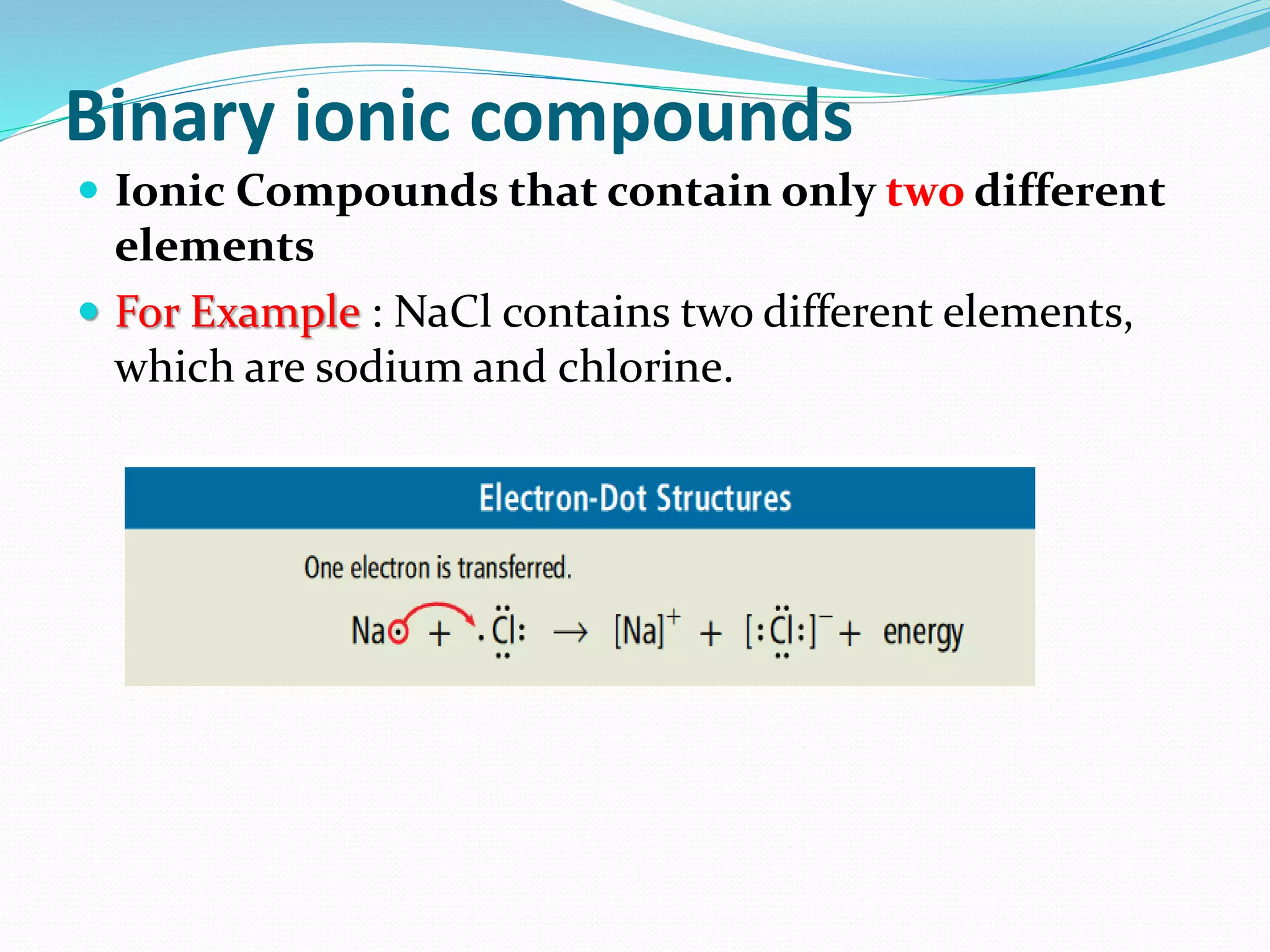
 Ionic Compounds that contain only two different
elements
 For Example : NaCl contains two different elements,
which are sodium and chlorine.
Compound formation and charge
Example (calcium fluoride )
 Calcium needs to lose two electrons to attain the stable
configuration of argon.
 Fluorine must gain one electron to attain the stable
configuration of neon
(1()2( + )+2()1–= )
0
7- sodium loses one electron to form 1+ ion and nitrogen needs
to gain 3 electrons forming 3- ion
The ions attract forming Na3N
Summarize the charges on each ion
in the following ionic compounds
MgO , NaF , SrCl2
Mg 2+ , O2- , Na + , F - ,Sr 2+ , Cl -
Physical properties of ionic compounds
 Melting point, boiling point, and hardness are physical
properties of matter that depend on how strongly the
particles that make up the matter are attracted to one
another
 the ability of a material to conduct electricity depends on
the availability of freely moving charged particles.
 In the solid state, the ions in an ionic compound are locked
into fixed positions by strong attractive forces. As a result,
ionic solids do not conduct electricity.
 but when an ionic solid melts to become a liquid or is
dissolved in solution. The ions are now free to move and
conduct an electric current.
Physical properties
 Electrolyte :An ionic compound whose aqueous
solution conducts the electricity
 Ionic crystals have high melting points and high
boiling points , Why?
 Because ionic bonds are relatively strong, ionic crystals
require a large amount of energy to be broken apart
What makes the crystal cracks ?
the crystal cracks or breaks apart, as shown in
Figure 9. The crystal breaks apart because the
applied force repositions the like-charged ions
next to each other; the resulting repulsive force
breaks apart the crystal.
Energy and the Ionic Bond
Exothermic
Endothermic
During every chemical reaction, energy is
either absorbed or released.
If energy is absorbed during a chemical reaction, the
reaction is endothermic. If energy is released, it is
exothermic
The formation of ionic compounds from positive ions
and negative ions is always Exothermic
Properties of Ionic Compounds
 the ionic bonds produce unique physical structures,
unlike those of other compounds
 A crystal lattice is a three-dimensional geometric
arrangement of particles
 lattice energy :the energy required to separate 1 mol of
the ions of an ionic compound
 In a crystal lattice, each positive ion is surrounded by
negative ions, and each negative ion is surrounded by
positive ions.
crystal lattice
is a three-dimensional geometric arrangement of
particles In a crystal lattice, each positive ion is
surrounded by negative
 The greater the lattice energy, the stronger the force of
attraction.
 Lattice energy is related to the size of the ions
bonded.
Because the electrostatic force of attraction between
opposite charges increases as the distance between
the charges decreases
1- Smaller ions produce stronger interionic
attractions and greater lattice energies.
• For example :
• The lattice energy of a lithium compound is
greater than that of a potassium compound
containing the same anion because the lithium
ion is smaller than the potassium ion.
2- The value of lattice energy is also affected by the
charge of the ion.
• The ionic bond formed from the attraction of
ions with larger positive or negative charges
generally has a greater lattice energy.
Size and charge & lattice energy
So : MgO is four times greater than NaF

Ionic bonds and Ionic compounds

  • 2.
    Objectives Describing the formationof ionic bond Explaining: compound formation and charge
  • 3.
    True or False Tablesalt (sodium chloride ) conducts electricity .
  • 4.
    Ionic Bonds AndIonic Compounds  Oppositely charged ions attract each other, forming electrically neutral ionic compounds  Formation of an Ionic Bond  Ionic bond : The electrostatic force that holds oppositely charged particles together in an ionic compound  Compounds that contain ionic bonds are Ionic compounds  If ionic bonds occur between metals and the (oxygen) , oxides form. Most other ionic compounds are called salts.
  • 5.
    Binary ionic compounds Ionic Compounds that contain only two different elements  For Example : NaCl contains two different elements, which are sodium and chlorine.
  • 6.
    Compound formation andcharge Example (calcium fluoride )  Calcium needs to lose two electrons to attain the stable configuration of argon.  Fluorine must gain one electron to attain the stable configuration of neon (1()2( + )+2()1–= ) 0
  • 7.
    7- sodium losesone electron to form 1+ ion and nitrogen needs to gain 3 electrons forming 3- ion The ions attract forming Na3N
  • 8.
    Summarize the chargeson each ion in the following ionic compounds MgO , NaF , SrCl2 Mg 2+ , O2- , Na + , F - ,Sr 2+ , Cl -
  • 9.
    Physical properties ofionic compounds  Melting point, boiling point, and hardness are physical properties of matter that depend on how strongly the particles that make up the matter are attracted to one another  the ability of a material to conduct electricity depends on the availability of freely moving charged particles.  In the solid state, the ions in an ionic compound are locked into fixed positions by strong attractive forces. As a result, ionic solids do not conduct electricity.  but when an ionic solid melts to become a liquid or is dissolved in solution. The ions are now free to move and conduct an electric current.
  • 10.
    Physical properties  Electrolyte:An ionic compound whose aqueous solution conducts the electricity  Ionic crystals have high melting points and high boiling points , Why?  Because ionic bonds are relatively strong, ionic crystals require a large amount of energy to be broken apart
  • 11.
    What makes thecrystal cracks ? the crystal cracks or breaks apart, as shown in Figure 9. The crystal breaks apart because the applied force repositions the like-charged ions next to each other; the resulting repulsive force breaks apart the crystal.
  • 12.
    Energy and theIonic Bond Exothermic Endothermic During every chemical reaction, energy is either absorbed or released. If energy is absorbed during a chemical reaction, the reaction is endothermic. If energy is released, it is exothermic The formation of ionic compounds from positive ions and negative ions is always Exothermic
  • 13.
    Properties of IonicCompounds  the ionic bonds produce unique physical structures, unlike those of other compounds  A crystal lattice is a three-dimensional geometric arrangement of particles  lattice energy :the energy required to separate 1 mol of the ions of an ionic compound  In a crystal lattice, each positive ion is surrounded by negative ions, and each negative ion is surrounded by positive ions.
  • 14.
    crystal lattice is athree-dimensional geometric arrangement of particles In a crystal lattice, each positive ion is surrounded by negative  The greater the lattice energy, the stronger the force of attraction.  Lattice energy is related to the size of the ions bonded. Because the electrostatic force of attraction between opposite charges increases as the distance between the charges decreases
  • 15.
    1- Smaller ionsproduce stronger interionic attractions and greater lattice energies. • For example : • The lattice energy of a lithium compound is greater than that of a potassium compound containing the same anion because the lithium ion is smaller than the potassium ion. 2- The value of lattice energy is also affected by the charge of the ion. • The ionic bond formed from the attraction of ions with larger positive or negative charges generally has a greater lattice energy. Size and charge & lattice energy So : MgO is four times greater than NaF