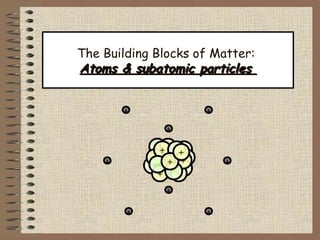
The Building Blocks of Matter:
Atoms & subatomic particlesAtoms & subatomic particles
+
+
+
+
+
++
-
-
-
-
--
-
-
+
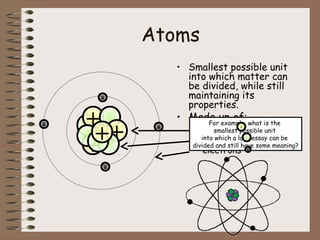
Atoms
• Smallest possible unit
into which matter can
be divided, while still
maintaining its
properties.
• Made up of:
– protons
– neutrons
– electrons
For example, what is the
smallest possible unit
into which a long essay can be
divided and still have some meaning?
+
-
+
+
+
-
-
- -
+
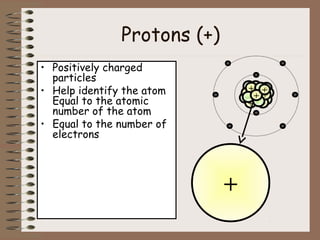
Protons (+)
• Positively charged
particles
• Help identify the atom
Equal to the atomic
number of the atom
• Equal to the number of
electrons
+
+
+
+
+
+
++
-
-
-
-
--
-
-
+
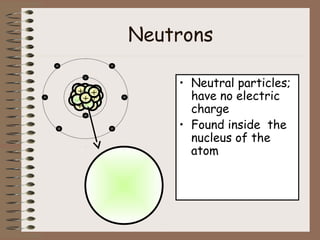
Neutrons
• Neutral particles;
have no electric
charge
• Found inside the
nucleus of the
atom
+
+
+
+
+
++
-
-
-
-
--
-
-
+
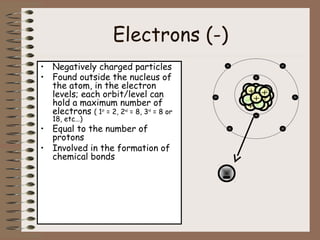
Electrons (-)
• Negatively charged particles
• Found outside the nucleus of
the atom, in the electron
levels; each orbit/level can
hold a maximum number of
electrons ( 1st
= 2, 2nd
= 8, 3rd
= 8 or
18, etc…)
• Equal to the number of
protons
• Involved in the formation of
chemical bonds
-
+
+
+
+
+
++
-
-
-
-
--
-
-
+
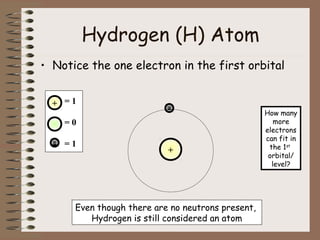
Hydrogen (H) Atom
• Notice the one electron in the first orbital
+
-
Even though there are no neutrons present,
Hydrogen is still considered an atom
+
-
= 1
= 0
= 1
How many
more
electrons
can fit in
the 1st
orbital/
level?
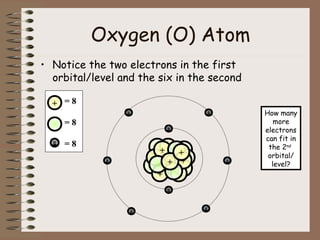
Oxygen (O) Atom
• Notice the two electrons in the first
orbital/level and the six in the second
+
+
+
+
+
++
-
-
-
-
--
-
-
+
+
-
= 8
= 8
= 8
How many
more
electrons
can fit in
the 2nd
orbital/
level?
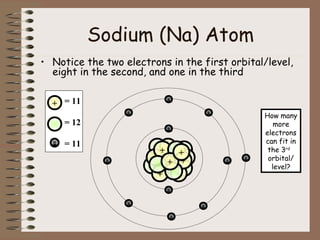
Sodium (Na) Atom
• Notice the two electrons in the first orbital/level,
eight in the second, and one in the third
+
+
+
+
+
++
-
-
-
-
--
-
-
+
-
-
-
+
-
= 11
= 12
= 11
How many
more
electrons
can fit in
the 3rd
orbital/
level?
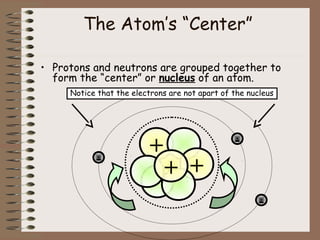
The Atom’s “Center”
• Protons and neutrons are grouped together to
form the “center” or nucleus of an atom.
-
+
++
Notice that the electrons are not apart of the nucleus
-
-
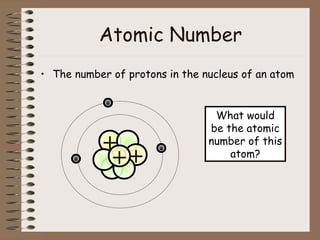
Atomic Number
• The number of protons in the nucleus of an atom
+
++
-
-
-
What would
be the atomic
number of this
atom?
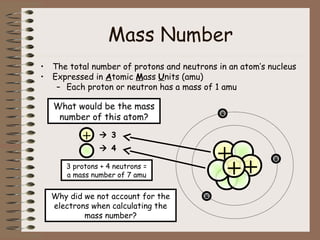
Mass Number
• The total number of protons and neutrons in an atom’s nucleus
• Expressed in Atomic Mass Units (amu)
– Each proton or neutron has a mass of 1 amu
+
++
-
-
-
What would be the mass
number of this atom?
+  3
 4
3 protons + 4 neutrons =
a mass number of 7 amu
Why did we not account for the
electrons when calculating the
mass number?
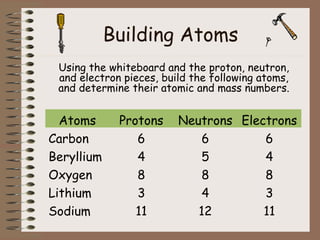
Building Atoms
Using the whiteboard and the proton, neutron,
and electron pieces, build the following atoms,
and determine their atomic and mass numbers.
Atoms Protons Neutrons Electrons
Carbon 6 6 6
Beryllium 4 5 4
Oxygen 8 8 8
Lithium 3 4 3
Sodium 11 12 11
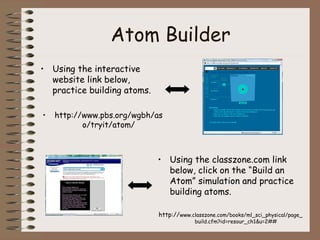
Atom Builder
• Using the interactive
website link below,
practice building atoms.
• http://www.pbs.org/wgbh/as
o/tryit/atom/
• Using the classzone.com link
below, click on the “Build an
Atom” simulation and practice
building atoms.
http://www.classzone.com/books/ml_sci_physical/page_
build.cfm?id=resour_ch1&u=2##
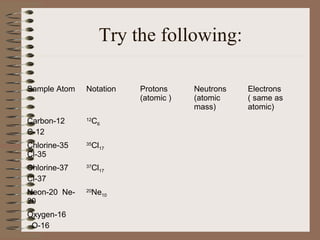
Try the following:
Sample Atom Notation Protons
(atomic )
Neutrons
(atomic
mass)
Electrons
( same as
atomic)
Carbon-12
C-12
12
C6
Chlorine-35
Cl-35
35
Cl17
Chlorine-37
Cl-37
37
Cl17
Neon-20 Ne-
20
20
Ne10
Oxygen-16
O-16
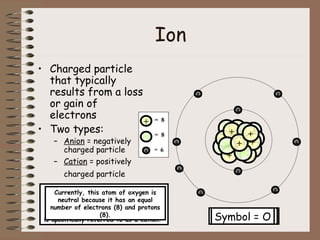
Symbol = O2+
Ion
• Charged particle
that typically
results from a loss
or gain of
electrons
• Two types:
– Anion = negatively
charged particle
– Cation = positively
charged particle
+
+
+
+
+
++
-
-
-
-
--
-
-
+
-
Now that this atom of oxygen just
gained an electron, it is no longer
neutral or an atom. It is now
considered an ion (anion). This ion has
more electrons (9) than protons (8).
+
-
= 8
= 8
= 896
Symbol = O1-
Now that three electrons were lost,
the number of electrons (6) and
protons (8) is still unbalanced;
therefore, it is still an ion, but now it
is specifically referred to as a cation.
Currently, this atom of oxygen is
neutral because it has an equal
number of electrons (8) and protons
(8).
Symbol = O

Atoms

  • 1.
    The Building Blocksof Matter: Atoms & subatomic particlesAtoms & subatomic particles + + + + + ++ - - - - -- - - +
  • 2.
    Atoms • Smallest possibleunit into which matter can be divided, while still maintaining its properties. • Made up of: – protons – neutrons – electrons For example, what is the smallest possible unit into which a long essay can be divided and still have some meaning? + - + + + - - - - +
  • 3.
    Protons (+) • Positivelycharged particles • Help identify the atom Equal to the atomic number of the atom • Equal to the number of electrons + + + + + + ++ - - - - -- - - +
  • 4.
    Neutrons • Neutral particles; haveno electric charge • Found inside the nucleus of the atom + + + + + ++ - - - - -- - - +
  • 5.
    Electrons (-) • Negativelycharged particles • Found outside the nucleus of the atom, in the electron levels; each orbit/level can hold a maximum number of electrons ( 1st = 2, 2nd = 8, 3rd = 8 or 18, etc…) • Equal to the number of protons • Involved in the formation of chemical bonds - + + + + + ++ - - - - -- - - +
  • 6.
    Hydrogen (H) Atom •Notice the one electron in the first orbital + - Even though there are no neutrons present, Hydrogen is still considered an atom + - = 1 = 0 = 1 How many more electrons can fit in the 1st orbital/ level?
  • 7.
    Oxygen (O) Atom •Notice the two electrons in the first orbital/level and the six in the second + + + + + ++ - - - - -- - - + + - = 8 = 8 = 8 How many more electrons can fit in the 2nd orbital/ level?
  • 8.
    Sodium (Na) Atom •Notice the two electrons in the first orbital/level, eight in the second, and one in the third + + + + + ++ - - - - -- - - + - - - + - = 11 = 12 = 11 How many more electrons can fit in the 3rd orbital/ level?
  • 9.
    The Atom’s “Center” •Protons and neutrons are grouped together to form the “center” or nucleus of an atom. - + ++ Notice that the electrons are not apart of the nucleus - -
  • 10.
    Atomic Number • Thenumber of protons in the nucleus of an atom + ++ - - - What would be the atomic number of this atom?
  • 11.
    Mass Number • Thetotal number of protons and neutrons in an atom’s nucleus • Expressed in Atomic Mass Units (amu) – Each proton or neutron has a mass of 1 amu + ++ - - - What would be the mass number of this atom? +  3  4 3 protons + 4 neutrons = a mass number of 7 amu Why did we not account for the electrons when calculating the mass number?
  • 12.
    Building Atoms Using thewhiteboard and the proton, neutron, and electron pieces, build the following atoms, and determine their atomic and mass numbers. Atoms Protons Neutrons Electrons Carbon 6 6 6 Beryllium 4 5 4 Oxygen 8 8 8 Lithium 3 4 3 Sodium 11 12 11
  • 13.
    Atom Builder • Usingthe interactive website link below, practice building atoms. • http://www.pbs.org/wgbh/as o/tryit/atom/ • Using the classzone.com link below, click on the “Build an Atom” simulation and practice building atoms. http://www.classzone.com/books/ml_sci_physical/page_ build.cfm?id=resour_ch1&u=2##
  • 14.
    Try the following: SampleAtom Notation Protons (atomic ) Neutrons (atomic mass) Electrons ( same as atomic) Carbon-12 C-12 12 C6 Chlorine-35 Cl-35 35 Cl17 Chlorine-37 Cl-37 37 Cl17 Neon-20 Ne- 20 20 Ne10 Oxygen-16 O-16
  • 15.
    Symbol = O2+ Ion •Charged particle that typically results from a loss or gain of electrons • Two types: – Anion = negatively charged particle – Cation = positively charged particle + + + + + ++ - - - - -- - - + - Now that this atom of oxygen just gained an electron, it is no longer neutral or an atom. It is now considered an ion (anion). This ion has more electrons (9) than protons (8). + - = 8 = 8 = 896 Symbol = O1- Now that three electrons were lost, the number of electrons (6) and protons (8) is still unbalanced; therefore, it is still an ion, but now it is specifically referred to as a cation. Currently, this atom of oxygen is neutral because it has an equal number of electrons (8) and protons (8). Symbol = O