ACID &BASE
THEORIES
Lesson
1:Bronsted/Lowry
Theory of Acids and
Bases
OBJECTIVES
Define a Brønsted–Lowry acid as a proton/H+ donor and a Brønsted–Lowry
base is a proton/H+ acceptor.
State that an amphiprotic species can act as both Brønsted–Lowry acids and
bases.
Distinguish between a pair of species differing by a single proton as a
conjugate acid-base pair.
BRONSTED/LOWRY THEORY OF
ACIDS AND BASES
Danish chemist Bronsted + English chemist Lowry independently
proposed new definitions for an acid and a base
These simply state that:
Acid is hydrogen-ion donor (H+ or proton)
Base is hydrogen-ion acceptor.
Acids and bases always come in pairs.
BRØNSTED-LOWRY
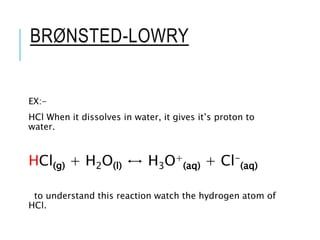
EX:-
HCl When it dissolves in water, it gives it’s proton to
water.
HCl(g) + H2O(l) ↔ H3O+
(aq) + Cl-
(aq)
to understand this reaction watch the hydrogen atom of
HCl.
CONSIDER THIS
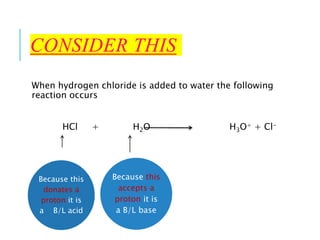
When hydrogen chloride is added to water the following
reaction occurs
HCl + H2O H3O+ + Cl-
Because this
donates a
proton it is
a B/L acid
Because this
accepts a
proton it is
a B/L base
CONSIDER THIS
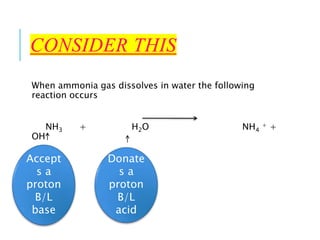
When ammonia gas dissolves in water the following
reaction occurs
NH3 + H2O NH4
+ +
OH-
Accept
s a
proton
B/L
base
Donate
s a
proton
B/L
acid
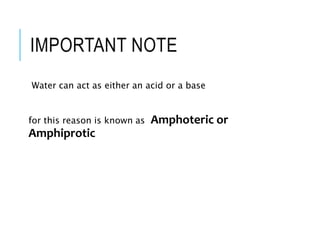
IMPORTANT NOTE
Water can act as either an acid or a base
for this reason is known as Amphoteric or
Amphiprotic
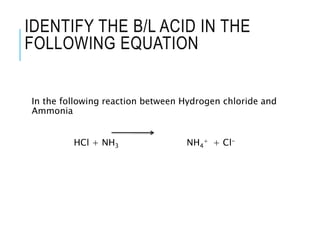
IDENTIFY THE B/L ACID IN THE
FOLLOWING EQUATION
In the following reaction between Hydrogen chloride and
Ammonia
HCl + NH3 NH4
+ + Cl-
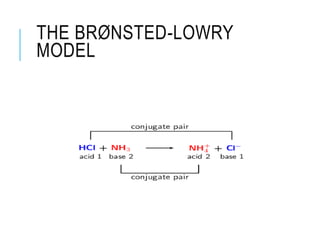
THE BRØNSTED-LOWRY
MODEL
NOTE
An acid will only donate a proton when there is
something there to accept it
A base will only accept a proton if there is something
there to donate it
THE BRØNSTED-
LOWRY MODEL
CONJUGATE ACID-BASE PAIR
 When an acid donates its proton, the remaining part of the acid is called the
conjugate base of that acid.
THE BRØNSTED-
LOWRY MODEL
CONJUGATE ACID-
BASE PAIR
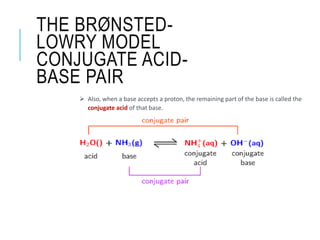
 Also, when a base accepts a proton, the remaining part of the base is called the
conjugate acid of that base.
THE BRØNSTED-LOWRY
MODEL CONJUGATE ACID-
BASE PAIR
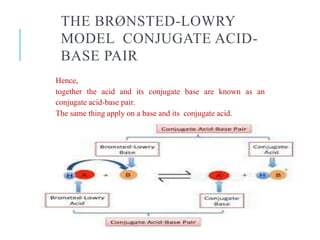
Hence,
together the acid and its conjugate base are known as an
conjugate acid-base pair.
The same thing apply on a base and its conjugate acid.
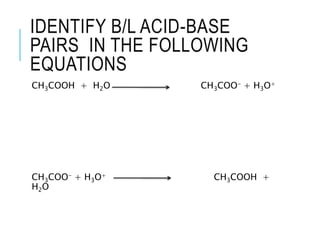
IDENTIFY B/L ACID-BASE
PAIRS IN THE FOLLOWING
EQUATIONS
CH3COOH + H2O CH3COO- + H3O+
CH3COO- + H3O+ CH3COOH +
H2O
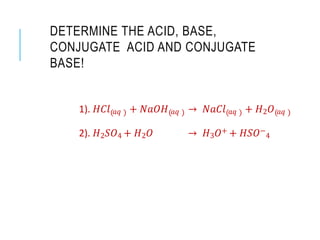
DETERMINE THE ACID, BASE,
CONJUGATE ACID AND CONJUGATE
BASE!
1). 𝐻𝐶𝑙 𝑎𝑞 + 𝑁𝑎𝑂𝐻 𝑎𝑞 → 𝑁𝑎𝐶𝑙 𝑎𝑞 + 𝐻2 𝑂 𝑎𝑞
2). 𝐻2 𝑆𝑂4 + 𝐻2 𝑂 → 𝐻3 𝑂+ + 𝐻𝑆𝑂−
4
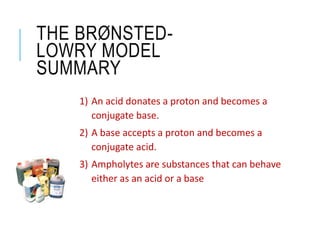
THE BRØNSTED-
LOWRY MODEL
SUMMARY
1) An acid donates a proton and becomes a
conjugate base.
2) A base accepts a proton and becomes a
conjugate acid.
3) Ampholytes are substances that can behave
either as an acid or a base

Bronsted lowry acid and base

  • 1.
  • 2.
    OBJECTIVES Define a Brønsted–Lowryacid as a proton/H+ donor and a Brønsted–Lowry base is a proton/H+ acceptor. State that an amphiprotic species can act as both Brønsted–Lowry acids and bases. Distinguish between a pair of species differing by a single proton as a conjugate acid-base pair.
  • 3.
    BRONSTED/LOWRY THEORY OF ACIDSAND BASES Danish chemist Bronsted + English chemist Lowry independently proposed new definitions for an acid and a base These simply state that: Acid is hydrogen-ion donor (H+ or proton) Base is hydrogen-ion acceptor. Acids and bases always come in pairs.
  • 4.
    BRØNSTED-LOWRY EX:- HCl When itdissolves in water, it gives it’s proton to water. HCl(g) + H2O(l) ↔ H3O+ (aq) + Cl- (aq) to understand this reaction watch the hydrogen atom of HCl.
  • 5.
    CONSIDER THIS When hydrogenchloride is added to water the following reaction occurs HCl + H2O H3O+ + Cl- Because this donates a proton it is a B/L acid Because this accepts a proton it is a B/L base
  • 6.
    CONSIDER THIS When ammoniagas dissolves in water the following reaction occurs NH3 + H2O NH4 + + OH- Accept s a proton B/L base Donate s a proton B/L acid
  • 7.
    IMPORTANT NOTE Water canact as either an acid or a base for this reason is known as Amphoteric or Amphiprotic
  • 8.
    IDENTIFY THE B/LACID IN THE FOLLOWING EQUATION In the following reaction between Hydrogen chloride and Ammonia HCl + NH3 NH4 + + Cl-
  • 9.
  • 10.
    NOTE An acid willonly donate a proton when there is something there to accept it A base will only accept a proton if there is something there to donate it
  • 11.
    THE BRØNSTED- LOWRY MODEL CONJUGATEACID-BASE PAIR  When an acid donates its proton, the remaining part of the acid is called the conjugate base of that acid.
  • 12.
    THE BRØNSTED- LOWRY MODEL CONJUGATEACID- BASE PAIR  Also, when a base accepts a proton, the remaining part of the base is called the conjugate acid of that base.
  • 13.
    THE BRØNSTED-LOWRY MODEL CONJUGATEACID- BASE PAIR Hence, together the acid and its conjugate base are known as an conjugate acid-base pair. The same thing apply on a base and its conjugate acid.
  • 14.
    IDENTIFY B/L ACID-BASE PAIRSIN THE FOLLOWING EQUATIONS CH3COOH + H2O CH3COO- + H3O+ CH3COO- + H3O+ CH3COOH + H2O
  • 15.
    DETERMINE THE ACID,BASE, CONJUGATE ACID AND CONJUGATE BASE! 1). 𝐻𝐶𝑙 𝑎𝑞 + 𝑁𝑎𝑂𝐻 𝑎𝑞 → 𝑁𝑎𝐶𝑙 𝑎𝑞 + 𝐻2 𝑂 𝑎𝑞 2). 𝐻2 𝑆𝑂4 + 𝐻2 𝑂 → 𝐻3 𝑂+ + 𝐻𝑆𝑂− 4
  • 16.
    THE BRØNSTED- LOWRY MODEL SUMMARY 1)An acid donates a proton and becomes a conjugate base. 2) A base accepts a proton and becomes a conjugate acid. 3) Ampholytes are substances that can behave either as an acid or a base