KS3 Chemistry

8E Atoms and
Elements
1 of 36
20

© Boardworks Ltd 2004
2005
Contents

8E Atoms and Elements
What are atoms and elements?
Symbols for elements
Elements in the periodic table
Making compounds
Chemical reactions
Summary activities
1 of 36
20
2

© Boardworks Ltd 2004
2005
How many different substances are there?

How many
different substances
can you think of?

There are millions of different substances!
What are they all made of?
1 of 36
20
3

© Boardworks Ltd 2004
2005
All substances are made of atoms
All substances are made of very tiny particles called atoms.
Many substances are made up of different types of atoms.

hydrogen and
oxygen atoms

iron, aluminium,
silicon, oxygen
and boron atoms
1 of 36
20
4

carbon and
hydrogen atoms

carbon, nitrogen,
hydrogen, oxygen
and sulphur atoms
© Boardworks Ltd 2004
2005
What is an element?
All substances are made of very tiny particles called atoms.
There are about one hundred substances that are made up
of just one type of atom. These are the elements.

carbon

helium

copper
The elements are the simplest substances in the universe.
The elements are the building blocks of all other substances.
1 of 36
20
5

© Boardworks Ltd 2004
2005
Atoms in elements
An element is a substance made up of only one type of atom.

Copper is an
element made up of
copper atoms only.
1 of 36
20
6

Carbon is an
element made up of
carbon atoms only.

Helium is an
element made up of
helium atoms only.
© Boardworks Ltd 2004
2005
Atoms and molecules of elements
An element is a substance made up of only one type of atom.
In some elements, the atoms are joined in groups of two or
more. A particle containing atoms grouped in this way is
called a molecule.
Oxygen is an
element made up of
oxygen atoms only.
How many atoms
are there in an
oxygen molecule?
Other elements, that contain atoms joined in molecules are
hydrogen, nitrogen, chlorine and bromine.
1 of 36
20
7

© Boardworks Ltd 2004
2005
Contents

8E Atoms and Elements
What are atoms and elements?
Symbols for elements
Elements in the periodic table
Making compounds
Chemical reactions
Summary activities
1 of 36
20
8

© Boardworks Ltd 2004
2005
Introducing chemical symbols
A standard set of symbols is used to represent elements:
The symbol for many of the more common elements uses
just the first letter of the name.

H = hydrogen
C = carbon
F = fluorine
Others elements have
the first two letters.

Li = lithium
Al = aluminium
He = helium
1 of 36
20
9

O = oxygen
N = nitrogen
I = iodine
Some of the symbols are not
always as you might expect.

Pb = lead
Au = gold
Ag = silver
© Boardworks Ltd 2004
2005
Symbols as an international language

1 of 20
10 of 36

© Boardworks Ltd 2004
2005
How to write symbols for elements
Two important rules should be followed when writing the
symbols of elements so that there is no confusion.
1. The first letter of an element’s symbol is always
a capital letter.
e.g.

N (not n) for nitrogen

2. If there are two letters in the element’s symbol,
the second letter is always a small letter.
e.g.

Co (not CO) for cobalt

No, Watson! It was
carbon monoxide
poisoning – not cobalt.

1 of 20
11 of 36

© Boardworks Ltd 2004
2005
Chemical symbols game

1 of 20
12 of 36

© Boardworks Ltd 2004
2005
The Story of ‘The Kid’

1 of 20
13 of 36

© Boardworks Ltd 2004
2005
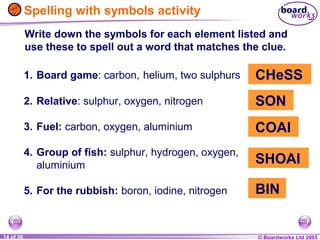
Spelling with symbols activity
Write down the symbols for each element listed and
use these to spell out a word that matches the clue.
1. Board game: carbon, helium, two sulphurs
2. Relative: sulphur, oxygen, nitrogen

SON

3. Fuel: carbon, oxygen, aluminium

COAl

4. Group of fish: sulphur, hydrogen, oxygen,
aluminium

SHOAl

5. For the rubbish: boron, iodine, nitrogen

1 of 20
14 of 36

CHeSS

BIN

© Boardworks Ltd 2004
2005
Symbols for molecules of elements
In some elements, the atoms are joined together and
form molecules. Combining the symbols of the atoms
in a molecule gives you the formula of the molecule.
What is the formula for the molecules in each element?

oxygen

nitrogen
1 of 20
15 of 36

O2
N2

There are
groups of
two atoms
in each
molecule.

© Boardworks Ltd 2004
2005
Contents

8E Atoms and Elements
What are atoms and elements?
Symbols for elements
Elements in the periodic table
Making compounds
Chemical reactions
Summary activities
1 of 20
16 of 36

© Boardworks Ltd 2004
2005
Arranging elements

1 of 20
17 of 36

© Boardworks Ltd 2004
2005
Metal or non-metal?
Is this element a metal

or a non-metal ?
Hard to
say!

H
Li Be
Na Mg
K Ca Sc
Rb Sr Y
Cs Ba La
Fr Ra Ac
1 of 20
18 of 36

B C N O
Al Si P S
V Cr Mn Fe Co Ni Cu Zn Ga Ge As Se
Nb Mo Tc Ru Rh Pd Ag Cd In Sn Sb Te
Ta W Re Os Ir Pt Au Hg Tl Pb Bi Po
Db Sg Bh Hs Mt ? ? ?

antimony (S)
iodine iron (Fe) (Mg)
(I)
copper (Cu)
phosphorus
sulfur (Sb)
magnesium (P)
Ti
Zr
Hf
Rf

F
Cl
Br
I
At

He
Ne
Ar
Kr
Xe
Rn

© Boardworks Ltd 2004
2005
Metals and non-metals in the periodic table
The periodic table is a list of all the known elements which
are arranged according to the similarities in their properties.
Non-metals are
Metals are on the
mostly on the right.
left and in the centre.

Xe

What type of elements are between metals and non-metals?
1 of 20
19 of 36

© Boardworks Ltd 2004
2005
Types of elements in the periodic table

1 of 20
20 of 36

© Boardworks Ltd 2004
2005
Metal, non-metal or metalloid?
krypton(Si)
francium (Fr)
silicon (Kr)
scandium (Sc)
cobalt (Co)
Which are
What side
are the
are the nonmetalloids?
metals on?

H
Li Be
Na Mg
K Ca Sc
Rb Sr Y
Cs Ba La
Fr Ra Ac

Ti
Zr
Hf
Rf

metalloid
non-metal
metal

B C N O
Al Si P S
V Cr Mn Fe Co Ni Cu Zn Ga Ge As Se
Nb Mo Tc Ru Rh Pd Ag Cd In Sn Sb Te
Ta W Re Os Ir Pt Au Hg Tl Pb Bi Po
Db Sg Bh Hs Mt ? ? ?

F
Cl
Br
I
At

He
Ne
Ar
Kr
Xe
Rn

Metals are on
Metalloids sometimes
Non-metals
the left and in
behave like metals and
are mostly
the centre. sometimes like non-metals. on the right.
1 of 20
21 of 36

© Boardworks Ltd 2004
2005
Contents

8E Atoms and Elements
What are atoms and elements?
Symbols for elements
Elements in the periodic table
Making compounds
Chemical reactions
Summary activities
1 of 20
22 of 36

© Boardworks Ltd 2004
2005
Combining elements
How is possible to have so many different materials from
a limited number of elements?

1 of 20
23 of 36

© Boardworks Ltd 2004
2005
Combining elements
How do you get so many
different cheeses?
What is the key ingredient in
all cheeses?
Milk is combined with a
small number of ingredients
under different conditions to
make a huge number of
different cheeses.
In a similar way, a small number of elements can be
combined in many different ways to make a huge
number of different compounds.
1 of 20
24 of 36

© Boardworks Ltd 2004
2005
What is a compound?
A compound is the substance produced when two or more
elements combine in a chemical reaction.
Two elements, hydrogen (H)
and oxygen (O), combine to
make the compound, water.

Which two elements combine
to make the compound
carbon dioxide?
A compound is always made up of two or more
different types of atom.
1 of 20
25 of 36

© Boardworks Ltd 2004
2005
Making a compound – carbon dioxide
A compound has very different properties to the elements
from which it is made.

elements
carbon

oxygen
combines
with

A black solid
which can be
used as a fuel.

1 of 20
26 of 36

compound
carbon dioxide
to make

A colourless gas
which is essential
for life.

A colourless gas
which is used
to put out fires.

© Boardworks Ltd 2004
2005
Making a compound – water
What are the elements which make up water?
In what ways are the elements different to their compound?

elements
oxygen

hydrogen
combines
with

A colourless gas
which is used in
hot air balloons.

1 of 20
27 of 36

compound
water
to make

A colourless gas
which is essential
for life.

A liquid which is
essential to our
lives and has many
different uses.
© Boardworks Ltd 2004
2005
Element or compound?

1 of 20
28 of 36

© Boardworks Ltd 2004
2005
Element or compound?

1 of 20
29 of 36

© Boardworks Ltd 2004
2005
Contents

8E Atoms and Elements
What are atoms and elements?
Symbols for elements
Elements in the periodic table
Making compounds
Chemical reactions
Summary activities
1 of 20
30 of 36

© Boardworks Ltd 2004
2005
Chemical reaction to make water
In a chemical reaction new substances are formed.
Elements combine with each other to make new substances
called compounds.

+
hydrogen

oxygen

water

The substances which combine in a reaction are the reactants.
The new substances produced in a reaction are the products.
The products have different properties to the reactants from
which they are formed.
Compounds can also combine with elements or other
compounds to make new compounds.
1 of 20
31 of 36

© Boardworks Ltd 2004
2005
Atoms joining in a chemical reaction
When the two elements, hydrogen and oxygen, combine in a
chemical reaction, the hydrogen and oxygen atoms do not
just mix together they become joined to one another.

hydrogen

H H
H H

+

oxygen

+ O

water

O

In a chemical reaction, the atoms in the reactants
become joined in different ways and this is how
new substances are formed.
1 of 20
32 of 36

© Boardworks Ltd 2004
2005
Contents

8E Atoms and Elements
What are atoms and elements?
Symbols for elements
Elements in the periodic table
Making compounds
Chemical reactions
Summary activities
1 of 20
33 of 36

© Boardworks Ltd 2004
2005
Glossary
atom – The smallest particle that can exist on its own.
compound – Substance made up of two or more

different elements that are chemically joined together.

element – Substance made up of only one type of atom.
formula – The symbols and numbers that represent the
atoms in a substance.

molecule – Two or more atoms that are chemically
joined together.

periodic table – Table in which all known elements are
arranged based on their properties.

symbol – One or two letters that represent an element.
1 of 20
34 of 36

© Boardworks Ltd 2004
2005
Anagrams

1 of 20
35 of 36

© Boardworks Ltd 2004
2005
Multiple-choice quiz

1 of 20
36 of 36

© Boardworks Ltd 2004
2005

8 e atoms & elements (boardworks)

  • 1.
    KS3 Chemistry 8E Atomsand Elements 1 of 36 20 © Boardworks Ltd 2004 2005
  • 2.
    Contents 8E Atoms andElements What are atoms and elements? Symbols for elements Elements in the periodic table Making compounds Chemical reactions Summary activities 1 of 36 20 2 © Boardworks Ltd 2004 2005
  • 3.
    How many differentsubstances are there? How many different substances can you think of? There are millions of different substances! What are they all made of? 1 of 36 20 3 © Boardworks Ltd 2004 2005
  • 4.
    All substances aremade of atoms All substances are made of very tiny particles called atoms. Many substances are made up of different types of atoms. hydrogen and oxygen atoms iron, aluminium, silicon, oxygen and boron atoms 1 of 36 20 4 carbon and hydrogen atoms carbon, nitrogen, hydrogen, oxygen and sulphur atoms © Boardworks Ltd 2004 2005
  • 5.
    What is anelement? All substances are made of very tiny particles called atoms. There are about one hundred substances that are made up of just one type of atom. These are the elements. carbon helium copper The elements are the simplest substances in the universe. The elements are the building blocks of all other substances. 1 of 36 20 5 © Boardworks Ltd 2004 2005
  • 6.
    Atoms in elements Anelement is a substance made up of only one type of atom. Copper is an element made up of copper atoms only. 1 of 36 20 6 Carbon is an element made up of carbon atoms only. Helium is an element made up of helium atoms only. © Boardworks Ltd 2004 2005
  • 7.
    Atoms and moleculesof elements An element is a substance made up of only one type of atom. In some elements, the atoms are joined in groups of two or more. A particle containing atoms grouped in this way is called a molecule. Oxygen is an element made up of oxygen atoms only. How many atoms are there in an oxygen molecule? Other elements, that contain atoms joined in molecules are hydrogen, nitrogen, chlorine and bromine. 1 of 36 20 7 © Boardworks Ltd 2004 2005
  • 8.
    Contents 8E Atoms andElements What are atoms and elements? Symbols for elements Elements in the periodic table Making compounds Chemical reactions Summary activities 1 of 36 20 8 © Boardworks Ltd 2004 2005
  • 9.
    Introducing chemical symbols Astandard set of symbols is used to represent elements: The symbol for many of the more common elements uses just the first letter of the name. H = hydrogen C = carbon F = fluorine Others elements have the first two letters. Li = lithium Al = aluminium He = helium 1 of 36 20 9 O = oxygen N = nitrogen I = iodine Some of the symbols are not always as you might expect. Pb = lead Au = gold Ag = silver © Boardworks Ltd 2004 2005
  • 10.
    Symbols as aninternational language 1 of 20 10 of 36 © Boardworks Ltd 2004 2005
  • 11.
    How to writesymbols for elements Two important rules should be followed when writing the symbols of elements so that there is no confusion. 1. The first letter of an element’s symbol is always a capital letter. e.g. N (not n) for nitrogen 2. If there are two letters in the element’s symbol, the second letter is always a small letter. e.g. Co (not CO) for cobalt No, Watson! It was carbon monoxide poisoning – not cobalt. 1 of 20 11 of 36 © Boardworks Ltd 2004 2005
  • 12.
    Chemical symbols game 1of 20 12 of 36 © Boardworks Ltd 2004 2005
  • 13.
    The Story of‘The Kid’ 1 of 20 13 of 36 © Boardworks Ltd 2004 2005
  • 14.
    Spelling with symbolsactivity Write down the symbols for each element listed and use these to spell out a word that matches the clue. 1. Board game: carbon, helium, two sulphurs 2. Relative: sulphur, oxygen, nitrogen SON 3. Fuel: carbon, oxygen, aluminium COAl 4. Group of fish: sulphur, hydrogen, oxygen, aluminium SHOAl 5. For the rubbish: boron, iodine, nitrogen 1 of 20 14 of 36 CHeSS BIN © Boardworks Ltd 2004 2005
  • 15.
    Symbols for moleculesof elements In some elements, the atoms are joined together and form molecules. Combining the symbols of the atoms in a molecule gives you the formula of the molecule. What is the formula for the molecules in each element? oxygen nitrogen 1 of 20 15 of 36 O2 N2 There are groups of two atoms in each molecule. © Boardworks Ltd 2004 2005
  • 16.
    Contents 8E Atoms andElements What are atoms and elements? Symbols for elements Elements in the periodic table Making compounds Chemical reactions Summary activities 1 of 20 16 of 36 © Boardworks Ltd 2004 2005
  • 17.
    Arranging elements 1 of20 17 of 36 © Boardworks Ltd 2004 2005
  • 18.
    Metal or non-metal? Isthis element a metal or a non-metal ? Hard to say! H Li Be Na Mg K Ca Sc Rb Sr Y Cs Ba La Fr Ra Ac 1 of 20 18 of 36 B C N O Al Si P S V Cr Mn Fe Co Ni Cu Zn Ga Ge As Se Nb Mo Tc Ru Rh Pd Ag Cd In Sn Sb Te Ta W Re Os Ir Pt Au Hg Tl Pb Bi Po Db Sg Bh Hs Mt ? ? ? antimony (S) iodine iron (Fe) (Mg) (I) copper (Cu) phosphorus sulfur (Sb) magnesium (P) Ti Zr Hf Rf F Cl Br I At He Ne Ar Kr Xe Rn © Boardworks Ltd 2004 2005
  • 19.
    Metals and non-metalsin the periodic table The periodic table is a list of all the known elements which are arranged according to the similarities in their properties. Non-metals are Metals are on the mostly on the right. left and in the centre. Xe What type of elements are between metals and non-metals? 1 of 20 19 of 36 © Boardworks Ltd 2004 2005
  • 20.
    Types of elementsin the periodic table 1 of 20 20 of 36 © Boardworks Ltd 2004 2005
  • 21.
    Metal, non-metal ormetalloid? krypton(Si) francium (Fr) silicon (Kr) scandium (Sc) cobalt (Co) Which are What side are the are the nonmetalloids? metals on? H Li Be Na Mg K Ca Sc Rb Sr Y Cs Ba La Fr Ra Ac Ti Zr Hf Rf metalloid non-metal metal B C N O Al Si P S V Cr Mn Fe Co Ni Cu Zn Ga Ge As Se Nb Mo Tc Ru Rh Pd Ag Cd In Sn Sb Te Ta W Re Os Ir Pt Au Hg Tl Pb Bi Po Db Sg Bh Hs Mt ? ? ? F Cl Br I At He Ne Ar Kr Xe Rn Metals are on Metalloids sometimes Non-metals the left and in behave like metals and are mostly the centre. sometimes like non-metals. on the right. 1 of 20 21 of 36 © Boardworks Ltd 2004 2005
  • 22.
    Contents 8E Atoms andElements What are atoms and elements? Symbols for elements Elements in the periodic table Making compounds Chemical reactions Summary activities 1 of 20 22 of 36 © Boardworks Ltd 2004 2005
  • 23.
    Combining elements How ispossible to have so many different materials from a limited number of elements? 1 of 20 23 of 36 © Boardworks Ltd 2004 2005
  • 24.
    Combining elements How doyou get so many different cheeses? What is the key ingredient in all cheeses? Milk is combined with a small number of ingredients under different conditions to make a huge number of different cheeses. In a similar way, a small number of elements can be combined in many different ways to make a huge number of different compounds. 1 of 20 24 of 36 © Boardworks Ltd 2004 2005
  • 25.
    What is acompound? A compound is the substance produced when two or more elements combine in a chemical reaction. Two elements, hydrogen (H) and oxygen (O), combine to make the compound, water. Which two elements combine to make the compound carbon dioxide? A compound is always made up of two or more different types of atom. 1 of 20 25 of 36 © Boardworks Ltd 2004 2005
  • 26.
    Making a compound– carbon dioxide A compound has very different properties to the elements from which it is made. elements carbon oxygen combines with A black solid which can be used as a fuel. 1 of 20 26 of 36 compound carbon dioxide to make A colourless gas which is essential for life. A colourless gas which is used to put out fires. © Boardworks Ltd 2004 2005
  • 27.
    Making a compound– water What are the elements which make up water? In what ways are the elements different to their compound? elements oxygen hydrogen combines with A colourless gas which is used in hot air balloons. 1 of 20 27 of 36 compound water to make A colourless gas which is essential for life. A liquid which is essential to our lives and has many different uses. © Boardworks Ltd 2004 2005
  • 28.
    Element or compound? 1of 20 28 of 36 © Boardworks Ltd 2004 2005
  • 29.
    Element or compound? 1of 20 29 of 36 © Boardworks Ltd 2004 2005
  • 30.
    Contents 8E Atoms andElements What are atoms and elements? Symbols for elements Elements in the periodic table Making compounds Chemical reactions Summary activities 1 of 20 30 of 36 © Boardworks Ltd 2004 2005
  • 31.
    Chemical reaction tomake water In a chemical reaction new substances are formed. Elements combine with each other to make new substances called compounds. + hydrogen oxygen water The substances which combine in a reaction are the reactants. The new substances produced in a reaction are the products. The products have different properties to the reactants from which they are formed. Compounds can also combine with elements or other compounds to make new compounds. 1 of 20 31 of 36 © Boardworks Ltd 2004 2005
  • 32.
    Atoms joining ina chemical reaction When the two elements, hydrogen and oxygen, combine in a chemical reaction, the hydrogen and oxygen atoms do not just mix together they become joined to one another. hydrogen H H H H + oxygen + O water O In a chemical reaction, the atoms in the reactants become joined in different ways and this is how new substances are formed. 1 of 20 32 of 36 © Boardworks Ltd 2004 2005
  • 33.
    Contents 8E Atoms andElements What are atoms and elements? Symbols for elements Elements in the periodic table Making compounds Chemical reactions Summary activities 1 of 20 33 of 36 © Boardworks Ltd 2004 2005
  • 34.
    Glossary atom – Thesmallest particle that can exist on its own. compound – Substance made up of two or more different elements that are chemically joined together. element – Substance made up of only one type of atom. formula – The symbols and numbers that represent the atoms in a substance. molecule – Two or more atoms that are chemically joined together. periodic table – Table in which all known elements are arranged based on their properties. symbol – One or two letters that represent an element. 1 of 20 34 of 36 © Boardworks Ltd 2004 2005
  • 35.
    Anagrams 1 of 20 35of 36 © Boardworks Ltd 2004 2005
  • 36.
    Multiple-choice quiz 1 of20 36 of 36 © Boardworks Ltd 2004 2005

Editor's Notes

  • #19 On this slide there are seven elements to be identified as metal or non-metal.
  • #22 On this slide there are five elements to be identified as metal, non-metal or metalloid.