Chemical Bonds


Created by Justin Loh SJ, 2013 Hwa Chong Institution Chemistry   1
In this lesson, you will learn to
• determine the charge of ions formed by the
  atoms of different elements,
• draw dot-cross diagrams for ionic substances,
• draw dot-cross diagrams, structural formula
  and Lewis structures for covalent molecules
• deduce if the central atom of a molecule is
  electron deficient or has an expanded octet
Forming Ionic Bonds (R)
Determining the Charge of an Ion
•   The charge of an ion can be determined by comparing the number of
    protons to electrons in the particle.

Positive Ion
    • Formed when an atom loses electrons
    • This results in the atom having more protons than electrons

      A particle that has an overall positive charge.

Exercise
Deduce the particle that has 12 protons, 12 neutrons and 10 electrons.


                                                                         3
Forming Ionic Bonds (R)
Determining the Charge of an Ion
•   The charge of an ion can be determined by comparing the number of
    protons to electrons in the particle.

Negative Ion
   • Formed when an atom gains electrons.
   • This results in the atom having more electrons than protons.

      A particle that has an overall negative charge.

Exercise
Deduce the particle that has 8 protons, 8 neutrons and 10 electrons.


                                                                        4
Forming Ionic Bonds (R)
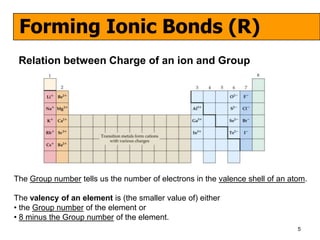
 Relation between Charge of an ion and Group


The Group number tells us the number of electrons in the valence shell of an atom.

The valency of an element is (the smaller value of) either
• the Group number of the element or
• 8 minus the Group number of the element.
                                                                               5
Forming Ionic Bonds (R)
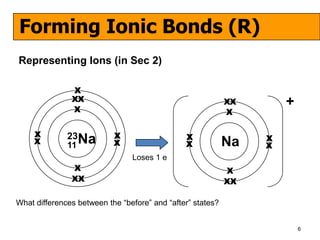
Representing Ions (in Sec 2)

               X
               XX                                           XX
               X
                                                                     +
                                                            X

     X        23Na         X                   X                 X
     X                     X                   X            Na
              11                                                 X
                                Loses 1 e
               X                                            X
               XX                                           XX

What differences between the “before” and “after” states?


                                                                         6
Forming Ionic Bonds
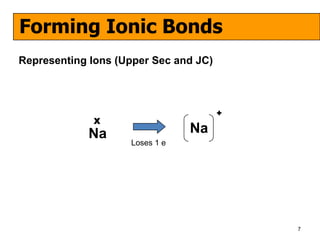
Representing Ions (Upper Sec and JC)


                                       +
             X
            Na                  Na
                    Loses 1 e


                                           7
Forming Ionic Bonds (R)
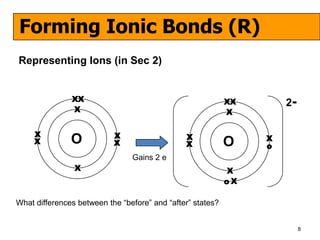
Representing Ions (in Sec 2)


               XX                                           XX       2-
               X                                            X

     X                     X                   X                 X
     X         O           X                   X            O    o
                                Gains 2 e
                X                                           X
                                                            oX

What differences between the “before” and “after” states?


                                                                          8
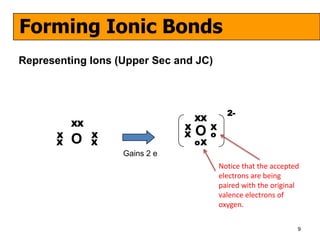
Forming Ionic Bonds
Representing Ions (Upper Sec and JC)


                                           2-
                                    XX
           XX                   X
       X        X               X   OX
                                     o
       X   O    X                   oX
                    Gains 2 e
                                         Notice that the accepted
                                         electrons are being
                                         paired with the original
                                         valence electrons of
                                         oxygen.

                                                                9
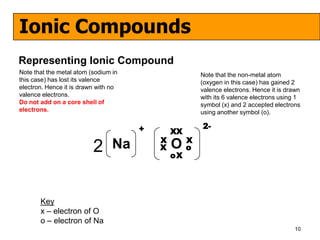
Ionic Compounds
Representing Ionic Compound
Note that the metal atom (sodium in                Note that the non-metal atom
this case) has lost its valence                    (oxygen in this case) has gained 2
electron. Hence it is drawn with no                valence electrons. Hence it is drawn
valence electrons.                                 with its 6 valence electrons using 1
Do not add on a core shell of                      symbol (x) and 2 accepted electrons
electrons.                                         using another symbol (o).

                                      +            2-
                                              XX
                                          X    X
                          2      Na       X   Oo
                                              oX


       Key
       x – electron of O
       o – electron of Na
                                                                                     10
Forming Ionic Bonds
Simple Ion vs. Complex Ion
A simple ion is formed when an atom of an element loses or accepts
electron(s) to form a charged particle. Eg. Mg2+, K+, Cl-, S2-, O2-

A complex ion is a charged particle that consist of more than 1 atom (of one or
more element). Eg. SO42-, CO32-, MnO4-, Cr2O72-


Extra
A radical is a particle (atom or molecule) that contains an unpaired electron.


                                                                                 11
Forming Covalent Bonds
Sharing of Electrons

Chemical bond formation between 2 non–metal atoms
 • Neither non-metallic atom would want to lose their valence electrons.

 • To achieve an noble gas electronic configuration, the valence electrons of
   two or more atoms are shared.

 • Shared electrons count towards the total number of electrons that surround
   an atom.

 A covalent bond is formed when 2 atoms share a pair of valence
    electrons when their atomic orbitals overlap.


                                                                                12
Forming Covalent Bonds (R)
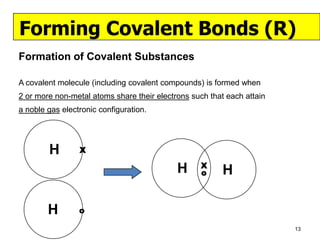
Formation of Covalent Substances

A covalent molecule (including covalent compounds) is formed when
2 or more non-metal atoms share their electrons such that each attain
a noble gas electronic configuration.


        H        X
                                                  X
                                            H     o      H

        H        o

                                                                        13
Forming Covalent Substances

             Rules for Drawing Dot-Cross Diagrams
             (Covalent compounds)

• Draw only the electrons in the valence shell of the atoms.
• Ensure each atom satisfies the Octet Rule (whenever possible, for H – duplet
 rules apply).
• Draw electrons in pairs where possible.
• Have a KEY or LEGEND to denote the electrons of each atom.


                                                                             14
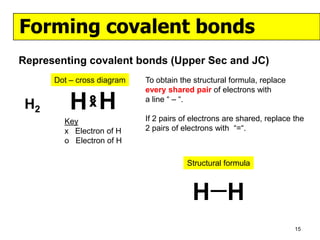
Forming covalent bonds
Representing covalent bonds (Upper Sec and JC)
      Dot – cross diagram   To obtain the structural formula, replace
                            every shared pair of electrons with
               o
 H2       H H  X
                            a line “ – “.

                            If 2 pairs of electrons are shared, replace the
        Key
        x Electron of H     2 pairs of electrons with “=“.
        o Electron of H

                                        Structural formula


                                         H H
                                                                        15
Forming covalent bonds
Representing covalent bonds (Upper Sec and JC)
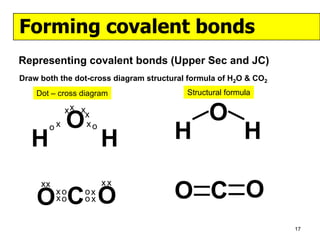
Draw both the dot-cross diagram structural formula of H2O & CO2


            Draw before advancing the powerpoint.


                                                                  16
Forming covalent bonds
Representing covalent bonds (Upper Sec and JC)
Draw both the dot-cross diagram structural formula of H2O & CO2
    Dot – cross diagram                   Structural formula


       ox
          x x xx
           O   xo
                                                O
   H                 H                 H                  H
                     xx
     xx

    O C O xo
          xo
                ox
                ox                     O C O
                                                                  17
Forming covalent bonds
Representing covalent bonds (Upper Sec and JC)
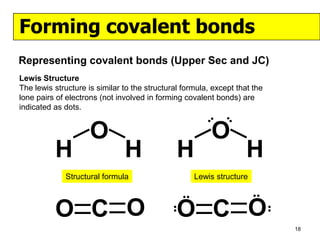
Lewis Structure
The lewis structure is similar to the structural formula, except that the
lone pairs of electrons (not involved in forming covalent bonds) are
indicated as dots.


                     O                                     O
          H                    H               H                     H
             Structural formula                        Lewis structure

                                                                       

          O C O                                O C O
                                             


                                                                              
                                                                                   18
Forming covalent bonds
Representing covalent bonds (Upper Sec and JC)
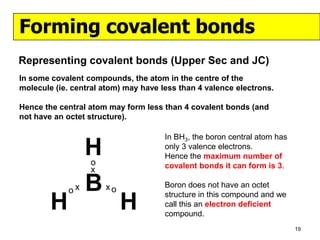
In some covalent compounds, the atom in the centre of the
molecule (ie. central atom) may have less than 4 valence electrons.

Hence the central atom may form less than 4 covalent bonds (and
not have an octet structure).

                                      In BH3, the boron central atom has
                 Ho
                                      only 3 valence electrons.
                                      Hence the maximum number of
                                      covalent bonds it can form is 3.
                  x

            ox   B    xo              Boron does not have an octet
                                      structure in this compound and we
        H                  H          call this an electron deficient
                                      compound.
                                                                           19
Forming covalent bonds
Representing covalent bonds (Upper Sec and JC)
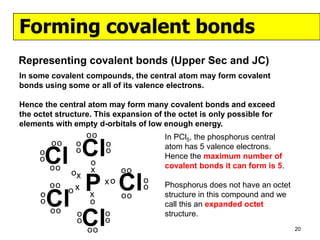
In some covalent compounds, the central atom may form covalent
bonds using some or all of its valence electrons.

Hence the central atom may form many covalent bonds and exceed
the octet structure. This expansion of the octet is only possible for
elements with empty d-orbitals of low enough energy.
                   oo                  In PCl5, the phosphorus central
     o
     oCl Cl
         oo    o
               o
                   o
                        o
                        o              atom has 5 valence electrons.
                                       Hence the maximum number of
         oo                            covalent bonds it can form is 5.
              ox   x         oo

         P Cl
         oo
              ox
                        xo        o
                                  o    Phosphorus does not have an octet
     o
     oCl oo
                   x
                   o
                             oo        structure in this compound and we
                                       call this an expanded octet

         Cl    o
               o
                   oo
                        o
                        o
                                       structure.
                                                                           20
Forming covalent bonds
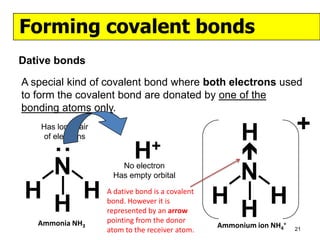
Dative bonds

A special kind of covalent bond where both electrons used
to form the covalent bond are donated by one of the
bonding atoms only.
    Has lone pair
                                                       H              +
       ..
    of electrons

                            H+                         
       N               No electron
                     Has empty orbital                 N
 H             H    A dative bond is a covalent
                                                  H            H
       H            bond. However it is
                    represented by an arrow
                    pointing from the donor
                                                       H
   Ammonia NH3                                    Ammonium ion NH4+
                    atom to the receiver atom.                        21

Drawing dot cross diagrams

  • 1.
    Chemical Bonds Created byJustin Loh SJ, 2013 Hwa Chong Institution Chemistry 1
  • 2.
    In this lesson,you will learn to • determine the charge of ions formed by the atoms of different elements, • draw dot-cross diagrams for ionic substances, • draw dot-cross diagrams, structural formula and Lewis structures for covalent molecules • deduce if the central atom of a molecule is electron deficient or has an expanded octet
  • 3.
    Forming Ionic Bonds(R) Determining the Charge of an Ion • The charge of an ion can be determined by comparing the number of protons to electrons in the particle. Positive Ion • Formed when an atom loses electrons • This results in the atom having more protons than electrons  A particle that has an overall positive charge. Exercise Deduce the particle that has 12 protons, 12 neutrons and 10 electrons. 3
  • 4.
    Forming Ionic Bonds(R) Determining the Charge of an Ion • The charge of an ion can be determined by comparing the number of protons to electrons in the particle. Negative Ion • Formed when an atom gains electrons. • This results in the atom having more electrons than protons.  A particle that has an overall negative charge. Exercise Deduce the particle that has 8 protons, 8 neutrons and 10 electrons. 4
  • 5.
    Forming Ionic Bonds(R) Relation between Charge of an ion and Group The Group number tells us the number of electrons in the valence shell of an atom. The valency of an element is (the smaller value of) either • the Group number of the element or • 8 minus the Group number of the element. 5
  • 6.
    Forming Ionic Bonds(R) Representing Ions (in Sec 2) X XX XX X + X X 23Na X X X X X X Na 11 X Loses 1 e X X XX XX What differences between the “before” and “after” states? 6
  • 7.
    Forming Ionic Bonds RepresentingIons (Upper Sec and JC) + X Na Na Loses 1 e 7
  • 8.
    Forming Ionic Bonds(R) Representing Ions (in Sec 2) XX XX 2- X X X X X X X O X X O o Gains 2 e X X oX What differences between the “before” and “after” states? 8
  • 9.
    Forming Ionic Bonds RepresentingIons (Upper Sec and JC) 2- XX XX X X X X OX o X O X oX Gains 2 e Notice that the accepted electrons are being paired with the original valence electrons of oxygen. 9
  • 10.
    Ionic Compounds Representing IonicCompound Note that the metal atom (sodium in Note that the non-metal atom this case) has lost its valence (oxygen in this case) has gained 2 electron. Hence it is drawn with no valence electrons. Hence it is drawn valence electrons. with its 6 valence electrons using 1 Do not add on a core shell of symbol (x) and 2 accepted electrons electrons. using another symbol (o). + 2- XX X X 2 Na X Oo oX Key x – electron of O o – electron of Na 10
  • 11.
    Forming Ionic Bonds SimpleIon vs. Complex Ion A simple ion is formed when an atom of an element loses or accepts electron(s) to form a charged particle. Eg. Mg2+, K+, Cl-, S2-, O2- A complex ion is a charged particle that consist of more than 1 atom (of one or more element). Eg. SO42-, CO32-, MnO4-, Cr2O72- Extra A radical is a particle (atom or molecule) that contains an unpaired electron. 11
  • 12.
    Forming Covalent Bonds Sharingof Electrons Chemical bond formation between 2 non–metal atoms • Neither non-metallic atom would want to lose their valence electrons. • To achieve an noble gas electronic configuration, the valence electrons of two or more atoms are shared. • Shared electrons count towards the total number of electrons that surround an atom. A covalent bond is formed when 2 atoms share a pair of valence electrons when their atomic orbitals overlap. 12
  • 13.
    Forming Covalent Bonds(R) Formation of Covalent Substances A covalent molecule (including covalent compounds) is formed when 2 or more non-metal atoms share their electrons such that each attain a noble gas electronic configuration. H X X H o H H o 13
  • 14.
    Forming Covalent Substances Rules for Drawing Dot-Cross Diagrams (Covalent compounds) • Draw only the electrons in the valence shell of the atoms. • Ensure each atom satisfies the Octet Rule (whenever possible, for H – duplet rules apply). • Draw electrons in pairs where possible. • Have a KEY or LEGEND to denote the electrons of each atom. 14
  • 15.
    Forming covalent bonds Representingcovalent bonds (Upper Sec and JC) Dot – cross diagram To obtain the structural formula, replace every shared pair of electrons with o H2 H H X a line “ – “. If 2 pairs of electrons are shared, replace the Key x Electron of H 2 pairs of electrons with “=“. o Electron of H Structural formula H H 15
  • 16.
    Forming covalent bonds Representingcovalent bonds (Upper Sec and JC) Draw both the dot-cross diagram structural formula of H2O & CO2 Draw before advancing the powerpoint. 16
  • 17.
    Forming covalent bonds Representingcovalent bonds (Upper Sec and JC) Draw both the dot-cross diagram structural formula of H2O & CO2 Dot – cross diagram Structural formula ox x x xx O xo O H H H H xx xx O C O xo xo ox ox O C O 17
  • 18.
    Forming covalent bonds Representingcovalent bonds (Upper Sec and JC) Lewis Structure The lewis structure is similar to the structural formula, except that the lone pairs of electrons (not involved in forming covalent bonds) are indicated as dots. O O H H H H Structural formula Lewis structure   O C O O C O   18
  • 19.
    Forming covalent bonds Representingcovalent bonds (Upper Sec and JC) In some covalent compounds, the atom in the centre of the molecule (ie. central atom) may have less than 4 valence electrons. Hence the central atom may form less than 4 covalent bonds (and not have an octet structure). In BH3, the boron central atom has Ho only 3 valence electrons. Hence the maximum number of covalent bonds it can form is 3. x ox B xo Boron does not have an octet structure in this compound and we H H call this an electron deficient compound. 19
  • 20.
    Forming covalent bonds Representingcovalent bonds (Upper Sec and JC) In some covalent compounds, the central atom may form covalent bonds using some or all of its valence electrons. Hence the central atom may form many covalent bonds and exceed the octet structure. This expansion of the octet is only possible for elements with empty d-orbitals of low enough energy. oo In PCl5, the phosphorus central o oCl Cl oo o o o o o atom has 5 valence electrons. Hence the maximum number of oo covalent bonds it can form is 5. ox x oo P Cl oo ox xo o o Phosphorus does not have an octet o oCl oo x o oo structure in this compound and we call this an expanded octet Cl o o oo o o structure. 20
  • 21.
    Forming covalent bonds Dativebonds A special kind of covalent bond where both electrons used to form the covalent bond are donated by one of the bonding atoms only. Has lone pair H + .. of electrons H+  N No electron Has empty orbital N H H A dative bond is a covalent H H H bond. However it is represented by an arrow pointing from the donor H Ammonia NH3 Ammonium ion NH4+ atom to the receiver atom. 21