

Made by :M. Fahd-Un-Nabi Khan
        USMAN PUBLIC SCHOOL
                          XI-0
BONDING:
 The way in which atoms join and combine with
  each other

 STRUCTURE:
 Thearrangement of resulting particles after
 bonding
1. Ionic Bonds
2. Covalent Bonds
3. Metallic Bonds
 Ionic  bonding is the transfer of electrons from
  one atom to another to achieve an inert gas
  configuration, forming ions.
 Ionic bonds are formed between METALLIC and
  NON- METALLIC atoms ONLY.
  - Metals lose electrons to form positive ions
  (cations)
  - Non-metals gain electrons to form negative ions
  (anions)
 An ionic bond is an attraction between
  oppositely charged ions, which are formed by
  the transfer of electrons from one atom to
  another.
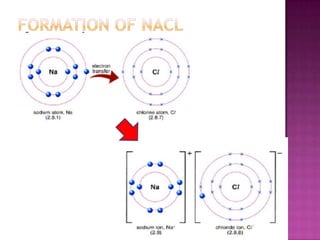
 E.g. In sodium chloride, each sodium atom
  transfers an electron to a chlorine atom. The
  result is a sodium ion and a chloride anion.
  These two ions attract each other to form a
  stable compound.
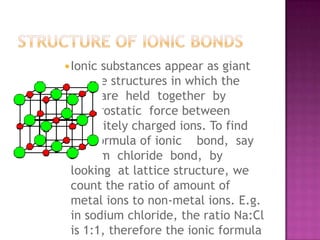
 Ionicsubstances appear as giant
 lattice structures in which the
 ions are held together by
 electrostatic force between
 oppositely charged ions. To find
 the formula of ionic bond, say
 sodium chloride bond, by
 looking at lattice structure, we
 count the ratio of amount of
 metal ions to non-metal ions. E.g.
 in sodium chloride, the ratio Na:Cl
 is 1:1, therefore the ionic formula
 Since ions are held strongly in place by the other
 ions, they cannot move or slip over each other
 easily and are hence hard and brittle.


      Melting and boiling point
• The attraction between opposite ions is very
  strong. A lot of kinetic energy is thus
  required to overcome them and the melting
  point and boiling point of ionic compounds is
  very high.
   Since ionic solids contain ions, they are
    attracted by electric fields and will, if possible,
    move towards the electrodes and thus conduct
    electricity. In the solid state, however, the ions
    are not free to move since they are tightly held
    in place by each other. Thus ionic compounds do
    not conduct electricity in the solid state. Ionic
    solids are thus good insulators.

   In the liquid(aqueous or molten) state, the ions
    are free to move and so can move towards their
    respective electrodes. Thus ionic compounds can
    conduct electricity in the liquid state.
 Ioniccompounds are soluble in water but
 insoluble in organic compounds. This is
 because the ions attract water molecules
 which distrupts the crystal structure,
 causing them separate & go into solution.
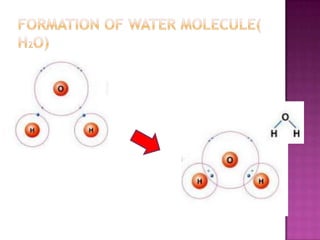
 Covalent  bonding is the sharing a pair of
  electrons to gain electronic configuration of
  an inert gas, usually for molecules.
 Covalent bonds occur between NON-
  METALLIC ATOMS ONLY.
 In covalent bond, we try to substitute
  the short of electrons of two/more atoms
  between each other to form the 2 or 8
  valence electrons (noble gas structure). The
  shared electrons appear in pairs.
A  pair of shared electrons between 2 atoms
  forms Single bond, X – Y.
 Two pairs of shared electrons between 2
  atoms forms Double bond, X = Y.
 Three pairs of shared electrons between 2
  atoms forms Triple bond, X = Y.

 This
     information is important when you
 want to know the bond forces between
 atoms in exothermic/endothermic reactions.
Electrical conductivity
 There are no ions and no delocalised electrons, so
  there is little electrical conductivity in either solid
  or liquid state.
             Structure
 The intermolecular forces are weak and generally
  non-directional, so most molecular covalent
  substances are soft, crumbly and not very strong.
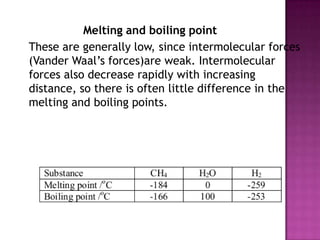
Melting and boiling point
These are generally low, since intermolecular forces
(Vander Waal’s forces)are weak. Intermolecular
forces also decrease rapidly with increasing
distance, so there is often little difference in the
melting and boiling points.
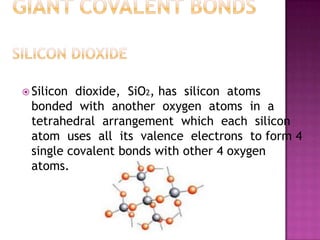
 Silicondioxide, SiO2, has silicon atoms
 bonded with another oxygen atoms in a
 tetrahedral arrangement which each silicon
 atom uses all its valence electrons to form 4
 single covalent bonds with other 4 oxygen
 atoms.
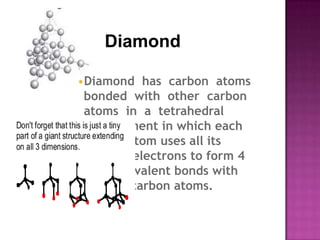
Diamond

•Diamond has carbon atoms
 bonded with other carbon
 atoms in a tetrahedral
 arrangement in which each
 carbon atom uses all its
 valence electrons to form 4
 single covalent bonds with
 other 4 carbon atoms.
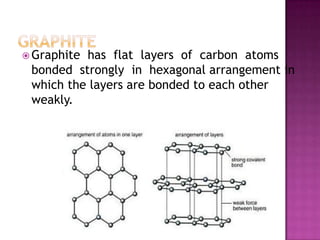
 Graphitehas flat layers of carbon atoms
 bonded strongly in hexagonal arrangement in
 which the layers are bonded to each other
 weakly.
 It is a hard solid because it consists of
  many strong covalent bonds between atoms.
  This property makes it suitable as abrasives.
 It has very high melting and boiling points.
 It does not conduct electricity (except
  graphite) because there are no free electrons
  in covalent bonds since they are used to
  form bonds; hence electrons are in fixed
  positions. To conduct electricity, there must be
  free electrons.
 All covalent structures are insoluble in water.
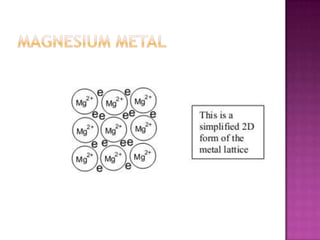
 Metallicbonding is the attraction between
 cations and a sea of delocalised electrons.
 The cations are arranged to form a lattice,
 with the electrons free to move between
 them.

 Thestructure of the lattice varies from
 metal to metal, and they do not need to be
 known in detail .The generalised structure
 can be drawn as follows:
   Metals can be bent (ductile) and can be stretched (malleable)
    because the layers of atoms in metals slide over each other
    when force is applied but will not break due to attractive force
    between electrons and metal ions.
   2. Metals conduct electricity as it has free electrons which carries
    current.
   3. Metals conduct heat as it has free electrons which gains
    energy when heated and moves faster to collide with metal
    atoms, releasing heat in collisions.
   4. Metals have high melting and boiling points because the
    bonds between metals is very strong. Hence very high heat energy
    is needed to break the bonds.
Bonding and Structure

Bonding and Structure

  • 1.
    Made by :M.Fahd-Un-Nabi Khan USMAN PUBLIC SCHOOL XI-0
  • 2.
    BONDING:  The wayin which atoms join and combine with each other STRUCTURE:  Thearrangement of resulting particles after bonding
  • 3.
    1. Ionic Bonds 2.Covalent Bonds 3. Metallic Bonds
  • 4.
     Ionic bonding is the transfer of electrons from one atom to another to achieve an inert gas configuration, forming ions.  Ionic bonds are formed between METALLIC and NON- METALLIC atoms ONLY. - Metals lose electrons to form positive ions (cations) - Non-metals gain electrons to form negative ions (anions)
  • 5.
     An ionicbond is an attraction between oppositely charged ions, which are formed by the transfer of electrons from one atom to another.  E.g. In sodium chloride, each sodium atom transfers an electron to a chlorine atom. The result is a sodium ion and a chloride anion. These two ions attract each other to form a stable compound.
  • 7.
     Ionicsubstances appearas giant lattice structures in which the ions are held together by electrostatic force between oppositely charged ions. To find the formula of ionic bond, say sodium chloride bond, by looking at lattice structure, we count the ratio of amount of metal ions to non-metal ions. E.g. in sodium chloride, the ratio Na:Cl is 1:1, therefore the ionic formula
  • 8.
     Since ionsare held strongly in place by the other ions, they cannot move or slip over each other easily and are hence hard and brittle. Melting and boiling point • The attraction between opposite ions is very strong. A lot of kinetic energy is thus required to overcome them and the melting point and boiling point of ionic compounds is very high.
  • 9.
    Since ionic solids contain ions, they are attracted by electric fields and will, if possible, move towards the electrodes and thus conduct electricity. In the solid state, however, the ions are not free to move since they are tightly held in place by each other. Thus ionic compounds do not conduct electricity in the solid state. Ionic solids are thus good insulators.  In the liquid(aqueous or molten) state, the ions are free to move and so can move towards their respective electrodes. Thus ionic compounds can conduct electricity in the liquid state.
  • 10.
     Ioniccompounds aresoluble in water but insoluble in organic compounds. This is because the ions attract water molecules which distrupts the crystal structure, causing them separate & go into solution.
  • 11.
     Covalent bonding is the sharing a pair of electrons to gain electronic configuration of an inert gas, usually for molecules.  Covalent bonds occur between NON- METALLIC ATOMS ONLY.  In covalent bond, we try to substitute the short of electrons of two/more atoms between each other to form the 2 or 8 valence electrons (noble gas structure). The shared electrons appear in pairs.
  • 12.
    A pairof shared electrons between 2 atoms forms Single bond, X – Y.  Two pairs of shared electrons between 2 atoms forms Double bond, X = Y.  Three pairs of shared electrons between 2 atoms forms Triple bond, X = Y.  This information is important when you want to know the bond forces between atoms in exothermic/endothermic reactions.
  • 14.
    Electrical conductivity  Thereare no ions and no delocalised electrons, so there is little electrical conductivity in either solid or liquid state. Structure  The intermolecular forces are weak and generally non-directional, so most molecular covalent substances are soft, crumbly and not very strong.
  • 15.
    Melting and boilingpoint These are generally low, since intermolecular forces (Vander Waal’s forces)are weak. Intermolecular forces also decrease rapidly with increasing distance, so there is often little difference in the melting and boiling points.
  • 16.
     Silicondioxide, SiO2,has silicon atoms bonded with another oxygen atoms in a tetrahedral arrangement which each silicon atom uses all its valence electrons to form 4 single covalent bonds with other 4 oxygen atoms.
  • 17.
    Diamond •Diamond has carbonatoms bonded with other carbon atoms in a tetrahedral arrangement in which each carbon atom uses all its valence electrons to form 4 single covalent bonds with other 4 carbon atoms.
  • 18.
     Graphitehas flatlayers of carbon atoms bonded strongly in hexagonal arrangement in which the layers are bonded to each other weakly.
  • 19.
     It isa hard solid because it consists of many strong covalent bonds between atoms. This property makes it suitable as abrasives.  It has very high melting and boiling points.  It does not conduct electricity (except graphite) because there are no free electrons in covalent bonds since they are used to form bonds; hence electrons are in fixed positions. To conduct electricity, there must be free electrons.  All covalent structures are insoluble in water.
  • 20.
     Metallicbonding isthe attraction between cations and a sea of delocalised electrons. The cations are arranged to form a lattice, with the electrons free to move between them.  Thestructure of the lattice varies from metal to metal, and they do not need to be known in detail .The generalised structure can be drawn as follows:
  • 22.
    Metals can be bent (ductile) and can be stretched (malleable) because the layers of atoms in metals slide over each other when force is applied but will not break due to attractive force between electrons and metal ions.  2. Metals conduct electricity as it has free electrons which carries current.  3. Metals conduct heat as it has free electrons which gains energy when heated and moves faster to collide with metal atoms, releasing heat in collisions.  4. Metals have high melting and boiling points because the bonds between metals is very strong. Hence very high heat energy is needed to break the bonds.