Name:……………………………………………
Grade: ……………………………………..
Subject: Chemistry
Date: ………………………………
CHAPTER 5 : Electrons in Atoms
Section 3 : Electron Configuration
 Ground-StateElectron Configuration
 The arrangement of electrons in an atom is called the atom’s electron
configuration. Because low-energy systems are more stable than
high-energy systems, electrons in an atom tend to assume the
arrangement that gives the atom the lowest energy possible.
 The most stable, lowest-energy arrangement of the electrons is called
the element’s
ground-state electron configuration.
 Three rules, or principlesdefinehow electrons can be arranged in
an atom’s orbitals.
1. Aufbau principle,
2. Pauli exclusion principle,
3. Hund’s rule
 The aufbau principle
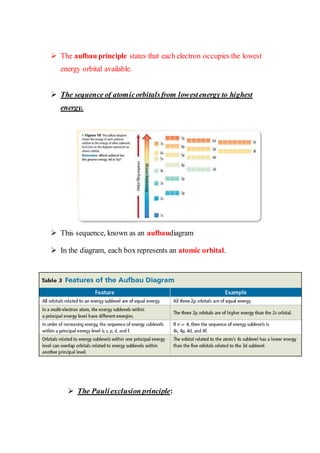
 The aufbau principle states that each electron occupies the lowest
energy orbital available.
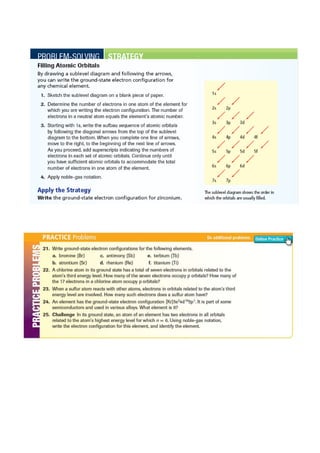
 The sequence of atomicorbitalsfrom lowestenergy to highest
energy.
 This sequence, known as an aufbaudiagram
 In the diagram, each box represents an atomic orbital.
 The Pauliexclusion principle:
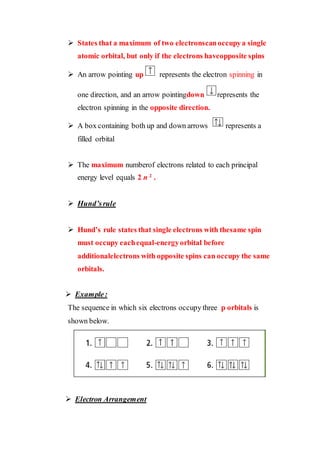
 States that a maximum of two electronscanoccupya single
atomic orbital, but only if the electrons haveopposite spins
 An arrow pointing up represents the electron spinning in
one direction, and an arrow pointingdown represents the
electron spinning in the opposite direction.
 A box containing both up and down arrows represents a
filled orbital
 The maximum numberof electrons related to each principal
energy level equals 2 n 2
.
 Hund’srule
 Hund’s rule states that single electrons with thesame spin
must occupy eachequal-energyorbital before
additionalelectrons with opposite spins can occupy the same
orbitals.
 Example:
The sequence in which six electrons occupy three p orbitals is
shown below.
 Electron Arrangement
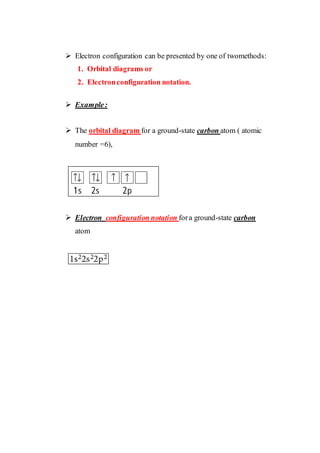
 Electron configuration can be presented by one of twomethods:
1. Orbital diagrams or
2. Electronconfiguration notation.
 Example:
 The orbital diagram for a ground-state carbon atom ( atomic
number =6),
 Electron configuration notation fora ground-state carbon
atom
 Example:Electron configuration notation and orbital diagram of
sodium atom
 Noble-gasnotation:
 The noble-gas notation uses bracketedsymbols.
 For example,
 [He]( atomic number =2) represents the electron configuration
for helium, 1 s 2
,
 [Ne]( atomic number =10) represents the electron configuration
for neon,
1 s 2
2 s 2
2 p 6
.
 Noble gas notation of sodium :
 ElectronConfiguration notation of sodium (atomic number
= 11) is
 Using noble-gas notation, sodium’s electron configuration can
be shortened to the form [Ne] 3 s 1 .
 Exceptionsto predicted configurations
 You can use theaufbau diagram to write correct ground-state electron
configurations
 Valenceelectrons are defined as electrons inthe atom’s outermost
orbitals—generally those orbitals associated with theatom’s
highest principal energy level.
 Example:

SulfuratomS contains16 electrons,

Noble-gas notationof S is [Ne] 3S 2
3 p 4
 Sulfur has six valence electrons.
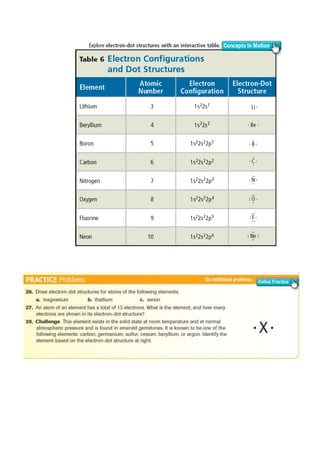
 Electron-dot structures(Lewisstructure) :
Consists of the element’ssymbol,surrounded bydots representing
all of the atom’s valenceelectrons
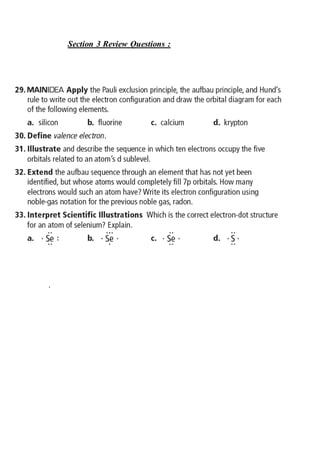
Section 3 Review Questions :
.

Electron configuration lecture notes

  • 1.
    Name:…………………………………………… Grade: …………………………………….. Subject: Chemistry Date:……………………………… CHAPTER 5 : Electrons in Atoms Section 3 : Electron Configuration  Ground-StateElectron Configuration  The arrangement of electrons in an atom is called the atom’s electron configuration. Because low-energy systems are more stable than high-energy systems, electrons in an atom tend to assume the arrangement that gives the atom the lowest energy possible.  The most stable, lowest-energy arrangement of the electrons is called the element’s ground-state electron configuration.  Three rules, or principlesdefinehow electrons can be arranged in an atom’s orbitals. 1. Aufbau principle, 2. Pauli exclusion principle, 3. Hund’s rule  The aufbau principle
  • 2.
     The aufbauprinciple states that each electron occupies the lowest energy orbital available.  The sequence of atomicorbitalsfrom lowestenergy to highest energy.  This sequence, known as an aufbaudiagram  In the diagram, each box represents an atomic orbital.  The Pauliexclusion principle:
  • 3.
     States thata maximum of two electronscanoccupya single atomic orbital, but only if the electrons haveopposite spins  An arrow pointing up represents the electron spinning in one direction, and an arrow pointingdown represents the electron spinning in the opposite direction.  A box containing both up and down arrows represents a filled orbital  The maximum numberof electrons related to each principal energy level equals 2 n 2 .  Hund’srule  Hund’s rule states that single electrons with thesame spin must occupy eachequal-energyorbital before additionalelectrons with opposite spins can occupy the same orbitals.  Example: The sequence in which six electrons occupy three p orbitals is shown below.  Electron Arrangement
  • 4.
     Electron configurationcan be presented by one of twomethods: 1. Orbital diagrams or 2. Electronconfiguration notation.  Example:  The orbital diagram for a ground-state carbon atom ( atomic number =6),  Electron configuration notation fora ground-state carbon atom
  • 5.
     Example:Electron configurationnotation and orbital diagram of sodium atom  Noble-gasnotation:  The noble-gas notation uses bracketedsymbols.  For example,  [He]( atomic number =2) represents the electron configuration for helium, 1 s 2 ,  [Ne]( atomic number =10) represents the electron configuration for neon, 1 s 2 2 s 2 2 p 6 .
  • 6.
     Noble gasnotation of sodium :  ElectronConfiguration notation of sodium (atomic number = 11) is  Using noble-gas notation, sodium’s electron configuration can be shortened to the form [Ne] 3 s 1 .  Exceptionsto predicted configurations  You can use theaufbau diagram to write correct ground-state electron configurations
  • 9.
     Valenceelectrons aredefined as electrons inthe atom’s outermost orbitals—generally those orbitals associated with theatom’s highest principal energy level.  Example:  SulfuratomS contains16 electrons,  Noble-gas notationof S is [Ne] 3S 2 3 p 4  Sulfur has six valence electrons.  Electron-dot structures(Lewisstructure) : Consists of the element’ssymbol,surrounded bydots representing all of the atom’s valenceelectrons
  • 12.
    Section 3 ReviewQuestions : .