• Compare period and
group trends of several
properties.
principal energy level:
the major energy level of
an atom
ion
ionization energy
octet rule
electronegativity
• Relate period and group
trends in atomic radii to
electron configuration.
Trends among elements in the periodic
table include their size and their ability to
lose or attract electrons
SECTION
6.3 Periodic Trends
Trends
 A trend : is a predictable change in a particular
direction.
 Why it is important? .
 It help us to make prediction about chemical
behavior of the element.
1. The number of occupiedEnergy Level:
The distance between the outermost electrons and the
nucleus “
Higher energy levels are further away from the
nucleus.
2. Nuclear charge :(number of protons)
More protons (+ ) pulls electrons (–) in closer.
3. Shielding effect of inner electrons.
ALL Periodic Table Trends Influenced
by three factors:
The reduction of the attraction force between the a
positively charged nucleus and the outermost
electrons due to the inner electrons
Atomic Radius:
 Atomic radius of metals :
Half the distance between
adjacent nuclei in a crystal of the
element
 For elements that commonly occur
as molecules, such as many
nonmetals, the atomic radius is
defined as :
 It is half the distance from centre
to centre of two like atoms that
are bonded together.
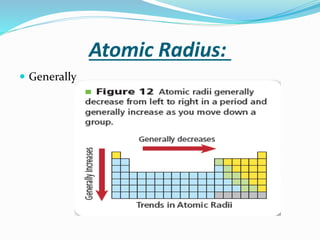
Trends within periods
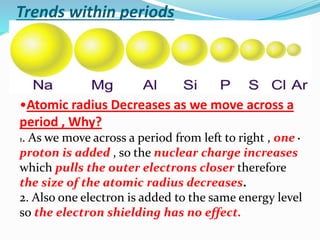
•Atomic radius Decreases as we move across a
period , Why?
•1. As we move across a period from left to right , one
proton is added , so the nuclear charge increases
which pulls the outer electrons closer therefore
the size of the atomic radius decreases.
2. Also one electron is added to the same energy level
so the electron shielding has no effect.
Trends within groups
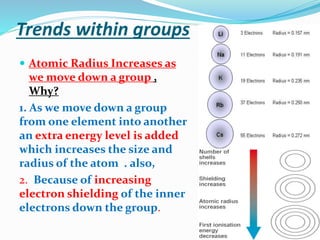
 Atomic Radius Increases as
we move down a group ,
Why?
1. As we move down a group
from one element into another
an extra energy level is added
which increases the size and
radius of the atom . also,
2. Because of increasing
electron shielding of the inner
electrons down the group.
Atomic Radius:
 Generally
Ionic Radius
An ion :
is an atom or a bonded group of atoms that has a
positive or negative charge
 a- cations (positive ions )
 The electron lost from the atom will almost be a valence
electron
 The loss of a valence electron can leave a completely empty
outer orbital, which results in a smaller radius.
 The electrostatic repulsion between the now-fewer number of
remaining electrons decreases allowing these remaining
electrons to be pulled closer to the positively charged nucleus
The size decreases
because
1- Losing one electron
will leave a completely
empty outer energy
level
2- one electron is
removed so the
attraction force of the
positive nucleus
increases
b- anions ( negative anions)
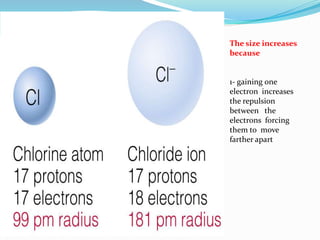
 When atoms gain electrons and form negatively
charged ions, they become larger.
 The addition of an electron to an atom increases the
electrostatic repulsion between the atom’s outer
electrons, forcing them to move farther apart.
 The increased distance between the outer electrons
results in a larger radius.
 For example: chlorine atom
The size increases
because
1- gaining one
electron increases
the repulsion
between the
electrons forcing
them to move
farther apart
Now :
 As we move down a group : as the atomic radius
increases usually the ionic radius increases as well.
 As we move across a period : as the atomic radius
decreases from left to right the ionic radius decreases
as well.
Ionization Energy
 Ionization energy is defined as : the energy
required to remove an electron from a gaseous
atom
 The energy required to remove the first outermost
electron from an atom is called the first ionization
energy
 Atoms with large ionization energy values are less
likely to form positive ions
 The group 1 metals have low Ionization energies
( they can lose electrons easily).
Ionization Energy
 Thus, group 1 metals (Li, Na, K, Rb) are likely to
form positive ions.
 The group 18 elements (He, Ne, Ar, Kr, Xe) have
high ionization energies and are unlikely to form
ions.
 Removing more than one electron
 The amount of energy required to remove a second
electron from a 1+ ion is called the second ionization
energy,
21
The energy required for each successive ionization always
increases because atoms hold onto their inner core
electrons much more strongly than they hold onto their
valence electrons.
:The second ionization energy
The amount of energy required to remove a
second electron from a 1+ ion.
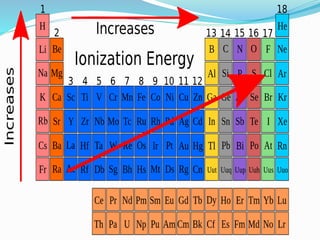
Ionization Energy within groups
Ionization Energy Decreases as we move
down a group :
1- An extra energy level is added from one element into
another.
•The distance between the nucleus and the outer most electron
increases.
• The attraction force between them decreases.
•Less energy is needed to remove the outermost electrons, less
ionization energy is needed.
•2- The electron shielding increases (because the number of inner
electrons increases which reduce the attraction force of the
nucleus , so less ionization energy is needed.
Ionization Energy within periods
1. From one element to the next in the period the
number of protons increase by one .
2. The additional proton will increase the attraction
force of the nucleus to the outermost electrons, so
more ionization energy is needed to remove the
outermost electron .
 Electron shielding remains constant across a period
because the number of inner electrons remain the
same.
Octet rule:
 The octet rule states that : atoms tend to gain,
lose, or share electrons in order to acquire a full
set of eight valence electrons
 Elements on the right side of the periodic table tend to
gain electrons forming negative ions in order to
acquire the noble gas configuration
 Elements on the left side of the table tend to lose
electrons and form positive ions in order to acquire
the noble gas configuration;
Electronegativity
 Electronegativity : is a measure of the ability of an
atom in a chemical compounds to attract
electrons
 Electronegativity values are expressed in terms of a
numerical value of 3.98 or less.
 The units of electronegativity are arbitrary units called
Paulings
 Fluorine is the most electronegative element, with a
value of 3.98.
 Cesium and francium are the least electronegative
elements, with values of 0.79 and 0.70, respectively.
 In a chemical bond, the atom with the greater
electronegativity more strongly attracts the bond’s
electrons.
 Noble gases form very few compounds, so they do
not have electronegativity values.
Electro negativity decreases as we
move down a group:
 1. An extra energy level is added from one element
into another.
The distance between the nucleus and the outer most
electron increases.
The attraction force between them decreases.
So the nucleus cannot attract the valence electrons
easily i.e less electro negativity.
 2 .The electron shielding increases because the
number of inner electrons increases which reduce
the attraction force of the nucleus .
Electro negativity increases as we
move across a period
1- As move across a period from left to right an extra
proton is added to the nucleus ( the nuclear charge
increases) , So the nucleus can attract the electrons
more strongly.
2- Electron shielding remains constant across a
period because the number of inner electrons
remains the same
Electro negativity increases as we
move across a period
1- As move across a period from left to right an extra
proton is added to the nucleus ( the nuclear charge
increases) , So the nucleus can attract the electrons
more strongly.
2- Electron shielding remains constant across a
period because the number of inner electrons
remains the same
Generally
The lowest ionization energy is the ____.
A. first
B. second
C. third
D. fourth
SECTION
6.3 Section Check
The ionic radius of a negative ion
becomes larger when:
A. moving up a group
B. moving right to left across period
C. moving down a group
D. the ion loses electrons
SECTION
6.3 Section Check

periodic table trends

  • 2.
    • Compare periodand group trends of several properties. principal energy level: the major energy level of an atom ion ionization energy octet rule electronegativity • Relate period and group trends in atomic radii to electron configuration. Trends among elements in the periodic table include their size and their ability to lose or attract electrons SECTION 6.3 Periodic Trends
  • 3.
    Trends  A trend: is a predictable change in a particular direction.  Why it is important? .  It help us to make prediction about chemical behavior of the element.
  • 5.
    1. The numberof occupiedEnergy Level: The distance between the outermost electrons and the nucleus “ Higher energy levels are further away from the nucleus. 2. Nuclear charge :(number of protons) More protons (+ ) pulls electrons (–) in closer. 3. Shielding effect of inner electrons. ALL Periodic Table Trends Influenced by three factors: The reduction of the attraction force between the a positively charged nucleus and the outermost electrons due to the inner electrons
  • 6.
    Atomic Radius:  Atomicradius of metals : Half the distance between adjacent nuclei in a crystal of the element  For elements that commonly occur as molecules, such as many nonmetals, the atomic radius is defined as :  It is half the distance from centre to centre of two like atoms that are bonded together.
  • 7.
    Trends within periods •Atomicradius Decreases as we move across a period , Why? •1. As we move across a period from left to right , one proton is added , so the nuclear charge increases which pulls the outer electrons closer therefore the size of the atomic radius decreases. 2. Also one electron is added to the same energy level so the electron shielding has no effect.
  • 8.
    Trends within groups Atomic Radius Increases as we move down a group , Why? 1. As we move down a group from one element into another an extra energy level is added which increases the size and radius of the atom . also, 2. Because of increasing electron shielding of the inner electrons down the group.
  • 9.
  • 13.
    Ionic Radius An ion: is an atom or a bonded group of atoms that has a positive or negative charge  a- cations (positive ions )  The electron lost from the atom will almost be a valence electron  The loss of a valence electron can leave a completely empty outer orbital, which results in a smaller radius.  The electrostatic repulsion between the now-fewer number of remaining electrons decreases allowing these remaining electrons to be pulled closer to the positively charged nucleus
  • 14.
    The size decreases because 1-Losing one electron will leave a completely empty outer energy level 2- one electron is removed so the attraction force of the positive nucleus increases
  • 15.
    b- anions (negative anions)  When atoms gain electrons and form negatively charged ions, they become larger.  The addition of an electron to an atom increases the electrostatic repulsion between the atom’s outer electrons, forcing them to move farther apart.  The increased distance between the outer electrons results in a larger radius.  For example: chlorine atom
  • 16.
    The size increases because 1-gaining one electron increases the repulsion between the electrons forcing them to move farther apart
  • 17.
    Now :  Aswe move down a group : as the atomic radius increases usually the ionic radius increases as well.  As we move across a period : as the atomic radius decreases from left to right the ionic radius decreases as well.
  • 19.
    Ionization Energy  Ionizationenergy is defined as : the energy required to remove an electron from a gaseous atom  The energy required to remove the first outermost electron from an atom is called the first ionization energy  Atoms with large ionization energy values are less likely to form positive ions  The group 1 metals have low Ionization energies ( they can lose electrons easily).
  • 20.
    Ionization Energy  Thus,group 1 metals (Li, Na, K, Rb) are likely to form positive ions.  The group 18 elements (He, Ne, Ar, Kr, Xe) have high ionization energies and are unlikely to form ions.  Removing more than one electron  The amount of energy required to remove a second electron from a 1+ ion is called the second ionization energy,
  • 21.
    21 The energy requiredfor each successive ionization always increases because atoms hold onto their inner core electrons much more strongly than they hold onto their valence electrons. :The second ionization energy The amount of energy required to remove a second electron from a 1+ ion.
  • 22.
    Ionization Energy withingroups Ionization Energy Decreases as we move down a group : 1- An extra energy level is added from one element into another. •The distance between the nucleus and the outer most electron increases. • The attraction force between them decreases. •Less energy is needed to remove the outermost electrons, less ionization energy is needed. •2- The electron shielding increases (because the number of inner electrons increases which reduce the attraction force of the nucleus , so less ionization energy is needed.
  • 23.
    Ionization Energy withinperiods 1. From one element to the next in the period the number of protons increase by one . 2. The additional proton will increase the attraction force of the nucleus to the outermost electrons, so more ionization energy is needed to remove the outermost electron .  Electron shielding remains constant across a period because the number of inner electrons remain the same.
  • 25.
    Octet rule:  Theoctet rule states that : atoms tend to gain, lose, or share electrons in order to acquire a full set of eight valence electrons  Elements on the right side of the periodic table tend to gain electrons forming negative ions in order to acquire the noble gas configuration  Elements on the left side of the table tend to lose electrons and form positive ions in order to acquire the noble gas configuration;
  • 27.
    Electronegativity  Electronegativity :is a measure of the ability of an atom in a chemical compounds to attract electrons  Electronegativity values are expressed in terms of a numerical value of 3.98 or less.  The units of electronegativity are arbitrary units called Paulings
  • 28.
     Fluorine isthe most electronegative element, with a value of 3.98.  Cesium and francium are the least electronegative elements, with values of 0.79 and 0.70, respectively.  In a chemical bond, the atom with the greater electronegativity more strongly attracts the bond’s electrons.  Noble gases form very few compounds, so they do not have electronegativity values.
  • 29.
    Electro negativity decreasesas we move down a group:  1. An extra energy level is added from one element into another. The distance between the nucleus and the outer most electron increases. The attraction force between them decreases. So the nucleus cannot attract the valence electrons easily i.e less electro negativity.  2 .The electron shielding increases because the number of inner electrons increases which reduce the attraction force of the nucleus .
  • 30.
    Electro negativity increasesas we move across a period 1- As move across a period from left to right an extra proton is added to the nucleus ( the nuclear charge increases) , So the nucleus can attract the electrons more strongly. 2- Electron shielding remains constant across a period because the number of inner electrons remains the same
  • 31.
    Electro negativity increasesas we move across a period 1- As move across a period from left to right an extra proton is added to the nucleus ( the nuclear charge increases) , So the nucleus can attract the electrons more strongly. 2- Electron shielding remains constant across a period because the number of inner electrons remains the same
  • 32.
  • 34.
    The lowest ionizationenergy is the ____. A. first B. second C. third D. fourth SECTION 6.3 Section Check
  • 35.
    The ionic radiusof a negative ion becomes larger when: A. moving up a group B. moving right to left across period C. moving down a group D. the ion loses electrons SECTION 6.3 Section Check