CHEMICAL BONDS
XYLENE AR
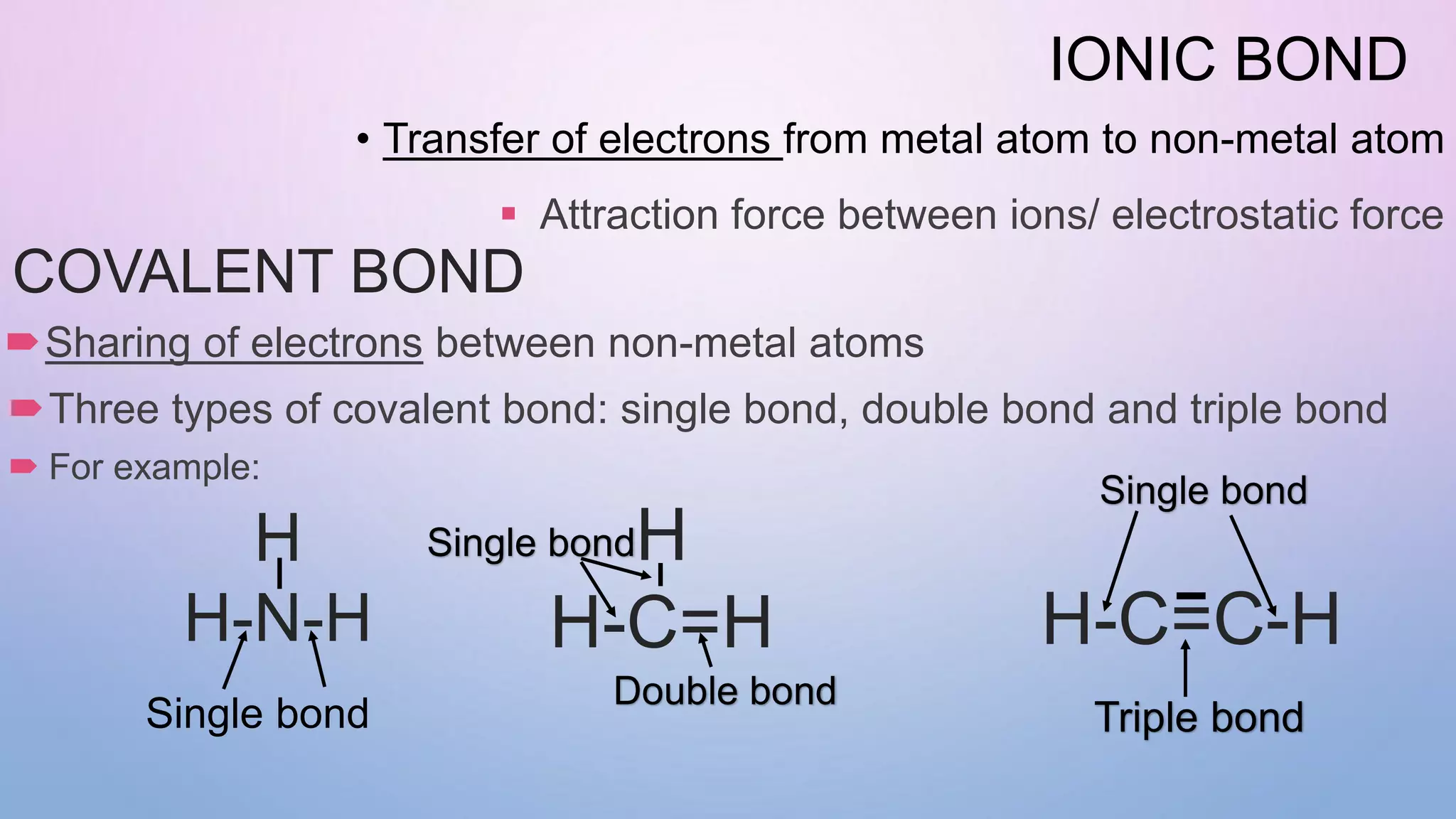
IONIC BOND
• Transfer of electrons from metal atom to non-metal atom
COVALENT BOND
Sharing of electrons between non-metal atoms
 Attraction force between ions/ electrostatic force
Three types of covalent bond: single bond, double bond and triple bond
 For example:
H
H-N-H
H
H-C=H H-C=C-H
Double bond
Single bond
Triple bond
Single bond
Single bond
Why?
• Stability of atom
• Outer shell filled with electrons
• Duplet configuration (2 electrons) – H, Li, Be, B
• Octate configuration (8 electrons) – others
How?
1. Atom donates/ losses of electrons
2. Atom accepts electrons
Ion formation
POSITIVE & NEGATIVE IONS
Positive ions  metal atom donates/ losses of
electrons towards non-metal atom
Cation
Negative ions  non-metal atom
accepts electrons from metal atom
Anion
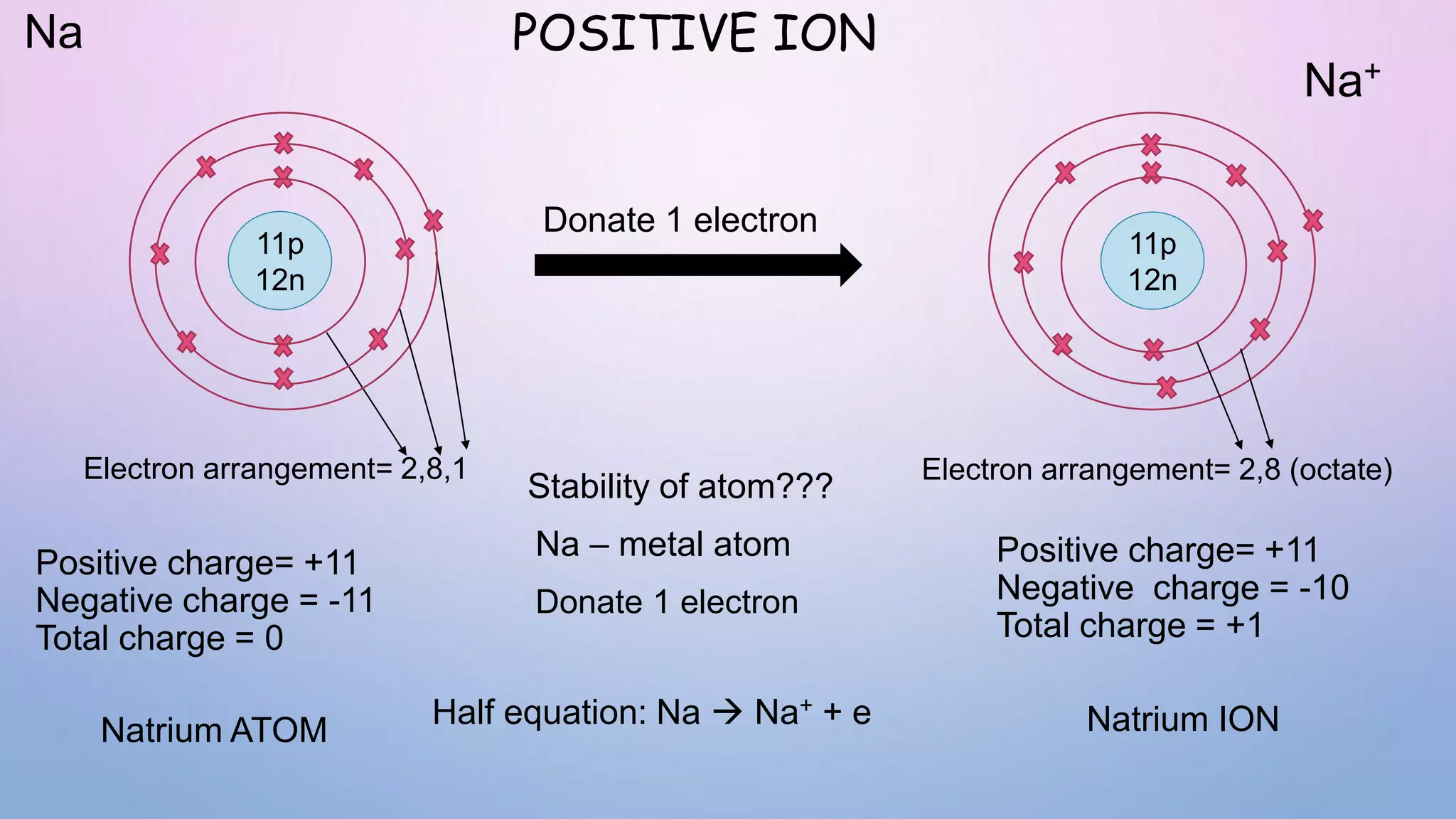
POSITIVE ION
Na
Electron arrangement= 2,8,1
Positive charge= +11
Negative charge = -11
Total charge = 0
Donate 1 electron
Stability of atom???
Na – metal atom
Donate 1 electron
11p
12n
Electron arrangement= 2,8 (octate)
Na+
Positive charge= +11
Negative charge = -10
Total charge = +1
Natrium ION
Natrium ATOM
11p
12n
Half equation: Na  Na+ + e
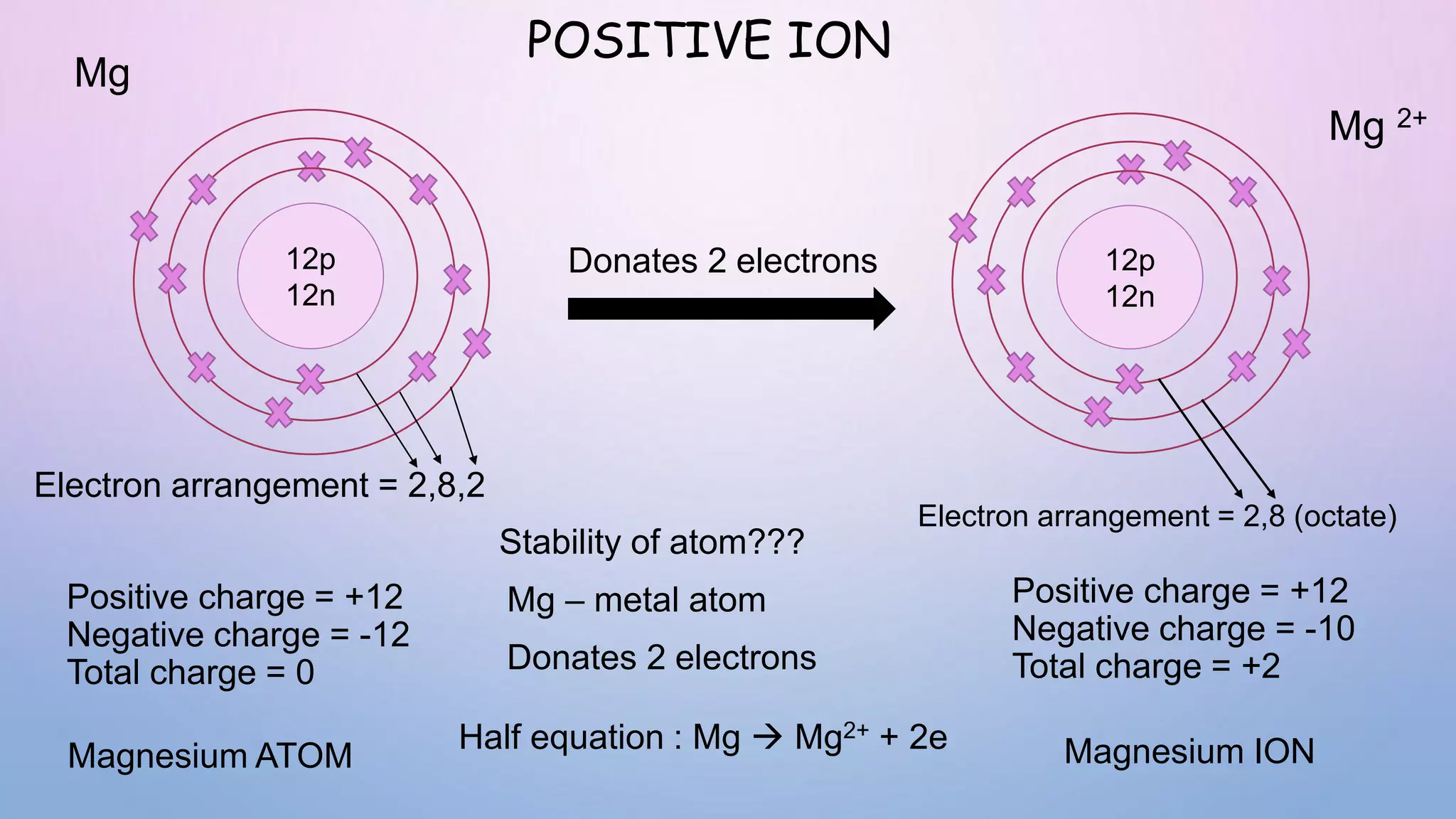
Mg
Electron arrangement = 2,8,2
Positive charge = +12
Negative charge = -12
Total charge = 0 Donates 2 electrons
Stability of atom???
Mg – metal atom
Donates 2 electrons
Electron arrangement = 2,8 (octate)
Mg 2+
Positive charge = +12
Negative charge = -10
Total charge = +2
12p
12n
12p
12n
Magnesium ATOM Magnesium ION
Half equation : Mg  Mg2+ + 2e
POSITIVE ION
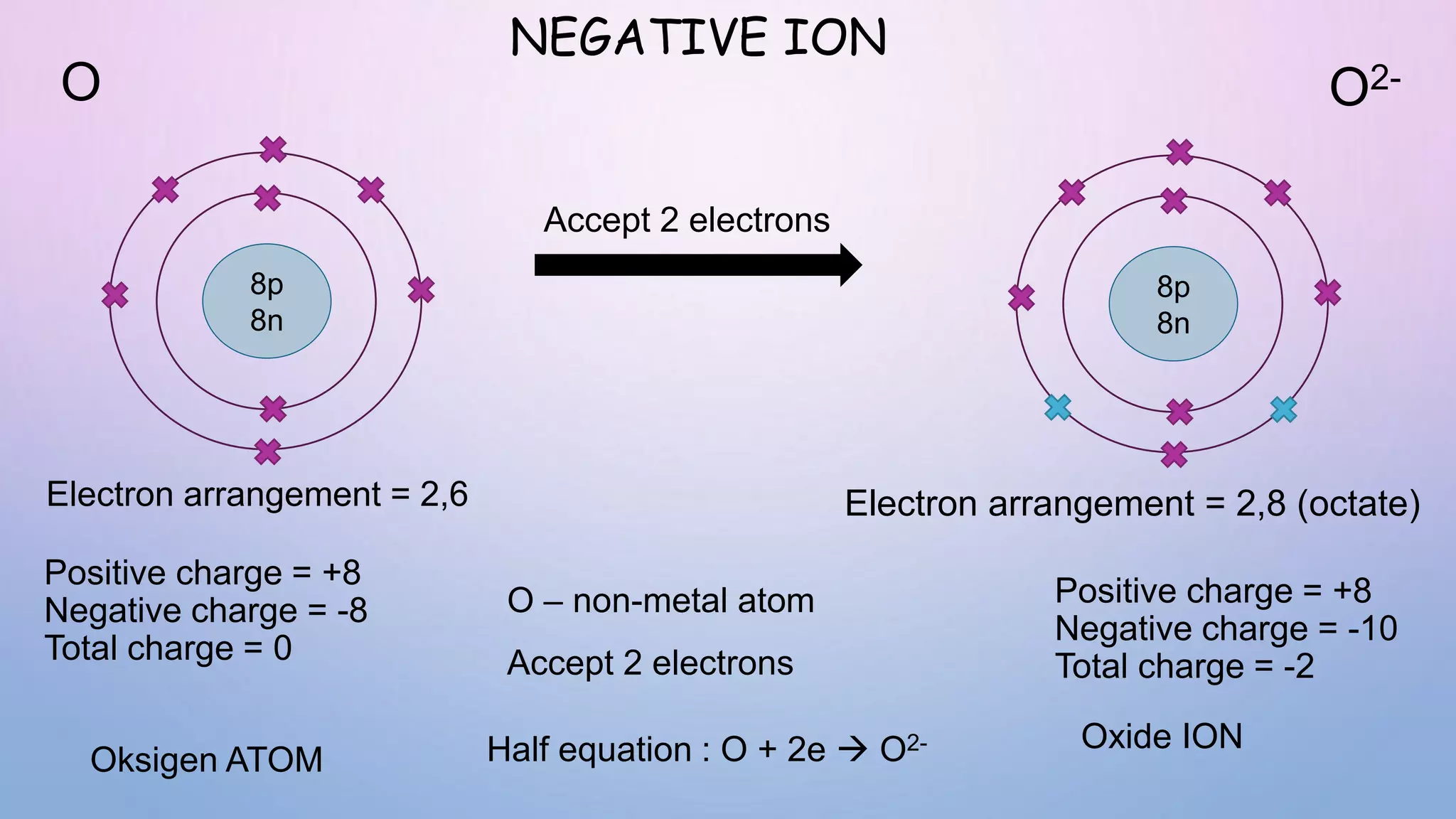
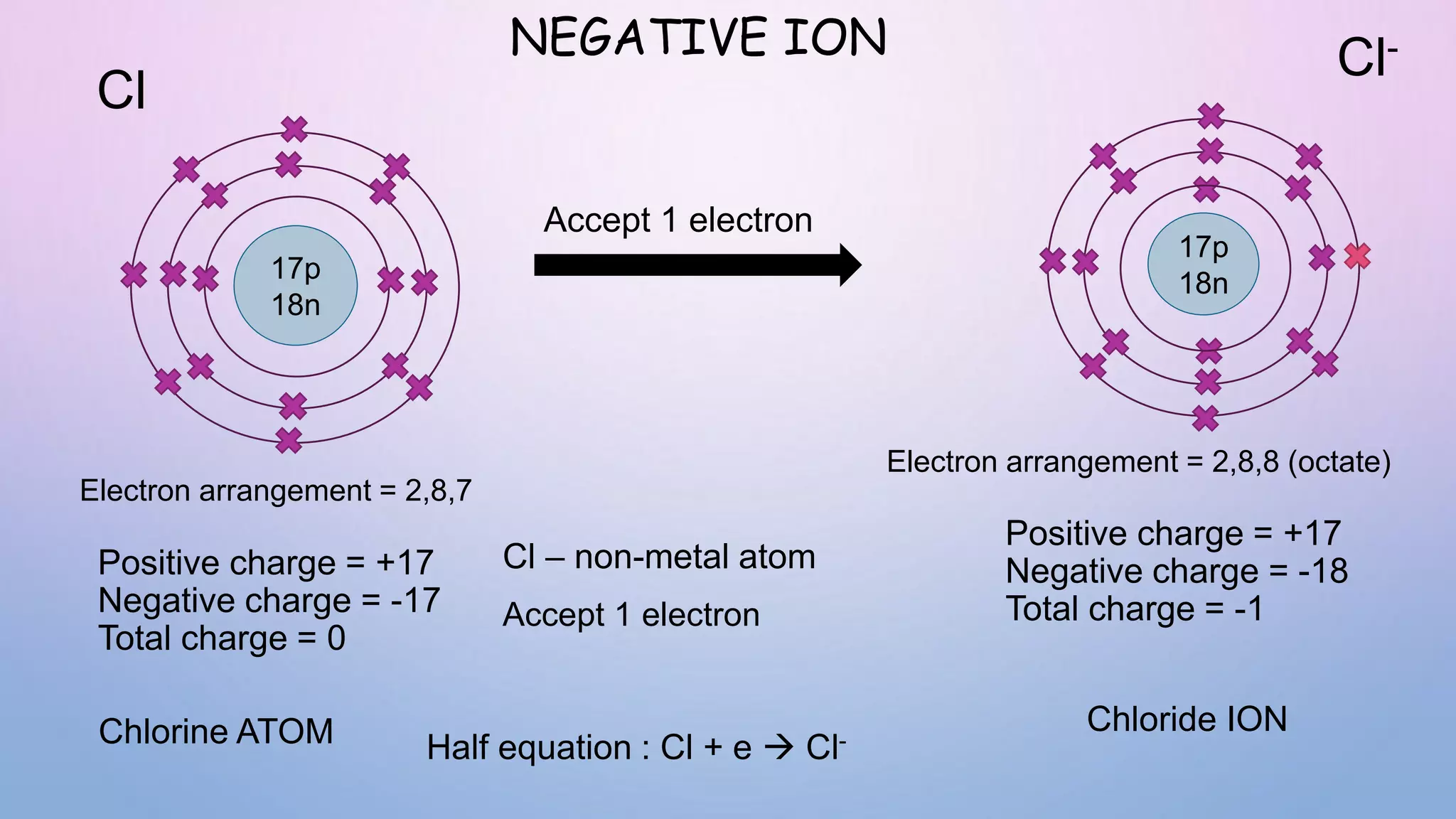
NEGATIVE ION
O
Electron arrangement = 2,6
Positive charge = +8
Negative charge = -8
Total charge = 0 Accept 2 electrons
O – non-metal atom
Accept 2 electrons
Electron arrangement = 2,8 (octate)
O2-
Positive charge = +8
Negative charge = -10
Total charge = -2
Oxide ION
Oksigen ATOM
8p
8n
8p
8n
Half equation : O + 2e  O2-
Cl
Electron arrangement = 2,8,7
Positive charge = +17
Negative charge = -17
Total charge = 0
Accept 1 electron
Cl – non-metal atom
Accept 1 electron
Electron arrangement = 2,8,8 (octate)
Cl-
Positive charge = +17
Negative charge = -18
Total charge = -1
Chloride ION
Chlorine ATOM
17p
18n
17p
18n
Half equation : Cl + e  Cl-
NEGATIVE ION
PERIODIC TABLE OF ELEMENTS
1
H
Hydrogen
1
2
He
Helium
4
3 (2,1)
Li
Lithium
7
4 (2,2)
Be
Beryllium
9
5 (2,3)
B
Boron
11
6 (2,4)
C
Carbon
12
7 (2,5)
N
Nitrogen
14
8 (2,6)
O
Oxygen
16
9 (2,7)
F
Flourine
19
10 (2,8)
Ne
Neon
20
11 (2,8,1)
Na
Sodium
23
12 (2,8,2)
Mg
Magnesiu
m
24
13 (2,8,3)
Al
Aluminiu
m
27
14 (2,8,4)
Si
Silicon
28
15 (2,8,5)
P
Phosphor
us
31
16 (2,8,6)
S
Sulphur
32
17 (2,8,7)
Cl
Chlorine
35.5
18 (2,8,8)
Ar
Argon
40
19
(2,8,8,1)
K
Potassiu
m
39
20
(2,8,8,2)
Ca
Calcium
40
5
B
Boron
11
Proton
number
Name of
element Nucleon
number
Symbol of
element
+ 2
+
3
+
3- 2- -
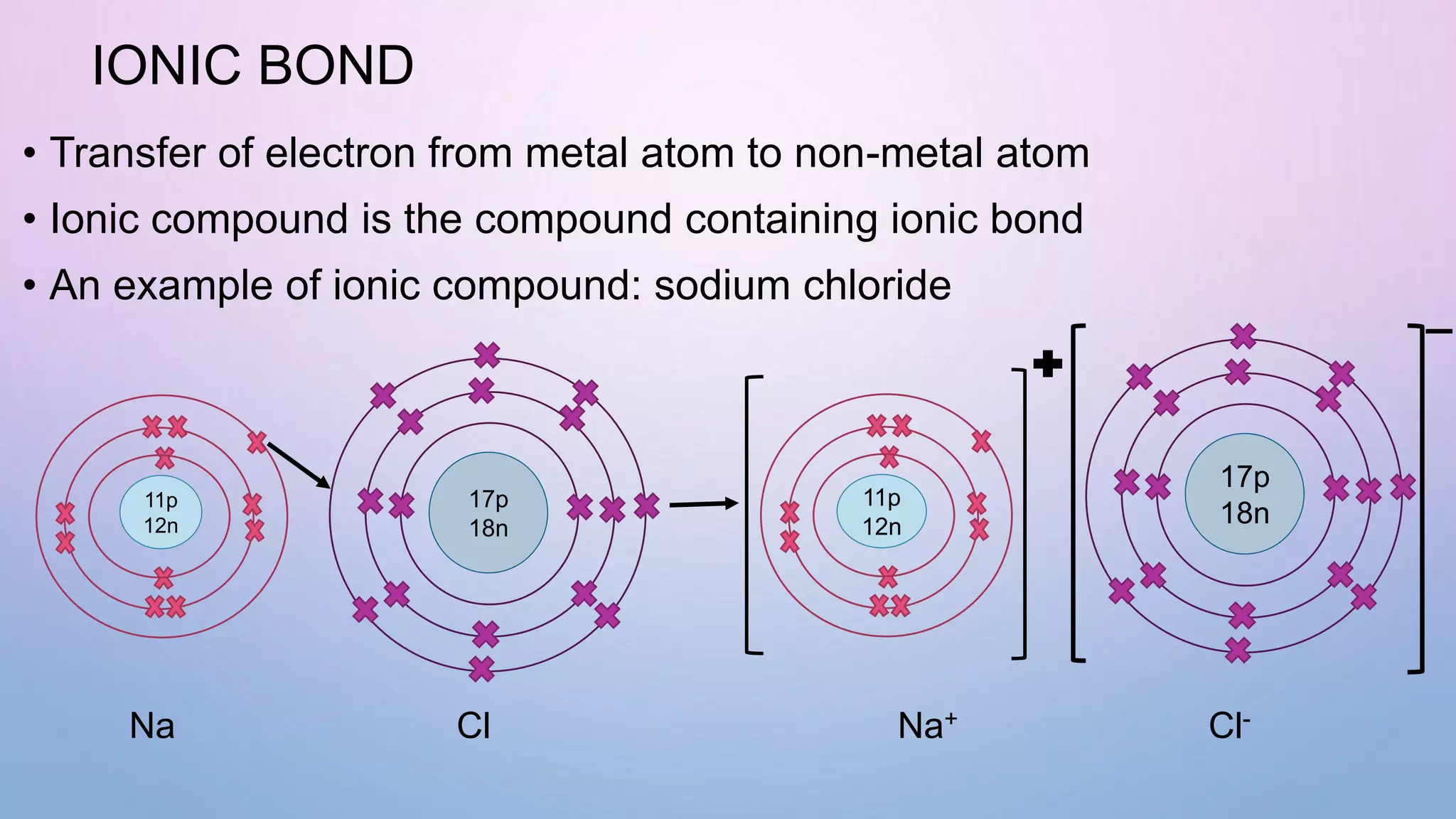
IONIC BOND
• Transfer of electron from metal atom to non-metal atom
• Ionic compound is the compound containing ionic bond
• An example of ionic compound: sodium chloride
11p
12n
17p
18n
Na Cl
11p
12n
17p
18n
Na+ Cl-
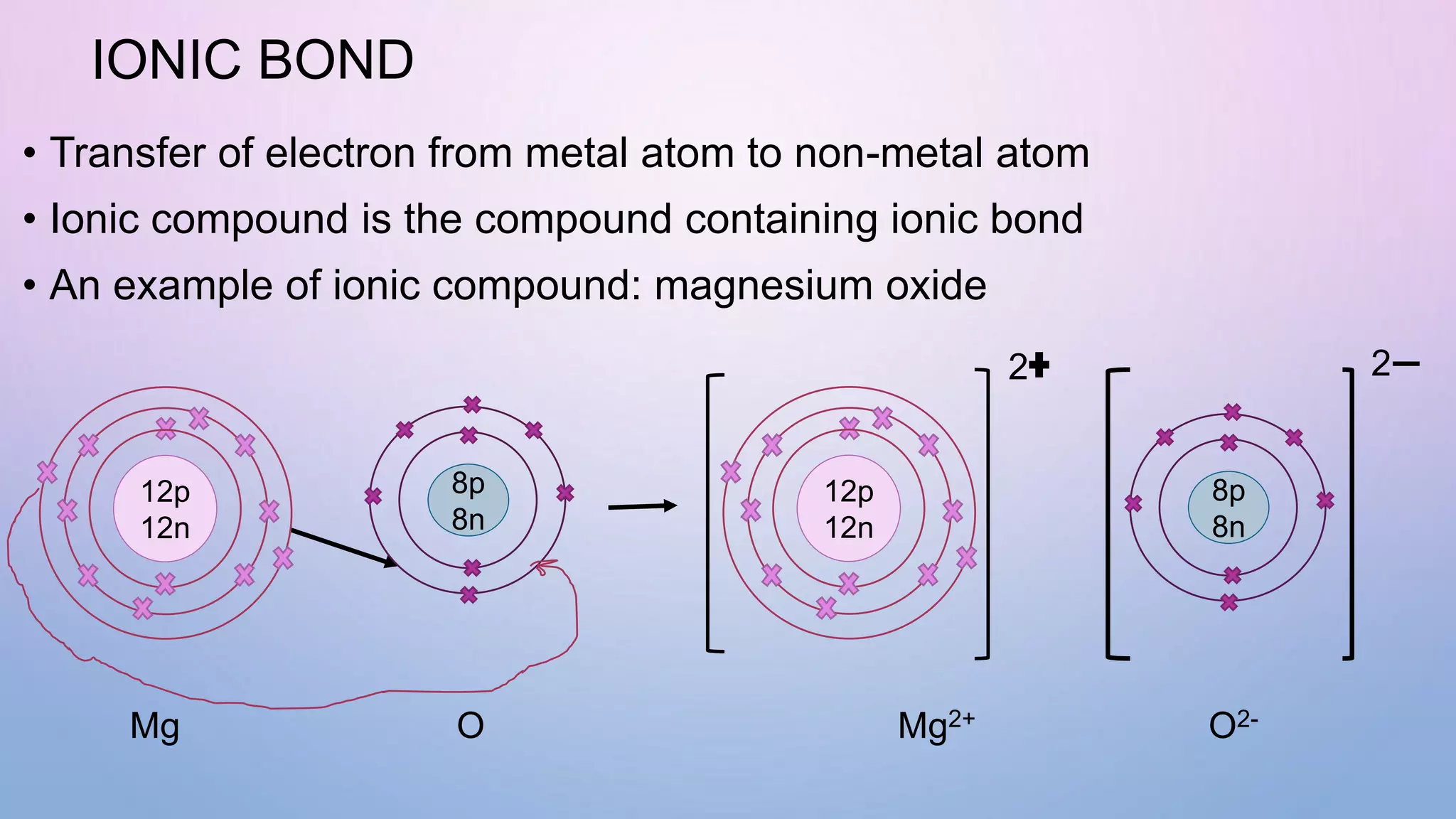
Mg O Mg2+ O2-
12p
12n
8p
8n
12p
12n
8p
8n
2
2
IONIC BOND
• Transfer of electron from metal atom to non-metal atom
• Ionic compound is the compound containing ionic bond
• An example of ionic compound: magnesium oxide
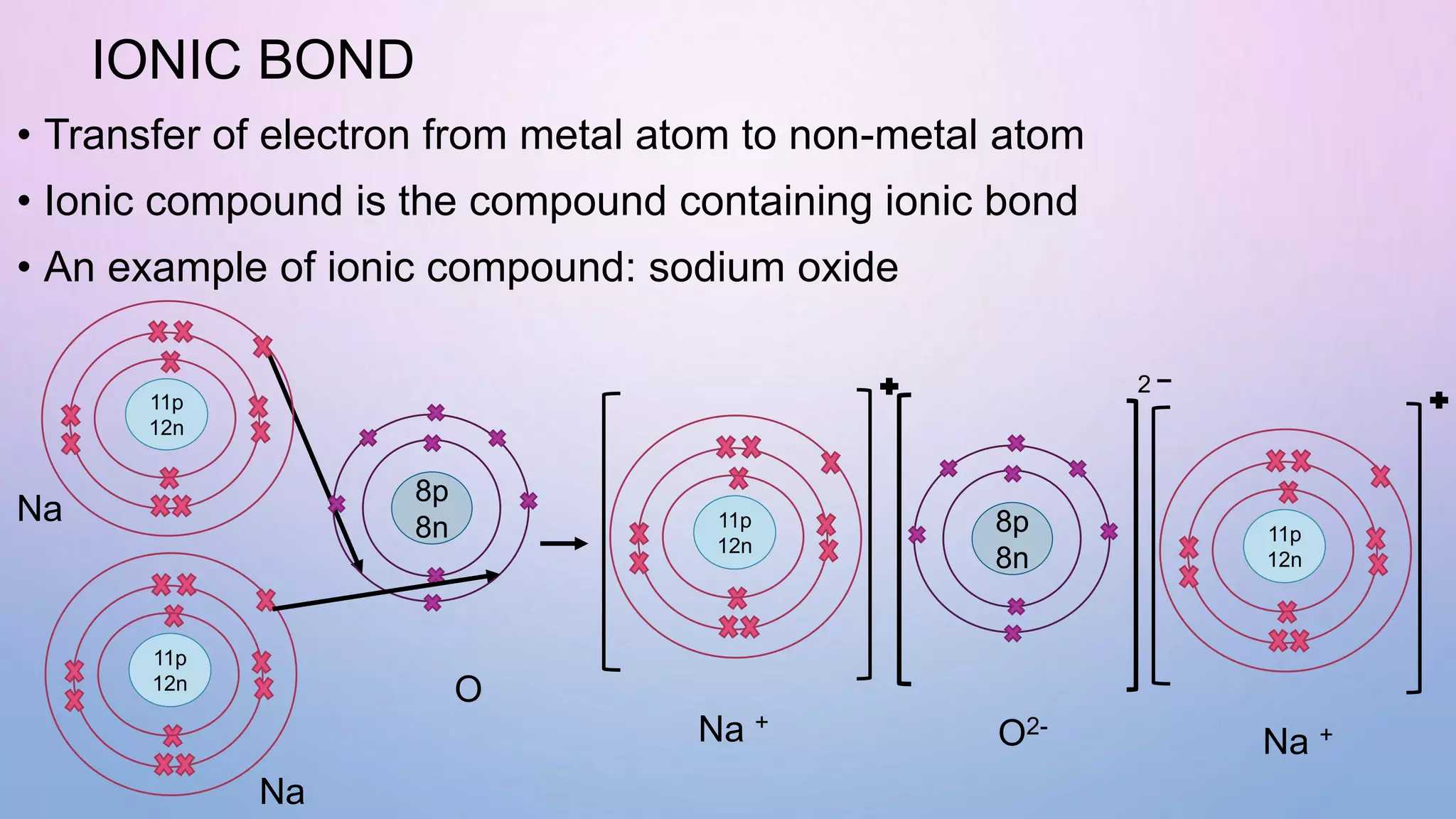
O
Na +
O2-
8p
8n 8p
8n
2
11p
12n
11p
12n
Na
Na 11p
12n
11p
12n
Na +
IONIC BOND
• Transfer of electron from metal atom to non-metal atom
• Ionic compound is the compound containing ionic bond
• An example of ionic compound: sodium oxide
COVALENT BOND
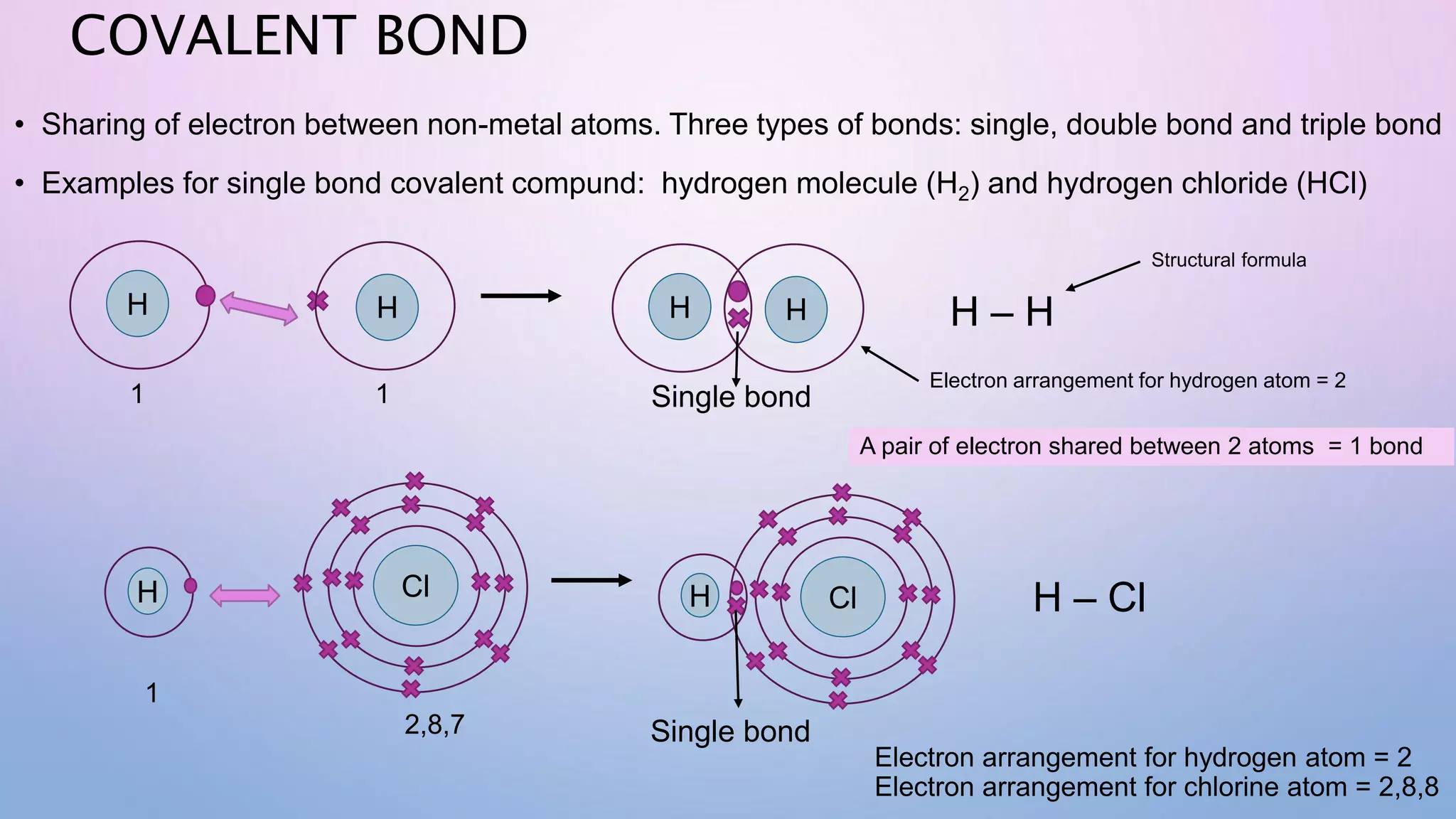
• Sharing of electron between non-metal atoms. Three types of bonds: single, double bond and triple bond
• Examples for single bond covalent compund: hydrogen molecule (H2) and hydrogen chloride (HCl)
1
H
H
H
H
Electron arrangement for hydrogen atom = 2
H – H
1 Single bond
Cl
H Cl
H
Single bond
H – Cl
Electron arrangement for hydrogen atom = 2
Electron arrangement for chlorine atom = 2,8,8
Structural formula
1
2,8,7
A pair of electron shared between 2 atoms = 1 bond
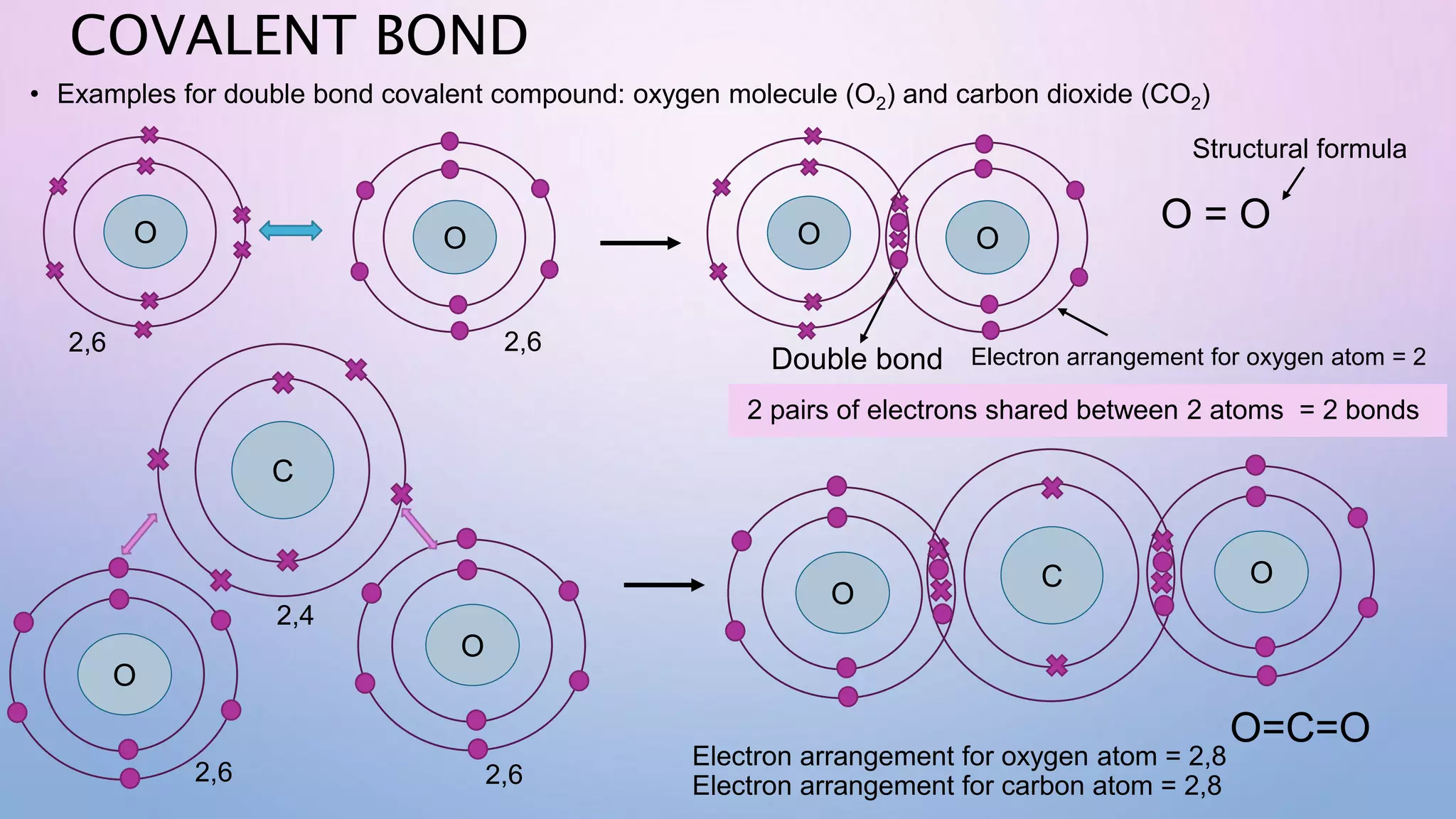
• Examples for double bond covalent compound: oxygen molecule (O2) and carbon dioxide (CO2)
Electron arrangement for oxygen atom = 2
O = O
2,6
Double bond
O=C=O
Electron arrangement for oxygen atom = 2,8
Electron arrangement for carbon atom = 2,8
Structural formula
O
2,6
O O
O
2 pairs of electrons shared between 2 atoms = 2 bonds
C
O
O
2,6 2,6
2,4
C O
O
COVALENT BOND
• Examples for triple bond covalent compound : nitrogen molecule (N2)
Electron arrangement for nitrogen atom = 2,8
2,5
Triple bond
Structural formula
2,5
N
3 pairs of electrons shared between 2 atoms = 3 bonds
N N
N
N N
COVALENT BOND
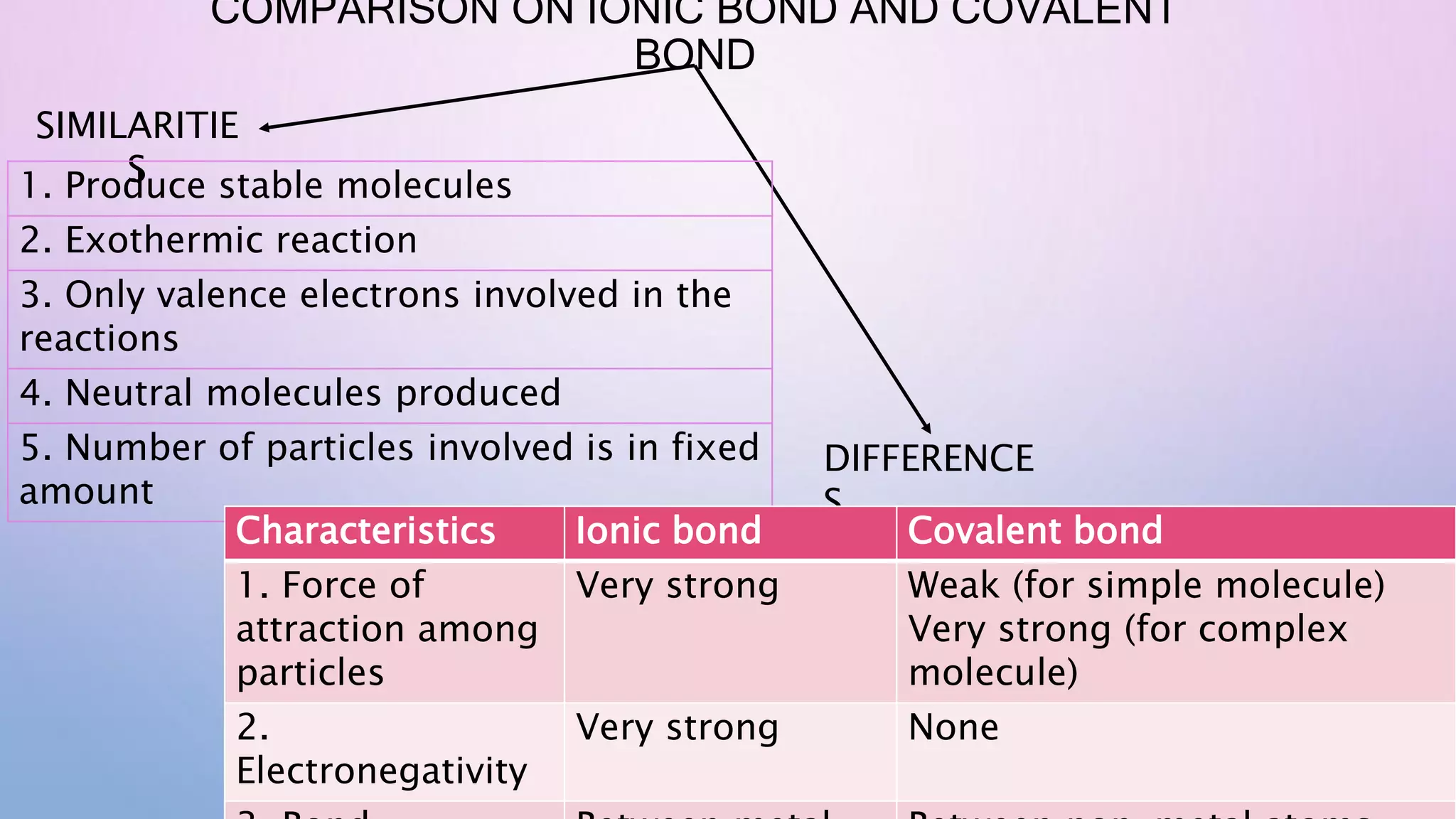
COMPARISON ON IONIC BOND AND COVALENT
BOND
SIMILARITIE
S
DIFFERENCE
S
1. Produce stable molecules
2. Exothermic reaction
3. Only valence electrons involved in the
reactions
4. Neutral molecules produced
5. Number of particles involved is in fixed
amount
Characteristics Ionic bond Covalent bond
1. Force of
attraction among
particles
Very strong Weak (for simple molecule)
Very strong (for complex
molecule)
2.
Electronegativity
Very strong None
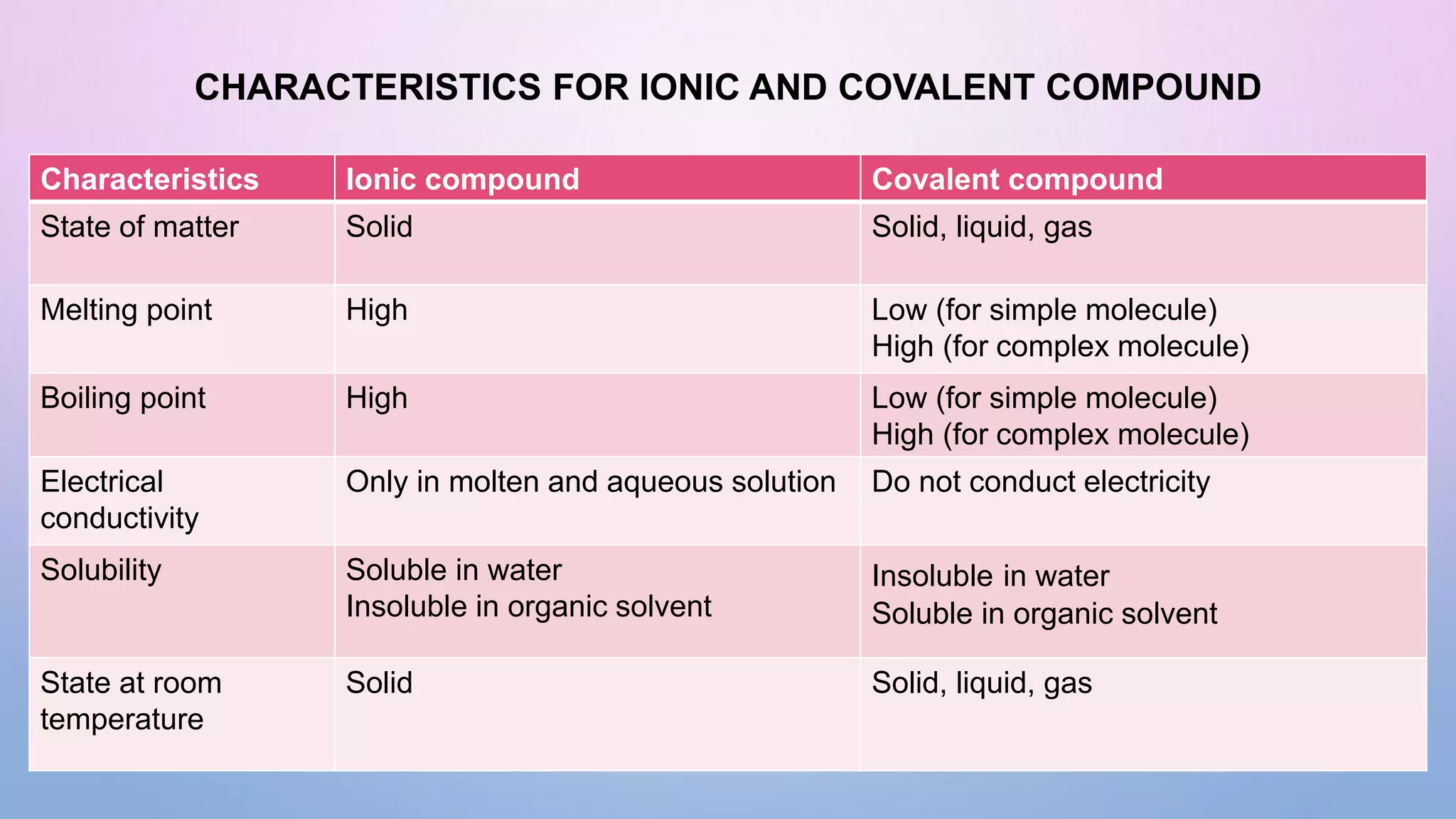
CHARACTERISTICS FOR IONIC AND COVALENT COMPOUND
Characteristics Ionic compound Covalent compound
State of matter Solid Solid, liquid, gas
Melting point High Low (for simple molecule)
High (for complex molecule)
Boiling point High Low (for simple molecule)
High (for complex molecule)
Electrical
conductivity
Only in molten and aqueous solution Do not conduct electricity
Solubility Soluble in water
Insoluble in organic solvent
Insoluble in water
Soluble in organic solvent
State at room
temperature
Solid Solid, liquid, gas

Ionic and covalent bonds

  • 1.
  • 2.
    IONIC BOND • Transferof electrons from metal atom to non-metal atom COVALENT BOND Sharing of electrons between non-metal atoms  Attraction force between ions/ electrostatic force Three types of covalent bond: single bond, double bond and triple bond  For example: H H-N-H H H-C=H H-C=C-H Double bond Single bond Triple bond Single bond Single bond
  • 3.
    Why? • Stability ofatom • Outer shell filled with electrons • Duplet configuration (2 electrons) – H, Li, Be, B • Octate configuration (8 electrons) – others How? 1. Atom donates/ losses of electrons 2. Atom accepts electrons Ion formation
  • 4.
    POSITIVE & NEGATIVEIONS Positive ions  metal atom donates/ losses of electrons towards non-metal atom Cation Negative ions  non-metal atom accepts electrons from metal atom Anion
  • 5.
    POSITIVE ION Na Electron arrangement=2,8,1 Positive charge= +11 Negative charge = -11 Total charge = 0 Donate 1 electron Stability of atom??? Na – metal atom Donate 1 electron 11p 12n Electron arrangement= 2,8 (octate) Na+ Positive charge= +11 Negative charge = -10 Total charge = +1 Natrium ION Natrium ATOM 11p 12n Half equation: Na  Na+ + e
  • 6.
    Mg Electron arrangement =2,8,2 Positive charge = +12 Negative charge = -12 Total charge = 0 Donates 2 electrons Stability of atom??? Mg – metal atom Donates 2 electrons Electron arrangement = 2,8 (octate) Mg 2+ Positive charge = +12 Negative charge = -10 Total charge = +2 12p 12n 12p 12n Magnesium ATOM Magnesium ION Half equation : Mg  Mg2+ + 2e POSITIVE ION
  • 7.
    NEGATIVE ION O Electron arrangement= 2,6 Positive charge = +8 Negative charge = -8 Total charge = 0 Accept 2 electrons O – non-metal atom Accept 2 electrons Electron arrangement = 2,8 (octate) O2- Positive charge = +8 Negative charge = -10 Total charge = -2 Oxide ION Oksigen ATOM 8p 8n 8p 8n Half equation : O + 2e  O2-
  • 8.
    Cl Electron arrangement =2,8,7 Positive charge = +17 Negative charge = -17 Total charge = 0 Accept 1 electron Cl – non-metal atom Accept 1 electron Electron arrangement = 2,8,8 (octate) Cl- Positive charge = +17 Negative charge = -18 Total charge = -1 Chloride ION Chlorine ATOM 17p 18n 17p 18n Half equation : Cl + e  Cl- NEGATIVE ION
  • 9.
    PERIODIC TABLE OFELEMENTS 1 H Hydrogen 1 2 He Helium 4 3 (2,1) Li Lithium 7 4 (2,2) Be Beryllium 9 5 (2,3) B Boron 11 6 (2,4) C Carbon 12 7 (2,5) N Nitrogen 14 8 (2,6) O Oxygen 16 9 (2,7) F Flourine 19 10 (2,8) Ne Neon 20 11 (2,8,1) Na Sodium 23 12 (2,8,2) Mg Magnesiu m 24 13 (2,8,3) Al Aluminiu m 27 14 (2,8,4) Si Silicon 28 15 (2,8,5) P Phosphor us 31 16 (2,8,6) S Sulphur 32 17 (2,8,7) Cl Chlorine 35.5 18 (2,8,8) Ar Argon 40 19 (2,8,8,1) K Potassiu m 39 20 (2,8,8,2) Ca Calcium 40 5 B Boron 11 Proton number Name of element Nucleon number Symbol of element + 2 + 3 + 3- 2- -
  • 10.
    IONIC BOND • Transferof electron from metal atom to non-metal atom • Ionic compound is the compound containing ionic bond • An example of ionic compound: sodium chloride 11p 12n 17p 18n Na Cl 11p 12n 17p 18n Na+ Cl-
  • 11.
    Mg O Mg2+O2- 12p 12n 8p 8n 12p 12n 8p 8n 2 2 IONIC BOND • Transfer of electron from metal atom to non-metal atom • Ionic compound is the compound containing ionic bond • An example of ionic compound: magnesium oxide
  • 12.
    O Na + O2- 8p 8n 8p 8n 2 11p 12n 11p 12n Na Na11p 12n 11p 12n Na + IONIC BOND • Transfer of electron from metal atom to non-metal atom • Ionic compound is the compound containing ionic bond • An example of ionic compound: sodium oxide
  • 13.
    COVALENT BOND • Sharingof electron between non-metal atoms. Three types of bonds: single, double bond and triple bond • Examples for single bond covalent compund: hydrogen molecule (H2) and hydrogen chloride (HCl) 1 H H H H Electron arrangement for hydrogen atom = 2 H – H 1 Single bond Cl H Cl H Single bond H – Cl Electron arrangement for hydrogen atom = 2 Electron arrangement for chlorine atom = 2,8,8 Structural formula 1 2,8,7 A pair of electron shared between 2 atoms = 1 bond
  • 14.
    • Examples fordouble bond covalent compound: oxygen molecule (O2) and carbon dioxide (CO2) Electron arrangement for oxygen atom = 2 O = O 2,6 Double bond O=C=O Electron arrangement for oxygen atom = 2,8 Electron arrangement for carbon atom = 2,8 Structural formula O 2,6 O O O 2 pairs of electrons shared between 2 atoms = 2 bonds C O O 2,6 2,6 2,4 C O O COVALENT BOND
  • 15.
    • Examples fortriple bond covalent compound : nitrogen molecule (N2) Electron arrangement for nitrogen atom = 2,8 2,5 Triple bond Structural formula 2,5 N 3 pairs of electrons shared between 2 atoms = 3 bonds N N N N N COVALENT BOND
  • 16.
    COMPARISON ON IONICBOND AND COVALENT BOND SIMILARITIE S DIFFERENCE S 1. Produce stable molecules 2. Exothermic reaction 3. Only valence electrons involved in the reactions 4. Neutral molecules produced 5. Number of particles involved is in fixed amount Characteristics Ionic bond Covalent bond 1. Force of attraction among particles Very strong Weak (for simple molecule) Very strong (for complex molecule) 2. Electronegativity Very strong None
  • 17.
    CHARACTERISTICS FOR IONICAND COVALENT COMPOUND Characteristics Ionic compound Covalent compound State of matter Solid Solid, liquid, gas Melting point High Low (for simple molecule) High (for complex molecule) Boiling point High Low (for simple molecule) High (for complex molecule) Electrical conductivity Only in molten and aqueous solution Do not conduct electricity Solubility Soluble in water Insoluble in organic solvent Insoluble in water Soluble in organic solvent State at room temperature Solid Solid, liquid, gas