Chapter 15 :
Energy and Chemical Change
SECTION 3 Thermochemical
Equations
Write thermochemical equations for chemical
reactions and other processes.
Describe how energy is lost or gained during
changes of state.
Calculate the heat absorbed or released in a chemical
reaction
objectives
Enthalpy change for Exothermic
reactions usually has negative
charge, Explain.
Round Robin
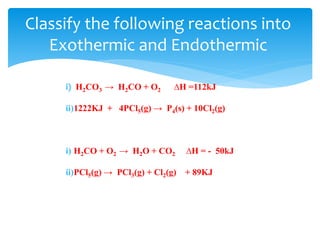
i) H2CO3 → H2CO + O2 ∆H =112kJ
ii)1222KJ + 4PCl5(g) → P4(s) + 10Cl2(g)
i) H2CO + O2 → H2O + CO2 ∆H = - 50kJ
ii)PCl5(g) → PCl3(g) + Cl2(g) + 89KJ
Classify the following reactions into
Exothermic and Endothermic
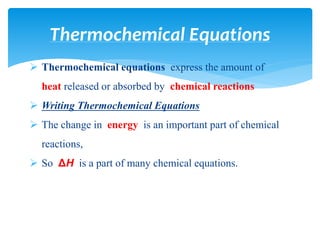
 Thermochemical equations express the amount of
heat released or absorbed by chemical reactions
 Writing Thermochemical Equations
 The change in energy is an important part of chemical
reactions,
 So ΔH is a part of many chemical equations.
Thermochemical Equations
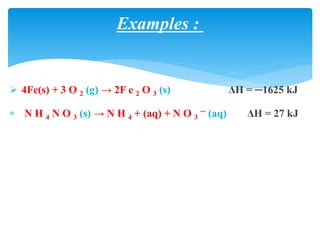
 4Fe(s) + 3 O 2 (g) → 2F e 2 O 3 (s) ΔH = ─1625 kJ
 N H 4 N O 3 (s) → N H 4 + (aq) + N O 3
─ (aq) ΔH = 27 kJ
Examples :
A thermochemical equation:
 is a balanced chemical equation that
includes the physical states of all reactants
and products and the energy change, usually
expressed as the change in enthalpy, ΔH.
How much heat is required to
vaporize 166 grams of water as its
boiling point is 40.7 kj/mol
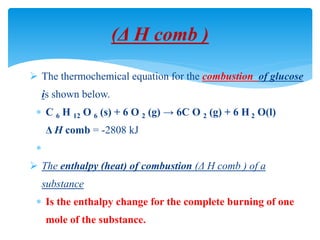
(Δ H comb )
 The thermochemical equation for the combustion of glucose
is shown below.
 C 6 H 12 O 6 (s) + 6 O 2 (g) → 6C O 2 (g) + 6 H 2 O(l)
Δ H comb = -2808 kJ

 The enthalpy (heat) of combustion (Δ H comb ) of a
substance
 Is the enthalpy change for the complete burning of one
mole of the substance.
 Standard enthalpy changes have the symbol Δ H ° .
 The zero superscript tells you that the enthalpy
changes were determined with all reactants and
products at standard conditions.
 Standard conditions are 1 atm pressure and 298 K
(25°C) and should not be confused with standard
temperature and pressure (STP).
Δ H °
Many processes other than chemical reactions absorb or
release heat.
 Molar enthalpy (heat) of vaporization (Δ H vap ).
 The heat required to vaporize one mole of a liquid .
 Molar enthalpy (heat) of fusion
 The heat required to melt one mole of a solid
substance
 Because vaporizing a liquid and melting a solid are
endothermic processes, their ΔH values are positive.
Changes of State
 How much heat is evolved when 54.0 g glucose ( C 6 H 12 O 6 )
is burned according to this equation?
 C 6 H 12 O 6 (s) + 6 O 2 (g) → 6C O 2 (g) + 6 H 2 O(l) Δ
 H comb = -2808 kJ
EXAMPLE Problem 4
Thermochemical equations for
changes of state
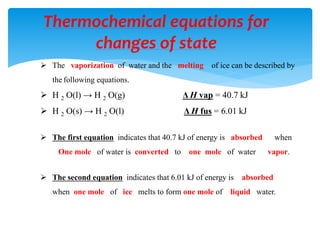
 The vaporization of water and the melting of ice can be described by
the following equations.
 H 2 O(l) → H 2 O(g) Δ H vap = 40.7 kJ
 H 2 O(s) → H 2 O(l) Δ H fus = 6.01 kJ
 The first equation indicates that 40.7 kJ of energy is absorbed when
One mole of water is converted to one mole of water vapor.
 The second equation indicates that 6.01 kJ of energy is absorbed
when one mole of ice melts to form one mole of liquid water.
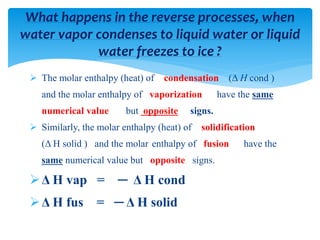
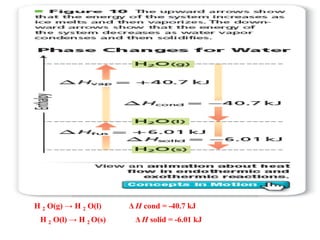
 The molar enthalpy (heat) of condensation (Δ H cond )
and the molar enthalpy of vaporization have the same
numerical value but opposite signs.
 Similarly, the molar enthalpy (heat) of solidification
(Δ H solid ) and the molar enthalpy of fusion have the
same numerical value but opposite signs.
Δ H vap = ─ Δ H cond
Δ H fus = ─ Δ H solid
What happens in the reverse processes, when
water vapor condenses to liquid water or liquid
water freezes to ice ?
H 2 O(g) → H 2 O(l) Δ H cond = -40.7 kJ
H 2 O(l) → H 2 O(s) Δ H solid = -6.01 kJ
 How much heat is evolved when 54.0 g glucose ( C 6
H 12 O 6 ) is burned according to this equation?
 C 6 H 12 O 6 (s) + 6 O 2 (g) → 6C O 2 (g) + 6 H 2 O(l) Δ
H comb = -2808 kJ
EXAMPLE Problem 4
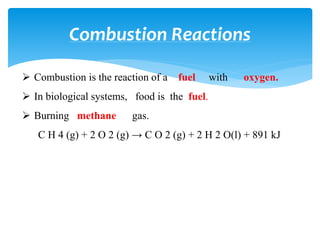
Combustion Reactions
 Combustion is the reaction of a fuel with oxygen.
 In biological systems, food is the fuel.
 Burning methane gas.
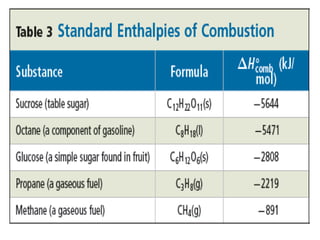
C H 4 (g) + 2 O 2 (g) → C O 2 (g) + 2 H 2 O(l) + 891 kJ
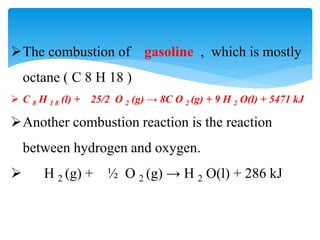
The combustion of gasoline , which is mostly
octane ( C 8 H 18 )
 C 8 H 1 8 (l) + 25/2 O 2 (g) → 8C O 2 (g) + 9 H 2 O(l) + 5471 kJ
Another combustion reaction is the reaction
between hydrogen and oxygen.
 H 2 (g) + ½ O 2 (g) → H 2 O(l) + 286 kJ
Thermochemical equations

Thermochemical equations

  • 1.
    Chapter 15 : Energyand Chemical Change SECTION 3 Thermochemical Equations
  • 2.
    Write thermochemical equationsfor chemical reactions and other processes. Describe how energy is lost or gained during changes of state. Calculate the heat absorbed or released in a chemical reaction objectives
  • 3.
    Enthalpy change forExothermic reactions usually has negative charge, Explain. Round Robin
  • 4.
    i) H2CO3 →H2CO + O2 ∆H =112kJ ii)1222KJ + 4PCl5(g) → P4(s) + 10Cl2(g) i) H2CO + O2 → H2O + CO2 ∆H = - 50kJ ii)PCl5(g) → PCl3(g) + Cl2(g) + 89KJ Classify the following reactions into Exothermic and Endothermic
  • 6.
     Thermochemical equationsexpress the amount of heat released or absorbed by chemical reactions  Writing Thermochemical Equations  The change in energy is an important part of chemical reactions,  So ΔH is a part of many chemical equations. Thermochemical Equations
  • 7.
     4Fe(s) +3 O 2 (g) → 2F e 2 O 3 (s) ΔH = ─1625 kJ  N H 4 N O 3 (s) → N H 4 + (aq) + N O 3 ─ (aq) ΔH = 27 kJ Examples :
  • 9.
    A thermochemical equation: is a balanced chemical equation that includes the physical states of all reactants and products and the energy change, usually expressed as the change in enthalpy, ΔH.
  • 10.
    How much heatis required to vaporize 166 grams of water as its boiling point is 40.7 kj/mol
  • 11.
    (Δ H comb)  The thermochemical equation for the combustion of glucose is shown below.  C 6 H 12 O 6 (s) + 6 O 2 (g) → 6C O 2 (g) + 6 H 2 O(l) Δ H comb = -2808 kJ   The enthalpy (heat) of combustion (Δ H comb ) of a substance  Is the enthalpy change for the complete burning of one mole of the substance.
  • 12.
     Standard enthalpychanges have the symbol Δ H ° .  The zero superscript tells you that the enthalpy changes were determined with all reactants and products at standard conditions.  Standard conditions are 1 atm pressure and 298 K (25°C) and should not be confused with standard temperature and pressure (STP). Δ H °
  • 14.
    Many processes otherthan chemical reactions absorb or release heat.  Molar enthalpy (heat) of vaporization (Δ H vap ).  The heat required to vaporize one mole of a liquid .  Molar enthalpy (heat) of fusion  The heat required to melt one mole of a solid substance  Because vaporizing a liquid and melting a solid are endothermic processes, their ΔH values are positive. Changes of State
  • 16.
     How muchheat is evolved when 54.0 g glucose ( C 6 H 12 O 6 ) is burned according to this equation?  C 6 H 12 O 6 (s) + 6 O 2 (g) → 6C O 2 (g) + 6 H 2 O(l) Δ  H comb = -2808 kJ EXAMPLE Problem 4
  • 17.
    Thermochemical equations for changesof state  The vaporization of water and the melting of ice can be described by the following equations.  H 2 O(l) → H 2 O(g) Δ H vap = 40.7 kJ  H 2 O(s) → H 2 O(l) Δ H fus = 6.01 kJ  The first equation indicates that 40.7 kJ of energy is absorbed when One mole of water is converted to one mole of water vapor.  The second equation indicates that 6.01 kJ of energy is absorbed when one mole of ice melts to form one mole of liquid water.
  • 18.
     The molarenthalpy (heat) of condensation (Δ H cond ) and the molar enthalpy of vaporization have the same numerical value but opposite signs.  Similarly, the molar enthalpy (heat) of solidification (Δ H solid ) and the molar enthalpy of fusion have the same numerical value but opposite signs. Δ H vap = ─ Δ H cond Δ H fus = ─ Δ H solid What happens in the reverse processes, when water vapor condenses to liquid water or liquid water freezes to ice ?
  • 19.
    H 2 O(g)→ H 2 O(l) Δ H cond = -40.7 kJ H 2 O(l) → H 2 O(s) Δ H solid = -6.01 kJ
  • 20.
     How muchheat is evolved when 54.0 g glucose ( C 6 H 12 O 6 ) is burned according to this equation?  C 6 H 12 O 6 (s) + 6 O 2 (g) → 6C O 2 (g) + 6 H 2 O(l) Δ H comb = -2808 kJ EXAMPLE Problem 4
  • 22.
    Combustion Reactions  Combustionis the reaction of a fuel with oxygen.  In biological systems, food is the fuel.  Burning methane gas. C H 4 (g) + 2 O 2 (g) → C O 2 (g) + 2 H 2 O(l) + 891 kJ
  • 23.
    The combustion ofgasoline , which is mostly octane ( C 8 H 18 )  C 8 H 1 8 (l) + 25/2 O 2 (g) → 8C O 2 (g) + 9 H 2 O(l) + 5471 kJ Another combustion reaction is the reaction between hydrogen and oxygen.  H 2 (g) + ½ O 2 (g) → H 2 O(l) + 286 kJ