1
Name:……………………………………………
Grade: ………………………..
Subject: Chemistry
Date: …………………………………………
CHAPTER 5 : Electrons in Atoms in
Section 2 : Quantum Theory and the Atom
Bohr’s Model of the Atom
Energy states of hydrogen
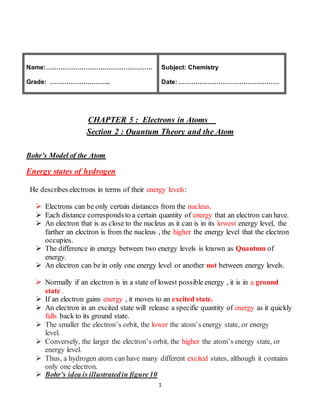
He describes electrons in terms of their energy levels:
 Electrons can be only certain distances from the nucleus.
 Each distance correspondsto a certain quantity of energy that an electron can have.
 An electron that is as close to the nucleus as it can is in its lowest energy level, the
farther an electron is from the nucleus , the higher the energy level that the electron
occupies.
 The difference in energy between two energy levels is known as Quantum of
energy.
 An electron can be in only one energy level or another not between energy levels.
 Normally if an electron is in a state of lowest possible energy , it is in a ground
state .
 If an electron gains energy , it moves to an excited state.
 An electron in an excited state will release a specific quantity of energy as it quickly
falls back to its ground state.
 The smaller the electron’s orbit, the lower the atom’s energy state, or energy
level.
 Conversely, the larger the electron’s orbit, the higher the atom’s energy state, or
energy level.
 Thus, a hydrogen atom can have many different excited states, although it contains
only one electron.
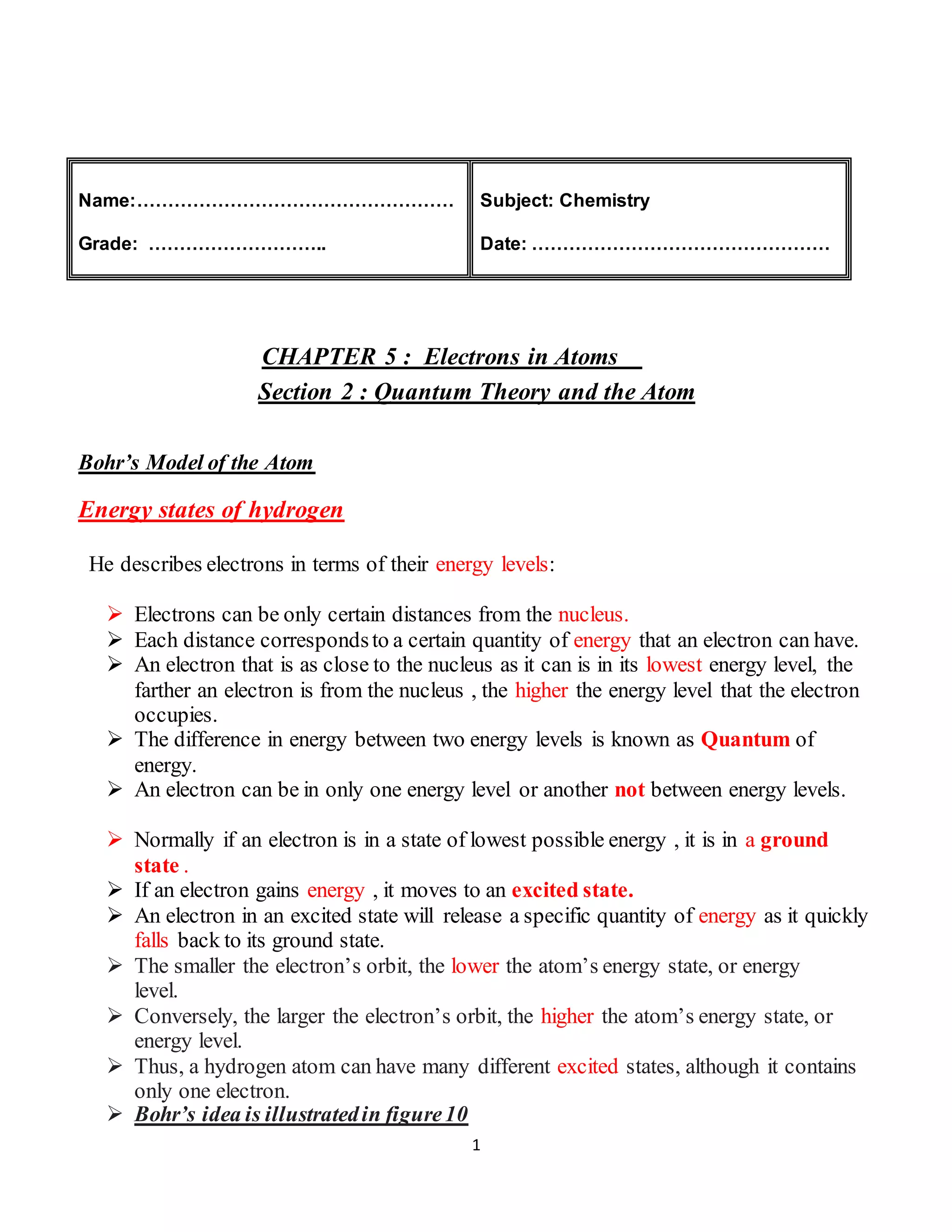
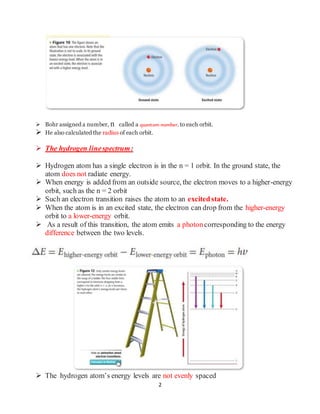
 Bohr’s idea is illustratedin figure10
2
 Bohr assigned a number, n called a quantum number, to each orbit.
 He also calculated the radius of each orbit.
 The hydrogen linespectrum:
 Hydrogen atom has a single electron is in the n = 1 orbit. In the ground state, the
atom does not radiate energy.
 When energy is added from an outside source, the electron moves to a higher-energy
orbit, such as the n = 2 orbit
 Such an electron transition raises the atom to an excitedstate.
 When the atom is in an excited state, the electron can drop from the higher-energy
orbit to a lower-energy orbit.
 As a result of this transition, the atom emits a photoncorresponding to the energy
difference between the two levels.
 The hydrogen atom’s energy levels are not evenly spaced
3
 The limitsof Bohr’s model
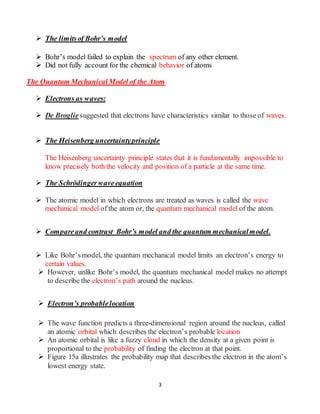
 Bohr’s model failed to explain the spectrum of any other element.
 Did not fully account for the chemical behavior of atoms
The Quantum Mechanical Model of the Atom
 Electrons as waves:
 De Brogliesuggested that electrons have characteristics similar to those of waves.
 The Heisenberg uncertaintyprinciple
The Heisenberg uncertainty principle states that it is fundamentally impossible to
know precisely both the velocity and position of a particle at the same time.
 The Schrödingerwaveequation
 The atomic model in which electrons are treated as waves is called the wave
mechanical model of the atom or, the quantum mechanical model of the atom.
 Compareand contrast Bohr’s model and the quantum mechanicalmodel.
 Like Bohr’s model, the quantum mechanical model limits an electron’s energy to
certain values.
 However, unlike Bohr’s model, the quantum mechanical model makes no attempt
to describe the electron’s path around the nucleus.
 Electron’s probablelocation
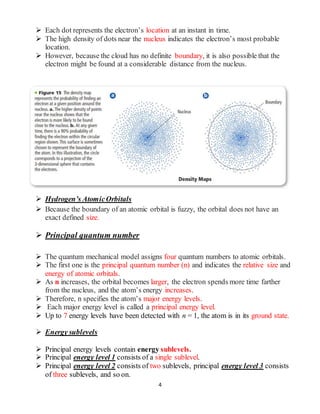
 The wave function predicts a three-dimensional region around the nucleus, called
an atomic orbital which describes the electron’s probable location
 An atomic orbital is like a fuzzy cloud in which the density at a given point is
proportional to the probability of finding the electron at that point.
 Figure 15a illustrates the probability map that describes the electron in the atom’s
lowest energy state.
4
 Each dot represents the electron’s location at an instant in time.
 The high density of dots near the nucleus indicates the electron’s most probable
location.
 However, because the cloud has no definite boundary, it is also possible that the
electron might be found at a considerable distance from the nucleus.
 Hydrogen’s AtomicOrbitals
 Because the boundary of an atomic orbital is fuzzy, the orbital does not have an
exact defined size.
 Principal quantum number
 The quantum mechanical model assigns four quantum numbers to atomic orbitals.
 The first one is the principal quantum number (n) and indicates the relative size and
energy of atomic orbitals.
 As n increases, the orbital becomes larger, the electron spends more time farther
from the nucleus, and the atom’s energy increases.
 Therefore, n specifies the atom’s major energy levels.
 Each major energy level is called a principal energy level.
 Up to 7 energy levels have been detected with n = 1, the atom is in its ground state.
 Energy sublevels
 Principal energy levels contain energy sublevels.
 Principal energy level 1 consists of a single sublevel.
 Principal energy level 2 consists of two sublevels, principal energy level 3 consists
of three sublevels, and so on.
5
 Shapes of orbitals ;
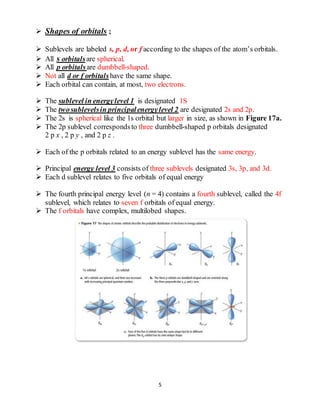
 Sublevels are labeled s, p, d, or f according to the shapes of the atom’s orbitals.
 All s orbitalsare spherical.
 All p orbitalsare dumbbell-shaped.
 Not all d or f orbitals have the same shape.
 Each orbital can contain, at most, two electrons.
 The sublevel in energylevel 1 is designated 1S
 The twosublevelsin principalenergylevel 2 are designated 2s and 2p.
 The 2s is spherical like the 1s orbital but larger in size, as shown in Figure 17a.
 The 2p sublevel correspondsto three dumbbell-shaped p orbitals designated
2 p x , 2 p y , and 2 p z .
 Each of the p orbitals related to an energy sublevel has the same energy.
 Principal energy level 3 consists of three sublevels designated 3s, 3p, and 3d.
 Each d sublevel relates to five orbitals of equal energy
 The fourth principal energy level (n = 4) contains a fourth sublevel, called the 4f
sublevel, which relates to seven f orbitals of equal energy.
 The f orbitals have complex, multilobed shapes.
6
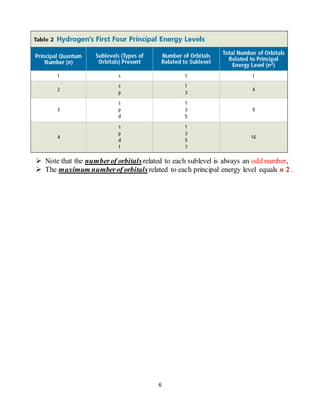
 Note that the numberof orbitals related to each sublevel is always an odd number,
 The maximum numberof orbitals related to each principal energy level equals n 2 .

Quantum theory and the atom

  • 1.
    1 Name:…………………………………………… Grade: ……………………….. Subject: Chemistry Date:………………………………………… CHAPTER 5 : Electrons in Atoms in Section 2 : Quantum Theory and the Atom Bohr’s Model of the Atom Energy states of hydrogen He describes electrons in terms of their energy levels:  Electrons can be only certain distances from the nucleus.  Each distance correspondsto a certain quantity of energy that an electron can have.  An electron that is as close to the nucleus as it can is in its lowest energy level, the farther an electron is from the nucleus , the higher the energy level that the electron occupies.  The difference in energy between two energy levels is known as Quantum of energy.  An electron can be in only one energy level or another not between energy levels.  Normally if an electron is in a state of lowest possible energy , it is in a ground state .  If an electron gains energy , it moves to an excited state.  An electron in an excited state will release a specific quantity of energy as it quickly falls back to its ground state.  The smaller the electron’s orbit, the lower the atom’s energy state, or energy level.  Conversely, the larger the electron’s orbit, the higher the atom’s energy state, or energy level.  Thus, a hydrogen atom can have many different excited states, although it contains only one electron.  Bohr’s idea is illustratedin figure10
  • 2.
    2  Bohr assigneda number, n called a quantum number, to each orbit.  He also calculated the radius of each orbit.  The hydrogen linespectrum:  Hydrogen atom has a single electron is in the n = 1 orbit. In the ground state, the atom does not radiate energy.  When energy is added from an outside source, the electron moves to a higher-energy orbit, such as the n = 2 orbit  Such an electron transition raises the atom to an excitedstate.  When the atom is in an excited state, the electron can drop from the higher-energy orbit to a lower-energy orbit.  As a result of this transition, the atom emits a photoncorresponding to the energy difference between the two levels.  The hydrogen atom’s energy levels are not evenly spaced
  • 3.
    3  The limitsofBohr’s model  Bohr’s model failed to explain the spectrum of any other element.  Did not fully account for the chemical behavior of atoms The Quantum Mechanical Model of the Atom  Electrons as waves:  De Brogliesuggested that electrons have characteristics similar to those of waves.  The Heisenberg uncertaintyprinciple The Heisenberg uncertainty principle states that it is fundamentally impossible to know precisely both the velocity and position of a particle at the same time.  The Schrödingerwaveequation  The atomic model in which electrons are treated as waves is called the wave mechanical model of the atom or, the quantum mechanical model of the atom.  Compareand contrast Bohr’s model and the quantum mechanicalmodel.  Like Bohr’s model, the quantum mechanical model limits an electron’s energy to certain values.  However, unlike Bohr’s model, the quantum mechanical model makes no attempt to describe the electron’s path around the nucleus.  Electron’s probablelocation  The wave function predicts a three-dimensional region around the nucleus, called an atomic orbital which describes the electron’s probable location  An atomic orbital is like a fuzzy cloud in which the density at a given point is proportional to the probability of finding the electron at that point.  Figure 15a illustrates the probability map that describes the electron in the atom’s lowest energy state.
  • 4.
    4  Each dotrepresents the electron’s location at an instant in time.  The high density of dots near the nucleus indicates the electron’s most probable location.  However, because the cloud has no definite boundary, it is also possible that the electron might be found at a considerable distance from the nucleus.  Hydrogen’s AtomicOrbitals  Because the boundary of an atomic orbital is fuzzy, the orbital does not have an exact defined size.  Principal quantum number  The quantum mechanical model assigns four quantum numbers to atomic orbitals.  The first one is the principal quantum number (n) and indicates the relative size and energy of atomic orbitals.  As n increases, the orbital becomes larger, the electron spends more time farther from the nucleus, and the atom’s energy increases.  Therefore, n specifies the atom’s major energy levels.  Each major energy level is called a principal energy level.  Up to 7 energy levels have been detected with n = 1, the atom is in its ground state.  Energy sublevels  Principal energy levels contain energy sublevels.  Principal energy level 1 consists of a single sublevel.  Principal energy level 2 consists of two sublevels, principal energy level 3 consists of three sublevels, and so on.
  • 5.
    5  Shapes oforbitals ;  Sublevels are labeled s, p, d, or f according to the shapes of the atom’s orbitals.  All s orbitalsare spherical.  All p orbitalsare dumbbell-shaped.  Not all d or f orbitals have the same shape.  Each orbital can contain, at most, two electrons.  The sublevel in energylevel 1 is designated 1S  The twosublevelsin principalenergylevel 2 are designated 2s and 2p.  The 2s is spherical like the 1s orbital but larger in size, as shown in Figure 17a.  The 2p sublevel correspondsto three dumbbell-shaped p orbitals designated 2 p x , 2 p y , and 2 p z .  Each of the p orbitals related to an energy sublevel has the same energy.  Principal energy level 3 consists of three sublevels designated 3s, 3p, and 3d.  Each d sublevel relates to five orbitals of equal energy  The fourth principal energy level (n = 4) contains a fourth sublevel, called the 4f sublevel, which relates to seven f orbitals of equal energy.  The f orbitals have complex, multilobed shapes.
  • 6.
    6  Note thatthe numberof orbitals related to each sublevel is always an odd number,  The maximum numberof orbitals related to each principal energy level equals n 2 .