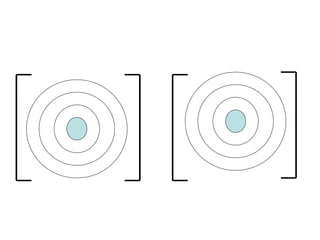
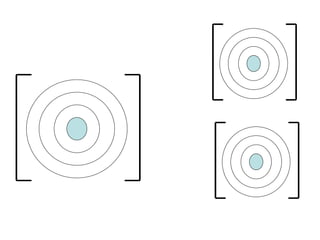
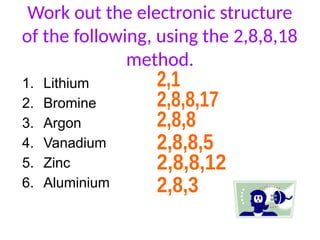
Work out theelectronic structure
of the following, using the 2,8,8,18
method.
1. Lithium
2. Bromine
3. Argon
4. Vanadium
5. Zinc
6. Aluminium
3.
Learning Outcomes
1. What
Howand why ions are formed and how they make
bonds
2. How
Working out ions and the bonding between them
3. Why
To know how compounds are made.
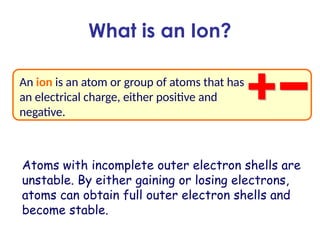
What is anIon?
An ion is an atom or group of atoms that has
an electrical charge, either positive and
negative.
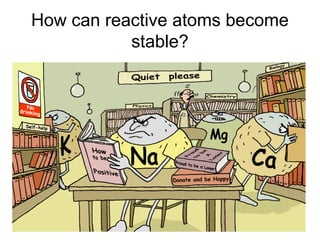
Atoms with incomplete outer electron shells are
unstable. By either gaining or losing electrons,
atoms can obtain full outer electron shells and
become stable.
6.
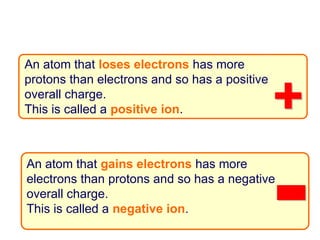
An atom thatloses electrons has more
protons than electrons and so has a positive
overall charge.
This is called a positive ion.
An atom that gains electrons has more
electrons than protons and so has a negative
overall charge.
This is called a negative ion.
7.
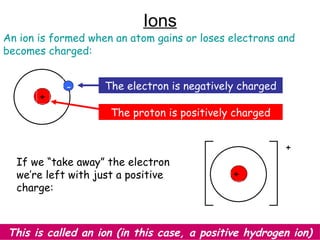
Ions
An ion isformed when an atom gains or loses electrons and
becomes charged:
If we “take away” the electron
we’re left with just a positive
charge:
This is called an ion (in this case, a positive hydrogen ion)
+
-
+
The electron is negatively charged
The proton is positively charged
+
How is asodium ion formed?
2.8.1
(partially full outer shell)
11 protons = +11
11 electrons = -11
Total charge = 0
Sodium atom:
11 protons = +11
10 electrons = -10
Total charge = +1
Sodium ion:
loses
1 electron
+
[2.8]
(full outer shell)
Na Na
11.
How is amagnesium ion formed?
2.8.2
(partially full outer shell)
12 protons = +12
12 electrons = -12
Total charge = 0
Magnesium atom:
12 protons = +12
10 electrons = -10
Total charge = +2
Magnesium ion:
[2.8]2+
(full outer shell)
2+
Mg Mg
loses
2 electrons
12.
How is afluoride ion formed?
2.7
(partially full outer shell)
9 protons = +9
9 electrons = -9
Total charge = 0
Fluorine atom:
9 protons = +9
10 electrons = -10
Total charge = -1
Fluoride ion:
[2.8]-
(full outer shell)
-
F F
gains 1
electron
13.
[2.8.8]2-
(full outer shell)
2.8.6
(partiallyfull outer shell)
How is a sulfide ion formed?
16 protons = +16
16 electrons = -16
Total charge = 0
Sulfur atom:
16 protons = +16
18 electrons = -18
Total charge = -2
Sulfide ion:
2-
S S
gains 2
electrons
14.
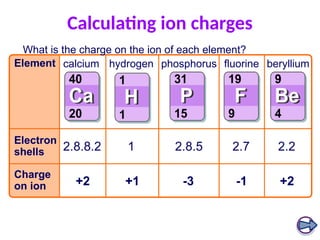
Calculating ion charges
Whatis the charge on the ion of each element?
+2 +2
+1 -3 -1
2.8.8.2 1 2.8.5 2.7 2.2
calcium hydrogen phosphorus fluorine beryllium
Element
Electron
shells
Charge
on ion
15.
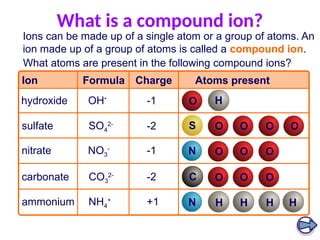
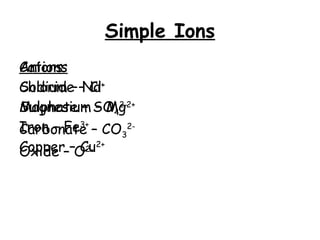
What is acompound ion?
Ions can be made up of a single atom or a group of atoms. An
ion made up of a group of atoms is called a compound ion.
hydroxide
sulfate
nitrate
carbonate
ammonium
-1
-2
-1
-2
+1
Ion Formula Charge Atoms present
NH4
+
CO3
2-
NO3
-
SO4
2-
OH-
O
O O
O
O
O O O
O
O
O
H
H H H
H
C
N
N
S
What atoms are present in the following compound ions?
16.
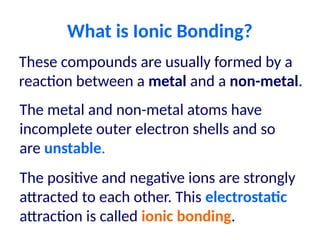
What is IonicBonding?
These compounds are usually formed by a
reaction between a metal and a non-metal.
The metal and non-metal atoms have
incomplete outer electron shells and so
are unstable.
The positive and negative ions are strongly
attracted to each other. This electrostatic
attraction is called ionic bonding.
17.
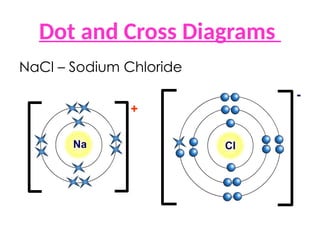
Dot and CrossDiagrams
NaCl – Sodium Chloride
-
Cl
Na
+
20.
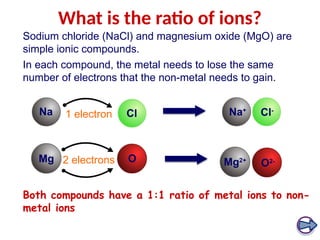
What is theratio of ions?
Sodium chloride (NaCl) and magnesium oxide (MgO) are
simple ionic compounds.
Both compounds have a 1:1 ratio of metal ions to non-
metal ions
Na Cl Na+
Cl-
1 electron
Mg Mg2+
O O2-
2 electrons
In each compound, the metal needs to lose the same
number of electrons that the non-metal needs to gain.
21.
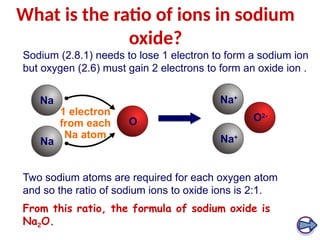
What is theratio of ions in sodium
oxide?
Sodium (2.8.1) needs to lose 1 electron to form a sodium ion
but oxygen (2.6) must gain 2 electrons to form an oxide ion .
Na
Na
O O2-
Na+
Na+
1 electron
from each
Na atom
Two sodium atoms are required for each oxygen atom
and so the ratio of sodium ions to oxide ions is 2:1.
From this ratio, the formula of sodium oxide is
Na2O.
22.
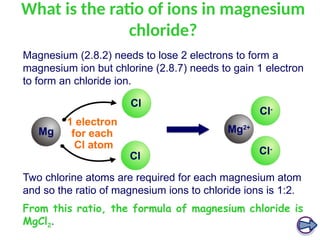
What is theratio of ions in magnesium
chloride?
Magnesium (2.8.2) needs to lose 2 electrons to form a
magnesium ion but chlorine (2.8.7) needs to gain 1 electron
to form an chloride ion.
Mg
Cl
Mg2+
Cl
Cl-
Cl-
1 electron
for each
Cl atom
Two chlorine atoms are required for each magnesium atom
and so the ratio of magnesium ions to chloride ions is 1:2.
From this ratio, the formula of magnesium chloride is
MgCl2.
23.
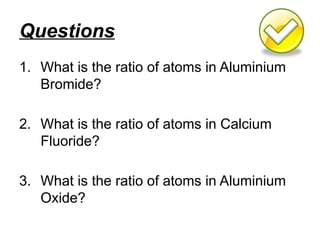
Questions
1. What isthe ratio of atoms in Aluminium
Bromide?
2. What is the ratio of atoms in Calcium
Fluoride?
3. What is the ratio of atoms in Aluminium
Oxide?
24.
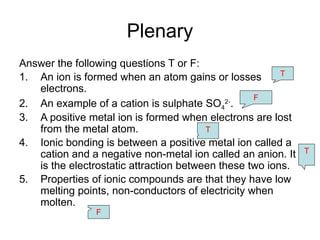
Plenary
Answer the followingquestions T or F:
1. An ion is formed when an atom gains or losses
electrons.
2. An example of a cation is sulphate SO4
2-
.
3. A positive metal ion is formed when electrons are lost
from the metal atom.
4. Ionic bonding is between a positive metal ion called a
cation and a negative non-metal ion called an anion. It
is the electrostatic attraction between these two ions.
5. Properties of ionic compounds are that they have low
melting points, non-conductors of electricity when
molten.
T
F
T
F
T
25.
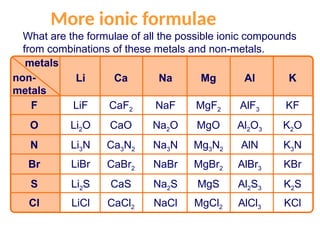
More ionic formulae
Whatare the formulae of all the possible ionic compounds
from combinations of these metals and non-metals.
metals
non-
metals
Li Ca Na Mg Al K
F
O
N
Br
S
Cl
LiF CaF2 NaF MgF2 AlF3 KF
Li2O CaO Na2O MgO Al2O3 K2O
Li3N Ca3N2 Na3N Mg3N2 AlN K3N
LiBr CaBr2 NaBr MgBr2 AlBr3 KBr
Li2S CaS Na2S MgS Al2S3 K2S
LiCl CaCl2 NaCl MgCl2 AlCl3 KCl
26.
Connect
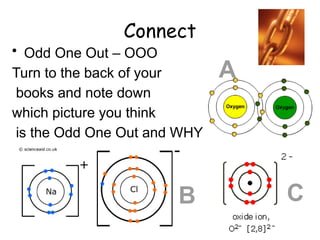
• Odd OneOut – OOO
Turn to the back of your
books and note down
which picture you think
is the Odd One Out and WHY
A
B C
27.
Learning Outcomes
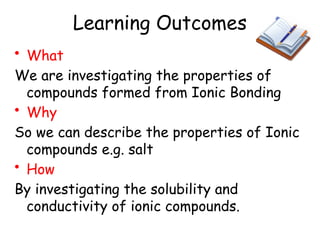
• What
Weare investigating the properties of
compounds formed from Ionic Bonding
• Why
So we can describe the properties of Ionic
compounds e.g. salt
• How
By investigating the solubility and
conductivity of ionic compounds.
28.
Properties of IonicCompounds
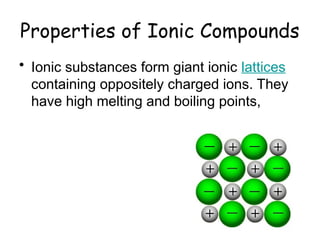
• Ionic substances form giant ionic lattices
containing oppositely charged ions. They
have high melting and boiling points,
29.
What is anionic lattice?
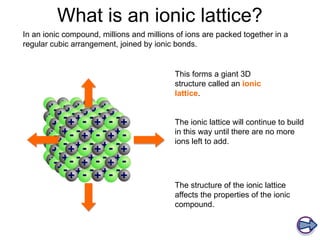
In an ionic compound, millions and millions of ions are packed together in a
regular cubic arrangement, joined by ionic bonds.
The structure of the ionic lattice
affects the properties of the ionic
compound.
The ionic lattice will continue to build
in this way until there are no more
ions left to add.
This forms a giant 3D
structure called an ionic
lattice.
30.
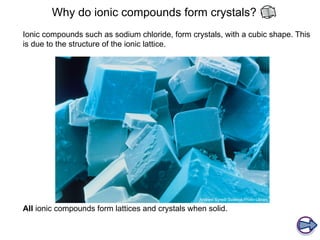
Why do ioniccompounds form crystals?
Ionic compounds such as sodium chloride, form crystals, with a cubic shape. This
is due to the structure of the ionic lattice.
All ionic compounds form lattices and crystals when solid.
31.
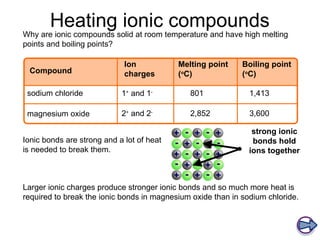
Heating ionic compounds
Whyare ionic compounds solid at room temperature and have high melting
points and boiling points?
Larger ionic charges produce stronger ionic bonds and so much more heat is
required to break the ionic bonds in magnesium oxide than in sodium chloride.
sodium chloride
magnesium oxide
Compound
Ion
charges
Melting point
(o
C)
Boiling point
(o
C)
1+
and 1-
2+
and 2-
801 1,413
2,852 3,600
strong ionic
bonds hold
ions together
Ionic bonds are strong and a lot of heat
is needed to break them.
32.
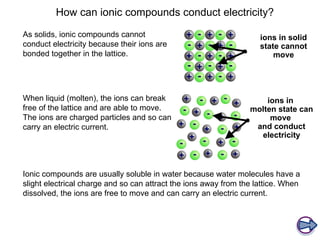
How can ioniccompounds conduct electricity?
When liquid (molten), the ions can break
free of the lattice and are able to move.
The ions are charged particles and so can
carry an electric current.
As solids, ionic compounds cannot
conduct electricity because their ions are
bonded together in the lattice.
ions in solid
state cannot
move
ions in
molten state can
move
and conduct
electricity
Ionic compounds are usually soluble in water because water molecules have a
slight electrical charge and so can attract the ions away from the lattice. When
dissolved, the ions are free to move and can carry an electric current.
33.
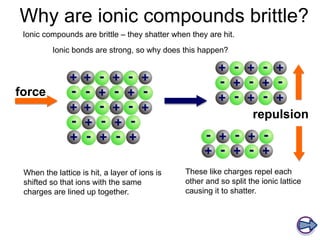
Why are ioniccompounds brittle?
Ionic compounds are brittle – they shatter when they are hit.
When the lattice is hit, a layer of ions is
shifted so that ions with the same
charges are lined up together.
These like charges repel each
other and so split the ionic lattice
causing it to shatter.
repulsion
force
Ionic bonds are strong, so why does this happen?
Editor's Notes
#30 Teacher notes
Photo credit: Andrew Syred/Science Photo Library.
The image is a coloured scanning electron micrograph (SEM) of common salt, sodium chloride, recrystallised from distilled water. The salt crystal is built up from a cubic lattice of sodium and chloride ions. In the absence of impurities the exact cubic crystal form is produced. This micrograph shows that in practice this basic cube is usually disrupted by dislocations; these give rise to crystals with a variety of shapes, although they all retain the basic cubic symmetry. Magnification: x280 at 5x7cm size. x975 at 10x8‘.
![How is a sodium ion formed?
2.8.1
(partially full outer shell)
11 protons = +11
11 electrons = -11
Total charge = 0
Sodium atom:
11 protons = +11
10 electrons = -10
Total charge = +1
Sodium ion:
loses
1 electron
+
[2.8]
(full outer shell)
Na Na](https://image.slidesharecdn.com/archions0ionicbondingpptcopycopycopy-251016140039-1db6711e/85/_archIons-0-Ionic-Bonding-PPT-copy-copy-copy-pptx-10-320.jpg)
![How is a magnesium ion formed?
2.8.2
(partially full outer shell)
12 protons = +12
12 electrons = -12
Total charge = 0
Magnesium atom:
12 protons = +12
10 electrons = -10
Total charge = +2
Magnesium ion:
[2.8]2+
(full outer shell)
2+
Mg Mg
loses
2 electrons](https://image.slidesharecdn.com/archions0ionicbondingpptcopycopycopy-251016140039-1db6711e/85/_archIons-0-Ionic-Bonding-PPT-copy-copy-copy-pptx-11-320.jpg)
![How is a fluoride ion formed?
2.7
(partially full outer shell)
9 protons = +9
9 electrons = -9
Total charge = 0
Fluorine atom:
9 protons = +9
10 electrons = -10
Total charge = -1
Fluoride ion:
[2.8]-
(full outer shell)
-
F F
gains 1
electron](https://image.slidesharecdn.com/archions0ionicbondingpptcopycopycopy-251016140039-1db6711e/85/_archIons-0-Ionic-Bonding-PPT-copy-copy-copy-pptx-12-320.jpg)
![[2.8.8]2-
(full outer shell)
2.8.6
(partially full outer shell)
How is a sulfide ion formed?
16 protons = +16
16 electrons = -16
Total charge = 0
Sulfur atom:
16 protons = +16
18 electrons = -18
Total charge = -2
Sulfide ion:
2-
S S
gains 2
electrons](https://image.slidesharecdn.com/archions0ionicbondingpptcopycopycopy-251016140039-1db6711e/85/_archIons-0-Ionic-Bonding-PPT-copy-copy-copy-pptx-13-320.jpg)