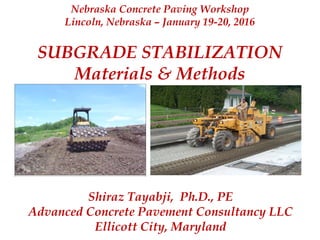
Nebraska Concrete Paving Workshop
Lincoln, Nebraska – January 19-20, 2016
SUBGRADE STABILIZATION
Materials & Methods
Shiraz Tayabji, Ph.D., PE
Advanced Concrete Pavement Consultancy LLC
Ellicott City, Maryland
Outline
o Subgrade Characteristics 101
o Role of Subgrade in a Concrete Pavement System
o Bearing capacity/Structural support
o Working platform
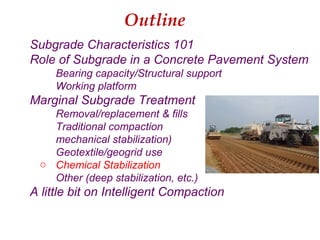
o Marginal Subgrade Treatment
o Removal/replacement & fills
o Traditional compaction (&
mechanical stabilization)
o Geotextile/geogrid use
o Chemical Stabilization
o Other (deep stabilization, etc.)
o A little bit on Intelligent Compaction
 Low volume roadways
 Residential streets
 State routes
 Interstate highways
 Airport runways and taxiways
 Parking lots
 Industrial storage facilities
 Port facilities
 Truck terminals
 Commercial sites
Where is Soil Stabilization Used?
In other
words…
In any
pavement
structure!
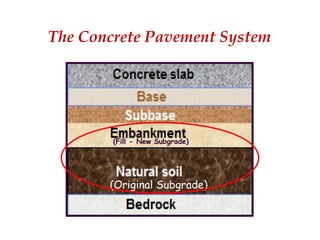
The Concrete Pavement System
Natural soil
(Original Subgrade)
(Fill - New Subgrade)
Subgrade
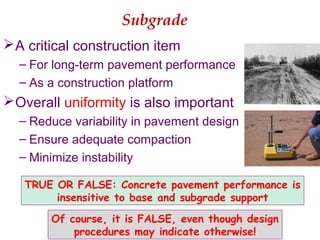
A critical construction item
– For long-term pavement performance
– As a construction platform
Overall uniformity is also important
– Reduce variability in pavement design
– Ensure adequate compaction
– Minimize instability
TRUE OR FALSE: Concrete pavement performance is
insensitive to base and subgrade support
Of course, it is FALSE, even though design
procedures may indicate otherwise!
Role of Subgrade in a Pavement System
Critical role/structural – if the support
system is marginal, pavement will not
perform well
– Overall bearing capacity very important
Construction platform - if subgrade is not
stiff/well-compacted, upper base/subbase
layers cannot be compacted effectively
Long-term performance - poor subgrades
are erodible under repeated traffic &
presence of heavy truck traffic
Managing Subgrade in a Pavement System
Increasing slab thickness is not an
effective method to account for marginal
subgrades
European approach – good support,
starting with an improved subgrade, if
necessary, leads to longer lasting
concrete pavements (less thick PCC)
Subgrade treatment/stabilization
“uniformizes” the support condition along
the project length, minimizing variability in
design and performance
8
Pavement Structural Design Basics
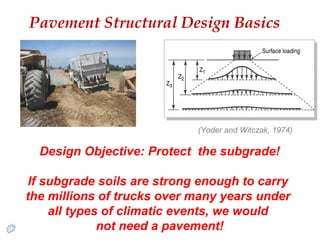
(Yoder and Witczak, 1974)
Design Objective: Protect the subgrade!
If subgrade soils are strong enough to carry
the millions of trucks over many years under
all types of climatic events, we would
not need a pavement!
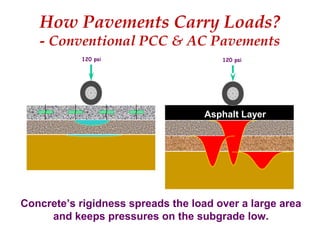
Asphalt Layer
How Pavements Carry Loads?
- Conventional PCC & AC Pavements
Concrete’s rigidness spreads the load over a large area
and keeps pressures on the subgrade low.
120 psi120 psi
Characterizing Subgrade Soils
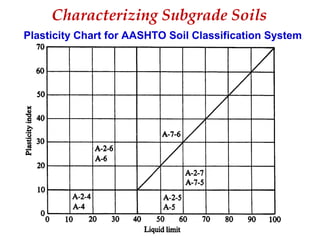
AASHTO Soil Classification System
Granular Soils w/ <35% passing
No. 200 (0.075 mm) sieve
Silt-Clay Soils w/ >35% passing
No. 200 (0.075 mm) sieve
A-1, A-2 &
A-3
A-4, A-5,
A-6, & A-7
GI = (F-35)[0.2+0.005(LL-40)] + 0.01(F-15)(PI-10)
where, GI = Group Index - follows symbol in ( ).
F = % < 0.075 mm
Plasticity Chart for AASHTO Soil Classification System
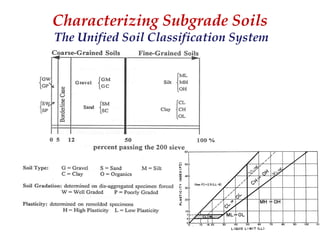
Characterizing Subgrade Soils
The Unified Soil Classification System
November 3, 2001
1100 0.2 Top soil, grass, and roots
Groundwater
6.0 18 3
1090 12.0 18 8
20.0 18 28
1080
28.5 10 22
30.0
1070 30.0
G. Benson
AGB-4
Top Soil Oct/30/2001
CL 32335
MH Tampa
CH Florida
SP ASTM D 1586
Notes:
Drive (split-barrel)
Hollow Stem Augers
ER = energy ratio per ASTM D-4633
at 8.9 ft on 11/02/01
Boring Terminated at 30'
Sample
Recovery
(in)
Soil
Sym.
K
Penetration
N 60
(blows/ft)
Remarks
Elevation
(ft-msl)
Sample
Depth
(ft)
Stratum
Depth
(ft)
Visual Soil Description
8.0
Soft red-brown fine to
medium sandy CLAY (CL)
14.0
22.5
Loose-Firm gray-blue silty
medium SAND (SM)
Firm yellow-tan slightly silty
fine SAND (SP-SM to SP)
Firm yellow-white fine to
medium SAND, trace silt (SP)
ENGINEERING SOIL TEST BORING RECORD
Boring Number:
Date Drilled:
Ef = Energy Efficiency of Hammer Used
Site Location:
Drilling Method:
Soil Symbols K (Unified Soil Classification System)
N = Penetration in blows per foot (ASTM D-1586)
Job Number
Other Symbols
Water
Level
N60 = (Ef/60) * Nmeasured = Energy-Corrected N-value
CME-850
(truck mounted)
Driller:
Hammer Type:
Drilling Rig:
Diedrich Automatic
(ER =82%)
Sampler:
Test Method:
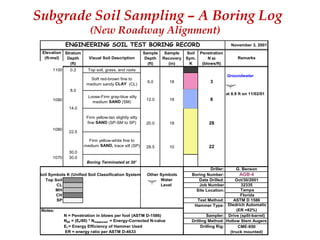
Subgrade Soil Sampling – A Boring Log
(New Roadway Alignment)
Pavement Related Subgrade Issues
Need for improvement (presentation focus)
– As a construction platform
– As a structural layer for long-term performance
Frost heave mitigation
– Typical treatment – use of select fill material
Swelling soils mitigation
– Site specific treatment – lime-treatment,
encapsulation, etc.
Subgrade Improvement
Purpose:
– Improve low strength soil (CBR < 6)
– Improve construction conditions
Methods:
– Excavation/replacement with select fill
– Compaction/mechanical improvement (mixing
in coarser material)
– Reinforcement with geosynthetics/geogrids
– Chemical stabilization (e.g., lime, cement)
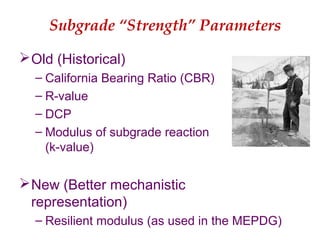
Subgrade “Strength” Parameters
Old (Historical)
– California Bearing Ratio (CBR)
– R-value
– DCP
– Modulus of subgrade reaction
(k-value)
New (Better mechanistic
representation)
– Resilient modulus (as used in the MEPDG)
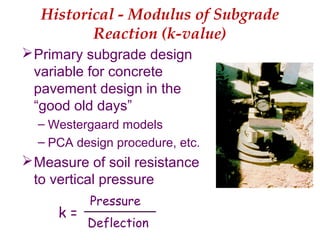
Historical - Modulus of Subgrade
Reaction (k-value)
Primary subgrade design
variable for concrete
pavement design in the
“good old days”
– Westergaard models
– PCA design procedure, etc.
Measure of soil resistance
to vertical pressure
Pressure
Deflection
k =
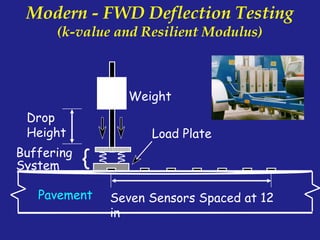
Modern - FWD Deflection Testing
(k-value and Resilient Modulus)
Weight
Buffering
System
Drop
Height
Pavement
{
Seven Sensors Spaced at 12
in
Load Plate
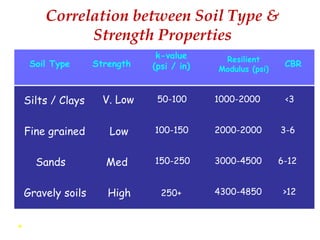
Correlation between Soil Type &
Strength Properties
• Backcalculation from deflection testing
Soil Type
Silts / Clays
Fine grained
Sands
Gravely soils
Strength
V. Low
Low
Med
High
k-value
(psi / in)
50-100
100-150
150-250
250+
Resilient
Modulus (psi)
1000-2000
2000-2000
3000-4500
4300-4850
CBR
<3
3-6
6-12
>12
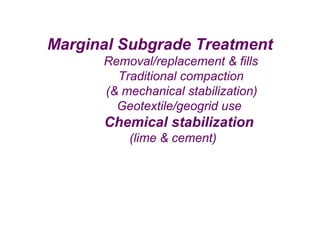
Marginal Subgrade Treatment
o Removal/replacement & fills
o Traditional compaction
(& mechanical stabilization)
o Geotextile/geogrid use
o Chemical stabilization
(lime & cement)
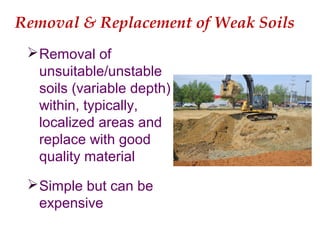
Removal & Replacement of Weak Soils
Removal of
unsuitable/unstable
soils (variable depth)
within, typically,
localized areas and
replace with good
quality material
Simple but can be
expensive
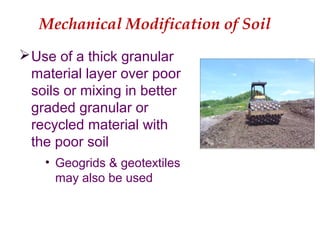
Mechanical Modification of Soil
Use of a thick granular
material layer over poor
soils or mixing in better
graded granular or
recycled material with
the poor soil
• Geogrids & geotextiles
may also be used
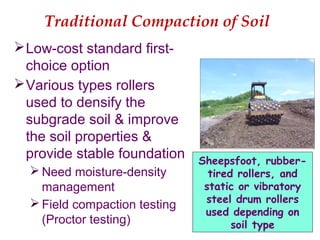
Traditional Compaction of Soil
Low-cost standard first-
choice option
Various types rollers
used to densify the
subgrade soil & improve
the soil properties &
provide stable foundation
 Need moisture-density
management
 Field compaction testing
(Proctor testing)
Sheepsfoot, rubber-
tired rollers, and
static or vibratory
steel drum rollers
used depending on
soil type
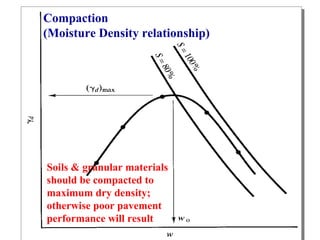
Compaction
(Moisture Density relationship)
1
t
d
w
γ
γ =
+
Soils & granular materials
should be compacted to
maximum dry density;
otherwise poor pavement
performance will result
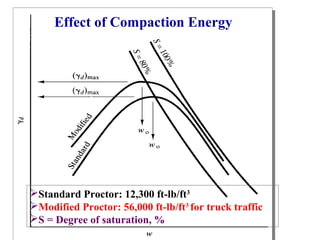
Effect of Compaction Energy
Standard Proctor: 12,300 ft-lb/ft3
Modified Proctor: 56,000 ft-lb/ft3
for truck traffic
S = Degree of saturation, %
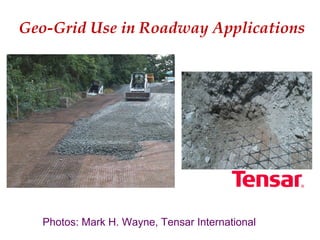
Geo-Grid Use in Roadway Applications
Photos: Mark H. Wayne, Tensar International
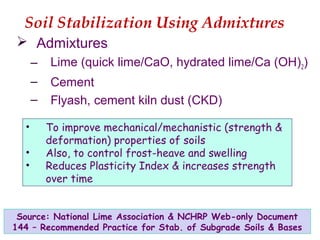
Soil Stabilization Using Admixtures
 Admixtures
– Lime (quick lime/CaO, hydrated lime/Ca (OH)2)
– Cement
– Flyash, cement kiln dust (CKD)
Source: National Lime Association & NCHRP Web-only Document
144 – Recommended Practice for Stab. of Subgrade Soils & Bases
• To improve mechanical/mechanistic (strength &
deformation) properties of soils
• Also, to control frost-heave and swelling
• Reduces Plasticity Index & increases strength
over time
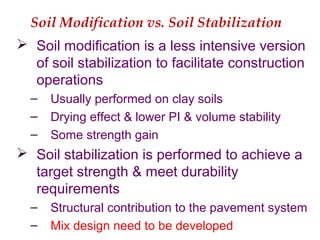
Soil Modification vs. Soil Stabilization
 Soil modification is a less intensive version
of soil stabilization to facilitate construction
operations
– Usually performed on clay soils
– Drying effect & lower PI & volume stability
– Some strength gain
 Soil stabilization is performed to achieve a
target strength & meet durability
requirements
– Structural contribution to the pavement system
– Mix design need to be developed
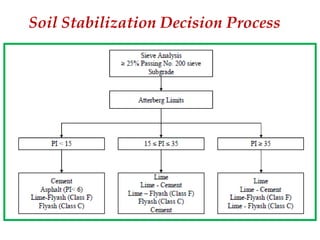
Soil Stabilization Decision Process
Soil Stabilization Using Admixtures
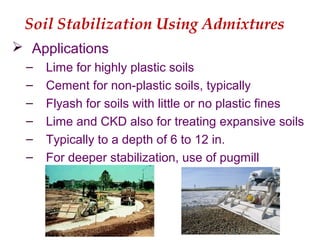
 Applications
– Lime for highly plastic soils
– Cement for non-plastic soils, typically
– Flyash for soils with little or no plastic fines
– Lime and CKD also for treating expansive soils
– Typically to a depth of 6 to 12 in.
– For deeper stabilization, use of pugmill
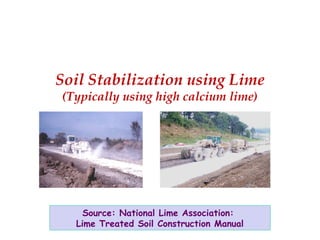
Soil Stabilization using Lime
(Typically using high calcium lime)
Source: National Lime Association:
Lime Treated Soil Construction Manual
Lime Stabilization
2 to 8 % lime mixed with soil
– Low level for soil modification/platform; dries
wet soils quickly (flocculation)
– Higher level for pavement structural benefits
– Lab testing to determine optimum lime content
Can significantly improve strength of fine
grained soils
– UC Strength ≥ 50 psi in 28 days
Moderate improvement in granular soils
Also, reduces swelling in highly plastic soils
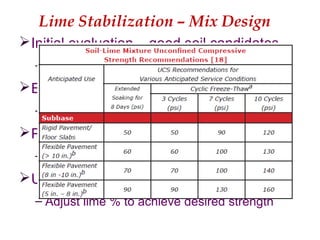
Lime Stabilization – Mix Design
Initial evaluation – good soil candidates
– >25% passing 75 micron sieve & PI>10
Eades & Grim test
– Minimum lime to bring PH to 12.4
Proctor test
– Optimum mc & max dry density
Unconfined compressive strength tests
– Adjust lime % to achieve desired strength
Lime Stabilization: Durability Issues
 With some soils fatigue cracking is an issue
 Water reduces strength by 15 to 25%
– test soaked
 Freeze-thaw reduces strength (may reverse
during warm periods)
 Leaching
 Carbonation may revert lime and make it
unstable
 Sulfate attack may cause swelling
– swell test should be performed
Initial Subgrade Preparation
(Common step for any admixture stabilization)
Shape area to crown and grade
Correct unstable subgrade areas
Initial soil moisture content
– Pre-wet if too dry
– Aerate/dry if too wet
Reshape to crown and grade
Lime Stabilization: Construction Steps
 Scarifying/pulverizing soil to specified depth
a. Provides more surface area for lime to interact
b. Remove non-soil material larger than 3 in.
 Spreading lime (uniformly across or in windrows)
a. Dry quicklime, Dry hydrated lime
b. Slurry lime (~40% quicklime (hot) or hydrated lime)
Note: depending on mixing equipment, dry lime may be
applied without scarifying the soil (but more lime loss
due to wind)
a. Slurry is always applied over scarified soil
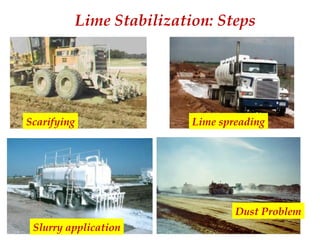
Lime Stabilization: Steps
Dust Problem
Scarifying Lime spreading
Slurry application
Lime Stabilization: Construction Steps
 Initial mixing
a. To distribute the lime to required depth
b. For heavy clays, mixing may need to be done a
second time after 24 to 48 hours
c. Shape and lightly compact the mixture
 Mellowing period
a. Allows chemical reaction to take place (break down of
the soil)
b. Period: 1 to 7 days, based on soil type
Lime Stabilization: Construction Steps
 Final mixing & pulverization
• Mixing/pulverization should continue until 100% of
non-stone material passes the 1 in. sieve and >60%
non-stone material passes the No. 4 sieve
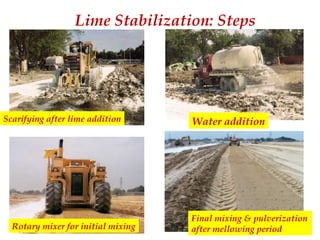
Lime Stabilization: Steps
Scarifying after lime addition Water addition
Rotary mixer for initial mixing
Final mixing & pulverization
after mellowing period
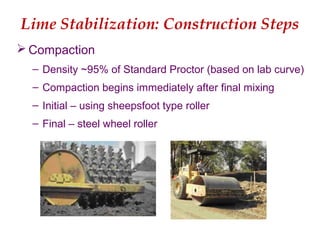
Lime Stabilization: Construction Steps
 Compaction
– Density ~95% of Standard Proctor (based on lab curve)
– Compaction begins immediately after final mixing
– Initial – using sheepsfoot type roller
– Final – steel wheel roller
Lime Stabilization: Construction Steps
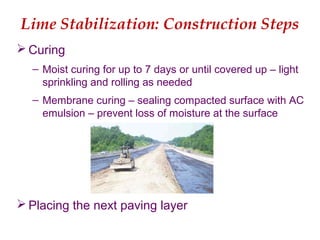
 Curing
– Moist curing for up to 7 days or until covered up – light
sprinkling and rolling as needed
– Membrane curing – sealing compacted surface with AC
emulsion – prevent loss of moisture at the surface
 Placing the next paving layer
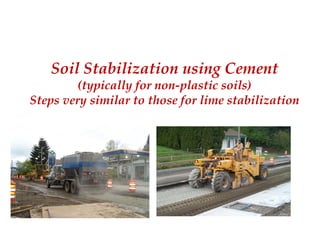
Soil Stabilization using Cement
(typically for non-plastic soils)
Steps very similar to those for lime stabilization
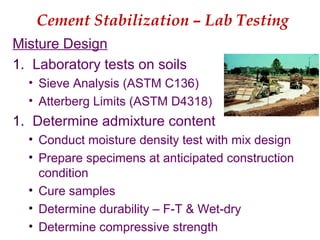
Cement Stabilization – Lab Testing
Misture Design
1. Laboratory tests on soils
• Sieve Analysis (ASTM C136)
• Atterberg Limits (ASTM D4318)
1. Determine admixture content
• Conduct moisture density test with mix design
• Prepare specimens at anticipated construction
condition
• Cure samples
• Determine durability – F-T & Wet-dry
• Determine compressive strength
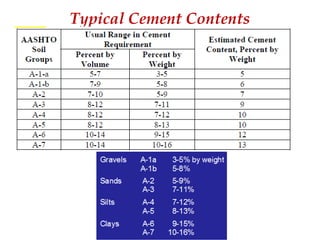
Typical Cement Contents
Gravels A-1a
A-1b
3-5% by weight
5-8%
Sands A-2
A-3
5-9%
7-11%
Silts A-4
A-5
7-12%
8-13%
Clays A-6
A-7
9-15%
10-16%
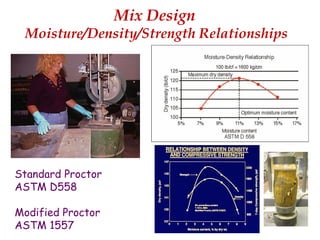
Mix Design
Moisture/Density/Strength Relationships
Standard Proctor
ASTM D558
Modified Proctor
ASTM 1557
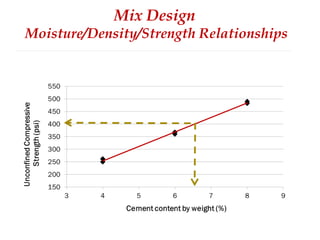
Mix Design
Moisture/Density/Strength Relationships
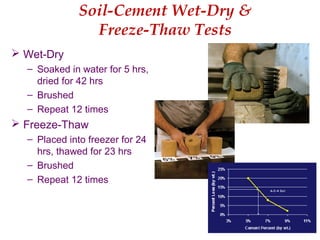
Soil-Cement Wet-Dry &
Freeze-Thaw Tests
 Wet-Dry
– Soaked in water for 5 hrs,
dried for 42 hrs
– Brushed
– Repeat 12 times
 Freeze-Thaw
– Placed into freezer for 24
hrs, thawed for 23 hrs
– Brushed
– Repeat 12 times
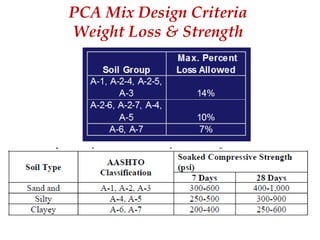
PCA Mix Design Criteria
Weight Loss & Strength
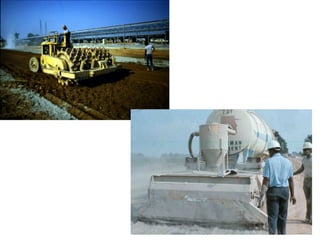
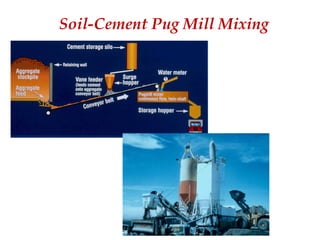
Cement Stabilization - Mixing
Mixed-in-place
– Spread portland cement and mix
– Apply water and re-mix
Central mixing plant (pug mill)
– Mix soil/aggregate, cement and water
– Haul mixed material to placing area
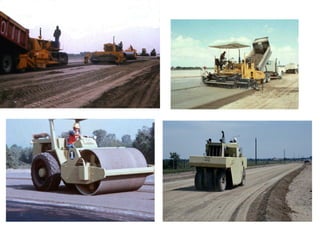
– Spread soil-cement uniformly
Soil-Cement Pug Mill Mixing
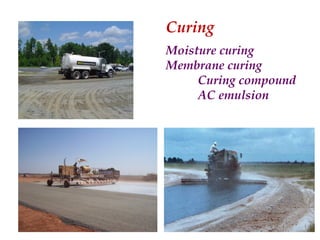
Curing
Moisture curing
Membrane curing
Curing compound
AC emulsion
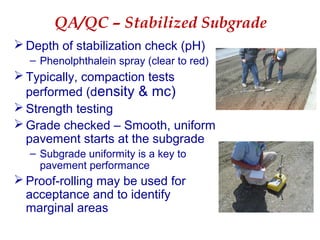
QA/QC – Stabilized Subgrade
 Depth of stabilization check (pH)
– Phenolphthalein spray (clear to red)
 Typically, compaction tests
performed (density & mc)
 Strength testing
 Grade checked – Smooth, uniform
pavement starts at the subgrade
– Subgrade uniformity is a key to
pavement performance
 Proof-rolling may be used for
acceptance and to identify
marginal areas
Intelligent Compaction
(a European technology being implemented in the US)
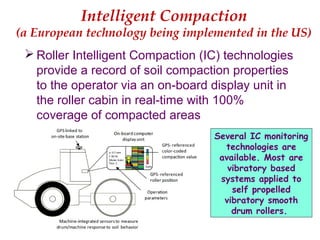
 Roller Intelligent Compaction (IC) technologies
provide a record of soil compaction properties
to the operator via an on-board display unit in
the roller cabin in real-time with 100%
coverage of compacted areas
Several IC monitoring
technologies are
available. Most are
vibratory based
systems applied to
self propelled
vibratory smooth
drum rollers.
Intelligent Compaction
(a European technology being implemented in the US)
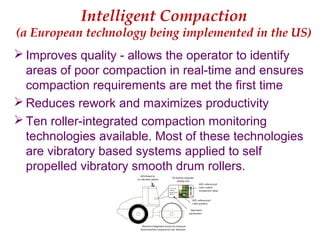
 Improves quality - allows the operator to identify
areas of poor compaction in real-time and ensures
compaction requirements are met the first time
 Reduces rework and maximizes productivity
 Ten roller-integrated compaction monitoring
technologies available. Most of these technologies
are vibratory based systems applied to self
propelled vibratory smooth drum rollers.
Some Good References
1. NCHRP Web-Only Document 144 –
Recommended Practice for Stabilization of
Subgrade Soils & Base Materials, 2009
2. SHRP2 R02 material (www.GeoTechTools.org)
3. FHWA Study: Geotechnical Aspects of
Pavements
• Reference Manual/Participant Workbook
Publication No. FHWA NHI-05-037, 2006
• www.fhwa.dot.gov/engineering/geotech/pubs/
4. PCA & National Lime Association publications
Thank You!
stayabji@gmail.com

Subgrade Stabilization: Materials & Methods

  • 1.
    Nebraska Concrete PavingWorkshop Lincoln, Nebraska – January 19-20, 2016 SUBGRADE STABILIZATION Materials & Methods Shiraz Tayabji, Ph.D., PE Advanced Concrete Pavement Consultancy LLC Ellicott City, Maryland
  • 2.
    Outline o Subgrade Characteristics101 o Role of Subgrade in a Concrete Pavement System o Bearing capacity/Structural support o Working platform o Marginal Subgrade Treatment o Removal/replacement & fills o Traditional compaction (& mechanical stabilization) o Geotextile/geogrid use o Chemical Stabilization o Other (deep stabilization, etc.) o A little bit on Intelligent Compaction
  • 3.
     Low volumeroadways  Residential streets  State routes  Interstate highways  Airport runways and taxiways  Parking lots  Industrial storage facilities  Port facilities  Truck terminals  Commercial sites Where is Soil Stabilization Used? In other words… In any pavement structure!
  • 4.
    The Concrete PavementSystem Natural soil (Original Subgrade) (Fill - New Subgrade)
  • 5.
    Subgrade A critical constructionitem – For long-term pavement performance – As a construction platform Overall uniformity is also important – Reduce variability in pavement design – Ensure adequate compaction – Minimize instability TRUE OR FALSE: Concrete pavement performance is insensitive to base and subgrade support Of course, it is FALSE, even though design procedures may indicate otherwise!
  • 6.
    Role of Subgradein a Pavement System Critical role/structural – if the support system is marginal, pavement will not perform well – Overall bearing capacity very important Construction platform - if subgrade is not stiff/well-compacted, upper base/subbase layers cannot be compacted effectively Long-term performance - poor subgrades are erodible under repeated traffic & presence of heavy truck traffic
  • 7.
    Managing Subgrade ina Pavement System Increasing slab thickness is not an effective method to account for marginal subgrades European approach – good support, starting with an improved subgrade, if necessary, leads to longer lasting concrete pavements (less thick PCC) Subgrade treatment/stabilization “uniformizes” the support condition along the project length, minimizing variability in design and performance
  • 8.
    8 Pavement Structural DesignBasics (Yoder and Witczak, 1974) Design Objective: Protect the subgrade! If subgrade soils are strong enough to carry the millions of trucks over many years under all types of climatic events, we would not need a pavement!
  • 9.
    Asphalt Layer How PavementsCarry Loads? - Conventional PCC & AC Pavements Concrete’s rigidness spreads the load over a large area and keeps pressures on the subgrade low. 120 psi120 psi
  • 10.
    Characterizing Subgrade Soils AASHTOSoil Classification System Granular Soils w/ <35% passing No. 200 (0.075 mm) sieve Silt-Clay Soils w/ >35% passing No. 200 (0.075 mm) sieve A-1, A-2 & A-3 A-4, A-5, A-6, & A-7 GI = (F-35)[0.2+0.005(LL-40)] + 0.01(F-15)(PI-10) where, GI = Group Index - follows symbol in ( ). F = % < 0.075 mm
  • 11.
    Plasticity Chart forAASHTO Soil Classification System Characterizing Subgrade Soils
  • 12.
    Characterizing Subgrade Soils TheUnified Soil Classification System
  • 13.
    November 3, 2001 11000.2 Top soil, grass, and roots Groundwater 6.0 18 3 1090 12.0 18 8 20.0 18 28 1080 28.5 10 22 30.0 1070 30.0 G. Benson AGB-4 Top Soil Oct/30/2001 CL 32335 MH Tampa CH Florida SP ASTM D 1586 Notes: Drive (split-barrel) Hollow Stem Augers ER = energy ratio per ASTM D-4633 at 8.9 ft on 11/02/01 Boring Terminated at 30' Sample Recovery (in) Soil Sym. K Penetration N 60 (blows/ft) Remarks Elevation (ft-msl) Sample Depth (ft) Stratum Depth (ft) Visual Soil Description 8.0 Soft red-brown fine to medium sandy CLAY (CL) 14.0 22.5 Loose-Firm gray-blue silty medium SAND (SM) Firm yellow-tan slightly silty fine SAND (SP-SM to SP) Firm yellow-white fine to medium SAND, trace silt (SP) ENGINEERING SOIL TEST BORING RECORD Boring Number: Date Drilled: Ef = Energy Efficiency of Hammer Used Site Location: Drilling Method: Soil Symbols K (Unified Soil Classification System) N = Penetration in blows per foot (ASTM D-1586) Job Number Other Symbols Water Level N60 = (Ef/60) * Nmeasured = Energy-Corrected N-value CME-850 (truck mounted) Driller: Hammer Type: Drilling Rig: Diedrich Automatic (ER =82%) Sampler: Test Method: Subgrade Soil Sampling – A Boring Log (New Roadway Alignment)
  • 14.
    Pavement Related SubgradeIssues Need for improvement (presentation focus) – As a construction platform – As a structural layer for long-term performance Frost heave mitigation – Typical treatment – use of select fill material Swelling soils mitigation – Site specific treatment – lime-treatment, encapsulation, etc.
  • 15.
    Subgrade Improvement Purpose: – Improvelow strength soil (CBR < 6) – Improve construction conditions Methods: – Excavation/replacement with select fill – Compaction/mechanical improvement (mixing in coarser material) – Reinforcement with geosynthetics/geogrids – Chemical stabilization (e.g., lime, cement)
  • 16.
    Subgrade “Strength” Parameters Old(Historical) – California Bearing Ratio (CBR) – R-value – DCP – Modulus of subgrade reaction (k-value) New (Better mechanistic representation) – Resilient modulus (as used in the MEPDG)
  • 17.
    Historical - Modulusof Subgrade Reaction (k-value) Primary subgrade design variable for concrete pavement design in the “good old days” – Westergaard models – PCA design procedure, etc. Measure of soil resistance to vertical pressure Pressure Deflection k =
  • 18.
    Modern - FWDDeflection Testing (k-value and Resilient Modulus) Weight Buffering System Drop Height Pavement { Seven Sensors Spaced at 12 in Load Plate
  • 19.
    Correlation between SoilType & Strength Properties • Backcalculation from deflection testing Soil Type Silts / Clays Fine grained Sands Gravely soils Strength V. Low Low Med High k-value (psi / in) 50-100 100-150 150-250 250+ Resilient Modulus (psi) 1000-2000 2000-2000 3000-4500 4300-4850 CBR <3 3-6 6-12 >12
  • 20.
    Marginal Subgrade Treatment oRemoval/replacement & fills o Traditional compaction (& mechanical stabilization) o Geotextile/geogrid use o Chemical stabilization (lime & cement)
  • 21.
    Removal & Replacementof Weak Soils Removal of unsuitable/unstable soils (variable depth) within, typically, localized areas and replace with good quality material Simple but can be expensive
  • 22.
    Mechanical Modification ofSoil Use of a thick granular material layer over poor soils or mixing in better graded granular or recycled material with the poor soil • Geogrids & geotextiles may also be used
  • 23.
    Traditional Compaction ofSoil Low-cost standard first- choice option Various types rollers used to densify the subgrade soil & improve the soil properties & provide stable foundation  Need moisture-density management  Field compaction testing (Proctor testing) Sheepsfoot, rubber- tired rollers, and static or vibratory steel drum rollers used depending on soil type
  • 24.
    Compaction (Moisture Density relationship) 1 t d w γ γ= + Soils & granular materials should be compacted to maximum dry density; otherwise poor pavement performance will result
  • 25.
    Effect of CompactionEnergy Standard Proctor: 12,300 ft-lb/ft3 Modified Proctor: 56,000 ft-lb/ft3 for truck traffic S = Degree of saturation, %
  • 26.
    Geo-Grid Use inRoadway Applications Photos: Mark H. Wayne, Tensar International
  • 27.
    Soil Stabilization UsingAdmixtures  Admixtures – Lime (quick lime/CaO, hydrated lime/Ca (OH)2) – Cement – Flyash, cement kiln dust (CKD) Source: National Lime Association & NCHRP Web-only Document 144 – Recommended Practice for Stab. of Subgrade Soils & Bases • To improve mechanical/mechanistic (strength & deformation) properties of soils • Also, to control frost-heave and swelling • Reduces Plasticity Index & increases strength over time
  • 28.
    Soil Modification vs.Soil Stabilization  Soil modification is a less intensive version of soil stabilization to facilitate construction operations – Usually performed on clay soils – Drying effect & lower PI & volume stability – Some strength gain  Soil stabilization is performed to achieve a target strength & meet durability requirements – Structural contribution to the pavement system – Mix design need to be developed
  • 29.
  • 30.
    Soil Stabilization UsingAdmixtures  Applications – Lime for highly plastic soils – Cement for non-plastic soils, typically – Flyash for soils with little or no plastic fines – Lime and CKD also for treating expansive soils – Typically to a depth of 6 to 12 in. – For deeper stabilization, use of pugmill
  • 31.
    Soil Stabilization usingLime (Typically using high calcium lime) Source: National Lime Association: Lime Treated Soil Construction Manual
  • 32.
    Lime Stabilization 2 to8 % lime mixed with soil – Low level for soil modification/platform; dries wet soils quickly (flocculation) – Higher level for pavement structural benefits – Lab testing to determine optimum lime content Can significantly improve strength of fine grained soils – UC Strength ≥ 50 psi in 28 days Moderate improvement in granular soils Also, reduces swelling in highly plastic soils
  • 33.
    Lime Stabilization –Mix Design Initial evaluation – good soil candidates – >25% passing 75 micron sieve & PI>10 Eades & Grim test – Minimum lime to bring PH to 12.4 Proctor test – Optimum mc & max dry density Unconfined compressive strength tests – Adjust lime % to achieve desired strength
  • 34.
    Lime Stabilization: DurabilityIssues  With some soils fatigue cracking is an issue  Water reduces strength by 15 to 25% – test soaked  Freeze-thaw reduces strength (may reverse during warm periods)  Leaching  Carbonation may revert lime and make it unstable  Sulfate attack may cause swelling – swell test should be performed
  • 35.
    Initial Subgrade Preparation (Commonstep for any admixture stabilization) Shape area to crown and grade Correct unstable subgrade areas Initial soil moisture content – Pre-wet if too dry – Aerate/dry if too wet Reshape to crown and grade
  • 36.
    Lime Stabilization: ConstructionSteps  Scarifying/pulverizing soil to specified depth a. Provides more surface area for lime to interact b. Remove non-soil material larger than 3 in.  Spreading lime (uniformly across or in windrows) a. Dry quicklime, Dry hydrated lime b. Slurry lime (~40% quicklime (hot) or hydrated lime) Note: depending on mixing equipment, dry lime may be applied without scarifying the soil (but more lime loss due to wind) a. Slurry is always applied over scarified soil
  • 37.
    Lime Stabilization: Steps DustProblem Scarifying Lime spreading Slurry application
  • 38.
    Lime Stabilization: ConstructionSteps  Initial mixing a. To distribute the lime to required depth b. For heavy clays, mixing may need to be done a second time after 24 to 48 hours c. Shape and lightly compact the mixture  Mellowing period a. Allows chemical reaction to take place (break down of the soil) b. Period: 1 to 7 days, based on soil type
  • 39.
    Lime Stabilization: ConstructionSteps  Final mixing & pulverization • Mixing/pulverization should continue until 100% of non-stone material passes the 1 in. sieve and >60% non-stone material passes the No. 4 sieve
  • 40.
    Lime Stabilization: Steps Scarifyingafter lime addition Water addition Rotary mixer for initial mixing Final mixing & pulverization after mellowing period
  • 41.
    Lime Stabilization: ConstructionSteps  Compaction – Density ~95% of Standard Proctor (based on lab curve) – Compaction begins immediately after final mixing – Initial – using sheepsfoot type roller – Final – steel wheel roller
  • 42.
    Lime Stabilization: ConstructionSteps  Curing – Moist curing for up to 7 days or until covered up – light sprinkling and rolling as needed – Membrane curing – sealing compacted surface with AC emulsion – prevent loss of moisture at the surface  Placing the next paving layer
  • 43.
    Soil Stabilization usingCement (typically for non-plastic soils) Steps very similar to those for lime stabilization
  • 44.
    Cement Stabilization –Lab Testing Misture Design 1. Laboratory tests on soils • Sieve Analysis (ASTM C136) • Atterberg Limits (ASTM D4318) 1. Determine admixture content • Conduct moisture density test with mix design • Prepare specimens at anticipated construction condition • Cure samples • Determine durability – F-T & Wet-dry • Determine compressive strength
  • 45.
    Typical Cement Contents GravelsA-1a A-1b 3-5% by weight 5-8% Sands A-2 A-3 5-9% 7-11% Silts A-4 A-5 7-12% 8-13% Clays A-6 A-7 9-15% 10-16%
  • 46.
    Mix Design Moisture/Density/Strength Relationships StandardProctor ASTM D558 Modified Proctor ASTM 1557
  • 47.
  • 48.
    Soil-Cement Wet-Dry & Freeze-ThawTests  Wet-Dry – Soaked in water for 5 hrs, dried for 42 hrs – Brushed – Repeat 12 times  Freeze-Thaw – Placed into freezer for 24 hrs, thawed for 23 hrs – Brushed – Repeat 12 times
  • 49.
    PCA Mix DesignCriteria Weight Loss & Strength
  • 50.
    Cement Stabilization -Mixing Mixed-in-place – Spread portland cement and mix – Apply water and re-mix Central mixing plant (pug mill) – Mix soil/aggregate, cement and water – Haul mixed material to placing area – Spread soil-cement uniformly
  • 52.
  • 54.
  • 55.
    QA/QC – StabilizedSubgrade  Depth of stabilization check (pH) – Phenolphthalein spray (clear to red)  Typically, compaction tests performed (density & mc)  Strength testing  Grade checked – Smooth, uniform pavement starts at the subgrade – Subgrade uniformity is a key to pavement performance  Proof-rolling may be used for acceptance and to identify marginal areas
  • 56.
    Intelligent Compaction (a Europeantechnology being implemented in the US)  Roller Intelligent Compaction (IC) technologies provide a record of soil compaction properties to the operator via an on-board display unit in the roller cabin in real-time with 100% coverage of compacted areas Several IC monitoring technologies are available. Most are vibratory based systems applied to self propelled vibratory smooth drum rollers.
  • 57.
    Intelligent Compaction (a Europeantechnology being implemented in the US)  Improves quality - allows the operator to identify areas of poor compaction in real-time and ensures compaction requirements are met the first time  Reduces rework and maximizes productivity  Ten roller-integrated compaction monitoring technologies available. Most of these technologies are vibratory based systems applied to self propelled vibratory smooth drum rollers.
  • 58.
    Some Good References 1.NCHRP Web-Only Document 144 – Recommended Practice for Stabilization of Subgrade Soils & Base Materials, 2009 2. SHRP2 R02 material (www.GeoTechTools.org) 3. FHWA Study: Geotechnical Aspects of Pavements • Reference Manual/Participant Workbook Publication No. FHWA NHI-05-037, 2006 • www.fhwa.dot.gov/engineering/geotech/pubs/ 4. PCA & National Lime Association publications
  • 59.