Presented By
Aniket Pateriya
SEMINAR ON
Overview of Soil Stabilization
:Cement / Lime
Guided By
Dr. Suneet Kaur
CONTENTS
 INTRODUCTION
SOIL-CEMENT STABILIZATION
 SOIL-LIME STABILIZATION
CASE STUDY
REFERENCES
 Soil-Cement
 Soil-Lime
 Least amount of treatment
 Greater degree of treatment
INTRODUCTION
 Soil-Cement stabilization:
• Laboratory tests
• Construction method :
 Pulverising the soil
 Shaping the sub grade and scarifying the soil
 Adding and mixing cement
 Adding the mixing water
 Compacting
 Finishing
 Curing
 Adding wearing surfacing
• Cement stabilizes soil in two ways,
 Reduces soil plasticity (In Soil having high amount of clay in general).
 Cementation
• The strength of soil-cement increases with age
 Importance factor affecting strength of soil-cement matrix are
as follow:
 Nature of soil: Effective when clay soil LL is less than 45% and PI is less than about 25%.
 Cement content range: Granular soil (3 to 10%) and clay soil (7 to 16%).
 Moisture content of new matrix: Same as OMC for achieve maximum dry density.
Maximum strength is achieved at moisture content slightly less than this.
 Admixtures: Either to reduce cement content or in order to make soil suitable for stability,
Etc.
Advantages:
• Stiffness: Distribute loads over a wider area and rutting is relatively simple and less
expensive to correct.
• Great Strength: Reserve strength also resists cyclic cold, rain and spring-thaw damage.
• Superior Performance: Good service at low maintenance costs
• Reduces the occurrence of fatigue cracking.
• It is designed material whose properties and production can be very carefully tested and
controlled.
• It is durable material
• Due to fractural strength it offend classified as semi-rigid material.
Disadvantages:
 Cement is costly material.
 As cement hydrated volumetric change may take place give shrinkage crack.
 Soil-Lime stabilization:
• Fine-grained clay soils (with a minimum of 25 percent passing the #200 sieve (75μm)
and a Plasticity Index greater than 10) are considered to be good candidates for
stabilization.
• Subgrade stabilization requires adding 3 to 6 % lime by weight of the dry soil.
 The Chemistry of Lime Treatment:
 Drying:
• Chemical reaction
• Subsequent reactions reduce the soil’s moisture holding capacity.
 Modification:
• Flocculation and agglomeration“,
• Lime content of 3 to 18% by volume are used to reduce plasticity of clay.
 Pozzolanic or cementation reaction: Stable calcium silicate and aluminates
form
 Carbonation:
• Lime react with carbon dioxide and form calcium carbonate it increases
the
• Excessive lime does not produce beneficial results.
 Importance Factor Affecting Strength of Soil-lime Matrix :
• Compaction Characteristic:
 The maximum density decreases with curing time and lime content.
 The optimum moisture content, Increase with curing time and lime content.
• Plasticity and workability:
 Plasticity index decreases and shrinkage limit increases.
 Soil with high plastic index initially required high lime content.
• Volume change: significant reduction in swell potential and swell pressure occur.
• Strength:
 Lime increase the
 Minor changes in angle of internal friction.
Advantages:
 Lime stabilization improved the strength, stiffness and durability of fine-grained soil,
Effective in heavy clay soils.
 When use in clay, lower the LL and PI of soil.
 It produces maximum density under higher optimum moisture content then in untreated soil.
 Lime stabilization also use for highly unstable plastic and swelling clay.
Disadvantages:
This mainly suitable for clayey coil, Soil contain more than 2% organic content may not
suitable.
 Case Study :
In-Situ Stabilization of Road Base Using Cement
trial section along the North-South Expressway in Malaysia
Design parameters adopted in the cement stabilized base (CTB) design is as follows:
 Design water content within 4.5+0.5% of the dry mass of aggregate and cement.
 Design cement content was 3.5% (by mass of the dry aggregate). The cement content was
decided based on the targeted compressive strength (4 MPa to 8 MPa).
 A minimum effective stiffness modulus of 1000MPa to be achieved after 28 days of curing.
 The average 7-days compressive strength determined from a group of 5 cubes of the CTB
road-base shall be between 4 and 8MPa.
 The average in-situ wet density shall not be less than 94% of the average wet density of the
corresponding group of 5 cubes.
Age
at
test (days)
In-situ compressive strength (MPa)
from core samples
In-situ compressive
strength (MPa) from
cube specimens
1 - 3
3 - 5.5
4 4.5 -
7 - 6.0
8 6.0 -
29 7.5 -
Table : Compressive strength of the CTB layer
[Source: G. W. K. Chai et al (2005)]
Falling Weight Deflectometer (FWD) was adopted to determine the in-situ stiffness of the
cement stabilized road base material.
Figure : Falling weight deflectometer (FWD)
[Source: researchgate.net]
• Normalized deflection readings were measured by geophones at distances (0, 300mm,
600mm, 900mm, 1200mm, 1500mm and 2100mm) from the center of the loading
plate
• FWD test:
 Center deflection reading of 900 microns at 85 percentile value.
 For tests performed on the CTB, center deflection value at 85 percentiles for the 3
and 7 days are 500 micron and 400 microns, respectively.
 Center deflection at 85 percentile gives a value of 300 micron for 28 days cure.
Figure : FWD center deflection profiles before and after cement stabilization
A: (3 and 7 days); B: (28 days)
[Source: G. W. K. Chai et al (2005)]
Test stages Effective stiffness modulus (MPa)
at 85 percentile values
Pavement Layers CTB Road base
Granular Road base
Before Recycling
- 280
CTB after 3 days 700 -
CTB after 7 days 1150 -
Asphalt Surface after
28 days
1350 -
Table : Effective stiffness modulus of the CTB layer
[Source: G. W. K. Chai et al (2005)]
Figure : Compressive strength and deflection D1 relationship from FWD.
[Source: G. W. K. Chai et al (2005)]
Figure : Stiffness modulus and compressive strength relationship from field test
[Source: G. W. K. Chai et al (2005)]
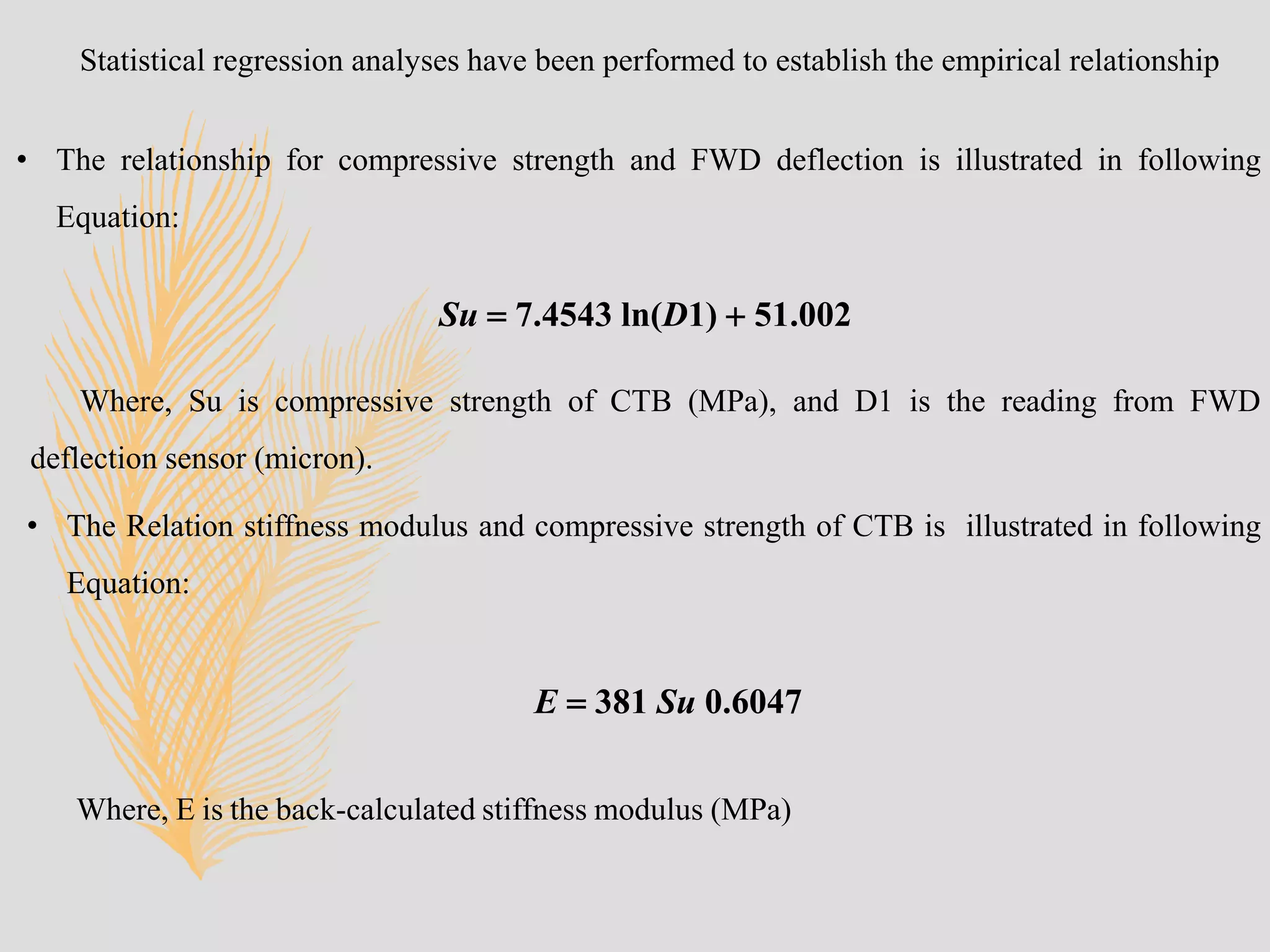
Statistical regression analyses have been performed to establish the empirical relationship
• The relationship for compressive strength and FWD deflection is illustrated in following
Equation:
Su = 7.4543 ln(D1) + 51.002
Where, Su is compressive strength of CTB (MPa), and D1 is the reading from FWD
deflection sensor (micron).
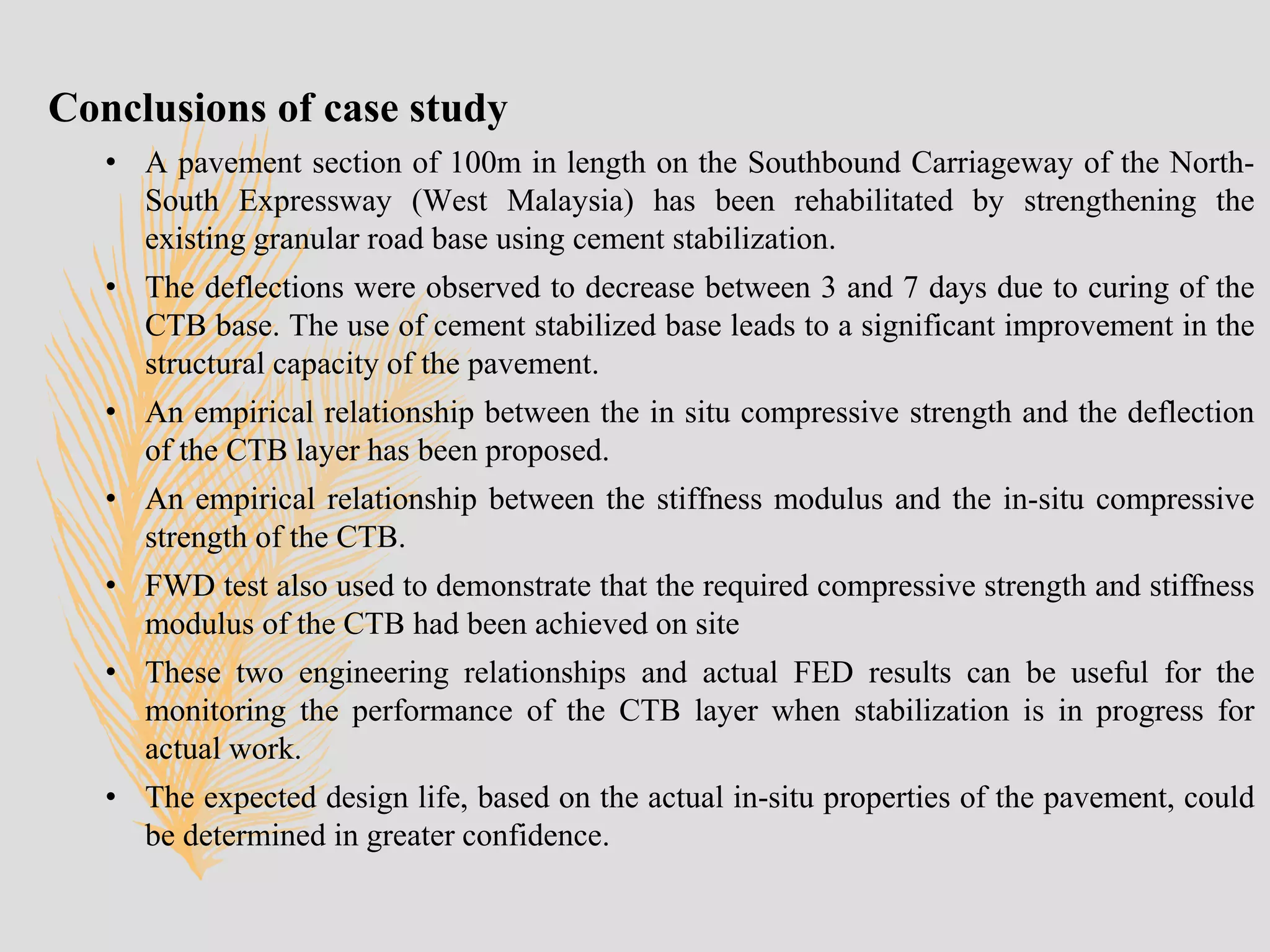
• The Relation stiffness modulus and compressive strength of CTB is illustrated in following
Equation:
E = 381 Su 0.6047
Where, E is the back-calculated stiffness modulus (MPa)
Conclusions of case study
• A pavement section of 100m in length on the Southbound Carriageway of the North-
South Expressway (West Malaysia) has been rehabilitated by strengthening the
existing granular road base using cement stabilization.
• The deflections were observed to decrease between 3 and 7 days due to curing of the
CTB base. The use of cement stabilized base leads to a significant improvement in the
structural capacity of the pavement.
• An empirical relationship between the in situ compressive strength and the deflection
of the CTB layer has been proposed.
• An empirical relationship between the stiffness modulus and the in-situ compressive
strength of the CTB.
• FWD test also used to demonstrate that the required compressive strength and stiffness
modulus of the CTB had been achieved on site
• These two engineering relationships and actual FED results can be useful for the
monitoring the performance of the CTB layer when stabilization is in progress for
actual work.
• The expected design life, based on the actual in-situ properties of the pavement, could
be determined in greater confidence.
REFERENCES
 Bikash Chandra Chattopadhyay, Joyanta Maity. “Foundation Engineering” ;(Text
Book), PHI, New Delhi.
 Dastidar, A.G. (1985). “Treatment of weak soil- An Indian perspective” -
Geotechnical Engineering, Vol. 1.
 G. W. K. Chai, E. Y. N. Oh and A. S. Balasubramaniam. (2014). “In-Situ Stabilization
of Road Base Using Cement - A Case Study in Malaysia”, School of Engineering,
Griffith University, Australia.
 Lamb, T.W. (1962). “Soil Stabilization in foundation engineering”. - G. A. Leonard
(Ed.) McGraw-Hill, New York.
 NLA (National Lime Association). (1985). “Lime Stabilization Construction
Manual”; Bulletin 326, Arlington, VA.
 Shashi Gulhati, Manoj Datta. “Geotechnical Engineering” ;(Text Book), McGraw-
Hill, New Delhi.
Thank
You
Overview of Soil Stabilization :Cement / Lime :PPT

Overview of Soil Stabilization :Cement / Lime :PPT

  • 1.
    Presented By Aniket Pateriya SEMINARON Overview of Soil Stabilization :Cement / Lime Guided By Dr. Suneet Kaur
  • 2.
    CONTENTS  INTRODUCTION SOIL-CEMENT STABILIZATION SOIL-LIME STABILIZATION CASE STUDY REFERENCES
  • 3.
     Soil-Cement  Soil-Lime Least amount of treatment  Greater degree of treatment INTRODUCTION
  • 4.
     Soil-Cement stabilization: •Laboratory tests • Construction method :  Pulverising the soil  Shaping the sub grade and scarifying the soil  Adding and mixing cement  Adding the mixing water  Compacting  Finishing  Curing  Adding wearing surfacing
  • 5.
    • Cement stabilizessoil in two ways,  Reduces soil plasticity (In Soil having high amount of clay in general).  Cementation • The strength of soil-cement increases with age
  • 6.
     Importance factoraffecting strength of soil-cement matrix are as follow:  Nature of soil: Effective when clay soil LL is less than 45% and PI is less than about 25%.  Cement content range: Granular soil (3 to 10%) and clay soil (7 to 16%).  Moisture content of new matrix: Same as OMC for achieve maximum dry density. Maximum strength is achieved at moisture content slightly less than this.  Admixtures: Either to reduce cement content or in order to make soil suitable for stability, Etc.
  • 7.
    Advantages: • Stiffness: Distributeloads over a wider area and rutting is relatively simple and less expensive to correct. • Great Strength: Reserve strength also resists cyclic cold, rain and spring-thaw damage. • Superior Performance: Good service at low maintenance costs • Reduces the occurrence of fatigue cracking. • It is designed material whose properties and production can be very carefully tested and controlled. • It is durable material • Due to fractural strength it offend classified as semi-rigid material.
  • 8.
    Disadvantages:  Cement iscostly material.  As cement hydrated volumetric change may take place give shrinkage crack.
  • 9.
     Soil-Lime stabilization: •Fine-grained clay soils (with a minimum of 25 percent passing the #200 sieve (75μm) and a Plasticity Index greater than 10) are considered to be good candidates for stabilization. • Subgrade stabilization requires adding 3 to 6 % lime by weight of the dry soil.
  • 10.
     The Chemistryof Lime Treatment:  Drying: • Chemical reaction • Subsequent reactions reduce the soil’s moisture holding capacity.  Modification: • Flocculation and agglomeration“, • Lime content of 3 to 18% by volume are used to reduce plasticity of clay.  Pozzolanic or cementation reaction: Stable calcium silicate and aluminates form  Carbonation: • Lime react with carbon dioxide and form calcium carbonate it increases the • Excessive lime does not produce beneficial results.
  • 11.
     Importance FactorAffecting Strength of Soil-lime Matrix : • Compaction Characteristic:  The maximum density decreases with curing time and lime content.  The optimum moisture content, Increase with curing time and lime content. • Plasticity and workability:  Plasticity index decreases and shrinkage limit increases.  Soil with high plastic index initially required high lime content. • Volume change: significant reduction in swell potential and swell pressure occur. • Strength:  Lime increase the  Minor changes in angle of internal friction.
  • 12.
    Advantages:  Lime stabilizationimproved the strength, stiffness and durability of fine-grained soil, Effective in heavy clay soils.  When use in clay, lower the LL and PI of soil.  It produces maximum density under higher optimum moisture content then in untreated soil.  Lime stabilization also use for highly unstable plastic and swelling clay. Disadvantages: This mainly suitable for clayey coil, Soil contain more than 2% organic content may not suitable.
  • 13.
     Case Study: In-Situ Stabilization of Road Base Using Cement trial section along the North-South Expressway in Malaysia Design parameters adopted in the cement stabilized base (CTB) design is as follows:  Design water content within 4.5+0.5% of the dry mass of aggregate and cement.  Design cement content was 3.5% (by mass of the dry aggregate). The cement content was decided based on the targeted compressive strength (4 MPa to 8 MPa).  A minimum effective stiffness modulus of 1000MPa to be achieved after 28 days of curing.  The average 7-days compressive strength determined from a group of 5 cubes of the CTB road-base shall be between 4 and 8MPa.  The average in-situ wet density shall not be less than 94% of the average wet density of the corresponding group of 5 cubes.
  • 14.
    Age at test (days) In-situ compressivestrength (MPa) from core samples In-situ compressive strength (MPa) from cube specimens 1 - 3 3 - 5.5 4 4.5 - 7 - 6.0 8 6.0 - 29 7.5 - Table : Compressive strength of the CTB layer [Source: G. W. K. Chai et al (2005)]
  • 15.
    Falling Weight Deflectometer(FWD) was adopted to determine the in-situ stiffness of the cement stabilized road base material. Figure : Falling weight deflectometer (FWD) [Source: researchgate.net]
  • 16.
    • Normalized deflectionreadings were measured by geophones at distances (0, 300mm, 600mm, 900mm, 1200mm, 1500mm and 2100mm) from the center of the loading plate • FWD test:  Center deflection reading of 900 microns at 85 percentile value.  For tests performed on the CTB, center deflection value at 85 percentiles for the 3 and 7 days are 500 micron and 400 microns, respectively.  Center deflection at 85 percentile gives a value of 300 micron for 28 days cure. Figure : FWD center deflection profiles before and after cement stabilization A: (3 and 7 days); B: (28 days) [Source: G. W. K. Chai et al (2005)]
  • 17.
    Test stages Effectivestiffness modulus (MPa) at 85 percentile values Pavement Layers CTB Road base Granular Road base Before Recycling - 280 CTB after 3 days 700 - CTB after 7 days 1150 - Asphalt Surface after 28 days 1350 - Table : Effective stiffness modulus of the CTB layer [Source: G. W. K. Chai et al (2005)]
  • 18.
    Figure : Compressivestrength and deflection D1 relationship from FWD. [Source: G. W. K. Chai et al (2005)]
  • 19.
    Figure : Stiffnessmodulus and compressive strength relationship from field test [Source: G. W. K. Chai et al (2005)]
  • 20.
    Statistical regression analyseshave been performed to establish the empirical relationship • The relationship for compressive strength and FWD deflection is illustrated in following Equation: Su = 7.4543 ln(D1) + 51.002 Where, Su is compressive strength of CTB (MPa), and D1 is the reading from FWD deflection sensor (micron). • The Relation stiffness modulus and compressive strength of CTB is illustrated in following Equation: E = 381 Su 0.6047 Where, E is the back-calculated stiffness modulus (MPa)
  • 21.
    Conclusions of casestudy • A pavement section of 100m in length on the Southbound Carriageway of the North- South Expressway (West Malaysia) has been rehabilitated by strengthening the existing granular road base using cement stabilization. • The deflections were observed to decrease between 3 and 7 days due to curing of the CTB base. The use of cement stabilized base leads to a significant improvement in the structural capacity of the pavement. • An empirical relationship between the in situ compressive strength and the deflection of the CTB layer has been proposed. • An empirical relationship between the stiffness modulus and the in-situ compressive strength of the CTB. • FWD test also used to demonstrate that the required compressive strength and stiffness modulus of the CTB had been achieved on site • These two engineering relationships and actual FED results can be useful for the monitoring the performance of the CTB layer when stabilization is in progress for actual work. • The expected design life, based on the actual in-situ properties of the pavement, could be determined in greater confidence.
  • 22.
    REFERENCES  Bikash ChandraChattopadhyay, Joyanta Maity. “Foundation Engineering” ;(Text Book), PHI, New Delhi.  Dastidar, A.G. (1985). “Treatment of weak soil- An Indian perspective” - Geotechnical Engineering, Vol. 1.  G. W. K. Chai, E. Y. N. Oh and A. S. Balasubramaniam. (2014). “In-Situ Stabilization of Road Base Using Cement - A Case Study in Malaysia”, School of Engineering, Griffith University, Australia.  Lamb, T.W. (1962). “Soil Stabilization in foundation engineering”. - G. A. Leonard (Ed.) McGraw-Hill, New York.  NLA (National Lime Association). (1985). “Lime Stabilization Construction Manual”; Bulletin 326, Arlington, VA.  Shashi Gulhati, Manoj Datta. “Geotechnical Engineering” ;(Text Book), McGraw- Hill, New Delhi.
  • 23.