Presentation by:
Aditya kumar
(0801ce17me01)
M.E in structures (2nd sem)
 Mechanical
properties are not
adequate.
 Swelling & shrinkage
 Collapsible soils
 Soft soils
 Organic and peaty
soils
 Sand and gravelly
deposits
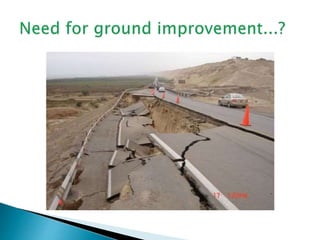
 Ground improvement refers to a technique
that improves the engineering properties of
the soil mass treated.
 Usually the properties that are modified are:
Shear strength,stiffness & permeability.
 Ground improvement techniques are different
for different soil types
 Densification
 Consolidation
 Weight Reduction
 Reinforcement
 Chemical Treatment
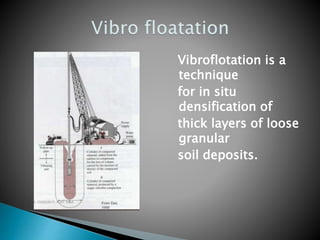
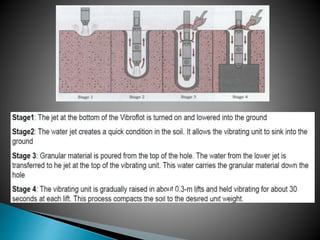
Vibroflotation is a
technique
for in situ
densification of
thick layers of loose
granular
soil deposits.
FUNCTIONS AND USES
1. To increase the bearing
capacity
2. Improves the stiffness of
subsoil to decrease
settlements
3. To carry very high loads
4. More economical than
piling
5. No waiting period after
installation
6. homogenizes variable soil
properties
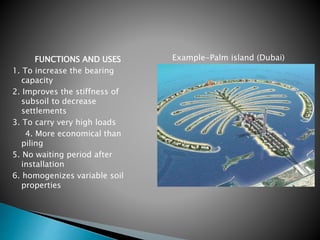
Example-Palm island (Dubai)
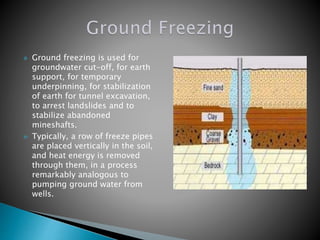
 Ground freezing is used for
groundwater cut-off, for earth
support, for temporary
underpinning, for stabilization
of earth for tunnel excavation,
to arrest landslides and to
stabilize abandoned
mineshafts.
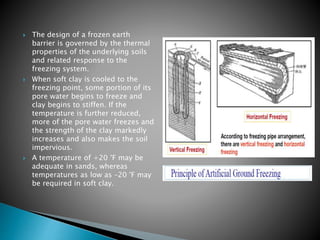
 Typically, a row of freeze pipes
are placed vertically in the soil,
and heat energy is removed
through them, in a process
remarkably analogous to
pumping ground water from
wells.
 The design of a frozen earth
barrier is governed by the thermal
properties of the underlying soils
and related response to the
freezing system.
 When soft clay is cooled to the
freezing point, some portion of its
pore water begins to freeze and
clay begins to stiffen. If the
temperature is further reduced,
more of the pore water freezes and
the strength of the clay markedly
increases and also makes the soil
impervious.
 A temperature of +20 °F may be
adequate in sands, whereas
temperatures as low as –20 °F may
be required in soft clay.
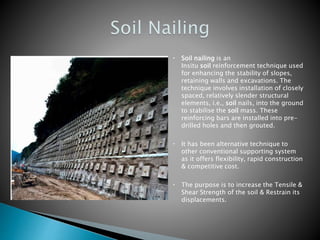
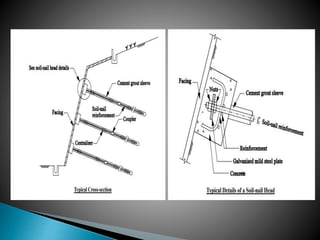
Soil nailing is an
Insitu soil reinforcement technique used
for enhancing the stability of slopes,
retaining walls and excavations. The
technique involves installation of closely
spaced, relatively slender structural
elements, i.e., soil nails, into the ground
to stabilise the soil mass. These
reinforcing bars are installed into pre-
drilled holes and then grouted.
It has been alternative technique to
other conventional supporting system
as it offers flexibility, rapid construction
& competitive cost.
The purpose is to increase the Tensile &
Shear Strength of the soil & Restrain its
displacements.
The following are typical merits of adopting the soil nailing technique
in respect of construction, cost and performance:
It is suitable for cramped sites with difficult access because the construction
plant required for soil nail installation is small and mobile.
 It can easily cope with site constraints and variations in ground conditions
encountered during construction, e.g., by adjusting the location and length of
the soil nails to suit the site conditions.
During construction, it causes less environmental impact than cutting back
and retaining wall construction as no major earthworks and tree felling are
needed.
There could be time and cost savings compared to conventional techniques of
cutting back and retaining wall construction which usually involve substantial
earthworks and temporary works.
It is less sensitive to undetected adverse geological features, and thus more
robust and reliable than unsupported cuts. In addition, it renders higher system
redundancy than unsupported cuts or anchored slopes due to the presence of a
large number of soil nails. (f) The failure mode of a soil-nailed system is likely
to be ductile, thus providing warning signs before failure.
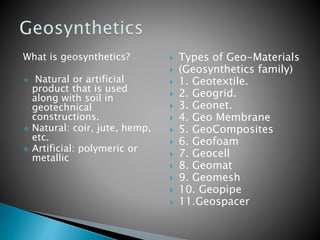
What is geosynthetics?
 Natural or artificial
product that is used
along with soil in
geotechnical
constructions.
 Natural: coir, jute, hemp,
etc.
 Artificial: polymeric or
metallic
 Types of Geo-Materials
 (Geosynthetics family)
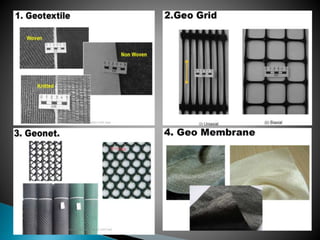
 1. Geotextile.
 2. Geogrid.
 3. Geonet.
 4. Geo Membrane
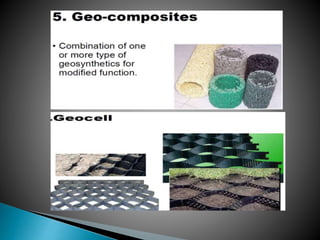
 5. GeoComposites
 6. Geofoam
 7. Geocell
 8. Geomat
 9. Geomesh
 10. Geopipe
 11.Geospacer
 www.google.com
 www.slideshare.net
 http://www.cedd.g
ov.hk
 https://en.wikipedi
a.org
 https://theconstruc
tor.org
Ground improvement techniques

Ground improvement techniques

  • 1.
  • 3.
     Mechanical properties arenot adequate.  Swelling & shrinkage  Collapsible soils  Soft soils  Organic and peaty soils  Sand and gravelly deposits
  • 4.
     Ground improvementrefers to a technique that improves the engineering properties of the soil mass treated.  Usually the properties that are modified are: Shear strength,stiffness & permeability.  Ground improvement techniques are different for different soil types
  • 5.
     Densification  Consolidation Weight Reduction  Reinforcement  Chemical Treatment
  • 6.
    Vibroflotation is a technique forin situ densification of thick layers of loose granular soil deposits.
  • 10.
    FUNCTIONS AND USES 1.To increase the bearing capacity 2. Improves the stiffness of subsoil to decrease settlements 3. To carry very high loads 4. More economical than piling 5. No waiting period after installation 6. homogenizes variable soil properties Example-Palm island (Dubai)
  • 13.
     Ground freezingis used for groundwater cut-off, for earth support, for temporary underpinning, for stabilization of earth for tunnel excavation, to arrest landslides and to stabilize abandoned mineshafts.  Typically, a row of freeze pipes are placed vertically in the soil, and heat energy is removed through them, in a process remarkably analogous to pumping ground water from wells.
  • 14.
     The designof a frozen earth barrier is governed by the thermal properties of the underlying soils and related response to the freezing system.  When soft clay is cooled to the freezing point, some portion of its pore water begins to freeze and clay begins to stiffen. If the temperature is further reduced, more of the pore water freezes and the strength of the clay markedly increases and also makes the soil impervious.  A temperature of +20 °F may be adequate in sands, whereas temperatures as low as –20 °F may be required in soft clay.
  • 15.
    Soil nailing isan Insitu soil reinforcement technique used for enhancing the stability of slopes, retaining walls and excavations. The technique involves installation of closely spaced, relatively slender structural elements, i.e., soil nails, into the ground to stabilise the soil mass. These reinforcing bars are installed into pre- drilled holes and then grouted. It has been alternative technique to other conventional supporting system as it offers flexibility, rapid construction & competitive cost. The purpose is to increase the Tensile & Shear Strength of the soil & Restrain its displacements.
  • 17.
    The following aretypical merits of adopting the soil nailing technique in respect of construction, cost and performance: It is suitable for cramped sites with difficult access because the construction plant required for soil nail installation is small and mobile.  It can easily cope with site constraints and variations in ground conditions encountered during construction, e.g., by adjusting the location and length of the soil nails to suit the site conditions. During construction, it causes less environmental impact than cutting back and retaining wall construction as no major earthworks and tree felling are needed. There could be time and cost savings compared to conventional techniques of cutting back and retaining wall construction which usually involve substantial earthworks and temporary works. It is less sensitive to undetected adverse geological features, and thus more robust and reliable than unsupported cuts. In addition, it renders higher system redundancy than unsupported cuts or anchored slopes due to the presence of a large number of soil nails. (f) The failure mode of a soil-nailed system is likely to be ductile, thus providing warning signs before failure.
  • 18.
    What is geosynthetics? Natural or artificial product that is used along with soil in geotechnical constructions.  Natural: coir, jute, hemp, etc.  Artificial: polymeric or metallic  Types of Geo-Materials  (Geosynthetics family)  1. Geotextile.  2. Geogrid.  3. Geonet.  4. Geo Membrane  5. GeoComposites  6. Geofoam  7. Geocell  8. Geomat  9. Geomesh  10. Geopipe  11.Geospacer
  • 21.
     www.google.com  www.slideshare.net http://www.cedd.g ov.hk  https://en.wikipedi a.org  https://theconstruc tor.org