Keep your eyes on the stars, your feet on the ground, and your hands
creating a Spark.
by
SHUBHAM GIRI -
150553
SOIL
STABALIZATION
GOVIND BALLABH PANT INSTITUTE OF
ENGINEERING & TECHNOLOGY
ARODOUCTION
WHY
HOW
B
EMENT
S
C
45%
ASTIC LIMIT
2.65
P. GRAVITY
D
N
HOME INTRO METHODS CASE STUDY CONCLUSION
SOIL
STABALIZATION
Procedure wherein the engineering properties of the soil are ALTERED &
ENHANCED to increase its suitability for construction purposes
NEED OF SOIL
STABALIZATION ?
WHY
HOME INTRO METHODS CASE STUDY CONCLUSION
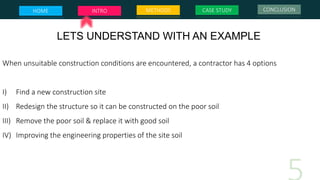
LETS UNDERSTAND WITH AN EXAMPLE
When unsuitable construction conditions are encountered, a contractor has 4 options
I) Find a new construction site
II) Redesign the structure so it can be constructed on the poor soil
III) Remove the poor soil & replace it with good soil
IV) Improving the engineering properties of the site soil
HOME INTRO METHODS CASE STUDY CONCLUSION
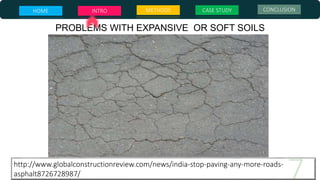
PROBLEMS WITH EXPANSIVE OR SOFT SOILS
Source http://texturelib.com/#!/category/?path=/Textures/road/damaged
HOME INTRO METHODS CASE STUDY CONCLUSION
http://www.globalconstructionreview.com/news/india-stop-paving-any-more-roads-
asphalt8726728987/
PROBLEMS WITH EXPANSIVE OR SOFT SOILS
HOME INTRO METHODS CASE STUDY CONCLUSION
MAIN OBJECTIVE
Stability
Cost of Construction
Shear Strength
Compressibility
Bearing Capacity
Permeability
HOME INTRO METHODS CASE STUDY CONCLUSION
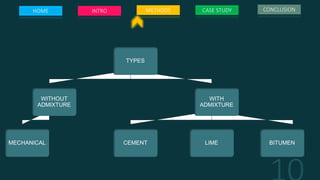
Methods Of Stabilization
TYPES
MECHANICAL
WITHOUT
ADMIXTURE
WITH
ADMIXTURE
CEMENT LIME BITUMEN
HOME INTRO METHODS CASE STUDY CONCLUSION
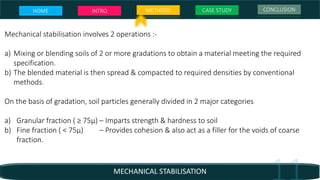
Mechanical stabilisation involves 2 operations :-
a) Mixing or blending soils of 2 or more gradations to obtain a material meeting the required
specification.
b) The blended material is then spread & compacted to required densities by conventional
methods.
On the basis of gradation, soil particles generally divided in 2 major categories
a) Granular fraction ( ≥ 75µ) – Imparts strength & hardness to soil
b) Fine fraction ( < 75µ) – Provides cohesion & also act as a filler for the voids of coarse
fraction.
MECHANICAL STABILISATION
HOME INTRO METHODS CASE STUDY CONCLUSION
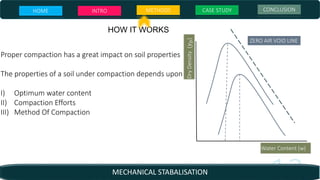
HOW IT WORKS
DryDensity()
Water Content (w)
ZERO AIR VOID LINE
Proper compaction has a great impact on soil properties
The properties of a soil under compaction depends upon
I) Optimum water content
II) Compaction Efforts
III) Method Of Compaction
HOME INTRO METHODS CASE STUDY CONCLUSION
MECHANICAL STABALISATION
LIME STABALISATION
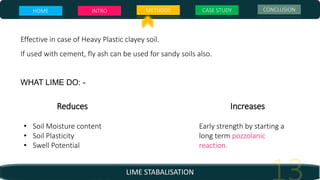
Effective in case of Heavy Plastic clayey soil.
If used with cement, fly ash can be used for sandy soils also.
WHAT LIME DO: -
Increases
Early strength by starting a
long term pozzolanic
reaction.
Reduces
• Soil Moisture content
• Soil Plasticity
• Swell Potential
HOME INTRO METHODS CASE STUDY CONCLUSION
LIME STABALISATION
HOW IT WORKS
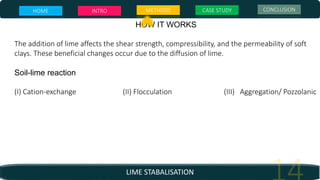
The addition of lime affects the shear strength, compressibility, and the permeability of soft
clays. These beneficial changes occur due to the diffusion of lime.
Soil-lime reaction
(I) Cation-exchange (II) Flocculation (III) Aggregation/ Pozzolanic
HOME INTRO METHODS CASE STUDY CONCLUSION
LIME STABALISATION
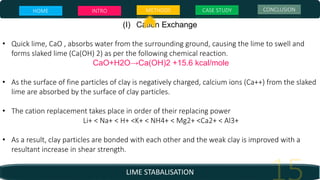
(I) Cation Exchange
• Quick lime, CaO , absorbs water from the surrounding ground, causing the lime to swell and
forms slaked lime (Ca(OH) 2) as per the following chemical reaction.
CaO+H2O→Ca(OH)2 +15.6 kcal/mole
• As the surface of fine particles of clay is negatively charged, calcium ions (Ca++) from the slaked
lime are absorbed by the surface of clay particles.
• The cation replacement takes place in order of their replacing power
Li+ < Na+ < H+ <K+ < NH4+ < Mg2+ <Ca2+ < Al3+
• As a result, clay particles are bonded with each other and the weak clay is improved with a
resultant increase in shear strength.
HOME INTRO METHODS CASE STUDY CONCLUSION
LIME STABALISATION
(II) Flocculation
The fine clay particles react with lime & get flocculated or aggregated to into large particle groups
which are more stable even in soaking conditions.
HOME INTRO METHODS CASE STUDY CONCLUSION
LIME STABALISATION
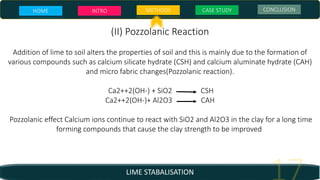
(II) Pozzolanic Reaction
Addition of lime to soil alters the properties of soil and this is mainly due to the formation of
various compounds such as calcium silicate hydrate (CSH) and calcium aluminate hydrate (CAH)
and micro fabric changes(Pozzolanic reaction).
Ca2++2(OH-) + SiO2 CSH
Ca2++2(OH-)+ Al2O3 CAH
Pozzolanic effect Calcium ions continue to react with SiO2 and Al2O3 in the clay for a long time
forming compounds that cause the clay strength to be improved.
HOME INTRO METHODS CASE STUDY CONCLUSION
LIME STABALISATION
Factors affecting lime stabalised soils
T
HOME INTRO METHODS CASE STUDY CONCLUSION
LIME STABALISATION
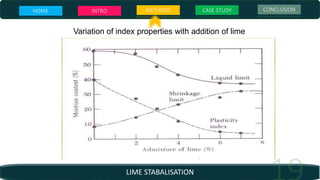
Variation of index properties with addition of lime
HOME INTRO METHODS CASE STUDY CONCLUSION
CEMENT STABALISATION
• Soil stabilized with cement is known as SOIL CEMENT
• Cementing action is believed to be the result of chemical reaction of cement with
silicious soil during hydration
• The binding action of individual particles through cement may be possible only in
case of COARSE Grained Soil. In case of FINE grained soil only some of the particles
are expected to have Cement bond & rest are bonded through natural cohesion.
• By using pozzolanic materials such as fly ash, rice husk fine grained soils can also be
stabilized.
HOME INTRO METHODS CASE STUDY CONCLUSION
CEMENT STABALISATION
1) NATURE OF SOIL: -
Coarse Grained Soils are more feasible with this method as compared to Fine Grained.
Well Graded soils ( < 50 % finer then 75 µ & Plasticity Index < 20 % ) give best results.
2) CEMENT CONTENT: -
Soil cement strength increases with increase of cement content.
Approximate amount of cement for different types of soils may be
GRAVELS SANDS SILTS
5-10 % 7-12 % 12- 15 %
HOME INTRO METHODS CASE STUDY CONCLUSION
CEMENT STABALISATION
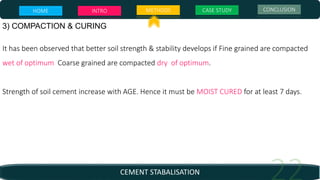
3) COMPACTION & CURING
It has been observed that better soil strength & stability develops if Fine grained are compacted
wet of optimum Coarse grained are compacted dry of optimum.
Strength of soil cement increase with AGE. Hence it must be MOIST CURED for at least 7 days.
HOME INTRO METHODS CASE STUDY CONCLUSION
CEMENT STABALISATION
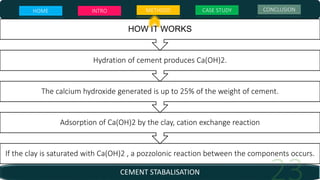
If the clay is saturated with Ca(OH)2 , a pozzolonic reaction between the components occurs.
Adsorption of Ca(OH)2 by the clay, cation exchange reaction
The calcium hydroxide generated is up to 25% of the weight of cement.
Hydration of cement produces Ca(OH)2.
HOW IT WORKS
HOME INTRO METHODS CASE STUDY CONCLUSION
BITUMEN STABALISATION
• Asphalts & Tars are bituminous materials which are used for stabilisation of soil.
• The Fluidity of both are increased either by heating or by Cut-Back process .
• Bituminous material when added to a soil impart Binding Action & reduce Water
absorption.
HOME INTRO METHODS CASE STUDY CONCLUSION
BITUMEN STABALISATION
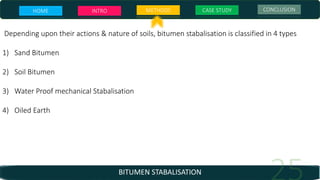
Depending upon their actions & nature of soils, bitumen stabalisation is classified in 4 types
1) Sand Bitumen
2) Soil Bitumen
3) Water Proof mechanical Stabalisation
4) Oiled Earth
HOME INTRO METHODS CASE STUDY CONCLUSION
CHEMICAL STABALISATION
1) Sand Bitumen: -
The term refers to bitumen stabalised Cohesion less soil.
The primary function of bitumen is to bind the soil particles.
2) Soil Bitumen: -
It refers to a cohesive soil stabalised by Bituminous material.
The main function is to preserve the natural cohesive strength by water proofing the soil
HOME INTRO METHODS CASE STUDY CONCLUSION
BITUMEN STABALISATION
3) Water proof Mechanical Stabalisation
Small amount of bitumen ( 1-3 %), are sometime added to mechanically stabalised soils to make
them water proof.
4) Oiled Earth
Slow & Medium curing road oils are spread on the ground surface to make it water & abrasion
resistant.
HOME INTRO METHODS CASE STUDY CONCLUSION
CASE STUDY - SYRIA
Effect of adding natural pozzolana on geotechnical properties
of lime-stabilized clayey soil
CASE STUDY
Abstract
Clayey soils in Syria cover a total area of more than 20,000 km2 of the country, most of which are
located in the southwestern region. In many places of the country, the clayey soils caused severe
damage to infrastructures. Extensive studies have been carried out on the stabilization of clayey
soils using lime. Syria is rich in both lime and natural pozzolana. However, few works have been
conducted to investigate the influence of adding natural pozzolana on the geotechnical properties
of lime-treated clayey soils. The aim of this paper is to understand the effect of adding natural
pozzolana on some geotechnical properties of lime-stabilized clayey soils. Natural pozzolana and
lime are added to soil within the range of 0%–20% and 0%–8%, respectively.
HOME INTRO METHODS CASE STUDY CONCLUSION
CASE STUDY
Consistency, compaction, California bearing ratio (CBR) and linear shrinkage properties are
particularly investigated. The test results show that the investigated properties of lime-treated
clayey soils can be considerably enhanced when the natural pozzolana is added as a stabilizing
agent. Analysis results of scanning electron microscopy (SEM) and energy-dispersive X-ray
spectroscopy (EDX) show significant changes in the microstructure of the treated clayey soil. A
better flocculation of clayey particles and further formation of cementing materials in the natural
pozzolana-lime-treated clayey soil are clearly observed.
HOME INTRO METHODS CASE STUDY CONCLUSION
CASE STUDY
1. Introduction
Clayey soils usually have the potential to demonstrate undesirable geotechnical properties,
such as low bearing capacity, high compressibility, shrinkage and swell characteristics and
high moisture susceptibility (Sakr et al., 2009). Several methods have been adopted to
improve the geotechnical properties of such soils so that the stability and serviceability
requirements can be met.
HOME INTRO METHODS CASE STUDY CONCLUSION
CASE STUDY
Lime is the oldest traditional stabilizer used for soil stabilization (Mallela et al., 2004). Many
significant geotechnical properties of clayey soils can be beneficially modified by lime treatment,
as lime decreases the plasticity index (PI), increases the workability, shrinkage limit, strength and
California bearing ratio (CBR) as well as eliminates almost all swelling problems (Rogers and
Glendinning, 1996; Sakr et al., 2009).
2. Materials and methods
2.1. Materials
2.1.1. Soil
The soil samples used in the study have been obtained from a site called Aalqeen situated at
about 40 km southwest of Damascus.
The clay minerals are kaolinite, illite and montmorillonite, with the percentages of 23%, 14% and
7%, respectively. The main non-clay minerals are quartz, feldspar and calcite.
2.1.2. Lime
The lime used was a quick lime. It was quarried from Hama Governance at about 200 km north of
Damascus
CASE STUDY
HOME INTRO METHODS CASE STUDY CONCLUSION
Color Depth
(m)
S.G
(G)
Passin
g
75 μm
(%)
Media
n
particl
e size
(μm)
LL (%) PL (%) PI (%) Classif
icatio
n
(USCS
)
Optim
um
moist
ure
conte
nt
(OMC
) (%)
Maxi
mum
dry
densit
y
(MDD
)
(kN/m
3)
CBR
of
soake
d
sampl
e (%)
CBR
of
non-
soake
d
sampl
e (%)
Swelli
ng
using
CBR
mold
(%)
Brow
n to
red
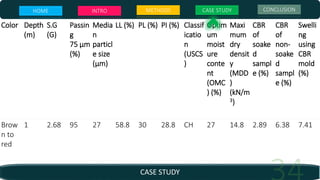
1 2.68 95 27 58.8 30 28.8 CH 27 14.8 2.89 6.38 7.41
CASE STUDY
HOME INTRO METHODS CASE STUDY CONCLUSION
CASE STUDY
HOME INTRO METHODS CASE STUDY CONCLUSION
2.1.3. Natural pozzolana
ASTM C125 (2003) describes pozzolana as a siliceous or silicious and aluminous material which
in itself possesses little or no cementitious value but will, in finely divided form and in the
presence of moisture, chemically reacts with calcium hydroxide at ordinary temperatures to
form compounds possessing cementitious properties. The natural pozzolana used in the
experiments was collected from a Tal Shihan's quarry, about 70 km southeast of Damascus,
CASE STUDY
HOME INTRO METHODS CASE STUDY CONCLUSION
2.2. Methods
A series of laboratory tests consisting of initial consumption of lime, Atterberg limits, compaction,
CBR was conducted on the clayey soil.
3. Results and discussion
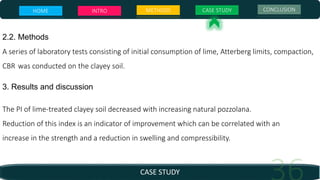
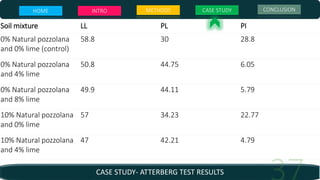
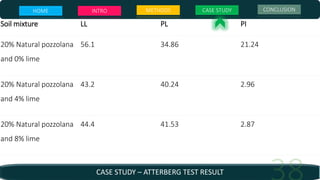
The PI of lime-treated clayey soil decreased with increasing natural pozzolana.
Reduction of this index is an indicator of improvement which can be correlated with an
increase in the strength and a reduction in swelling and compressibility.
Soil mixture LL PL PI
0% Natural pozzolana
and 0% lime (control)
58.8 30 28.8
0% Natural pozzolana
and 4% lime
50.8 44.75 6.05
0% Natural pozzolana
and 8% lime
49.9 44.11 5.79
10% Natural pozzolana
and 0% lime
57 34.23 22.77
10% Natural pozzolana
and 4% lime
47 42.21 4.79
CASE STUDY- ATTERBERG TEST RESULTS
HOME INTRO METHODS CASE STUDY CONCLUSION
Soil mixture LL PL PI
20% Natural pozzolana
and 0% lime
56.1 34.86 21.24
20% Natural pozzolana
and 4% lime
43.2 40.24 2.96
20% Natural pozzolana
and 8% lime
44.4 41.53 2.87
CASE STUDY – ATTERBERG TEST RESULT
HOME INTRO METHODS CASE STUDY CONCLUSION
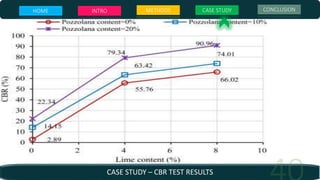
(2) CBR TEST
Adding natural pozzolana has a beneficial effect on the bearing capacity of lime
treated soil. It has the potential to significantly increase the CBR value up to 90%
(a value that normally characterizes an excellently compacted pavement
subgrade).
CASE STUDY
HOME INTRO METHODS CASE STUDY CONCLUSION
CASE STUDY – CBR TEST RESULTS
HOME INTRO METHODS CASE STUDY CONCLUSION
CONCLUSION
• Stabilisation methods are employed for modifying the properties of a
soil to improve its engineering performance.
• Soil stabilisation is used in construction of road and air-field pavements,
where the main objective is to increase the strength of soil and to
reduce the construction cost by making best use of locally available
materials.
HOME INTRO METHODS CASE STUDY CONCLUSION
1) BOOKS REFFERD
B.C Punmia
Khanna N Justo
Manoj Dutta
2) NPTEL
http://nptel.ac.in/courses/105108075/module6/Lecture17.pdf
http://nptel.ac.in/courses/105108075/module2/Lecture05.pdf
http://nptel.ac.in/courses/105108075/module6/Lecture19.pdf
2) RESEARCH GATE
https://www.researchgate.net/publication/292090709_Influence_of_Delay_after_Mixing_on_
Compaction_Characteristics_of_Cement-Locust_Bean_Waste_Ash_Modified_Lateritic_Soil
https://www.researchgate.net/publication/322059624_STUDY_ON_UNCONFINED_COMPRESS
IVE_STRENGTH_OF_SOIL_CEMENT_STABILIZED_BY_NORMAL_PORTLAND_CEMENT
HOME INTRO METHODS CASE STUDY CONCLUSION
REFRENCE
4) SLIDE SHARE
https://www.slideshare.net/husna004/introduction-to-soil-stabilization-and-introduction-to-
geo-textiles-and-synthetics-applications/5
https://www.slideshare.net/safiullahkha/soil-stabilisation-1
https://www.slideshare.net/mobile/prashanthkumar81/stabilization-of-soil-using-bitumenous-
emulsions-40717891
https://www.slideshare.net/mobile/VeluppillaiMohan1/cement-stabilization-of-soils-ppt
5) https://globalroadtechnology.com/definition-soil-stabilization/
6) https://pdfs.semanticscholar.org/b538/f91d5d13229e413aa9c80b56c4024bdae578.pdf
7) https://www.hindawi.com/journals/amse/2014/810652/
8) http://envirotac-dust-control-products.blogspot.in/2016/11/why-stabilizing-soil-with-
polymers-is.html?m=1
9) http://www.bitumina.co.uk/cutback-bitumen.html
10) http://www.civilengineeringterms.com/soil-mechanics-2/bitumen-and-lime-stabilization/
HOME INTRO METHODS CASE STUDY CONCLUSION
REFRENCE
REFRENCE
10) YOUTUBE
a) https://www.youtube.com/channel/UC_RzcFofsK3DKYuNyR5P75Q
b) https://www.youtube.com/watch?v=iC5YWjZjVVM&list=PLbMVogVj5nJRb_yA6oMKfo
T89hyUcuHIA
c) https://www.youtube.com/watch?v=ahlu0gVP42I
11) QUORA
12) SCIENCE DIRECT
https://www.sciencedirect.com/science/article/pii/S1674775517302019
https://www.sciencedirect.com/science/article/pii/0008884695002197
https://www.sciencedirect.com/science/article/pii/S1877705816304465
12) GBPIET HELP GUIDE ( Animated images)
https://gbpietguide.000webhostapp.com/
HOME INTRO METHODS CASE STUDY CONCLUSION
THANK YOU

Methods Of Soil stabilization

  • 1.
    Keep your eyeson the stars, your feet on the ground, and your hands creating a Spark.
  • 2.
    by SHUBHAM GIRI - 150553 SOIL STABALIZATION GOVINDBALLABH PANT INSTITUTE OF ENGINEERING & TECHNOLOGY ARODOUCTION WHY HOW B EMENT S C 45% ASTIC LIMIT 2.65 P. GRAVITY D N
  • 3.
    HOME INTRO METHODSCASE STUDY CONCLUSION SOIL STABALIZATION Procedure wherein the engineering properties of the soil are ALTERED & ENHANCED to increase its suitability for construction purposes
  • 4.
    NEED OF SOIL STABALIZATION? WHY HOME INTRO METHODS CASE STUDY CONCLUSION
  • 5.
    LETS UNDERSTAND WITHAN EXAMPLE When unsuitable construction conditions are encountered, a contractor has 4 options I) Find a new construction site II) Redesign the structure so it can be constructed on the poor soil III) Remove the poor soil & replace it with good soil IV) Improving the engineering properties of the site soil HOME INTRO METHODS CASE STUDY CONCLUSION
  • 6.
    PROBLEMS WITH EXPANSIVEOR SOFT SOILS Source http://texturelib.com/#!/category/?path=/Textures/road/damaged HOME INTRO METHODS CASE STUDY CONCLUSION
  • 7.
  • 8.
    MAIN OBJECTIVE Stability Cost ofConstruction Shear Strength Compressibility Bearing Capacity Permeability HOME INTRO METHODS CASE STUDY CONCLUSION
  • 9.
  • 10.
  • 11.
    Mechanical stabilisation involves2 operations :- a) Mixing or blending soils of 2 or more gradations to obtain a material meeting the required specification. b) The blended material is then spread & compacted to required densities by conventional methods. On the basis of gradation, soil particles generally divided in 2 major categories a) Granular fraction ( ≥ 75µ) – Imparts strength & hardness to soil b) Fine fraction ( < 75µ) – Provides cohesion & also act as a filler for the voids of coarse fraction. MECHANICAL STABILISATION HOME INTRO METHODS CASE STUDY CONCLUSION
  • 12.
    HOW IT WORKS DryDensity() WaterContent (w) ZERO AIR VOID LINE Proper compaction has a great impact on soil properties The properties of a soil under compaction depends upon I) Optimum water content II) Compaction Efforts III) Method Of Compaction HOME INTRO METHODS CASE STUDY CONCLUSION MECHANICAL STABALISATION
  • 13.
    LIME STABALISATION Effective incase of Heavy Plastic clayey soil. If used with cement, fly ash can be used for sandy soils also. WHAT LIME DO: - Increases Early strength by starting a long term pozzolanic reaction. Reduces • Soil Moisture content • Soil Plasticity • Swell Potential HOME INTRO METHODS CASE STUDY CONCLUSION
  • 14.
    LIME STABALISATION HOW ITWORKS The addition of lime affects the shear strength, compressibility, and the permeability of soft clays. These beneficial changes occur due to the diffusion of lime. Soil-lime reaction (I) Cation-exchange (II) Flocculation (III) Aggregation/ Pozzolanic HOME INTRO METHODS CASE STUDY CONCLUSION
  • 15.
    LIME STABALISATION (I) CationExchange • Quick lime, CaO , absorbs water from the surrounding ground, causing the lime to swell and forms slaked lime (Ca(OH) 2) as per the following chemical reaction. CaO+H2O→Ca(OH)2 +15.6 kcal/mole • As the surface of fine particles of clay is negatively charged, calcium ions (Ca++) from the slaked lime are absorbed by the surface of clay particles. • The cation replacement takes place in order of their replacing power Li+ < Na+ < H+ <K+ < NH4+ < Mg2+ <Ca2+ < Al3+ • As a result, clay particles are bonded with each other and the weak clay is improved with a resultant increase in shear strength. HOME INTRO METHODS CASE STUDY CONCLUSION
  • 16.
    LIME STABALISATION (II) Flocculation Thefine clay particles react with lime & get flocculated or aggregated to into large particle groups which are more stable even in soaking conditions. HOME INTRO METHODS CASE STUDY CONCLUSION
  • 17.
    LIME STABALISATION (II) PozzolanicReaction Addition of lime to soil alters the properties of soil and this is mainly due to the formation of various compounds such as calcium silicate hydrate (CSH) and calcium aluminate hydrate (CAH) and micro fabric changes(Pozzolanic reaction). Ca2++2(OH-) + SiO2 CSH Ca2++2(OH-)+ Al2O3 CAH Pozzolanic effect Calcium ions continue to react with SiO2 and Al2O3 in the clay for a long time forming compounds that cause the clay strength to be improved. HOME INTRO METHODS CASE STUDY CONCLUSION
  • 18.
    LIME STABALISATION Factors affectinglime stabalised soils T HOME INTRO METHODS CASE STUDY CONCLUSION
  • 19.
    LIME STABALISATION Variation ofindex properties with addition of lime HOME INTRO METHODS CASE STUDY CONCLUSION
  • 20.
    CEMENT STABALISATION • Soilstabilized with cement is known as SOIL CEMENT • Cementing action is believed to be the result of chemical reaction of cement with silicious soil during hydration • The binding action of individual particles through cement may be possible only in case of COARSE Grained Soil. In case of FINE grained soil only some of the particles are expected to have Cement bond & rest are bonded through natural cohesion. • By using pozzolanic materials such as fly ash, rice husk fine grained soils can also be stabilized. HOME INTRO METHODS CASE STUDY CONCLUSION
  • 21.
    CEMENT STABALISATION 1) NATUREOF SOIL: - Coarse Grained Soils are more feasible with this method as compared to Fine Grained. Well Graded soils ( < 50 % finer then 75 µ & Plasticity Index < 20 % ) give best results. 2) CEMENT CONTENT: - Soil cement strength increases with increase of cement content. Approximate amount of cement for different types of soils may be GRAVELS SANDS SILTS 5-10 % 7-12 % 12- 15 % HOME INTRO METHODS CASE STUDY CONCLUSION
  • 22.
    CEMENT STABALISATION 3) COMPACTION& CURING It has been observed that better soil strength & stability develops if Fine grained are compacted wet of optimum Coarse grained are compacted dry of optimum. Strength of soil cement increase with AGE. Hence it must be MOIST CURED for at least 7 days. HOME INTRO METHODS CASE STUDY CONCLUSION
  • 23.
    CEMENT STABALISATION If theclay is saturated with Ca(OH)2 , a pozzolonic reaction between the components occurs. Adsorption of Ca(OH)2 by the clay, cation exchange reaction The calcium hydroxide generated is up to 25% of the weight of cement. Hydration of cement produces Ca(OH)2. HOW IT WORKS HOME INTRO METHODS CASE STUDY CONCLUSION
  • 24.
    BITUMEN STABALISATION • Asphalts& Tars are bituminous materials which are used for stabilisation of soil. • The Fluidity of both are increased either by heating or by Cut-Back process . • Bituminous material when added to a soil impart Binding Action & reduce Water absorption. HOME INTRO METHODS CASE STUDY CONCLUSION
  • 25.
    BITUMEN STABALISATION Depending upontheir actions & nature of soils, bitumen stabalisation is classified in 4 types 1) Sand Bitumen 2) Soil Bitumen 3) Water Proof mechanical Stabalisation 4) Oiled Earth HOME INTRO METHODS CASE STUDY CONCLUSION
  • 26.
    CHEMICAL STABALISATION 1) SandBitumen: - The term refers to bitumen stabalised Cohesion less soil. The primary function of bitumen is to bind the soil particles. 2) Soil Bitumen: - It refers to a cohesive soil stabalised by Bituminous material. The main function is to preserve the natural cohesive strength by water proofing the soil HOME INTRO METHODS CASE STUDY CONCLUSION
  • 27.
    BITUMEN STABALISATION 3) Waterproof Mechanical Stabalisation Small amount of bitumen ( 1-3 %), are sometime added to mechanically stabalised soils to make them water proof. 4) Oiled Earth Slow & Medium curing road oils are spread on the ground surface to make it water & abrasion resistant. HOME INTRO METHODS CASE STUDY CONCLUSION
  • 28.
    CASE STUDY -SYRIA Effect of adding natural pozzolana on geotechnical properties of lime-stabilized clayey soil
  • 29.
    CASE STUDY Abstract Clayey soilsin Syria cover a total area of more than 20,000 km2 of the country, most of which are located in the southwestern region. In many places of the country, the clayey soils caused severe damage to infrastructures. Extensive studies have been carried out on the stabilization of clayey soils using lime. Syria is rich in both lime and natural pozzolana. However, few works have been conducted to investigate the influence of adding natural pozzolana on the geotechnical properties of lime-treated clayey soils. The aim of this paper is to understand the effect of adding natural pozzolana on some geotechnical properties of lime-stabilized clayey soils. Natural pozzolana and lime are added to soil within the range of 0%–20% and 0%–8%, respectively. HOME INTRO METHODS CASE STUDY CONCLUSION
  • 30.
    CASE STUDY Consistency, compaction,California bearing ratio (CBR) and linear shrinkage properties are particularly investigated. The test results show that the investigated properties of lime-treated clayey soils can be considerably enhanced when the natural pozzolana is added as a stabilizing agent. Analysis results of scanning electron microscopy (SEM) and energy-dispersive X-ray spectroscopy (EDX) show significant changes in the microstructure of the treated clayey soil. A better flocculation of clayey particles and further formation of cementing materials in the natural pozzolana-lime-treated clayey soil are clearly observed. HOME INTRO METHODS CASE STUDY CONCLUSION
  • 31.
    CASE STUDY 1. Introduction Clayeysoils usually have the potential to demonstrate undesirable geotechnical properties, such as low bearing capacity, high compressibility, shrinkage and swell characteristics and high moisture susceptibility (Sakr et al., 2009). Several methods have been adopted to improve the geotechnical properties of such soils so that the stability and serviceability requirements can be met. HOME INTRO METHODS CASE STUDY CONCLUSION
  • 32.
    HOME INTRO METHODSCASE STUDY CONCLUSION CASE STUDY Lime is the oldest traditional stabilizer used for soil stabilization (Mallela et al., 2004). Many significant geotechnical properties of clayey soils can be beneficially modified by lime treatment, as lime decreases the plasticity index (PI), increases the workability, shrinkage limit, strength and California bearing ratio (CBR) as well as eliminates almost all swelling problems (Rogers and Glendinning, 1996; Sakr et al., 2009).
  • 33.
    2. Materials andmethods 2.1. Materials 2.1.1. Soil The soil samples used in the study have been obtained from a site called Aalqeen situated at about 40 km southwest of Damascus. The clay minerals are kaolinite, illite and montmorillonite, with the percentages of 23%, 14% and 7%, respectively. The main non-clay minerals are quartz, feldspar and calcite. 2.1.2. Lime The lime used was a quick lime. It was quarried from Hama Governance at about 200 km north of Damascus CASE STUDY HOME INTRO METHODS CASE STUDY CONCLUSION
  • 34.
    Color Depth (m) S.G (G) Passin g 75 μm (%) Media n particl esize (μm) LL (%) PL (%) PI (%) Classif icatio n (USCS ) Optim um moist ure conte nt (OMC ) (%) Maxi mum dry densit y (MDD ) (kN/m 3) CBR of soake d sampl e (%) CBR of non- soake d sampl e (%) Swelli ng using CBR mold (%) Brow n to red 1 2.68 95 27 58.8 30 28.8 CH 27 14.8 2.89 6.38 7.41 CASE STUDY HOME INTRO METHODS CASE STUDY CONCLUSION
  • 35.
    CASE STUDY HOME INTROMETHODS CASE STUDY CONCLUSION 2.1.3. Natural pozzolana ASTM C125 (2003) describes pozzolana as a siliceous or silicious and aluminous material which in itself possesses little or no cementitious value but will, in finely divided form and in the presence of moisture, chemically reacts with calcium hydroxide at ordinary temperatures to form compounds possessing cementitious properties. The natural pozzolana used in the experiments was collected from a Tal Shihan's quarry, about 70 km southeast of Damascus,
  • 36.
    CASE STUDY HOME INTROMETHODS CASE STUDY CONCLUSION 2.2. Methods A series of laboratory tests consisting of initial consumption of lime, Atterberg limits, compaction, CBR was conducted on the clayey soil. 3. Results and discussion The PI of lime-treated clayey soil decreased with increasing natural pozzolana. Reduction of this index is an indicator of improvement which can be correlated with an increase in the strength and a reduction in swelling and compressibility.
  • 37.
    Soil mixture LLPL PI 0% Natural pozzolana and 0% lime (control) 58.8 30 28.8 0% Natural pozzolana and 4% lime 50.8 44.75 6.05 0% Natural pozzolana and 8% lime 49.9 44.11 5.79 10% Natural pozzolana and 0% lime 57 34.23 22.77 10% Natural pozzolana and 4% lime 47 42.21 4.79 CASE STUDY- ATTERBERG TEST RESULTS HOME INTRO METHODS CASE STUDY CONCLUSION
  • 38.
    Soil mixture LLPL PI 20% Natural pozzolana and 0% lime 56.1 34.86 21.24 20% Natural pozzolana and 4% lime 43.2 40.24 2.96 20% Natural pozzolana and 8% lime 44.4 41.53 2.87 CASE STUDY – ATTERBERG TEST RESULT HOME INTRO METHODS CASE STUDY CONCLUSION
  • 39.
    (2) CBR TEST Addingnatural pozzolana has a beneficial effect on the bearing capacity of lime treated soil. It has the potential to significantly increase the CBR value up to 90% (a value that normally characterizes an excellently compacted pavement subgrade). CASE STUDY HOME INTRO METHODS CASE STUDY CONCLUSION
  • 40.
    CASE STUDY –CBR TEST RESULTS HOME INTRO METHODS CASE STUDY CONCLUSION
  • 41.
    CONCLUSION • Stabilisation methodsare employed for modifying the properties of a soil to improve its engineering performance. • Soil stabilisation is used in construction of road and air-field pavements, where the main objective is to increase the strength of soil and to reduce the construction cost by making best use of locally available materials. HOME INTRO METHODS CASE STUDY CONCLUSION
  • 42.
    1) BOOKS REFFERD B.CPunmia Khanna N Justo Manoj Dutta 2) NPTEL http://nptel.ac.in/courses/105108075/module6/Lecture17.pdf http://nptel.ac.in/courses/105108075/module2/Lecture05.pdf http://nptel.ac.in/courses/105108075/module6/Lecture19.pdf 2) RESEARCH GATE https://www.researchgate.net/publication/292090709_Influence_of_Delay_after_Mixing_on_ Compaction_Characteristics_of_Cement-Locust_Bean_Waste_Ash_Modified_Lateritic_Soil https://www.researchgate.net/publication/322059624_STUDY_ON_UNCONFINED_COMPRESS IVE_STRENGTH_OF_SOIL_CEMENT_STABILIZED_BY_NORMAL_PORTLAND_CEMENT HOME INTRO METHODS CASE STUDY CONCLUSION REFRENCE
  • 43.
    4) SLIDE SHARE https://www.slideshare.net/husna004/introduction-to-soil-stabilization-and-introduction-to- geo-textiles-and-synthetics-applications/5 https://www.slideshare.net/safiullahkha/soil-stabilisation-1 https://www.slideshare.net/mobile/prashanthkumar81/stabilization-of-soil-using-bitumenous- emulsions-40717891 https://www.slideshare.net/mobile/VeluppillaiMohan1/cement-stabilization-of-soils-ppt 5)https://globalroadtechnology.com/definition-soil-stabilization/ 6) https://pdfs.semanticscholar.org/b538/f91d5d13229e413aa9c80b56c4024bdae578.pdf 7) https://www.hindawi.com/journals/amse/2014/810652/ 8) http://envirotac-dust-control-products.blogspot.in/2016/11/why-stabilizing-soil-with- polymers-is.html?m=1 9) http://www.bitumina.co.uk/cutback-bitumen.html 10) http://www.civilengineeringterms.com/soil-mechanics-2/bitumen-and-lime-stabilization/ HOME INTRO METHODS CASE STUDY CONCLUSION REFRENCE
  • 44.
    REFRENCE 10) YOUTUBE a) https://www.youtube.com/channel/UC_RzcFofsK3DKYuNyR5P75Q b)https://www.youtube.com/watch?v=iC5YWjZjVVM&list=PLbMVogVj5nJRb_yA6oMKfo T89hyUcuHIA c) https://www.youtube.com/watch?v=ahlu0gVP42I 11) QUORA 12) SCIENCE DIRECT https://www.sciencedirect.com/science/article/pii/S1674775517302019 https://www.sciencedirect.com/science/article/pii/0008884695002197 https://www.sciencedirect.com/science/article/pii/S1877705816304465 12) GBPIET HELP GUIDE ( Animated images) https://gbpietguide.000webhostapp.com/ HOME INTRO METHODS CASE STUDY CONCLUSION
  • 45.

Editor's Notes

  • #6 Talking of first 3 examples, makes the constructon uneconomical or not possible