At the end of the class, you should be able to:
1. State the classes of lipid
2. Explain what is saponification  LAB
3. Explain fatty acid degradation in ß-oxidation
4. Explain fatty acid biosynthesis using Palmitate as an example
LIPID
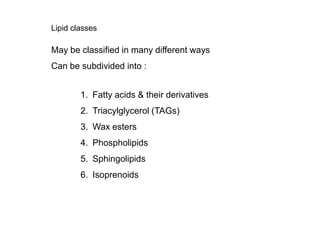
Lipid classes
May be classified in many different ways
Can be subdivided into :
1. Fatty acids & their derivatives
2. Triacylglycerol (TAGs)
3. Wax esters
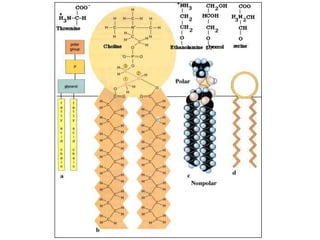
4. Phospholipids
5. Sphingolipids
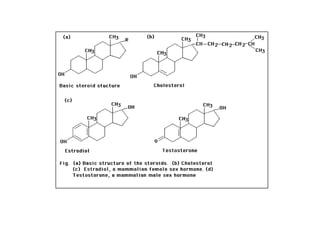
6. Isoprenoids
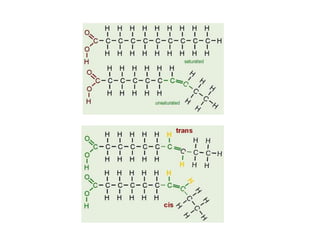
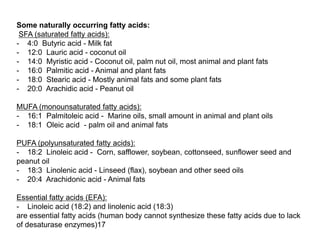
Some naturally occurring fatty acids:
SFA (saturated fatty acids):
- 4:0 Butyric acid - Milk fat
- 12:0 Lauric acid - coconut oil
- 14:0 Myristic acid - Coconut oil, palm nut oil, most animal and plant fats
- 16:0 Palmitic acid - Animal and plant fats
- 18:0 Stearic acid - Mostly animal fats and some plant fats
- 20:0 Arachidic acid - Peanut oil
MUFA (monounsaturated fatty acids):
- 16:1 Palmitoleic acid - Marine oils, small amount in animal and plant oils
- 18:1 Oleic acid - palm oil and animal fats
PUFA (polyunsaturated fatty acids):
- 18:2 Linoleic acid - Corn, safflower, soybean, cottonseed, sunflower seed and
peanut oil
- 18:3 Linolenic acid - Linseed (flax), soybean and other seed oils
- 20:4 Arachidonic acid - Animal fats
Essential fatty acids (EFA):
- Linoleic acid (18:2) and linolenic acid (18:3)
are essential fatty acids (human body cannot synthesize these fatty acids due to lack
of desaturase enzymes)17
What is it?
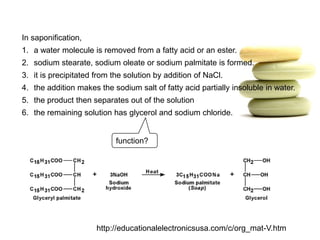
In saponification,
1. a water molecule is removed from a fatty acid or an ester.
2. sodium stearate, sodium oleate or sodium palmitate is formed.
3. it is precipitated from the solution by addition of NaCl.
4. the addition makes the sodium salt of fatty acid partially insoluble in water.
5. the product then separates out of the solution
6. the remaining solution has glycerol and sodium chloride.
function?
http://educationalelectronicsusa.com/c/org_mat-V.htm
anabolism
catabolism
metabolism
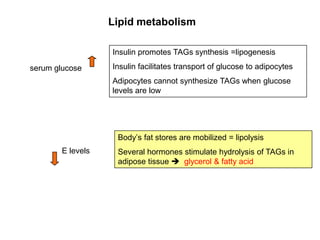
Lipid metabolism
serum glucose
Insulin promotes TAGs synthesis =lipogenesis
Insulin facilitates transport of glucose to adipocytes
Adipocytes cannot synthesize TAGs when glucose
levels are low
E levels
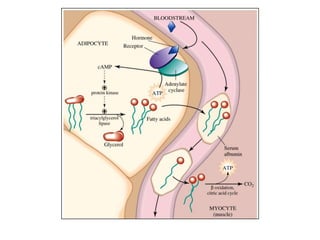
Body’s fat stores are mobilized = lipolysis
Several hormones stimulate hydrolysis of TAGs in
adipose tissue  glycerol & fatty acid
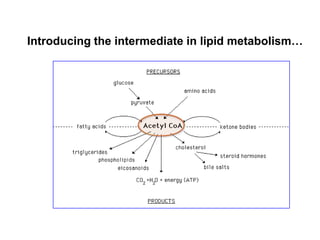
Introducing the intermediate in lipid metabolism…
Q: How do we generate energy from fatty acid?
3primary resources of fatty acids for
energy metabolism
1. Dietary triacylglycerols
2. Triacylglycerols synthesized in the liver
3. Triacylglycerols stored in adipocytes as lipid
droplets
What?
Where?
Why?
How?
http://www.rose-hulman.edu/~brandt/Chem331/Lipid_Breakdown.pdf
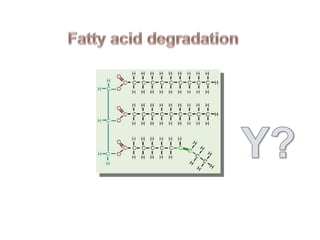
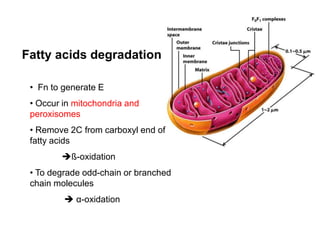
Fatty acids degradation
• Fn to generate E
• Occur in mitochondria and
peroxisomes
• Remove 2C from carboxyl end of
fatty acids
ß-oxidation
• To degrade odd-chain or branched
chain molecules
 α-oxidation
Fatty acids degradation
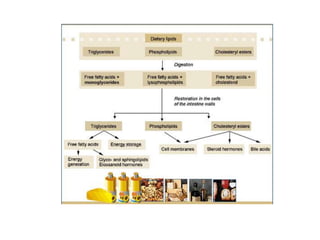
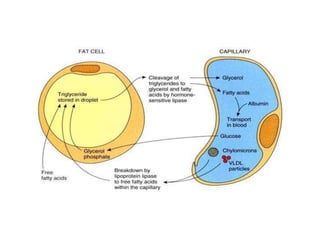
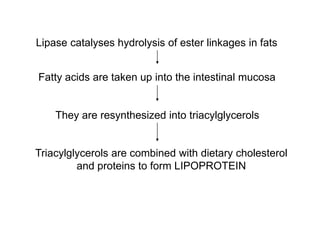
Triacylglycerols are combined with dietary cholesterol
and proteins to form LIPOPROTEIN
Lipase catalyses hydrolysis of ester linkages in fats
Fatty acids are taken up into the intestinal mucosa
They are resynthesized into triacylglycerols
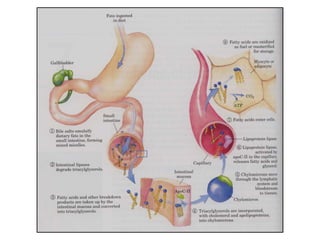
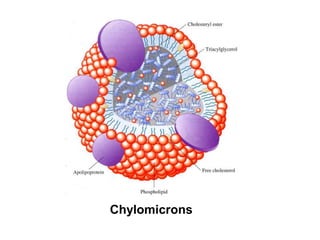
• Triacylglycerol are transported by chylomicrons
• Chylomicrons are one of the plasma lipoproteins
• released by exocytosis from enterocytes into lacteals, lymphatic vessels
originating in the villi of the small intestine
• during the circulation, chylomicron accept apolipoprotein C-II from HD
Lipoproteins.
•APOC2 is a cofactor for lipoprotein lipase activity
• Fatty acids that have been delivered to muscle tissue via blood
capillaries diffuse through cell plasma membrane into the cytoplasm
• From cytoplasm/cytosol it will undergo degradation in the matrix
mitochondria.
• HOW?
Chylomicrons
Lipid metabolism
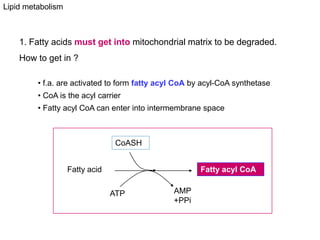
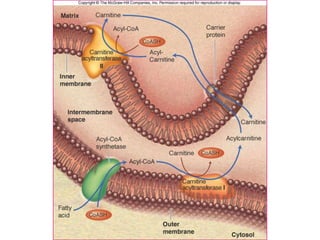
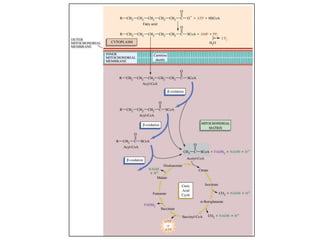
1. Fatty acids must get into mitochondrial matrix to be degraded.
How to get in ?
Fatty acid Fatty acyl CoA
ATP AMP
+PPi
CoASH
• f.a. are activated to form fatty acyl CoA by acyl-CoA synthetase
• CoA is the acyl carrier
• Fatty acyl CoA can enter into intermembrane space
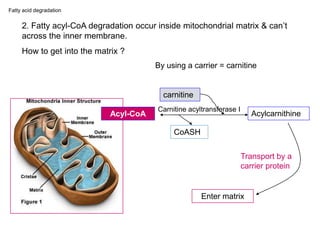
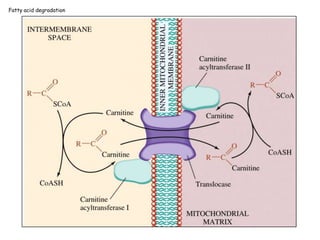
2. Fatty acyl-CoA degradation occur inside mitochondrial matrix & can’t
across the inner membrane.
How to get into the matrix ?
By using a carrier = carnitine
Acylcarnithine
carnitine
CoASH
Carnitine acyltransferase I
Enter matrix
Transport by a
carrier protein
Acyl-CoA
Fatty acid degradation
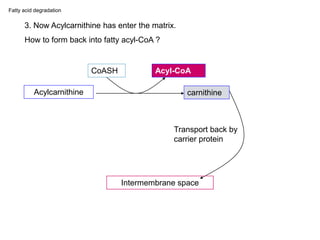
3. Now Acylcarnithine has enter the matrix.
How to form back into fatty acyl-CoA ?
Acylcarnithine carnithine
CoASH Acyl-CoA
Intermembrane space
Transport back by
carrier protein
Fatty acid degradation
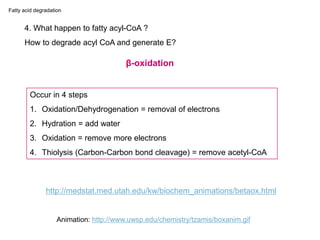
β-oxidation
Occur in 4 steps
1. Oxidation/Dehydrogenation = removal of electrons
2. Hydration = add water
3. Oxidation = remove more electrons
4. Thiolysis (Carbon-Carbon bond cleavage) = remove acetyl-CoA
4. What happen to fatty acyl-CoA ?
How to degrade acyl CoA and generate E?
Fatty acid degradation
Animation: http://www.uwsp.edu/chemistry/tzamis/boxanim.gif
http://medstat.med.utah.edu/kw/biochem_animations/betaox.html
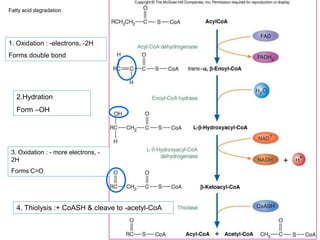
1. Oxidation : -electrons, -2H
Forms double bond
2.Hydration
Form –OH
3. Oxidation : - more electrons, -
2H
Forms C=O
4. Thiolysis :+ CoASH & cleave to -acetyl-CoA
Fatty acid degradation
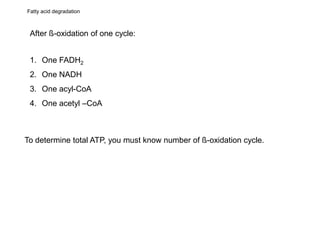
After ß-oxidation of one cycle:
1. One FADH2
2. One NADH
3. One acyl-CoA
4. One acetyl –CoA
To determine total ATP, you must know number of ß-oxidation cycle.
Fatty acid degradation
• Most of acetyl CoA is used by TCA cycle or isoprenoid
synthesis
• But some acetyl CoA follow alternate pathway:
•During fasting/starvation  glycolysis ↓ [OAA become
depleted and could not accept acetyl-CoA] and
gluconeogenesis ↑
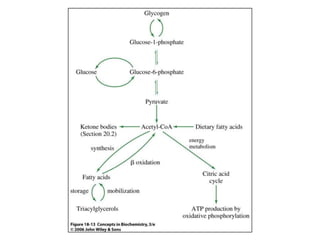
•Therefore the excess of acetyl CoA  is converted to ketone
bodies by ketogenesis (occur in matrix of liver mitochondria)
•Ketone bodies = acetoacetate, ß-hydroxybutarate, acetone
•They are water soluble lipids and can be readily
transported in the blood plasma
• Ketone bodies can be used to generate E (as a substitute
to glucose) in brain, cardiac & skeletal muscle
Question:
What happen if our diet contain:
Low in fat?
High carbohydrate ?
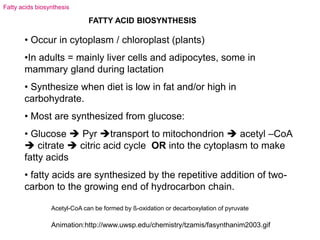
FATTY ACID BIOSYNTHESIS
• Occur in cytoplasm / chloroplast (plants)
•In adults = mainly liver cells and adipocytes, some in
mammary gland during lactation
• Synthesize when diet is low in fat and/or high in
carbohydrate.
• Most are synthesized from glucose:
• Glucose  Pyr transport to mitochondrion  acetyl –CoA
 citrate  citric acid cycle OR into the cytoplasm to make
fatty acids
• fatty acids are synthesized by the repetitive addition of two-
carbon to the growing end of hydrocarbon chain.
Fatty acids biosynthesis
Acetyl-CoA can be formed by ß-oxidation or decarboxylation of pyruvate
Animation:http://www.uwsp.edu/chemistry/tzamis/fasynthanim2003.gif
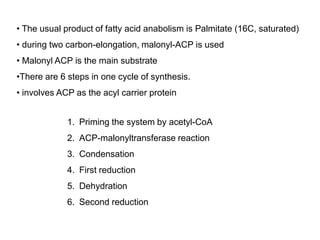
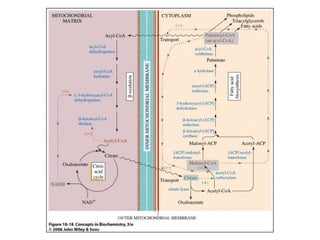
• The usual product of fatty acid anabolism is Palmitate (16C, saturated)
• during two carbon-elongation, malonyl-ACP is used
• Malonyl ACP is the main substrate
•There are 6 steps in one cycle of synthesis.
• involves ACP as the acyl carrier protein
1. Priming the system by acetyl-CoA
2. ACP-malonyltransferase reaction
3. Condensation
4. First reduction
5. Dehydration
6. Second reduction
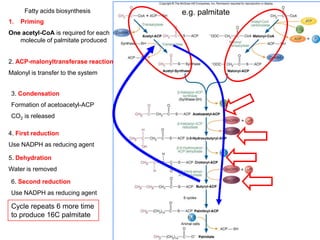
Fatty acids biosynthesis e.g. palmitate
1. Priming
One acetyl-CoA is required for each
molecule of palmitate produced
2. ACP-malonyltransferase reaction
Malonyl is transfer to the system
3. Condensation
Formation of acetoacetyl-ACP
CO2 is released
4. First reduction
Use NADPH as reducing agent
5. Dehydration
Water is removed
6. Second reduction
Use NADPH as reducing agent
Cycle repeats 6 more time
to produce 16C palmitate
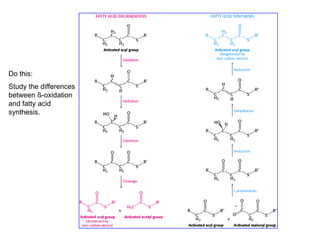
Do this:
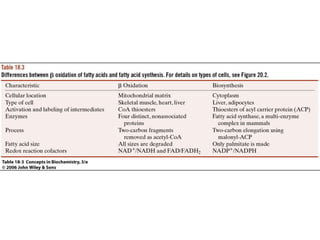
Study the differences
between ß-oxidation
and fatty acid
synthesis.
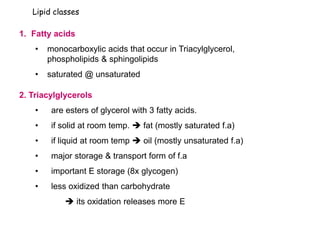
Lipid classes
1. Fatty acids
• monocarboxylic acids that occur in Triacylglycerol,
phospholipids & sphingolipids
• saturated @ unsaturated
2. Triacylglycerols
• are esters of glycerol with 3 fatty acids.
• if solid at room temp.  fat (mostly saturated f.a)
• if liquid at room temp  oil (mostly unsaturated f.a)
• major storage & transport form of f.a
• important E storage (8x glycogen)
• less oxidized than carbohydrate
 its oxidation releases more E
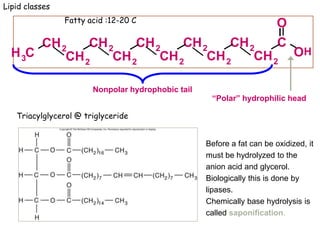
Nonpolar hydrophobic tail
CH3
CH2
CH2
CH2
CH2
CH2
CH2
CH2
CH2
CH2
CH2
C
O
O
“Polar” hydrophilic head
Fatty acid :12-20 C
Triacylglycerol @ triglyceride
Before a fat can be oxidized, it
must be hydrolyzed to the
anion acid and glycerol.
Biologically this is done by
lipases.
Chemically base hydrolysis is
called saponification.
Lipid classes
H
Lipid classes
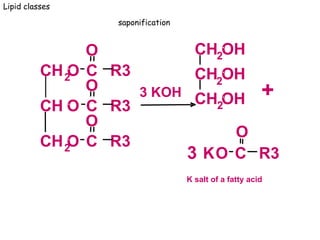
saponification
CH2
CH
CH2
O
O
O C
O
C
O
C
O
R3
R3
R3
3 KOH
CH2
CH
CH2
OH
OH
OH +
KO C
O
R3
K salt of a fatty acid
3
2
Lipid classes
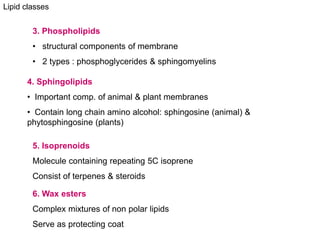
3. Phospholipids
• structural components of membrane
• 2 types : phosphoglycerides & sphingomyelins
4. Sphingolipids
• Important comp. of animal & plant membranes
• Contain long chain amino alcohol: sphingosine (animal) &
phytosphingosine (plants)
5. Isoprenoids
Molecule containing repeating 5C isoprene
Consist of terpenes & steroids
6. Wax esters
Complex mixtures of non polar lipids
Serve as protecting coat
LIPID 2014 for PBCM
LIPID 2014 for PBCM

LIPID 2014 for PBCM

  • 1.
    At the endof the class, you should be able to: 1. State the classes of lipid 2. Explain what is saponification  LAB 3. Explain fatty acid degradation in ß-oxidation 4. Explain fatty acid biosynthesis using Palmitate as an example LIPID
  • 6.
    Lipid classes May beclassified in many different ways Can be subdivided into : 1. Fatty acids & their derivatives 2. Triacylglycerol (TAGs) 3. Wax esters 4. Phospholipids 5. Sphingolipids 6. Isoprenoids
  • 7.
    Some naturally occurringfatty acids: SFA (saturated fatty acids): - 4:0 Butyric acid - Milk fat - 12:0 Lauric acid - coconut oil - 14:0 Myristic acid - Coconut oil, palm nut oil, most animal and plant fats - 16:0 Palmitic acid - Animal and plant fats - 18:0 Stearic acid - Mostly animal fats and some plant fats - 20:0 Arachidic acid - Peanut oil MUFA (monounsaturated fatty acids): - 16:1 Palmitoleic acid - Marine oils, small amount in animal and plant oils - 18:1 Oleic acid - palm oil and animal fats PUFA (polyunsaturated fatty acids): - 18:2 Linoleic acid - Corn, safflower, soybean, cottonseed, sunflower seed and peanut oil - 18:3 Linolenic acid - Linseed (flax), soybean and other seed oils - 20:4 Arachidonic acid - Animal fats Essential fatty acids (EFA): - Linoleic acid (18:2) and linolenic acid (18:3) are essential fatty acids (human body cannot synthesize these fatty acids due to lack of desaturase enzymes)17
  • 8.
  • 9.
    In saponification, 1. awater molecule is removed from a fatty acid or an ester. 2. sodium stearate, sodium oleate or sodium palmitate is formed. 3. it is precipitated from the solution by addition of NaCl. 4. the addition makes the sodium salt of fatty acid partially insoluble in water. 5. the product then separates out of the solution 6. the remaining solution has glycerol and sodium chloride. function? http://educationalelectronicsusa.com/c/org_mat-V.htm
  • 10.
  • 12.
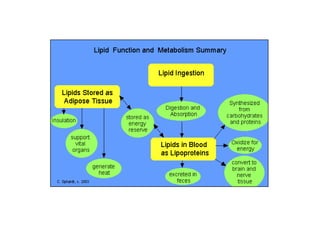
    Lipid metabolism serum glucose Insulinpromotes TAGs synthesis =lipogenesis Insulin facilitates transport of glucose to adipocytes Adipocytes cannot synthesize TAGs when glucose levels are low E levels Body’s fat stores are mobilized = lipolysis Several hormones stimulate hydrolysis of TAGs in adipose tissue  glycerol & fatty acid
  • 13.
    Introducing the intermediatein lipid metabolism…
  • 16.
    Q: How dowe generate energy from fatty acid?
  • 17.
    3primary resources offatty acids for energy metabolism 1. Dietary triacylglycerols 2. Triacylglycerols synthesized in the liver 3. Triacylglycerols stored in adipocytes as lipid droplets
  • 18.
  • 19.
    • Fn togenerate E • Occur in mitochondria and peroxisomes • Remove 2C from carboxyl end of fatty acids ß-oxidation • To degrade odd-chain or branched chain molecules  α-oxidation Fatty acids degradation
  • 21.
    Triacylglycerols are combinedwith dietary cholesterol and proteins to form LIPOPROTEIN Lipase catalyses hydrolysis of ester linkages in fats Fatty acids are taken up into the intestinal mucosa They are resynthesized into triacylglycerols
  • 24.
    • Triacylglycerol aretransported by chylomicrons • Chylomicrons are one of the plasma lipoproteins • released by exocytosis from enterocytes into lacteals, lymphatic vessels originating in the villi of the small intestine • during the circulation, chylomicron accept apolipoprotein C-II from HD Lipoproteins. •APOC2 is a cofactor for lipoprotein lipase activity • Fatty acids that have been delivered to muscle tissue via blood capillaries diffuse through cell plasma membrane into the cytoplasm • From cytoplasm/cytosol it will undergo degradation in the matrix mitochondria. • HOW?
  • 25.
  • 28.
    Lipid metabolism 1. Fattyacids must get into mitochondrial matrix to be degraded. How to get in ? Fatty acid Fatty acyl CoA ATP AMP +PPi CoASH • f.a. are activated to form fatty acyl CoA by acyl-CoA synthetase • CoA is the acyl carrier • Fatty acyl CoA can enter into intermembrane space
  • 29.
    2. Fatty acyl-CoAdegradation occur inside mitochondrial matrix & can’t across the inner membrane. How to get into the matrix ? By using a carrier = carnitine Acylcarnithine carnitine CoASH Carnitine acyltransferase I Enter matrix Transport by a carrier protein Acyl-CoA Fatty acid degradation
  • 30.
    3. Now Acylcarnithinehas enter the matrix. How to form back into fatty acyl-CoA ? Acylcarnithine carnithine CoASH Acyl-CoA Intermembrane space Transport back by carrier protein Fatty acid degradation
  • 31.
  • 34.
    β-oxidation Occur in 4steps 1. Oxidation/Dehydrogenation = removal of electrons 2. Hydration = add water 3. Oxidation = remove more electrons 4. Thiolysis (Carbon-Carbon bond cleavage) = remove acetyl-CoA 4. What happen to fatty acyl-CoA ? How to degrade acyl CoA and generate E? Fatty acid degradation Animation: http://www.uwsp.edu/chemistry/tzamis/boxanim.gif http://medstat.med.utah.edu/kw/biochem_animations/betaox.html
  • 35.
    1. Oxidation :-electrons, -2H Forms double bond 2.Hydration Form –OH 3. Oxidation : - more electrons, - 2H Forms C=O 4. Thiolysis :+ CoASH & cleave to -acetyl-CoA Fatty acid degradation
  • 36.
    After ß-oxidation ofone cycle: 1. One FADH2 2. One NADH 3. One acyl-CoA 4. One acetyl –CoA To determine total ATP, you must know number of ß-oxidation cycle. Fatty acid degradation
  • 37.
    • Most ofacetyl CoA is used by TCA cycle or isoprenoid synthesis • But some acetyl CoA follow alternate pathway: •During fasting/starvation  glycolysis ↓ [OAA become depleted and could not accept acetyl-CoA] and gluconeogenesis ↑ •Therefore the excess of acetyl CoA  is converted to ketone bodies by ketogenesis (occur in matrix of liver mitochondria) •Ketone bodies = acetoacetate, ß-hydroxybutarate, acetone •They are water soluble lipids and can be readily transported in the blood plasma • Ketone bodies can be used to generate E (as a substitute to glucose) in brain, cardiac & skeletal muscle
  • 39.
    Question: What happen ifour diet contain: Low in fat? High carbohydrate ?
  • 41.
    FATTY ACID BIOSYNTHESIS •Occur in cytoplasm / chloroplast (plants) •In adults = mainly liver cells and adipocytes, some in mammary gland during lactation • Synthesize when diet is low in fat and/or high in carbohydrate. • Most are synthesized from glucose: • Glucose  Pyr transport to mitochondrion  acetyl –CoA  citrate  citric acid cycle OR into the cytoplasm to make fatty acids • fatty acids are synthesized by the repetitive addition of two- carbon to the growing end of hydrocarbon chain. Fatty acids biosynthesis Acetyl-CoA can be formed by ß-oxidation or decarboxylation of pyruvate Animation:http://www.uwsp.edu/chemistry/tzamis/fasynthanim2003.gif
  • 42.
    • The usualproduct of fatty acid anabolism is Palmitate (16C, saturated) • during two carbon-elongation, malonyl-ACP is used • Malonyl ACP is the main substrate •There are 6 steps in one cycle of synthesis. • involves ACP as the acyl carrier protein 1. Priming the system by acetyl-CoA 2. ACP-malonyltransferase reaction 3. Condensation 4. First reduction 5. Dehydration 6. Second reduction
  • 43.
    Fatty acids biosynthesise.g. palmitate 1. Priming One acetyl-CoA is required for each molecule of palmitate produced 2. ACP-malonyltransferase reaction Malonyl is transfer to the system 3. Condensation Formation of acetoacetyl-ACP CO2 is released 4. First reduction Use NADPH as reducing agent 5. Dehydration Water is removed 6. Second reduction Use NADPH as reducing agent Cycle repeats 6 more time to produce 16C palmitate
  • 44.
    Do this: Study thedifferences between ß-oxidation and fatty acid synthesis.
  • 49.
    Lipid classes 1. Fattyacids • monocarboxylic acids that occur in Triacylglycerol, phospholipids & sphingolipids • saturated @ unsaturated 2. Triacylglycerols • are esters of glycerol with 3 fatty acids. • if solid at room temp.  fat (mostly saturated f.a) • if liquid at room temp  oil (mostly unsaturated f.a) • major storage & transport form of f.a • important E storage (8x glycogen) • less oxidized than carbohydrate  its oxidation releases more E
  • 50.
    Nonpolar hydrophobic tail CH3 CH2 CH2 CH2 CH2 CH2 CH2 CH2 CH2 CH2 CH2 C O O “Polar”hydrophilic head Fatty acid :12-20 C Triacylglycerol @ triglyceride Before a fat can be oxidized, it must be hydrolyzed to the anion acid and glycerol. Biologically this is done by lipases. Chemically base hydrolysis is called saponification. Lipid classes H
  • 51.
    Lipid classes saponification CH2 CH CH2 O O O C O C O C O R3 R3 R3 3KOH CH2 CH CH2 OH OH OH + KO C O R3 K salt of a fatty acid 3 2
  • 52.
    Lipid classes 3. Phospholipids •structural components of membrane • 2 types : phosphoglycerides & sphingomyelins 4. Sphingolipids • Important comp. of animal & plant membranes • Contain long chain amino alcohol: sphingosine (animal) & phytosphingosine (plants) 5. Isoprenoids Molecule containing repeating 5C isoprene Consist of terpenes & steroids 6. Wax esters Complex mixtures of non polar lipids Serve as protecting coat